
Tag: Groq

  • NVIDIA’s $20 Billion Groq Gambit: The Strategic Pivot to the ‘Inference Era’

    NVIDIA’s $20 Billion Groq Gambit: The Strategic Pivot to the ‘Inference Era’

    In a move that has sent shockwaves through the semiconductor industry, NVIDIA (NASDAQ:NVDA) has finalized a monumental $20 billion deal to acquire the primary assets, intellectual property, and world-class engineering talent of Groq, the pioneer of the Language Processing Unit (LPU). Announced in early January 2026, the transaction is structured as a massive "license and acqui-hire" arrangement, allowing NVIDIA to integrate Groq’s ultra-high-speed inference architecture into its own roadmap while navigating the complex regulatory landscape that has previously hampered large-scale tech mergers.

    The deal represents a definitive shift in NVIDIA’s corporate strategy, signaling the end of the "Training Era" dominance and the beginning of a fierce battle for the "Inference Era." By absorbing roughly 90% of Groq’s workforce—including founder and former Google TPU architect Jonathan Ross—NVIDIA is effectively neutralizing its most potent challenger in the low-latency AI market. This $20 billion investment is aimed squarely at solving the "Memory Wall," the primary bottleneck preventing today’s AI models from achieving the instantaneous, human-like responsiveness required for next-generation agentic workflows and real-time robotics.

    The Technical Leap: LPUs and the Vera Rubin Architecture

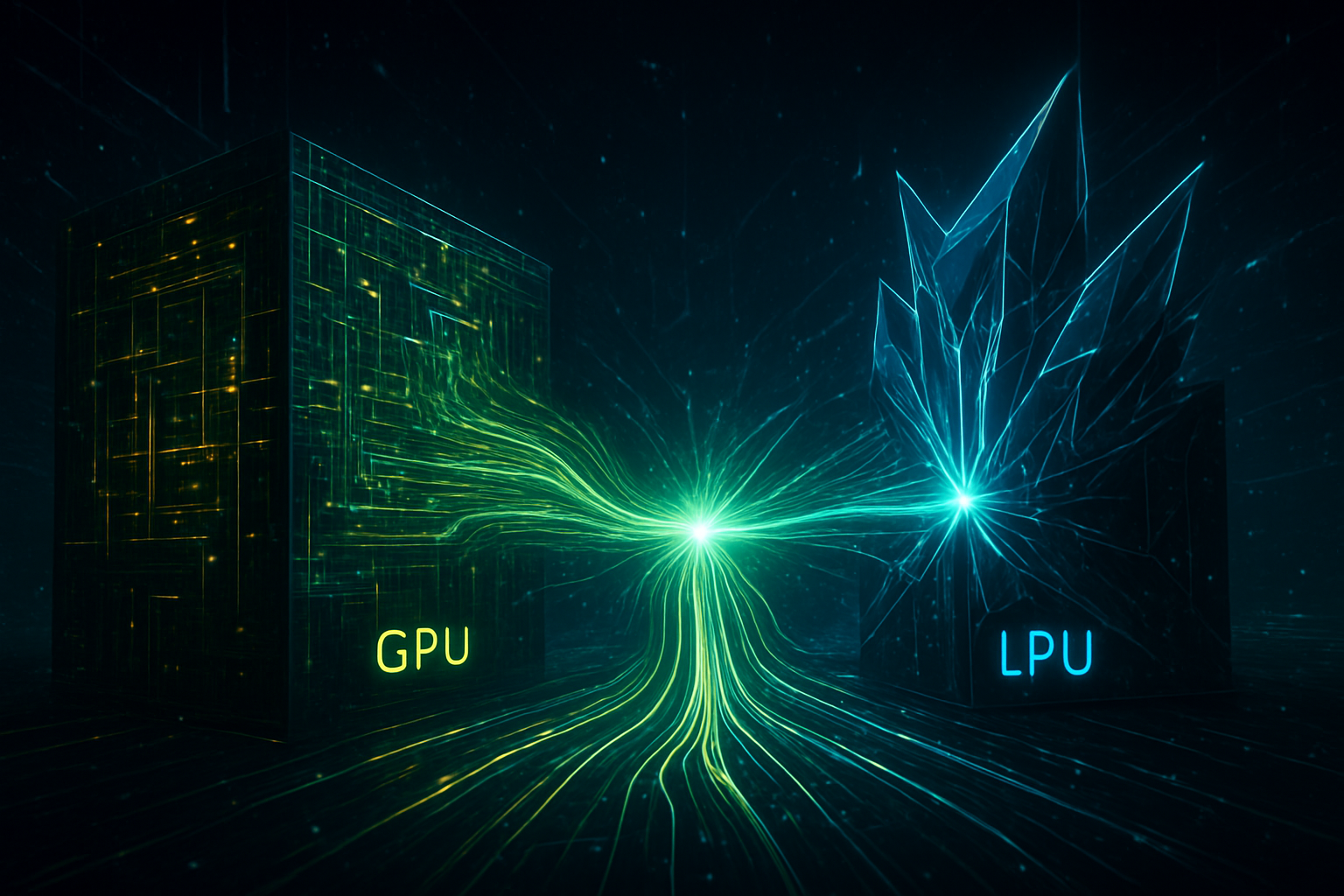
    At the heart of this acquisition is Groq’s proprietary LPU technology, which differs fundamentally from NVIDIA’s traditional GPU architecture. While GPUs rely on massive parallelization and High Bandwidth Memory (HBM) to handle large batches of data, Groq’s LPU utilizes a deterministic, SRAM-based design. This architecture eliminates the need for complex memory management and allows data to move across the chip at unprecedented speeds. Technical specifications released following the deal suggest that NVIDIA is already integrating these "LPU strips" into its upcoming Vera Rubin (R100) platform. The result is the Rubin CPX (Context Processing X), a specialized module designed to handle the sequential nature of token generation with near-zero latency.

    Initial performance benchmarks for the integrated Rubin-Groq hybrid chips are staggering. Engineering samples are reportedly achieving inference speeds of 500 to 800 tokens per second for large language models, a five-fold increase over the H200 series. This is achieved by keeping the active model weights in on-chip SRAM, bypassing the slow trip to external memory that plagues current-gen hardware. By combining its existing Tensor Core dominance for parallel processing with Groq’s sequential efficiency, NVIDIA has created a "heterogeneous" compute monster capable of both training the world’s largest models and serving them at the speed of thought.

    The AI research community has reacted with a mix of awe and apprehension. Industry experts note that this move effectively solves the "cold start" problem for real-time AI agents. "For years, we’ve been limited by the lag in LLM responses," noted one senior researcher at OpenAI. "With Groq’s LPU logic inside the NVIDIA stack, we are moving from 'chatbots' to 'living systems' that can participate in voice-to-voice conversations without the awkward two-second pause." This technical synergy positions NVIDIA not just as a chip vendor, but as the foundational architect of the real-time AI economy.

    Market Dominance and the Neutralization of Rivals

    The strategic implications of this deal for the broader tech ecosystem are profound. By structuring the deal as a licensing and talent acquisition rather than a traditional merger, NVIDIA has effectively sidestepped the antitrust hurdles that famously scuttled its pursuit of Arm. While a "shell" of Groq remains as an independent cloud provider, the loss of its core engineering team and IP means it will no longer produce merchant silicon to compete with NVIDIA’s Blackwell or Rubin lines. This move effectively closes the door on a significant competitive threat just as the market for dedicated inference hardware began to explode.

    For rivals like AMD (NASDAQ:AMD) and Intel (NASDAQ:INTC), the NVIDIA-Groq alliance is a daunting development. Both companies had been positioning their upcoming chips as lower-cost, high-efficiency alternatives for inference workloads. However, by incorporating Groq’s deterministic compute model, NVIDIA has undercut the primary value proposition of its competitors: specialized speed. Startups in the AI hardware space now face an even steeper uphill battle, as NVIDIA’s software ecosystem, CUDA, will now natively support LPU-accelerated workflows, making it the default choice for any developer building low-latency applications.

    The deal also shifts the power balance among the "Hyperscalers." While Google (NASDAQ:GOOGL) and Amazon (NASDAQ:AMZN) have been developing their own in-house AI chips (TPUs and Inferentia), they now face a version of NVIDIA hardware that may outperform their custom silicon on their own cloud platforms. NVIDIA’s "AI Factory" vision is now complete; they provide the GPUs to build the model, the LPUs to run the model, and the high-speed networking to connect them. This vertical integration makes it increasingly difficult for any other player to offer a comparable price-to-performance ratio for real-time AI services.

    The Broader Significance: Breaking the Memory Wall

    This acquisition is more than just a corporate maneuver; it is a milestone in the evolution of computing history. Since the dawn of the modern AI boom, the industry has been constrained by the "Von Neumann bottleneck"—the delay caused by moving data between the processor and memory. Groq’s LPU architecture was the first viable solution to this problem for LLMs. By bringing this technology under the NVIDIA umbrella, the "Memory Wall" is effectively being dismantled. This marks a transition from "batch processing" AI, where efficiency comes from processing many requests at once, to "interactive AI," where efficiency comes from the speed of a single interaction.

    The broader significance lies in the enablement of Agentic AI. For an AI agent to operate an autonomous vehicle or manage a complex manufacturing floor, it cannot wait for a cloud-based GPU to process a batch of data. It needs deterministic, sub-100ms response times. The integration of Groq’s technology into NVIDIA’s edge and data center products provides the infrastructure necessary for these agents to move from the lab into the real world. However, this consolidation of power also raises concerns regarding the "NVIDIA tax" and the potential for a monoculture in AI hardware that could stifle further radical innovation.

    Comparisons are already being drawn to the early days of the graphics industry, where NVIDIA’s acquisition of 3dfx assets in 2000 solidified its dominance for decades. The Groq deal is viewed as the 21st-century equivalent—a strategic strike to capture the most innovative technology of a burgeoning era before it can become a standalone threat. As AI becomes the primary workload for all global compute, owning the fastest way to "think" (inference) is arguably more valuable than owning the fastest way to "learn" (training).

    The Road Ahead: Robotics and Real-Time Interaction

    Looking toward the near-term future, the first products featuring "Groq-infused" NVIDIA silicon are expected to hit the market by late 2026. The most immediate application will likely be in the realm of high-end enterprise assistants and real-time translation services. Imagine a global conference where every attendee wears an earpiece providing instantaneous, nuanced translation with zero perceptible lag—this is the type of use case that the Rubin CPX is designed to dominate.

    In the longer term, the impact on robotics and autonomous systems will be transformative. NVIDIA’s Project GR00T, their platform for humanoid robots, will likely be the primary beneficiary of the LPU integration. For a humanoid robot to navigate a crowded room, its "brain" must process sensory input and generate motor commands in milliseconds. The deterministic nature of Groq’s architecture is perfectly suited for these safety-critical, real-time environments. Experts predict that within the next 24 months, we will see a surge in "Edge AI" deployments that were previously thought to be years away, driven by the sudden availability of ultra-low-latency compute.

    However, challenges remain. Integrating two vastly different architectures—one based on parallel HBM and one on sequential SRAM—will be a monumental task for NVIDIA’s software engineers. Maintaining the ease of use that has made CUDA the industry standard while optimizing for this new hardware paradigm will be the primary focus of 2026. If successful, the result will be a unified compute platform that is virtually unassailable.

    A New Era of Artificial Intelligence

    The NVIDIA-Groq deal of 2026 will likely be remembered as the moment the AI industry matured from experimental research into a ubiquitous utility. By spending $20 billion to acquire the talent and technology of its fastest-moving rival, NVIDIA has not only protected its market share but has also accelerated the timeline for real-time, agentic AI. The key takeaways from this development are clear: inference is the new frontline, latency is the new benchmark, and NVIDIA remains the undisputed king of the hill.

    As we move deeper into 2026, the industry will be watching closely for the first silicon benchmarks from the Vera Rubin architecture. The success of this integration will determine whether we truly enter the age of "instant AI" or if the technical hurdles of merging these two architectures prove more difficult than anticipated. For now, the message to the world is clear: NVIDIA is no longer just the company that builds the chips that train AI—it is now the company that defines how AI thinks.


    This content is intended for informational purposes only and represents analysis of current AI developments.

    TokenRing AI delivers enterprise-grade solutions for multi-agent AI workflow orchestration, AI-powered development tools, and seamless remote collaboration platforms.
    For more information, visit https://www.tokenring.ai/.
  • Nvidia Secures Future of Inference with Massive $20 Billion “Strategic Absorption” of Groq

    Nvidia Secures Future of Inference with Massive $20 Billion “Strategic Absorption” of Groq

    The artificial intelligence landscape has undergone a seismic shift as NVIDIA (NASDAQ: NVDA) moves to solidify its dominance over the burgeoning "Inference Economy." Following months of intense speculation and market rumors, it has been confirmed that Nvidia finalized a $20 billion "strategic absorption" of Groq, the startup famed for its ultra-fast Language Processing Units (LPUs). The deal, which was completed in late December 2025, represents a massive $20 billion commitment to pivot Nvidia’s architecture from a focus on heavy-duty model training to the high-speed, real-time execution that now defines the generative AI market in early 2026.

    This acquisition is not a traditional merger; instead, Nvidia has structured the deal as a non-exclusive licensing agreement for Groq’s foundational intellectual property alongside a massive "acqui-hire" of nearly 90% of Groq’s engineering talent. This includes Groq’s founder, Jonathan Ross—the former Google engineer who helped create the original Tensor Processing Unit (TPU)—who now serves as Nvidia’s Senior Vice President of Inference Architecture. By integrating Groq’s deterministic compute model, Nvidia aims to eliminate the latency bottlenecks that have plagued its GPUs during the final "token generation" phase of large language model (LLM) serving.

    The LPU Advantage: SRAM and Deterministic Compute

    The core of the Groq acquisition lies in its radical departure from traditional GPU architecture. While Nvidia’s H100 and Blackwell chips have dominated the training of models like GPT-4, they rely heavily on High Bandwidth Memory (HBM). This dependence creates a "memory wall" where the chip’s processing speed far outpaces its ability to fetch data from external memory, leading to variable latency or "jitter." Groq’s LPU sidesteps this by utilizing massive on-chip Static Random Access Memory (SRAM), which is orders of magnitude faster than HBM. In recent benchmarks, this architecture allowed models to run at 10x the speed of standard GPU setups while consuming one-tenth the energy.

    Groq’s technology is "software-defined," meaning the data flow is scheduled by a compiler rather than managed by hardware-level schedulers during execution. This results in "deterministic compute," where the time it takes to process a token is consistent and predictable. Initial reactions from the AI research community suggest that this acquisition solves Nvidia’s greatest vulnerability: the high cost and inconsistent performance of real-time AI agents. Industry experts note that while GPUs are excellent for the parallel processing required to build a model, Groq’s LPUs are the superior tool for the sequential processing required to talk back to a user in real-time.

    Disrupting the Custom Silicon Wave

    Nvidia’s $20 billion move serves as a direct counter-offensive against the rise of custom silicon within Big Tech. Over the past two years, Alphabet (NASDAQ: GOOGL), Amazon (NASDAQ: AMZN), and Meta Platforms (NASDAQ: META) have increasingly turned to their own custom-built chips—such as TPUs, Inferentia, and MTIA—to reduce their reliance on Nvidia's expensive hardware for inference. By absorbing Groq’s IP, Nvidia is positioning itself to offer a "Total Compute" stack that is more efficient than the in-house solutions currently being developed by cloud providers.

    This deal also creates a strategic moat against rivals like Advanced Micro Devices (NASDAQ: AMD) and Intel (NASDAQ: INTC), who have been gaining ground by marketing their chips as more cost-effective inference alternatives. Analysts believe that by bringing Jonathan Ross and his team in-house, Nvidia has neutralized its most potent technical threat—the "CUDA-killer" architecture. With Groq’s talent integrated into Nvidia’s engineering core, the company can now offer hybrid chips that combine the training power of Blackwell with the inference speed of the LPU, making it nearly impossible for competitors to match their vertical integration.

    A Hedge Against the HBM Supply Chain

    Beyond performance, the acquisition of Groq’s SRAM-based architecture provides Nvidia with a critical strategic hedge. Throughout 2024 and 2025, the AI industry was frequently paralyzed by shortages of HBM, as producers like SK Hynix and Samsung struggled to meet the insatiable demand for GPU memory. Because Groq’s LPUs rely on SRAM—which can be manufactured using more standard, reliable processes—Nvidia can now diversify its hardware designs. This reduces its extreme exposure to the volatile HBM supply chain, ensuring that even in the face of memory shortages, Nvidia can continue to ship high-performance inference hardware.

    This shift mirrors a broader trend in the AI landscape: the transition from the "Training Era" to the "Inference Era." By early 2026, it is estimated that nearly two-thirds of all AI compute spending is dedicated to running existing models rather than building new ones. Concerns about the environmental impact of AI and the staggering electricity costs of data centers have also driven the demand for more efficient architectures. Groq’s energy efficiency provides Nvidia with a "green" narrative, aligning the company with global sustainability goals and reducing the total cost of ownership for enterprise customers.

    The Road to "Vera Rubin" and Beyond

    The first tangible results of this acquisition are expected to manifest in Nvidia’s upcoming "Vera Rubin" architecture, scheduled for a late 2026 release. Reports suggest that these next-generation chips will feature dedicated "LPU strips" on the die, specifically reserved for the final phases of LLM token generation. This hybrid approach would allow a single server rack to handle both the massive weights of a multi-trillion parameter model and the millisecond-latency requirements of a human-like voice interface.

    Looking further ahead, the integration of Groq’s deterministic compute will be essential for the next frontier of AI: autonomous agents and robotics. In these fields, variable latency is more than just an inconvenience—it can be a safety hazard. Experts predict that the fusion of Nvidia’s CUDA ecosystem with Groq’s high-speed inference will enable a new class of AI that can reason and respond in real-time environments, such as surgical robots or autonomous flight systems. The primary challenge remains the software integration; Nvidia must now map its vast library of AI tools onto Groq’s compiler-driven architecture.

    A New Chapter in AI History

    Nvidia’s absorption of Groq marks a definitive moment in AI history, signaling that the era of general-purpose compute dominance may be evolving into an era of specialized, architectural synergy. While the $20 billion price tag was viewed by some as a "dominance tax," the strategic value of securing the world’s leading inference talent cannot be overstated. Nvidia has not just bought a company; it has acquired the blueprint for how the world will interact with AI for the next decade.

    In the coming weeks and months, the industry will be watching closely to see how quickly Nvidia can deploy "GroqCloud" capabilities across its own DGX Cloud infrastructure. As the integration progresses, the focus will shift to whether Nvidia can maintain its market share against the growing "Sovereign AI" movements in Europe and Asia, where nations are increasingly seeking to build their own chip ecosystems. For now, however, Nvidia has once again demonstrated its ability to outmaneuver the market, turning a potential rival into the engine of its future growth.


    This content is intended for informational purposes only and represents analysis of current AI developments.

    TokenRing AI delivers enterprise-grade solutions for multi-agent AI workflow orchestration, AI-powered development tools, and seamless remote collaboration platforms.
    For more information, visit https://www.tokenring.ai/.
  • NVIDIA Seals $20 Billion ‘Acqui-Hire’ of Groq to Power Rubin Platform and Shatter the AI ‘Memory Wall’

    NVIDIA Seals $20 Billion ‘Acqui-Hire’ of Groq to Power Rubin Platform and Shatter the AI ‘Memory Wall’

    In a move that has sent shockwaves through Silicon Valley and global financial markets, NVIDIA (NASDAQ: NVDA) has officially finalized a landmark $20 billion strategic licensing and "acqui-hire" deal with Groq, the pioneer of the Language Processing Unit (LPU). Announced in late December 2025 and moving into full integration phase as of January 2026, the deal represents NVIDIA’s most aggressive maneuver to date to consolidate its lead in the burgeoning "Inference Economy." By absorbing Groq’s core intellectual property and its world-class engineering team—including legendary founder Jonathan Ross—NVIDIA aims to fuse Groq’s ultra-high-speed deterministic compute with its upcoming "Rubin" architecture, scheduled for a late 2026 release.

    The significance of this deal cannot be overstated; it marks a fundamental shift in NVIDIA's architectural philosophy. While NVIDIA has dominated the AI training market for a decade, the industry is rapidly pivoting toward high-volume inference, where speed and latency are the only metrics that matter. By integrating Groq’s specialized LPU technology, NVIDIA is positioning itself to solve the "memory wall"—the physical limitation where data transfer speeds between memory and processors cannot keep up with the demands of massive Large Language Models (LLMs). This acquisition signals the end of the era of general-purpose AI hardware and the beginning of a specialized, inference-first future.

    Breaking the Memory Wall: LPU Tech Meets the Rubin Platform

    The technical centerpiece of this $20 billion deal is the integration of Groq’s SRAM-based (Static Random Access Memory) architecture into NVIDIA’s Rubin platform. Unlike traditional GPUs that rely on High Bandwidth Memory (HBM), which resides off-chip and introduces significant latency penalties, Groq’s LPU utilizes a "software-defined hardware" approach. By placing memory directly on the chip and using a proprietary compiler to pre-schedule every data movement down to the nanosecond, Groq’s tech achieves deterministic performance. In early benchmarks, Groq systems have demonstrated the ability to run models like Llama 3 at speeds exceeding 400 tokens per second—roughly ten times faster than current-generation hardware.

    The Rubin platform, which succeeds the Blackwell architecture, will now feature a hybrid memory hierarchy. While Rubin will still utilize HBM4 for massive model parameters, it is expected to incorporate a "Groq-layer" of high-speed SRAM inference cores. This combination allows the system to overcome the "memory wall" by keeping the most critical, frequently accessed data in the ultra-fast SRAM buffer, while the broader model sits in HBM4. This architectural synergy is designed to support the next generation of "Agentic AI"—autonomous systems that require near-instantaneous reasoning and multi-step planning to function in real-time environments.

    Industry experts have reacted with a mix of awe and concern. Dr. Sarah Chen, lead hardware analyst at SemiAnalysis, noted that "NVIDIA essentially just bought the only viable threat to its inference dominance." The AI research community is particularly excited about the deterministic nature of the Groq-Rubin integration. Unlike current GPUs, which suffer from performance "jitter" due to complex hardware scheduling, the new architecture provides a guaranteed, constant latency. This is a prerequisite for safety-critical AI applications in robotics, autonomous vehicles, and high-frequency financial modeling.

    Strategic Dominance and the 'Acqui-Hire' Model

    This deal is a masterstroke of corporate strategy and regulatory maneuvering. By structuring the agreement as a $20 billion licensing deal combined with a mass talent migration—rather than a traditional acquisition—NVIDIA appears to have circumvented the protracted antitrust scrutiny that famously derailed its attempt to buy ARM in 2022. The deal effectively brings Groq’s 300+ engineers into the NVIDIA fold, with Jonathan Ross, a principal architect of the original Google TPU at Alphabet (NASDAQ: GOOGL), now serving as a Senior Vice President of Inference Architecture at NVIDIA.

    For competitors like Advanced Micro Devices (NASDAQ: AMD) and Intel (NASDAQ: INTC), the NVIDIA-Groq alliance creates a formidable barrier to entry. AMD has made significant strides with its MI300 and MI400 series, but it remains heavily reliant on HBM-based architectures. By pivoting toward the Groq-style SRAM model for inference, NVIDIA is diversifying its technological portfolio in a way that its rivals may struggle to replicate without similar multi-billion-dollar investments. Startups in the AI chip space, such as Cerebras and SambaNova, now face a landscape where the market leader has just absorbed their most potent architectural rival.

    The market implications extend beyond just hardware sales. By controlling the most efficient inference platform, NVIDIA is also solidifying its software moat. The integration of GroqWare—Groq's highly optimized compiler stack—into NVIDIA’s CUDA ecosystem means that developers will be able to deploy ultra-low-latency models without learning an entirely new programming language. This vertical integration ensures that NVIDIA remains the default choice for the world’s largest hyperscalers and cloud service providers, who are desperate to lower the cost-per-token of running AI services.

    A New Era of Real-Time, Agentic AI

    The broader significance of the NVIDIA-Groq deal lies in its potential to unlock "Agentic AI." Until now, AI has largely been a reactive tool—users prompt, and the model responds with a slight delay. However, the future of the industry revolves around agents that can think, plan, and act autonomously. These agents require "Fast Thinking" capabilities that current GPU architectures struggle to provide at scale. By incorporating LPU technology, NVIDIA is providing the "nervous system" required for AI that operates at the speed of human thought, or faster.

    This development also aligns with the growing trend of "Sovereign AI." Many nations are now building their own domestic AI infrastructure to ensure data privacy and national security. Groq had already established a strong foothold in this sector, recently securing a $1.5 billion contract for a data center in Saudi Arabia. By acquiring this expertise, NVIDIA is better positioned to partner with governments around the world, providing turnkey solutions that combine high-performance compute with the specific architectural requirements of sovereign data centers.

    However, the consolidation of such massive power in one company's hands remains a point of concern for the industry. Critics argue that NVIDIA’s "virtual buyout" of Groq further centralizes the AI supply chain, potentially leading to higher prices for developers and limited architectural diversity. Comparison to previous milestones, like the acquisition of Mellanox, suggests that NVIDIA will use this deal to tighten the integration of its networking and compute stacks, making it increasingly difficult for customers to "mix and match" components from different vendors.

    The Road to Rubin and Beyond

    Looking ahead, the next 18 months will be a period of intense integration. The immediate focus is on merging Groq’s compiler technology with NVIDIA’s TensorRT-LLM software. The first hardware fruit of this labor will likely be the R100 "Rubin" GPU. Sources close to the project suggest that NVIDIA is also exploring the possibility of "mini-LPUs"—specialized inference blocks that could be integrated into consumer-grade hardware, such as the rumored RTX 60-series, enabling near-instant local LLM processing on personal workstations.

    Predicting the long-term impact, many analysts believe this deal marks the beginning of the "post-GPU" era for AI. While the term "GPU" will likely persist as a brand, the internal architecture is evolving into a heterogeneous "AI System on a Chip." Challenges remain, particularly in scaling SRAM to the levels required for the trillion-parameter models of 2027 and beyond. Nevertheless, the industry expects that by the time the Rubin platform ships in late 2026, it will set a new world record for inference efficiency, potentially reducing the energy cost of AI queries by an order of magnitude.

    Conclusion: Jensen Huang’s Final Piece of the Puzzle

    The $20 billion NVIDIA-Groq deal is more than just a transaction; it is a declaration of intent. By bringing Jonathan Ross and his LPU technology into the fold, Jensen Huang has successfully addressed the one area where NVIDIA was perceived as potentially vulnerable: ultra-low-latency inference. The "memory wall," which has long been the Achilles' heel of high-performance computing, is finally being dismantled through a combination of SRAM-first design and deterministic software control.

    As we move through 2026, the tech world will be watching closely to see how quickly the Groq team can influence the Rubin roadmap. If successful, this integration will cement NVIDIA’s status not just as a chipmaker, but as the foundational architect of the entire AI era. For now, the "Inference Economy" has a clear leader, and the gap between NVIDIA and the rest of the field has never looked wider.


    This content is intended for informational purposes only and represents analysis of current AI developments.

    TokenRing AI delivers enterprise-grade solutions for multi-agent AI workflow orchestration, AI-powered development tools, and seamless remote collaboration platforms.
    For more information, visit https://www.tokenring.ai/.
  • The Inference Revolution: How Groq’s LPU Architecture Forced NVIDIA’s $20 Billion Strategic Pivot

    The Inference Revolution: How Groq’s LPU Architecture Forced NVIDIA’s $20 Billion Strategic Pivot

    As of January 19, 2026, the artificial intelligence hardware landscape has reached a definitive turning point, centered on the resolution of a multi-year rivalry between the traditional GPU powerhouses and specialized inference startups. The catalyst for this seismic shift is the definitive "strategic absorption" of Groq’s core engineering team and technology by NVIDIA (NASDAQ: NVDA) in a deal valued at approximately $20 billion. This agreement, which surfaced as a series of market-shaking rumors in late 2025, has effectively integrated Groq’s groundbreaking Language Processing Unit (LPU) architecture into the heart of the world’s most powerful AI ecosystem, signaling the end of the "GPU-only" era for large language model (LLM) deployment.

    The significance of this development cannot be overstated; it marks the transition from an AI industry obsessed with model training to one ruthlessly optimized for real-time inference. For years, Groq’s LPU was the "David" to NVIDIA’s "Goliath," claiming speeds that made traditional GPUs look sluggish in comparison. By finally bringing Groq’s deterministic, SRAM-based architecture under its wing, NVIDIA has not only neutralized its most potent architectural threat but has also set a new standard for the "Time to First Token" (TTFT) metrics that now define the user experience in agentic AI and voice-to-voice communication.

    The Architecture of Immediacy: Inside the Groq LPU

    At the core of Groq's disruption is the Language Processing Unit (LPU), a hardware architecture that fundamentally reimagines how data flows through a processor. Unlike the Graphics Processing Unit (GPU) utilized by NVIDIA for decades, which relies on massive parallelism and complex hardware-managed caches to handle various workloads, the LPU is an Application-Specific Integrated Circuit (ASIC) designed exclusively for the sequential nature of LLMs. The LPU’s most radical departure from the status quo is its reliance on Static Random Access Memory (SRAM) instead of the High Bandwidth Memory (HBM3e) found in NVIDIA’s Blackwell chips. While HBM offers high capacity, its latency is a bottleneck; Groq’s SRAM-only approach delivers bandwidth upwards of 80 TB/s, allowing the processor to feed data to the compute cores at nearly ten times the speed of conventional high-end GPUs.

    Beyond memory, Groq’s technical edge lies in its "Software-Defined Hardware" philosophy. In a traditional GPU, the hardware must constantly predict where data needs to go, leading to "jitter" or variable latency. Groq eliminated this by moving the complexity to a proprietary compiler. The Groq compiler handles all scheduling at compile-time, creating a completely deterministic execution path. This means the hardware knows exactly where every bit of data is at every nanosecond, eliminating the need for branch predictors or cache managers. When networked together using their "Plesiosynchronous" protocol, hundreds of LPUs act as a single, massive, synchronized processor. This architecture allows a Llama 3 (70B) model to run at over 400 tokens per second—a feat that, until recently, was nearly double the performance of a standard H100 cluster.

    Market Disruption and the $20 Billion "Defensive Killshot"

    The market rumors that dominated the final quarter of 2025 suggested that AMD (NASDAQ: AMD) and Intel (NASDAQ: INTC) were both aggressively bidding for Groq to bridge their own inference performance gaps. NVIDIA’s preemptive $20 billion licensing and "acqui-hire" deal is being viewed by industry analysts as a defensive masterstroke. By securing Groq’s talent, including founder Jonathan Ross, NVIDIA has integrated these low-latency capabilities into its upcoming "Vera Rubin" architecture. This move has immediate competitive implications: NVIDIA is no longer just selling chips; it is selling "real-time intelligence" hardware that makes it nearly impossible for major cloud providers like Amazon (NASDAQ: AMZN) or Alphabet Inc. (NASDAQ: GOOGL) to justify switching to their internal custom silicon for high-speed agentic tasks.

    For the broader startup ecosystem, the Groq-NVIDIA deal has clarified the "Inference Flip." Throughout 2025, revenue from running AI models (inference) officially surpassed revenue from building them (training). Startups that were previously struggling with high API costs and slow response times are now flocking to "Groq-powered" NVIDIA clusters. This consolidation has effectively reinforced NVIDIA’s "CUDA moat," as the LPU’s compiler-based scheduling is now being integrated into the CUDA ecosystem, making the switching cost for developers higher than ever. Meanwhile, companies like Meta (NASDAQ: META), which rely on open-source model distribution, stand to benefit significantly as their models can now be served to billions of users with human-like latency.

    A Wider Shift: From Latency to Agency

    The significance of Groq’s architecture fits into a broader trend toward "Agentic AI"—systems that don't just answer questions but perform complex, multi-step tasks in real-time. In the old GPU paradigm, the latency of a multi-step "thought process" for an AI agent could take 10 to 20 seconds, making it unusable for interactive applications. With Groq’s LPU architecture, those same processes occur in under two seconds. This leap is comparable to the transition from dial-up internet to broadband; it doesn't just make the existing experience faster; it enables entirely new categories of applications, such as instantaneous live translation and autonomous customer service agents that can interrupt and be interrupted without lag.

    However, this transition has not been without concern. The primary trade-off of the LPU architecture is its power density and memory capacity. Because SRAM takes up significantly more physical space on a chip than HBM, Groq’s solution requires more physical hardware to run the same size model. Critics argue that while the speed is revolutionary, the "energy-per-token" at scale still faces challenges compared to more memory-efficient architectures. Despite this, the industry consensus is that for the most valuable AI use cases—those requiring human-level interaction—speed is the only metric that matters, and Groq’s LPU has proven that deterministic hardware is the fastest path forward.

    The Horizon: Sovereign AI and Heterogeneous Computing

    Looking toward late 2026 and 2027, the focus is shifting to "Sovereign AI" projects. Following its restructuring, the remaining GroqCloud entity has secured a landmark $1.5 billion contract to build massive LPU-based data centers in Saudi Arabia. This suggests a future where specialized inference "super-hubs" are distributed globally to provide ultra-low-latency AI services to specific regions. Furthermore, the upcoming NVIDIA "Vera Rubin" chips are expected to be heterogeneous, featuring traditional GPU cores for massive parallel training and "LPU strips" for the final token-generation phase of inference. This hybrid approach could potentially solve the memory-capacity issues that plagued standalone LPUs.

    Experts predict that the next challenge will be the "Memory Wall" at the edge. While data centers can chain hundreds of LPUs together, bringing this level of inference speed to consumer devices remains a hurdle. We expect to see a surge in research into "Distilled SRAM" architectures, attempting to shrink Groq’s deterministic principles down to a scale suitable for smartphones and laptops. If successful, this could decentralize AI, moving high-speed inference away from massive data centers and directly into the hands of users.

    Conclusion: The New Standard for AI Speed

    The rise of Groq and its subsequent integration into the NVIDIA empire represents one of the most significant chapters in the history of AI hardware. By prioritizing deterministic execution and SRAM bandwidth over traditional GPU parallelism, Groq forced the entire industry to rethink its approach to the "inference bottleneck." The key takeaway from this era is clear: as models become more intelligent, the speed at which they "think" becomes the primary differentiator for commercial success.

    In the coming months, the industry will be watching the first benchmarks of NVIDIA’s LPU-integrated hardware. If these "hybrid" chips can deliver Groq-level speeds with NVIDIA-level memory capacity, the competitive gap between NVIDIA and the rest of the semiconductor industry may become insurmountable. For now, the "Speed Wars" have a clear winner, and the era of real-time, seamless AI interaction has officially begun.


    This content is intended for informational purposes only and represents analysis of current AI developments.

    TokenRing AI delivers enterprise-grade solutions for multi-agent AI workflow orchestration, AI-powered development tools, and seamless remote collaboration platforms.
    For more information, visit https://www.tokenring.ai/.

  • NVIDIA Seals the Inference Era: The $20 Billion Groq Deal Redefines the AI Hardware Race

    NVIDIA Seals the Inference Era: The $20 Billion Groq Deal Redefines the AI Hardware Race

    In a move that has sent shockwaves through Silicon Valley and global financial markets, NVIDIA (NASDAQ: NVDA) has effectively neutralized its most potent architectural rival. As of January 16, 2026, details have emerged regarding a landmark $20 billion licensing and "acqui-hire" agreement with Groq, the startup that revolutionized real-time AI with its Language Processing Unit (LPU). This strategic maneuver, executed in late December 2025, represents a decisive pivot for NVIDIA as it seeks to extend its dominance from the model training phase into the high-stakes, high-volume world of AI inference.

    The deal is far more than a simple asset purchase; it is a calculated effort to bypass the intense antitrust scrutiny that has previously plagued large-scale tech mergers. By structuring the transaction as a massive $20 billion intellectual property licensing agreement coupled with a near-total absorption of Groq’s engineering talent—including founder and CEO Jonathan Ross—NVIDIA has effectively integrated Groq’s "deterministic" compute logic into its own ecosystem. This acquisition of expertise and IP marks the beginning of the "Inference Era," where the speed of token generation is now the primary metric of AI supremacy.

    The Death of Latency: Why the LPU Architecture Changed the Game

    The technical core of this $20 billion deal lies in Groq’s fundamental departure from traditional processor design. While NVIDIA’s legendary H100 and Blackwell GPUs were built on a foundation of massive parallel processing—ideal for training models on gargantuan datasets—they often struggle with the sequential nature of Large Language Model (LLM) inference. GPUs rely on High Bandwidth Memory (HBM), which, despite its name, creates a "memory wall" where the processor must wait for data to travel from off-chip storage. Groq’s LPU bypassed this entirely by utilizing on-chip SRAM (Static Random-Access Memory), which is nearly 100 times faster than the HBM found in standard AI chips.

    Furthermore, Groq introduced the concept of deterministic execution. In a traditional GPU environment, scheduling and batching of requests can cause "jitter," or inconsistent response times, which is a significant hurdle for real-time applications like voice-based AI assistants or high-frequency trading bots. The Groq architecture uses a single-core "assembly line" approach where every instruction’s timing is known to the nanosecond. This allowed Groq to achieve speeds of over 500 tokens per second for models like Llama 3, a benchmark that was previously thought impossible for commercial-grade hardware.

    Industry experts and researchers have reacted with a mix of awe and apprehension. While the integration of Groq’s tech into NVIDIA’s upcoming Rubin architecture promises a massive leap in consumer AI performance, the consolidation of such a disruptive technology into the hands of the market leader has raised concerns. "NVIDIA didn't just buy a company; they bought the solution to their only real weakness: latency," remarked one lead researcher at the AI Open Institute. By absorbing Groq’s compiler stack and hardware logic, NVIDIA has effectively closed the performance gap that startups were hoping to exploit.

    Market Consolidation and the "Inference Flip"

    The strategic implications for the broader semiconductor industry are profound. For the past three years, the "training moat"—NVIDIA’s total control over the chips used to build AI—seemed unassailable. However, as the industry matured, the focus shifted toward inference, the process of actually running those models for end-users. Competitors like Advanced Micro Devices, Inc. (NASDAQ: AMD) and Intel Corporation (NASDAQ: INTC) had begun to gain ground by offering specialized inference solutions. By securing Groq’s IP, NVIDIA has successfully front-run its competitors, ensuring that the next generation of AI "agents" will run almost exclusively on NVIDIA-powered infrastructure.

    The deal also places significant pressure on other ASIC (Application-Specific Integrated Circuit) startups such as Cerebras and SambaNova. With NVIDIA now controlling the most efficient inference architecture on the market, the venture capital appetite for hardware startups may cool, as the barrier to entry has just been raised by an order of magnitude. For cloud providers like Microsoft (NASDAQ: MSFT) and Alphabet Inc. (NASDAQ: GOOGL), the deal is a double-edged sword: they will benefit from the vastly improved inference speeds of the NVIDIA-Groq hybrid chips, but their dependence on NVIDIA’s hardware stack has never been deeper.

    Perhaps the most ingenious aspect of the deal is its regulatory shielding. By allowing a "shell" of Groq to continue operating as an independent entity for legacy support, NVIDIA has created a complex legal buffer against the Federal Trade Commission (FTC) and European regulators. This "acqui-hire" model allows NVIDIA to claim it is not technically a monopoly through merger, even as it moves 90% of Groq’s workforce—the primary drivers of the innovation—onto its own payroll.

    A New Frontier for Real-Time AI Agents and Global Stability

    Beyond the corporate balance sheets, the NVIDIA-Groq alliance signals a shift in the broader AI landscape toward "Real-Time Agency." We are moving away from chatbots that take several seconds to "think" and toward AI systems that can converse, reason, and act with zero perceptible latency. This is critical for the burgeoning field of Sovereign AI, where nations are building their own localized AI infrastructures. With Groq’s technology, these nations can deploy ultra-fast, efficient models that require significantly less energy than previous GPU clusters, addressing growing concerns over the environmental impact of AI data centers.

    However, the consolidation of such power is not without its critics. Concerns regarding "Compute Sovereignty" are mounting, as a single corporation now holds the keys to both the creation and the execution of artificial intelligence at a global scale. Comparisons are already being drawn to the early days of the microprocessor era, but with a crucial difference: the pace of AI evolution is logarithmic, not linear. The $20 billion price tag is seen by many as a "bargain" if it grants NVIDIA a permanent lock on the hardware layer of the most transformative technology in human history.

    What’s Next: The Rubin Architecture and the End of the "Memory Wall"

    In the near term, all eyes are on NVIDIA’s Vera Rubin platform, expected to ship in late 2026. This new hardware line is predicted to natively incorporate Groq’s deterministic logic, effectively merging the throughput of a GPU with the latency-free performance of an LPU. This will likely enable a new class of "Instant AI" applications, from real-time holographic translation to autonomous robotic systems that can react to environmental changes in milliseconds.

    The challenges ahead are largely integration-based. Merging Groq’s unique compiler stack with NVIDIA’s established CUDA software ecosystem will be a Herculean task for the newly formed "Deterministic Inference" division. If successful, however, the result will be a unified software-hardware stack that covers every possible AI use case, from training a trillion-parameter model to running a lightweight agent on a handheld device. Analysts predict that by 2027, the concept of "waiting" for an AI response will be a relic of the past.

    Summary: A Historic Milestone in the AI Arms Race

    NVIDIA’s $20 billion move to absorb Groq’s technology and talent is a definitive moment in tech history. It marks the transition from an era defined by "bigger models" to one defined by "faster interactions." By neutralizing its most dangerous architectural rival and integrating a superior inference technology, NVIDIA has solidified its position not just as a chipmaker, but as the foundational architect of the AI-driven world.

    Key Takeaways:

    • The Deal: A $20 billion licensing and acqui-hire agreement that effectively moves Groq’s brain trust to NVIDIA.
    • The Tech: Integration of deterministic LPU architecture and SRAM-based compute to eliminate inference latency.
    • The Strategy: NVIDIA’s pivot to dominate the high-volume inference market while bypassing traditional antitrust hurdles.
    • The Future: Expect the "Rubin" architecture to deliver 500+ tokens per second, making real-time AI agents the new industry standard.

    In the coming months, the industry will watch closely as the first "NVIDIA-powered Groq" clusters go online. If the performance gains match the hype, the $20 billion spent today may be remembered as the most consequential investment of the decade.


    This content is intended for informational purposes only and represents analysis of current AI developments.

    TokenRing AI delivers enterprise-grade solutions for multi-agent AI workflow orchestration, AI-powered development tools, and seamless remote collaboration platforms.
    For more information, visit https://www.tokenring.ai/.

  • NVIDIA’s $20 Billion Groq Gambit: The Dawn of the Inference Era

    NVIDIA’s $20 Billion Groq Gambit: The Dawn of the Inference Era

    In a move that has sent shockwaves through the semiconductor industry, NVIDIA (NASDAQ: NVDA) has finalized a landmark $20 billion licensing and talent-acquisition deal with Groq, the pioneer of the Language Processing Unit (LPU). Announced in the final days of 2025 and coming into full focus this January 2026, the deal represents a strategic pivot for the world’s most valuable chipmaker. By integrating Groq’s ultra-high-speed inference architecture into its own roadmap, NVIDIA is signaling that the era of AI "training" dominance is evolving into a new, high-stakes battleground: the "Inference Flip."

    The deal, structured as a non-exclusive licensing agreement combined with a massive "acqui-hire" of nearly 90% of Groq’s workforce, allows NVIDIA to bypass the regulatory hurdles that previously sank its bid for Arm. With Groq founder and TPU visionary Jonathan Ross now leading NVIDIA’s newly formed "Deterministic Inference" division, the tech giant is moving to solve the "memory wall"—the persistent bottleneck that has limited the speed of real-time AI agents. This $20 billion investment is not just an acquisition of technology; it is a defensive and offensive masterstroke designed to ensure that the next generation of AI—autonomous, real-time, and agentic—runs almost exclusively on NVIDIA-powered silicon.

    The Technical Fusion: Fusing GPU Power with LPU Speed

    At the heart of this deal is the technical integration of Groq’s LPU architecture into NVIDIA’s newly unveiled Vera Rubin platform. Debuted just last week at CES 2026, the Rubin architecture is the first to natively incorporate Groq’s "assembly line" logic. Unlike traditional GPUs that rely heavily on external High Bandwidth Memory (HBM)—which, while powerful, introduces significant latency—Groq’s technology utilizes dense, on-chip SRAM (Static Random-Access Memory). This shift allows for "Batch Size 1" processing, meaning AI models can process individual requests with near-zero latency, a requirement for the low-latency demands of human-like AI conversation and real-time robotics.

    The technical specifications of the upcoming Rubin NVL144 CPX rack are staggering. Early benchmarks suggest a 7.5x improvement in inference performance over the previous Blackwell generation, specifically optimized for processing million-token contexts. By folding Groq’s software libraries and compiler technology into the CUDA platform, NVIDIA has created a "dual-stack" ecosystem. Developers can now train massive models on NVIDIA GPUs and, with a single click, deploy them for ultra-fast, deterministic inference using LPU-enhanced hardware. This deterministic scheduling eliminates the "jitter" or variability in response times that has plagued large-scale AI deployments in the past.

    Initial reactions from the AI research community have been a mix of awe and strategic concern. Researchers at OpenAI and Anthropic have praised the move, noting that the ability to run "inference-time compute"—where a model "thinks" longer to provide a better answer—requires exactly the kind of deterministic, high-speed throughput that the NVIDIA-Groq fusion provides. However, some hardware purists argue that by moving toward a hybrid LPU-GPU model, NVIDIA may be increasing the complexity of its hardware stack, potentially creating new challenges for cooling and power delivery in already strained data centers.

    Reshaping the Competitive Landscape

    The $20 billion deal creates immediate pressure on NVIDIA’s rivals. Advanced Micro Devices (NASDAQ: AMD), which recently launched its MI455 chip to compete with Blackwell, now finds itself chasing a moving target as NVIDIA shifts the goalposts from raw FLOPS to "cost per token." AMD CEO Lisa Su has doubled down on an open-source software strategy with ROCm, but NVIDIA’s integration of Groq’s compiler tech into CUDA makes the "moat" around NVIDIA’s software ecosystem even deeper.

    Cloud hyperscalers like Alphabet Inc. (NASDAQ: GOOGL), Amazon.com Inc. (NASDAQ: AMZN), and Microsoft Corp. (NASDAQ: MSFT) are also in a delicate position. While these companies have been developing their own internal AI chips—such as Google’s TPU, Amazon’s Inferentia, and Microsoft’s Maia—the NVIDIA-Groq alliance offers a level of performance that may be difficult to match internally. For startups and smaller AI labs, the deal is a double-edged sword: while it promises significantly faster and cheaper inference in the long run, it further consolidates power within a single vendor, making it harder for alternative hardware architectures like Cerebras or Sambanova to gain a foothold in the enterprise market.

    Furthermore, the strategic advantage for NVIDIA lies in neutralizing its most credible threat. Groq had been gaining significant traction with its "GroqCloud" service, proving that specialized inference hardware could outperform GPUs by an order of magnitude in specific tasks. By licensing the IP and hiring the talent behind that success, NVIDIA has effectively closed a "crack in the armor" that competitors were beginning to exploit.

    The "Inference Flip" and the Global AI Landscape

    This deal marks the official arrival of the "Inference Flip"—the point in history where the revenue and compute demand for running AI models (inference) surpasses the demand for building them (training). As of early 2026, industry analysts estimate that inference now accounts for nearly two-thirds of all AI compute spending. The world has moved past the era of simply training larger and larger models; the focus is now on making those models useful, fast, and economical for billions of end-users.

    The wider significance also touches on the global energy crisis. Data center power constraints have become the primary bottleneck for AI expansion in 2026. Groq’s LPU technology is notoriously more energy-efficient for inference tasks than traditional GPUs. By integrating this efficiency into the Vera Rubin platform, NVIDIA is addressing the "sustainability wall" that threatened to stall the AI revolution. This move aligns with global trends toward "Edge AI," where high-speed inference is required not just in massive data centers, but in local hubs and even high-end consumer devices.

    However, the deal has not escaped the notice of regulators. Antitrust watchdogs in the EU and the UK have already launched preliminary inquiries, questioning whether a $20 billion "licensing and talent" deal is merely a "quasi-merger" designed to circumvent acquisition bans. Unlike the failed Arm deal, NVIDIA’s current approach leaves Groq as a legal entity—led by new CEO Simon Edwards—to fulfill existing contracts, such as its massive $1.5 billion infrastructure deal with Saudi Arabia. Whether this legal maneuvering will satisfy regulators remains to be seen.

    Future Horizons: Agents, Robotics, and Beyond

    Looking ahead, the integration of Groq’s technology into NVIDIA’s roadmap paves the way for the "Age of Agents." Near-term developments will likely focus on "Real-Time Agentic Orchestration," where AI agents can interact with each other and with humans in sub-100-millisecond timeframes. This is critical for applications like high-frequency automated negotiation, real-time language translation in augmented reality, and autonomous vehicle networks that require split-second decision-making.

    In the long term, we can expect to see this technology migrate from the data center to the "Prosumer" level. Experts predict that by 2027, "Rubin-Lite" chips featuring integrated LPU cells could appear in high-end workstations, enabling local execution of massive models that currently require cloud connectivity. The challenge will be software optimization; while CUDA is the industry standard, fully exploiting the deterministic nature of LPU logic requires a shift in how developers write AI applications.

    A New Chapter in AI History

    NVIDIA’s $20 billion licensing deal with Groq is more than a corporate transaction; it is a declaration of the future. It marks the moment when the industry’s focus shifted from the "brute force" of model training to the "surgical precision" of high-speed inference. By securing Groq’s IP and the visionary leadership of Jonathan Ross, NVIDIA has fortified its position as the indispensable backbone of the AI economy for the foreseeable future.

    As we move deeper into 2026, the industry will be watching the rollout of the Vera Rubin platform with intense scrutiny. The success of this integration will determine whether NVIDIA can maintain its near-monopoly or if the sheer cost and complexity of its new hybrid architecture will finally leave room for a new generation of competitors. For now, the message is clear: the inference era has arrived, and it is being built on NVIDIA’s terms.


    This content is intended for informational purposes only and represents analysis of current AI developments.

    TokenRing AI delivers enterprise-grade solutions for multi-agent AI workflow orchestration, AI-powered development tools, and seamless remote collaboration platforms.
    For more information, visit https://www.tokenring.ai/.
  • The Inference Flip: Nvidia’s $20 Billion Groq Acquisition and the Dawn of the Rubin Era

    The Inference Flip: Nvidia’s $20 Billion Groq Acquisition and the Dawn of the Rubin Era

    In a move that has fundamentally reshaped the semiconductor landscape, Nvidia (NASDAQ: NVDA) has finalized a landmark $20 billion transaction to acquire the core assets and intellectual property of AI chip innovator Groq. The deal, structured as a massive "acqui-hire" and licensing agreement, was completed in late December 2025, signaling a definitive strategic pivot for the world’s most valuable chipmaker. By absorbing Groq’s specialized Language Processing Unit (LPU) technology and nearly its entire engineering workforce, Nvidia is positioning itself to dominate the "Inference Era"—the next phase of the AI revolution where the speed and cost of running models outweigh the raw power required to train them.

    This acquisition serves as the technological foundation for Nvidia’s newly unveiled Rubin architecture, which debuted at CES 2026. As the industry moves away from static chatbots toward "Agentic AI"—autonomous systems capable of reasoning and executing complex tasks in real-time—the integration of Groq’s deterministic, low-latency architecture into Nvidia’s roadmap represents a "moat-building" exercise of unprecedented scale. Industry analysts are already calling this the "Inference Flip," marking the moment when the global market for AI deployment officially surpassed the market for AI development.

    Technical Synergy: Fusing the GPU with the LPU

    The centerpiece of this expansion is the integration of Groq’s "assembly line" processing architecture into Nvidia’s upcoming Vera Rubin platform. Unlike traditional Graphics Processing Units (GPUs) that rely on massive parallel throughput and high-latency batching, Groq’s LPU technology utilizes a deterministic, software-defined approach that eliminates the "jitter" and unpredictability of token generation. This allows for "Batch Size 1" processing, where an AI can respond to an individual user with near-zero latency, a requirement for fluid voice interactions and real-time robotic control.

    The Rubin architecture itself, the successor to the Blackwell line, represents a quantum leap in performance. Featuring the third-generation Transformer Engine, the Rubin GPU delivers a staggering 50 petaflops of NVFP4 inference performance—a five-fold improvement over its predecessor. The platform is powered by the "Vera" CPU, an Arm-based processor with 88 custom "Olympus" cores designed specifically for data movement and agentic reasoning. By incorporating Groq’s SRAM-heavy (Static Random-Access Memory) design principles, the Rubin platform can bypass traditional memory bottlenecks that have long plagued HBM-dependent systems.

    Initial reactions from the AI research community have been overwhelmingly positive, particularly regarding the architecture’s efficiency. The Rubin NVL72 rack system provides 260 terabytes per second of aggregate bandwidth via NVLink 6, a figure that exceeds the total bandwidth of the public internet. Researchers at major labs have noted that the "Inference Context Memory Storage Platform" within Rubin—which uses BlueField-4 DPUs to cache "key-value" data—could reduce the cost of maintaining long-context AI conversations by as much as 90%, making "infinite memory" agents a technical reality.

    A Competitive Shockwave Across Silicon Valley

    The $20 billion deal has sent shockwaves through the competitive landscape, forcing rivals to rethink their long-term strategies. For Advanced Micro Devices (NASDAQ: AMD), the acquisition is a significant hurdle; while AMD’s Instinct MI-series has focused on increasing HBM capacity, Nvidia now possesses a specialized "speed-first" alternative that can handle inference tasks without relying on the volatile HBM supply chain. Reports suggest that AMD is now accelerating its own specialized ASIC development to counter Nvidia’s new-found dominance in low-latency processing.

    Intel (NASDAQ: INTC) has also been forced into a defensive posture. Following the Nvidia-Groq announcement, Intel reportedly entered late-stage negotiations to acquire SambaNova, another AI chip startup, in a bid to bolster its own inference capabilities. Meanwhile, the startup ecosystem is feeling the chill of consolidation. Cerebras, which had been preparing for a highly anticipated IPO, reportedly withdrew its plans in early 2026, as investors began to question whether any independent hardware firm can compete with the combined might of Nvidia’s training dominance and Groq’s inference speed.

    Strategic analysts at firms like Gartner and BofA Securities suggest that Nvidia’s move was a "preemptive strike" against hyperscalers like Alphabet (NASDAQ: GOOGL) and Amazon (NASDAQ: AMZN), who have been developing their own custom silicon (TPUs and Trainium/Inferentia). By acquiring Groq, Nvidia has effectively "taken the best engineers off the board," ensuring that its hardware remains the gold standard for the emerging "Agentic AI" economy. The $20 billion price tag, while steep, is viewed by many as "strategic insurance" to maintain a hardware monoculture in the AI sector.

    The Broader Implications for the AI Landscape

    The significance of this acquisition extends far beyond hardware benchmarks; it represents a fundamental shift in how AI is integrated into society. As we enter 2026, the industry is transitioning from "generative" AI—which creates content—to "agentic" AI, which performs actions. These agents require a "central nervous system" that can reason and react in milliseconds. The fusion of Nvidia’s Rubin architecture with Groq’s deterministic processing provides exactly that, enabling a new class of autonomous applications in healthcare, finance, and autonomous manufacturing.

    However, this consolidation also raises concerns regarding market competition and the democratization of AI. With Nvidia controlling both the training and inference layers of the stack, the barrier to entry for new hardware players has never been higher. Some industry experts worry that a "hardware-defined" AI future could lead to a lack of diversity in model architectures, as developers optimize their software specifically for Nvidia’s proprietary Rubin-Groq ecosystem. This mirrors the "CUDA moat" that has protected Nvidia’s software dominance for over a decade, now extended into the physical architecture of inference.

    Comparatively, this milestone is being likened to the "iPhone moment" for AI hardware. Just as the integration of high-speed mobile data and multi-touch interfaces enabled the app economy, the integration of ultra-low-latency inference into the global data center fleet is expected to trigger an explosion of real-time AI services. The "Inference Flip" is not just a financial metric; it is a technological pivot point that marks the end of the experimental phase of AI and the beginning of its ubiquitous deployment.

    The Road Ahead: Agentic AI and Global Scaling

    Looking toward the remainder of 2026 and into 2027, the industry expects a rapid rollout of Rubin-based systems across major cloud providers. The potential applications are vast: from AI "digital twins" that manage global supply chains in real-time to personalized AI tutors that can engage in verbal dialogue with students without any perceptible lag. The primary challenge moving forward will be the power grid; while the Rubin architecture is five times more power-efficient than Blackwell, the sheer scale of the "Inference Flip" will put unprecedented strain on global energy infrastructure.

    Experts predict that the next frontier will be "Edge Inference," where the technologies acquired from Groq are shrunk down for use in consumer devices and robotics. We may soon see "Rubin-Lite" chips in everything from humanoid robots to high-end automobiles, bringing the power of a data center to the palm of a hand. As Jonathan Ross, now Nvidia’s Chief Software Architect, recently stated, "The goal is to make the latency of AI lower than the latency of human thought."

    A New Chapter in Computing History

    Nvidia’s $20 billion acquisition of Groq and the subsequent launch of the Rubin architecture represent a masterstroke in corporate strategy. By identifying the shift from training to inference early and moving aggressively to secure the leading technology in the field, Nvidia has likely secured its dominance for the next half-decade. The transition to "Agentic AI" is no longer a theoretical future; it is a hardware-supported reality that will redefine how humans interact with machines.

    As we watch the first Rubin systems come online in the coming months, the focus will shift from "how big can we build these models" to "how fast can we make them work for everyone." The "Inference Flip" is complete, and the era of the autonomous, real-time agent has officially begun. The tech world will be watching closely as the first "Groq-powered" Nvidia racks begin shipping to customers in Q3 2026, marking the true beginning of the Rubin era.


    This content is intended for informational purposes only and represents analysis of current AI developments.

    TokenRing AI delivers enterprise-grade solutions for multi-agent AI workflow orchestration, AI-powered development tools, and seamless remote collaboration platforms.
    For more information, visit https://www.tokenring.ai/.
  • The Inference Revolution: Nvidia’s $20 Billion Groq Acquisition Redefines the AI Hardware Landscape

    The Inference Revolution: Nvidia’s $20 Billion Groq Acquisition Redefines the AI Hardware Landscape

    In a move that has sent shockwaves through Silicon Valley and global financial markets, Nvidia (NASDAQ: NVDA) officially announced the $20 billion acquisition of the core assets and intellectual property of Groq, the pioneer of the Language Processing Unit (LPU). Announced just before the turn of the year in late December 2025, this transaction marks the largest and most strategically significant move in Nvidia’s history. It signals a definitive pivot from the "Training Era," where Nvidia’s H100s and B200s built the world’s largest models, to the "Inference Era," where the focus has shifted to the real-time execution and deployment of AI at a massive, consumer-facing scale.

    The deal, which industry insiders have dubbed the "Christmas Eve Coup," is structured as a massive asset and talent acquisition to navigate the increasingly complex global antitrust landscape. By bringing Groq’s revolutionary LPU architecture and its founder, Jonathan Ross—the former Google engineer who created the Tensor Processing Unit (TPU)—directly into the fold, Nvidia is effectively neutralizing its most potent threat in the low-latency inference market. As of January 5, 2026, the tech world is watching closely as Nvidia prepares to integrate this technology into its next-generation "Vera Rubin" architecture, promising a future where AI interactions are as instantaneous as human thought.

    Technical Mastery: The LPU Meets the GPU

    The core of the acquisition lies in Groq’s unique Language Processing Unit (LPU) technology, which represents a fundamental departure from traditional GPU design. While Nvidia’s standard Graphics Processing Units are masters of parallel processing—essential for training models on trillions of parameters—they often struggle with the sequential nature of "token generation" in large language models (LLMs). Groq’s LPU solves this through a deterministic architecture that utilizes on-chip SRAM (Static Random-Access Memory) instead of the High Bandwidth Memory (HBM) used by traditional chips. This allows the LPU to bypass the "memory wall," delivering inference speeds that are reportedly 10 to 15 times faster than current state-of-the-art GPUs.

    The technical community has responded with a mixture of awe and caution. AI researchers at top-tier labs have noted that Groq’s ability to generate hundreds of tokens per second makes real-time, voice-to-voice AI agents finally viable for the mass market. Unlike previous hardware iterations that focused on throughput (how much data can be processed at once), the Groq-integrated Nvidia roadmap focuses on latency (how fast a single request is completed). This transition is critical for the next generation of "Agentic AI," where software must reason, plan, and respond in milliseconds to be effective in professional and personal environments.

    Initial reactions from industry experts suggest that this deal effectively ends the "inference war" before it could truly begin. By acquiring the LPU patent portfolio, Nvidia has effectively secured a monopoly on the most efficient way to run models like Llama 4 and GPT-5. Industry analyst Ming-Chi Kuo noted that the integration of Groq’s deterministic logic into Nvidia’s upcoming R100 "Vera Rubin" chips will create a "Universal AI Processor" that can handle both heavy-duty training and ultra-fast inference on a single platform, a feat previously thought to require two separate hardware ecosystems.

    Market Dominance: Tightening the Grip on the AI Value Chain

    The strategic implications for the broader tech market are profound. For years, competitors like AMD (NASDAQ: AMD) and Intel (NASDAQ: INTC) have been racing to catch up to Nvidia’s training dominance by focusing on "inference-first" chips. With the Groq acquisition, Nvidia has effectively pulled the rug out from under its rivals. By absorbing Groq’s engineering team—including nearly 80% of its staff—Nvidia has not only acquired technology but has also conducted a "reverse acqui-hire" that leaves its competitors with a significantly diminished talent pool to draw from in the specialized field of deterministic compute.

    Cloud service providers, who have been increasingly building their own custom silicon to reduce reliance on Nvidia, now face a difficult choice. While Amazon (NASDAQ: AMZN) and Google have their Trainium and TPU programs, the sheer speed of the Groq-powered Nvidia ecosystem may make third-party chips look obsolete for high-end applications. Startups in the "Inference-as-a-Service" sector, which had been flocking to GroqCloud for its superior speed, now find themselves essentially becoming Nvidia customers, further entrenching the green giant’s ecosystem (CUDA) as the industry standard.

    Investment firms like BlackRock (NYSE: BLK), which had previously participated in Groq’s $750 million Series E round in 2025, are seeing a massive windfall from the $20 billion payout. However, the move has also sparked renewed calls for regulatory oversight. Analysts suggest that the "asset acquisition" structure was a deliberate attempt to avoid the fate of Nvidia’s failed Arm merger. By leaving the legal entity of "Groq Inc." nominally independent to manage legacy contracts, Nvidia is walking a fine line between market consolidation and monopolistic behavior, a balance that will likely be tested in courts throughout 2026.

    The Inference Flip: A Paradigm Shift in the AI Landscape

    The acquisition is the clearest signal yet of a phenomenon economists call the "Inference Flip." Throughout 2023 and 2024, the vast majority of capital expenditure in the AI sector was directed toward training—buying thousands of GPUs to build models. However, by mid-2025, the data showed that for the first time, global spending on running these models (inference) had surpassed the cost of building them. As AI moves from a research curiosity to a ubiquitous utility integrated into every smartphone and enterprise software suite, the cost and speed of inference have become the most important metrics in the industry.

    This shift mirrors the historical evolution of the internet. If the 2023-2024 period was the "infrastructure phase"—laying the fiber optic cables of AI—then 2026 is the "application phase." Nvidia’s move to own the inference layer suggests that the company no longer views itself as just a chipmaker, but as the foundational layer for all real-time digital intelligence. The broader AI landscape is now moving away from "static" chat interfaces toward "dynamic" agents that can browse the web, write code, and control hardware in real-time. These applications require the near-zero latency that only Groq’s LPU technology has consistently demonstrated.

    However, this consolidation of power brings significant concerns. The "Inference Flip" means that the cost of intelligence is now tied directly to a single company’s hardware roadmap. Critics argue that if Nvidia controls both the training of the world’s models and the fastest way to run them, the "AI Tax" on startups and developers could become a barrier to innovation. Comparisons are already being made to the early days of the PC era, where Microsoft and Intel (the "Wintel" duopoly) controlled the pace of technological progress for decades.

    The Future of Real-Time Intelligence: Beyond the Data Center

    Looking ahead, the integration of Groq’s technology into Nvidia’s product line will likely accelerate the development of "Edge AI." While most inference currently happens in massive data centers, the efficiency of the LPU architecture makes it a prime candidate for localized hardware. We expect to see "Nvidia-Groq" modules appearing in high-end robotics, autonomous vehicles, and even wearable AI devices by 2027. The ability to process complex linguistic and visual reasoning locally, without waiting for a round-trip to the cloud, is the "Holy Grail" of autonomous systems.

    In the near term, the most immediate application will be the "Voice Revolution." Current voice assistants often suffer from a perceptible lag that breaks the illusion of natural conversation. With Groq’s token-generation speeds, we are likely to see the rollout of AI assistants that can interrupt, laugh, and respond with human-like cadence in real-time. Furthermore, "Chain-of-Thought" reasoning—where an AI thinks through a problem before answering—has traditionally been too slow for consumer use. The new architecture could make these "slow-thinking" models run at "fast-thinking" speeds, dramatically increasing the accuracy of AI in fields like medicine and law.

    The primary challenge remaining is the "Power Wall." While LPUs are incredibly fast, they are also power-hungry due to their reliance on SRAM. Nvidia’s engineering challenge over the next 18 months will be to marry Groq’s speed with Nvidia’s power-efficiency innovations. If they succeed, the predicted "AI Agent" economy—where every human is supported by a dozen specialized digital workers—could arrive much sooner than even the most optimistic forecasts suggested at the start of the decade.

    A New Chapter in the Silicon Wars

    Nvidia’s $20 billion acquisition of Groq is more than just a corporate merger; it is a declaration of intent. By securing the world’s fastest inference technology, Nvidia has effectively transitioned from being the architect of AI’s birth to the guardian of its daily life. The "Inference Flip" of 2025 has been codified into hardware, ensuring that the road to real-time artificial intelligence runs directly through Nvidia’s silicon.

    As we move further into 2026, the key takeaways are clear: the era of "slow AI" is over, and the battle for the future of computing has moved from the training cluster to the millisecond-response time. While competitors will undoubtedly continue to innovate, Nvidia’s preemptive strike has given them a multi-year head start in the race to power the world’s real-time digital minds. The tech industry must now adapt to a world where the speed of thought is no longer a biological limitation, but a programmable feature of the hardware we use every day.

    Watch for the upcoming CES 2026 keynote and the first benchmarks of the "Vera Rubin" R100 chips later this year. These will be the first true tests of whether the Nvidia-Groq marriage can deliver on its promise of a frictionless, AI-driven future.


    This content is intended for informational purposes only and represents analysis of current AI developments.

    TokenRing AI delivers enterprise-grade solutions for multi-agent AI workflow orchestration, AI-powered development tools, and seamless remote collaboration platforms.
    For more information, visit https://www.tokenring.ai/.
  • NVIDIA Solidifies AI Hegemony with $20 Billion Acquisition of Groq’s Breakthrough Inference IP

    NVIDIA Solidifies AI Hegemony with $20 Billion Acquisition of Groq’s Breakthrough Inference IP

    In a move that has sent shockwaves through Silicon Valley and global markets, NVIDIA (NASDAQ: NVDA) has officially finalized a landmark $20 billion strategic transaction to acquire the core intellectual property (IP) and top engineering talent of Groq, the high-speed AI chip startup. Announced in the closing days of 2025 and finalized as the industry enters 2026, the deal is being hailed as the most significant consolidation in the semiconductor space since the AI boom began. By absorbing Groq’s disruptive Language Processing Unit (LPU) technology, NVIDIA is positioning itself to dominate not just the training of artificial intelligence, but the increasingly lucrative and high-stakes market for real-time AI inference.

    The acquisition is structured as a comprehensive technology licensing and asset transfer agreement, designed to navigate the complex regulatory environment that has previously hampered large-scale semiconductor mergers. Beyond the $20 billion price tag—a staggering three-fold premium over Groq’s last private valuation—the deal brings Groq’s founder and former Google TPU lead, Jonathan Ross, into the NVIDIA fold as Chief Software Architect. This "quasi-acquisition" signals a fundamental pivot in NVIDIA’s strategy: moving from the raw parallel power of the GPU to the precision-engineered, ultra-low latency requirements of the next generation of "agentic" and "reasoning" AI models.

    The Technical Edge: SRAM and Deterministic Computing

    The technical crown jewel of this acquisition is Groq’s Tensor Streaming Processor (TSP) architecture, which powers the LPU. Unlike traditional NVIDIA GPUs that rely on High Bandwidth Memory (HBM) located off-chip, Groq’s architecture utilizes on-chip SRAM (Static Random Access Memory). This architectural shift effectively dismantles the "Memory Wall"—the physical bottleneck where processors sit idle waiting for data to travel from memory banks. By placing data physically adjacent to the compute cores, the LPU achieves internal memory bandwidth of up to 80 terabytes per second, allowing it to process Large Language Models (LLMs) at speeds previously thought impossible, often exceeding 500 tokens per second for complex models like Llama 3.

    Furthermore, the LPU introduces a paradigm shift through its deterministic execution. While standard GPUs use dynamic hardware schedulers that can lead to "jitter" or unpredictable latency, the Groq architecture is entirely controlled by the compiler. Every data movement is choreographed down to the individual clock cycle before the program even runs. This "static scheduling" ensures that AI responses are not only incredibly fast but also perfectly predictable in their timing. This is a critical requirement for "System-2" AI—models that need to "think" or reason through steps—where any variance in synchronization can lead to a collapse in the model's logic chain.

    Initial reactions from the AI research community have been a mix of awe and strategic concern. Industry experts note that while NVIDIA’s Blackwell architecture is the gold standard for training massive models, it was never optimized for the "batch size 1" requirements of individual user interactions. By integrating Groq’s IP, NVIDIA can now offer a specialized hardware tier that provides instantaneous, human-like conversational speeds without the massive energy overhead of traditional GPU clusters. "NVIDIA just bought the fast-lane to the future of real-time interaction," noted one lead researcher at a major AI lab.

    Shifting the Competitive Landscape

    The competitive implications of this deal are profound, particularly for NVIDIA’s primary rivals, AMD (NASDAQ: AMD) and Intel (NASDAQ: INTC). For years, competitors have attempted to chip away at NVIDIA’s dominance by offering cheaper or more specialized alternatives for inference. By snatching up Groq, NVIDIA has effectively neutralized its most credible architectural threat. Analysts suggest that this move prevents a competitor like AMD from acquiring a "turnkey" solution to the latency problem, further widening the "moat" around NVIDIA’s data center business.

    Hyperscalers like Alphabet Inc. (NASDAQ: GOOGL) and Meta Platforms (NASDAQ: META), who have been developing their own in-house silicon to reduce dependency on NVIDIA, now face a more formidable incumbent. While Google’s TPU remains a powerful force for internal workloads, NVIDIA’s ability to offer Groq-powered inference speeds through its ubiquitous CUDA software stack makes it increasingly difficult for third-party developers to justify switching to proprietary cloud chips. The deal also places pressure on memory manufacturers like Micron Technology (NASDAQ: MU) and SK Hynix (KRX: 000660), as NVIDIA’s shift toward SRAM-heavy architectures for inference could eventually reduce its insatiable demand for HBM.

    For AI startups, the acquisition is a double-edged sword. On one hand, the integration of Groq’s technology into NVIDIA’s "AI Factories" will likely lower the cost-per-token for low-latency applications, enabling a new wave of real-time voice and agentic startups. On the other hand, the consolidation of such critical technology under a single corporate umbrella raises concerns about long-term pricing power and the potential for a "hardware monoculture" that could stifle alternative architectural innovations.

    Broader Significance: The Era of Real-Time Intelligence

    Looking at the broader AI landscape, the Groq acquisition marks the official end of the "Training Era" as the sole driver of the industry. In 2024 and 2025, the primary goal was building the biggest models possible. In 2026, the focus has shifted to how those models are used. As AI agents become integrated into every aspect of software—from automated coding to real-time customer service—the "tokens per second" metric has replaced "teraflops" as the most important KPI in the industry. NVIDIA’s move is a clear acknowledgment that the future of AI is not just about intelligence, but about the speed of that intelligence.

    This milestone draws comparisons to NVIDIA’s failed attempt to acquire ARM in 2022. While that deal was blocked by regulators due to its potential impact on the entire mobile ecosystem, the Groq deal’s structure as an IP acquisition appears to have successfully threaded the needle. It demonstrates a more sophisticated approach to M&A in the post-antitrust-scrutiny era. However, potential concerns remain regarding the "talent drain" from the startup ecosystem, as NVIDIA continues to absorb the most brilliant minds in semiconductor design, potentially leaving fewer independent players to challenge the status quo.

    The shift toward deterministic, LPU-style hardware also aligns with the growing trend of "Physical AI" and robotics. In these fields, latency isn't just a matter of user experience; it's a matter of safety and functional success. A robot performing a delicate surgical procedure or navigating a complex environment cannot afford the "jitter" of a traditional GPU. By owning the IP for the world’s most predictable AI chip, NVIDIA is positioning itself to be the brains behind the next decade of autonomous machines.

    Future Horizons: Integrating the LPU into the NVIDIA Ecosystem

    In the near term, the industry expects NVIDIA to integrate Groq’s logic into its upcoming 2026 "Vera Rubin" architecture. This will likely result in a hybrid chip that combines the massive parallel processing of a traditional GPU with a dedicated "Inference Engine" powered by Groq’s SRAM-based IP. We can expect to see the first "NVIDIA-Groq" powered instances appearing in major cloud providers by the third quarter of 2026, promising a 10x improvement in response times for the world's most popular LLMs.

    The long-term challenge for NVIDIA will be the software integration. While the acquisition includes Groq’s world-class compiler team, making a deterministic, statically-scheduled chip fully compatible with the dynamic nature of the CUDA ecosystem is a Herculean task. If NVIDIA succeeds, it will create a seamless pipeline where a model can be trained on Blackwell GPUs and deployed instantly on Rubin LPUs with zero code changes. Experts predict this "unified stack" will become the industry standard, making it nearly impossible for any other hardware provider to compete on ease of use.

    A Final Assessment: The New Gold Standard

    NVIDIA’s $20 billion acquisition of Groq’s IP is more than just a business transaction; it is a strategic realignment of the entire AI industry. By securing the technology necessary for ultra-low latency, deterministic inference, NVIDIA has addressed its only major vulnerability and set the stage for a new era of real-time, agentic AI. The deal underscores the reality that in the AI race, speed is the ultimate currency, and NVIDIA is now the primary printer of that currency.

    As we move further into 2026, the industry will be watching closely to see how quickly NVIDIA can productize this new IP and whether regulators will take a second look at the deal's long-term impact on market competition. For now, the message is clear: the "Inference-First" era has arrived, and it is being led by a more powerful and more integrated NVIDIA than ever before.


    This content is intended for informational purposes only and represents analysis of current AI developments.

    TokenRing AI delivers enterprise-grade solutions for multi-agent AI workflow orchestration, AI-powered development tools, and seamless remote collaboration platforms.
    For more information, visit https://www.tokenring.ai/.
  • Nvidia Secures the Inference Era: Inside the $20 Billion Acquisition of Groq’s AI Powerhouse

    Nvidia Secures the Inference Era: Inside the $20 Billion Acquisition of Groq’s AI Powerhouse

    In a move that has sent shockwaves through Silicon Valley and the global semiconductor industry, Nvidia (NASDAQ: NVDA) finalized a landmark $20 billion asset and talent acquisition of the high-performance AI chip startup Groq in late December 2025. Announced on Christmas Eve, the deal represents one of the most significant strategic maneuvers in Nvidia’s history, effectively absorbing the industry’s leading low-latency inference technology and its world-class engineering team.

    The acquisition is a decisive strike aimed at cementing Nvidia’s dominance as the artificial intelligence industry shifts its primary focus from training massive models to the "Inference Era"—the real-time execution of those models in consumer and enterprise applications. By bringing Groq’s revolutionary Language Processing Unit (LPU) architecture under its wing, Nvidia has not only neutralized its most formidable technical challenger but also secured a vital technological hedge against the ongoing global shortage of High Bandwidth Memory (HBM).

    The LPU Breakthrough: Solving the Memory Wall

    At the heart of this $20 billion deal is Groq’s proprietary LPU architecture, which has consistently outperformed traditional GPUs in real-time language tasks throughout 2024 and 2025. Unlike Nvidia’s current H100 and B200 chips, which rely on HBM to manage data, Groq’s LPUs utilize on-chip SRAM (Static Random-Access Memory). This fundamental architectural difference eliminates the "memory wall"—a bottleneck where the processor spends more time waiting for data to arrive from memory than actually performing calculations.

    Technical specifications released during the acquisition reveal that Groq’s LPUs deliver nearly 10x the throughput of standard GPUs for Large Language Model (LLM) inference while consuming approximately 90% less power. This deterministic performance allows for the near-instantaneous token generation required for the next generation of interactive AI agents. Industry experts note that Nvidia plans to integrate this LPU logic directly into its upcoming "Vera Rubin" chip architecture, scheduled for a 2026 release, marking a radical evolution in Nvidia’s hardware roadmap.

    Strengthening the Software Moat and Neutralizing Rivals

    The acquisition is as much about software as it is about silicon. Nvidia is already moving to integrate Groq’s software libraries into its ubiquitous CUDA platform. This "dual-stack" strategy will allow developers to use a single programming environment to train models on Nvidia GPUs and then deploy them for ultra-fast inference on LPU-enhanced hardware. By folding Groq’s innovations into CUDA, Nvidia is making its software ecosystem even more indispensable to the AI industry, creating a formidable barrier to entry for competitors.

    From a competitive standpoint, the deal effectively removes Groq from the board as an independent entity just as it was beginning to gain significant traction with major cloud providers. While companies like Advanced Micro Devices, Inc. (NASDAQ: AMD) and Intel Corporation (NASDAQ: INTC) have been racing to catch up to Nvidia’s training capabilities, Groq was widely considered the only startup with a credible lead in specialized inference hardware. By paying a 3x premium over Groq’s last private valuation, Nvidia has ensured that this technology—and the talent behind it, including Groq founder and TPU pioneer Jonathan Ross—stays within the Nvidia ecosystem.

    Navigating the Shift to the Inference Era

    The broader significance of this acquisition lies in the changing landscape of AI compute. In 2023 and 2024, the market was defined by a desperate "land grab" for training hardware as companies raced to build foundational models. However, by late 2025, the focus shifted toward the economics of running those models at scale. As AI moves into everyday devices and real-time assistants, the cost and latency of inference have become the primary concerns for tech giants and startups alike.

    Nvidia’s move also addresses a critical vulnerability in the AI supply chain: the reliance on HBM. With HBM production capacity frequently strained by high demand from multiple chipmakers, Groq’s SRAM-based approach offers Nvidia a strategic alternative that does not depend on the same constrained manufacturing processes. This diversification of its hardware portfolio makes Nvidia’s "AI Factory" vision more resilient to the geopolitical and logistical shocks that have plagued the semiconductor industry in recent years.

    The Road Ahead: Real-Time Agents and Vera Rubin

    Looking forward, the integration of Groq’s technology is expected to accelerate the deployment of "Agentic AI"—autonomous systems capable of complex reasoning and real-time interaction. In the near term, we can expect Nvidia to launch specialized inference cards based on Groq’s designs, targeting the rapidly growing market for edge computing and private enterprise AI clouds.

    The long-term play, however, is the Vera Rubin platform. Analysts predict that the 2026 chip generation will be the first to truly hybridize GPU and LPU architectures, creating a "universal AI processor" capable of handling both massive training workloads and ultra-low-latency inference on a single die. The primary challenge remaining for Nvidia will be navigating the inevitable antitrust scrutiny from regulators in the US and EU, who are increasingly wary of Nvidia’s near-monopoly on the "oxygen" of the AI economy.

    A New Chapter in AI History

    The acquisition of Groq marks the end of an era for AI hardware startups and the beginning of a consolidated phase where the "Big Three" of AI compute—Nvidia, and to a lesser extent, the custom silicon efforts of Microsoft (NASDAQ: MSFT) and Alphabet Inc. (NASDAQ: GOOGL)—vye for total control of the stack. By securing Jonathan Ross and his team, Nvidia has not only bought technology but also the visionary leadership that helped define the modern AI era at Google.

    As we enter 2026, the key takeaway is clear: Nvidia is no longer just a "graphics" or "training" company; it has evolved into the definitive infrastructure provider for the entire AI lifecycle. The success of the Groq integration will be the defining story of the coming year, as the industry watches to see if Nvidia can successfully merge two distinct hardware philosophies into a single, unstoppable AI powerhouse.


    This content is intended for informational purposes only and represents analysis of current AI developments.

    TokenRing AI delivers enterprise-grade solutions for multi-agent AI workflow orchestration, AI-powered development tools, and seamless remote collaboration platforms.
    For more information, visit https://www.tokenring.ai/.