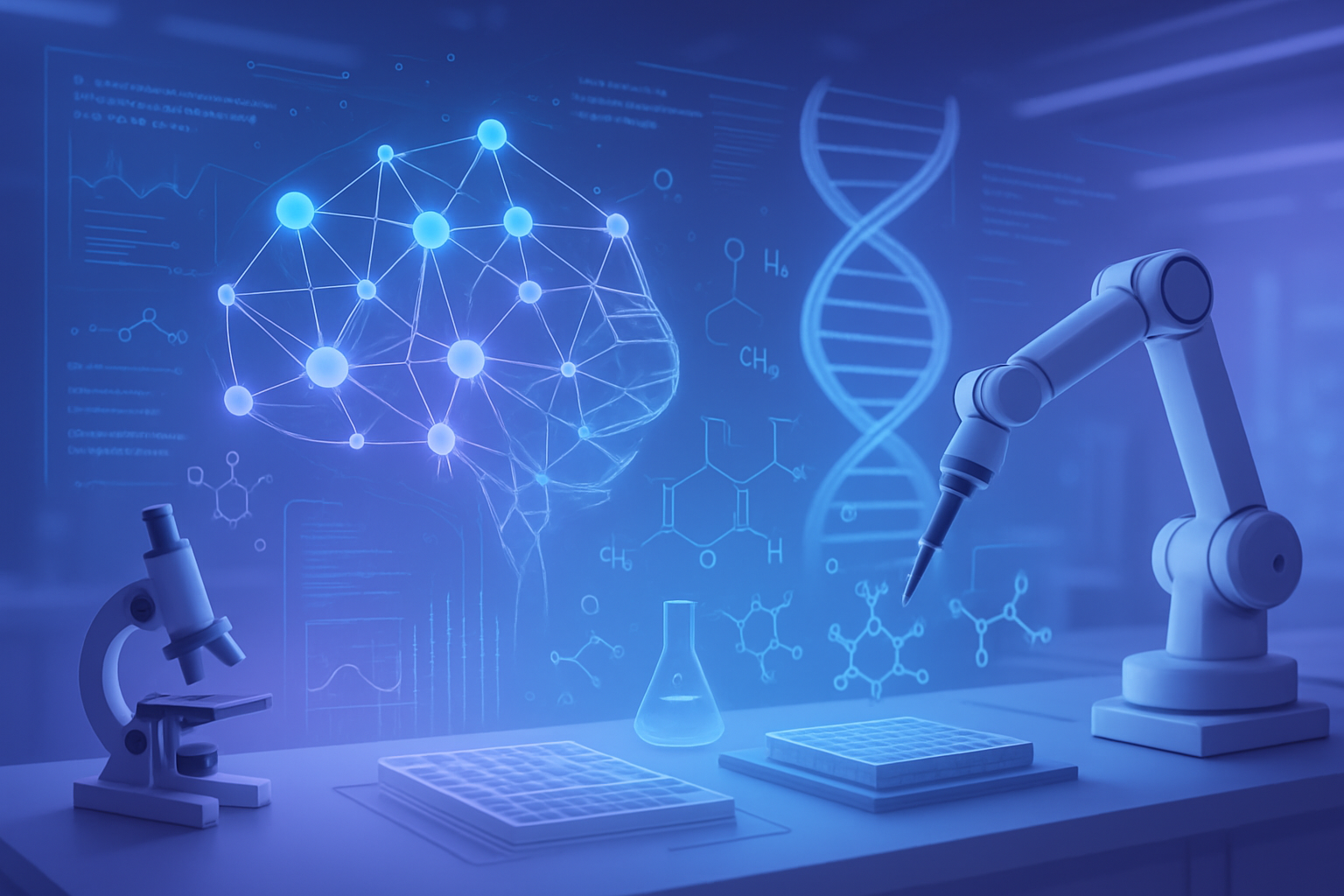
Artificial intelligence (AI) is ushering in a transformative era for pharmaceutical research and development (R&D), fundamentally reshaping how new medicines are discovered, developed, and brought to market. Driven by advanced data integration and sophisticated analytics, AI is dramatically accelerating timelines, reducing costs, and significantly improving success rates across the entire drug development pipeline. This paradigm shift holds immediate significance for patients worldwide, promising faster access to life-saving therapies and ushering in an age of precision medicine.
The pharmaceutical industry, historically characterized by lengthy, expensive, and high-risk development cycles, is now leveraging AI's unparalleled ability to process, analyze, and derive insights from vast, complex, and heterogeneous datasets. This includes everything from genomic and proteomic data to real-world patient information and scientific literature, all integrated and harmonized by AI platforms. The immediate impact is evident in the compression of drug discovery phases from years to months, with some companies reporting up to 50% reductions in early development times and significantly higher success rates for AI-derived drug candidates in initial clinical trials.
The Technical Core: How AI is Redefining Drug Development
At the heart of this revolution are advanced AI methodologies that differ starkly from previous, more manual or statistically limited computational approaches. The technical capabilities driving this acceleration include:
Machine Learning (ML) and Deep Learning (DL): These algorithms form the bedrock, enabling systems to learn from vast datasets to predict bioactivity, efficacy, toxicity, and pharmacokinetic properties with unprecedented speed and accuracy. Deep learning, in particular, utilizes multi-layered neural networks (e.g., CNNs, RNNs, Graph Neural Networks) to learn abstract features directly from raw data like molecular structures or biological sequences, eliminating the need for extensive manual feature engineering. This allows for rapid virtual screening of millions of compounds and accurate prediction of drug-target interactions.
Natural Language Processing (NLP): Crucial for extracting insights from unstructured text data, NLP sifts through scientific literature, clinical notes, and regulatory documents. Capabilities like Named Entity Recognition (NER), word embeddings, and relation extraction help identify and understand semantic relationships between drugs, diseases, and proteins. Large Language Models (LLMs) are now interpreting biological and chemical "languages" to uncover previously hidden insights.
Generative AI (e.g., GANs, VAEs): Perhaps the most revolutionary, generative AI models are capable of de novo molecular design. Instead of merely modifying existing compounds, these models can create entirely new chemical entities with desired pharmacological properties from scratch, optimized for potency, selectivity, and safety profiles. This marks a significant departure from traditional methods that relied heavily on modifying known compounds.
Unlike traditional drug discovery, which was often a trial-and-error process with labor-intensive high-throughput screening, AI offers unparalleled scale, speed, and accuracy. It allows for the rapid screening of vast chemical spaces, the performance of in silico experiments, and more precise predictions of efficacy and toxicity. Initial reactions from the AI research community and industry experts are overwhelmingly enthusiastic, viewing AI as an indispensable tool for a more efficient, data-driven pharmaceutical future. However, concerns regarding data quality, interpretability, the shortage of skilled personnel, and regulatory hurdles are also frequently highlighted, underscoring the need for careful implementation and validation.
Competitive Implications: A Reshaped Pharma Landscape
The integration of AI into pharmaceutical R&D is creating a dynamic competitive landscape, benefiting traditional pharmaceutical giants, specialized AI companies, tech behemoths, and innovative startups alike.
Companies like Eli Lilly (NYSE: LLY) are leading the charge, having deployed the world's largest AI factory in pharma, powered by NVIDIA (NASDAQ: NVDA) Blackwell-based DGX SuperPODs. This strategic move aims to compress drug discovery timelines and drive breakthroughs in genomics and personalized medicine. Other major players such as Pfizer (NYSE: PFE), AstraZeneca (LSE: AZN), Novartis (NYSE: NVS), Roche (SIX: ROG), and Janssen (a subsidiary of Johnson & Johnson (NYSE: JNJ)) are heavily investing in AI collaborations and in-house platforms, demonstrating a clear commitment to integrating AI across their R&D value chains.
A new ecosystem of specialized AI companies is also flourishing. Insilico Medicine, Exscientia, Recursion Pharmaceuticals (NASDAQ: RXRX), BenevolentAI (AMS: BAI), Generate Biomedicines, Atomwise, and Iktos are pioneering AI-driven platforms for target discovery, molecule generation, and clinical trial optimization. Many of these originated as startups and have scaled rapidly, often partnering with established pharma companies.
Tech giants are also making significant inroads. NVIDIA (NASDAQ: NVDA) is a primary beneficiary, providing the essential GPU infrastructure and platforms like Clara and TuneLab that power complex AI computations. Alphabet (NASDAQ: GOOG, GOOGL), through its DeepMind spin-off Isomorphic Labs, is establishing "AI Science Factories" that combine specialized AI models with automated lab robotics. Microsoft (NASDAQ: MSFT) and IBM (NYSE: IBM) are forging strategic alliances with pharma companies, providing foundational AI capabilities and cloud infrastructure.
This shift promises significant disruption. AI can drastically reduce drug discovery costs by up to 40% and development timelines from years to months, fundamentally altering the traditional, lengthy, and expensive drug development paradigm. Higher success rates for AI-powered drug candidates (up to 80-90% in Phase 1 trials compared to 40-65% historically) will redefine the risk profile of R&D. Companies that fail to strategically integrate AI risk losing innovation leadership to "digital pharma players" or AI-native competitors. Strategic partnerships, proprietary AI platforms, and access to unique, high-quality datasets are becoming crucial for market positioning and securing a first-mover advantage, allowing for faster market entry and extended patent life for new therapies.
Wider Significance: A New Horizon for Healthcare
AI's accelerating role in pharmaceutical R&D is a pivotal development within the broader AI landscape, signifying a profound maturation of AI's capabilities beyond generalized tasks to highly specialized, life-saving applications. This fits seamlessly into current AI trends, particularly the rise of advanced machine learning, deep learning, and generative AI, which are increasingly data-centric and capable of handling vast, complex biological datasets.
The societal impacts are immense: faster access to life-saving treatments, the advent of truly personalized medicine tailored to individual genetic profiles, and potentially reduced healthcare costs due to more efficient development. Scientifically, AI is leading to a deeper understanding of disease mechanisms, enhanced predictive capabilities for drug efficacy and toxicity, and the automation of tedious tasks, freeing researchers for higher-level strategic thinking.
However, this advancement also brings significant concerns. Data privacy and security remain paramount, especially with the use of vast amounts of sensitive patient data. The potential for bias in AI models, if trained on unrepresentative data, could lead to unequal access to treatments. Ethical considerations surrounding AI decision-making transparency and accountability are also critical in a highly regulated industry. Furthermore, the sheer complexity and heterogeneity of pharmaceutical data, often siloed in legacy systems, pose considerable challenges for effective integration and model training.
Compared to previous AI milestones, such as DeepMind's AlphaGo mastering the game of Go, the current state of AI in pharma represents a shift from narrow intelligence to broad, transformative utility. The advent of generative AI, exemplified by models like ChatGPT and its applications in de novo molecular design, positions AI not merely as a tool but as a core competitive capability that can actively design and optimize rather than just analyze. This marks a significant evolution from earlier computational chemistry methods, leveraging unprecedented data volumes and computational power for far greater accuracy and scale.
Future Developments: Towards Autonomous Discovery and Hyper-Personalization
The trajectory of AI in pharmaceutical R&D points towards even more profound transformations in both the near and long term.
In the near term, expect continued refinement of AI-driven data integration and advanced analytics. This includes more sophisticated multi-omics data analysis for target identification, enhanced predictive modeling for lead optimization, and increasingly intelligent clinical trial design platforms that leverage real-world evidence. Generative AI will see further innovation in in silico drug engineering and the automated generation of clinical trial protocols, significantly cutting development time. Experts predict that by 2025, approximately 30% of new drugs will be discovered or developed with AI, with success rates for AI-discovered molecules in Phase 1 trials reaching 80-90%.
Looking further ahead, long-term developments envision truly autonomous laboratories by 2030, where AI-powered machines conduct most R&D with minimal human intervention. The integration of AI with synthetic biology and quantum computing promises to tackle even more complex biological systems and long-standing challenges like drug resistance. The ultimate goal is hyper-personalized therapies, designed specifically for individuals based on real-time health data, genomic insights, and predicted drug responses, with the first entirely AI-designed drugs available to patients by 2030.
Despite this optimistic outlook, challenges persist. Data quality, availability, and the integration of siloed datasets remain critical hurdles. The "black box" nature of some AI models requires continuous efforts towards transparency and interpretability to build trust and facilitate regulatory approval. The significant skills gap—the need for professionals proficient in both AI and pharmaceutical science—also needs to be addressed through interdisciplinary training and collaboration. Experts predict that while AI will automate many routine tasks, human oversight and expertise will remain crucial for interpreting complex results, devising experimental strategies, and providing validation.
Comprehensive Wrap-up: An Indispensable Force for Health
The rapid integration of AI into pharmaceutical R&D is not merely an incremental improvement but a fundamental re-engineering of the drug discovery and development process. It represents a critical milestone in AI history, showcasing its maturation into an indispensable force capable of addressing some of humanity's most pressing health challenges.
The key takeaways are clear: AI, through its unparalleled ability to integrate and analyze vast, complex datasets, is dramatically accelerating drug discovery, optimizing clinical trials, and paving the way for personalized medicine. This translates into faster access to life-saving therapies, potentially reduced healthcare costs, and a deeper scientific understanding of disease.
The long-term impact will be revolutionary, shaping a healthcare system that is more proactive, efficient, and patient-centric. We can anticipate broader drug accessibility, hope for treating currently incurable conditions, and the widespread adoption of precision medicine. Pharmaceutical companies will evolve into agile, AI-driven enterprises, with AI embedded in their core operational and strategic DNA.
In the coming weeks and months, watch for intensified efforts in robust data governance and management as health authorities increasingly mandate structured data submissions. The ability to break down data silos and integrate disparate datasets into unified platforms will be paramount. Concurrently, expect further innovation in generative AI for in silico drug engineering and automated protocol generation, alongside advanced natural language processing for extracting insights from unstructured clinical data. Real-time predictive analytics and the integration of AI with genomics for biomarker discovery will also be crucial areas of development. As pharmaceutical companies transition from experimental AI deployments to fully integrated, scaled solutions, the emphasis will be on demonstrating tangible return on investment and solidifying AI's indispensable role in delivering life-changing therapies faster and more efficiently.
This content is intended for informational purposes only and represents analysis of current AI developments.
TokenRing AI delivers enterprise-grade solutions for multi-agent AI workflow orchestration, AI-powered development tools, and seamless remote collaboration platforms.
For more information, visit https://www.tokenring.ai/.