
Tag: High-NA EUV

  • The Angstrom Era Arrives: Intel’s $380 Million High-NA Gamble Redefines the Limits of Physics

    The Angstrom Era Arrives: Intel’s $380 Million High-NA Gamble Redefines the Limits of Physics

    The global semiconductor race has officially entered a new, smaller, and vastly more expensive chapter. As of January 14, 2026, Intel (NASDAQ: INTC) has announced the successful installation and completion of acceptance testing for its first commercial-grade High-Numerical Aperture (High-NA) Extreme Ultraviolet (EUV) lithography machine. The system, the ASML (NASDAQ: ASML) Twinscan EXE:5200B, represents a $380 million bet that the future of silicon belongs to those who can master the "Angstrom Era"—the threshold where transistor features are measured in units smaller than a single nanometer.

    This milestone is more than just a logistical achievement; it marks a fundamental shift in how the world’s most advanced chips are manufactured. By transitioning from the industry-standard 0.33 Numerical Aperture (NA) optics to the 0.55 NA system found in the EXE:5200B, Intel has unlocked the ability to print features with a resolution of 8nm, compared to the 13nm limit of previous generations. This leap is the primary gatekeeper for Intel’s upcoming 14A (1.4nm) process node, a technology designed to provide the massive computational density required for next-generation artificial intelligence and high-performance computing.

    The Physics of 0.55 NA: From Multi-Patterning Complexity to Single-Patterning Precision

    The technical heart of the EXE:5200B lies in its anamorphic optics. Unlike previous EUV machines that used uniform 4x magnification mirrors, the High-NA system employs a specialized mirror configuration that magnifies the X and Y axes differently (4x and 8x respectively). This allows for a much steeper angle of light to hit the silicon wafer, significantly sharpening the focus. For years, the industry has relied on "multi-patterning"—a process where a single layer of a chip is exposed multiple times using 0.33 NA machines to achieve high density. However, multi-patterning is prone to "stochastic" defects, where random variations in photon intensity create errors.

    With the 0.55 NA optics of the EXE:5200B, Intel is moving back to single-patterning for critical layers. This shift reduces the manufacturing cycle for the Intel 14A node from roughly 40 processing steps per layer to fewer than 10. Initial testing benchmarks from Intel’s D1X facility in Oregon indicate a throughput of up to 220 wafers per hour (wph), surpassing the early experimental models. More importantly, Intel has demonstrated mastery of "field stitching"—a necessary technique where two half-fields are seamlessly joined to create large AI chips, achieving an overlay accuracy of 0.7nm. This level of precision is equivalent to lining up two human hairs from across a football field with zero margin for error.

    A Geopolitical and Competitive Paradigm Shift for Foundry Leaders

    The successful deployment of High-NA EUV positions Intel as the first mover in a market that has been dominated by TSMC (NYSE: TSM) for the better part of a decade. While TSMC has opted for a "fast-follower" strategy, choosing to push its existing 0.33 NA tools to their limits for its upcoming A14 node, Intel’s early adoption gives it a projected two-year lead in High-NA operational experience. This "five nodes in four years" strategy is a calculated risk to reclaim the process leadership crown. If Intel can successfully scale the 14A node using the EXE:5200B, it may offer density and power-efficiency advantages that its competitors cannot match until they adopt High-NA for their 1nm-class nodes later this decade.

    Samsung Electronics (OTC: SSNLF) is not far behind, having recently received its own EXE:5200B units. Samsung is expected to use the technology for its SF2 (2nm) logic nodes and next-generation HBM4 memory, setting up a high-stakes three-way battle for AI chip supremacy. For chip designers like Nvidia or Apple, the choice of foundry will now depend on who can best manage the trade-off between the high costs of High-NA machines and the yield improvements provided by single-patterning. Intel’s early proficiency in this area could disrupt the existing foundry ecosystem, luring high-profile clients back to American soil as part of the broader "Intel Foundry" initiative.

    Beyond Moore’s Law: The Broader Significance for the AI Landscape

    The transition to the Angstrom Era is the industry’s definitive answer to those who claimed Moore’s Law was dead. The ability to pack nearly three times the transistor density into the same area is essential for the evolution of Large Language Models (LLMs) and autonomous systems. As AI models grow in complexity, the hardware bottleneck often comes down to the physical proximity of transistors and memory. The 14A node, bolstered by High-NA lithography, is designed to work in tandem with Intel’s PowerVia (backside power delivery) and RibbonFET architecture to maximize energy efficiency.

    However, this breakthrough also brings potential concerns regarding the "Billion Dollar Fab." With a single High-NA machine costing nearly $400 million and a full production line requiring dozens of them, the barrier to entry for semiconductor manufacturing is now insurmountable for all but the wealthiest nations and corporations. This concentration of technology heightens the geopolitical importance of ASML’s headquarters in the Netherlands and Intel’s facilities in the United States, further entrenching the "silicon shield" that defines modern international relations and supply chain security.

    Challenges on the Horizon and the Road to 1nm

    Despite the successful testing of the EXE:5200B, significant challenges remain. The industry must now develop new photoresists and masks capable of handling the increased light intensity and smaller feature sizes of High-NA EUV. There are also concerns about the "half-field" exposure size of the 0.55 NA optics, which forces chip designers to rethink how they layout massive AI accelerators. If the stitching process fails to yield high enough results, the cost-per-transistor could actually rise despite the reduction in patterning steps.

    Looking further ahead, researchers are already discussing "Hyper-NA" lithography, which would push numerical aperture beyond 1.0. While that remains a project for the 2030s, the immediate focus will be on refining the 14A process for high-volume manufacturing by late 2026 or 2027. Experts predict that the next eighteen months will be a period of intense "yield ramp" testing, where Intel must prove that it can turn these $380 million machines into reliable, around-the-clock workhorses.

    Summary of the Angstrom Era Transition

    Intel’s successful installation of the ASML Twinscan EXE:5200B marks a historic pivot point for the semiconductor industry. By moving to 0.55 NA optics, Intel is attempting to bypass the complexities of multi-patterning and jump directly into the 1.4nm (14A) node. This development signifies a major technical victory, demonstrating that sub-nanometer precision is achievable at scale.

    In the coming weeks and months, the tech world will be watching for the first "tape-outs" from Intel's partners using the 14A PDK. The ultimate success of this transition will be measured not just by the resolution of the mirrors, but by Intel's ability to translate this technical lead into a viable, profitable foundry business that can compete with the giants of Asia. For now, the "Angstrom Era" has a clear frontrunner, and the race to 1nm is officially on.


    This content is intended for informational purposes only and represents analysis of current AI developments.

    TokenRing AI delivers enterprise-grade solutions for multi-agent AI workflow orchestration, AI-powered development tools, and seamless remote collaboration platforms.
    For more information, visit https://www.tokenring.ai/.
  • The High-NA Revolution: Inside the $400 Million Machines Defining the Angstrom Era

    The High-NA Revolution: Inside the $400 Million Machines Defining the Angstrom Era

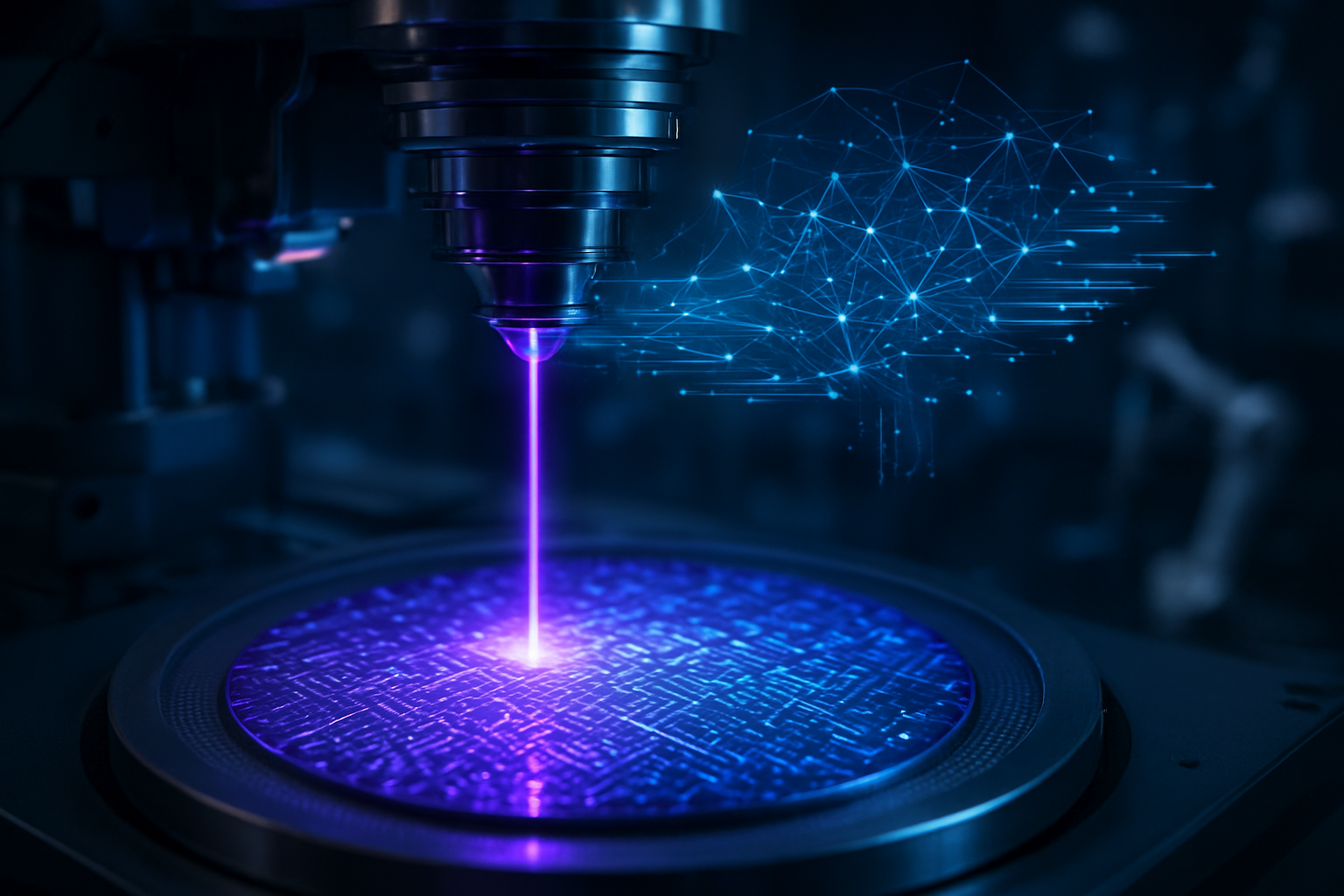
    The global race for artificial intelligence supremacy has officially entered its most expensive and physically demanding chapter yet. As of early 2026, the transition from experimental R&D to high-volume manufacturing (HVM) for High-Numerical Aperture (High-NA) Extreme Ultraviolet (EUV) lithography is complete. These massive, $400 million machines, manufactured exclusively by ASML (NASDAQ: ASML), have become the literal gatekeepers of the "Angstrom Era," enabling the production of transistors so small that they are measured by the width of individual atoms.

    The arrival of High-NA EUV is not merely an incremental upgrade; it is a critical pivot point for the entire AI industry. As Large Language Models (LLMs) scale toward 100-trillion parameter architectures, the demand for more energy-efficient and dense silicon has made traditional lithography obsolete. Without the precision afforded by High-NA, the hardware required to sustain the current pace of AI development would hit a "thermal wall," where energy consumption and heat dissipation would outpace any gains in raw processing power.

    The Optical Engineering Marvel: 0.55 NA and the End of Multi-Patterning

    At the heart of this revolution is the ASML Twinscan EXE:5200 series. The "High-NA" designation refers to the increase in numerical aperture from 0.33 to 0.55. In the world of optics, a higher NA allows the lens system to collect more light and achieve a finer resolution. For chipmakers, this means the ability to print features as small as 8nm, a significant leap from the 13nm limit of previous-generation EUV tools. This increased resolution enables a nearly 3-fold increase in transistor density, allowing engineers to cram more logic and memory into the same square millimeter of silicon.

    The most immediate technical benefit for foundries is the return to "single-patterning." In the previous sub-3nm era, manufacturers were forced to use complex "multi-patterning" techniques—essentially printing a single layer of a chip across multiple exposures—to bypass the resolution limits of 0.33 NA machines. This process was notoriously error-prone, time-consuming, and decimated yields. The High-NA systems allow for these intricate designs to be printed in a single pass, slashing the number of critical layer process steps from over 40 to fewer than 10. This efficiency is what makes the 1.4nm (Intel 14A) and upcoming 1nm nodes economically viable.

    Initial reactions from the semiconductor research community have been a mix of awe and cautious pragmatism. While the technical capabilities of the EXE:5200B are undisputed—boasting a throughput of over 200 wafers per hour and sub-nanometer overlay accuracy—the sheer scale of the hardware has presented logistical nightmares. These machines are roughly the size of a double-decker bus and weigh 150,000 kilograms, requiring cleanrooms with reinforced flooring and specialized ceiling heights that many older fabs simply cannot accommodate.

    The Competitive Tectonic Shift: Intel’s Lead and the Foundries' Dilemma

    The deployment of High-NA has created a stark strategic divide among the world’s leading chipmakers. Intel (NASDAQ: INTC) has emerged as the early winner in this transition, having successfully completed acceptance testing for its first high-volume EXE:5200B system in Oregon this month. By being the "First Mover," Intel is leveraging High-NA to underpin its Intel 14A node, aiming to reclaim the title of process leadership from its rivals. This aggressive stance is a cornerstone of Intel Foundry's strategy to attract external customers like NVIDIA (NASDAQ: NVDA) and Microsoft (NASDAQ: MSFT) who are desperate for the most advanced AI silicon.

    In contrast, TSMC (NYSE: TSM) has adopted a "calculated delay" strategy. The Taiwanese giant has spent the last year optimizing its A16 (1.6nm) node using older 0.33 NA machines with sophisticated multi-patterning to maintain its industry-leading yields. However, TSMC is not ignoring the future; the company has reportedly secured an massive order of nearly 70 High-NA machines for its A14 and A10 nodes slated for 2027 and beyond. This creates a fascinating competitive window where Intel may have a technical density advantage, while TSMC maintains a volume and cost-efficiency lead.

    Meanwhile, Samsung (KRX: 005930) is attempting a high-stakes "leapfrog" maneuver. After integrating its first High-NA units for 2nm production, internal reports suggest the company may skip the 1.4nm node entirely to focus on a "dream" 1nm process. This strategic pivot is intended to close the gap with TSMC by betting on the ultimate physical limit of silicon earlier than its competitors. For AI labs and chip designers, this means the next three years will be defined by which foundry can most effectively balance the astronomical costs of High-NA with the performance demands of next-gen Blackwell and Rubin-class GPUs.

    Moore's Law and the "2-Atom Wall"

    The wider significance of High-NA EUV lies in its role as the ultimate life-support system for Moore’s Law. We are no longer just fighting the laws of economics; we are fighting the laws of physics. At the 1.4nm and 1nm levels, we are approaching what researchers call the "2-atom wall"—a point where transistor features are only two atoms thick. Beyond this, traditional silicon faces insurmountable challenges from quantum tunneling, where electrons literally jump through barriers they are supposed to be blocked by, leading to massive data errors and power leakage.

    High-NA is being used in tandem with other radical architectures to circumvent these limits. Technologies like Backside Power Delivery (which Intel calls PowerVia) move the power lines to the back of the wafer, freeing up space on the front for even denser transistor placement. This synergy is what allows for the power-efficiency gains required for the next generation of "Physical AI"—autonomous robots and edge devices that need massive compute power without being tethered to a power plant.

    However, the concentration of this technology in the hands of a single supplier, ASML, and three primary customers raises significant concerns about the democratization of AI. The $400 million price tag per machine, combined with the billions required for fab construction, creates a barrier to entry that effectively locks out any new players in the leading-edge foundry space. This consolidation ensures that the "AI haves" and "AI have-nots" will be determined by who has the deepest pockets and the most stable supply chains for Dutch-made optics.

    The Horizon: Hyper-NA and the Sub-1nm Future

    As the industry digests the arrival of High-NA, ASML is already looking toward the next frontier: Hyper-NA. With a projected numerical aperture of 0.75, Hyper-NA systems (likely the HXE series) are already on the roadmap for 2030. These machines will be necessary to push manufacturing into the sub-10-Angstrom (sub-1nm) range. However, experts predict that Hyper-NA will face even steeper challenges, including "polarization death," where the angles of light become so extreme that they cancel each other out, requiring entirely new types of polarization filters.

    In the near term, the focus will shift from "can we print it?" to "can we yield it?" The industry is expected to see a surge in the use of AI-driven metrology and inspection tools to manage the extreme precision required by High-NA. We will also likely see a major shift in material science, with researchers exploring 2D materials like molybdenum disulfide to replace silicon as we hit the 2-atom wall. The chips powering the AI models of 2028 and beyond will likely look nothing like the processors we use today.

    Conclusion: A Tectonic Moment in Computing History

    The successful deployment of ASML’s High-NA EUV tools marks one of the most significant milestones in the history of the semiconductor industry. It represents the pinnacle of human engineering—using light to manipulate matter at the near-atomic scale. For the AI industry, this is the infrastructure that makes the "Sovereign AI" dreams of nations and the "AGI" goals of labs possible.

    The key takeaways for the coming year are clear: Intel has secured a narrow but vital head start in the Angstrom era, while TSMC remains the formidable incumbent betting on refined execution. The massive capital expenditure required for these tools will likely drive up the price of high-end AI chips, but the performance and efficiency gains will be the engine that drives the next decade of digital transformation. Watch closely for the first 1.4nm "tape-outs" from major AI players in the second half of 2026; they will be the first true test of whether the $400 million gamble has paid off.


    This content is intended for informational purposes only and represents analysis of current AI developments.

    TokenRing AI delivers enterprise-grade solutions for multi-agent AI workflow orchestration, AI-powered development tools, and seamless remote collaboration platforms.
    For more information, visit https://www.tokenring.ai/.

  • The $380 Million Gamble: Intel Seizes the Lead in the Angstrom Era with High-NA EUV

    The $380 Million Gamble: Intel Seizes the Lead in the Angstrom Era with High-NA EUV

    As of January 13, 2026, the global semiconductor landscape has reached a historic inflection point. Intel Corp (NASDAQ: INTC) has officially transitioned its 18A (1.8-nanometer) process node into High-Volume Manufacturing (HVM), marking the first time in over a decade that the American chipmaker has arguably leapfrogged its primary rivals in manufacturing technology. This milestone is underpinned by the strategic deployment of High Numerical Aperture (High-NA) Extreme Ultraviolet (EUV) lithography, a revolutionary printing technique that allows for unprecedented transistor density and precision.

    The immediate significance of this development cannot be overstated. By being the first to integrate ASML Holding (NASDAQ: ASML) Twinscan EXE:5200B scanners into its production lines, Intel is betting that it can overcome the "yield wall" that has plagued sub-2nm development. While competitors have hesitated due to the astronomical costs of the new hardware, Intel’s early adoption is already bearing fruit, with the company reporting stable 18A yields that have cleared the 65% threshold—making mass-market production of its next-generation "Panther Lake" and "Clearwater Forest" processors economically viable.

    Precision at the Atomic Scale: The 0.55 NA Advantage

    The technical leap from standard EUV to High-NA EUV is defined by the increase in numerical aperture from 0.33 to 0.55. This shift allows the ASML Twinscan EXE:5200B to achieve a resolution of just 8nm, a massive improvement over the 13.5nm limit of previous-generation machines. In practical terms, this enables Intel to print features that are 1.7x smaller than before, contributing to a nearly 2.9x increase in overall transistor density. For the first time, engineers are working with tolerances where a single stray atom can determine the success or failure of a logic gate.

    Unlike previous approaches that required complex "multi-patterning"—where a single layer of a chip is printed multiple times to achieve the desired resolution—High-NA EUV allows for single-exposure patterning of the most critical layers. This reduction in process steps is the secret weapon behind Intel’s yield improvements. By eliminating the cumulative errors inherent in multi-patterning, Intel has managed to improve its 18A yields by approximately 7% month-over-month throughout late 2025. The new scanners also boast a record-breaking 0.7nm overlay accuracy, ensuring that the dozens of atomic-scale layers in a modern processor are aligned with near-perfect precision.

    Initial reactions from the semiconductor research community have been a mix of awe and cautious optimism. Analysts at major firms have noted that while the transition to High-NA involves a "half-field" mask size—effectively halving the area a scanner can print in one go—the EXE:5200B’s throughput of 175 to 200 wafers per hour mitigates the potential productivity loss. The industry consensus is that Intel has successfully navigated the steepest part of the learning curve, gaining operational knowledge that its competitors have yet to even begin acquiring.

    A $380 Million Barrier to Entry: Shifting Industry Dynamics

    The primary deterrent for High-NA adoption has been the staggering price tag: approximately $380 million (€350 million) per machine. This cost represents more than just the hardware; it includes a massive logistical tail, requiring specialized fab cleanrooms and a six-month installation period led by hundreds of ASML engineers. Intel’s decision to purchase the lion's share of ASML's early production run has created a temporary monopoly on the most advanced manufacturing capacity in the world, effectively building a "moat" made of capital and specialized expertise.

    This strategy has placed Taiwan Semiconductor Manufacturing Company (NYSE: TSM) in an uncharacteristically defensive position. TSMC has opted to extend its existing 0.33 NA tools for its A14 node, utilizing advanced multi-patterning to avoid the high capital expenditure of High-NA. While this conservative approach protects TSMC’s short-term margins, it leaves them trailing Intel in High-NA operational experience by an estimated 24 months. Meanwhile, Samsung Electronics (KRX: 005930) continues to struggle with yield issues on its 2nm Gate-All-Around (GAA) process, further delaying its own High-NA roadmap until at least 2028.

    For AI companies and tech giants, Intel’s resurgence offers a vital second source for cutting-edge silicon. As the demand for AI accelerators and high-performance computing (HPC) chips continues to outpace supply, Intel’s Foundry services are becoming an attractive alternative to TSMC. By providing a "High-NA native" path for its upcoming 14A node, Intel is positioning itself as the premier partner for the next generation of AI hardware, potentially disrupting the long-standing dominance of the "TSMC-only" supply chain for top-tier silicon.

    Sustaining Moore’s Law in the AI Era

    The deployment of High-NA EUV is more than just a corporate victory for Intel; it is a vital sign for the longevity of Moore’s Law. As the industry moved toward the 2nm limit, many feared that the physical and economic barriers of lithography would bring the era of rapid transistor scaling to an end. High-NA EUV effectively resets the clock, providing a clear technological roadmap into the 1nm (10 Angstrom) range and beyond. This fits into a broader trend where the "Angstrom Era" is defined not just by smaller transistors, but by the integration of advanced packaging and backside power delivery—technologies like Intel’s PowerVia that work in tandem with High-NA lithography.

    However, the wider significance of this milestone also brings potential concerns regarding the "geopolitics of silicon." With High-NA tools being so expensive and rare, the gap between the "haves" and the "have-nots" in the semiconductor world is widening. Only a handful of companies—and by extension, a handful of nations—can afford to participate at the leading edge. This concentration of power could lead to increased market volatility if supply chain disruptions occur at the few sites capable of housing these $380 million machines.

    Compared to previous milestones, such as the initial introduction of EUV in 2019, the High-NA transition has been remarkably focused on the US-based manufacturing footprint. Intel’s primary High-NA operations are centered in Oregon and Arizona, signaling a significant shift in the geographical concentration of advanced chipmaking. This alignment with domestic manufacturing goals has provided Intel with a strategic tailwind, as Western governments prioritize the resilience of high-end semiconductor supplies for AI and national security.

    The Road to 14A and Beyond

    Looking ahead, the next two to three years will be defined by the maturation of the 14A (1.4nm) node. While 18A uses a "hybrid" approach with High-NA applied only to the most critical layers, the 14A node is expected to be "High-NA native," utilizing the technology across a much broader range of the chip’s architecture. Experts predict that by 2027, the operational efficiencies gained from High-NA will begin to lower the cost-per-transistor once again, potentially sparking a new wave of innovation in consumer electronics and edge-AI devices.

    One of the primary challenges remaining is the evolution of the mask and photoresist ecosystem. High-NA requires thinner resists and more complex mask designs to handle the higher angles of light. ASML and its partners are already working on the next iteration of the EXE platform, with rumors of "Hyper-NA" (0.75 NA) already circulating in R&D circles for the 2030s. For now, the focus remains on perfecting the 18A ramp and ensuring that the massive capital investment in High-NA translates into sustained market share gains.

    Predicting the next move, industry analysts expect TSMC to accelerate its High-NA evaluation as Intel’s 18A products hit the shelves. If Intel’s "Panther Lake" processors demonstrate a significant performance-per-watt advantage, the pressure on TSMC to abandon its conservative stance will become overwhelming. The "Lithography Wars" are far from over, but in early 2026, Intel has clearly seized the high ground.

    Conclusion: A New Leader in the Silicon Race

    The strategic deployment of High-NA EUV lithography in 2026 marks the beginning of a new chapter in semiconductor history. Intel’s willingness to shoulder the $380 million cost of early adoption has paid off, providing the company with a 24-month head start in the most critical manufacturing technology of the decade. With 18A yields stabilizing and high-volume manufacturing underway, the "Angstrom Era" is no longer a theoretical roadmap—it is a production reality.

    The key takeaway for the industry is that the "barrier to entry" at the leading edge has been raised to unprecedented heights. The combination of extreme capital requirements and the steep learning curve of 0.55 NA optics has created a bifurcated market. Intel’s success in reclaiming the manufacturing "crown" will be measured not just by the performance of its own chips, but by its ability to attract major foundry customers who are hungry for the density and efficiency that only High-NA can provide.

    In the coming months, all eyes will be on the first third-party benchmarks of Intel 18A silicon. If these chips deliver on their promises, the shift in the balance of power from East to West may become a permanent fixture of the tech landscape. For now, Intel’s $380 million gamble looks like the smartest bet in the history of the industry.


    This content is intended for informational purposes only and represents analysis of current AI developments.

    TokenRing AI delivers enterprise-grade solutions for multi-agent AI workflow orchestration, AI-powered development tools, and seamless remote collaboration platforms.
    For more information, visit https://www.tokenring.ai/.
  • Intel’s 1.8nm Era: Reclaiming the Silicon Crown as 18A Enters High-Volume Production

    Intel’s 1.8nm Era: Reclaiming the Silicon Crown as 18A Enters High-Volume Production

    SANTA CLARA, Calif. — In a historic milestone for the American semiconductor industry, Intel (NASDAQ: INTC) has officially announced that its 18A (1.8nm-class) process node has entered high-volume manufacturing (HVM). The announcement, made during the opening keynote of CES 2026, marks the successful completion of the company’s ambitious "five nodes in four years" roadmap. For the first time in nearly a decade, Intel appears to have parity—and by some technical measures, a clear lead—over its primary rival, Taiwan Semiconductor Manufacturing Company (NYSE: TSM), in the race to power the next generation of artificial intelligence.

    The immediate significance of 18A cannot be overstated. As AI models grow exponentially in complexity, the demand for chips that offer higher transistor density and significantly lower power consumption has reached a fever pitch. By reaching high-volume production with 18A, Intel is not just releasing a new processor; it is launching a fully-fledged foundry service capable of building the world’s most advanced AI accelerators for third-party clients. With anchor customers like Microsoft (NASDAQ: MSFT) and Amazon (NASDAQ: AMZN) already ramping up production on the node, the silicon landscape is undergoing its most radical shift since the invention of the integrated circuit.

    The Architecture of Leadership: RibbonFET and PowerVia

    The Intel 18A node represents a fundamental departure from the FinFET transistor architecture that has dominated the industry for over a decade. At the heart of 18A are two "world-first" technologies: RibbonFET and PowerVia. RibbonFET is Intel’s implementation of a Gate-All-Around (GAA) transistor, where the gate wraps entirely around the conducting channel. This provides superior electrostatic control, drastically reducing current leakage and allowing for higher drive currents at lower voltages. While TSMC (NYSE: TSM) has also moved to GAA with its N2 node, Intel’s 18A is distinguished by its integration of PowerVia—the industry’s first backside power delivery system.

    PowerVia solves one of the most persistent bottlenecks in chip design: "voltage droop" and signal interference. In traditional chips, power and signal lines are intertwined on the front side of the wafer, competing for space. PowerVia moves the entire power delivery network to the back of the wafer, leaving the front exclusively for data signals. This separation allows for a 15% to 25% improvement in performance-per-watt and enables chips to run at higher clock speeds without overheating. Initial data from early 18A production runs indicates that Intel has achieved a transistor density of approximately 238 million transistors per square millimeter (MTr/mm²), providing a potent combination of raw speed and energy efficiency that is specifically tuned for AI workloads.

    Industry experts have reacted with cautious optimism, noting that while TSMC’s N2 node still holds a slight lead in pure area density, Intel’s lead in backside power delivery gives it a strategic "performance-per-watt" advantage that is critical for massive data centers. "Intel has effectively leapfrogged the industry in power delivery architecture," noted one senior analyst at the event. "While the competition is still figuring out how to untangle their power lines, Intel is already shipping at scale."

    A New Titan in the Foundry Market

    The arrival of 18A transforms Intel Foundry from a theoretical competitor into a genuine threat to the TSMC-Samsung duopoly. By securing Microsoft (NASDAQ: MSFT) as a primary customer for its custom "Maia 2" AI accelerators, Intel has proven that its foundry model can attract the world’s largest "hyperscalers." Amazon (NASDAQ: AMZN) has similarly committed to 18A for its custom AI fabric and Graviton-series processors, seeking to reduce its reliance on external suppliers and optimize its internal cloud infrastructure for the generative AI era.

    This development creates a complex competitive dynamic for AI leaders like NVIDIA (NASDAQ: NVDA). While NVIDIA remains heavily reliant on TSMC for its current H-series and B-series GPUs, the company reportedly made a strategic $5 billion investment in Intel’s advanced packaging capabilities in 2025. With 18A now in high-volume production, the industry is watching closely to see if NVIDIA will shift a portion of its next-generation "Rubin" or "Post-Rubin" architecture to Intel’s fabs to diversify its supply chain and hedge against geopolitical risks in the Taiwan Strait.

    For startups and smaller AI labs, the emergence of a high-performance alternative in the United States could lower the barrier to entry for custom silicon. Intel’s "Secure Enclave" partnership with the U.S. Department of Defense further solidifies 18A as the premier node for sovereign AI applications, ensuring that the most sensitive government and defense chips are manufactured on American soil using the most advanced process technology available.

    The Geopolitics of Silicon and the AI Landscape

    The success of 18A is a pivotal moment for the broader AI landscape, which has been plagued by hardware shortages and energy constraints. As AI training clusters grow to consume hundreds of megawatts, the efficiency gains provided by PowerVia and RibbonFET are no longer just "nice-to-have" features—they are economic imperatives. Intel’s ability to deliver more "compute-per-watt" directly impacts the total cost of ownership for AI companies, potentially slowing the rise of energy costs associated with LLM (Large Language Model) development.

    Furthermore, 18A represents the first major fruit of the CHIPS and Science Act, which funneled billions into domestic semiconductor manufacturing. The fact that this node is being produced at scale in Fab 52 in Chandler, Arizona, signals a shift in the global center of gravity for high-end manufacturing. It alleviates concerns about the "single point of failure" in the global AI supply chain, providing a robust, domestic alternative to East Asian foundries.

    However, the transition is not without concerns. The complexity of 18A manufacturing is immense, and maintaining high yields at 1.8nm is a feat of engineering that requires constant vigilance. While current yields are reported in the 65%–75% range, any dip in production efficiency could lead to supply shortages or increased costs for customers. Comparisons to previous milestones, such as the transition to EUV (Extreme Ultraviolet) lithography, suggest that the first year of a new node is always a period of intense "learning by doing."

    The Road to 14A and High-NA EUV

    Looking ahead, Intel is already preparing the successor to 18A: the 14A (1.4nm) node. While 18A relies on standard 0.33 NA EUV lithography with multi-patterning, 14A will be the first node to fully utilize ASML (NASDAQ: ASML) High-NA (Numerical Aperture) EUV machines. Intel was the first in the industry to receive these "Twinscan EXE:5200" tools, and the company is currently using them for risk production and R&D to refine the 1.4nm process.

    The near-term roadmap includes the launch of Intel’s "Panther Lake" mobile processors and "Clearwater Forest" server chips, both built on 18A. These products will serve as the "canary in the coal mine" for the node’s real-world performance. If Clearwater Forest, with its massive 288-core count, can deliver on its promised efficiency gains, it will likely trigger a wave of data center upgrades across the globe. Experts predict that by 2027, the industry will transition into the "Angstrom Era" entirely, where 18A and 14A become the baseline for all high-end AI and edge computing devices.

    A Resurgent Intel in the AI History Books

    The entry of Intel 18A into high-volume production is more than just a technical achievement; it is a corporate resurrection. After years of delays and lost leadership, Intel has successfully executed a "Manhattan Project" style turnaround. By betting early on backside power delivery and securing the world’s first High-NA EUV tools, Intel has positioned itself as the primary architect of the hardware that will define the late 2020s.

    In the history of AI, the 18A node will likely be remembered as the point where hardware efficiency finally began to catch up with software ambition. The long-term impact will be felt in everything from the battery life of AI-integrated smartphones to the carbon footprint of massive neural network training runs. For the coming months, the industry will be watching yield reports and customer testimonials with intense scrutiny. If Intel can sustain this momentum, the "silicon crown" may stay in Santa Clara for a long time to come.


    This content is intended for informational purposes only and represents analysis of current AI developments.

    TokenRing AI delivers enterprise-grade solutions for multi-agent AI workflow orchestration, AI-powered development tools, and seamless remote collaboration platforms.
    For more information, visit https://www.tokenring.ai/.

  • The Angstrom Era Begins: Intel Completes Acceptance Testing of ASML’s $400M High-NA EUV Machine for 1.4nm Dominance

    The Angstrom Era Begins: Intel Completes Acceptance Testing of ASML’s $400M High-NA EUV Machine for 1.4nm Dominance

    In a landmark moment for the semiconductor industry, Intel (NASDAQ: INTC) has officially announced the successful completion of acceptance testing for ASML’s (NASDAQ: ASML) TWINSCAN EXE:5200B, the world’s most advanced High-Numerical Aperture (High-NA) Extreme Ultraviolet (EUV) lithography system. This milestone, finalized in early January 2026, signals the transition of High-NA technology from experimental pilot programs into a production-ready state. By validating the performance of this $400 million machine, Intel has effectively fired the starting gun for the "Angstrom Era," a new epoch of chip manufacturing defined by features measured at the sub-2-nanometer scale.

    The completion of these tests at Intel’s D1X facility in Oregon represents a massive strategic bet by the American chipmaker to reclaim the crown of process leadership. With the EXE:5200B now fully operational and under Intel Foundry’s control, the company is moving aggressively toward the development of its Intel 14A (1.4nm) node. This development is not merely a technical upgrade; it is a foundational shift in how the world’s most complex silicon—particularly the high-performance processors required for generative AI—will be designed and manufactured over the next decade.

    Technical Mastery: The EXE:5200B and the Physics of 1.4nm

    The ASML EXE:5200B represents a quantum leap over standard EUV systems by increasing the Numerical Aperture (NA) from 0.33 to 0.55. This change in optics allows the machine to project much finer patterns onto silicon wafers, achieving a resolution of 8nm in a single exposure. This is a critical departure from previous methods where manufacturers had to rely on "double-patterning"—a time-consuming and error-prone process of splitting a single layer's design across two masks. By utilizing High-NA EUV, Intel can achieve the necessary precision for the 14A node with single-patterning, significantly reducing manufacturing complexity and improving potential yields.

    During the recently concluded acceptance testing, the EXE:5200B met or exceeded all critical performance benchmarks required for high-volume manufacturing (HVM). Most notably, the system demonstrated a throughput of 175 to 220 wafers per hour, a substantial improvement over the 185 wph limit of the earlier EXE:5000 pilot system. Furthermore, the machine achieved an overlay precision of 0.7 nanometers, a level of accuracy equivalent to aligning two objects with the width of a few atoms across a distance of several miles. This precision is essential for the 14A node, which integrates Intel’s second-generation "PowerDirect" backside power delivery and refined RibbonFET (Gate-All-Around) transistors.

    The reaction from the semiconductor research community has been one of cautious optimism mixed with awe at the engineering feat. Industry experts note that while the $400 million price tag per unit is staggering, the reduction in mask steps and the ability to print features at the 1.4nm scale are the only viable paths forward as the industry hits the physical limits of light-based lithography. The successful validation of the EXE:5200B proves that the industry’s roadmap toward the 10-Angstrom (1nm) threshold is no longer a theoretical exercise but a mechanical reality.

    A New Competitive Front: Intel vs. The World

    The operationalization of High-NA EUV creates a stark divergence in the strategies of the world’s leading foundries. While Intel has moved "all-in" on High-NA to leapfrog its competitors, Taiwan Semiconductor Manufacturing Company (NYSE: TSM) has maintained a more conservative stance. TSMC has indicated it will continue to push standard 0.33 NA EUV to its limits for its own 1.4nm-class (A14) nodes, likely relying on complex multi-patterning techniques. This gives Intel a narrow but significant window to establish a "High-NA lead," potentially offering better cycle times and lower defect rates for the next generation of AI chips.

    For AI giants and fabless designers like NVIDIA (NASDAQ: NVDA) and Apple (NASDAQ: AAPL), Intel’s progress is a welcome development that could provide a much-needed alternative to TSMC’s currently oversubscribed capacity. Intel Foundry has already released the Process Design Kit (PDK) 1.0 for the 14A node to early customers, allowing them to begin the multi-year design process for chips that will eventually run on the EXE:5200B. If Intel can translate this hardware advantage into stable, high-yield production, it could disrupt the current foundry hierarchy and regain the strategic advantage it lost over the last decade.

    However, the stakes are equally high for the startups and mid-tier players in the AI space. The extreme cost of High-NA lithography—both in terms of the machines themselves and the design complexity of 1.4nm chips—threatens to create a "compute divide." Only the most well-capitalized firms will be able to afford the multi-billion dollar design costs associated with the Angstrom Era. This could lead to further market consolidation, where a handful of tech titans control the most advanced hardware, while others are left to innovate on older, more affordable nodes like 18A or 3nm.

    Moore’s Law and the Geopolitics of Silicon

    The arrival of the EXE:5200B is a powerful rebuttal to those who have long predicted the death of Moore’s Law. By successfully shrinking features below the 2nm barrier, Intel and ASML have demonstrated that the "treadmill" of semiconductor scaling still has several generations of life left. This is particularly significant for the broader AI landscape; as large language models (LLMs) grow in complexity, the demand for more transistors per square millimeter and better power efficiency becomes an existential requirement for the industry’s growth.

    Beyond the technical achievements, the deployment of these machines has profound geopolitical and economic implications. The $400 million cost per machine, combined with the billions required for the cleanrooms that house them, makes advanced chipmaking one of the most capital-intensive endeavors in human history. With Intel’s primary High-NA site located in Oregon, the United States is positioning itself as a central hub for the most advanced manufacturing on the planet. This aligns with broader national security goals to secure the supply chain for the chips that power everything from autonomous defense systems to the future of global finance.

    However, the sheer scale of this investment raises concerns about the sustainability of the "smaller is better" race. The energy requirements of EUV lithography are immense, and the complexity of the supply chain—where a single company, ASML, is the sole provider of the necessary hardware—creates a single point of failure for the entire global tech economy. As we enter the Angstrom Era, the industry must balance its drive for performance with the reality of these economic and environmental costs.

    The Road to 10A: What Lies Ahead

    Looking toward the near term, the focus now shifts from acceptance testing to "risk production." Intel expects to begin risk production on the 14A node by late 2026, with high-volume manufacturing (HVM) targeted for the 2027–2028 timeframe. During this period, the company will need to refine the integration of High-NA EUV with its other "Angstrom-ready" technologies, such as the PowerDirect backside power delivery system, which moves power lines to the back of the wafer to free up space for signals on the front.

    The long-term roadmap is even more ambitious. The lessons learned from the EXE:5200B will pave the way for the Intel 10A (1nm) node, which is expected to debut toward the end of the decade. Experts predict that the next few years will see a flurry of innovation in "chiplet" architectures and advanced packaging, as manufacturers look for ways to augment the gains provided by High-NA lithography. The challenge will be managing the heat and power density of chips that pack billions of transistors into a space the size of a fingernail.

    Predicting the exact impact of 1.4nm silicon is difficult, but the potential applications are transformative. We are looking at a future where on-device AI can handle tasks currently reserved for massive data centers, where medical devices can perform real-time genomic sequencing, and where the energy efficiency of global compute infrastructure finally begins to keep pace with its expanding scale. The hurdles remain significant—particularly in terms of software optimization and the cooling of these ultra-dense chips—but the hardware foundation is now being laid.

    A Milestone in the History of Computing

    The completion of acceptance testing for the ASML EXE:5200B marks a definitive turning point in the history of artificial intelligence and computing. It represents the successful navigation of one of the most difficult engineering challenges ever faced by the semiconductor industry: moving beyond the limits of standard EUV to enter the Angstrom Era. For Intel, it is a "make or break" moment that validates their aggressive roadmap and places them at the forefront of the next generation of silicon manufacturing.

    As we move through 2026, the industry will be watching closely for the first "first-light" chips from the 14A node and the subsequent performance data. The success of this $400 million technology will ultimately be measured by the capabilities of the AI models it powers and the efficiency of the devices it inhabits. For now, the message is clear: the race to the bottom of the nanometer scale has reached a new, high-velocity phase, and the era of 1.4nm dominance has officially begun.


    This content is intended for informational purposes only and represents analysis of current AI developments.

    TokenRing AI delivers enterprise-grade solutions for multi-agent AI workflow orchestration, AI-powered development tools, and seamless remote collaboration platforms.
    For more information, visit https://www.tokenring.ai/.

  • The $400 Million Gamble: How High-NA EUV is Forging the Path to 1nm

    The $400 Million Gamble: How High-NA EUV is Forging the Path to 1nm

    As of early 2026, the global semiconductor industry has officially crossed the threshold into the "Angstrom Era," a transition defined by a radical shift in how the world’s most advanced microchips are manufactured. At the heart of this revolution is High-Numerical Aperture (High-NA) Extreme Ultraviolet (EUV) lithography—a technology so complex and expensive that it has rewritten the competitive strategies of the world’s leading chipmakers. These machines, produced exclusively by ASML (NASDAQ:ASML) and carrying a price tag exceeding $380 million each, are no longer just experimental prototypes; they are now the primary engines driving the development of 2nm and 1nm process nodes.

    The immediate significance of High-NA EUV cannot be overstated. As artificial intelligence models swell toward 10-trillion-parameter scales, the demand for more efficient, denser, and more powerful silicon has reached a fever pitch. By enabling the printing of features as small as 8nm with a single exposure, High-NA EUV allows companies like Intel (NASDAQ:INTC) to bypass the "multi-patterning" hurdles that have plagued the industry for years. This leap in resolution is the critical unlock for the next generation of AI accelerators, promising a 15–20% performance-per-watt improvement that will define the hardware landscape for the remainder of the decade.

    The Physics of Precision: Inside the High-NA Breakthrough

    Technically, High-NA EUV represents the most significant architectural change in lithography since the introduction of EUV itself. The "NA" refers to the numerical aperture, a measure of the system's ability to collect and focus light. While standard EUV systems use a 0.33 NA, the new Twinscan EXE:5200 platform increases this to 0.55. According to Rayleigh’s Criterion, this higher aperture allows for a much finer resolution—moving from the previous 13nm limit down to 8nm. This allows chipmakers to print the ultra-dense transistor gates and interconnects required for the 2nm and 1nm (10-Angstrom) nodes without the need for multiple, error-prone exposures.

    To achieve this, ASML and its partner Zeiss had to reinvent the system's optics. Because 0.55 NA mirrors are so large that they would physically block the light path in a conventional setup, the machines utilize "anamorphic" optics. This design provides 8x magnification in one direction and 4x in the other, effectively halving the exposure field size to 26mm x 16.5mm. This "half-field" constraint has introduced a new challenge known as "field stitching," where large chips—such as NVIDIA (NASDAQ:NVDA) Blackwell successors—must be printed in two separate halves and aligned with a sub-nanometer overlay accuracy of approximately 0.7nm.

    This approach differs fundamentally from the 0.33 NA systems that powered the 5nm and 3nm eras. In those nodes, manufacturers often had to use "double-patterning," essentially printing a pattern in two stages to achieve the desired density. This added complexity, increased the risk of defects, and lowered yields. High-NA returns the industry to "single-patterning" for critical layers, which simplifies the manufacturing flow and, theoretically, improves the long-term cost-efficiency of the most advanced chips, despite the staggering upfront cost of the hardware.

    A New Hierarchy: Winners and Losers in the High-NA Race

    The deployment of these machines has created a strategic schism among the "Big Three" foundries. Intel (NASDAQ:INTC) has emerged as the most aggressive early adopter, having secured the entire initial supply of High-NA machines in 2024 and 2025. By early 2026, Intel’s 14A process has become the industry’s first "High-NA native" node. This "first-mover" advantage is central to Intel’s bid to regain process leadership and attract high-end foundry customers like Amazon (NASDAQ:AMZN) and Microsoft (NASDAQ:MSFT) who are hungry for custom AI silicon.

    In contrast, TSMC (NYSE:TSM) has maintained a more conservative "wait-and-see" approach. The world’s largest foundry opted to stick with 0.33 NA multi-patterning for its A16 (1.6nm) node, which is slated for mass production in late 2026. TSMC’s leadership argues that the maturity and cost-efficiency of standard EUV still outweigh the benefits of High-NA for most customers. However, industry analysts suggest that TSMC is now under pressure to accelerate its High-NA roadmap for its A14 and A10 nodes to prevent a performance gap from opening up against Intel’s 14A-powered chips.

    Meanwhile, Samsung Electronics (KRX:005930) and SK Hynix (KRX:000660) are leveraging High-NA for more than just logic. By January 2026, both Korean giants have integrated High-NA into their roadmaps for advanced memory, specifically HBM4 (High Bandwidth Memory). As AI GPUs require ever-faster data access, the density gains provided by High-NA in the DRAM layer are becoming just as critical as the logic gates themselves. This move positions Samsung to compete fiercely for Tesla’s (NASDAQ:TSLA) custom AI chips and other high-performance computing (HPC) contracts.

    Moore’s Law and the Geopolitics of Silicon

    The broader significance of High-NA EUV lies in its role as the ultimate life-support system for Moore’s Law. For years, skeptics argued that the physical limits of silicon would bring the era of exponential scaling to a halt. High-NA EUV proves that while scaling is getting exponentially more expensive, it is not yet physically impossible. This technology ensures a roadmap down to the 1nm level, providing the foundation for the next decade of "Super-Intelligence" and the transition from traditional LLMs to autonomous, world-model-based AI.

    However, this breakthrough comes with significant concerns regarding market concentration and economic barriers to entry. With a single machine costing nearly $400 million, only a handful of companies on Earth can afford to participate in the leading-edge semiconductor race. This creates a "rich-get-richer" dynamic where the top-tier foundries and their largest customers—primarily the "Magnificent Seven" tech giants—further distance themselves from smaller startups and mid-sized chip designers.

    Furthermore, the geopolitical weight of ASML’s technology has never been higher. As the sole provider of High-NA systems, the Netherlands-based company sits at the center of the ongoing tech tug-of-war between the West and China. With strict export controls preventing Chinese firms from acquiring even standard EUV systems, the arrival of High-NA in the US, Taiwan, and Korea widens the "technology moat" to a span that may take decades for competitors to cross, effectively cementing Western dominance in high-end AI hardware for the foreseeable future.

    Beyond 1nm: The Hyper-NA Horizon

    Looking toward the future, the industry is already eyeing the next milestone: Hyper-NA EUV. While High-NA (0.55 NA) is expected to carry the industry through the 1.4nm and 1nm nodes, ASML has already begun formalizing the roadmap for 0.75 NA systems, dubbed "Hyper-NA." Targeted for experimental use around 2030, Hyper-NA will be essential for the sub-1nm era (7-Angstrom and 5-Angstrom nodes). These future systems will face even more daunting physics challenges, including extreme light polarization that will require even higher-power light sources to maintain productivity.

    In the near term, the focus will shift from the machines themselves to the "ecosystem" required to support them. This includes the development of new photoresists that can handle the higher resolution without "stochastics" (random defects) and the perfection of advanced packaging techniques. As chip sizes for AI GPUs continue to grow, the industry will likely see a move toward "system-on-package" designs, where High-NA is used for the most critical logic tiles, while less sensitive components are manufactured on older, more cost-effective nodes and joined via high-speed interconnects.

    The Angstrom Era Begins

    The arrival of High-NA EUV marks one of the most pivotal moments in the history of the semiconductor industry. It is a testament to human engineering that a machine can align patterns with the precision of a few atoms across a silicon wafer. This development ensures that the hardware underlying the AI revolution will continue to advance, providing the trillions of transistors necessary to power the next generation of digital intelligence.

    As we move through 2026, the key metrics to watch will be the yield rates of Intel’s 14A process and the timing of TSMC’s inevitable pivot to High-NA for its 1.4nm nodes. The "stitching" success for massive AI GPUs will also be a major indicator of whether the industry can continue to build the monolithic "giant chips" that current AI architectures favor. For now, the $400 million gamble seems to be paying off, securing the future of silicon scaling and the relentless march of artificial intelligence.


    This content is intended for informational purposes only and represents analysis of current AI developments.

    TokenRing AI delivers enterprise-grade solutions for multi-agent AI workflow orchestration, AI-powered development tools, and seamless remote collaboration platforms.
    For more information, visit https://www.tokenring.ai/.

  • The Race to 1.8nm and 1.6nm: Intel 18A vs. TSMC A16—Evaluating the Next Frontier of Transistor Scaling

    The Race to 1.8nm and 1.6nm: Intel 18A vs. TSMC A16—Evaluating the Next Frontier of Transistor Scaling

    As of January 6, 2026, the semiconductor industry has officially crossed the threshold into the "Angstrom Era," a pivotal transition where transistor dimensions are now measured in units smaller than a single nanometer. This milestone is marked by a high-stakes showdown between Intel (NASDAQ: INTC) and Taiwan Semiconductor Manufacturing Company (NYSE: TSM), as both giants race to provide the foundational silicon for the next generation of artificial intelligence. While Intel has aggressively pushed its 18A (1.8nm-class) process into high-volume manufacturing to reclaim its "process leadership" crown, TSMC is readying its A16 (1.6nm) node, promising a more refined, albeit slightly later, alternative for the world’s most demanding AI workloads.

    The immediate significance of this race cannot be overstated. For the first time in over a decade, Intel appears to have a credible chance of matching or exceeding TSMC’s transistor density and power efficiency. With the global demand for AI compute continuing to skyrocket, the winner of this technical duel will not only secure billions in foundry revenue but will also dictate the performance ceiling for the large language models and autonomous systems of the late 2020s.

    The Technical Frontier: RibbonFET, PowerVia, and the High-NA Gamble

    The shift to 1.8nm and 1.6nm represents the most radical architectural change in semiconductor design since the introduction of FinFET in 2011. Intel’s 18A node relies on two breakthrough technologies: RibbonFET and PowerVia. RibbonFET is Intel’s implementation of Gate-All-Around (GAA) transistors, which wrap the gate around all four sides of the channel to minimize current leakage and maximize performance. However, the true "secret sauce" for Intel in 2026 is PowerVia, the industry’s first commercial implementation of backside power delivery. By moving power routing to the back of the wafer, Intel has decoupled power and signal lines, significantly reducing interference and allowing for a much denser, more efficient chip layout.

    In contrast, TSMC’s A16 node, currently in the final stages of risk production before its late-2026 mass-market debut, introduces "Super PowerRail." While similar in concept to PowerVia, Super PowerRail is technically more complex, connecting the power network directly to the transistor’s source and drain. This approach is expected to offer superior scaling for high-performance computing (HPC) but has required a more cautious rollout. Furthermore, a major rift has emerged in lithography strategy: Intel has fully embraced ASML (NASDAQ: ASML) High-NA EUV (Extreme Ultraviolet) machines, deploying the Twinscan EXE:5200 to simplify manufacturing. TSMC, citing the $400 million per-unit cost, has opted to stick with Low-NA EUV multi-patterning for A16, betting that their process maturity will outweigh Intel’s new-machine advantage.

    Initial reactions from the research community have been cautiously optimistic for Intel. Analysts at TechInsights recently noted that Intel 18A’s normalized performance-per-transistor metrics are currently tracking slightly ahead of TSMC’s 2nm (N2) node, which is TSMC's primary high-volume offering as of early 2026. However, industry experts remain focused on "yield"—the percentage of functional chips per wafer. While Intel’s 18A is in high-volume manufacturing at Fab 52 in Arizona, TSMC’s legendary yield consistency remains the benchmark that Intel must meet to truly displace the incumbent leader.

    Market Disruption: A New Foundry Landscape

    The competitive landscape for AI companies is shifting as Intel Foundry gains momentum. Microsoft (NASDAQ: MSFT) has emerged as the anchor customer for Intel 18A, utilizing the node for its "Maia 2" AI accelerators. Perhaps more shocking to the industry was the early 2026 announcement that Nvidia (NASDAQ: NVDA) had taken a $5 billion strategic stake in Intel’s manufacturing capabilities to secure U.S.-based capacity for its future "Rubin" and "Feynman" GPU architectures. This move signals that even TSMC’s most loyal customers are looking to diversify their supply chains to mitigate geopolitical risks and meet the insatiable demand for AI silicon.

    TSMC, however, remains the dominant force, controlling over 70% of the foundry market. Apple (NASDAQ: AAPL) continues to be TSMC’s most vital partner, though reports suggest Apple may skip the A16 node in favor of a direct jump to the 1.4nm (A14) node in 2027. This leaves a potential opening for companies like Broadcom (NASDAQ: AVGO) and MediaTek to leverage Intel 18A for high-performance networking and mobile chips, potentially disrupting the long-standing "TSMC-first" hierarchy. The availability of 18A as a "sovereign silicon" option—manufactured on U.S. soil—provides a strategic advantage for Western tech giants facing increasing regulatory pressure to secure domestic supply chains.

    The Geopolitical and Energy Stakes of the Angstrom Era

    This race fits into a broader trend of "computational sovereignty." As AI becomes a core component of national security and economic productivity, the ability to manufacture the world’s most advanced chips is no longer just a business goal; it is a geopolitical imperative. The U.S. CHIPS Act has played a visible role in fueling Intel’s resurgence, providing the subsidies necessary for the massive capital expenditure required for High-NA EUV and 18A production. The success of 18A is seen by many as a litmus test for whether the United States can return to the forefront of leading-edge semiconductor manufacturing.

    Furthermore, the energy efficiency gains of the 1.8nm and 1.6nm nodes are critical for the sustainability of the AI boom. With data centers consuming an ever-increasing share of global electricity, the 30-40% power reduction promised by 18A and A16 over previous generations is the only viable path forward for scaling large-scale AI models. Concerns remain, however, regarding the complexity of these designs. The transition to backside power delivery and GAA transistors increases the risk of manufacturing defects, and any significant yield issues could lead to supply shortages that would stall AI development across the entire industry.

    Looking Ahead: The Road to 1.4nm and Beyond

    In the near term, all eyes are on the retail launch of Intel’s "Panther Lake" CPUs and "Clearwater Forest" Xeon processors, which will be the first mass-market products to showcase 18A’s capabilities. If these chips deliver on their promised 50% performance-per-watt improvements, Intel will have successfully closed the gap that opened during its 10nm delays years ago. Meanwhile, TSMC is expected to accelerate its A16 production timeline to counter Intel’s momentum, potentially pulling forward its 2026 H2 targets.

    The long-term horizon is already coming into focus with the 1.4nm (14A for Intel, A14 for TSMC) node. Experts predict that the use of High-NA EUV will become mandatory at these scales, potentially giving Intel a "learning curve" advantage since they are already using the technology today. The challenges ahead are formidable, including the need for new materials like carbon nanotubes or 2D semiconductors to replace silicon channels as we approach the physical limits of atomic scaling.

    Conclusion: A Turning Point in Silicon History

    The race to 1.8nm and 1.6nm marks a definitive turning point in the history of computing. Intel’s successful execution of its 18A roadmap has shattered the perception of TSMC’s invincibility, creating a true duopoly at the leading edge. For the AI industry, this competition is a windfall, driving faster innovation, better energy efficiency, and more resilient supply chains. The key takeaway from early 2026 is that the "Angstrom Era" is not just a marketing term—it is a tangible shift in how the world’s most powerful machines are built.

    In the coming weeks and months, the industry will be watching for the first independent benchmarks of Intel’s 18A hardware and for TSMC’s quarterly updates on A16 risk production yields. The fight for process leadership is far from over, but for the first time in a generation, the crown is truly up for grabs.


    This content is intended for informational purposes only and represents analysis of current AI developments.

    TokenRing AI delivers enterprise-grade solutions for multi-agent AI workflow orchestration, AI-powered development tools, and seamless remote collaboration platforms.
    For more information, visit https://www.tokenring.ai/.
  • TSMC’s Strategic High-NA Pivot: Balancing Cost and Cutting-Edge Lithography in the AI Era

    TSMC’s Strategic High-NA Pivot: Balancing Cost and Cutting-Edge Lithography in the AI Era

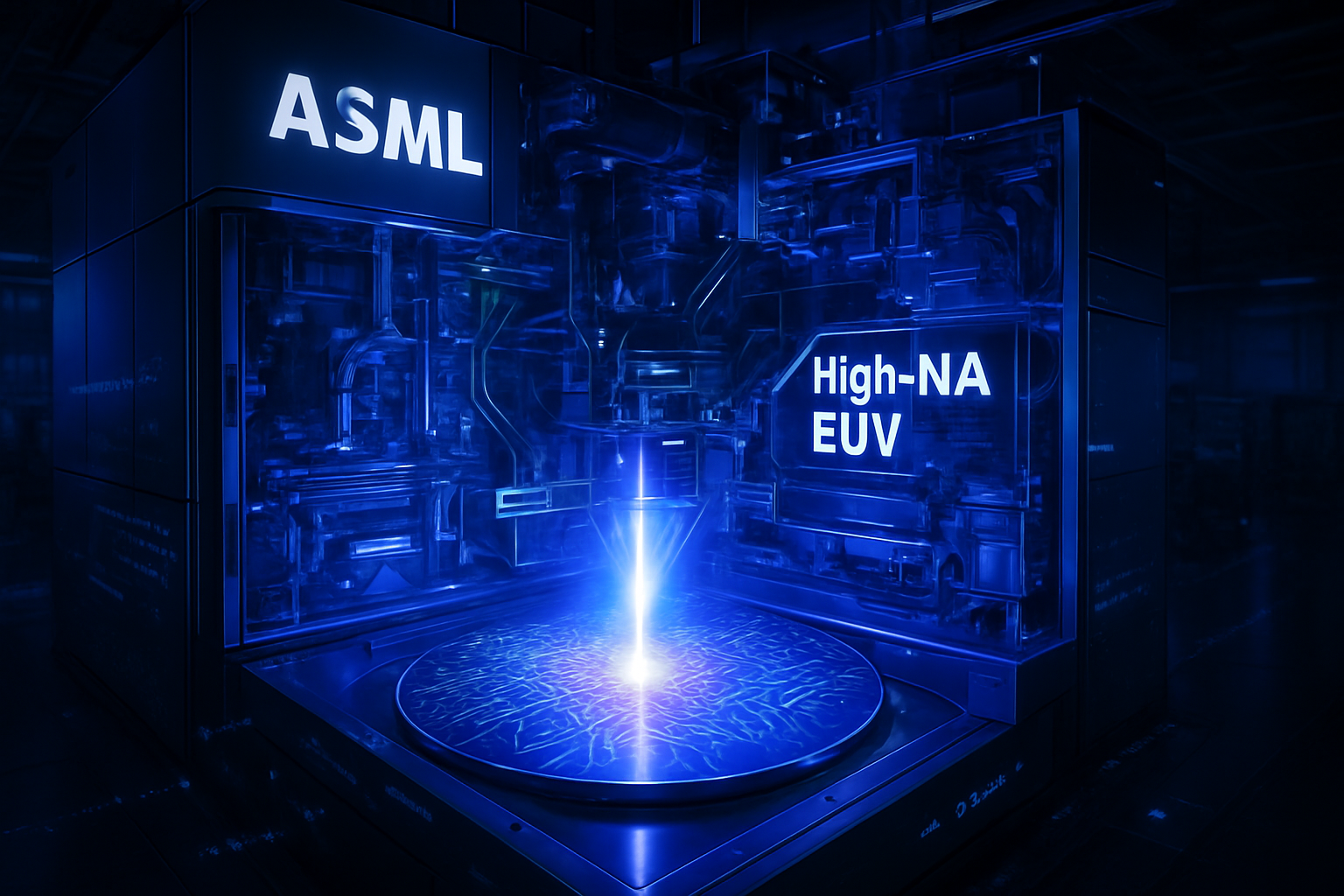
    As of January 2026, the global semiconductor landscape has reached a critical inflection point in the race toward the "Angstrom Era." While the industry watches the rapid evolution of artificial intelligence, Taiwan Semiconductor Manufacturing Company (TSM:NYSE) has officially entered its High-NA EUV (Extreme Ultraviolet) era, albeit with a strategy defined by characteristic caution and economic pragmatism. While competitors like Intel (INTC:NASDAQ) have aggressively integrated ASML (ASML:NASDAQ) latest high-numerical aperture machines into their production lines, TSMC is pursuing a "calculated delay," focusing on refining the technology in its R&D labs while milking the efficiency of its existing fleet for the upcoming A16 and A14 process nodes.

    This strategic divergence marks one of the most significant moments in foundry history. TSMC’s decision to prioritize cost-effectiveness and yield stability over being "first to market" with High-NA hardware is a high-stakes gamble. With AI giants demanding ever-smaller, more power-efficient transistors to fuel the next generation of Large Language Models (LLMs) and autonomous systems, the world’s leading foundry is betting that its mastery of current-generation lithography and advanced packaging will maintain its dominance until the 1.4nm and 1nm nodes become the new industry standard.

    Technical Foundations: The Power of 0.55 NA

    The core of this transition is the ASML Twinscan EXE:5200, a marvel of engineering that represents the most significant leap in lithography in over a decade. Unlike the previous generation of Low-NA (0.33 NA) EUV machines, the High-NA system utilizes a 0.55 numerical aperture to collect more light, enabling a resolution of approximately 8nm. This allows for the printing of features nearly 1.7 times smaller than what was previously possible. For TSMC, the shift to High-NA isn't just about smaller transistors; it’s about reducing the complexity of multi-patterning—a process where a single layer is printed multiple times to achieve fine resolution—which has become increasingly prone to errors at the 2nm scale.

    However, the move to High-NA introduces a significant technical hurdle: the "half-field" challenge. Because of the anamorphic optics required to achieve 0.55 NA, the exposure field of the EXE:5200 is exactly half the size of standard scanners. For massive AI chips like those produced by Nvidia (NVDA:NASDAQ), this requires "field stitching," a process where two halves of a die are printed separately and joined with sub-nanometer precision. TSMC is currently utilizing its R&D units to perfect this stitching and refine the photoresist chemistry, ensuring that when High-NA is finally deployed for high-volume manufacturing (HVM) in the late 2020s, the yield rates will meet the stringent demands of its top-tier customers.

    Competitive Implications and the AI Hardware Boom

    The impact of TSMC’s High-NA strategy ripples across the entire AI ecosystem. Nvidia, currently the world’s most valuable chip designer, stands as both a beneficiary and a strategic balancer in this transition. Nvidia’s upcoming "Rubin" and "Rubin Ultra" architectures, slated for late 2026 and 2027, are expected to leverage TSMC’s 2nm and 1.6nm (A16) nodes. Because these chips are physically massive, Nvidia is leaning heavily into chiplet-based designs and CoWoS-L (Chip on Wafer on Substrate) packaging to bypass the field-size limits of High-NA lithography. By sticking with TSMC’s mature Low-NA processes for now, Nvidia avoids the "bleeding edge" yield risks associated with Intel’s more aggressive High-NA roadmap.

    Meanwhile, Apple (AAPL:NASDAQ) continues to be the primary driver for TSMC’s mobile-first innovations. For the upcoming A19 and A20 chips, Apple is prioritizing transistor density and battery life over the raw resolution gains of High-NA. Industry experts suggest that Apple will likely be the lead customer for TSMC’s A14P node in 2028, which is projected to be the first point of entry for High-NA EUV in consumer electronics. This cautious approach provides a strategic opening for Intel, which has finalized its 14A node using High-NA. In a notable shift, Nvidia even finalized a multi-billion dollar investment in Intel Foundry Services in late 2025 as a hedge, ensuring they have access to High-NA capacity if TSMC’s timeline slips.

    The Broader Significance: Moore’s Law on Life Support

    The transition to High-NA EUV is more than just a hardware upgrade; it is the "life support" for Moore’s Law in an age where AI compute demand is doubling every few months. In the broader AI landscape, the ability to pack nearly three times more transistors into the same silicon area is the only path toward the 100-trillion parameter models envisioned for the end of the decade. However, the sheer cost of this progress is staggering. With each High-NA machine costing upwards of $380 million, the barrier to entry for semiconductor manufacturing has never been higher, further consolidating power among a handful of global players.

    There are also growing concerns regarding power density. As transistors shrink toward the 1nm (A10) mark, managing the thermal output of a 1000W+ AI "superchip" becomes as much a challenge as printing the chip itself. TSMC is addressing this through the implementation of Backside Power Delivery (Super PowerRail) in its A16 node, which moves power routing to the back of the wafer to reduce interference and heat. This synergy between lithography and power delivery is the new frontier of semiconductor physics, echoing the industry's shift from simple scaling to holistic system-level optimization.

    Looking Ahead: The Roadmap to 1nm

    The near-term future for TSMC is focused on the mass production of the A16 node in the second half of 2026. This node will serve as the bridge to the true Angstrom era, utilizing advanced Low-NA techniques to deliver performance gains without the astronomical costs of a full High-NA fleet. Looking further out, the industry expects the A14P node (circa 2028) and the A10 node (2030) to be the true "High-NA workhorses." These nodes will likely be the first to fully adopt 0.55 NA across all critical layers, enabling the next generation of sub-1nm architectures that will power the AI agents and robotics of the 2030s.

    The primary challenge remaining is the economic viability of these sub-1nm processes. Experts predict that as the cost per transistor begins to level off or even rise due to the expense of High-NA, the industry will see an even greater reliance on "More than Moore" strategies. This includes 3D-stacked dies and heterogeneous integration, where only the most critical parts of a chip are made on the expensive High-NA nodes, while less sensitive components are relegated to older, cheaper processes.

    A New Chapter in Silicon History

    TSMC’s entry into the High-NA era, characterized by its "calculated delay," represents a masterclass in industrial strategy. By allowing Intel to bear the initial "pioneer's tax" of debugging ASML’s most complex machines, TSMC is positioning itself to enter the market with higher yields and lower costs when the technology is truly ready for prime time. This development reinforces TSMC's role as the indispensable foundation of the AI revolution, providing the silicon bedrock upon which the future of intelligence is built.

    In the coming weeks and months, the industry will be watching for the first production results from TSMC’s A16 pilot lines and any further shifts in Nvidia’s foundry allocations. As we move deeper into 2026, the success of TSMC’s balanced approach will determine whether it remains the undisputed king of the foundry world or if the aggressive technological leaps of its competitors can finally close the gap. One thing is certain: the High-NA era has arrived, and the chips it produces will define the limits of human and artificial intelligence for decades to come.


    This content is intended for informational purposes only and represents analysis of current AI developments.

    TokenRing AI delivers enterprise-grade solutions for multi-agent AI workflow orchestration, AI-powered development tools, and seamless remote collaboration platforms.
    For more information, visit https://www.tokenring.ai/.

  • The Angstrom Era Begins: ASML’s High-NA EUV and the $380 Million Bet to Save Moore’s Law

    The Angstrom Era Begins: ASML’s High-NA EUV and the $380 Million Bet to Save Moore’s Law

    As of January 5, 2026, the semiconductor industry has officially entered the "Angstrom Era," a transition marked by the high-volume deployment of the most complex machine ever built: the High-Numerical Aperture (High-NA) Extreme Ultraviolet (EUV) lithography scanner. Developed by ASML (NASDAQ: ASML), the Twinscan EXE:5200B has become the defining tool for the sub-2nm generation of chips. This technological leap is not merely an incremental upgrade; it is the gatekeeper for the next decade of Moore’s Law, providing the precision necessary to print transistors at scales where atoms are the primary unit of measurement.

    The immediate significance of this development lies in the radical shift of the competitive landscape. Intel (NASDAQ: INTC), after a decade of trailing its rivals, has seized the "first-mover" advantage by becoming the first to integrate High-NA into its production lines. This aggressive stance is aimed directly at reclaiming the process leadership crown from TSMC (NYSE: TSM), which has opted for a more conservative, cost-optimized approach. As AI workloads demand exponentially more compute density and power efficiency, the success of High-NA EUV will dictate which silicon giants will power the next generation of generative AI models and hyperscale data centers.

    The Twinscan EXE:5200B: Engineering the Sub-2nm Frontier

    The technical specifications of the Twinscan EXE:5200B represent a paradigm shift in lithography. The "High-NA" designation refers to the increase in numerical aperture from 0.33 in standard EUV machines to 0.55. This change allows the machine to achieve a staggering 8nm resolution, enabling the printing of features approximately 1.7 times smaller than previous tools. In practical terms, this translates to a 2.9x increase in transistor density, allowing engineers to cram billions more gates onto a single piece of silicon without the need for the complex "multi-patterning" techniques that have plagued 3nm and 2nm yields.

    Beyond resolution, the EXE:5200B addresses the two most significant hurdles of early High-NA prototypes: throughput and alignment. The production-ready model now achieves a throughput of 175 to 200 wafers per hour (wph), matching the productivity of the latest low-NA scanners. Furthermore, it boasts an overlay accuracy of 0.7nm. This sub-nanometer precision is critical for a process known as "field stitching." Because High-NA optics halve the exposure field size, larger chips—such as the massive GPUs produced by NVIDIA (NASDAQ: NVDA)—must be printed in two separate halves. The 0.7nm overlay ensures these halves are aligned with such perfection that they function as a single, seamless monolithic die.

    This approach differs fundamentally from the industry's previous trajectory. For the past five years, foundries have relied on "multi-patterning," where a single layer is printed using multiple exposures to achieve finer detail. While effective, multi-patterning increases the risk of defects and significantly lengthens the manufacturing cycle. High-NA EUV returns the industry to "single-patterning" for the most critical layers, drastically simplifying the manufacturing flow and improving the "time-to-market" for cutting-edge designs. Initial reactions from the research community suggest that while the $380 million price tag per machine is daunting, the reduction in process steps and the jump in density make it an inevitable necessity for the sub-2nm era.

    A Tale of Two Strategies: Intel’s Leap vs. TSMC’s Caution

    The deployment of High-NA EUV has created a strategic schism between the world’s leading chipmakers. Intel has positioned itself as the "High-NA Vanguard," utilizing the EXE:5200B to underpin its 18A (1.8nm) and 14A (1.4nm) nodes. By early 2026, Intel's 18A process has reached high-volume manufacturing, with the first "Panther Lake" consumer chips hitting shelves. While 18A was designed to be compatible with standard EUV, Intel is selectively using High-NA tools to "de-risk" the technology before its 14A node becomes "High-NA native" later this year. This early adoption is a calculated risk to prove to foundry customers that Intel Foundry is once again the world's most advanced manufacturer.

    Conversely, TSMC has maintained a "wait-and-see" approach, focusing on optimizing its existing low-NA EUV infrastructure for its A14 (1.4nm) node. TSMC’s leadership has argued that the current cost-per-wafer for High-NA is too high for mass-market mobile chips, preferring to use multi-patterning on its ultra-mature NXE:3800E scanners. This creates a fascinating market dynamic: Intel is betting on technical superiority and process simplification to attract high-margin AI customers, while TSMC is betting on cost-efficiency and yield stability.

    The implications for the broader market are profound. If Intel successfully scales 14A using the EXE:5200B, it could potentially offer AI companies like AMD (NASDAQ: AMD) and even NVIDIA a performance-per-watt advantage that TSMC cannot match until its own High-NA transition, currently slated for 2027 or 2028. This disruption could shift the balance of power in the foundry business, which TSMC has dominated for over a decade. Startups specializing in "AI-first" silicon also stand to benefit, as the single-patterning capability of High-NA reduces the "design-to-chip" lead time, allowing for faster iteration of specialized neural processing units (NPUs).

    The Silicon Gatekeeper of the AI Revolution

    The significance of ASML’s High-NA dominance extends far beyond corporate rivalry; it is the physical foundation of the AI revolution. Modern Large Language Models (LLMs) are currently constrained by two factors: the amount of high-speed memory that can be placed near the compute units and the power efficiency of the data center. Sub-2nm chips produced with the EXE:5200B are expected to consume 25% to 35% less power for the same frequency compared to 3nm equivalents. In an era where electricity and cooling costs are the primary bottlenecks for AI scaling, these efficiency gains are worth billions to hyperscalers like Microsoft (NASDAQ: MSFT) and Google (NASDAQ: GOOGL).

    Furthermore, the transition to High-NA mirrors previous industry milestones, such as the initial shift from DUV to EUV in 2019. Just as that transition enabled the 5nm and 3nm chips that power today’s smartphones and AI accelerators, High-NA is the "second act" of EUV that will carry the industry toward the 1nm mark. However, the stakes are higher now. The geopolitical importance of semiconductor leadership has never been greater, and the "High-NA club" is currently an exclusive group. With ASML being the sole provider of these machines, the global supply chain for the most advanced AI hardware now runs through a single point of failure in Veldhoven, Netherlands.

    Potential concerns remain regarding the "halved field" issue. While field stitching has been proven in the lab, doing it at a scale of millions of units per month without impacting yield is a monumental challenge. If the stitching process leads to higher defect rates, the cost of the world’s most advanced AI GPUs could skyrocket, potentially slowing the democratization of AI compute. Nevertheless, the industry has historically overcome such lithographic hurdles, and the consensus is that High-NA is the only viable path forward.

    The Road to 14A and Beyond

    Looking ahead, the next 24 months will be critical for the validation of High-NA technology. Intel is expected to release its 14A Process Design Kit (PDK 1.0) to foundry customers in the coming months, which will be the first design environment built entirely around the capabilities of the EXE:5200B. This node will introduce "PowerDirect," a second-generation backside power delivery system that, when combined with High-NA lithography, promises a 20% performance boost over the already impressive 18A node.

    Experts predict that by 2028, the "High-NA gap" between Intel and TSMC will close as the latter finally integrates the tools into its "A14P" process. However, the "learning curve" advantage Intel is building today could prove difficult to overcome. We are also likely to see the emergence of "Hyper-NA" research—tools with numerical apertures even higher than 0.55—as the industry begins to look toward the sub-10-angstrom (sub-1nm) era in the 2030s. The immediate challenge for ASML and its partners will be to drive down the cost of these machines and improve the longevity of the specialized photoresists and masks required for such extreme resolutions.

    A New Chapter in Computing History

    The deployment of the ASML Twinscan EXE:5200B marks a definitive turning point in the history of computing. By enabling the mass production of sub-2nm chips, ASML has effectively extended the life of Moore’s Law at a time when many predicted its demise. Intel’s aggressive adoption of this technology represents a "moonshot" attempt to regain its former glory, while the industry’s shift toward "Angstrom-class" silicon provides the necessary hardware runway for the next decade of AI innovation.

    The key takeaways are clear: the EXE:5200B is the most productive and precise lithography tool ever created, Intel is currently the only player using it for high-volume manufacturing, and the future of AI hardware is now inextricably linked to the success of High-NA EUV. In the coming weeks and months, all eyes will be on Intel’s 18A yield reports and the first customer tape-outs for the 14A node. These metrics will serve as the first real-world evidence of whether the High-NA era will deliver on its promise of a new golden age for silicon.


    This content is intended for informational purposes only and represents analysis of current AI developments.

    TokenRing AI delivers enterprise-grade solutions for multi-agent AI workflow orchestration, AI-powered development tools, and seamless remote collaboration platforms.
    For more information, visit https://www.tokenring.ai/.

  • Intel’s Angstrom Era Arrives: 18A and 14A Multi-Chiplet Breakthroughs Signal a New Frontier in AI Compute

    Intel’s Angstrom Era Arrives: 18A and 14A Multi-Chiplet Breakthroughs Signal a New Frontier in AI Compute

    In a landmark demonstration of semiconductor engineering, Intel (NASDAQ: INTC) has officially showcased its next-generation multi-chiplet processors built on the 18A and 14A process nodes. This milestone, revealed at the start of 2026, marks the successful culmination of Intel’s "five nodes in four years" strategy and signals the company's aggressive return to the forefront of the silicon manufacturing race. By leveraging advanced 3D packaging and the industry’s first commercial implementation of High-Numerical Aperture (High-NA) EUV lithography, Intel is positioning itself as a formidable "Systems Foundry" capable of producing the massive, high-density chips required for the next decade of artificial intelligence and high-performance computing (HPC).

    The showcase featured the first live silicon of the "Clearwater Forest" Xeon processor, a multi-tile marvel that utilizes Intel 18A for its compute logic, and a conceptual "Mega-Package" built on the upcoming 14A node. These developments are not merely incremental updates; they represent a fundamental shift in how chips are designed and manufactured. By decoupling the various components of a processor into specialized "chiplets" and reassembling them with high-speed interconnects, Intel is challenging the dominance of Taiwan Semiconductor Manufacturing Company (NYSE: TSM) and aiming to reclaim the crown of process leadership it lost nearly a decade ago.

    Technical Breakthroughs: RibbonFET, PowerVia, and High-NA EUV

    The technical foundation of Intel’s resurgence lies in two revolutionary technologies: RibbonFET and PowerVia. RibbonFET, Intel’s implementation of a Gate-All-Around (GAA) transistor, is now in high-volume manufacturing on the 18A node. Unlike traditional FinFETs, RibbonFET surrounds the transistor channel on all four sides, allowing for precise control over current flow and significantly reducing power leakage—a critical requirement for AI data centers operating at the edge of thermal limits. Complementing this is PowerVia, a groundbreaking "backside power delivery" system that moves power routing to the reverse side of the silicon wafer. This separation of power and signal lines eliminates the "wiring congestion" that has plagued chip designers for years, enabling higher clock speeds and improved energy efficiency.

    Moving beyond 18A, the 14A node represents Intel's first full-scale utilization of High-NA EUV lithography, powered by the ASML (NASDAQ: ASML) Twinscan EXE:5200B. This advanced machinery provides a resolution of 8nm, nearly doubling the precision of standard EUV tools. For the 14A node, this allows Intel to print the most critical circuit patterns in a single pass, avoiding the complexity and yield-loss risks associated with multi-patterning. Furthermore, Intel has introduced "PowerDirect" on the 14A node, a second-generation backside power solution designed to handle the extreme current densities required by future AI accelerators.

    The multi-chiplet architecture showcased by Intel also highlights the company’s lead in advanced packaging. Using Foveros Direct 3D and EMIB (Embedded Multi-die Interconnect Bridge), Intel demonstrated the ability to stack and tile chips with unprecedented density. One of the most striking reveals was a 14A-based AI "Mega-Package" that integrates 16 compute tiles with 24 stacks of HBM5 memory. To manage the immense heat and physical stress of such a large package, Intel has transitioned to glass substrates, which offer 50% less pattern distortion and superior thermal stability compared to traditional organic materials.

    Initial reactions from the semiconductor research community have been cautiously optimistic, with many experts noting that Intel has achieved a significant "first-mover" advantage in backside power delivery. While TSMC and Samsung (KRX: 005930) are working on similar technologies, Intel’s 18A is the first to reach high-volume production with these features. Industry analysts suggest that if Intel can maintain its yield rates, the combination of RibbonFET, PowerVia, and High-NA EUV could provide a 12-to-18-month technological lead over its rivals in specific high-performance metrics.

    Market Impact: Securing the AI Supply Chain

    The implications for the broader tech industry are profound, as Intel Foundry begins to secure "anchor" customers who were previously reliant solely on TSMC. Microsoft (NASDAQ: MSFT) has already committed to using the 18A and 18A-P nodes for its next-generation Maia 2 AI accelerators, a move that allows the software giant to secure a domestic U.S. supply chain for its Azure AI infrastructure. Similarly, Amazon (NASDAQ: AMZN) through its AWS division, has signed a multi-billion dollar deal to produce custom Trainium3 chips on Intel’s 18A node. These partnerships validate Intel’s "Systems Foundry" model, where the company provides not just the silicon, but the packaging and interconnect standards necessary for complex AI systems.

    NVIDIA (NASDAQ: NVDA), the current king of AI hardware, has also entered the fold in a strategic shift that could disrupt the status quo. While NVIDIA continues to manufacture its primary GPUs with TSMC, it has signed a landmark $5 billion agreement to utilize Intel’s advanced packaging services. More intriguingly, the two companies are reportedly co-developing "Intel x86 RTX SOCs"—hybrid processors that fuse Intel’s high-performance x86 cores with NVIDIA’s RTX graphics chiplets. This collaboration suggests that even the fiercest competitors see the value in Intel’s unique packaging capabilities, potentially leading to a new class of "best-of-both-worlds" hardware for workstations and high-end gaming.

    For startups and smaller AI labs, Intel’s progress offers a much-needed alternative in a market that has been bottlenecked by TSMC’s capacity limits. By providing a credible second source for leading-edge manufacturing, Intel is likely to drive down costs and accelerate the pace of hardware iteration. However, the competitive pressure on TSMC remains high; the Taiwanese giant still holds the lead in raw transistor density and has a decades-long track record of manufacturing reliability. Intel’s challenge will be to prove that it can match TSMC’s legendary yield consistency at scale, especially as it navigates the transition to the 14A node.

    Geopolitics and the New "System-Level" Moore’s Law

    Beyond the corporate rivalry, Intel’s 18A and 14A progress carries significant geopolitical and economic weight. As the only Western company capable of manufacturing chips at the Angstrom level, Intel is the primary beneficiary of the U.S. CHIPS and Science Act. The successful ramp-up of Fab 52 in Arizona and the High-NA installation in Oregon are seen as critical milestones in the effort to rebalance the global semiconductor supply chain, which is currently heavily concentrated in East Asia. This "Silicon Shield" strategy is designed to ensure that the most advanced AI capabilities remain accessible to Western nations regardless of regional instability.

    The shift toward multi-chiplet "systems-on-package" also signals the end of the traditional Moore’s Law era, where performance gains were driven primarily by shrinking individual transistors. We are now entering the era of "System-Level Moore’s Law," where the focus has shifted to how efficiently different chips can talk to one another. Intel’s embrace of open standards like UCIe (Universal Chiplet Interconnect Express) ensures that its 18A and 14A nodes can serve as a "chassis" for a diverse ecosystem of chiplets from different vendors, fostering a more modular and innovative hardware landscape.

    However, this transition is not without its concerns. The extreme cost of High-NA EUV tools—upwards of $350 million per machine—and the complexity of glass substrate manufacturing create a high barrier to entry that could further centralize power among a few "mega-foundries." There are also environmental considerations; the massive energy requirements of these advanced fabs and the AI chips they produce continue to be a point of contention for sustainability advocates. Despite these challenges, the leap from the 5nm/3nm era to the 1.8nm/1.4nm era is being hailed as the most significant jump in computing power since the introduction of the microprocessor.

    The Road to 10A: What’s Next for Intel Foundry?

    Looking ahead, the roadmap for 2026 and beyond is focused on the refinement of the 14A node and the early research into the "10A" (1nm) generation. Intel has hinted that its 14A-P (Performance) variant, expected in late 2027, will introduce even more advanced 3D stacking techniques that could allow for memory to be bonded directly on top of logic with near-zero latency. This would be a game-changer for Large Language Models (LLMs) that are currently limited by the "memory wall"—the speed at which data can move between the processor and RAM.

    Experts predict that the next two years will see a surge in "specialized AI silicon" as companies move away from general-purpose GPUs toward custom chiplet-based designs tailored for specific neural network architectures. Intel’s ability to offer a "menu" of chiplets—some on 18A for efficiency, some on 14A for peak performance—will likely make it the preferred partner for this custom silicon wave. The main hurdle remains the software stack; while Intel’s hardware is catching up, it must continue to invest in its OneAPI and OpenVINO platforms to ensure that developers can easily port their AI workloads from NVIDIA’s proprietary CUDA environment.

    Conclusion: A New Chapter in Silicon History

    The showcase of Intel’s 18A and 14A nodes marks a definitive turning point in the history of the semiconductor industry. After years of delays and skepticism, the company has demonstrated that it possesses the technical roadmap and the manufacturing discipline to compete at the absolute cutting edge. The arrival of the "Angstrom Era" is not just a win for Intel; it is a catalyst for the entire AI industry, providing the raw compute power and architectural flexibility needed to move toward more autonomous and sophisticated artificial intelligence systems.

    As we move through 2026, the industry will be watching Intel’s yield rates and the commercial success of the Panther Lake and Clearwater Forest chips with a magnifying glass. If Intel can deliver on its promises of performance-per-watt leadership, it will have successfully rewritten its narrative from a legacy giant in decline to the primary architect of the AI hardware future. The race for silicon supremacy has never been more intense, and for the first time in a decade, the path to the top runs through Santa Clara.


    This content is intended for informational purposes only and represents analysis of current AI developments.

    TokenRing AI delivers enterprise-grade solutions for multi-agent AI workflow orchestration, AI-powered development tools, and seamless remote collaboration platforms.
    For more information, visit https://www.tokenring.ai/.