Tag: Inference Costs

  • NVIDIA Rubin Architecture Unleashed: The Dawn of the $0.01 Inference Era

    NVIDIA Rubin Architecture Unleashed: The Dawn of the $0.01 Inference Era

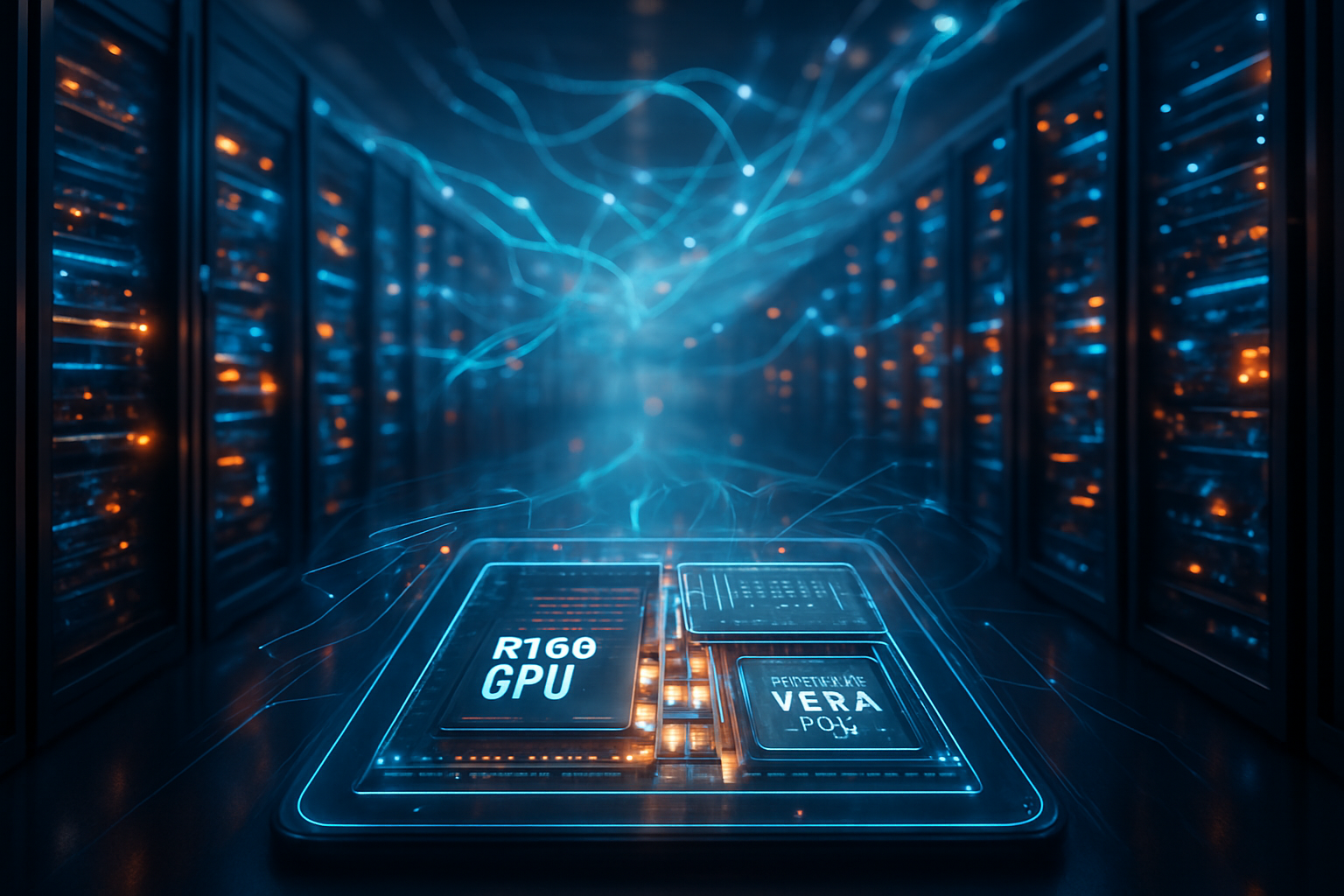
    LAS VEGAS — Just weeks after the conclusion of CES 2026, the global technology landscape is still reeling from NVIDIA’s (NASDAQ: NVDA) definitive unveil of the Rubin platform. Positioned as the successor to the already-formidable Blackwell architecture, Rubin is not merely an incremental hardware update; it is a fundamental reconfiguration of the AI factory. By integrating the new Vera CPU and R100 GPUs, NVIDIA has promised a staggering 10x reduction in inference costs, effectively signaling the end of the "expensive AI" era and the beginning of the age of autonomous, agentic systems.

    The significance of this launch cannot be overstated. As large language models (LLMs) transition from passive text generators to active "Agentic AI"—systems capable of multi-step reasoning, tool use, and autonomous decision-making—the demand for efficient, high-frequency compute has skyrocketed. NVIDIA’s Rubin platform addresses this by collapsing the traditional barriers between memory and processing, providing the infrastructure necessary for "swarms" of AI agents to operate at a fraction of today's operational expenditure.

    The Technical Leap: R100, Vera, and the End of the Memory Wall

    At the heart of the Rubin platform lies the R100 GPU, a marvel of engineering fabricated on TSMC's (NYSE: TSM) enhanced 3nm (N3P) process. The R100 utilizes a sophisticated chiplet-based design, packing 336 billion transistors into a single package—a 1.6x density increase over the Blackwell generation. Most critically, the R100 marks the industry’s first wide-scale adoption of HBM4 memory. With eight stacks of HBM4 delivering 22 TB/s of bandwidth, NVIDIA has effectively shattered the "memory wall" that has long throttled the performance of complex AI reasoning tasks.

    Complementing the R100 is the Vera CPU, NVIDIA's first dedicated high-performance processor designed specifically for the orchestration of AI workloads. Featuring 88 custom "Olympus" ARM cores (v9.2-A architecture), the Vera CPU replaces the previous Grace architecture. Vera is engineered to handle the massive data movement and logic orchestration required by agentic AI, providing 1.2 TB/s of LPDDR5X memory bandwidth. This "Superchip" pairing is then scaled into the Vera Rubin NVL72, a liquid-cooled rack-scale system that offers 260 TB/s of aggregate bandwidth—a figure NVIDIA CEO Jensen Huang famously claimed is "more than the throughput of the entire internet."

    The jump in efficiency is largely attributed to the third-generation Transformer Engine and the introduction of the NVFP4 format. These advancements allow for hardware-accelerated adaptive compression, enabling the Rubin platform to achieve a 10x reduction in the cost per inference token compared to Blackwell. Initial reactions from the research community have been electric, with experts noting that the ability to run multi-million token context windows with negligible latency will fundamentally change how AI models are designed and deployed.

    The Battle for the AI Factory: Hyperscalers and Competitors

    The launch has drawn immediate and vocal support from the world's largest cloud providers. Microsoft (NASDAQ: MSFT), Amazon (NASDAQ: AMZN), and Alphabet (NASDAQ: GOOGL) have already announced massive procurement orders for Rubin-class hardware. Microsoft’s Azure division confirmed that its upcoming "Fairwater" superfactories were pre-engineered to support the 132kW power density of the Rubin NVL72 racks. Google Cloud’s CEO Sundar Pichai emphasized that the Rubin platform is essential for the next generation of Gemini models, which are expected to function as fully autonomous research and coding agents.

    However, the Rubin launch has also intensified the competitive pressure on AMD (NASDAQ: AMD) and Intel (NASDAQ: INTC). At CES, AMD attempted to preempt NVIDIA’s announcement with its own Instinct MI455X and the "Helios" platform. While AMD’s offering boasts more HBM4 capacity (432GB per GPU), it lacks the tightly integrated CPU-GPU-Networking ecosystem that NVIDIA has cultivated with Vera and NVLink 6. Intel, meanwhile, is pivoting toward the "Sovereign AI" market, positioning its Gaudi 4 and Falcon Shores chips as price-to-performance alternatives for enterprises that do not require the bleeding-edge scale of the Rubin architecture.

    For the startup ecosystem, Rubin represents an "Inference Reckoning." The 90% drop in token costs means that the "LLM wrapper" business model is effectively dead. To survive, AI startups are now shifting their focus toward proprietary data flywheels and specialized agentic workflows. The barrier to entry for building complex, multi-agent systems has dropped, but the bar for providing actual, measurable ROI to enterprise clients has never been higher.

    Beyond the Chatbot: The Era of Agentic Significance

    The Rubin platform represents a philosophical shift in the AI landscape. Until now, the industry focus has been on training larger and more capable models. With Rubin, NVIDIA is signaling that the frontier has shifted to inference. The platform’s architecture is uniquely optimized for "Agentic AI"—systems that don't just answer questions, but execute tasks. Features like Inference Context Memory Storage (ICMS) offload the "KV cache" (the short-term memory of an AI agent) to dedicated storage tiers, allowing agents to maintain context over thousands of interactions without slowing down.

    This shift does not come without concerns, however. The power requirements for the Rubin platform are unprecedented. A single Rubin NVL72 rack consumes approximately 132kW, with "Ultra" configurations projected to hit 600kW per rack. This has sparked a "power-grid arms race," leading hyperscalers like Microsoft and Amazon to invest heavily in carbon-free energy solutions, including the restart of nuclear reactors. The environmental impact of these "AI mega-factories" remains a central point of debate among policymakers and environmental advocates.

    Comparatively, the Rubin launch is being viewed as the "GPT-4 moment" for hardware. Just as GPT-4 proved the viability of massive LLMs, Rubin is proving the viability of massive, low-cost inference. This breakthrough is expected to accelerate the deployment of AI in high-stakes fields like medicine, where autonomous agents can now perform real-time diagnostic reasoning, and legal services, where AI can navigate massive case-law databases with perfect memory and reasoning capabilities.

    The Horizon: What Comes After Rubin?

    Looking ahead, NVIDIA has already hinted at its post-Rubin roadmap, which includes an annual cadence of "Ultra" and "Super" refreshes. In the near term, we expect to see the rollout of the Rubin-Ultra in early 2027, which will likely push HBM4 capacity even further. The long-term development of "Sovereign AI" clouds—where nations build their own Rubin-powered data centers—is also gaining momentum, with significant interest from the EU and Middle Eastern sovereign wealth funds.

    The next major challenge for the industry will be the "data center bottleneck." While NVIDIA can produce chips at an aggressive pace, the physical infrastructure—the cooling systems, the power transformers, and the land—cannot be scaled as quickly. Experts predict that the next two years will be defined by how well companies can navigate these physical constraints. We are also likely to see a surge in demand for liquid-cooling technology, as the 2300W TDP of individual Rubin GPUs makes traditional air cooling obsolete.

    Conclusion: A New Chapter in AI History

    The launch of the NVIDIA Rubin platform at CES 2026 marks a watershed moment in the history of computing. By delivering a 10x reduction in inference costs and a dedicated architecture for agentic AI, NVIDIA has moved the industry closer to the goal of true autonomous intelligence. The platform’s combination of the R100 GPU, Vera CPU, and HBM4 memory sets a new benchmark that will take years for competitors to match.

    As we move into the second half of 2026, the focus will shift from the specs of the chips to the applications they enable. The success of the Rubin era will be measured not by teraflops or transistors, but by the reliability and utility of the AI agents that now have the compute they need to think, learn, and act. For now, one thing is certain: the cost of intelligence has just plummeted, and the world is about to change because of it.


    This content is intended for informational purposes only and represents analysis of current AI developments.

    TokenRing AI delivers enterprise-grade solutions for multi-agent AI workflow orchestration, AI-powered development tools, and seamless remote collaboration platforms.
    For more information, visit https://www.tokenring.ai/.

  • The 2026 Unit Economics Reckoning: Proving AI’s Profitability

    The 2026 Unit Economics Reckoning: Proving AI’s Profitability

    As of January 5, 2026, the artificial intelligence industry has officially transitioned from the "build-at-all-costs" era of speculative hype into a disciplined "Efficiency Era." This shift, often referred to by industry analysts as the "Premium Reckoning," marks the moment when the blank checks of 2023 and 2024 were finally called in. Investors, boards, and Chief Financial Officers are no longer satisfied with "vanity pilots" or impressive demos; they are demanding a clear, measurable return on investment (ROI) and sustainable unit economics that prove AI can be a profit center rather than a bottomless pit of capital expenditure.

    The immediate significance of this reckoning is a fundamental revaluation of the AI stack. While the previous two years were defined by the race to train the largest models, 2025 and the beginning of 2026 have seen a pivot toward inference—the actual running of these models in production. With inference now accounting for an estimated 80% to 90% of total AI compute consumption, the industry is hyper-focused on the "Great Token Deflation," where the cost of delivering intelligence has plummeted, forcing companies to prove they can turn these cheaper tokens into high-margin revenue.

    The Great Token Deflation and the Rise of Efficient Inference

    The technical landscape of 2026 is defined by a staggering collapse in the cost of intelligence. In early 2024, achieving GPT-4 level performance cost approximately $60 per million tokens; by the start of 2026, that cost has plummeted by over 98%, with high-efficiency models now delivering comparable reasoning for as little as $0.30 to $0.75 per million tokens. This deflation has been driven by a "triple threat" of technical advancements: specialized inference silicon, advanced quantization, and the strategic deployment of Small Language Models (SLMs).

    NVIDIA (NASDAQ:NVDA) has maintained its dominance by shifting its architecture to meet this demand. The Blackwell B200 and GB200 systems introduced native FP4 (4-bit floating point) precision, which effectively tripled throughput and delivered a 15x ROI for inference-heavy workloads compared to previous generations. Simultaneously, the industry has embraced "hybrid architectures." Rather than routing every query to a massive frontier model, enterprises now use "router" agents that send 80% of routine tasks to SLMs—models with 1 billion to 8 billion parameters like Microsoft’s Phi-3 or Google’s Gemma 2—which operate at 1/10th the cost of their larger siblings.

    This technical shift differs from previous approaches by prioritizing "compute-per-dollar" over "parameters-at-any-cost." The AI research community has largely pivoted from "Scaling Laws" for training to "Inference-Time Scaling," where models use more compute during the thinking phase rather than just the training phase. Industry experts note that this has democratized high-tier performance, as techniques like NVFP4 and QLoRA (Quantized Low-Rank Adaptation) allow 70-billion-parameter models to run on single-GPU instances, drastically lowering the barrier to entry for self-hosted enterprise AI.

    The Margin War: Winners and Losers in the New Economy

    The reckoning has created a clear divide between "monetizers" and "storytellers." Microsoft (NASDAQ:MSFT) has emerged as a primary beneficiary, successfully transitioning into an AI-first platform. By early 2026, Azure's growth has consistently hovered around 40%, driven by its early integration of OpenAI services and its ability to upsell "Copilot" seats to its massive enterprise base. Similarly, Alphabet (NASDAQ:GOOGL) saw a surge in operating income in late 2025, as Google Cloud's decade-long investment in custom Tensor Processing Units (TPUs) provided a significant price-performance edge in the ongoing API price wars.

    However, the pressure on pure-play AI labs has intensified. OpenAI, despite reaching an estimated $14 billion in revenue for 2025, continues to face massive operational overhead. The company’s recent $40 billion investment from SoftBank (OTC:SFTBY) in late 2025 was seen as a bridge to a potential $100 billion-plus IPO, but it came with strict mandates for profitability. Meanwhile, Amazon (NASDAQ:AMZN) has seen AWS margins climb toward 40% as its custom Trainium and Inferentia chips finally gained mainstream adoption, offering a 30% to 50% cost advantage over rented general-purpose GPUs.

    For startups, the "burn multiple"—the ratio of net burn to new Annual Recurring Revenue (ARR)—has replaced "user growth" as the most important metric. The trend of "tiny teams," where startups of fewer than 20 people generate millions in revenue using agentic workflows, has disrupted the traditional VC model. Many mid-tier AI companies that failed to find a "unit-economic fit" by late 2025 are currently being consolidated or wound down, leading to a healthier, albeit leaner, ecosystem.

    From Hype to Utility: The Wider Economic Significance

    The 2026 reckoning mirrors the post-Dot-com era, where the initial infrastructure build-out was followed by a period of intense focus on business models. The "AI honeymoon" ended when CFOs began writing off the 42% of AI initiatives that failed to show ROI by late 2025. This has led to a more pragmatic AI landscape where the technology is viewed as a utility—like electricity or cloud computing—rather than a magical solution.

    One of the most significant impacts has been on the labor market and productivity. Instead of the mass unemployment predicted by some in 2023, 2026 has seen the rise of "Agentic Orchestration." Companies are now using AI to automate the "middle-office" tasks that were previously too expensive to digitize. This shift has raised concerns about the "hollowing out" of entry-level white-collar roles, but it has also allowed firms to scale revenue without scaling headcount, a key component of the improved unit economics being seen across the S&P 500.

    Comparisons to previous milestones, such as the 2012 AlexNet moment or the 2022 ChatGPT launch, suggest that 2026 is the year of "Economic Maturity." While the technology is no longer "new," its integration into the bedrock of global finance and operations is now irreversible. The potential concern remains the "compute moat"—the idea that only the wealthiest companies can afford the massive capex required for frontier models—though the rise of efficient training methods and SLMs is providing a necessary counterweight to this centralization.

    The Road Ahead: Agentic Workflows and Edge AI

    Looking toward the remainder of 2026 and into 2027, the focus is shifting toward "Vertical AI" and "Edge AI." As the cost of tokens continues to drop, the next frontier is running sophisticated models locally on devices to eliminate latency and further reduce cloud costs. Apple (NASDAQ:AAPL) and various PC manufacturers are expected to launch a new generation of "Neural-First" hardware in late 2026 that will handle complex reasoning locally, fundamentally changing the unit economics for consumer AI apps.

    Experts predict that the next major breakthrough will be the "Self-Paying Agent." These are AI systems capable of performing complex, multi-step tasks—such as procurement, customer support, or software development—where the cost of the AI's "labor" is a fraction of the value it creates. The challenge remains in the "reliability gap"; as AI becomes cheaper, the cost of an AI error becomes the primary bottleneck to adoption. Addressing this through automated "evals" and verification layers will be the primary focus of R&D in the coming months.

    Summary of the Efficiency Era

    The 2026 Unit Economics Reckoning has successfully separated AI's transformative potential from its initial speculative excesses. The key takeaways from this period are the 98% reduction in token costs, the dominance of inference over training, and the rise of the "Efficiency Era" where profit margins are the ultimate validator of technology. This development is perhaps the most significant in AI history because it proves that the "Intelligence Age" is not just technically possible, but economically sustainable.

    In the coming weeks and months, the industry will be watching for the anticipated OpenAI IPO filing and the next round of quarterly earnings from the "Hyperscalers" (Microsoft, Google, and Amazon). These reports will provide the final confirmation of whether the shift toward agentic workflows and specialized silicon has permanently fixed the AI industry's margin problem. For now, the message to the market is clear: the time for experimentation is over, and the era of profitable AI has begun.


    This content is intended for informational purposes only and represents analysis of current AI developments.

    TokenRing AI delivers enterprise-grade solutions for multi-agent AI workflow orchestration, AI-powered development tools, and seamless remote collaboration platforms.
    For more information, visit https://www.tokenring.ai/.