Tag: Intel 18A

  • Intel Reclaims the Silicon Throne: 18A Process Enters High-Volume Manufacturing

    Intel Reclaims the Silicon Throne: 18A Process Enters High-Volume Manufacturing

    In a definitive moment for the global semiconductor industry, Intel Corporation (NASDAQ: INTC) officially announced on December 19, 2025, that its cutting-edge 18A (1.8nm-class) process node has entered High-Volume Manufacturing (HVM). This milestone, achieved at the company’s flagship Fab 52 facility in Chandler, Arizona, represents the successful culmination of the "Five Nodes in Four Years" (5N4Y) roadmap—a daring strategy once viewed with skepticism by industry analysts. The transition to HVM signals that Intel has finally stabilized yields and is ready to challenge the dominance of Asian foundry giants.

    The launch is headlined by the first retail shipments of "Panther Lake" processors, branded as the Core Ultra 300 series. These chips, which power a new generation of AI-native laptops from partners like Dell and HP, serve as the primary vehicle for Intel’s most advanced transistor technologies to date. By hitting this production target before the close of 2025, Intel has not only met its internal deadlines but has also leapfrogged competitors in key architectural innovations, most notably in power delivery and transistor structure.

    The Architecture of Dominance: RibbonFET and PowerVia

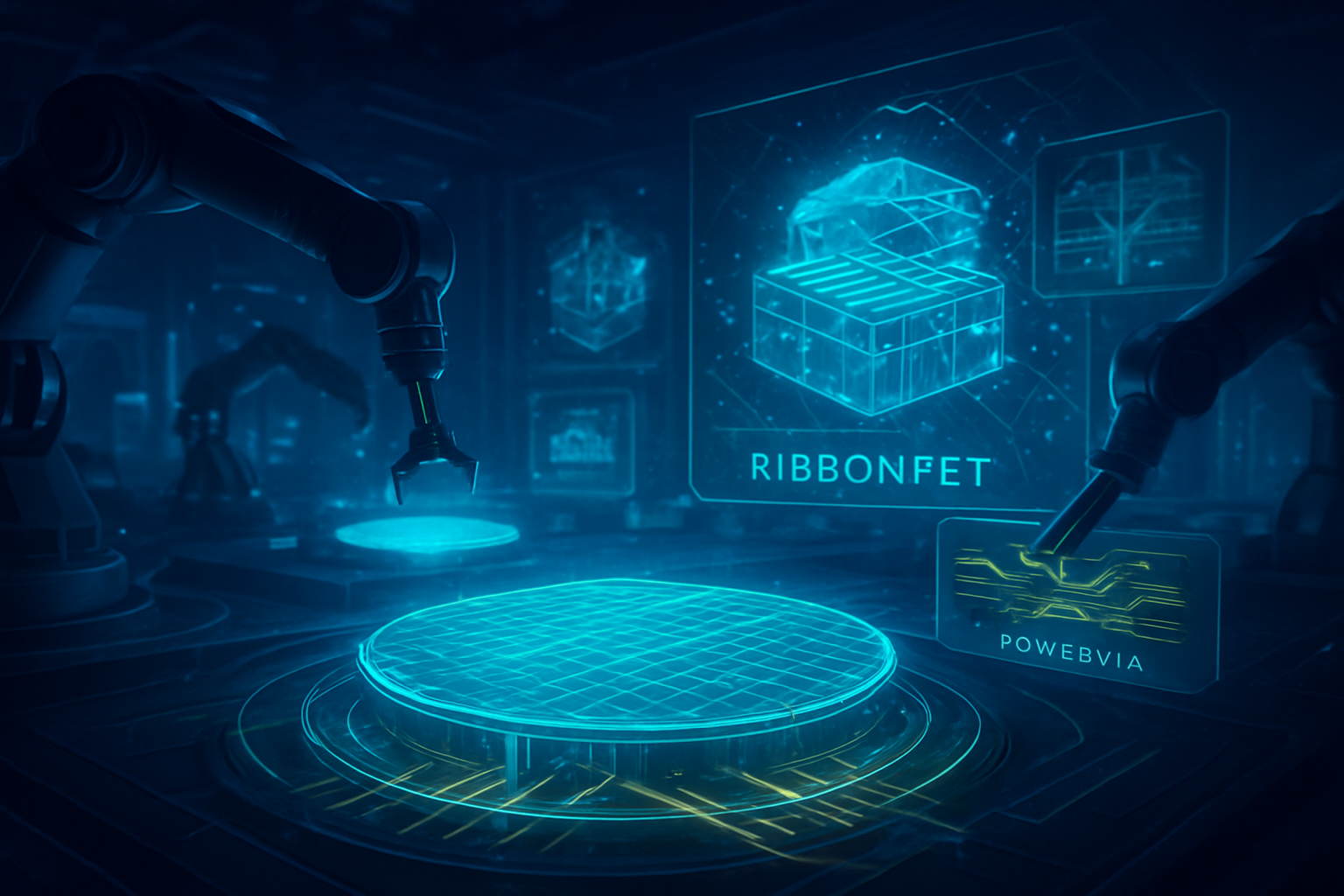
    The technical backbone of the 18A node rests on two revolutionary technologies: RibbonFET and PowerVia. RibbonFET is Intel’s implementation of Gate-All-Around (GAA) transistor architecture, which replaces the long-standing FinFET design. By surrounding the conducting channel on all four sides with the gate, RibbonFET provides superior electrostatic control, drastically reducing power leakage while increasing switching speeds. This allows for higher performance at lower voltages, a critical requirement for the thermally constrained environments of modern laptops and high-density data centers.

    However, the true "secret sauce" of 18A is PowerVia, Intel’s proprietary backside power delivery system. Traditionally, power and signal lines are bundled together on the front of a silicon wafer, leading to "routing congestion" and voltage drops. PowerVia moves the power delivery network to the back of the wafer, separating it entirely from the signal lines. Technical data released during the HVM launch indicates that PowerVia reduces IR (voltage) droop by approximately 10% and enables a 6% to 10% frequency gain. Furthermore, by freeing up space on the front side, Intel has achieved a 30% increase in transistor density over its previous Intel 3 node, reaching an estimated 238 million transistors per square millimeter (MTr/mm²).

    Initial reactions from the semiconductor research community have been overwhelmingly positive. Analysts note that while Taiwan Semiconductor Manufacturing Company (NYSE: TSM) still maintains a slight lead in raw transistor density with its N2 node, TSMC’s implementation of backside power is not expected until the N2P or A16 nodes in late 2026. This gives Intel a temporary but significant technical advantage in power efficiency—a metric that has become the primary battleground in the AI era.

    Reshaping the Foundry Landscape

    The move to HVM for 18A is more than a technical victory; it is a strategic earthquake for the foundry market. Under the leadership of CEO Lip-Bu Tan, who took the helm in early 2025, Intel Foundry has been spun off into an independent subsidiary, a move that has successfully courted major tech giants. Microsoft (NASDAQ: MSFT) and Amazon (NASDAQ: AMZN) have already emerged as anchor customers, with Microsoft reportedly utilizing 18A for its "Maia 2" AI accelerators. Perhaps most surprisingly, NVIDIA (NASDAQ: NVDA) finalized a $5 billion strategic investment in Intel late this year, signaling a collaborative shift where the two companies are co-developing custom x86 CPUs for data center applications.

    For years, the industry was a duopoly between TSMC and Samsung Electronics (KRX: 005930). However, Intel’s 18A yields—now stabilized between 60% and 65%—have allowed it to overtake Samsung, whose 2nm-class SF2 process has reportedly struggled with yield bottlenecks near the 40% mark. This positioning makes Intel the clear secondary alternative to TSMC for high-performance silicon. Even Apple (NASDAQ: AAPL), which has historically been exclusive to TSMC for its flagship chips, is reportedly evaluating Intel 18A for its lower-tier Mac and iPad silicon starting in 2027 to diversify its supply chain and mitigate geopolitical risks.

    AI Integration and the Broader Silicon Landscape

    The broader significance of the 18A launch lies in its optimization for Artificial Intelligence. The lead product, Panther Lake, features a next-generation Neural Processing Unit (NPU) capable of over 100 TOPS (Trillions of Operations Per Second). This is specifically architected to handle local generative AI workloads, such as real-time language translation and on-device image generation, without relying on cloud resources. The inclusion of the Xe3 "Celestial" graphics architecture further bolsters this, delivering a 50% improvement in integrated GPU performance over previous generations.

    In the context of the global AI race, 18A provides the hardware foundation necessary for the next leap in "Agentic AI"—autonomous systems that require massive local compute power. This milestone echoes the historical significance of the move to 45nm and High-K Metal Gate technology in 2007, which cemented Intel's dominance for a decade. By successfully navigating the transition to GAA and backside power simultaneously, Intel has proven that the "IDM 2.0" strategy was not just a survival plan, but a roadmap to regaining industry leadership.

    The Road to 14A and Beyond

    Looking ahead, the HVM status of 18A is just the beginning. Intel has already begun installing "High-NA" (High Numerical Aperture) EUV lithography machines from ASML Holding (NASDAQ: ASML) for its upcoming 14A node. Near-term developments include the broad global launch of Panther Lake at CES 2026 and the ramp-up of "Clearwater Forest," a high-core-count server chip designed for the world’s largest data centers.

    Experts predict that the next challenge will be scaling these innovations to the "Angstrom Era" (10A and beyond). While the 18A node has solved the immediate yield crisis, maintaining this momentum will require constant refinement of the High-NA EUV process and further advancements in 3D chip stacking (Foveros Direct). The industry will be watching closely to see if Intel can maintain its yield improvements as it moves toward 14A in 2027.

    Conclusion: A New Chapter for Intel

    The official launch of Intel 18A into high-volume manufacturing marks the most significant turnaround in the company's 57-year history. By successfully delivering RibbonFET and PowerVia, Intel has reclaimed its position at the leading edge of semiconductor manufacturing. The key takeaways are clear: Intel is no longer just a chipmaker, but a world-class foundry capable of serving the most demanding AI and hyperscale customers.

    In the coming months, the focus will shift from manufacturing capability to market adoption. As Panther Lake laptops hit the shelves and Microsoft’s 18A-based AI chips enter the data center, the real-world performance of this silicon will be the ultimate test. For now, the "Silicon Throne" is once again a contested seat, and the competition between Intel and TSMC promises to drive an unprecedented era of innovation in AI hardware.


    This content is intended for informational purposes only and represents analysis of current AI developments.

    TokenRing AI delivers enterprise-grade solutions for multi-agent AI workflow orchestration, AI-powered development tools, and seamless remote collaboration platforms.
    For more information, visit https://www.tokenring.ai/.
  • Intel’s 18A Comeback: Can the US Giant Retake the Manufacturing Crown?

    Intel’s 18A Comeback: Can the US Giant Retake the Manufacturing Crown?

    As the sun sets on 2025, the global semiconductor landscape has reached a definitive turning point. Intel (NASDAQ: INTC) has officially transitioned its flagship 18A process node into high-volume manufacturing (HVM), signaling the successful completion of its audacious "five nodes in four years" (5N4Y) strategy. This milestone is more than just a technical achievement; it represents a high-stakes geopolitical victory for the United States, as the company seeks to reclaim the manufacturing crown it lost to TSMC (NYSE: TSM) nearly a decade ago.

    The 18A node is the linchpin of Intel’s "IDM 2.0" vision, a roadmap designed to transform the company into a world-class foundry while maintaining its lead in PC and server silicon. With the support of the U.S. government’s $3 billion "Secure Enclave" initiative and a massive $8.9 billion federal equity stake, Intel is positioning itself as the "National Champion" of domestic chip production. As of late December 2025, the first 18A-powered products—the "Panther Lake" client CPUs and "Clearwater Forest" Xeon server chips—are already reaching customers, marking the first time in years that Intel has been in a dead heat with its Asian rivals for process leadership.

    The Technical Leap: RibbonFET and PowerVia

    The Intel 18A process is not a mere incremental update; it introduces two foundational shifts in transistor architecture that have eluded the industry for years. The first is RibbonFET, Intel’s implementation of Gate-All-Around (GAA) technology. Unlike the traditional FinFET transistors used for the past decade, RibbonFET surrounds the channel with the gate on all four sides, allowing for better control over electrical current and significant reductions in power leakage. While TSMC and Samsung (KRX: 005930) are also moving to GAA, Intel’s implementation on 18A is optimized for high-performance computing and AI workloads.

    The second, and perhaps more critical, innovation is PowerVia. This is the industry’s first commercial implementation of backside power delivery, a technique that moves the power wiring from the top of the silicon wafer to the bottom. By separating the power and signal wires, Intel has solved a major bottleneck in chip design, reducing voltage drop and clearing "congestion" on the chip’s surface. Initial industry analysis suggests that PowerVia provides a 6% to 10% frequency gain and a significant boost in power efficiency, giving Intel a temporary technical lead over TSMC’s N2 node, which is not expected to integrate similar backside power technology until its "A16" node in 2026.

    Industry experts have reacted with cautious optimism. While TSMC still maintains a slight lead in raw transistor density—boasting approximately 313 million transistors per square millimeter compared to Intel 18A’s 238 million—Intel’s yield rates for 18A have stabilized at an impressive 60% by late 2025. This is a stark contrast to the early 2020s, when Intel’s 10nm and 7nm delays nearly crippled the company. The research community views 18A as the moment Intel finally "fixed" its execution engine, delivering a node that is competitive in both performance and manufacturability.

    A New Foundry Powerhouse: Microsoft, AWS, and the Secure Enclave

    The successful ramp of 18A has fundamentally altered the competitive dynamics of the AI industry. Intel Foundry, now operating as a largely independent subsidiary, has secured a roster of "anchor" customers that were once unthinkable. Microsoft (NASDAQ: MSFT) has officially committed to using 18A for its Maia 2 AI accelerators, while Amazon (NASDAQ: AMZN) is utilizing the node for its custom AI Fabric chips. These tech giants are eager to diversify their supply chains away from a total reliance on Taiwan, seeking the "geographical resilience" that Intel’s U.S.-based fabs in Oregon and Arizona provide.

    The strategic significance is further underscored by the Secure Enclave program. This $3 billion Department of Defense initiative ensures that the U.S. military has a dedicated, secure supply of leading-edge AI and defense chips. By 2025, Intel has become the only company capable of manufacturing sub-2nm chips on American soil, a fact that has led the U.S. government to take a nearly 10% equity stake in the company. This "silicon nationalism" provides Intel with a financial and regulatory moat that its competitors in Taiwan and South Korea cannot easily replicate.

    Even rivals are taking notice. NVIDIA (NASDAQ: NVDA) finalized a $5 billion strategic investment in Intel in late 2025, co-developing custom x86 CPUs for data centers. While NVIDIA still relies on TSMC for its flagship Blackwell and Rubin GPUs, the partnership suggests a future where Intel could eventually manufacture portions of NVIDIA’s massive AI portfolio. For startups and smaller AI labs, the emergence of a viable second source for leading-edge manufacturing is expected to ease the supply constraints that have plagued the industry since the start of the AI boom.

    Geopolitics and the End of the Monopoly

    Intel’s 18A success fits into a broader global trend of decoupling and "friend-shoring." For years, the world’s most advanced AI models were dependent on a single point of failure: the 100-mile-wide Taiwan Strait. By bringing 18A to high-volume manufacturing in the U.S., Intel has effectively ended TSMC’s monopoly on the most advanced process nodes. This achievement is being compared to the 1970s "Sputnik moment," representing a massive mobilization of state and private capital to secure technological sovereignty.

    However, this comeback has not been without its costs. To reach this point, Intel underwent a brutal restructuring in early 2025 under new CEO Lip-Bu Tan, who replaced Pat Gelsinger. Tan’s "back-to-basics" approach saw the company cut 20% of its workforce and narrow its focus strictly to 18A and its successor, 14A. While the technical milestone has been reached, the financial toll remains heavy; Intel’s foundry business is not expected to reach profitability until 2027, despite the 80% surge in its stock price over the course of 2025.

    The potential concerns now shift from "Can they build it?" to "Can they scale it profitably?" TSMC remains a formidable opponent with a much larger ecosystem of design tools and a proven track record of high-yield volume production. Critics argue that Intel’s reliance on government subsidies could lead to inefficiencies, but for now, the momentum is clearly in Intel's favor as it proves that American manufacturing can still compete at the "bleeding edge."

    The Road to 1.4nm: What Lies Ahead

    Looking toward 2026 and beyond, Intel is already preparing its next move: the Intel 14A node. This 1.4nm-class process is expected to enter risk production by late 2026, utilizing "High-NA" EUV lithography machines that Intel has already installed in its Oregon facilities. The 14A node aims to extend Intel’s lead in power efficiency and will be the first to feature even more advanced iterations of RibbonFET technology.

    Near-term developments will focus on the mobile market. While Intel 18A has dominated the data center and PC markets in 2025, it has yet to win over Apple (NASDAQ: AAPL) or Qualcomm for their flagship smartphone chips. Reports suggest that Apple is in advanced negotiations to move some lower-end M-series production to Intel by 2027, but the "crown jewel" of the iPhone processor remains with TSMC for now. Intel must prove that 18A can meet the stringent thermal and battery-life requirements of the mobile world to truly claim total manufacturing dominance.

    Experts predict that the next two years will be a "war of attrition" between Intel and TSMC. The focus will shift from transistor architecture to "advanced packaging"—the art of stacking multiple chips together to act as one. Intel’s Foveros and EMIB packaging technologies are currently world-leading, and the company plans to integrate these with 18A to create massive "system-on-package" solutions for the next generation of generative AI models.

    A Historic Pivot in Silicon History

    The story of Intel 18A is a rare example of a legacy giant successfully reinventing itself under extreme pressure. By delivering on the "five nodes in four years" promise, Intel has closed a gap that many analysts thought was permanent. The significance of this development in AI history cannot be overstated: it ensures that the hardware foundation for future artificial intelligence will be geographically distributed and technologically diverse.

    The key takeaways for the end of 2025 are clear: Intel is back in the game, the U.S. has a domestic leading-edge foundry, and the "2nm era" has officially begun. While the financial road to recovery is still long, the technical hurdles that once seemed insurmountable have been cleared.

    In the coming months, the industry will be watching the retail performance of Panther Lake laptops and the first benchmarks of Microsoft’s 18A-based AI chips. If these products meet their performance targets, the manufacturing crown may well find its way back to Santa Clara by the time the next decade begins.


    This content is intended for informational purposes only and represents analysis of current AI developments.

    TokenRing AI delivers enterprise-grade solutions for multi-agent AI workflow orchestration, AI-powered development tools, and seamless remote collaboration platforms.
    For more information, visit https://www.tokenring.ai/.
  • Intel’s 18A Era Begins: Can the “Silicon Underdog” Break the TSMC-Samsung Duopoly?

    Intel’s 18A Era Begins: Can the “Silicon Underdog” Break the TSMC-Samsung Duopoly?

    As of late 2025, the semiconductor industry has reached a pivotal turning point with the official commencement of high-volume manufacturing (HVM) for Intel’s 18A process node. This milestone represents the successful completion of the company’s ambitious "five nodes in four years" roadmap, a journey that has redefined the company’s internal culture and corporate structure. With the 18A node now churning out silicon for major partners, Intel Corp (NASDAQ: INTC) is attempting to reclaim the manufacturing leadership it lost nearly a decade ago, positioning itself as the primary Western alternative to the long-standing advanced logic duopoly of TSMC (NYSE: TSM) and Samsung Electronics (KRX: 005930).

    The arrival of 18A is more than just a technical achievement; it is the centerpiece of a high-stakes corporate transformation. Following the retirement of Pat Gelsinger in late 2024 and the appointment of semiconductor veteran Lip-Bu Tan as CEO in early 2025, Intel has pivoted toward a "service-first" foundry model. By restructuring Intel Foundry into an independent subsidiary with its own operating board and financial reporting, the company is making an aggressive play to win the trust of fabless giants who have historically viewed Intel as a competitor rather than a partner.

    The Technical Edge: RibbonFET and the PowerVia Revolution

    The Intel 18A node introduces two foundational architectural shifts that represent the most significant change to transistor design since the introduction of FinFET in 2011. The first is RibbonFET, Intel’s implementation of Gate-All-Around (GAA) technology. By replacing the vertical "fins" of previous generations with stacked horizontal nanoribbons, the gate now surrounds the channel on all four sides. This provides superior electrostatic control, allowing for higher performance at lower voltages and significantly reducing power leakage—a critical requirement for the massive power demands of modern AI data centers.

    However, the true "secret sauce" of 18A is PowerVia, an industry-first Backside Power Delivery Network (BSPDN). While traditional chips route power and data signals through a complex web of wiring on the front of the wafer, PowerVia moves the power delivery to the back. This separation eliminates the "voltage droop" and signal interference that plague traditional designs. Initial data from late 2025 suggests that PowerVia provides a 10% reduction in IR (voltage) droop and up to a 15% improvement in performance-per-watt. Crucially, Intel has managed to implement this technology nearly two years ahead of TSMC’s scheduled rollout of backside power in its A16 node, giving Intel a temporary but significant architectural window of superiority.

    The reaction from the semiconductor research community has been one of "cautious validation." While experts acknowledge Intel’s technical lead in power delivery, the focus has shifted entirely to yields. Reports from mid-2025 indicated that Intel struggled with early defect rates, but by December, the company reported "predictable monthly improvements" toward the 70% yield threshold required for high-margin profitability. Industry analysts note that while TSMC’s N2 node remains denser in terms of raw transistor count, Intel’s PowerVia offers thermal and power efficiency gains that are specifically optimized for the "thermal wall" challenges of next-generation AI accelerators.

    Reshaping the AI Supply Chain: The Microsoft and AWS Wins

    The business implications of 18A are already manifesting in major customer wins that challenge the dominance of Asian foundries. Microsoft (NASDAQ: MSFT) has emerged as a cornerstone customer, utilizing the 18A node for its Maia 2 AI accelerators. This partnership is a major endorsement of Intel’s ability to handle complex, large-die AI silicon. Similarly, Amazon (NASDAQ: AMZN) through AWS has partnered with Intel to produce custom AI fabric chips on 18A, securing a domestic supply chain for its cloud infrastructure. Even Apple (NASDAQ: AAPL), though still deeply entrenched with TSMC, has reportedly engaged in deep technical evaluations of the 18A PDKs (Process Design Kits) for potential secondary sourcing in 2027.

    Despite these wins, Intel Foundry faces a significant "trust deficit" with companies like Nvidia (NASDAQ: NVDA) and AMD (NASDAQ: AMD). Because Intel’s product arm still designs competing GPUs and CPUs, these fabless giants remain wary of sharing their most sensitive intellectual property with a subsidiary of a direct rival. To mitigate this, CEO Lip-Bu Tan has enforced a strict "firewall" policy, but analysts argue that a full spin-off may eventually be necessary. Current CHIPS Act restrictions require Intel to maintain at least 51% ownership of the foundry for the next five years, meaning a complete divorce is unlikely before 2030.

    The strategic advantage for Intel lies in its positioning as a "geopolitical hedge." As tensions in the Taiwan Strait continue to influence corporate risk assessments, Intel’s domestic manufacturing footprint in Ohio and Arizona has become a powerful selling point. For U.S.-based tech giants, 18A represents not just a process node, but a "Secure Enclave" for critical AI IP, supported by billions in subsidies from the CHIPS and Science Act.

    The Geopolitical and AI Significance: A New Era of Silicon Sovereignty

    The 18A node is the first major test of the West's ability to repatriate leading-edge semiconductor manufacturing. In the broader AI landscape, the shift from general-purpose computing to specialized AI silicon has made power efficiency the primary metric of success. As LLMs (Large Language Models) grow in complexity, the chips powering them are hitting physical limits of heat dissipation. Intel’s 18A, with its backside power delivery, is specifically "architected for the AI era," providing a roadmap for chips that can run faster and cooler than those built on traditional architectures.

    However, the transition has not been without concerns. The immense capital expenditure required to keep pace with TSMC has strained Intel’s balance sheet, leading to significant workforce reductions and the suspension of non-core projects in 2024. Furthermore, the reliance on a single domestic provider for "secure" silicon creates a new kind of bottleneck. If Intel fails to achieve the same economies of scale as TSMC, the cost of "made-in-America" AI silicon could remain prohibitively high for everyone except the largest hyperscalers and the defense department.

    Comparatively, this moment is being likened to the 1990s "Pentium era," where Intel’s manufacturing prowess defined the industry. But the stakes are higher now. In 2025, silicon is the new oil, and the 18A node is the refinery. If Intel can prove that it can manufacture at scale with competitive yields, it will effectively end the era of "Taiwan-only" advanced logic, fundamentally altering the power dynamics of the global tech economy.

    Future Horizons: Beyond 18A and the Path to 14A

    Looking ahead to 2026 and 2027, the focus is already shifting to the Intel 14A node. This next step will incorporate High-NA (Numerical Aperture) EUV lithography, a technology for which Intel has secured the first production machines from ASML. Experts predict that 14A will be the node where Intel must achieve "yield parity" with TSMC to truly break the duopoly. On the horizon, we also expect to see the integration of Foveros Direct 3D packaging, which will allow for even tighter integration of high-bandwidth memory (HBM) directly onto the logic die, a move that could provide another 20-30% boost in AI training performance.

    The challenges remain formidable. Intel must navigate the complexities of a multi-client foundry while simultaneously launching its own competitive products like the "Panther Lake" and "Nova Lake" architectures. The next 18 months will be a "yield war," where every percentage point of improvement in wafer output translates directly into hundreds of millions of dollars in foundry revenue. If Lip-Bu Tan can maintain the current momentum, Intel predicts it will become the world's second-largest foundry by 2030, trailing only TSMC.

    Conclusion: The Rubicon of Re-Industrialization

    The successful ramp of Intel 18A in late 2025 marks the end of Intel’s "survival phase" and the beginning of its "competitive phase." By delivering RibbonFET and PowerVia ahead of its rivals, Intel has proven that its engineering talent can still innovate at the bleeding edge. The significance of this development in AI history cannot be overstated; it provides the physical foundation for the next generation of generative AI models and secures a diversified supply chain for the world’s most critical technology.

    Key takeaways for the coming months include the monitoring of 18A yield stability and the announcement of further "anchor customers" beyond Microsoft and AWS. The industry will also be watching closely for any signs of a deeper structural split between Intel Foundry and Intel Products. While the TSMC-Samsung duopoly is not yet broken, for the first time in a decade, it is being seriously challenged. The "Silicon Underdog" has returned to the fight, and the results will define the technological landscape for the remainder of the decade.


    This content is intended for informational purposes only and represents analysis of current AI developments.

    TokenRing AI delivers enterprise-grade solutions for multi-agent AI workflow orchestration, AI-powered development tools, and seamless remote collaboration platforms.
    For more information, visit https://www.tokenring.ai/.

  • Moore’s Law Reimagined: Advanced Lithography and Novel Materials Drive the Future of Semiconductors

    Moore’s Law Reimagined: Advanced Lithography and Novel Materials Drive the Future of Semiconductors

    The semiconductor industry stands at the precipice of a monumental shift, driven by an unyielding global demand for increasingly powerful, efficient, and compact chips. As traditional silicon-based scaling approaches its fundamental physical limits, a new era of innovation is dawning, characterized by radical advancements in process technology and the pioneering exploration of materials beyond the conventional silicon substrate. This transformative period is not merely an incremental step but a fundamental re-imagining of how microprocessors are designed and manufactured, promising to unlock unprecedented capabilities for artificial intelligence, 5G/6G communications, autonomous systems, and high-performance computing. The immediate significance of these developments is profound, enabling a new generation of electronic devices and intelligent systems that will redefine technological landscapes and societal interactions.

    This evolution is critical for maintaining the relentless pace of innovation that has defined the digital age. The push for higher transistor density, reduced power consumption, and enhanced performance is fueling breakthroughs in every facet of chip fabrication, from the atomic-level precision of lithography to the three-dimensional architecture of integrated circuits and the introduction of exotic new materials. These advancements are not only extending the spirit of Moore's Law—the observation that the number of transistors on a microchip doubles approximately every two years—but are also laying the groundwork for entirely new paradigms in computing, ensuring that the digital frontier continues to expand at an accelerating rate.

    The Microscopic Revolution: Intel's 18A and the Era of Atomic Precision

    The semiconductor industry's relentless pursuit of miniaturization and enhanced performance is epitomized by breakthroughs in process technology, with Intel's (NASDAQ: INTC) 18A process node serving as a prime example of the cutting edge. This node, slated for production in late 2024 or early 2025, represents a significant leap forward, leveraging next-generation lithography and transistor architectures to push the boundaries of what's possible in chip design.

    Intel's 18A, which denotes an 1.8-nanometer equivalent process, is designed to utilize High-Numerical Aperture (High-NA) Extreme Ultraviolet (EUV) lithography. This advanced form of EUV, with a numerical aperture of 0.55, significantly improves resolution compared to current 0.33 NA EUV systems. High-NA EUV enables the patterning of features approximately 70% smaller, leading to nearly three times higher transistor density. This allows for more compact and intricate circuit designs, simplifying manufacturing processes by reducing the need for complex multi-patterning steps that are common with less advanced lithography, thereby potentially lowering costs and defect rates. The adoption of High-NA EUV, with ASML (AMS: ASML) being the primary supplier of these highly specialized machines, is a critical enabler for sub-2nm nodes.

    Beyond lithography, Intel's 18A will feature RibbonFET, their implementation of a Gate-All-Around (GAA) transistor architecture. RibbonFETs replace the traditional FinFET (Fin Field-Effect Transistor) design, which has been the industry standard for several generations. In a GAA structure, the gate material completely surrounds the transistor channel, typically in the form of stacked nanosheets or nanowires. This 'all-around' gating provides superior electrostatic control over the channel, drastically reducing current leakage and improving drive current and performance at lower voltages. This enhanced control is crucial for continued scaling, enabling higher transistor density and improved power efficiency compared to FinFETs, which only surround the channel on three sides. Competitors like Samsung (KRX: 005930) have already adopted GAA (branded as Multi-Bridge-Channel FET or MBCFET) at their 3nm node, while Taiwan Semiconductor Manufacturing Company (TSMC) (NYSE: TSM) is expected to introduce GAA with its 2nm node.

    The initial reactions from the semiconductor research community and industry experts have been largely positive, albeit with an understanding of the immense challenges involved. Intel's aggressive roadmap, particularly with 18A and its earlier Intel 20A node (featuring PowerVia back-side power delivery), signals a strong intent to regain process leadership. The transition to GAA and the early adoption of High-NA EUV are seen as necessary, albeit capital-intensive, steps to remain competitive with TSMC and Samsung, who have historically led in advanced node production. Experts emphasize that the successful ramp-up and yield of these complex technologies will be critical for determining their real-world impact and market adoption. The industry is closely watching how these advanced processes translate into actual chip performance and cost-effectiveness.

    Reshaping the Landscape: Competitive Implications and Strategic Advantages

    The advancements in chip manufacturing, particularly the push towards sub-2nm process nodes and the adoption of novel architectures and materials, are profoundly reshaping the competitive landscape for major AI companies, tech giants, and startups alike. The ability to access and leverage these cutting-edge fabrication technologies is becoming a primary differentiator, determining who can develop the most powerful, efficient, and cost-effective hardware for the next generation of computing.

    Companies like Intel (NASDAQ: INTC), TSMC (NYSE: TSM), and Samsung (KRX: 005930) are at the forefront of this manufacturing race. Intel, with its ambitious roadmap including 18A, aims to regain its historical process leadership, a move critical for its integrated device manufacturing (IDM) strategy. By developing both design and manufacturing capabilities, Intel seeks to offer a compelling alternative to pure-play foundries. TSMC, currently the dominant foundry, continues to invest heavily in its 2nm and future nodes, maintaining its lead in offering advanced process technologies to fabless semiconductor companies. Samsung, also an IDM, is aggressively pursuing GAA technology and advanced packaging to compete directly with both Intel and TSMC. The success of these companies in ramping up their advanced nodes will directly impact the performance and capabilities of chips used by virtually every major tech player.

    Fabless AI companies and tech giants such as NVIDIA (NASDAQ: NVDA), Advanced Micro Devices (NASDAQ: AMD), Apple (NASDAQ: AAPL), Qualcomm (NASDAQ: QCOM), and Google (NASDAQ: GOOGL) stand to benefit immensely from these developments. These companies rely on leading-edge foundries to produce their custom AI accelerators, CPUs, GPUs, and mobile processors. Smaller, more powerful, and more energy-efficient chips enable them to design products with unparalleled performance for AI training and inference, high-performance computing, and consumer electronics, offering significant competitive advantages. The ability to integrate more transistors and achieve higher clock speeds at lower power translates directly into superior product offerings, whether it's for data center AI clusters, gaming consoles, or smartphones.

    Conversely, the escalating cost and complexity of advanced manufacturing processes could pose challenges for smaller startups or companies with less capital. Access to these cutting-edge nodes often requires significant investment in design and intellectual property, potentially widening the gap between well-funded tech giants and emerging players. However, the rise of specialized IP vendors and chip design tools that abstract away some of the complexities might offer pathways for innovation even without direct foundry ownership. The strategic advantage lies not just in manufacturing capability, but in the ability to effectively design chips that fully exploit the potential of these new process technologies and materials. Companies that can optimize their architectures for GAA transistors, 3D stacking, and novel materials will be best positioned to lead the market.

    Beyond Silicon: A Paradigm Shift for the Broader AI Landscape

    The advancements in chip manufacturing, particularly the move beyond traditional silicon and the innovations in process technology, represent a foundational paradigm shift that will reverberate across the broader AI landscape and the tech industry at large. These developments are not just about making existing chips faster; they are about enabling entirely new computational capabilities that will accelerate the evolution of AI and unlock applications previously deemed impossible.

    The integration of Gate-All-Around (GAA) transistors, High-NA EUV lithography, and advanced packaging techniques like 3D stacking directly translates into more powerful and energy-efficient AI hardware. This means AI models can become larger, more complex, and perform inference with lower latency and power consumption. For AI training, it allows for faster iteration cycles and the processing of massive datasets, accelerating research and development in areas like large language models, computer vision, and reinforcement learning. This fits perfectly into the broader trend of "AI everywhere," where intelligence is embedded into everything from edge devices to cloud data centers.

    The exploration of novel materials beyond silicon, such as Gallium Nitride (GaN), Silicon Carbide (SiC), 2D materials like graphene and molybdenum disulfide (MoS₂), and carbon nanotubes (CNTs), carries immense significance. GaN and SiC are already making inroads in power electronics, enabling more efficient power delivery for AI servers and electric vehicles, which are critical components of the AI ecosystem. The potential of 2D materials and CNTs, though still largely in research phases, is even more transformative. If successfully integrated into manufacturing, they could lead to transistors that are orders of magnitude smaller and faster than current silicon-based designs, potentially overcoming the physical limits of silicon and extending the trajectory of performance improvements well into the future. This could enable novel computing architectures, including those optimized for neuromorphic computing or even quantum computing, by providing the fundamental building blocks.

    The potential impacts are far-reaching: more robust and efficient AI at the edge for autonomous vehicles and IoT devices, significantly greener data centers due to reduced power consumption, and the acceleration of scientific discovery through high-performance computing. However, potential concerns include the immense cost of developing and deploying these advanced fabrication techniques, which could exacerbate technological divides. The supply chain for these new materials and specialized equipment also needs to mature, presenting geopolitical and economic challenges. Comparing this to previous AI milestones, such as the rise of GPUs for deep learning or the transformer architecture, these chip manufacturing advancements are foundational. They are the bedrock upon which the next wave of AI breakthroughs will be built, providing the necessary computational horsepower to realize the full potential of sophisticated AI models.

    The Horizon of Innovation: Future Developments and Uncharted Territories

    The journey of chip manufacturing is far from over; indeed, it is entering one of its most dynamic phases, with a clear trajectory of expected near-term and long-term developments that promise to redefine computing itself. Experts predict a continued push beyond current technological boundaries, driven by both evolutionary refinements and revolutionary new approaches.

    In the near term, the industry will focus on perfecting the implementation of Gate-All-Around (GAA) transistors and scaling High-NA EUV lithography. We can expect to see further optimization of GAA structures, potentially moving towards Complementary FET (CFET) devices, which vertically stack NMOS and PMOS transistors to achieve even higher densities. The maturation of High-NA EUV will be critical for achieving high-volume manufacturing at 2nm and 1.4nm equivalent nodes, simplifying patterning and improving yield. Advanced packaging, including chiplets and 3D stacking with Through-Silicon Vias (TSVs), will become even more pervasive, allowing for heterogeneous integration of different chip types (logic, memory, specialized accelerators) into a single, compact package, overcoming some of the limitations of monolithic die scaling.

    Looking further ahead, the exploration of novel materials will intensify. While Gallium Nitride (GaN) and Silicon Carbide (SiC) will continue to expand their footprint in power electronics and RF applications, the focus for logic will shift more towards two-dimensional (2D) materials like molybdenum disulfide (MoS₂) and tungsten diselenide (WSe₂), and carbon nanotubes (CNTs). These materials offer the promise of ultra-thin, high-performance transistors that could potentially scale beyond the limits of silicon and even GAA. Research is also ongoing into ferroelectric materials for non-volatile memory and negative capacitance transistors, which could lead to ultra-low power logic. Quantum computing, while still in its nascent stages, will also drive specialized chip manufacturing demands, particularly for superconducting qubits or silicon spin qubits, requiring extreme precision and novel material integration.

    Potential applications and use cases on the horizon are vast. More powerful and efficient chips will accelerate the development of true artificial general intelligence (AGI), enabling AI systems with human-like cognitive abilities. Edge AI will become ubiquitous, powering fully autonomous robots, smart cities, and personalized healthcare devices with real-time, on-device intelligence. High-performance computing will tackle grand scientific challenges, from climate modeling to drug discovery, at unprecedented speeds. Challenges that need to be addressed include the escalating cost of R&D and manufacturing, the complexity of integrating diverse materials, and the need for robust supply chains for specialized equipment and raw materials. Experts predict a future where chip design becomes increasingly co-optimized with software and AI algorithms, leading to highly specialized hardware tailored for specific computational tasks, rather than a one-size-fits-all approach. The industry will also face increasing pressure to adopt more sustainable manufacturing practices to mitigate environmental impact.

    The Dawn of a New Computing Era: A Comprehensive Wrap-up

    The semiconductor industry is currently navigating a pivotal transition, moving beyond the traditional silicon-centric paradigm to embrace a future defined by radical innovations in process technology and the adoption of novel materials. The key takeaways from this transformative period include the critical role of advanced lithography, exemplified by High-NA EUV, in enabling sub-2nm nodes; the architectural shift from FinFET to Gate-All-Around (GAA) transistors (like Intel's RibbonFET) for superior electrostatic control and efficiency; and the burgeoning importance of materials beyond silicon, such as Gallium Nitride (GaN), Silicon Carbide (SiC), 2D materials, and carbon nanotubes, to overcome inherent physical limitations.

    These developments mark a significant inflection point in AI history, providing the foundational hardware necessary to power the next generation of artificial intelligence, high-performance computing, and ubiquitous smart devices. The ability to pack more transistors into smaller spaces, operate at lower power, and achieve higher speeds will accelerate AI research, enable more sophisticated AI models, and push intelligence further to the edge. This era promises not just incremental improvements but a fundamental reshaping of what computing can achieve, leading to breakthroughs in fields from medicine and climate science to autonomous systems and personalized technology.

    The long-term impact will be a computing landscape characterized by extreme specialization and efficiency. We are moving towards a future where chips are not merely general-purpose processors but highly optimized engines designed for specific AI workloads, leveraging a diverse palette of materials and 3D architectures. This will foster an ecosystem of innovation, where the physical limits of semiconductors are continuously pushed, opening doors to entirely new forms of computation.

    In the coming weeks and months, the tech world will be closely watching the ramp-up of Intel's 18A process, the continued deployment of High-NA EUV by ASML, and the progress of TSMC and Samsung in their respective sub-2nm nodes. Further announcements regarding breakthroughs in 2D material integration and carbon nanotube-based transistors will also be key indicators of the industry's trajectory. The competition for process leadership will intensify, driving further innovation and setting the stage for the next decade of technological advancement.

    This content is intended for informational purposes only and represents analysis of current AI developments.

    TokenRing AI delivers enterprise-grade solutions for multi-agent AI workflow orchestration, AI-powered development tools, and seamless remote collaboration platforms.
    For more information, visit https://www.tokenring.ai/.
  • Intel Foundry Services: A New Era of Competition in Chip Manufacturing

    Intel Foundry Services: A New Era of Competition in Chip Manufacturing

    Intel (NASDAQ: INTC) is orchestrating one of the most ambitious turnarounds in semiconductor history with its IDM 2.0 strategy, a bold initiative designed to reclaim process technology leadership and establish Intel Foundry as a formidable competitor in the highly lucrative and strategically vital chip manufacturing market. This strategic pivot, launched by CEO Pat Gelsinger in 2021, aims to challenge the long-standing dominance of Taiwan Semiconductor Manufacturing Company (NYSE: TSM), or TSMC, and Samsung Electronics (KRX: 005930) in advanced silicon fabrication. As of late 2025, Intel Foundry is not merely a vision but a rapidly developing entity, with significant investments, an aggressive technological roadmap, and a growing roster of high-profile customers signaling a potential seismic shift in the global chip supply chain, particularly relevant for the burgeoning AI industry.

    The immediate significance of Intel's re-entry into the foundry arena cannot be overstated. With geopolitical tensions and supply chain vulnerabilities highlighting the critical need for diversified chip manufacturing capabilities, Intel Foundry offers a compelling alternative, particularly for Western nations. Its success could fundamentally reshape how AI companies, tech giants, and startups source their cutting-edge processors, fostering greater innovation, resilience, and competition in an industry that underpins virtually all technological advancement.

    The Technical Blueprint: IDM 2.0 and the "Five Nodes in Four Years" Marathon

    Intel's IDM 2.0 strategy is built on three foundational pillars: maintaining internal manufacturing for core products, expanding the use of third-party foundries for specific components, and crucially, establishing Intel Foundry as a world-class provider of foundry services to external customers. This marks a profound departure from Intel's historical integrated device manufacturing model, where it almost exclusively produced its own designs. The ambition is clear: to return Intel to "process performance leadership" by 2025 and become the world's second-largest foundry by 2030.

    Central to this audacious goal is Intel's "five nodes in four years" (5N4Y) roadmap, an accelerated development schedule designed to rapidly close the gap with competitors. This roadmap progresses through Intel 7 (formerly 10nm Enhanced SuperFin, already in high volume), Intel 4 (formerly 7nm, in production since H2 2022), and Intel 3 (leveraging EUV and enhanced FinFETs, now in high volume and monitoring). The true game-changers, however, are the "Angstrom era" nodes: Intel 20A and Intel 18A. Intel 20A, introduced in 2024, debuted RibbonFET (Intel's gate-all-around transistor) and PowerVia (backside power delivery), innovative technologies aimed at delivering significant performance and power efficiency gains. Intel 18A, refining these advancements, is slated for volume manufacturing in late 2025, with Intel confidently predicting it will regain process leadership by this timeline. Looking further ahead, Intel 14A has been unveiled for 2026, already being developed in close partnership with major external clients.

    This aggressive technological push is already attracting significant interest. Microsoft (NASDAQ: MSFT) has publicly committed to utilizing Intel's 18A process for its in-house designed chips, a monumental validation for Intel Foundry. Amazon (NASDAQ: AMZN) and the U.S. Department of Defense are also confirmed customers for the advanced 18A node. Qualcomm (NASDAQ: QCOM) was an early adopter for the Intel 20A node. Furthermore, Nvidia (NASDAQ: NVDA) has made a substantial $5 billion investment in Intel and is collaborating on custom x86 CPUs for AI infrastructure and integrated SOC solutions, expanding Intel's addressable market. Rumors also circulate about potential early-stage talks with AMD (NASDAQ: AMD) to diversify its supply chain and even Apple (NASDAQ: AAPL) for strategic partnerships, signaling a potential shift in the foundry landscape.

    Reshaping the AI Hardware Landscape: Implications for Tech Giants and Startups

    The emergence of Intel Foundry as a credible third-party option carries profound implications for AI companies, established tech giants, and innovative startups alike. For years, the advanced chip manufacturing landscape has been largely a duopoly, with TSMC and Samsung holding sway. This limited choice has led to supply chain bottlenecks, intense competition for fabrication slots, and significant pricing power for the dominant foundries. Intel Foundry offers a much-needed alternative, promoting supply chain diversification and resilience—a critical factor in an era of increasing geopolitical uncertainty.

    Companies developing cutting-edge AI accelerators, specialized data center chips, or advanced edge AI devices stand to benefit immensely from Intel Foundry's offerings. Access to Intel's leading-edge process technologies like 18A, coupled with its advanced packaging solutions such as EMIB and Foveros, could unlock new levels of performance and integration for AI hardware. Furthermore, Intel's full "systems foundry" approach, which includes IP, design services, and packaging, could streamline the development process for companies lacking extensive in-house manufacturing expertise. The potential for custom x86 CPUs, as seen with the Nvidia collaboration, also opens new avenues for AI infrastructure optimization.

    The competitive implications are significant. While TSMC and Samsung remain formidable, Intel Foundry's entry could intensify competition, potentially leading to more favorable terms and greater innovation across the board. For companies like Microsoft, Amazon, and potentially AMD, working with Intel Foundry could reduce their reliance on a single vendor, mitigating risks and enhancing their strategic flexibility. This diversification is particularly crucial for AI companies, where access to the latest silicon is a direct determinant of competitive advantage. The substantial backing from the U.S. CHIPS Act, providing Intel with up to $11.1 billion in grants and loans, further underscores the strategic importance of building a robust domestic semiconductor manufacturing base, appealing to companies prioritizing Western supply chains.

    A Wider Lens: Geopolitics, Supply Chains, and the Future of AI

    Intel Foundry's resurgence fits squarely into broader global trends concerning technological sovereignty and supply chain resilience. The COVID-19 pandemic and subsequent geopolitical tensions vividly exposed the fragility of a highly concentrated semiconductor manufacturing ecosystem. Governments worldwide, particularly in the U.S. and Europe, are actively investing billions to incentivize domestic chip production. Intel Foundry, with its massive investments in new fabrication facilities across Arizona, Ohio, Ireland, and Germany (totaling approximately $100 billion), is a direct beneficiary and a key player in this global rebalancing act.

    For the AI landscape, this means a more robust and diversified foundation for future innovation. Advanced chips are the lifeblood of AI, powering everything from large language models and autonomous systems to medical diagnostics and scientific discovery. A more competitive and resilient foundry market ensures that the pipeline for these critical components remains open and secure. However, challenges remain. Reports of Intel's 18A process yields being significantly lower than those of TSMC's 2nm (10-30% versus 60% as of summer 2025, though Intel disputes these figures) highlight the persistent difficulties in advanced manufacturing execution. While Intel is confident in its yield ramp, consistent improvement is paramount to gaining customer trust and achieving profitability.

    Financially, Intel Foundry is still in its investment phase, with operating losses expected to peak in 2024 as the company executes its aggressive roadmap. The target to achieve break-even operating margins by the end of 2030 underscores the long-term commitment and the immense capital expenditure required. This journey is a testament to the scale of the challenge but also the potential reward. Comparisons to previous AI milestones, such as the rise of specialized AI accelerators or the breakthroughs in deep learning, highlight that foundational hardware shifts often precede significant leaps in AI capabilities. A revitalized Intel Foundry could be one such foundational shift, accelerating the next generation of AI innovation.

    The Road Ahead: Scaling, Diversifying, and Sustaining Momentum

    Looking ahead, the near-term focus for Intel Foundry will be on successfully ramping up volume manufacturing of its Intel 18A process in late 2025, proving its yield capabilities, and securing additional marquee customers beyond its initial strategic wins. The successful execution of its aggressive roadmap, particularly for Intel 14A and beyond, will be crucial for sustaining momentum and achieving its long-term ambition of becoming the world's second-largest foundry by 2030.

    Potential applications on the horizon include a wider array of custom AI accelerators tailored for specific workloads, specialized chips for industries like automotive and industrial IoT, and a significant increase in domestic chip production for national security and economic stability. Challenges that need to be addressed include consistently improving manufacturing yields to match or exceed competitors, attracting a diverse customer base that includes major fabless design houses, and navigating the intense capital demands of advanced process development. Experts predict that while the path will be arduous, Intel Foundry, bolstered by government support and strategic partnerships, has a viable chance to become a significant and disruptive force in the global foundry market, offering a much-needed alternative to the existing duopoly.

    A New Dawn for Chip Manufacturing

    Intel's IDM 2.0 strategy and the establishment of Intel Foundry represent a pivotal moment not just for the company, but for the entire semiconductor industry and, by extension, the future of AI. The key takeaways are clear: Intel is making a determined, multi-faceted effort to regain its manufacturing prowess and become a leading foundry service provider. Its aggressive technological roadmap, including innovations like RibbonFET and PowerVia, positions it to offer cutting-edge process nodes. The early customer wins and strategic partnerships, especially with Microsoft and Nvidia, provide crucial validation and market traction.

    This development is immensely significant in AI history, as it addresses the critical bottleneck of advanced chip manufacturing. A more diversified and competitive foundry landscape promises greater supply chain resilience, fosters innovation by offering more options for custom AI hardware, and potentially mitigates the geopolitical risks associated with a concentrated manufacturing base. While the journey is long and fraught with challenges, particularly concerning yield maturation and financial investment, Intel's strategic foundations are strong. What to watch for in the coming weeks and months will be continued updates on Intel 18A yields, announcements of new customer engagements, and the financial performance trajectory of Intel Foundry as it strives to achieve its ambitious goals. The re-emergence of Intel as a major foundry player could very well usher in a new era of competition and innovation, fundamentally reshaping the technological landscape for decades to come.

    This content is intended for informational purposes only and represents analysis of current AI developments.

    TokenRing AI delivers enterprise-grade solutions for multi-agent AI workflow orchestration, AI-powered development tools, and seamless remote collaboration platforms.
    For more information, visit https://www.tokenring.ai/.