Tag: Jonathan Ross

  • NVIDIA’s $20 Billion ‘Shadow Merger’: How the Groq IP Deal Cemented the Inference Empire

    NVIDIA’s $20 Billion ‘Shadow Merger’: How the Groq IP Deal Cemented the Inference Empire

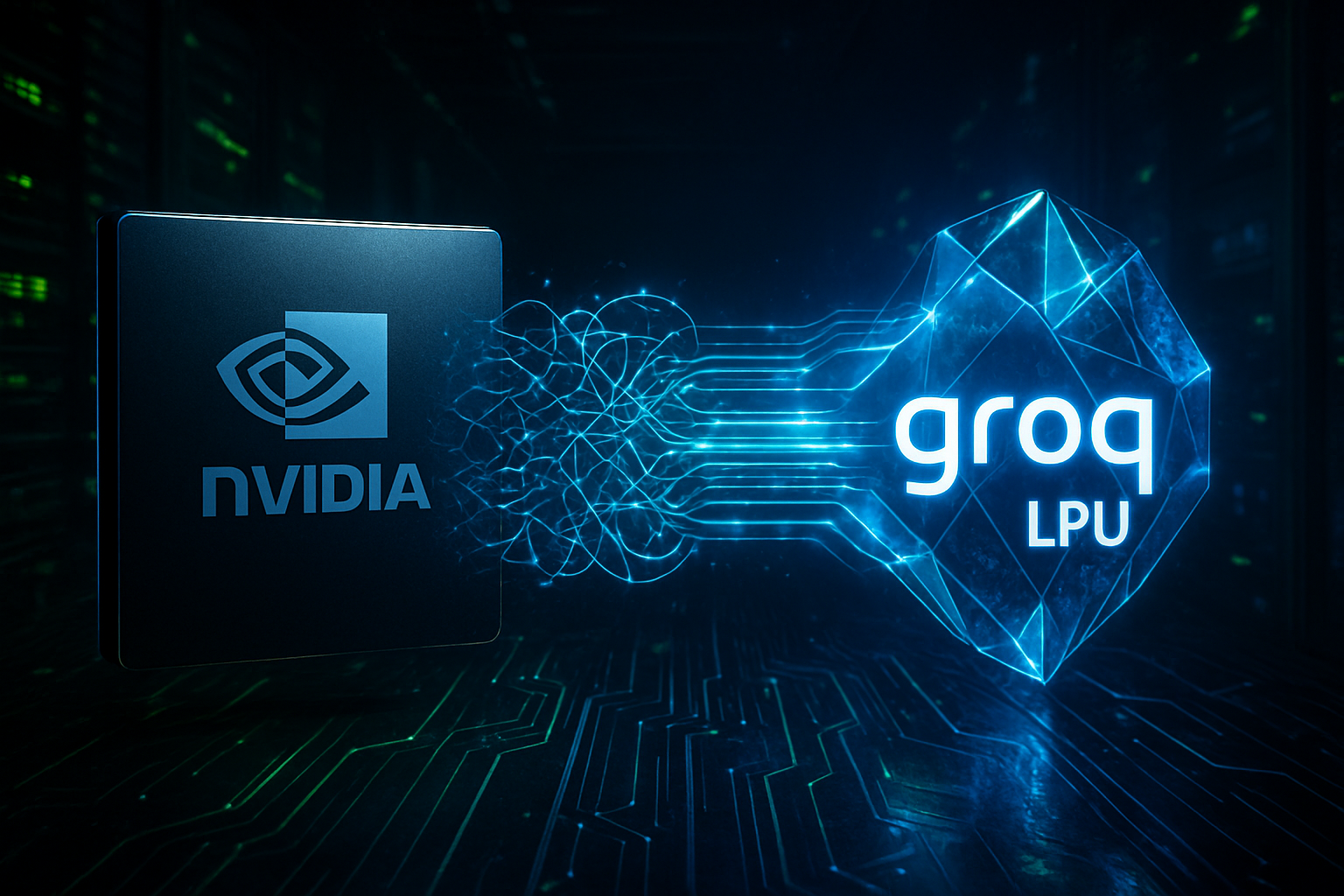
    In a move that has sent shockwaves through Silicon Valley and the halls of global antitrust regulators, NVIDIA (NASDAQ: NVDA) has effectively neutralized its most formidable rival in the AI inference space through a complex $20 billion "reverse acquihire" and licensing agreement with Groq. Announced in the final days of 2025, the deal marks a pivotal shift for the chip giant, moving beyond its historical dominance in AI training to seize total control over the burgeoning real-time inference market. Personally orchestrated by NVIDIA CEO Jensen Huang, the transaction allows the company to absorb Groq’s revolutionary Language Processing Unit (LPU) technology and its top-tier engineering talent while technically keeping the startup alive to evade intensifying regulatory scrutiny.

    The centerpiece of this strategic masterstroke is the migration of Groq founder and CEO Jonathan Ross—the legendary architect behind Google’s original Tensor Processing Unit (TPU)—to NVIDIA. By bringing Ross and approximately 80% of Groq’s engineering staff into the fold, NVIDIA has successfully "bought the architect" of the only hardware platform that consistently outperformed its own Blackwell architecture in low-latency token generation. This deal ensures that as the AI industry shifts its focus from building massive models to serving them at scale, NVIDIA remains the undisputed gatekeeper of the infrastructure.

    The LPU Advantage: Integrating Deterministic Speed into the NVIDIA Stack

    Technically, the deal centers on a non-exclusive perpetual license for Groq’s LPU architecture, a system designed specifically for the sequential, "step-by-step" nature of Large Language Model (LLM) inference. Unlike NVIDIA’s traditional GPUs, which rely on massive parallelization and expensive High Bandwidth Memory (HBM), Groq’s LPU utilizes a deterministic architecture and high-speed SRAM. This approach eliminates the "jitter" and latency spikes common in GPU clusters, allowing for real-time AI responses that feel instantaneous to the user. Initial industry benchmarks suggest that by integrating Groq’s IP, NVIDIA’s upcoming "Vera Rubin" platform (slated for late 2026) could deliver a 10x improvement in tokens-per-second while reducing energy consumption by nearly 90% compared to current Blackwell-based systems.

    The hire of Jonathan Ross is particularly significant for NVIDIA’s software strategy. Ross is expected to lead a new "Ultra-Low Latency" division, tasked with weaving Groq’s deterministic execution model directly into the CUDA software stack. This integration solves a long-standing criticism of NVIDIA hardware: that it is "over-engineered" for simple inference tasks. By adopting Groq’s SRAM-heavy approach, NVIDIA is also creating a strategic hedge against the volatile HBM supply chain, which has been a primary bottleneck for chip production throughout 2024 and 2025.

    Industry experts have reacted with a mix of awe and concern. "NVIDIA didn't just buy a company; they bought the future of the inference market and took the best engineers off the board," noted one senior analyst at Gartner. While the AI research community has long praised Groq’s speed, there were doubts about the startup’s ability to scale its manufacturing. Under NVIDIA’s wing, those scaling issues disappear, effectively ending the era where specialized "NVIDIA-killers" could hope to compete on raw performance alone.

    Bypassing the Regulators: The Rise of the 'Reverse Acquihire'

    The structure of the $20 billion deal is a sophisticated legal maneuver designed to bypass the Hart-Scott-Rodino (HSR) Act and similar antitrust hurdles in the European Union and United Kingdom. By paying a massive licensing fee and hiring the staff rather than acquiring the corporate entity of Groq Inc., NVIDIA avoids a formal merger review that could have taken years. Groq continues to exist as a "zombie" entity under new leadership, maintaining its GroqCloud service and retaining its name. This creates the legal illusion of continued competition in the market, even as its core intellectual property and human capital have been absorbed by the dominant player.

    This "license-and-hire" playbook follows a trend established by Microsoft (NASDAQ: MSFT) with Inflection AI and Amazon (NASDAQ: AMZN) with Adept earlier in the decade. However, the scale of the NVIDIA-Groq deal is unprecedented. For major AI labs like OpenAI and Alphabet (NASDAQ: GOOGL), the deal is a double-edged sword. While they will benefit from more efficient inference hardware, they are now even more beholden to NVIDIA’s ecosystem. The competitive implications are dire for smaller chip startups like Cerebras and Sambanova, who now face a "Vera Rubin" architecture that combines NVIDIA’s massive ecosystem with the specific architectural advantages they once used to differentiate themselves.

    Market analysts suggest this move effectively closes the door on the "custom silicon" threat. Many tech giants had begun designing their own in-house inference chips to escape NVIDIA’s high margins. By absorbing Groq’s IP, NVIDIA has raised the performance bar so high that the internal R&D efforts of its customers may no longer be economically viable, further entrenching NVIDIA’s market positioning.

    From Training Gold Rush to the Inference Era

    The significance of the Groq deal cannot be overstated in the context of the broader AI landscape. For the past three years, the industry has been in a "Training Gold Rush," where companies spent billions on H100 and B200 GPUs to build foundational models. As we enter 2026, the market is pivoting toward the "Inference Era," where the value lies in how cheaply and quickly those models can be queried. Estimates suggest that by 2030, inference will account for 75% of all AI-related compute spend. NVIDIA’s move ensures it won't be disrupted by more efficient, specialized architectures during this transition.

    This development also highlights a growing concern regarding the consolidation of AI power. By using its massive cash reserves to "acqui-license" its fastest rivals, NVIDIA is creating a moat that is increasingly difficult to cross. This mirrors previous tech milestones, such as Intel's dominance in the PC era or Cisco's role in the early internet, but with a faster pace of consolidation. The potential for a "compute monopoly" is now a central topic of debate among policymakers, who worry that the "reverse acquihire" loophole is being used to circumvent the spirit of competition laws.

    Comparatively, this deal is being viewed as NVIDIA’s "Instagram moment"—a preemptive strike against a smaller, faster competitor that could have eventually threatened the core business. Just as Facebook secured its social media dominance by acquiring Instagram, NVIDIA has secured its AI dominance by bringing Jonathan Ross and the LPU architecture under its roof.

    The Road to Vera Rubin and Real-Time Agents

    Looking ahead, the integration of Groq’s technology into NVIDIA’s roadmap points toward a new generation of "Real-Time AI Agents." Current AI interactions often involve a noticeable delay as the model "thinks." The ultra-low latency promised by the Groq-infused "Vera Rubin" chips will enable seamless, voice-first AI assistants and robotic controllers that can react to environmental changes in milliseconds. We expect to see the first silicon samples utilizing this combined IP by the third quarter of 2026.

    However, challenges remain. Merging the deterministic, SRAM-based architecture of Groq with the massive, HBM-based GPU clusters of NVIDIA will require a significant overhaul of the NVLink interconnect system. Furthermore, NVIDIA must manage the cultural integration of the Groq team, who famously prided themselves on being the "scrappy underdog" to NVIDIA’s "Goliath." If successful, the next two years will likely see a wave of new applications in high-frequency trading, real-time medical diagnostics, and autonomous systems that were previously limited by inference lag.

    Conclusion: A New Chapter in the AI Arms Race

    NVIDIA’s $20 billion deal with Groq is more than just a talent grab; it is a calculated strike to define the next decade of AI compute. By securing the LPU architecture and the mind of Jonathan Ross, Jensen Huang has effectively neutralized the most credible threat to his company's dominance. The "reverse acquihire" strategy has proven to be an effective, if controversial, tool for market consolidation, allowing NVIDIA to move faster than the regulators tasked with overseeing it.

    As we move into 2026, the key takeaway is that the "Inference Gap" has been closed. NVIDIA is no longer just a GPU company; it is a holistic AI compute company that owns the best technology for both building and running the world's most advanced models. Investors and competitors alike should watch closely for the first "Vera Rubin" benchmarks in the coming months, as they will likely signal the start of a new era in real-time artificial intelligence.


    This content is intended for informational purposes only and represents analysis of current AI developments.

    TokenRing AI delivers enterprise-grade solutions for multi-agent AI workflow orchestration, AI-powered development tools, and seamless remote collaboration platforms.
    For more information, visit https://www.tokenring.ai/.
  • NVIDIA’s $20 Billion Groq Deal: A Strategic Strike for AI Inference Dominance

    NVIDIA’s $20 Billion Groq Deal: A Strategic Strike for AI Inference Dominance

    In a move that has sent shockwaves through Silicon Valley and the global semiconductor industry, NVIDIA (NASDAQ: NVDA) has finalized a blockbuster $20 billion agreement to license the intellectual property of AI chip innovator Groq and transition the vast majority of its engineering talent into the NVIDIA fold. The deal, structured as a strategic "license-and-acquihire," represents the largest single investment in NVIDIA’s history and marks a decisive pivot toward securing total dominance in the rapidly accelerating AI inference market.

    The centerpiece of the agreement is the integration of Groq’s ultra-low-latency Language Processing Unit (LPU) technology and the appointment of Groq founder and Tensor Processing Unit (TPU) inventor Jonathan Ross to a senior leadership role within NVIDIA. By absorbing the team and technology that many analysts considered the most credible threat to its hardware hegemony, NVIDIA is effectively skipping years of research and development. This strategic strike not only neutralizes a potent rival but also positions NVIDIA to own the "real-time" AI era, where speed and efficiency in running models are becoming as critical as the power used to train them.

    The LPU Advantage: Redefining AI Performance

    At the heart of this deal is Groq’s revolutionary LPU architecture, which differs fundamentally from the traditional Graphics Processing Units (GPUs) that have powered the AI boom to date. While GPUs are masters of parallel processing—handling thousands of small tasks simultaneously—they often struggle with the sequential nature of Large Language Models (LLMs), leading to "jitter" or variable latency. In contrast, the LPU utilizes a deterministic, single-core architecture. This design allows the system to know exactly where data is at any given nanosecond, resulting in predictable, sub-millisecond response times that are essential for fluid, human-like AI interactions.

    Technically, the LPU’s secret weapon is its reliance on massive on-chip SRAM (Static Random-Access Memory) rather than the High Bandwidth Memory (HBM) used by NVIDIA’s current H100 and B200 chips. By keeping data directly on the processor, the LPU achieves a memory bandwidth of up to 80 terabytes per second—nearly ten times that of existing high-end GPUs. This architecture excels at "Batch Size 1" processing, meaning it can generate tokens for a single user instantly without needing to wait for other requests to bundle together. For the AI research community, this is a game-changer; it enables "instantaneous" reasoning in models like GPT-5 and Claude 4, which were previously bottlenecked by the physical limits of HBM data transfer.

    Industry experts have reacted to the news with a mix of awe and caution. "NVIDIA just bought the fastest lane on the AI highway," noted one lead analyst at a major tech research firm. "By bringing Jonathan Ross—the man who essentially invented the modern AI chip at Google—into their ranks, NVIDIA isn't just buying hardware; they are buying the architectural blueprint for the next decade of computing."

    Reshaping the Competitive Landscape

    The strategic implications for the broader tech industry are profound. For years, major cloud providers and competitors like Alphabet Inc. (NASDAQ: GOOGL) and Advanced Micro Devices, Inc. (NASDAQ: AMD) have been racing to develop specialized inference ASICs (Application-Specific Integrated Circuits) to chip away at NVIDIA’s market share. Google’s TPU and Amazon’s Inferentia were designed specifically to offer a cheaper, faster alternative to NVIDIA’s general-purpose GPUs. By licensing Groq’s LPU technology, NVIDIA has effectively leapfrogged these custom solutions, offering a commercial product that matches or exceeds the performance of in-house hyperscaler silicon.

    This deal creates a significant hurdle for other AI chip startups, such as Cerebras and Sambanova, who now face a competitor that possesses both the massive scale of NVIDIA and the specialized speed of Groq. Furthermore, the "license-and-acquihire" structure allows NVIDIA to avoid some of the regulatory scrutiny that would accompany a full acquisition. Because Groq will continue to exist as an independent entity operating its "GroqCloud" service, NVIDIA can argue it is fostering an ecosystem rather than absorbing it, even as it integrates Groq’s core innovations into its own future product lines.

    For major AI labs like OpenAI and Anthropic, the benefit is immediate. Access to LPU-integrated NVIDIA hardware means they can deploy "agentic" AI—autonomous systems that can think, plan, and react in real-time—at a fraction of the current latency and power cost. This move solidifies NVIDIA’s position as the indispensable backbone of the AI economy, moving them from being the "trainers" of AI to the "engine" that runs it every second of the day.

    From Training to Inference: The Great AI Shift

    The $20 billion price tag reflects a broader trend in the AI landscape: the shift from the "Training Era" to the "Inference Era." While the last three years were defined by the massive clusters of GPUs needed to build models, the next decade will be defined by the trillions of queries those models must answer. Analysts predict that by 2030, the market for AI inference will be ten times larger than the market for training. NVIDIA’s move is a preemptive strike to ensure that as the industry evolves, its revenue doesn't peak with the completion of the world's largest data centers.

    This acquisition draws parallels to NVIDIA’s 2020 purchase of Mellanox, which gave the company control over the high-speed networking (InfiniBand) necessary for massive GPU clusters. Just as Mellanox allowed NVIDIA to dominate training at scale, Groq’s technology will allow them to dominate inference at speed. However, this milestone is perhaps even more significant because it addresses the growing concern over AI's energy consumption. The LPU architecture is significantly more power-efficient for inference tasks than traditional GPUs, providing a path toward sustainable AI scaling as global power grids face increasing pressure.

    Despite the excitement, the deal is not without its critics. Some in the open-source community express concern that NVIDIA’s tightening grip on both training and inference hardware could lead to a "black box" ecosystem where the most efficient AI can only run on proprietary NVIDIA stacks. This concentration of power in a single company’s hands remains a focal point for regulators in the US and EU, who are increasingly wary of "killer acquisitions" in the semiconductor space.

    The Road Ahead: Real-Time Agents and "Vera Rubin"

    Looking toward the near-term future, the first fruits of this deal are expected to appear in NVIDIA’s 2026 hardware roadmap, specifically the rumored "Vera Rubin" architecture. Industry insiders suggest that NVIDIA will integrate LPU-derived "inference blocks" directly onto its next-generation dies, creating a hybrid chip capable of switching between heavy-lift training and ultra-fast inference seamlessly. This would allow a single server rack to handle the entire lifecycle of an AI model with unprecedented efficiency.

    The most transformative applications will likely be in the realm of real-time AI agents. With the latency barriers removed, we can expect to see the rise of voice assistants that have zero "thinking" delay, real-time language translation that feels natural, and autonomous systems in robotics and manufacturing that can process visual data and make decisions in microseconds. The challenge for NVIDIA will be the complex task of merging Groq’s software-defined hardware approach with its own CUDA software stack, a feat of engineering that Jonathan Ross is uniquely qualified to lead.

    Experts predict that the coming months will see a flurry of activity as NVIDIA's partners, including Microsoft Corp. (NASDAQ: MSFT) and Meta, scramble to secure early access to the first LPU-enhanced systems. The "race to zero latency" has officially begun, and with this $20 billion move, NVIDIA has claimed the pole position.

    A New Chapter in the AI Revolution

    NVIDIA’s licensing of Groq’s IP and the absorption of its engineering core represents a watershed moment in the history of computing. It is a clear signal that the "GPU-only" era of AI is evolving into a more specialized, diverse hardware landscape. By successfully identifying and integrating the most advanced inference technology on the market, NVIDIA has once again demonstrated the strategic agility that has made it one of the most valuable companies in the world.

    The key takeaway for the industry is that the battle for AI supremacy has moved beyond who can build the largest model to who can deliver that model’s intelligence the fastest. As we look toward 2026, the integration of Groq’s deterministic architecture into the NVIDIA ecosystem will likely be remembered as the move that made real-time, ubiquitous AI a reality.

    In the coming weeks, all eyes will be on the first joint technical briefings from NVIDIA and the former Groq team. As the dust settles on this $20 billion deal, the message to the rest of the industry is clear: NVIDIA is no longer just a chip company; it is the architect of the real-time intelligent world.


    This content is intended for informational purposes only and represents analysis of current AI developments.

    TokenRing AI delivers enterprise-grade solutions for multi-agent AI workflow orchestration, AI-powered development tools, and seamless remote collaboration platforms.
    For more information, visit https://www.tokenring.ai/.

  • The Inference Crown: Nvidia’s $20 Billion Groq Gambit Redefines the AI Landscape

    The Inference Crown: Nvidia’s $20 Billion Groq Gambit Redefines the AI Landscape

    In a move that has sent shockwaves through Silicon Valley and global markets, Nvidia (NASDAQ: NVDA) has finalized a staggering $20 billion strategic intellectual property (IP) deal with the AI chip sensation Groq. Beyond the massive capital outlay, the deal includes the high-profile hiring of Groq’s visionary founder, Jonathan Ross, and nearly 80% of the startup’s engineering talent. This "license-and-acquihire" maneuver signals a definitive shift in Nvidia’s strategy, as the company moves to consolidate its dominance over the burgeoning AI inference market.

    The deal, announced as we close out 2025, represents a pivotal moment in the hardware arms race. While Nvidia has long been the undisputed king of AI "training"—the process of building massive models—the industry’s focus has rapidly shifted toward "inference," the actual running of those models for end-users. By absorbing Groq’s specialized Language Processing Unit (LPU) technology and the mind of the man who originally led Google’s (NASDAQ: GOOGL) TPU program, Nvidia is positioning itself to own the entire AI lifecycle, from the first line of code to the final millisecond of a user’s query.

    The LPU Advantage: Solving the Memory Bottleneck

    At the heart of this deal is Groq’s radical LPU architecture, which differs fundamentally from the GPU (Graphics Processing Unit) architecture that propelled Nvidia to its multi-trillion-dollar valuation. Traditional GPUs rely on High Bandwidth Memory (HBM), which, while powerful, creates a "Von Neumann bottleneck" during inference. Data must travel between the processor and external memory stacks, causing latency that can hinder real-time AI interactions. In contrast, Groq’s LPU utilizes massive amounts of on-chip SRAM (Static Random-Access Memory), allowing model weights to reside directly on the processor.

    The technical specifications of this integration are formidable. Groq’s architecture provides a deterministic execution model, meaning the performance is mathematically predictable to the nanosecond—a far cry from the "jitter" or variable latency found in probabilistic GPU scheduling. By integrating this into Nvidia’s upcoming "Vera Rubin" chip architecture, experts predict token-generation speeds could jump from the current 100 tokens per second to over 500 tokens per second for models like Llama 3. This enables "Batch Size 1" processing, where a single user receives an instantaneous response without the need for the system to wait for other requests to fill a queue.

    Initial reactions from the AI research community have been a mix of awe and apprehension. Dr. Elena Rodriguez, a senior fellow at the AI Hardware Institute, noted, "Nvidia isn't just buying a faster chip; they are buying a different way of thinking about compute. The deterministic nature of the LPU is the 'holy grail' for real-time applications like autonomous robotics and high-frequency trading." However, some industry purists worry that such consolidation may stifle the architectural diversity that has fueled recent innovation.

    A Strategic Masterstroke: Market Positioning and Antitrust Maneuvers

    The structure of the deal—a $20 billion IP license combined with a mass hiring event—is a calculated effort to bypass the regulatory hurdles that famously tanked Nvidia’s attempt to acquire ARM in 2022. By not acquiring Groq Inc. as a legal entity, Nvidia avoids the protracted 18-to-24-month antitrust reviews from global regulators. This "hollow-out" strategy, pioneered by Microsoft (NASDAQ: MSFT) and Amazon (NASDAQ: AMZN) earlier in the decade, allows Nvidia to secure the technology and talent it needs while leaving a shell of the original company to manage its existing "GroqCloud" service.

    For competitors like AMD (NASDAQ: AMD) and Intel (NASDAQ: INTC), this deal is a significant blow. AMD had recently made strides in the inference space with its MI300 series, but the integration of Groq’s LPU technology into the CUDA ecosystem creates a formidable barrier to entry. Nvidia’s ability to offer ultra-low-latency inference as a native feature of its hardware stack makes it increasingly difficult for startups or established rivals to argue for a "specialized" alternative.

    Furthermore, this move neutralizes one of the most credible threats to Nvidia’s cloud dominance. Groq had been rapidly gaining traction among developers who were frustrated by the high costs and latency of running large language models (LLMs) on standard GPUs. By bringing Jonathan Ross into the fold, Nvidia has effectively removed the "father of the TPU" from the competitive board, ensuring his next breakthroughs happen under the Nvidia banner.

    The Inference Era: A Paradigm Shift in AI

    The wider significance of this deal cannot be overstated. We are witnessing the end of the "Training Era" and the beginning of the "Inference Era." In 2023 and 2024, the primary constraint on AI was the ability to build models. In 2025, the constraint is the ability to run them efficiently, cheaply, and at scale. Groq’s LPU technology is significantly more energy-efficient for inference tasks than traditional GPUs, addressing a major concern for data center operators and environmental advocates alike.

    This milestone is being compared to the 2006 launch of CUDA, the software platform that originally transformed Nvidia from a gaming company into an AI powerhouse. Just as CUDA made GPUs programmable for general tasks, the integration of LPU architecture into Nvidia’s stack makes real-time, high-speed AI accessible for every enterprise. It marks a transition from AI being a "batch process" to AI being a "living interface" that can keep up with human thought and speech in real-time.

    However, the consolidation of such critical IP raises concerns about a "hardware monopoly." With Nvidia now controlling both the training and the most efficient inference paths, the tech industry must grapple with the implications of a single entity holding the keys to the world’s AI infrastructure. Critics argue that this could lead to higher prices for cloud compute and a "walled garden" that forces developers into the Nvidia ecosystem.

    Looking Ahead: The Future of Real-Time Agents

    In the near term, expect Nvidia to release a series of "Inference-First" modules designed specifically for edge computing and real-time voice and video agents. These products will likely leverage the newly acquired LPU IP to provide human-like interaction speeds in devices ranging from smart glasses to industrial robots. Jonathan Ross is reportedly leading a "Special Projects" division at Nvidia, tasked with merging the LPU’s deterministic pipeline with Nvidia’s massive parallel processing capabilities.

    The long-term applications are even more transformative. We are looking at a future where AI "agents" can reason and respond in milliseconds, enabling seamless real-time translation, complex autonomous decision-making in split-second scenarios, and personalized AI assistants that feel truly instantaneous. The challenge will be the software integration; porting the world’s existing AI models to a hybrid GPU-LPU architecture will require a massive update to the CUDA toolkit, a task that Ross’s team is expected to spearhead throughout 2026.

    A New Chapter for the AI Titan

    Nvidia’s $20 billion bet on Groq is more than just an acquisition of talent; it is a declaration of intent. By securing the most advanced inference technology on the market, CEO Jensen Huang has shored up the one potential weakness in Nvidia’s armor. The "license-and-acquihire" model has proven to be an effective, if controversial, tool for market leaders to stay ahead of the curve while navigating a complex regulatory environment.

    As we move into 2026, the industry will be watching closely to see how quickly the "Groq-infused" Nvidia hardware hits the market. This development will likely be remembered as the moment when the "Inference Gap" was closed, paving the way for the next generation of truly interactive, real-time artificial intelligence. For now, Nvidia remains the undisputed architect of the AI age, with a lead that looks increasingly insurmountable.


    This content is intended for informational purposes only and represents analysis of current AI developments.

    TokenRing AI delivers enterprise-grade solutions for multi-agent AI workflow orchestration, AI-powered development tools, and seamless remote collaboration platforms.
    For more information, visit https://www.tokenring.ai/.
  • NVIDIA’s $20 Billion Christmas Eve Gambit: The Groq “Reverse Acqui-hire” and the Future of AI Inference

    NVIDIA’s $20 Billion Christmas Eve Gambit: The Groq “Reverse Acqui-hire” and the Future of AI Inference

    In a move that sent shockwaves through Silicon Valley on Christmas Eve 2025, NVIDIA (NASDAQ: NVDA) announced a transformative $20 billion strategic partnership with Groq, the pioneer of Language Processing Unit (LPU) technology. Structured as a "reverse acqui-hire," the deal involves NVIDIA paying a massive licensing fee for Groq’s intellectual property while simultaneously bringing on Groq’s founder and CEO, Jonathan Ross—the legendary inventor of Google’s (NASDAQ: GOOGL) Tensor Processing Unit (TPU)—to lead a new high-performance inference division. This tactical masterstroke effectively neutralizes one of NVIDIA’s most potent architectural rivals while positioning the company to dominate the burgeoning AI inference market.

    The timing and structure of the deal are as significant as the technology itself. By opting for a licensing and talent-acquisition model rather than a traditional merger, NVIDIA CEO Jensen Huang has executed a sophisticated "regulatory arbitrage" play. This maneuver is designed to bypass the intense antitrust scrutiny from the Department of Justice and global regulators that has previously dogged the company’s expansion efforts. As the AI industry shifts its focus from the massive compute required to train models to the efficiency required to run them at scale, NVIDIA’s move signals a definitive pivot toward an inference-first future.

    Breaking the Memory Wall: LPU Technology and the Vera Rubin Integration

    At the heart of this $20 billion deal is Groq’s proprietary LPU technology, which represents a fundamental departure from the GPU-centric world NVIDIA helped create. Unlike traditional GPUs that rely on High Bandwidth Memory (HBM)—a component currently plagued by global supply chain shortages—Groq’s architecture utilizes on-chip SRAM (Static Random Access Memory). This "software-defined" hardware approach eliminates the "memory bottleneck" by keeping data on the chip, allowing for inference speeds up to 10 times faster than current state-of-the-art GPUs while reducing energy consumption by a factor of 20.

    The technical implications are profound. Groq’s architecture is entirely deterministic, meaning the system knows exactly where every bit of data is at any given microsecond. This eliminates the "jitter" and latency spikes common in traditional parallel processing, making it the gold standard for real-time applications like autonomous agents and high-speed LLM (Large Language Model) interactions. NVIDIA plans to integrate these LPU cores directly into its upcoming 2026 "Vera Rubin" architecture. The Vera Rubin chips, which are already expected to feature HBM4 and the new Vera CPU (NASDAQ: ARM), will now become hybrid powerhouses capable of utilizing GPUs for massive training workloads and LPU cores for lightning-fast, deterministic inference.

    Industry experts have reacted with a mix of awe and trepidation. "NVIDIA just bought the only architecture that threatened their inference moat," noted one senior researcher at OpenAI. By bringing Jonathan Ross into the fold, NVIDIA isn't just buying technology; it's acquiring the architectural philosophy that allowed Google to stay competitive with its TPUs for a decade. Ross’s move to NVIDIA marks a full-circle moment for the industry, as the man who built Google’s AI hardware foundation now takes the reins of the world’s most valuable semiconductor company.

    Neutralizing the TPU Threat and Hedging Against HBM Shortages

    This strategic move is a direct strike against Google’s (NASDAQ: GOOGL) internal hardware advantage. For years, Google’s TPUs have provided a cost and performance edge for its own AI services, such as Gemini and Search. By incorporating LPU technology, NVIDIA is effectively commoditizing the specialized advantages that TPUs once held, offering a superior, commercially available alternative to the rest of the industry. This puts immense pressure on other cloud competitors like Amazon (NASDAQ: AMZN) and Microsoft (NASDAQ: MSFT), who have been racing to develop their own in-house silicon to reduce their reliance on NVIDIA.

    Furthermore, the deal serves as a critical hedge against the fragile HBM supply chain. As manufacturers like SK Hynix and Samsung struggle to keep up with the insatiable demand for HBM3e and HBM4, NVIDIA’s move into SRAM-based LPU technology provides a "Plan B" that doesn't rely on external memory vendors. This vertical integration of inference technology ensures that NVIDIA can continue to deliver high-performance AI factories even if the global memory market remains constrained. It also creates a massive barrier to entry for competitors like AMD (NASDAQ: AMD) and Intel (NASDAQ: INTC), who are still heavily reliant on traditional GPU and HBM architectures to compete in the high-end AI space.

    Regulatory Arbitrage and the New Antitrust Landscape

    The "reverse acqui-hire" structure of the Groq deal is a direct response to the aggressive antitrust environment of 2024 and 2025. With the US Department of Justice and European regulators closely monitoring NVIDIA’s market dominance, a standard $20 billion acquisition of Groq would have likely faced years of litigation and a potential block. By licensing the IP and hiring the talent while leaving Groq as a semi-independent cloud entity, NVIDIA has followed the playbook established by Microsoft’s earlier deal with Inflection AI. This allows NVIDIA to absorb the "brains" and "blueprints" of its competitor without the legal headache of a formal merger.

    This move highlights a broader trend in the AI landscape: the consolidation of power through non-traditional means. As the barrier between software and hardware continues to blur, the most valuable assets are no longer just physical factories, but the specific architectural designs and the engineers who create them. However, this "stealth consolidation" is already drawing the attention of critics who argue that it allows tech giants to maintain monopolies while evading the spirit of antitrust laws. The Groq deal will likely become a landmark case study for regulators looking to update competition frameworks for the AI era.

    The Road to 2026: The Vera Rubin Era and Beyond

    Looking ahead, the integration of Groq’s LPU technology into the Vera Rubin platform sets the stage for a new era of "Artificial Superintelligence" (ASI) infrastructure. In the near term, we can expect NVIDIA to release specialized "Inference-Only" cards based on Groq’s designs, targeting the edge computing and enterprise sectors that prioritize latency over raw training power. Long-term, the 2026 launch of the Vera Rubin chips will likely represent the most significant architectural shift in NVIDIA’s history, moving away from a pure GPU focus toward a heterogeneous computing model that combines the best of GPUs, CPUs, and LPUs.

    The challenges remain significant. Integrating two fundamentally different architectures—the parallel-processing GPU and the deterministic LPU—into a single, cohesive software stack like CUDA will require a monumental engineering effort. Jonathan Ross will be tasked with ensuring that this transition is seamless for developers. If successful, the result will be a computing platform that is virtually untouchable in its versatility, capable of handling everything from the world’s largest training clusters to the most responsive real-time AI agents.

    A New Chapter in AI History

    NVIDIA’s Christmas Eve announcement is more than just a business deal; it is a declaration of intent. By securing the LPU technology and the leadership of Jonathan Ross, NVIDIA has addressed its two biggest vulnerabilities: the memory bottleneck and the rising threat of specialized inference chips. This $20 billion move ensures that as the AI industry matures from experimental training to mass-market deployment, NVIDIA remains the indispensable foundation upon which the future is built.

    As we look toward 2026, the significance of this moment will only grow. The "reverse acqui-hire" of Groq may well be remembered as the move that cemented NVIDIA’s dominance for the next decade, effectively ending the "inference wars" before they could truly begin. For competitors and regulators alike, the message is clear: NVIDIA is not just participating in the AI revolution; it is architecting the very ground it stands on.


    This content is intended for informational purposes only and represents analysis of current AI developments.

    TokenRing AI delivers enterprise-grade solutions for multi-agent AI workflow orchestration, AI-powered development tools, and seamless remote collaboration platforms.
    For more information, visit https://www.tokenring.ai/.
  • Nvidia Secures AI Inference Dominance with Landmark $20 Billion Groq Licensing Deal

    Nvidia Secures AI Inference Dominance with Landmark $20 Billion Groq Licensing Deal

    In a move that has sent shockwaves through Silicon Valley and the global semiconductor industry, Nvidia (NASDAQ:NVDA) announced a historic $20 billion strategic licensing agreement with AI chip innovator Groq on December 24, 2025. The deal, structured as a non-exclusive technology license and a massive "acqui-hire," marks a pivotal shift in the AI hardware wars. As part of the agreement, Groq’s visionary founder and CEO, Jonathan Ross—a primary architect of Google’s original Tensor Processing Unit (TPU)—will join Nvidia’s executive leadership team to spearhead the company’s next-generation inference architecture.

    The announcement comes at a critical juncture as the AI industry pivots from the "training era" to the "inference era." While Nvidia has long dominated the market for training massive Large Language Models (LLMs), the rise of real-time reasoning agents and "System-2" thinking models in late 2025 has created an insatiable demand for ultra-low latency compute. By integrating Groq’s proprietary Language Processing Unit (LPU) technology into its ecosystem, Nvidia effectively neutralizes its most potent architectural rival while fortifying its "CUDA lock-in" against a rising tide of custom silicon from hyperscalers.

    The Architectural Rebellion: Understanding the LPU Advantage

    At the heart of this $20 billion deal is Groq’s radical departure from traditional chip design. Unlike the many-core GPU architectures perfected by Nvidia, which rely on dynamic scheduling and complex hardware-level management, Groq’s LPU is built on a Tensor Streaming Processor (TSP) architecture. This design utilizes "static scheduling," where the compiler orchestrates every instruction and data movement down to the individual clock cycle before the code even runs. This deterministic approach eliminates the need for branch predictors and global synchronization locks, allowing for a "conveyor belt" of data that processes language tokens with unprecedented speed.

    The technical specifications of the LPU are tailored specifically for the sequential nature of LLM inference. While Nvidia’s flagship Blackwell B200 GPUs rely on off-chip High Bandwidth Memory (HBM) to store model weights, Groq’s LPU utilizes 230MB of on-chip SRAM with a staggering bandwidth of approximately 80 TB/s—nearly ten times faster than the HBM3E found in current top-tier GPUs. This allows the LPU to bypass the "memory wall" that often bottlenecks GPUs during single-user, real-time interactions. Benchmarks from late 2025 show the LPU delivering over 800 tokens per second on Meta's (NASDAQ:META) Llama 3 (8B) model, compared to roughly 150 tokens per second on equivalent GPU-based cloud instances.

    The integration of Jonathan Ross into Nvidia is perhaps as significant as the technology itself. Ross, who famously initiated the TPU project as a "20% project" at Google (NASDAQ:GOOGL), is widely regarded as the father of modern AI accelerators. His philosophy of "software-defined hardware" has long been the antithesis of Nvidia’s hardware-first approach. Initial reactions from the AI research community suggest that this merger of philosophies could lead to a "unified compute fabric" that combines the massive parallel throughput of Nvidia’s CUDA cores with the lightning-fast sequential processing of Ross’s LPU designs.

    Market Consolidation and the "Inference War"

    The strategic implications for the broader tech landscape are profound. By licensing Groq’s IP, Nvidia has effectively built a defensive moat around the inference market, which analysts at Morgan Stanley now project will represent more than 50% of total AI compute demand by the end of 2026. This deal puts immense pressure on AMD (NASDAQ:AMD), whose Instinct MI355X chips had recently gained ground by offering superior HBM capacity. While AMD remains a strong contender for high-throughput training, Nvidia’s new "LPU-enhanced" roadmap targets the high-margin, real-time application market where latency is the primary metric of success.

    Cloud service providers like Microsoft (NASDAQ:MSFT) and Amazon (NASDAQ:AMZN), who have been aggressively developing their own custom silicon (Maia and Trainium, respectively), now face a more formidable Nvidia. The "Groq-inside" Nvidia chips will likely offer a Total Cost of Ownership (TCO) that makes it difficult for proprietary chips to compete on raw performance-per-watt for real-time agents. Furthermore, the deal allows Nvidia to offer a "best-of-both-worlds" solution: GPUs for the massive batch processing required for training, and LPU-derived blocks for the instantaneous "thinking" required by next-generation reasoning models.

    For startups and smaller AI labs, the deal is a double-edged sword. On one hand, the widespread availability of LPU-speed inference through Nvidia’s global distribution network will accelerate the deployment of real-time AI voice assistants and interactive agents. On the other hand, the consolidation of such a disruptive technology into the hands of the market leader raises concerns about long-term pricing power. Analysts suggest that Nvidia may eventually integrate LPU technology directly into its upcoming "Vera Rubin" architecture, potentially making high-speed inference a standard feature of the entire Nvidia stack.

    Shifting the Paradigm: From Training to Reasoning

    This deal reflects a broader trend in the AI landscape: the transition from "System-1" intuitive response models to "System-2" reasoning models. Models like the OpenAI o3 and DeepSeek R1 require "Test-Time Compute," where the model performs multiple internal reasoning steps before generating a final answer. This process is highly sensitive to latency; if each internal step takes a second, the final response could take minutes. Groq’s LPU technology is uniquely suited for these "thinking" models, as it can cycle through internal reasoning loops at a fraction of the time required by traditional architectures.

    The energy implications are equally significant. As data centers face increasing scrutiny over their power consumption, the efficiency of the LPU—which consumes significantly fewer joules per token than a high-end GPU for inference tasks—offers a path toward more sustainable AI scaling. By adopting this technology, Nvidia is positioning itself as a leader in "Green AI," addressing one of the most persistent criticisms of the generative AI boom.

    Comparisons are already being made to Intel’s (NASDAQ:INTC) historic "Intel Inside" campaign or Nvidia’s own acquisition of Mellanox. However, the Groq deal is unique because it represents the first time Nvidia has looked outside its own R&D labs to fundamentally alter its core compute architecture. It signals an admission that the GPU, while versatile, may not be the optimal tool for the specific task of sequential language generation. This "architectural humility" could be what ensures Nvidia’s dominance for the remainder of the decade.

    The Road Ahead: Real-Time Agents and "Rubin" Integration

    In the near term, industry experts expect Nvidia to launch a dedicated "Inference Accelerator" card based on Groq’s licensed designs as early as Q3 2026. This product will likely target the "Edge Cloud" and enterprise sectors, where companies are desperate to run private LLMs with human-like response times. Longer-term, the true potential lies in the integration of LPU logic into the Vera Rubin platform, Nvidia’s successor to Blackwell. A hybrid "GR-GPU" (Groq-Nvidia GPU) could theoretically handle the massive context windows of 2026-era models while maintaining the sub-100ms latency required for seamless human-AI collaboration.

    The primary challenge remaining is the software transition. While Groq’s compiler is world-class, it operates differently than the CUDA environment most developers are accustomed to. Jonathan Ross’s primary task at Nvidia will likely be the fusion of Groq’s software-defined scheduling with the CUDA ecosystem, creating a seamless experience where developers can deploy to either architecture without rewriting their underlying kernels. If successful, this "Unified Inference Architecture" will become the standard for the next generation of AI applications.

    A New Chapter in AI History

    The Nvidia-Groq deal will likely be remembered as the moment the "Inference War" was won. By spending $20 billion to secure the world's fastest inference technology and the talent behind the Google TPU, Nvidia has not only expanded its product line but has fundamentally evolved its identity from a graphics company to the undisputed architect of the global AI brain. The move effectively ends the era of the "GPU-only" data center and ushers in a new age of heterogeneous AI compute.

    As we move into 2026, the industry will be watching closely to see how quickly Ross and his team can integrate their "streaming" philosophy into Nvidia’s roadmap. For competitors, the window to offer a superior alternative for real-time AI has narrowed significantly. For the rest of the world, the result will be AI that is not only smarter but significantly faster, more efficient, and more integrated into the fabric of daily life than ever before.


    This content is intended for informational purposes only and represents analysis of current AI developments.

    TokenRing AI delivers enterprise-grade solutions for multi-agent AI workflow orchestration, AI-powered development tools, and seamless remote collaboration platforms.
    For more information, visit https://www.tokenring.ai/.