Tag: Leadership Change

  • Logic Fruit Technologies Appoints Sunil Kar as President & CEO, Signaling Ambitious Global Growth in Semiconductor Solutions

    Logic Fruit Technologies Appoints Sunil Kar as President & CEO, Signaling Ambitious Global Growth in Semiconductor Solutions

    New Delhi, India – November 5, 2025 – Logic Fruit Technologies, a prominent player in FPGA, SoC, and semiconductor services, today announced the appointment of Sunil Kar as its new President and Chief Executive Officer. This strategic leadership change, effective immediately, marks a pivotal moment for the company as it embarks on an aggressive strategy to accelerate its global expansion and solidify its position as a premier worldwide provider of cutting-edge semiconductor solutions. The move comes as the global semiconductor industry continues its rapid evolution, with increasing demand for specialized design and verification expertise.

    Kar's appointment is poised to usher in a new era of growth and innovation for Logic Fruit Technologies. With a stated focus on significantly expanding market presence and revenue, the company aims to capitalize on burgeoning opportunities in high-growth sectors such as artificial intelligence, robotics, and advanced telecommunications. The transition also sees co-founder and outgoing CEO Sanjeev Kumar moving to the role of Executive Chairman, where he will dedicate his efforts to fostering strategic partnerships, building ecosystem alliances, and driving long-term growth initiatives, ensuring a seamless continuity of vision and strategic direction.

    Strategic Leadership for a Technical Powerhouse

    Sunil Kar brings over three decades of invaluable experience in driving growth, fostering innovation, and managing global operations within the semiconductor industry. His distinguished career includes senior leadership roles at industry giants such as Xilinx (now part of (NASDAQ: AMD)), IDT (now (TYO: 6723) Renesas), and NetLogic (acquired by (NASDAQ: AVGO) Broadcom). This extensive background positions Kar with a deep understanding of the complex technical and market dynamics crucial for steering Logic Fruit Technologies through its next phase of development. His expertise is particularly pertinent given Logic Fruit Technologies' specialization in high-quality, real-time, high-throughput FPGA/SoC embedded solutions and proof-of-concept designs.

    Logic Fruit Technologies' technical prowess lies in its ability to deliver sophisticated solutions across the entire semiconductor design lifecycle. Their core services encompass comprehensive FPGA design, including prototyping, IP core development, and high-speed protocol implementation, leveraging over two decades of experience and a rich library of proprietary IPs to expedite customer development cycles. In hardware design, the company excels at creating complex, high-speed boards integrating SoC and FPGA components, complemented by robust mechanical design and rigorous quality certifications. Furthermore, their embedded software development capabilities span various RTOS platforms, micro-kernels, Board Support Packages (BSPs), and device drivers.

    What differentiates Logic Fruit Technologies is their integrated approach to ASIC design services, offering solutions for prototyping, SoC building, and seamless migration between FPGA and ASIC architectures. Coupled with extensive design verification services, including high-performance and co-verification, they provide a holistic solution set that minimizes risks and accelerates time-to-market for complex silicon projects. This comprehensive technical offering, combined with Kar's proven track record in leading global semiconductor operations, positions Logic Fruit Technologies to not only enhance its existing capabilities but also to explore new avenues for innovation, particularly in areas demanding advanced DSP algorithm implementation and turnkey product development for diverse applications like data acquisition, image processing, and satellite communication.

    Competitive Implications and Market Dynamics

    The appointment of Sunil Kar and Logic Fruit Technologies' intensified focus on global growth carries significant implications for AI companies, tech giants, and startups operating within the semiconductor and embedded systems landscape. Companies that heavily rely on FPGA, SoC, and specialized semiconductor services for their AI hardware acceleration, edge computing, and complex embedded systems stand to benefit from Logic Fruit Technologies' expanded capabilities and market reach. As AI models become more sophisticated and demand greater computational efficiency at the hardware level, specialized design houses like Logic Fruit become critical partners for innovation.

    This strategic move will undoubtedly intensify competition within the niche but rapidly expanding market for semiconductor design and verification services. Major AI labs and tech companies, often reliant on internal teams or a select few external partners for their custom silicon needs, may find Logic Fruit Technologies a more formidable and globally accessible option under Kar's leadership. The company’s existing partnerships with industry leaders such as (NASDAQ: AMD) and (NASDAQ: INTC) Intel, along with its work for clients like Keysight, Siemens, ISRO, and DRDOs, underscore its established credibility and technical depth. Kar's experience at companies like Xilinx, a leader in FPGAs, further strengthens Logic Fruit's competitive edge in a market increasingly driven by programmable logic and adaptive computing.

    Potential disruption to existing products or services could arise from Logic Fruit Technologies' ability to offer more optimized, faster, or cost-effective design and verification cycles. For startups in the AI hardware space, access to a globally expanding and technically proficient partner like Logic Fruit could lower barriers to entry and accelerate product development. Logic Fruit's strategic advantages lie in its deep domain expertise across multiple semiconductor disciplines, its commitment to innovation, and its stated goal of establishing India as a leader in semiconductor system innovation. This market positioning allows them to serve as a crucial enabler for companies pushing the boundaries of AI, robotics, and advanced communication technologies.

    Broader Significance in the AI Landscape

    Logic Fruit Technologies' amplified global growth strategy, spearheaded by Sunil Kar, resonates deeply within the broader AI landscape and aligns with prevailing trends in semiconductor development. As AI models continue to scale in complexity and demand for real-time processing at the edge intensifies, the role of specialized hardware, particularly FPGAs and SoCs, becomes paramount. Logic Fruit's expertise in designing and verifying these critical components directly supports the advancement of AI by providing the foundational hardware necessary for efficient model deployment, inference, and even training in specific scenarios.

    The impacts of this development are multifaceted. Firstly, it underscores the increasing importance of robust, high-performance semiconductor design services as a bottleneck and enabler for AI innovation. As more companies seek custom silicon solutions to differentiate their AI offerings, the demand for partners with deep expertise in FPGA, SoC, and ASIC design will only grow. Secondly, Logic Fruit Technologies' ambition to establish India as a leader in semiconductor system innovation has wider geopolitical and economic significance, contributing to the decentralization of semiconductor design capabilities and fostering a more diverse global supply chain. This move could mitigate some of the concentration risks currently observed in the semiconductor industry.

    Potential concerns, however, include the intense competition for top talent in the semiconductor design space and the significant capital investment required to scale global operations and R&D. Comparisons to previous AI milestones often highlight the interplay between software algorithms and underlying hardware. Just as breakthroughs in neural network architectures required more powerful GPUs, continued advancements in AI will necessitate increasingly sophisticated and specialized silicon. Logic Fruit Technologies' expansion is a testament to this symbiotic relationship, signifying a critical step in providing the hardware backbone for the next generation of AI applications.

    Charting Future Developments

    Under Sunil Kar's leadership, Logic Fruit Technologies is poised for several near-term and long-term developments. Immediately, the company is expected to significantly expand its sales team, particularly in the United States, which currently accounts for 90% of its revenue. This expansion is crucial for capturing a larger share of the global market and solidifying its international presence. Furthermore, a key immediate objective is to accelerate revenue growth and market penetration, indicating a focus on aggressive business development and client acquisition. In the long term, the company's vision includes enhancing its capabilities in high-growth sectors such as AI, robotics, and telecom through strategic partnerships and increased R&D investments, aiming to position itself at the forefront of semiconductor innovation for these emerging technologies.

    The potential applications and use cases on the horizon for Logic Fruit Technologies' services are vast, particularly within the context of AI. Expect to see their expertise leveraged in developing custom AI accelerators for edge devices, specialized SoCs for autonomous systems, and high-throughput FPGA solutions for data centers processing massive AI workloads. Their focus on areas like image and video processing, security and surveillance, and satellite communication positions them to contribute significantly to AI applications in these domains. Challenges that need to be addressed include navigating the ever-increasing complexity of semiconductor designs, keeping pace with rapid technological advancements, and securing the necessary funding—the company is actively seeking to raise $5 million—to fuel its ambitious growth plans and potentially explore setting up its own manufacturing facilities.

    Experts predict that the demand for highly customized and efficient silicon will continue its upward trajectory as AI permeates more industries. Logic Fruit Technologies, with its renewed leadership and strategic focus, is well-positioned to meet this demand. The emphasis on establishing India as a leader in semiconductor system innovation could also lead to a more diversified talent pool and a greater concentration of design expertise in the region. What experts will be watching for next are the specific strategic partnerships Kar forges, the expansion of their client portfolio, and the tangible impact of their R&D investments on developing next-generation semiconductor solutions for AI and other advanced technologies.

    A New Chapter for Semiconductor Innovation

    The appointment of Sunil Kar as President & CEO of Logic Fruit Technologies marks a significant turning point for the company and underscores the dynamic evolution of the global semiconductor industry. The key takeaways from this development include the strategic intent to aggressively expand Logic Fruit Technologies' global footprint, particularly in the high-growth sectors of AI, robotics, and telecommunications, and the leveraging of Kar's extensive industry experience to drive this ambitious vision. The transition of co-founder Sanjeev Kumar to Executive Chairman further ensures strategic continuity while focusing on critical partnerships and long-term growth initiatives.

    This development holds considerable significance in the annals of AI history, as it highlights the indispensable role of specialized hardware design and verification in enabling the next wave of artificial intelligence breakthroughs. As AI moves from theoretical models to pervasive real-world applications, the demand for optimized and efficient silicon solutions will only escalate. Logic Fruit Technologies, with its deep expertise in FPGA, SoC, and semiconductor services, is poised to be a crucial enabler in this transition, providing the foundational technology that powers intelligent systems across various industries.

    Looking ahead, the long-term impact of this leadership change and strategic direction could see Logic Fruit Technologies emerge as a dominant global force in semiconductor solutions, particularly for AI-driven applications. Its commitment to innovation and market expansion, coupled with a focus on strategic alliances, positions it for sustained growth. In the coming weeks and months, industry observers will be keenly watching for announcements regarding new partnerships, significant project wins, and the tangible progress of its global expansion efforts, all of which will serve as indicators of its trajectory in the competitive semiconductor landscape.


    This content is intended for informational purposes only and represents analysis of current AI developments.

    TokenRing AI delivers enterprise-grade solutions for multi-agent AI workflow orchestration, AI-powered development tools, and seamless remote collaboration platforms.
    For more information, visit https://www.tokenring.ai/.
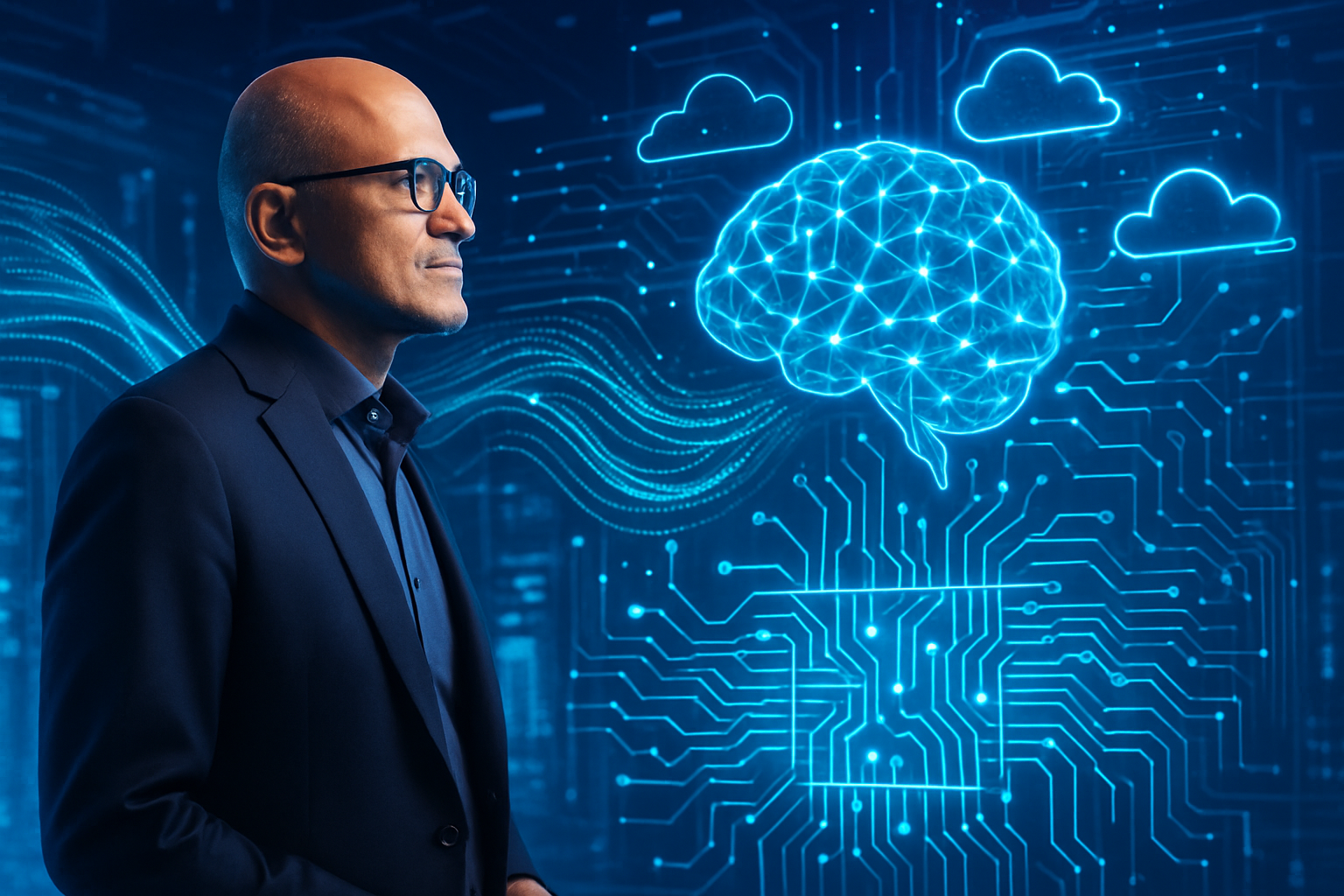
  • Microsoft Realigns for AI Supremacy: Nadella Takes the Helm of a Trillion-Dollar Transformation

    Microsoft Realigns for AI Supremacy: Nadella Takes the Helm of a Trillion-Dollar Transformation

    REDMOND, WA – October 2, 2025 – In a move signaling an unprecedented commitment to leading the artificial intelligence revolution, Microsoft (NASDAQ: MSFT) announced a significant leadership restructuring yesterday, October 1, 2025. CEO Satya Nadella has strategically reshuffled his executive team, effectively delegating extensive commercial responsibilities to Judson Althoff, now CEO of Commercial Business, to intensely focus his own efforts on AI development, data center expansion, systems architecture, and AI science. This pivot underscores Nadella's conviction that AI represents a "tectonic platform shift" poised to redefine productivity and drive substantial global economic growth.

    The immediate significance of this realignment is profound. Microsoft aims to solidify its position as the "partner of choice for AI transformation," targeting a rapidly expanding market estimated to be worth $3 trillion. By streamlining operational efficiencies and accelerating in-house AI innovation, the company is intensifying the global AI race, setting new benchmarks for productivity and cloud services, and reshaping the digital landscape. Investor confidence has surged, with Microsoft's stock price crossing the $500 mark, reflecting strong market validation for an AI-centric roadmap that promises sustained profitability and a dominant share in the AI-driven cloud market.

    Pioneering the AI Frontier: Microsoft's Technical Vision Unveiled

    Microsoft's renewed AI focus is underpinned by a robust technical strategy that includes the development of proprietary AI models, enhanced platforms, and monumental infrastructure investments. This approach marks a departure from solely relying on third-party solutions, emphasizing greater self-sufficiency and purpose-built AI systems.

    Among the notable in-house AI models are MAI-Voice-1, a high-speed, expressive speech generation model capable of producing a minute of high-quality audio in under a second on a single GPU. Integrated into Copilot Daily and Podcasts, it positions voice as a future primary interface for AI companions. Complementing this is MAI-1-preview, Microsoft's first internally developed foundation model, featuring a mixture-of-experts architecture trained on approximately 15,000 NVIDIA (NASDAQ: NVDA) H100 GPUs. Optimized for instruction following and everyday queries, MAI-1-preview is currently undergoing community benchmarking and is slated for integration into text-based Copilot use cases, offering API access to trusted testers.

    These models are deeply embedded within Microsoft's platform offerings. Microsoft 365 Copilot is seamlessly integrated across applications like Word, Excel, PowerPoint, Teams, and Outlook, leveraging natural language processing to assist users with content creation, data analysis, and workflow automation. Furthermore, Copilot Studio, a low-code/no-code platform, empowers organizations to build bespoke AI assistants tailored to their internal workflows and data, providing a significant leap from previous approaches like Power Virtual Agents by democratizing AI development within enterprises.

    To support these ambitions, Microsoft is undertaking massive infrastructure investments, including a commitment of $30 billion in the UK over four years for cloud and AI infrastructure, featuring the construction of the UK's largest supercomputer with over 23,000 NVIDIA GPUs. Globally, Microsoft is investing an estimated $80 billion in 2025 for AI-enabled data centers. The company is also developing custom AI chips, such as Azure Maia (an AI accelerator) and Azure Cobalt (a CPU), and innovating in cooling technologies like microfluidic cooling, which etches microscopic channels directly into silicon chips to remove heat three times more effectively than current methods. This integrated hardware-software strategy, coupled with a shift towards "agentic AI" capable of autonomous decision-making, represents a fundamental redefinition of the application stack. Initial reactions from the AI research community and industry experts have been overwhelmingly positive, highlighting Microsoft's competitive edge, the tangible productivity gains from Copilot, and the transformative potential of "agentic AI" for various industries.

    Reshaping the AI Battleground: Competitive Dynamics and Market Shifts

    Microsoft's aggressive AI strategy is sending ripples throughout the technology industry, creating both immense opportunities for some and intensified competitive pressures for others. The "cloud wars" are escalating, with AI capabilities now the primary battleground.

    While Microsoft (NASDAQ: MSFT) is developing its own custom chips, the overall surge in AI development continues to drive demand for high-performance GPUs, directly benefiting companies like NVIDIA (NASDAQ: NVDA) and Advanced Micro Devices (NASDAQ: AMD). Independent Software Vendors (ISVs) and developers also stand to gain, as Microsoft actively empowers them to build and integrate AI applications on its Azure platform, positioning Azure as a central hub for enterprise AI solutions. Niche AI startups offering specialized, customizable solutions that can integrate with major cloud platforms may also find new avenues for growth.

    However, major tech giants face significant competitive implications. Cloud rivals Amazon Web Services (AWS) and Google Cloud (NASDAQ: GOOGL) are under immense pressure to accelerate their own AI initiatives, with both making substantial capital investments in AI infrastructure and developing custom silicon (like Google's TPUs and Amazon's Trainium2 and Nova models) to reduce reliance on external suppliers. The relationship with OpenAI is also evolving; while Microsoft's foundational partnership has provided early access to cutting-edge AI, OpenAI is reportedly seeking more strategic independence, exploring partnerships with other cloud providers. Microsoft's own development of models like MAI-Voice-1 and MAI-1-preview could position OpenAI as a direct competitor in certain areas. Furthermore, other enterprise software rivals, such as Salesforce (NYSE: CRM) and Oracle (NYSE: ORCL), are compelled to rapidly advance their AI offerings to keep pace with Microsoft's deep integration of Copilot across its comprehensive suite of enterprise products.

    Microsoft's resulting market positioning is one of strong leadership. Its strategic partnership with OpenAI, coupled with its robust Azure cloud infrastructure, provides a powerful competitive advantage. The ability to seamlessly integrate AI into its vast and widely adopted product suite—from Microsoft 365 to Windows and GitHub—creates a "sticky" ecosystem that rivals struggle to replicate. The vertical integration strategy, encompassing custom AI chips and proprietary models, aims to reduce reliance on external partners, cut licensing costs, and gain greater control over the AI stack, ultimately boosting profit margins and competitive differentiation. This enterprise-first approach, backed by massive financial and R&D power, solidifies Microsoft as a critical infrastructure provider and a preferred partner for businesses seeking end-to-end AI solutions.

    The Broader AI Canvas: Societal Shifts and Ethical Imperatives

    Microsoft's intensified AI focus is not merely a corporate strategy; it's a driving force reshaping the broader AI landscape, impacting global innovation, workforce dynamics, and igniting crucial societal and ethical discussions. This strategic pivot underscores AI's ascent as a foundational technology, integrating intelligence into every facet of digital life.

    This move reflects the "AI Everywhere" trend, where AI transitions from a niche technology to an embedded intelligence within everyday software and services. Microsoft's aggressive integration of AI, particularly through Copilot, sets new benchmarks and intensifies pressure across the industry, driving a race towards Artificial General Intelligence (AGI) through collaborations like that with OpenAI. However, this consolidation of AI expertise among a few dominant players raises concerns about concentrated power and the potential for diverging from earlier visions of democratizing AI technology.

    Beyond direct competition, Microsoft's AI leadership profoundly impacts the global workforce and innovation. The integration of AI into tools like Copilot is projected to significantly enhance productivity, particularly for less experienced workers, enabling them to tackle more complex roles. However, this transformation also brings concerns about potential widespread job displacement and the loss of human knowledge if organizations prioritize AI over human effort. Simultaneously, there will be a surge in demand for skilled IT professionals capable of deploying and optimizing these new AI technologies. Microsoft's estimated $80 billion investment in building data centers worldwide underscores its intent to remain competitive in the global AI race, influencing geopolitical dynamics and the global balance of power in technology development.

    The rapid deployment of powerful AI tools also brings critical concerns. While Microsoft champions responsible AI development, guided by principles of fairness, reliability, safety, privacy, inclusiveness, transparency, and accountability, potential pitfalls remain. These include algorithmic bias, the spread of misinformation, the misuse of AI in harmful applications, and ensuring proper human oversight. Societal impacts center on potential job displacement and widening social inequalities if the benefits of AI are not broadly distributed. Economically, there is a risk of increased market concentration, with dominant tech companies potentially monopolizing AI expertise. From a regulatory standpoint, Microsoft's partnership with OpenAI has already attracted scrutiny regarding potential antitrust issues, as governments worldwide grapple with drafting AI laws that address high-risk applications and complex questions of AI rights.

    This current AI thrust marks a pivotal moment, drawing parallels to previous transformative periods like the advent of personal computing or the internet. While AI has a long history, the advent of generative AI and Microsoft's aggressive integration into widely used productivity suites is being hailed as a "major technological paradigm shift," fundamentally altering how work is done and fostering new levels of creativity. This moment is frequently described as a "critical juncture" and AI as the "defining technology of our time," underscoring its profound and enduring impact on society and the global economy.

    The Road Ahead: Anticipating AI's Next Evolution

    Microsoft's intensified AI focus is poised to drive significant near-term and long-term developments, impacting various sectors and presenting both immense opportunities and substantial challenges. The company is positioning itself at the forefront of the AI revolution, aiming to integrate AI deeply into its product ecosystem and provide foundational AI capabilities globally.

    In the near term, Microsoft's strategy heavily centers on the pervasive integration of its Copilot assistant across core product offerings. Enhanced productivity and efficiency are expected as Microsoft 365 Copilot embeds into everyday tools, assisting with content creation, data analysis, and workflow automation. The company is also empowering Independent Software Vendors (ISVs) to develop and integrate AI applications on Azure, aiming to become a central hub for enterprise AI solutions. Microsoft's continued strategic investments, including $80 billion globally in AI-enabled data centers in 2025, reinforce this commitment. Furthermore, a dual AI development strategy, balancing the pivotal partnership with OpenAI with strengthened in-house AI development through acquisitions like Inflection AI's team, aims to accelerate its proprietary model roadmap.

    Looking further ahead, Microsoft envisions AI as a transformative force shaping society, with a key long-term focus on advancing autonomous AI agents capable of planning and executing complex tasks. These agents are expected to handle increasingly proactive tasks, anticipating user needs. Microsoft Research is also dedicated to developing AI systems for scientific discovery, capable of understanding the "languages of nature" to drive breakthroughs in fields like biology and materials science, ultimately pushing towards Artificial General Intelligence (AGI). The democratization of AI, making advanced capabilities accessible to a wider range of users, remains a core objective, alongside continuous infrastructure expansion and optimization.

    Potential applications span industries: Microsoft 365 Copilot will profoundly transform workplaces by automating routine tasks and enhancing creativity; AI will advance diagnostics and drug discovery in healthcare; AI for Earth will address environmental sustainability; generative AI will optimize manufacturing processes; and AI will enhance accessibility, education, and cybersecurity. However, significant challenges remain. Technically, managing massive AI infrastructure, ensuring data quality and governance, addressing scalability constraints, refining AI accuracy to reduce "hallucinations," and managing the complexity of new tools are critical. Ethically, concerns around bias, transparency, accountability, privacy, security, plagiarism, and the misuse of AI demand continuous vigilance. Societally, job displacement, the need for massive reskilling efforts, and the potential for competitive imbalances among tech giants require proactive solutions and robust regulatory frameworks. Experts predict a shift from AI experimentation to execution in 2025, with the rise of AI agents and synthetic data dominance by 2030. Microsoft's disciplined capital allocation, AI-first innovation, and evolving partnerships position it as a juggernaut in the generative AI race, with responsible AI as a core, ongoing commitment.

    A New Era for AI: Microsoft's Defining Moment

    Microsoft's (NASDAQ: MSFT) recent leadership restructuring, placing CEO Satya Nadella squarely at the helm of its AI endeavors, marks a defining moment in the history of artificial intelligence. This strategic pivot, announced yesterday, October 1, 2025, is not merely an adjustment but a comprehensive "reinvention" aimed at harnessing AI as the singular, most transformative technology of our time.

    Key takeaways from this monumental shift include Nadella's unprecedented personal focus on AI, massive financial commitments exceeding $80 billion globally for AI data centers in 2025, a dual strategy of deepening its OpenAI partnership while aggressively developing in-house AI models like MAI-Voice-1 and MAI-1-preview, and the ubiquitous integration of Copilot across its vast product ecosystem. This "AI-first" strategy, characterized by vertical integration from custom chips to cloud platforms and applications, solidifies Microsoft's position as a dominant force in the generative AI race.

    In the annals of AI history, this move is comparable to the foundational shifts brought about by personal computing or the internet. By deeply embedding AI into its core productivity suite and cloud services, Microsoft is not just accelerating adoption but also setting new industry standards for responsible AI deployment. The long-term impact is expected to be transformative, fundamentally altering how work is done, fostering new levels of creativity, and reshaping the global workforce. Businesses and individuals will increasingly rely on AI-powered tools, leading to significant productivity gains and creating ample opportunities for ISVs and System Integrators to build a new wave of innovation on Microsoft's platforms. This strategic pivot is projected to drive sustained profitability and market leadership for Microsoft for years to come.

    In the coming weeks and months, the tech world will be closely watching several key indicators. Monitor the adoption rates and monetization success of Copilot features and Microsoft 365 Premium subscriptions. Observe the competitive responses from rivals like Amazon (NASDAQ: AMZN), Google (NASDAQ: GOOGL), and NVIDIA (NASDAQ: NVDA), as the AI arms race intensifies. Regulatory developments concerning AI ethics, data privacy, and antitrust scrutiny will also be crucial. Furthermore, keep an eye on Microsoft's proprietary AI model evolution and how it balances with its ongoing OpenAI partnership, especially as OpenAI explores relationships with other infrastructure providers. Finally, Microsoft's upcoming earnings reports, such as the one on October 28, 2025, will provide vital insights into the financial implications of its aggressive AI expansion. The continued emergence of autonomous AI agents capable of multi-step workflows will signal the next frontier, blending machine intelligence with human judgment in what promises to be a truly revolutionary era.

    This content is intended for informational purposes only and represents analysis of current AI developments.

    TokenRing AI delivers enterprise-grade solutions for multi-agent AI workflow orchestration, AI-powered development tools, and seamless remote collaboration platforms.
    For more information, visit https://www.tokenring.ai/.