Tag: Llama 3.2

  • Meta’s Llama 3.2: The “Hyper-Edge” Catalyst Bringing Multimodal Intelligence to the Pocket

    Meta’s Llama 3.2: The “Hyper-Edge” Catalyst Bringing Multimodal Intelligence to the Pocket

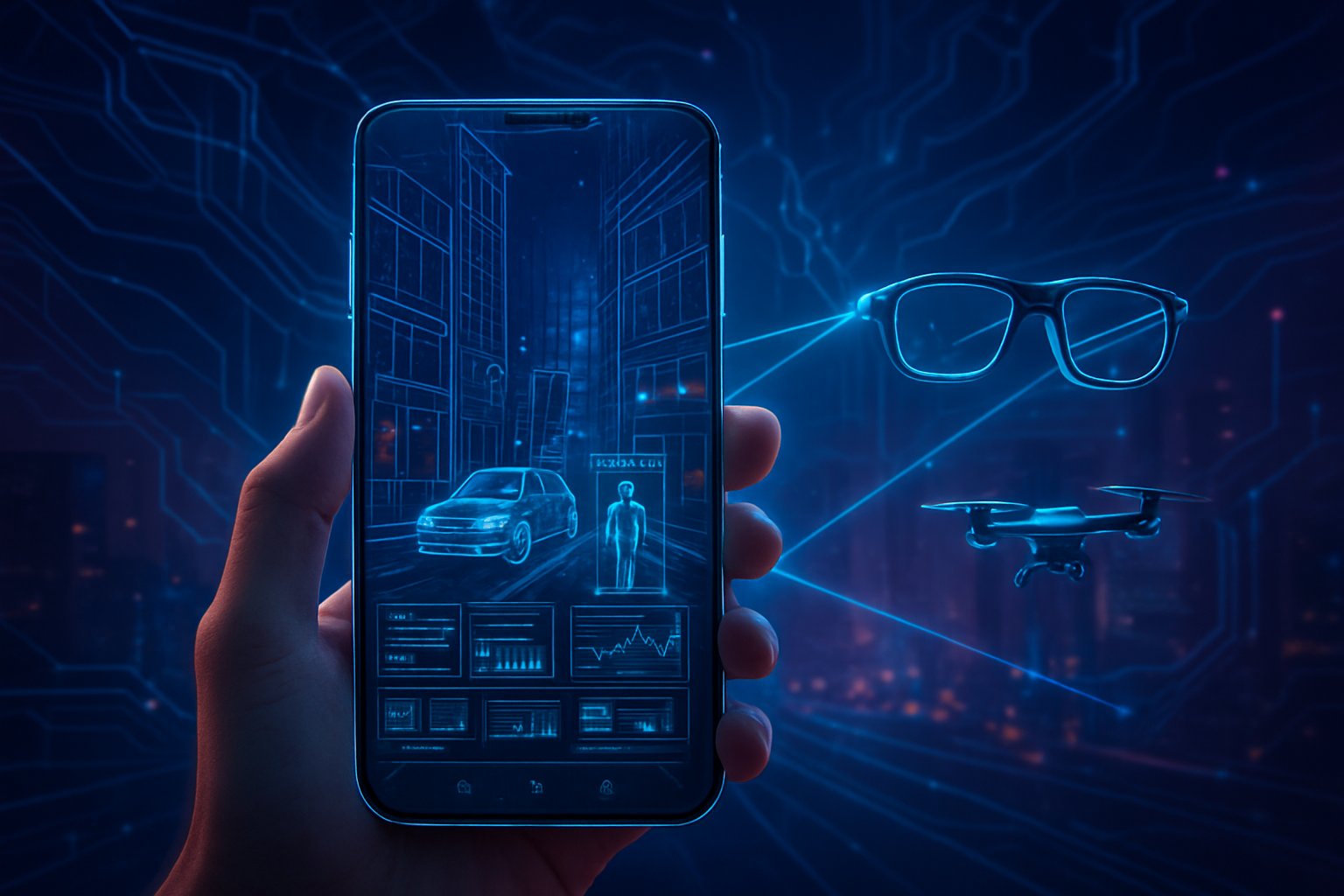
    As of early 2026, the artificial intelligence landscape has undergone a seismic shift from centralized data centers to the palm of the hand. At the heart of this transition is Meta Platforms, Inc. (NASDAQ: META) and its Llama 3.2 model series. While the industry has since moved toward the massive-scale Llama 4 family and "Project Avocado" architectures, Llama 3.2 remains the definitive milestone that proved sophisticated visual reasoning and agentic workflows could thrive entirely offline. By combining high-performance vision-capable models with ultra-lightweight text variants, Meta has effectively democratized "on-device" intelligence, fundamentally altering how consumers interact with their hardware.

    The immediate significance of Llama 3.2 lies in its "small-but-mighty" philosophy. Unlike its predecessors, which required massive server clusters to handle even basic multimodal tasks, Llama 3.2 was engineered specifically for mobile deployment. This development has catalyzed a new era of "Hyper-Edge" computing, where 55% of all AI inference now occurs locally on smartphones, wearables, and IoT devices. For the first time, users can process sensitive visual data—from private medical documents to real-time home security feeds—without a single packet of data leaving the device, marking a victory for both privacy and latency.

    Technical Architecture: Vision Adapters and Knowledge Distillation

    Technically, Llama 3.2 represents a masterclass in efficiency, divided into two distinct categories: the vision-enabled models (11B and 90B) and the lightweight edge models (1B and 3B). To achieve vision capabilities in the 11B and 90B variants, Meta researchers utilized a "compositional" adapter-based architecture. Rather than retraining a multimodal model from scratch, they integrated a Vision Transformer (ViT-H/14) encoder with the pre-trained Llama 3.1 text backbone. This was accomplished through a series of cross-attention layers that allow the language model to "attend" to visual tokens. As a result, these models can analyze complex charts, provide image captioning, and perform visual grounding with a massive 128K token context window.

    The 1B and 3B models, however, are perhaps the most influential for the 2026 mobile ecosystem. These models were not trained in a vacuum; they were "pruned" and "distilled" from the much larger Llama 3.1 8B and 70B models. Through a process of structured width pruning, Meta systematically removed less critical neurons while retaining the core knowledge base. This was followed by knowledge distillation, where the larger "teacher" models guided the "student" models to mimic their reasoning patterns. Initial reactions from the research community lauded this approach, noting that the 3B model often outperformed larger 7B models from 2024, providing a "distilled essence" of intelligence optimized for the Neural Processing Units (NPUs) found in modern silicon.

    The Strategic Power Shift: Hardware Giants and the Open Source Moat

    The market impact of Llama 3.2 has been transformative for the entire hardware industry. Strategic partnerships with Qualcomm (NASDAQ: QCOM), MediaTek (TWSE: 2454), and Arm (NASDAQ: ARM) have led to the creation of dedicated "Llama-optimized" hardware blocks. By January 2026, flagship chips like the Snapdragon 8 Gen 4 are capable of running Llama 3.2 3B at speeds exceeding 200 tokens per second using 4-bit quantization. This has allowed Meta to use open-source as a "Trojan Horse," commoditizing the intelligence layer and forcing competitors like Alphabet Inc. (NASDAQ: GOOGL) and Apple Inc. (NASDAQ: AAPL) to defend their closed-source ecosystems against a wave of high-performance, free-to-use alternatives.

    For startups, the availability of Llama 3.2 has ended the era of "API arbitrage." In 2026, success no longer comes from simply wrapping a GPT-4o-mini API; it comes from building "edge-native" applications. Companies specializing in robotics and wearables, such as those developing the next generation of smart glasses, are leveraging Llama 3.2 to provide real-time AR overlays that are entirely private and lag-free. By making these models open-source, Meta has effectively empowered a global "AI Factory" movement where enterprises can maintain total data sovereignty, bypassing the subscription costs and privacy risks associated with cloud-only providers like OpenAI or Microsoft (NASDAQ: MSFT).

    Privacy, Energy, and the Global Regulatory Landscape

    Beyond the balance sheets, Llama 3.2 has significant societal implications, particularly concerning data privacy and energy sustainability. In the context of the EU AI Act, which becomes fully applicable in mid-2026, local models have become the "safe harbor" for developers. Because Llama 3.2 operates on-device, it often avoids the heavy compliance burdens placed on high-risk cloud models. This shift has also addressed the growing environmental backlash against AI; recent data suggests that on-device inference consumes up to 95% less energy than sending a request to a remote data center, largely due to the elimination of data transmission and the efficiency of modern NPUs from Intel (NASDAQ: INTC) and AMD (NASDAQ: AMD).

    However, the transition to on-device AI has not been without concerns. The ability to run powerful vision models locally has raised questions about "dark AI"—untraceable models used for generating deepfakes or bypassing content filters in an "air-gapped" environment. To mitigate this, the 2026 tech stack has integrated hardware-level digital watermarking into NPUs. Comparing this to the 2022 release of ChatGPT, the industry has moved from a "wow" phase to a "how" phase, where the primary challenge is no longer making AI smart, but making it responsible and efficient enough to live within the constraints of a battery-powered device.

    The Horizon: From Llama 3.2 to Agentic "Post-Transformer" AI

    Looking toward the future, the legacy of Llama 3.2 is paving the way for the "Post-Transformer" era. While Llama 3.2 set the standard for 2024 and 2025, early 2026 is seeing the rise of even more efficient architectures. Technologies like BitNet (1-bit LLMs) and Liquid Neural Networks are beginning to succeed the standard Llama architecture by offering 10x the energy efficiency for robotics and long-context processing. Meta's own upcoming "Project Mango" is rumored to integrate native video generation and processing into an ultra-slim footprint, moving beyond the adapter-based vision approach of Llama 3.2.

    The next major frontier is "Agentic AI," where models do not just respond to text but autonomously orchestrate tasks. In this new paradigm, Llama 3.2 3B often serves as the "local orchestrator," a trusted agent that manages a user's calendar, summarizes emails, and calls upon more powerful models like NVIDIA (NASDAQ: NVDA) H200-powered cloud clusters only when necessary. Experts predict that within the next 24 months, the concept of a "standalone app" will vanish, replaced by a seamless fabric of interoperable local agents built on the foundations laid by the Llama series.

    A Lasting Legacy for the Open-Source Movement

    In summary, Meta’s Llama 3.2 has secured its place in AI history as the model that "liberated" intelligence from the server room. Its technical innovations in pruning, distillation, and vision adapters proved that the trade-off between model size and performance could be overcome, making AI a ubiquitous part of the physical world rather than a digital curiosity. By prioritizing edge-computing and mobile applications, Meta has not only challenged the dominance of cloud-first giants but has also established a standardized "Llama Stack" that developers now use as the default blueprint for on-device AI.

    As we move deeper into 2026, the industry's focus will likely shift toward "Sovereign AI" and the continued refinement of agentic workflows. Watch for upcoming announcements regarding the integration of Llama-derived models into automotive systems and medical wearables, where the low latency and high privacy of Llama 3.2 are most critical. The "Hyper-Edge" is no longer a futuristic concept—it is the current reality, and it began with the strategic release of a model small enough to fit in a pocket, but powerful enough to see the world.


    This content is intended for informational purposes only and represents analysis of current AI developments.

    TokenRing AI delivers enterprise-grade solutions for multi-agent AI workflow orchestration, AI-powered development tools, and seamless remote collaboration platforms.
    For more information, visit https://www.tokenring.ai/.
  • The Death of Cloud Dependency: How Small Language Models Like Llama 3.2 and FunctionGemma Rewrote the AI Playbook

    The Death of Cloud Dependency: How Small Language Models Like Llama 3.2 and FunctionGemma Rewrote the AI Playbook

    The artificial intelligence landscape has reached a decisive tipping point. As of January 26, 2026, the era of the "Cloud-First" AI dominance is officially ending, replaced by a "Localized AI" revolution that places the power of superintelligence directly into the pockets of billions. While the tech world once focused on massive models with trillions of parameters housed in energy-hungry data centers, today’s most significant breakthroughs are happening at the "Hyper-Edge"—on smartphones, smart glasses, and IoT sensors that operate with total privacy and zero latency.

    The announcement today from Alphabet Inc. (NASDAQ: GOOGL) regarding FunctionGemma, a 270-million parameter model designed for on-device API calling, marks the latest milestone in a journey that began with Meta Platforms, Inc. (NASDAQ: META) and its release of Llama 3.2 in late 2024. These "Small Language Models" (SLMs) have evolved from being mere curiosities to the primary engine of modern digital life, fundamentally changing how we interact with technology by removing the tether to the cloud for routine, sensitive, and high-speed tasks.

    The Technical Evolution: From 3B Parameters to 1.58-Bit Efficiency

    The shift toward localized AI was catalyzed by the release of Llama 3.2’s 1B and 3B models in September 2024. These models were the first to demonstrate that high-performance reasoning did not require massive server racks. By early 2026, the industry has refined these techniques through Knowledge Distillation and Mixture-of-Experts (MoE) architectures. Google’s new FunctionGemma (270M) takes this to the extreme, utilizing a "Thinking Split" architecture that allows the model to handle complex function calls locally, reaching 85% accuracy in translating natural language into executable code—all without sending a single byte of data to a remote server.

    A critical technical breakthrough fueling this rise is the widespread adoption of BitNet (1.58-bit) architectures. Unlike the traditional 16-bit or 8-bit floating-point models of 2024, 2026’s edge models use ternary weights (-1, 0, 1), drastically reducing the memory bandwidth and power consumption required for inference. When paired with the latest silicon like the MediaTek (TPE: 2454) Dimensity 9500s, which features native 1-bit hardware acceleration, these models run at speeds exceeding 220 tokens per second. This is significantly faster than human reading speed, making AI interactions feel instantaneous and fluid rather than conversational and laggy.

    Furthermore, the "Agentic Edge" has replaced simple chat interfaces. Today’s SLMs are no longer just talking heads; they are autonomous agents. Thanks to the integration of Microsoft Corp. (NASDAQ: MSFT) and its Model Context Protocol (MCP), models like Phi-4-mini can now interact with local files, calendars, and secure sensors to perform multi-step workflows—such as rescheduling a missed flight and updating all stakeholders—entirely on-device. This differs from the 2024 approach, where "agents" were essentially cloud-based scripts with high latency and significant privacy risks.

    Strategic Realignment: How Tech Giants are Navigating the Edge

    This transition has reshaped the competitive landscape for the world’s most powerful tech companies. Qualcomm Inc. (NASDAQ: QCOM) has emerged as a dominant force in the AI era, with its recently leaked Snapdragon 8 Elite Gen 6 "Pro" rumored to hit 6GHz clock speeds on a 2nm process. Qualcomm’s focus on NPU-first architecture has forced competitors to rethink their hardware strategies, moving away from general-purpose CPUs toward specialized AI silicon that can handle 7B+ parameter models on a mobile thermal budget.

    For Meta Platforms, Inc. (NASDAQ: META), the success of the Llama series has solidified its position as the "Open Source Architect" of the edge. By releasing the weights for Llama 3.2 and its 2025 successor, Llama 4 Scout, Meta has created a massive ecosystem of developers who prefer Meta’s architecture for private, self-hosted deployments. This has effectively sidelined cloud providers who relied on high API fees, as startups now opt to run high-efficiency SLMs on their own hardware.

    Meanwhile, NVIDIA Corporation (NASDAQ: NVDA) has pivoted its strategy to maintain dominance in a localized world. Following its landmark $20 billion acquisition of Groq in early 2026, NVIDIA has integrated ultra-high-speed Language Processing Units (LPUs) into its edge computing stack. This move is aimed at capturing the robotics and autonomous vehicle markets, where real-time inference is a life-or-death requirement. Apple Inc. (NASDAQ: AAPL) remains the leader in the consumer segment, recently announcing Apple Creator Studio, which uses a hybrid of on-device OpenELM models for privacy and Google Gemini for complex, cloud-bound creative tasks, maintaining a premium "walled garden" experience that emphasizes local security.

    The Broader Impact: Privacy, Sovereignty, and the End of Latency

    The rise of SLMs represents a paradigm shift in the social contract of the internet. For the first time since the dawn of the smartphone, "Privacy by Design" is a functional reality rather than a marketing slogan. Because models like Llama 3.2 and FunctionGemma can process voice, images, and personal data locally, the risk of data breaches or corporate surveillance during routine AI interactions has been virtually eliminated for users of modern flagship devices. This "Offline Necessity" has made AI accessible in environments with poor connectivity, such as rural areas or secure government facilities, democratizing the technology.

    However, this shift also raises concerns regarding the "AI Divide." As high-performance local AI requires expensive, cutting-edge NPUs and LPDDR6 RAM, a gap is widening between those who can afford "Private AI" on flagship hardware and those relegated to cloud-based services that may monetize their data. This mirrors previous milestones like the transition from desktop to mobile, where the hardware itself became the primary gatekeeper of innovation.

    Comparatively, the transition to SLMs is seen as a more significant milestone than the initial launch of ChatGPT. While ChatGPT introduced the world to generative AI, the rise of on-device SLMs has integrated AI into the very fabric of the operating system. In 2026, AI is no longer a destination—a website or an app you visit—but a pervasive, invisible layer of the user interface that anticipates needs and executes tasks in real-time.

    The Horizon: 1-Bit Models and Wearable Ubiquity

    Looking ahead, experts predict that the next eighteen months will focus on the "Shrink-to-Fit" movement. We are moving toward a world where 1-bit models will enable complex AI to run on devices as small as a ring or a pair of lightweight prescription glasses. Meta’s upcoming "Avocado" and "Mango" models, developed by their recently reorganized Superintelligence Labs, are expected to provide "world-aware" vision capabilities for the Ray-Ban Meta Gen 3 glasses, allowing the device to understand and interact with the physical environment in real-time.

    The primary challenge remains the "Memory Wall." While NPUs have become incredibly fast, the bandwidth required to move model weights from memory to the processor remains a bottleneck. Industry insiders anticipate a surge in Processing-in-Memory (PIM) technologies by late 2026, which would integrate AI processing directly into the RAM chips themselves, potentially allowing even smaller devices to run 10B+ parameter models with minimal heat generation.

    Final Thoughts: A Localized Future

    The evolution from the massive, centralized models of 2023 to the nimble, localized SLMs of 2026 marks a turning point in the history of computation. By prioritizing efficiency over raw size, companies like Meta, Google, and Microsoft have made AI more resilient, more private, and significantly more useful. The legacy of Llama 3.2 is not just in its weights or its performance, but in the shift in philosophy it inspired: that the most powerful AI is the one that stays with you, works for you, and never needs to leave your palm.

    In the coming weeks, the industry will be watching the full rollout of Google’s FunctionGemma and the first benchmarks of the Snapdragon 8 Elite Gen 6. As these technologies mature, the "Cloud AI" of the past will likely be reserved for only the most massive scientific simulations, while the rest of our digital lives will be powered by the tiny, invisible giants living inside our pockets.


    This content is intended for informational purposes only and represents analysis of current AI developments.

    TokenRing AI delivers enterprise-grade solutions for multi-agent AI workflow orchestration, AI-powered development tools, and seamless remote collaboration platforms.
    For more information, visit https://www.tokenring.ai/.
  • The Small Model Revolution: Powerful AI That Runs Entirely on Your Phone

    The Small Model Revolution: Powerful AI That Runs Entirely on Your Phone

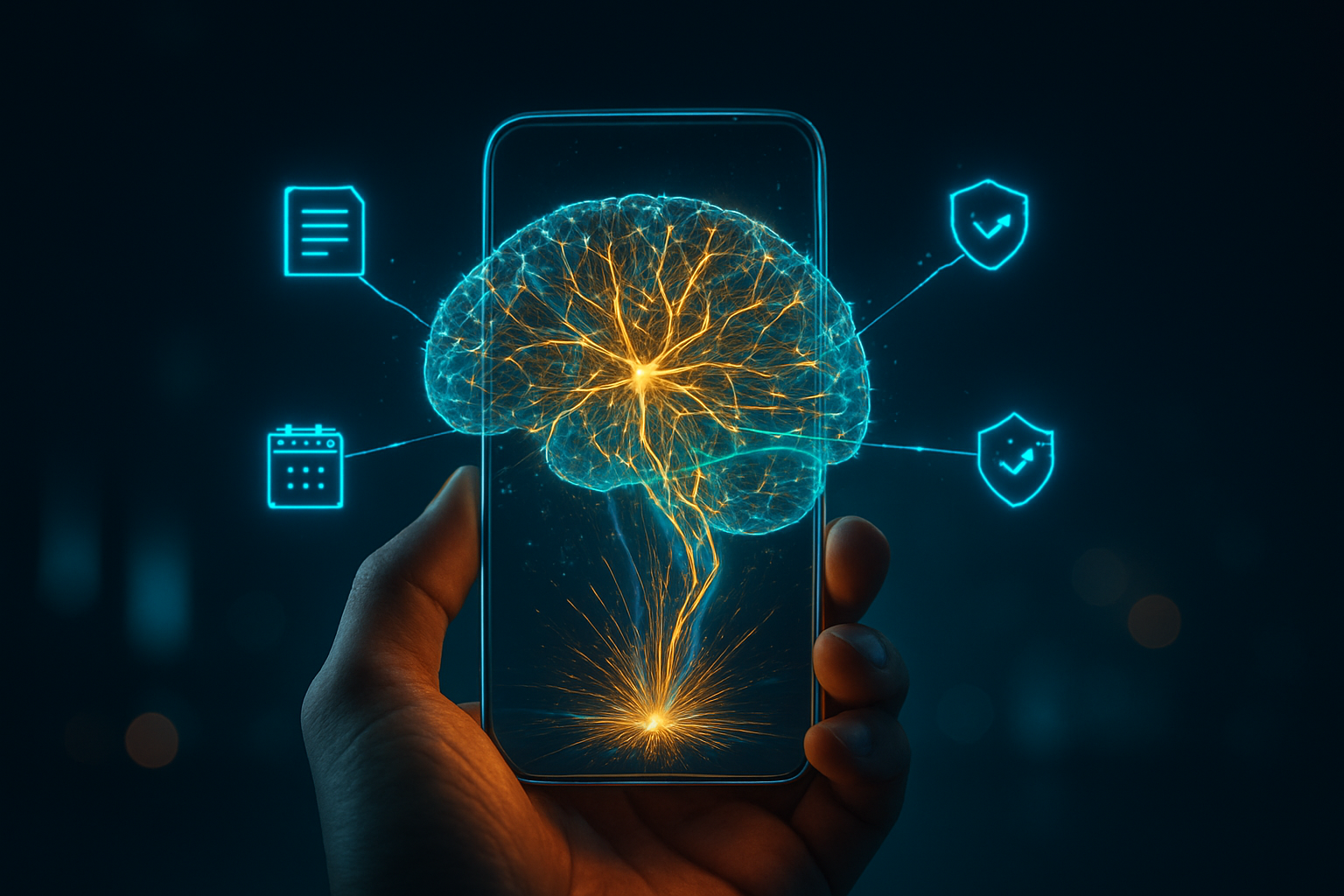
    For years, the narrative of artificial intelligence was defined by "bigger is better." Massive, power-hungry models like GPT-4 required sprawling data centers and billion-dollar investments to function. However, as of early 2026, the tide has officially turned. The "Small Model Revolution"—a movement toward highly efficient Small Language Models (SLMs) like Meta’s Llama 3.2 1B and 3B—has successfully migrated world-class intelligence from the cloud directly into the silicon of our smartphones. This shift marks a fundamental change in how we interact with technology, moving away from centralized, latency-heavy APIs toward instant, private, and local digital assistants.

    The significance of this transition cannot be overstated. By January 2026, the industry has reached an "Inference Inflection Point," where the majority of daily AI tasks—summarizing emails, drafting documents, and even complex coding—are handled entirely on-device. This development has effectively dismantled the "Cloud Tax," the high operational costs and privacy risks associated with sending personal data to remote servers. What began as a technical experiment in model compression has matured into a sophisticated ecosystem where your phone is no longer just a portal to an AI; it is the AI.

    The Architecture of Efficiency: How SLMs Outperform Their Weight Class

    The technical breakthrough that enabled this revolution lies in the transition from training models from scratch to "knowledge distillation" and "structured pruning." When Meta Platforms Inc. (NASDAQ: META) released Llama 3.2 in late 2024, it demonstrated that a 3-billion parameter model could achieve reasoning capabilities that previously required 10 to 20 times the parameters. Engineers achieved this by using larger "teacher" models to train smaller "students," effectively condensing the logic and world knowledge of a massive LLM into a compact footprint. These models feature a massive 128K token context window, allowing them to process entire books or long legal documents locally on a mobile device without running out of memory.

    This software efficiency is matched by unprecedented hardware synergy. The latest mobile chipsets, such as the Qualcomm Inc. (NASDAQ: QCOM) Snapdragon 8 Elite and the Apple Inc. (NASDAQ: AAPL) A19 Pro, are specifically designed with dedicated Neural Processing Units (NPUs) to handle these workloads. By early 2026, these chips deliver over 80 Tera Operations Per Second (TOPS), allowing a model like Llama 3.2 1B to run at speeds exceeding 30 tokens per second. This is faster than the average human reading speed, making the AI feel like a seamless extension of the user’s own thought process rather than a slow, typing chatbot.

    Furthermore, the integration of Grouped-Query Attention (GQA) has solved the memory bandwidth bottleneck that previously plagued mobile AI. By reducing the amount of data the processor needs to fetch from the phone’s RAM, SLMs can maintain high performance while consuming significantly less battery. Initial reactions from the research community have shifted from skepticism about "small model reasoning" to a race for "ternary" efficiency. We are now seeing the emergence of 1.58-bit models—often called "BitNet" architectures—which replace complex multiplications with simple additions, potentially reducing AI energy footprints by another 70% in the coming year.

    The Silicon Power Play: Tech Giants Battle for the Edge

    The shift to local processing has ignited a strategic war among tech giants, as the control of AI moves from the data center to the device. Apple has leveraged its vertical integration to position "Apple Intelligence" as a privacy-first moat, ensuring that sensitive user data never leaves the iPhone. By early 2026, the revamped Siri, powered by specialized on-device foundation models, has become the primary interface for millions, performing multi-step tasks like "Find the receipt from my dinner last night and add it to my expense report" without ever touching the cloud.

    Meanwhile, Microsoft Corporation (NASDAQ: MSFT) has pivoted its Phi model series to target the enterprise sector. Models like Phi-4 Mini have achieved reasoning parity with the original GPT-4, allowing businesses to deploy "Agentic OS" environments on local laptops. This has been a massive disruption for cloud-only providers; enterprises in regulated industries like healthcare and finance are moving away from expensive API subscriptions in favor of self-hosted SLMs. Alphabet Inc. (NASDAQ: GOOGL) has responded with its Gemma 3 series, which is natively multimodal, allowing Android devices to process text, image, and video inputs simultaneously on a single chip.

    The competitive landscape is no longer just about who has the largest model, but who has the most efficient one. This has created a "trickle-down" effect where startups can now build powerful AI applications without the massive overhead of cloud computing costs. Market data from late 2025 indicates that the cost to achieve high-level AI performance has plummeted by over 98%, leading to a surge in specialized "Edge AI" startups that focus on everything from real-time translation to autonomous local coding assistants.

    The Privacy Paradigm and the End of the Cloud Tax

    The wider significance of the Small Model Revolution is rooted in digital sovereignty. For the first time since the rise of the cloud, users have regained control over their data. Because SLMs process information locally, they are inherently immune to the data breaches and privacy concerns that have dogged centralized AI. This is particularly critical in the wake of the EU AI Act, which reached full compliance requirements in 2026. Local processing allows companies to satisfy strict GDPR and HIPAA requirements by ensuring that patient records or proprietary trade secrets remain behind the corporate firewall.

    Beyond privacy, the "democratization of intelligence" is a key social impact. In regions with limited internet connectivity, on-device AI provides a "pocket brain" that works in airplane mode. This has profound implications for education and emergency services in developing nations, where access to high-speed data is not guaranteed. The move to SLMs has also mitigated the "Cloud Tax"—the recurring monthly fees that were becoming a barrier to AI adoption for small businesses. By moving inference to the user's hardware, the marginal cost of an AI query has effectively dropped to zero.

    However, this transition is not without concerns. The rise of powerful, uncensored local models has sparked debates about AI safety and the potential for misuse. Unlike cloud models, which can be "turned off" or filtered by the provider, a model running locally on a phone is much harder to regulate. This has led to a new focus on "on-device guardrails"—lightweight safety layers that run alongside the SLM to prevent the generation of harmful content while respecting the user's privacy.

    Beyond Chatbots: The Rise of the Autonomous Agent

    Looking toward the remainder of 2026 and into 2027, the focus is shifting from "chatting" to "acting." The next generation of SLMs, such as the rumored Llama 4 "Scout" series, are being designed as autonomous agents with "screen awareness." These models will be able to "see" what is on a user's screen and navigate apps just like a human would. This will transform smartphones from passive tools into proactive assistants that can book travel, manage calendars, and coordinate complex projects across multiple platforms without manual intervention.

    Another major frontier is the integration of 6G edge computing. While the models themselves run locally, 6G will allow for "split-inference," where a mobile device handles the privacy-sensitive parts of a task and offloads the most compute-heavy reasoning to a nearby edge server. This hybrid approach promises to deliver the power of a trillion-parameter model with the latency of a local one. Experts predict that by 2028, the distinction between "local" and "cloud" AI will have blurred entirely, replaced by a fluid "Intelligence Fabric" that scales based on the task at hand.

    Conclusion: A New Era of Personal Computing

    The Small Model Revolution represents one of the most significant milestones in the history of artificial intelligence. It marks the transition of AI from a distant, mysterious power housed in massive server farms to a personal, private, and ubiquitous utility. The success of models like Llama 3.2 1B and 3B has proven that intelligence is not a function of size alone, but of architectural elegance and hardware optimization.

    As we move further into 2026, the key takeaway is that the "AI in your pocket" is no longer a toy—it is a sophisticated tool capable of handling the majority of human-AI interactions. The long-term impact will be a more resilient, private, and cost-effective digital world. In the coming weeks, watch for major announcements at the upcoming spring hardware summits, where the next generation of "Ternary" chips and "Agentic" operating systems are expected to push the boundaries of what a handheld device can achieve even further.


    This content is intended for informational purposes only and represents analysis of current AI developments.

    TokenRing AI delivers enterprise-grade solutions for multi-agent AI workflow orchestration, AI-powered development tools, and seamless remote collaboration platforms.
    For more information, visit https://www.tokenring.ai/.
  • The Rise of Small Language Models: How Llama 3.2 and Phi-3 are Revolutionizing On-Device AI

    The Rise of Small Language Models: How Llama 3.2 and Phi-3 are Revolutionizing On-Device AI

    As we enter 2026, the landscape of artificial intelligence has undergone a fundamental shift from massive, centralized data centers to the silicon in our pockets. The "bigger is better" mantra that dominated the early 2020s has been challenged by a new generation of Small Language Models (SLMs) that prioritize efficiency, privacy, and speed. What began as an experimental push by tech giants in 2024 has matured into a standard where high-performance AI no longer requires an internet connection or a subscription to a cloud provider.

    This transformation was catalyzed by the release of Meta Platforms, Inc. (NASDAQ:META) Llama 3.2 and Microsoft Corporation (NASDAQ:MSFT) Phi-3 series, which proved that models with fewer than 4 billion parameters could punch far above their weight. Today, these models serve as the backbone for "Agentic AI" on smartphones and laptops, enabling real-time, on-device reasoning that was previously thought to be the exclusive domain of multi-billion parameter giants.

    The Engineering of Efficiency: From Llama 3.2 to Phi-4

    The technical foundation of the SLM movement lies in the art of compression and specialized architecture. Meta’s Llama 3.2 1B and 3B models were pioneers in using structured pruning and knowledge distillation—a process where a massive "teacher" model (like Llama 3.1 405B) trains a "student" model to retain core reasoning capabilities in a fraction of the size. By utilizing Grouped-Query Attention (GQA), these models significantly reduced memory bandwidth requirements, allowing them to run fluidly on standard mobile RAM.

    Microsoft's Phi-3 and the subsequent Phi-4-mini-flash models took a different approach, focusing on "textbook quality" data. Rather than scraping the entire web, Microsoft researchers curated high-quality synthetic data to teach the models logic and STEM subjects. By early 2026, the Phi-4 series has introduced hybrid architectures like SambaY, which combines State Space Models (SSM) with traditional attention mechanisms. This allows for 10x higher throughput and near-instantaneous response times, effectively eliminating the "typing" lag associated with cloud-based LLMs.

    The integration of BitNet 1.58-bit technology has been another technical milestone. This "ternary" approach allows models to operate using only -1, 0, and 1 as weights, drastically reducing the computational power required for inference. When paired with 4-bit and 8-bit quantization, these models can occupy 75% less space than their predecessors while maintaining nearly identical accuracy in common tasks like summarization, coding assistance, and natural language understanding.

    Industry experts initially viewed SLMs as "lite" versions of real AI, but the reaction has shifted to one of awe as benchmarks narrow the gap. The AI research community now recognizes that for 80% of daily tasks—such as drafting emails, scheduling, and local data analysis—an optimized 3B parameter model is not just sufficient, but superior due to its zero-latency performance.

    A New Competitive Battlefield for Tech Titans

    The rise of SLMs has redistributed power across the tech ecosystem, benefiting hardware manufacturers and device OEMs as much as the software labs. Qualcomm Incorporated (NASDAQ:QCOM) has emerged as a primary beneficiary, with its Snapdragon 8 Elite (Gen 5) chipsets featuring dedicated NPUs (Neural Processing Units) capable of 80+ TOPS (Tera Operations Per Second). This hardware allows the latest Llama and Phi models to run entirely on-device, creating a massive incentive for consumers to upgrade to "AI-native" hardware.

    Apple Inc. (NASDAQ:AAPL) has leveraged this trend to solidify its ecosystem through Apple Intelligence. By running a 3B-parameter "controller" model locally on the A19 Pro chip, Apple ensures that Siri can handle complex requests—like "Find the document my boss sent yesterday and summarize the third paragraph"—without ever sending sensitive user data to the cloud. This has forced Alphabet Inc. (NASDAQ:GOOGL) to accelerate its own on-device Gemini Nano deployments to maintain the competitiveness of the Android ecosystem.

    For startups, the shift toward SLMs has lowered the barrier to entry for AI integration. Instead of paying exorbitant API fees to OpenAI or Anthropic, developers can now embed open-source models like Llama 3.2 directly into their applications. This "local-first" approach reduces operational costs to nearly zero and removes the privacy hurdles that previously prevented AI from being used in highly regulated sectors like healthcare and legal services.

    The strategic advantage has moved from those who own the most GPUs to those who can most effectively optimize models for the edge. Companies that fail to provide a compelling on-device experience are finding themselves at a disadvantage, as users increasingly prioritize privacy and the ability to use AI in "airplane mode" or areas with poor connectivity.

    Privacy, Latency, and the End of the 'Cloud Tax'

    The wider significance of the SLM revolution cannot be overstated; it represents the "democratization of intelligence" in its truest form. By moving processing to the device, the industry has addressed the two biggest criticisms of the LLM era: privacy and environmental impact. On-device AI ensures that a user’s most personal data—messages, photos, and calendar events—never leaves the local hardware, mitigating the risks of data breaches and intrusive profiling.

    Furthermore, the environmental cost of AI is being radically restructured. Cloud-based AI requires massive amounts of water and electricity to maintain data centers. In contrast, running an optimized 1B-parameter model on a smartphone uses negligible power, shifting the energy burden from centralized grids to individual, battery-efficient devices. This shift mirrors the transition from mainframes to personal computers in the 1980s, marking a move toward personal agency and digital sovereignty.

    However, this transition is not without concerns. The proliferation of powerful, offline AI models makes content moderation and safety filtering more difficult. While cloud providers can update their "guardrails" instantly, an SLM running on a disconnected device operates according to its last local update. This has sparked ongoing debates among policymakers about the responsibility of model weights and the potential for offline models to be used for generating misinformation or malicious code without oversight.

    Compared to previous milestones like the release of GPT-4, the rise of SLMs is a "quiet revolution." It isn't defined by a single world-changing demo, but by the gradual, seamless integration of intelligence into every app and interface we use. It is the transition of AI from a destination we visit (a chat box) to a layer of the operating system that anticipates our needs.

    The Road Ahead: Agentic AI and Screen Awareness

    Looking toward the remainder of 2026 and into 2027, the focus is shifting from "chatting" to "doing." The next generation of SLMs, such as the rumored Llama 4 Scout, are expected to feature "screen awareness," where the model can see and interact with any application the user is currently running. This will turn smartphones into true digital agents capable of multi-step task execution, such as booking a multi-leg trip by interacting with various travel apps on the user's behalf.

    We also expect to see the rise of "Personalized SLMs," where models are continuously fine-tuned on a user's local data in real-time. This would allow an AI to learn a user's specific writing style, professional jargon, and social nuances without that data ever being shared with a central server. The technical challenge remains balancing this continuous learning with the limited thermal and battery budgets of mobile devices.

    Experts predict that by 2028, the distinction between "Small" and "Large" models may begin to blur. We are likely to see "federated" systems where a local SLM handles the majority of tasks but can seamlessly "delegate" hyper-complex reasoning to a larger cloud model when necessary—a hybrid approach that optimizes for both speed and depth.

    Final Reflections on the SLM Era

    The rise of Small Language Models marks a pivotal chapter in the history of computing. By proving that Llama 3.2 and Phi-3 could deliver sophisticated intelligence on consumer hardware, Meta and Microsoft have effectively ended the era of cloud-only AI. This development has transformed the smartphone from a communication tool into a proactive personal assistant, all while upholding the critical pillars of user privacy and operational efficiency.

    The significance of this shift lies in its permanence; once intelligence is decentralized, it cannot be easily clawed back. The "Cloud Tax"—the cost, latency, and privacy risks of centralized AI—is finally being disrupted. As we look forward, the industry's focus will remain on squeezing every drop of performance out of the "small" to ensure that the future of AI is not just powerful, but personal and private.

    In the coming months, watch for the rollout of Android 16 and iOS 26, which are expected to be the first operating systems built entirely around these local, agentic models. The revolution is no longer in the cloud; it is in your hand.


    This content is intended for informational purposes only and represents analysis of current AI developments.

    TokenRing AI delivers enterprise-grade solutions for multi-agent AI workflow orchestration, AI-powered development tools, and seamless remote collaboration platforms.
    For more information, visit https://www.tokenring.ai/.