Tag: Local AI

  • The Silicon Sovereignty: How the AI PC Revolution Redefined Computing in 2026

    The Silicon Sovereignty: How the AI PC Revolution Redefined Computing in 2026

    As of January 2026, the long-promised "AI PC" has transitioned from a marketing catchphrase into the dominant paradigm of personal computing. Driven by the massive hardware refresh cycle following the retirement of Windows 10 in late 2025, over 55% of all new laptops and desktops hitting the market today feature dedicated Neural Processing Units (NPUs) capable of at least 40 Trillion Operations Per Second (TOPS). This shift represents the most significant architectural change to the personal computer since the introduction of the Graphical User Interface (GUI), moving the "brain" of the computer away from general-purpose processing and toward specialized, local artificial intelligence.

    The immediate significance of this revolution is the death of "cloud latency" for daily tasks. In early 2026, users no longer wait for a remote server to process their voice commands, summarize their meetings, or generate high-resolution imagery. By performing inference locally on specialized silicon, devices from Intel (NASDAQ: INTC), AMD (NASDAQ: AMD), and Qualcomm (NASDAQ: QCOM) have unlocked a level of privacy, speed, and battery efficiency that was technically impossible just 24 months ago.

    The NPU Arms Race: Technical Sovereignty on the Desktop

    The technical foundation of the 2026 AI PC rests on three titan architectures that matured throughout 2024 and 2025: Intel’s Lunar Lake (and the newly released Panther Lake), AMD’s Ryzen AI 300 "Strix Point," and Qualcomm’s Snapdragon X Elite series. While previous generations of processors relied on the CPU for logic and the GPU for graphics, these modern chips dedicate significant die area to the NPU. This specialized hardware is designed specifically for the matrix multiplication required by Large Language Models (LLMs) and Diffusion models, allowing them to run at a fraction of the power consumption required by a traditional GPU.

    Intel’s Lunar Lake, which served as the mainstream baseline throughout 2025, pioneered the 48-TOPS NPU that set the standard for Microsoft’s (NASDAQ: MSFT) Copilot+ PC designation. However, as of January 2026, the focus has shifted to Intel’s Panther Lake, built on the cutting-edge Intel 18A process, which pushes NPU performance to 50 TOPS and total platform throughput to 180 TOPS. Meanwhile, AMD’s Strix Point and its 2026 successor, "Gorgon Point," have carved out a niche for "unplugged performance." These chips utilize a multi-die approach that allows for superior multi-threaded performance, making them the preferred choice for developers running local model fine-tuning or heavy "Agentic" workflows.

    Qualcomm has arguably seen the most dramatic rise, with its Snapdragon X2 Elite currently leading the market in raw NPU throughput at a staggering 80 TOPS. This leap is critical for the "Agentic AI" era, where an AI is not just a chatbot but a persistent background process that can see the screen, manage a user’s inbox, and execute complex cross-app tasks autonomously. Unlike the 2024 era of AI, which struggled with high power draw, the 2026 Snapdragon chips enable these background "agents" to run for over 25 hours on a single charge, a feat that has finally validated the "Windows on ARM" ecosystem.

    Market Disruptions: Silicon Titans and the End of Cloud Dependency

    The shift toward local AI inference has fundamentally altered the strategic positioning of the world's largest tech companies. Intel, AMD, and Qualcomm are no longer just selling "faster" chips; they are selling "smarter" chips that reduce a corporation's reliance on expensive cloud API credits. This has created a competitive friction with cloud giants who previously controlled the AI narrative. As local models like Meta’s Llama 4 and Google’s (NASDAQ: GOOGL) Gemma 3 become the standard for on-device processing, the business model of charging per-token for basic AI tasks is rapidly eroding.

    Major software vendors have been forced to adapt. Adobe (NASDAQ: ADBE), for instance, has integrated its Firefly generative engine directly into the NPU-accelerated path of Creative Cloud. In 2026, "Generative Fill" in Photoshop can be performed entirely offline on an 80-TOPS machine, eliminating the need for cloud credits and ensuring that sensitive creative assets never leave the user's device. This "local-first" approach has become a primary selling point for enterprise customers who are increasingly wary of the data privacy implications and spiraling costs of centralized AI.

    Furthermore, the rise of the AI PC has forced Apple (NASDAQ: AAPL) to accelerate its own M-series silicon roadmap. While Apple was an early pioneer of the "Neural Engine," the aggressive 2026 targets set by Qualcomm and Intel have challenged Apple’s perceived lead in efficiency. The market is now witnessing a fierce battle for the "Pro" consumer, where the definition of a high-end machine is no longer measured by core count, but by how many billions of parameters a laptop can process per second without spinning up a fan.

    Privacy, Agency, and the Broader AI Landscape

    The broader significance of the 2026 AI PC revolution lies in the democratization of privacy. In the "Cloud AI" era (2022–2024), users had to trade their data for intelligence. In 2026, the AI PC has decoupled the two. Personal assistants can now index a user’s entire life—emails, photos, browsing history, and documents—to provide hyper-personalized assistance without that data ever touching a third-party server. This has effectively mitigated the "privacy paradox" that once threatened to slow AI adoption in sensitive sectors like healthcare and law.

    This development also marks the transition from "Generative AI" to "Agentic AI." Previous AI milestones focused on the ability to generate text or images; the 2026 milestone is about action. With 80-TOPS NPUs, PCs can now host "Physical AI" models that understand the spatial and temporal context of what a user is doing. If a user mentions a meeting in a video call, the local AI agent can automatically cross-reference their calendar, draft a summary, and file a follow-up task in a project management tool, all through local inference.

    However, this revolution is not without concerns. The "AI Divide" has become a reality, as users on legacy, non-NPU hardware are increasingly locked out of the modern software ecosystem. Developers are now optimizing "NPU-first," leaving those with 2023-era machines with a degraded, slower, and more expensive experience. Additionally, the rise of local AI has sparked new debates over "local misinformation," where highly realistic deepfakes can be generated at scale on consumer hardware without the safety filters typically found in cloud-based AI platforms.

    The Road Ahead: Multimodal Agents and the 100-TOPS Barrier

    Looking toward 2027 and beyond, the industry is already eyeing the 100-TOPS barrier as the next major hurdle. Experts predict that the next generation of AI PCs will move beyond text and image generation toward "World Models"—AI that can process real-time video feeds from the PC’s camera to provide contextual help in the physical world. For example, an AI might watch a student solve a physics problem on paper and provide real-time, local tutoring via an Augmented Reality (AR) overlay.

    We are also likely to see the rise of "Federated Local Learning," where a fleet of AI PCs in a corporate environment can collectively improve their internal models without sharing sensitive data. This would allow an enterprise to have an AI that gets smarter every day based on the specific jargon and workflows of that company, while maintaining absolute data sovereignty. The challenge remains in software fragmentation; while frameworks like Google’s LiteRT and AMD’s Ryzen AI Software 1.7 have made strides in unifying NPU access, the industry still lacks a truly universal "AI OS" that treats the NPU as a first-class citizen alongside the CPU and GPU.

    A New Chapter in Computing History

    The AI PC revolution of 2026 represents more than just an incremental hardware update; it is a fundamental shift in the relationship between humans and their machines. By embedding dedicated neural silicon into the heart of the consumer PC, Intel, AMD, and Qualcomm have turned the computer from a passive tool into an active, intelligent partner. The transition from "Cloud AI" to "Local Intelligence" has addressed the critical barriers of latency, cost, and privacy that once limited the technology's reach.

    As we look forward, the significance of 2026 will likely be compared to 1984 or 1995—years where the interface and capability of the personal computer changed so radically that there was no going back. For the rest of 2026, the industry will be watching for the first "killer app" that mandates an 80-TOPS NPU, potentially a fully autonomous personal agent that changes the very nature of white-collar work. The silicon is here; the agents have arrived; and the PC has finally become truly personal.


    This content is intended for informational purposes only and represents analysis of current AI developments.

    TokenRing AI delivers enterprise-grade solutions for multi-agent AI workflow orchestration, AI-powered development tools, and seamless remote collaboration platforms.
    For more information, visit https://www.tokenring.ai/.
  • The Dawn of the AI PC Era: How Local NPUs are Transforming the Silicon Landscape

    The Dawn of the AI PC Era: How Local NPUs are Transforming the Silicon Landscape

    The dream of a truly personal computer—one that understands, anticipates, and assists without tethering itself to a distant data center—has finally arrived. As of January 2026, the "AI PC" is no longer a futuristic marketing buzzword or a premium niche; it has become the standard for modern computing. This week at CES 2026, the industry witnessed a definitive shift as the latest silicon from the world’s leading chipmakers officially moved the heavy lifting of artificial intelligence from the cloud directly onto the local silicon of our laptops and desktops.

    This transformation marks the most significant architectural shift in personal computing since the introduction of the graphical user interface. By integrating dedicated Neural Processing Units (NPUs) directly into the heart of the processor, companies like Intel and AMD have enabled a new class of "always-on" AI experiences. From real-time, multi-language translation during live calls to the local generation of high-resolution video, the AI PC era is fundamentally changing how we interact with technology, prioritizing privacy, reducing latency, and slashing the massive energy costs associated with cloud-based AI.

    The Silicon Arms Race: Panther Lake vs. Gorgon Point

    The technical foundation of this era rests on the unprecedented performance of new NPUs. Intel (NASDAQ: INTC) recently unveiled its Core Ultra Series 3, codenamed "Panther Lake," built on the cutting-edge Intel 18A manufacturing process. These chips feature the "NPU 5" architecture, which delivers a consistent 50 Trillions of Operations Per Second (TOPS) dedicated solely to AI tasks. When combined with the new Xe3 "Celestial" GPU and the high-efficiency CPU cores, the total platform performance can reach a staggering 180 TOPS. This allows Panther Lake to handle complex "Physical AI" tasks—such as real-time gesture tracking and environment mapping—without breaking a thermal sweat.

    Not to be outdone, AMD (NASDAQ: AMD) has launched its Ryzen AI 400 series, featuring the "Gorgon Point" architecture. AMD’s strategy has focused on "AI ubiquity," bringing high-performance NPUs to even mid-range and budget-friendly laptops. The Gorgon Point chips utilize an upgraded XDNA 2 NPU capable of 60 TOPS, slightly edging out Intel in raw NPU throughput for small language models (SLMs). This hardware allows Windows 11 to run advanced features like "Cocreator" and "Restyle Image" near-instantly, using local weights rather than sending data to a remote server.

    This shift differs from previous approaches by moving away from "General Purpose" computing. In the past, AI tasks were offloaded to the GPU, which, while powerful, is a massive power drain. The NPU is a specialized "XPU" designed specifically for the matrix mathematics required by neural networks. Initial reactions from the research community have been overwhelmingly positive, with experts noting that the 2026 generation of chips finally provides the "thermal headroom" necessary for AI to run in the background 24/7 without killing battery life.

    A Seismic Shift in the Tech Power Structure

    The rise of the AI PC is creating a new hierarchy among tech giants. Microsoft (NASDAQ: MSFT) stands as perhaps the biggest beneficiary, having successfully transitioned its entire Windows ecosystem to the "Copilot+ PC" standard. By mandating a minimum of 40 NPU TOPS for its latest OS features, Microsoft has effectively forced a hardware refresh cycle. This was perfectly timed with the end of support for Windows 10 in late 2025, leading to a massive surge in enterprise upgrades. Businesses are now pivoting toward AI PCs to reduce "inference debt"—the recurring costs of paying for cloud-based AI APIs from providers like OpenAI or Google (NASDAQ: GOOGL).

    The competitive implications are equally stark for the mobile-first chipmakers. While Qualcomm (NASDAQ: QCOM) sparked the AI PC trend in 2024 with the Snapdragon X Elite, the 2026 resurgence of x86 dominance from Intel and AMD shows that traditional chipmakers have successfully closed the efficiency gap. By leveraging advanced nodes like Intel 18A, x86 chips now offer the same "all-day" battery life as ARM-based alternatives while maintaining superior compatibility with legacy enterprise software. This has put pressure on Apple (NASDAQ: AAPL), which, despite pioneering integrated NPUs with its M-series, now faces a Windows ecosystem that is more open and increasingly competitive in AI performance-per-watt.

    Furthermore, software giants like Adobe (NASDAQ: ADBE) are being forced to re-architect their creative suites. Instead of relying on "Cloud Credits" for generative fill or video upscaling, the 2026 versions of Photoshop and Premiere Pro are optimized to detect the local NPU. This disrupts the current SaaS (Software as a Service) model, shifting the value proposition from cloud-based "magic" to local, hardware-accelerated productivity.

    Privacy, Latency, and the Death of the Cloud Tether

    The wider significance of the AI PC era lies in the democratization of privacy. In 2024, Microsoft faced significant backlash over "Windows Recall," a feature that took snapshots of user activity. In 2026, the narrative has flipped. Thanks to the power of local NPUs, Recall data is now encrypted and stored in a "Secure Zone" on the chip, never leaving the device. This "Local-First" AI model is a direct response to growing consumer anxiety over data harvesting. When your PC translates a private business call or generates a sensitive document locally, the risk of a data breach is virtually eliminated.

    Beyond privacy, the impact on global bandwidth is profound. As AI PCs handle more generative tasks locally, the strain on global data centers is expected to plateau. This fits into the broader "Edge AI" trend, where intelligence is pushed to the periphery of the network. We are seeing a move away from the "Thin Client" philosophy of the last decade and a return to the "Fat Client," where the local machine is the primary engine of creation.

    However, this transition is not without concerns. There is a growing "AI Divide" between those who can afford the latest NPU-equipped hardware and those stuck on "legacy" systems. As software developers increasingly optimize for NPUs, older machines may feel significantly slower, not because their CPUs are weak, but because they lack the specialized silicon required for the modern, AI-integrated operating system.

    The Road Ahead: Agentic AI and Physical Interaction

    Looking toward the near future, the next frontier for the AI PC is "Agentic AI." While today’s systems are reactive—responding to prompts—the late 2026 and 2027 roadmaps suggest a shift toward proactive agents. These will be local models that observe your workflow across different apps and perform complex, multi-step tasks autonomously, such as "organizing all receipts from last month into a spreadsheet and flagging discrepancies."

    We are also seeing the emergence of "Physical AI" applications. With the high TOPS counts of 2026 hardware, PCs are becoming capable of processing high-fidelity spatial data. This will enable more immersive augmented reality (AR) integrations and sophisticated eye-tracking and gesture-based interfaces that feel natural rather than gimmicky. The challenge remains in standardization; while Microsoft has set the baseline with Copilot+, a unified API that allows developers to write one AI application that runs seamlessly across Intel, AMD, and Qualcomm silicon is still a work in progress.

    A Landmark Moment in Computing History

    The dawn of the AI PC era represents the final transition of the computer from a tool we use to a collaborator we work with. The developments seen in early 2026 confirm that the NPU is now as essential to the motherboard as the CPU itself. The key takeaways are clear: local AI is faster, more private, and increasingly necessary for modern software.

    As we look ahead, the significance of this milestone will likely be compared to the transition from command-line interfaces to Windows. The AI PC has effectively "humanized" the machine. In the coming months, watch for the first wave of "NPU-native" applications that move beyond simple chatbots and into true, local workflow automation. The "Crossover Year" has passed, and the era of the intelligent, autonomous personal computer is officially here.


    This content is intended for informational purposes only and represents analysis of current AI developments.

    TokenRing AI delivers enterprise-grade solutions for multi-agent AI workflow orchestration, AI-powered development tools, and seamless remote collaboration platforms.
    For more information, visit https://www.tokenring.ai/.
  • The Silicon Sovereignty: How the NPU Revolution Brought the Brain of AI to Your Desk and Pocket

    The Silicon Sovereignty: How the NPU Revolution Brought the Brain of AI to Your Desk and Pocket

    The dawn of 2026 marks a definitive turning point in the history of computing: the era of "Cloud-Only AI" has officially ended. Over the past 24 months, a quiet but relentless hardware revolution has fundamentally reshaped the architecture of personal technology. The Neural Processing Unit (NPU), once a niche co-processor tucked away in smartphone chips, has emerged as the most critical component of modern silicon. In this new landscape, the intelligence of our devices is no longer a borrowed utility from a distant data center; it is a native, local capability that lives in our pockets and on our desks.

    This shift, driven by aggressive silicon roadmaps from industry titans and a massive overhaul of operating systems, has birthed the "AI PC" and the "Agentic Smartphone." By moving the heavy lifting of large language models (LLMs) and small language models (SLMs) from the cloud to local hardware, the industry has solved the three greatest hurdles of the AI era: latency, cost, and privacy. As we step into 2026, the question is no longer whether your device has AI, but how many "Tera Operations Per Second" (TOPS) its NPU can handle to manage your digital life autonomously.

    The 80-TOPS Threshold: A Technical Deep Dive into 2026 Silicon

    The technical leap in NPU performance over the last two years has been nothing short of staggering. In early 2024, the industry celebrated breaking the 40-TOPS barrier to meet Microsoft (NASDAQ: MSFT) Copilot+ requirements. Today, as of January 2026, flagship silicon has nearly doubled those benchmarks. Leading the charge is Qualcomm (NASDAQ: QCOM) with its Snapdragon X2 Elite, which features a Hexagon NPU capable of a blistering 80 TOPS. This allows the chip to run 10-billion-parameter models locally with a "token-per-second" rate that makes AI interactions feel indistinguishable from human thought.

    Intel (NASDAQ: INTC) has also staged a massive architectural comeback with its Panther Lake series, built on the cutting-edge Intel 18A process node. While Intel’s dedicated NPU 6.0 targets 50+ TOPS, the company has pivoted to a "Platform TOPS" metric, combining the power of the CPU, GPU, and NPU to deliver up to 180 TOPS in high-end configurations. This disaggregated design allows for "Always-on AI," where the NPU handles background reasoning and semantic indexing at a fraction of the power required by traditional processors. Meanwhile, Apple (NASDAQ: AAPL) has refined its M5 and A19 Pro chips to focus on "Intelligence-per-Watt," integrating neural accelerators directly into the GPU fabric to achieve a 4x uplift in generative tasks compared to the previous generation.

    This represents a fundamental departure from the GPU-heavy approach of the past decade. Unlike Graphics Processing Units, which were designed for the massive parallelization required for gaming and video, NPUs are specialized for the specific mathematical operations—mostly low-precision matrix multiplication—that drive neural networks. This specialization allows a 2026-era laptop to run a local version of Meta’s Llama-3 or Microsoft’s Phi-Silica as a permanent background service, consuming less power than a standard web browser tab.

    The Great Uncoupling: Market Shifts and Industry Realignment

    The rise of local NPUs has triggered a seismic shift in the "Inference Economics" of the tech industry. For years, the AI boom was a windfall for cloud giants like Alphabet (NASDAQ: GOOGL) and Amazon, who charged per-token fees for every AI interaction. However, the 2026 market is seeing a massive "uncoupling" as routine tasks—transcription, photo editing, and email summarization—move back to the device. This shift has revitalized hardware OEMs like Dell (NYSE: DELL), HP (NYSE: HPQ), and Lenovo, who are now marketing "Silicon Sovereignty" as a reason for users to upgrade their aging hardware.

    NVIDIA (NASDAQ: NVDA), the undisputed king of the data center, has responded to the NPU threat by bifurcating the market. While integrated NPUs handle daily background tasks, NVIDIA has successfully positioned its RTX GPUs as "Premium AI" hardware for creators and developers, offering upwards of 1,000 TOPS for local model training and high-fidelity video generation. This has led to a fascinating "two-tier" AI ecosystem: the NPU provides the "common sense" for the OS, while the GPU provides the "creative muscle" for professional workloads.

    Furthermore, the software landscape has been completely rewritten. Adobe and Blackmagic Design have optimized their creative suites to leverage specific NPU instructions, allowing features like "Generative Fill" to run entirely offline. This has created a new competitive frontier for startups; by building "local-first" AI applications, new developers can bypass the ruinous API costs of OpenAI or Anthropic, offering users powerful AI tools without the burden of a monthly subscription.

    Privacy, Power, and the Agentic Reality

    Beyond the benchmarks and market shares, the NPU revolution is solving a growing societal crisis regarding data privacy. The 2024 backlash against features like "Microsoft Recall" taught the industry a harsh lesson: users are wary of AI that "watches" them from the cloud. In 2026, the evolution of these features has moved to a "Local RAG" (Retrieval-Augmented Generation) model. Your AI agent now builds a semantic index of your life—your emails, files, and meetings—entirely within a "Trusted Execution Environment" on the NPU. Because the data never leaves the silicon, it satisfies even the strictest GDPR and enterprise security requirements.

    There is also a significant environmental dimension to this shift. Running AI in the cloud is notoriously energy-intensive, requiring massive cooling systems and high-voltage power grids. By offloading small-scale inference to billions of edge devices, the industry has begun to mitigate the staggering energy demands of the AI boom. Early 2026 reports suggest that shifting routine AI tasks to local NPUs could offset up to 15% of the projected increase in global data center electricity consumption.

    However, this transition is not without its challenges. The "memory crunch" of 2025 has persisted into 2026, as the high-bandwidth memory required to keep local LLMs "warm" in RAM has driven up the cost of entry-level devices. We are seeing a new digital divide: those who can afford 32GB-RAM "AI PCs" enjoy a level of automated productivity that those on legacy hardware simply cannot match.

    The Horizon: Multi-Modal Agents and the 100-TOPS Era

    Looking ahead toward 2027, the industry is already preparing for the next leap: Multi-modal Agentic AI. While today’s NPUs are excellent at processing text and static images, the next generation of chips from Qualcomm and AMD (NASDAQ: AMD) is expected to break the 100-TOPS barrier for integrated silicon. This will enable devices to process real-time video streams locally—allowing an AI agent to "see" what you are doing on your screen or in the real world via AR glasses and provide context-aware assistance without any lag.

    We are also expecting a move toward "Federated Local Learning," where your device can fine-tune its local model based on your specific habits without ever sharing your raw data with a central server. The challenge remains in standardization; while Microsoft’s ONNX and Apple’s CoreML have provided some common ground, developers still struggle to optimize one model across the diverse NPU architectures of Intel, Qualcomm, and Apple.

    Conclusion: A New Chapter in Human-Computer Interaction

    The NPU revolution of 2024–2026 will likely be remembered as the moment the "Personal Computer" finally lived up to its name. By embedding the power of neural reasoning directly into silicon, the industry has transformed our devices from passive tools into active, private, and efficient collaborators. The significance of this milestone cannot be overstated; it is the most meaningful change to computer architecture since the introduction of the graphical user interface.

    As we move further into 2026, watch for the "Agentic" software wave to hit the mainstream. The hardware is now ready; the 80-TOPS chips are in the hands of millions. The coming months will see a flurry of new applications that move beyond "chatting" with an AI to letting an AI manage the complexities of our digital existence—all while the data stays safely on the chip, and the battery life remains intact. The brain of the AI has arrived, and it’s already in your pocket.


    This content is intended for informational purposes only and represents analysis of current AI developments.

    TokenRing AI delivers enterprise-grade solutions for multi-agent AI workflow orchestration, AI-powered development tools, and seamless remote collaboration platforms.
    For more information, visit https://www.tokenring.ai/.
  • The Silent Takeover: How the AI PC Revolution Redefined Computing in 2025

    The Silent Takeover: How the AI PC Revolution Redefined Computing in 2025

    As we cross into 2026, the landscape of personal computing has been irrevocably altered. What began in 2024 as a marketing buzzword—the "AI PC"—has matured into the dominant architecture of the modern laptop. By the close of 2025, AI-capable PCs accounted for approximately 43% of all global shipments, representing a staggering 533% year-over-year growth. This shift has moved artificial intelligence from the distant, expensive servers of the cloud directly onto the silicon sitting on our laps, fundamentally changing how we interact with our digital lives.

    The significance of this development cannot be overstated. For the first time in decades, the fundamental "brain" of the computer has evolved beyond the traditional CPU and GPU duo to include a dedicated Neural Processing Unit (NPU). This hardware pivot, led by giants like Intel (NASDAQ: INTC) and Qualcomm (NASDAQ: QCOM), has not only enabled high-speed generative AI to run locally but has also finally closed the efficiency gap that once allowed Apple’s M-series to dominate the premium market.

    The Silicon Arms Race: TOPS, Efficiency, and the NPU

    The technical heart of the AI PC revolution lies in the "TOPS" (Trillion Operations Per Second) arms race. Throughout 2024 and 2025, a fierce competition erupted between Intel’s Lunar Lake (Core Ultra 200V series), Qualcomm’s Snapdragon X Elite, and AMD (NASDAQ: AMD) with its Ryzen AI 300 series. While traditional processors were judged by clock speeds, these new chips are measured by their NPU performance. Intel’s Lunar Lake arrived with a 48 TOPS NPU, while Qualcomm’s Snapdragon X Elite delivered 45 TOPS, both meeting the stringent requirements for Microsoft (NASDAQ: MSFT) Copilot+ certification.

    What makes this generation of silicon different is the radical departure from previous x86 designs. Intel’s Lunar Lake, for instance, adopted an "Arm-like" efficiency by integrating memory directly onto the chip package and utilizing advanced TSMC nodes. This allowed Windows laptops to achieve 17 to 20 hours of real-world battery life—a feat previously exclusive to the MacBook Air. Meanwhile, Qualcomm’s Hexagon NPU became the gold standard for "Agentic AI," allowing for the execution of complex, multi-step workflows without the latency or privacy risks of sending data to the cloud.

    Initial reactions from the research community were a mix of awe and skepticism. While tech analysts at firms like IDC and Gartner praised the "death of the hot and loud Windows laptop," many questioned whether the "AI" features were truly necessary. Reviewers from The Verge and AnandTech noted that while features like Microsoft’s "Recall" and real-time translation were impressive, the real victory was the massive leap in performance-per-watt. By late 2025, however, the skeptics were largely silenced as professional software suites began to demand NPU acceleration as a baseline requirement.

    A New Power Dynamic: Intel, Qualcomm, and the Arm Threat

    The AI PC revolution has triggered a massive strategic shift among tech giants. Qualcomm (NASDAQ: QCOM), long a king of mobile, successfully leveraged the Snapdragon X Elite to become a Tier-1 player in the Windows ecosystem. This move challenged the long-standing "Wintel" duopoly and forced Intel (NASDAQ: INTC) to reinvent its core architecture. While x86 still maintains roughly 85-90% of the total market volume due to enterprise compatibility and vPro management features, the "Arm threat" has pushed Intel to innovate faster than it has in the last decade.

    Software companies have also seen a dramatic shift in their product roadmaps. Adobe (NASDAQ: ADBE) and Blackmagic Design (creators of DaVinci Resolve) have integrated NPU-specific optimizations that allow for generative video editing and "Magic Mask" tracking to run 2.4x faster than on 2023-era hardware. This shift benefits companies that can optimize for local silicon, reducing their reliance on expensive cloud-based AI processing. For startups, the "local-first" AI movement has lowered the barrier to entry, allowing them to build AI tools that run on a user's own hardware rather than incurring massive API costs from OpenAI or Google.

    The competitive implications extend to Apple (NASDAQ: AAPL) as well. After years of having no real competition in the "thin and light" category, the MacBook Air now faces Windows rivals that match its battery life and offer specialized AI hardware that is, in some cases, more flexible for developers. The result is a market where hardware differentiation is once again a primary driver of sales, breaking the stagnation that had plagued the PC industry for years.

    Privacy, Sovereignty, and the "Local-First" Paradigm

    The wider significance of the AI PC lies in the democratization of data sovereignty. By running Large Language Models (LLMs) like Llama 3 or Mistral locally, users no longer have to choose between AI productivity and data privacy. This has been a critical breakthrough for the enterprise sector, where "cloud tax" and data leakage concerns were major hurdles to AI adoption. In 2025, "Local RAG" (Retrieval-Augmented Generation) became a standard feature, allowing an AI to index a user's private documents and emails without a single byte ever leaving the device.

    However, this transition has not been without its concerns. The introduction of features like Microsoft’s "Recall"—which takes periodic snapshots of a user’s screen to enable a "photographic memory" for the PC—sparked intense privacy debates throughout late 2024. While the processing is local and encrypted, the sheer amount of sensitive data being aggregated on one device remains a target for sophisticated malware. This has forced a complete rethink of OS-level security, leading to the rise of "AI-driven" antivirus that uses the NPU to detect anomalous behavior in real-time.

    Compared to previous milestones like the transition to mobile or the rise of the cloud, the AI PC revolution is a "re-centralization" of computing. It signals a move away from the hyper-centralized cloud model of the 2010s and back toward the "Personal" in Personal Computer. The ability to generate images, summarize meetings, and write code entirely offline is a landmark achievement in the history of technology, comparable to the introduction of the graphical user interface.

    The Road to 2026: Agentic AI and Beyond

    Looking ahead, the next phase of the AI PC revolution is already coming into focus. In late 2025, Qualcomm announced the Snapdragon X2 Elite, featuring a staggering 80 TOPS NPU designed specifically for "Agentic AI." Unlike the current generation of AI assistants that wait for a prompt, these next-gen agents will be autonomous, capable of "seeing" the screen and executing complex tasks like "organizing a travel itinerary based on my emails and booking the flights" without human intervention.

    Intel is also preparing its "Panther Lake" architecture for 2026, which is expected to push total platform TOPS toward the 180 mark. These advancements will likely enable even larger local models—moving from 7-billion parameter models to 30-billion or more—further closing the gap between local performance and massive cloud models like GPT-4. The challenge remains in software optimization; while the hardware is ready, the industry still needs more "killer apps" that make the NPU indispensable for the average consumer.

    A New Era of Personal Computing

    The AI PC revolution of 2024-2025 will be remembered as the moment the computer became an active collaborator rather than a passive tool. By integrating high-performance NPUs and achieving unprecedented levels of efficiency, Intel, Qualcomm, and AMD have redefined what we expect from our hardware. The shift toward local generative AI has addressed the critical issues of privacy and latency, paving the way for a more secure and responsive digital future.

    As we move through 2026, watch for the expansion of "Agentic AI" and the continued decline of cloud-only AI services for everyday tasks. The "AI PC" is no longer a futuristic concept; it is the baseline. For the tech industry, the lesson of the last two years is clear: the future of AI isn't just in the data center—it's in your backpack.


    This content is intended for informational purposes only and represents analysis of current AI developments.

    TokenRing AI delivers enterprise-grade solutions for multi-agent AI workflow orchestration, AI-powered development tools, and seamless remote collaboration platforms.
    For more information, visit https://www.tokenring.ai/.
  • The Silicon Sovereignty: How the ‘AI PC’ Revolution of 2025 Ended the Cloud’s Monopoly on Intelligence

    The Silicon Sovereignty: How the ‘AI PC’ Revolution of 2025 Ended the Cloud’s Monopoly on Intelligence

    As we close out 2025, the technology landscape has undergone its most significant architectural shift since the transition from mainframes to personal computers. The "AI PC"—once dismissed as a marketing buzzword in early 2024—has become the undisputed industry standard. By moving generative AI processing from massive, energy-hungry data centers directly onto the silicon of laptops and smartphones, the industry has fundamentally rewritten the rules of privacy, latency, and digital agency.

    This shift toward local AI processing is driven by the maturation of dedicated Neural Processing Units (NPUs) and high-performance integrated graphics. Today, nearly 40% of all global PC shipments are classified as "AI-capable," meaning they possess the specialized hardware required to run Large Language Models (LLMs) and diffusion models without an internet connection. This "Silicon Sovereignty" marks the end of the cloud-first era, as users reclaim control over their data and their compute power.

    The Rise of the NPU: From 10 to 80 TOPS in Two Years

    In late 2025, the primary metric for computing power is no longer just clock speed or core count, but TOPS (Tera Operations Per Second). The industry has standardized a baseline of 45 to 50 NPU TOPS for any device carrying the "Copilot+" certification from Microsoft (NASDAQ: MSFT). This represents a staggering leap from the 10-15 TOPS seen in the first generation of AI-enabled chips. Leading the charge is Qualcomm (NASDAQ: QCOM) with its Snapdragon X2 Elite, which boasts a dedicated NPU capable of 80 TOPS. This allows for real-time, multi-modal AI interactions—such as live translation and screen-aware assistance—with negligible impact on the device's 22-hour battery life.

    Intel (NASDAQ: INTC) has responded with its Panther Lake architecture, built on the cutting-edge Intel 18A process, which emphasizes "Total Platform TOPS." By orchestrating the CPU, NPU, and the new Xe3 GPU in tandem, Intel-based machines can reach a combined 180 TOPS, providing enough headroom to run sophisticated "Agentic AI" that can navigate complex software interfaces on behalf of the user. Meanwhile, AMD (NASDAQ: AMD) has targeted the high-end creator market with its Ryzen AI Max 300 series. These chips feature massive integrated GPUs that allow enthusiasts to run 70-billion parameter models, like Llama 3, entirely on a laptop—a feat that required a server rack just 24 months ago.

    This technical evolution differs from previous approaches by solving the "memory wall." Modern AI PCs now utilize on-package memory and high-bandwidth unified architectures to ensure that the massive data sets required for AI inference don't bottleneck the processor. The result is a user experience where AI isn't a separate app you visit, but a seamless layer of the operating system that anticipates needs, summarizes local documents instantly, and generates content with zero round-trip latency to a remote server.

    A New Power Dynamic: Winners and Losers in the Local AI Era

    The move to local processing has created a seismic shift in market positioning. Silicon giants like Intel, AMD, and Qualcomm have seen a resurgence in relevance as the "PC upgrade cycle" finally accelerated after years of stagnation. However, the most dominant player remains NVIDIA (NASDAQ: NVDA). While NPUs handle background tasks, NVIDIA’s RTX 50-series GPUs, featuring the Blackwell architecture, offer upwards of 3,000 TOPS. By branding these as "Premium AI PCs," NVIDIA has captured the developer and researcher market, ensuring that anyone building the next generation of AI does so on their proprietary CUDA and TensorRT software stacks.

    Software giants are also pivoting. Microsoft and Apple (NASDAQ: AAPL) are no longer just selling operating systems; they are selling "Personal Intelligence." With the launch of the M5 chip and "Apple Intelligence Pro," Apple has integrated AI accelerators directly into every GPU core, allowing for a multimodal Siri that can perform cross-app actions securely. This poses a significant threat to pure-play AI startups that rely on cloud-based subscription models. If a user can run a high-quality LLM locally for free on their MacBook or Surface, the value proposition of paying $20 a month for a cloud-based chatbot begins to evaporate.

    Furthermore, this development disrupts the traditional cloud service providers. As more inference moves to the edge, the demand for massive cloud-AI clusters may shift toward training rather than daily execution. Companies like Adobe (NASDAQ: ADBE) have already adapted by moving their Firefly generative tools to run locally on NPU-equipped hardware, reducing their own server costs while providing users with faster, more private creative workflows.

    Privacy, Sovereignty, and the Death of the 'Dumb' OS

    The wider significance of the AI PC revolution lies in the concept of "Sovereign AI." In 2024, the primary concern for enterprise and individual users was data leakage—the fear that sensitive information sent to a cloud AI would be used to train future models. In 2025, that concern has been largely mitigated. Local AI processing means that a user’s "semantic index"—the total history of their files, emails, and screen activity—never leaves the device. This has enabled features like the matured version of Windows Recall, which acts as a perfect photographic memory for your digital life without compromising security.

    This transition mirrors the broader trend of decentralization in technology. Much like the PC liberated users from the constraints of time-sharing on mainframes, the AI PC is liberating users from the "intelligence-sharing" of the cloud. It represents a move toward an "Agentic OS," where the operating system is no longer a passive file manager but an active participant in the user's workflow. This shift has also sparked a renaissance in open-source AI; platforms like LM Studio and Ollama have become mainstream, allowing non-technical users to download and run specialized models tailored for medicine, law, or coding with a single click.

    However, this milestone is not without concerns. The "TOPS War" has led to increased power consumption in high-end laptops, and the environmental impact of manufacturing millions of new, AI-specialized chips is a subject of intense debate. Additionally, as AI becomes more integrated into the local OS, the potential for "local-side" malware that targets an individual's private AI model is a new frontier for cybersecurity experts.

    The Horizon: From Assistants to Autonomous Agents

    Looking ahead to 2026 and beyond, we expect the NPU baseline to cross the 100 TOPS threshold for even entry-level devices. This will usher in the era of truly autonomous agents—AI entities that don't just suggest text, but actually execute multi-step projects across different software environments. We will likely see the emergence of "Personal Foundation Models," AI systems that are fine-tuned on a user's specific voice, style, and professional knowledge base, residing entirely on their local hardware.

    The next challenge for the industry will be the "Memory Bottleneck." While NPU speeds are skyrocketing, the ability to feed these processors data quickly enough remains a hurdle. We expect to see more aggressive moves toward 3D-stacked memory and new interconnect standards designed specifically for AI-heavy workloads. Experts also predict that the distinction between a "smartphone" and a "PC" will continue to blur, as both devices will share the same high-TOPS silicon architectures, allowing a seamless AI experience that follows the user across all screens.

    Summary: A New Chapter in Computing History

    The emergence of the AI PC in 2025 marks a definitive turning point in the history of artificial intelligence. By successfully decentralizing intelligence, the industry has addressed the three biggest hurdles to AI adoption: cost, latency, and privacy. The transition from cloud-dependent chatbots to local, NPU-driven agents has transformed the personal computer from a tool we use into a partner that understands us.

    Key takeaways from this development include the standardization of the 50 TOPS NPU, the strategic pivot of silicon giants like Intel and Qualcomm toward edge AI, and the rise of the "Agentic OS." In the coming months, watch for the first wave of "AI-native" software applications that abandon the cloud entirely, as well as the ongoing battle between NVIDIA's high-performance discrete GPUs and the increasingly capable integrated NPUs from its competitors. The era of Silicon Sovereignty has arrived, and the cloud will never be the same.


    This content is intended for informational purposes only and represents analysis of current AI developments.

    TokenRing AI delivers enterprise-grade solutions for multi-agent AI workflow orchestration, AI-powered development tools, and seamless remote collaboration platforms.
    For more information, visit https://www.tokenring.ai/.
  • llama.cpp Unveils Revolutionary Model Router: A Leap Forward for Local LLM Management

    llama.cpp Unveils Revolutionary Model Router: A Leap Forward for Local LLM Management

    In a significant stride for local Large Language Model (LLM) deployment, the renowned llama.cpp project has officially released its highly anticipated model router feature. Announced just days ago on December 11, 2025, this groundbreaking addition transforms the llama.cpp server into a dynamic, multi-model powerhouse, allowing users to seamlessly load, unload, and switch between various GGUF-formatted LLMs without the need for server restarts. This advancement promises to dramatically streamline workflows for developers, researchers, and anyone leveraging LLMs on local hardware, marking a pivotal moment in the ongoing democratization of AI.

    The immediate significance of this feature cannot be overstated. By eliminating the friction of constant server reboots, llama.cpp now offers an "Ollama-style" experience, empowering users to rapidly iterate, compare, and integrate diverse models into their local applications. This move is set to enhance efficiency, foster innovation, and solidify llama.cpp's position as a cornerstone in the open-source AI ecosystem.

    Technical Deep Dive: A Multi-Process Revolution for Local AI

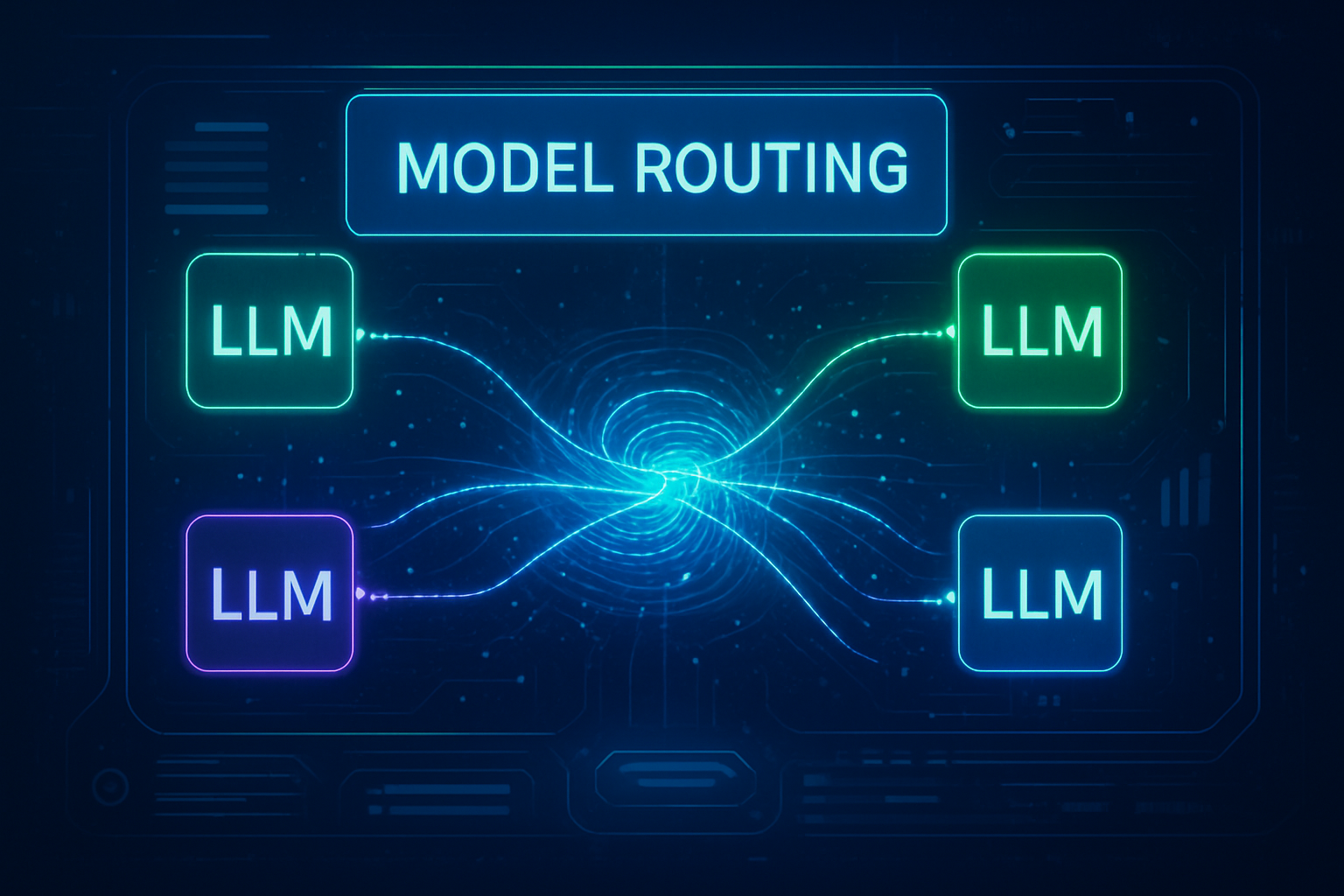
    The llama.cpp new model router introduces a suite of sophisticated technical capabilities designed to elevate the local LLM experience. At its core, the feature enables dynamic model loading and switching, allowing the server to remain operational while models are swapped on the fly. This is achieved through an OpenAI-compatible HTTP API, where requests can specify the target model, and the router intelligently directs the inference.

    A key architectural innovation is the multi-process design, where each loaded model operates within its own dedicated process. This provides robust isolation and stability, ensuring that a crash or issue in one model's execution does not bring down the entire server or affect other concurrently running models. Furthermore, the router boasts automatic model discovery, scanning the llama.cpp cache or user-specified directories for GGUF models. Models are loaded on-demand when first requested and are managed efficiently through an LRU (Least Recently Used) eviction policy, which automatically unloads less-used models when a configurable maximum (defaulting to four) is reached, optimizing VRAM and RAM utilization. The built-in llama.cpp web UI has also been updated to support this new model switching functionality.

    This approach marks a significant departure from previous llama.cpp server operations, which required a dedicated server instance for each model and manual restarts for any model change. While platforms like Ollama (built upon llama.cpp) have offered similar ease-of-use for model management, llama.cpp's router provides an integrated solution within its highly optimized C/C++ framework. llama.cpp is often lauded for its raw performance, with some benchmarks indicating it can be faster than Ollama for certain quantized models due to fewer abstraction layers. The new router brings comparable convenience without sacrificing llama.cpp's performance edge and granular control.

    Initial reactions from the AI research community and industry experts have been overwhelmingly positive. The feature is hailed as an "Awesome new feature!" and a "good addition" that makes local LLM development "feel more refined." Many have expressed that it delivers highly sought-after "Ollama-like functionality" directly within llama.cpp, eliminating significant friction for experimentation and A/B testing. The enhanced stability provided by the multi-process architecture is particularly appreciated, and experts predict it will be a crucial enabler for rapid innovation in Generative AI.

    Market Implications: Shifting Tides for AI Companies

    The llama.cpp new model router feature carries profound implications for a wide spectrum of AI companies, from burgeoning startups to established tech giants. Companies developing local AI applications and tools, such as desktop AI assistants or specialized development environments, stand to benefit immensely. They can now offer users a seamless experience, dynamically switching between models optimized for different tasks without interrupting workflow. Similarly, Edge AI and embedded systems providers can leverage this to deploy more sophisticated multi-LLM capabilities on constrained hardware, enhancing on-device intelligence for smart devices and industrial applications.

    Businesses prioritizing data privacy and security will find the router invaluable, as it facilitates entirely on-premises LLM inference, reducing reliance on cloud services and safeguarding sensitive information. This is particularly critical for regulated sectors like healthcare and finance. For startups and SMEs in AI development, the feature democratizes access to advanced LLM capabilities by significantly reducing the operational costs associated with cloud API calls, fostering innovation on a budget. Companies offering customized LLM solutions can also benefit from efficient multi-tenancy, easily deploying and managing client-specific models on a single server instance. Furthermore, hardware manufacturers (e.g., Apple (NASDAQ: AAPL) Silicon, AMD (NASDAQ: AMD)) stand to gain as the enhanced capabilities of llama.cpp drive demand for powerful local hardware optimized for multi-LLM workloads.

    For major AI labs (e.g., OpenAI, Google (NASDAQ: GOOGL) DeepMind, Meta (NASDAQ: META) AI) and tech companies (e.g., Microsoft (NASDAQ: MSFT), Amazon (NASDAQ: AMZN)), the rise of robust local inference presents a complex competitive landscape. It could potentially reduce dependency on proprietary cloud-based LLM APIs, impacting revenue streams for major cloud AI providers. These giants may need to further differentiate their offerings by emphasizing the unparalleled scale, unique capabilities, and ease of scalable deployment of their proprietary models and cloud platforms. A strategic shift towards hybrid AI strategies that seamlessly integrate local llama.cpp inference with cloud services for specific tasks or data sensitivities is also likely. Major players like Meta, which open-source models like Llama, indirectly benefit as llama.cpp makes their models more accessible and usable, driving broader adoption of their foundational research.

    The router can disrupt existing products or services that previously relied on spinning up separate llama.cpp server processes for each model, now finding a consolidated and more efficient approach. It will also accelerate the shift from cloud-only to hybrid/local-first AI architectures, especially for privacy-sensitive or cost-conscious users. Products involving frequent experimentation with different LLM versions will see development cycles significantly shortened. Companies can establish strategic advantages by positioning themselves as providers of cost-efficient, privacy-first AI solutions with unparalleled flexibility and customization. Focusing on enabling hybrid and edge AI, or leading the open-source ecosystem by contributing to and building upon llama.cpp, will be crucial for market positioning.

    Wider Significance: A Catalyst for the Local AI Revolution

    The llama.cpp new model router feature is not merely an incremental update; it is a significant accelerator of several profound trends in the broader AI landscape. It firmly entrenches llama.cpp at the forefront of the local and edge AI revolution, driven by growing concerns over data privacy, the desire for reduced operational costs, lower inference latency, and the imperative for offline capabilities. By making multi-model workflows practical on consumer hardware, it democratizes access to sophisticated AI, extending powerful LLM capabilities to a wider audience of developers and hobbyists.

    This development perfectly aligns with the industry's shift towards specialization and multi-model architectures. As AI moves away from a "one-model-fits-all" paradigm, the ability to easily swap between and intelligently route requests to different specialized local models is crucial. This feature lays foundational infrastructure for building complex agentic AI systems that can dynamically select and combine various models or tools to accomplish multi-step tasks. Experts predict that by 2028, 70% of top AI-driven enterprises will employ advanced multi-tool architectures for model routing, a trend directly supported by llama.cpp's innovation.

    The router also underscores the continuous drive for efficiency and accessibility in AI. By leveraging llama.cpp's optimizations and efficient quantization techniques, it allows users to harness a diverse range of models with optimized performance on their local machines. This strengthens data privacy and sovereignty, as sensitive information remains on-device, mitigating risks associated with third-party cloud services. Furthermore, by facilitating efficient local inference, it contributes to the discourse around sustainable AI, potentially reducing the energy footprint associated with large cloud data centers.

    However, the new capabilities also introduce potential concerns. Managing multiple concurrently running models can increase complexity in configuration and resource management, particularly for VRAM. While the multi-process design enhances stability, ensuring robust error handling and graceful degradation across multiple model processes remains a challenge. The need for dynamic hardware allocation for optimal performance on heterogeneous systems is also a non-trivial task.

    Comparing this to previous AI milestones, the llama.cpp router builds directly on the project's initial breakthrough of democratizing LLMs by making them runnable on commodity hardware. It extends this by democratizing the orchestration of multiple such models locally, moving beyond single-model interactions. It is a direct outcome of the thriving open-source movement in AI and the continuous development of efficient inference engines. This feature can be seen as a foundational component for the next generation of multi-agent systems, akin to how early AI systems transitioned from single-purpose programs to more integrated, modular architectures.

    Future Horizons: What Comes Next for the Model Router

    The llama.cpp new model router, while a significant achievement, is poised for continuous evolution in both the near and long term. In the near-term, community discussions highlight a strong demand for enhanced memory management, allowing users more granular control over which models remain persistently loaded. This includes the ability to configure smaller, frequently used models (e.g., for embeddings) to stay in memory, while larger, task-specific models are dynamically swapped. Advanced per-model configuration with individual control over context size, GPU layers (--ngl), and CPU-MoE settings will be crucial for fine-tuning performance on diverse hardware. Improved model aliasing and identification will simplify user experience, moving beyond reliance on GGUF filenames. Expect ongoing refinement of experimental features for stability and bug fixes, alongside significant API and UI integration improvements as projects like Jan update their backends to leverage the router.

    Looking long-term, the router is expected to tackle sophisticated resource orchestration, including intelligently allocating models to specific GPUs, especially in systems with varying capabilities or constrained PCIe bandwidth. This will involve solving complex "knapsack-style problems" for VRAM management. A broader aspiration could be cross-engine compatibility, facilitating swapping or routing across different inference engines beyond llama.cpp (e.g., vLLM, sglang). More intelligent, automated model selection and optimization based on query complexity or user intent could emerge, allowing the system to dynamically choose the most efficient model for a given task. The router's evolution will also align with llama.cpp's broader roadmap, which includes advancing community efforts for a unified GGML model format.

    These future developments will unlock a plethora of new applications and use cases. We can anticipate the rise of highly dynamic AI assistants and agents that leverage multiple specialized LLMs, with a "router agent" delegating tasks to the most appropriate model. The feature will further streamline A/B testing and model prototyping, accelerating development cycles. Multi-tenant LLM serving on a single llama.cpp instance will become more efficient, and optimized resource utilization in heterogeneous environments will allow users to maximize throughput by directing tasks to the fastest available compute resources. The enhanced local OpenAI-compatible API endpoints will solidify llama.cpp as a robust backend for local AI development, fostering innovative AI studios and development platforms.

    Despite the immense potential, several challenges need to be addressed. Complex memory and VRAM management across multiple dynamically loaded models remains a significant technical hurdle. Balancing configuration granularity with simplicity in the user interface is a key design challenge. Ensuring robustness and error handling across multiple model processes, and developing intelligent algorithms for dynamic hardware allocation are also critical.

    Experts predict that the llama.cpp model router will profoundly refine the developer experience for local LLM deployment, transforming llama.cpp into a flexible, multi-model environment akin to Ollama. The focus will be on advanced memory management, per-model configuration, and aliasing features. Its integration into higher-level applications signals a future where sophisticated local AI tools will seamlessly leverage this llama.cpp feature, further democratizing access to advanced AI capabilities on consumer hardware.

    A New Era for Local AI: The llama.cpp Router's Enduring Impact

    The introduction of the llama.cpp new model router feature marks a pivotal moment in the evolution of local AI inference. It is a testament to the continuous innovation within the open-source community, directly addressing a critical need for efficient and flexible management of large language models on personal hardware. This development, announced just days ago, fundamentally reshapes how developers and users interact with LLMs, moving beyond the limitations of single-model server instances to embrace a dynamic, multi-model paradigm.

    The key takeaways are clear: dynamic model loading, robust multi-process architecture, efficient resource management through auto-discovery and LRU eviction, and an OpenAI-compatible API for seamless integration. These capabilities collectively elevate llama.cpp from a powerful single-model inference engine to a comprehensive platform for local LLM orchestration. Its significance in AI history cannot be overstated; it further democratizes access to advanced AI, empowers rapid experimentation, and strengthens the foundation for privacy-preserving, on-device intelligence.

    The long-term impact will be profound, fostering accelerated innovation, enhanced local development workflows, and optimized resource utilization across diverse hardware landscapes. It lays crucial groundwork for the next generation of agentic AI systems and positions llama.cpp as an indispensable tool in the burgeoning field of edge and hybrid AI deployments.

    In the coming weeks and months, we should watch for wider adoption and integration of the router into downstream projects, further performance and stability improvements, and the development of more advanced routing capabilities. Community contributions will undoubtedly play a vital role in extending its functionality. As users provide feedback, expect continuous refinement and the introduction of new features that enhance usability and address specific, complex use cases. The llama.cpp model router is not just a feature; it's a foundation for a more flexible, efficient, and accessible future for AI.


    This content is intended for informational purposes only and represents analysis of current AI developments.

    TokenRing AI delivers enterprise-grade solutions for multi-agent AI workflow orchestration, AI-powered development tools, and seamless remote collaboration platforms.
    For more information, visit https://www.tokenring.ai/.