Tag: Loihi 2

  • The Brain-Scale Revolution: Intel’s Hala Point Cracks the ‘Energy Wall’ for Next-Generation AI

    The Brain-Scale Revolution: Intel’s Hala Point Cracks the ‘Energy Wall’ for Next-Generation AI

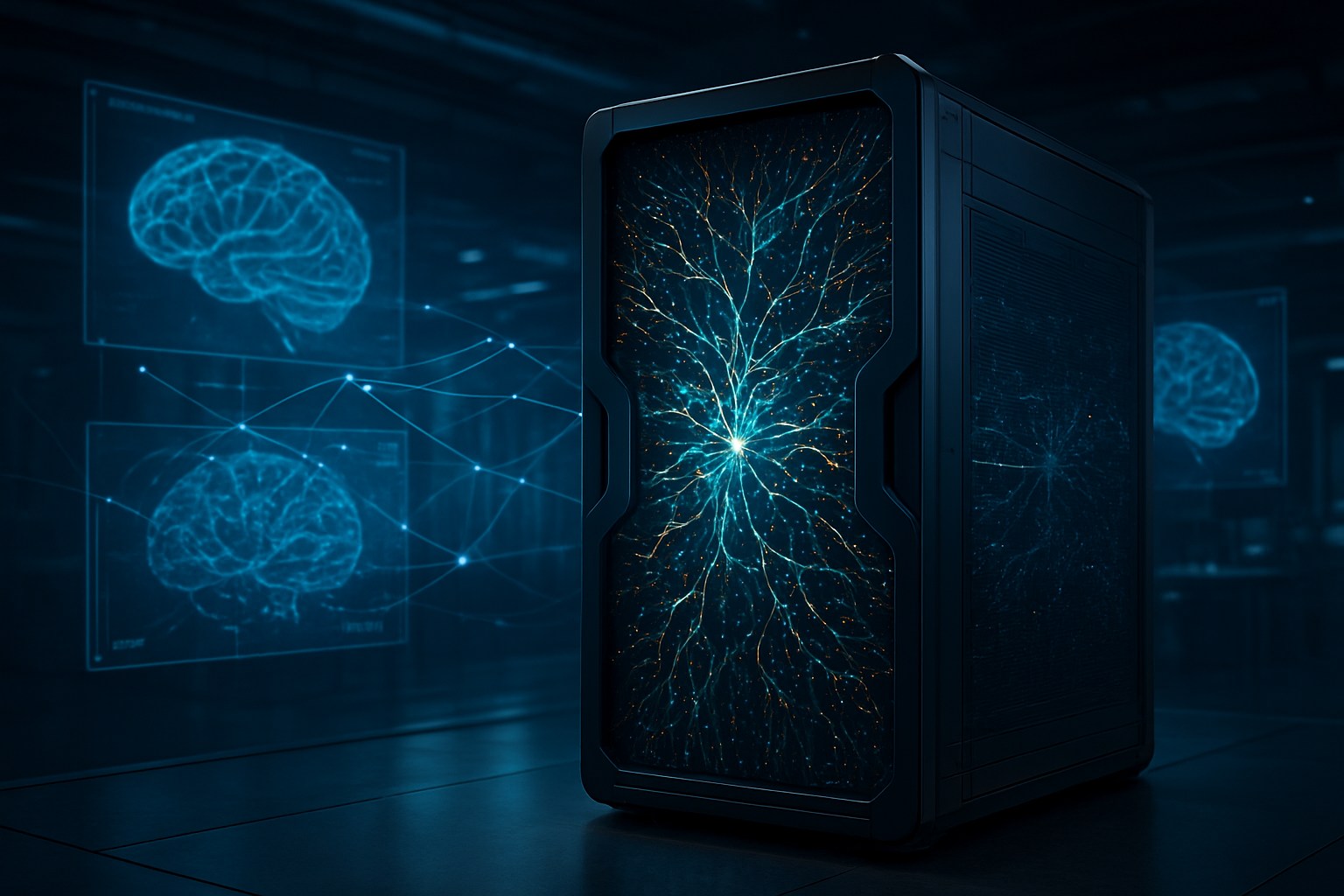
    The era of brute-force artificial intelligence is facing a reckoning. As the power demands of traditional data centers soar to unsustainable levels, Intel Corporation (NASDAQ: INTC) has unveiled a radical alternative that mimics the most efficient computer known to exist: the human brain. Hala Point, the world’s largest neuromorphic system, marks a definitive shift from the "muscle" of traditional computing to the "intelligence" of biological architecture. Deployed at Sandia National Laboratories, this 1.15-billion-neuron system is not just a research project; it is a direct challenge to the energy-intensive status quo of modern AI development.

    By utilizing the specialized Loihi 2 processor, Hala Point achieves a staggering 100x better energy efficiency than traditional GPUs for event-driven AI workloads. Unlike the synchronous, data-heavy processing required by today’s Large Language Models (LLMs), Hala Point operates on a principle of sparsity and "spikes," where artificial neurons only consume energy when they have information to process. This milestone arrives at a critical juncture as the industry grapples with the "energy wall"—the point at which the electrical and cooling costs of training massive models begin to outweigh their commercial utility.

    Architecting the Synthetic Mind: Inside Loihi 2 and the Hala Point Chassis

    At the heart of Hala Point lies a massive array of 1,152 Loihi 2 neuromorphic research processors. Manufactured on the advanced Intel 4 process node, this system packs 1.15 billion artificial neurons and 128 billion synapses into a six-rack-unit chassis roughly the size of a microwave oven. This represents a nearly 25-fold increase in capacity over Intel’s previous-generation system, Pohoiki Springs. The architecture is fundamentally "non-von Neumann," meaning it eliminates the constant shuffling of data between a central processor and separate memory—a process that accounts for the vast majority of energy waste in traditional silicon.

    Technically, Hala Point is designed for "event-driven" computing. In a standard GPU, like those produced by NVIDIA (NASDAQ: NVDA), every transistor is essentially "clocked" and active during a computation, regardless of whether the data is changing. In contrast, Hala Point’s neurons "spike" only when triggered by a change in input. This allows for massive parallelism without the massive heat signature. Benchmarks released in late 2025 and early 2026 show that for optimization problems and sparse neural networks, Hala Point can achieve up to 15 trillion 8-bit operations per second per watt (TOPS/W). For comparison, even the most advanced Blackwell-series GPUs from NVIDIA struggle to match a fraction of this efficiency in real-time, non-batched inference scenarios.

    The reaction from the research community has been one of cautious optimism followed by rapid adoption in specialized fields. Scientists at Sandia National Laboratories have already begun using Hala Point to solve complex Partial Differential Equations (PDEs)—the mathematical foundations of physics and climate modeling. Through the development of the "NeuroFEM" algorithm, researchers have demonstrated that they can perform exascale-level simulations with a power draw of just 2.6 kilowatts, a feat that would normally require megawatts of power on a traditional supercomputer.

    The Efficiency Pivot: Intel’s Strategic Moat Against NVIDIA’s Dominance

    The deployment of Hala Point signifies a broader market shift that analysts are calling "The Efficiency Pivot." While NVIDIA has dominated the AI landscape by providing the raw "muscle" needed to train massive transformers, Intel is carving out a "third stream" of computing that focuses on the edge and real-time adaptation. This development poses a long-term strategic threat to the high-margin data center business of both NVIDIA and Advanced Micro Devices (NASDAQ: AMD), particularly as companies look to deploy AI in power-constrained environments like autonomous robotics, satellites, and mobile devices.

    For Intel, Hala Point is a centerpiece of its IDM 2.0 strategy, proving that the company can still lead in architectural innovation even while playing catch-up in the GPU market. By positioning Loihi 2 as the premier solution for "Physical AI"—AI that interacts with the real world in real-time—Intel is targeting a high-growth sector where latency and battery life are more important than batch-processing throughput. This has already led to interest from sectors like telecommunications, where Ericsson has explored using neuromorphic chips to optimize wireless signals in 5G and 6G base stations with minimal energy overhead.

    The competitive landscape is further complicated by the arrival of specialized hardware from other tech giants. International Business Machines (NYSE: IBM) has seen success with its NorthPole chip, which uses "spatial computing" to eliminate the memory wall. However, Intel’s Hala Point remains the only system capable of brain-scale spiking neural networks (SNNs), a distinction that keeps it at the forefront of "continuous learning." While a traditional AI model is "frozen" after training, Hala Point’s Loihi 2 cores feature programmable learning engines that allow the system to adapt to new data on the fly without losing its previous knowledge.

    Beyond the Transistor: The Societal and Environmental Imperative

    The significance of Hala Point extends far beyond a simple benchmark. In the broader AI landscape, there is a growing concern regarding the environmental footprint of the "AI Gold Rush." With data centers projected to consume nearly 3% of global electricity by 2030, the 100x efficiency gain offered by neuromorphic computing is no longer a luxury—it is a necessity. Hala Point serves as a proof of concept that we can achieve "brain-scale" intelligence without building power plants specifically to fuel it.

    This shift mirrors previous milestones in computing history, such as the transition from vacuum tubes to transistors or the rise of RISC architecture. However, the move to neuromorphic computing is even more profound because it challenges the very way we think about information. By mimicking the "sparse" nature of biological thought, Hala Point avoids the pitfalls of the "Scaling Laws" that suggest we must simply build bigger and more power-hungry models to achieve smarter AI. Instead, it suggests that intelligence can be found in the efficiency of the connections, not just the number of parameters.

    There are, however, potential concerns. The software ecosystem for neuromorphic hardware, such as Intel’s "Lava" framework, is still maturing and lacks the decades of optimization found in NVIDIA’s CUDA. Critics argue that until developers can easily port their existing PyTorch or TensorFlow models to spiking hardware, the technology will remain confined to national laboratories and elite research institutions. Furthermore, the "real-time learning" capability of these systems introduces new questions about AI safety and predictability, as a system that learns continuously may behave differently tomorrow than it does today.

    The Road to Loihi 3: Commercializing the Synthetic Brain

    Looking ahead, the roadmap for Intel’s neuromorphic division is ambitious. As of early 2026, industry insiders are already tracking the development of "Loihi 3," which is expected to offer an 8x increase in neuron density and a move toward commercial-grade deployment. While Hala Point is a massive research testbed, the next generation of this technology is likely to be miniaturized for use in consumer products. Imagine a drone that can navigate a dense forest at 80 km/h by "learning" the layout in real-time, or a prosthetic limb that adapts to a user’s movements with the fluid grace of a biological appendage.

    Experts predict that the next two years will see the rise of "Hybrid AI" models. In this configuration, traditional GPUs will still handle the heavy lifting of initial training, while neuromorphic chips like Loihi will handle the deployment and "on-device" refinement. This would allow for a smartphone that learns its user's unique speech patterns or health metrics locally, ensuring both extreme privacy and extreme efficiency. The challenge remains the integration of these disparate architectures into a unified software stack that is accessible to the average developer.

    In the near term, watch for more results from Sandia National Laboratories as they push Hala Point toward more complex "multi-physics" simulations. These results will serve as the "ground truth" for whether neuromorphic hardware can truly replace traditional supercomputers for scientific discovery. If Sandia can prove that Hala Point can reliably model climate change or nuclear fusion with the power draw of a household appliance, the industrial shift toward neuromorphic architecture will become an unstoppable landslide.

    A New Chapter in Artificial Intelligence

    Intel’s Hala Point is more than a technical achievement; it is a manifesto for the future of computing. By delivering 1.15 billion neurons at 100x the efficiency of current hardware, Intel has demonstrated that the "energy wall" is not an impassable barrier, but a signpost pointing toward a different path. The deployment at Sandia National Laboratories marks the beginning of an era where AI is defined not by how much power it consumes, but by how much it can achieve with the energy it is given.

    As we move further into 2026, the success of Hala Point will be measured by how quickly its innovations trickle down into the commercial sector. The "brain-scale" revolution has begun, and while NVIDIA remains the king of the data center for now, Intel’s investment in the architecture of the future has created a formidable challenge. The coming months will likely see a surge in "Efficiency AI" announcements as the rest of the industry tries to match the benchmarks set by Loihi 2. For now, Hala Point stands as a beacon of what is possible when we stop trying to force computers to think like machines and start teaching them to think like us.


    This content is intended for informational purposes only and represents analysis of current AI developments.

    TokenRing AI delivers enterprise-grade solutions for multi-agent AI workflow orchestration, AI-powered development tools, and seamless remote collaboration platforms.
    For more information, visit https://www.tokenring.ai/.
  • The Brain-Inspired Breakthrough: How Intel’s ‘Hala Point’ is Solving AI’s Looming Energy Crisis

    The Brain-Inspired Breakthrough: How Intel’s ‘Hala Point’ is Solving AI’s Looming Energy Crisis

    As the global demand for artificial intelligence continues to spiral, the industry has hit a formidable roadblock: the "energy wall." With massive Large Language Models (LLMs) consuming megawatts of power and pushing data center grids to their breaking point, the race for a more sustainable computing architecture has moved from the fringes of research to the forefront of corporate strategy. At the center of this revolution is Intel Corporation (NASDAQ: INTC) and its groundbreaking "Hala Point" system, a neuromorphic computer that mimics the efficiency of the human brain to process data at a fraction of the energy cost of traditional chips.

    Unveiled as the world’s largest integrated neuromorphic system, Hala Point represents a fundamental shift in how we build intelligent machines. By moving away from the "Von Neumann" architecture—which has defined computing for nearly 80 years—and embracing "brain-inspired" hardware, engineers are proving that the future of AI isn't just about more power, but about smarter architecture. As of early 2026, the success of systems like Hala Point is forcing a re-evaluation of the dominance of the traditional GPU and signaling a new era of "Hybrid AI" where efficiency is the ultimate metric of performance.

    The Architecture of a Digital Brain: Scaling Loihi 2

    Hala Point is built on Intel’s second-generation neuromorphic research chip, Loihi 2, and represents a staggering 10-fold increase in neuron capacity over its predecessor, Pohoiki Springs. Manufactured on the Intel 4 process node, the system packs 1,152 Loihi 2 processors into a chassis roughly the size of a microwave oven. The technical specifications are unprecedented: it supports up to 1.15 billion artificial neurons and 128 billion synapses—roughly the neural complexity of an owl’s brain. This is achieved through 140,544 neuromorphic processing cores, capable of 20 quadrillion operations per second (20 petaops).

    What sets Hala Point apart from traditional hardware is its use of Spiking Neural Networks (SNNs) and in-memory computing. In a standard GPU, such as those produced by NVIDIA (NASDAQ: NVDA), energy is wasted constantly moving data between a separate processor and memory unit. In contrast, Hala Point integrates memory directly into the neural cores. Furthermore, its "event-driven" nature means neurons only consume power when they "fire" or spike in response to data, mirroring biological efficiency. Initial benchmarks have shown that for specific optimization and sensory tasks, Hala Point is up to 100 times more energy-efficient than traditional GPUs while operating 50 times faster.

    The AI research community has reacted to Hala Point with a mix of cautious optimism and strategic pivot. While traditional GPUs remain the "muscle" for training massive transformers, experts note that Hala Point is the "brain" for real-time inference and sensory perception. High-profile labs, including Sandia National Laboratories, have already begun using the system to solve complex scientific modeling problems that were previously too energy-intensive for even the most advanced supercomputers. The shift is clear: the industry is no longer just looking for raw FLOPs; it is looking for "brain-scale" efficiency.

    The Strategic Shift: Disruption in the Data Center

    The emergence of neuromorphic breakthroughs is creating a new competitive landscape for tech giants. While NVIDIA (NASDAQ: NVDA) continues to dominate the training market with its Blackwell and upcoming Rubin architectures, the high cost of running these chips is driving cloud providers like Microsoft (NASDAQ: MSFT), Amazon (NASDAQ: AMZN), and Alphabet (NASDAQ: GOOGL) to explore neuromorphic alternatives. Analysts project that by late 2026, the market for neuromorphic computing could reach nearly $10 billion, driven by the need for "Hybrid AI" data centers that use specialized chips for different parts of the AI lifecycle.

    This development poses a strategic challenge to the established GPU-centric order. For edge computing—such as autonomous drones, robotics, and "always-on" industrial sensors—neuromorphic hardware offers a decisive advantage. Startups like BrainChip (ASX: BRN) and the Sam Altman-backed Rain AI are already competing to bring neuromorphic "Synaptic Processing Units" to market, aiming to displace traditional silicon in battery-operated devices. Even IBM (NYSE: IBM) has entered the fray with its NorthPole chip, which claims to be 25 times more efficient than standard GPUs for vision-based AI tasks.

    For the major AI labs, the arrival of Hala Point-scale systems means a shift in research priorities. Instead of simply scaling model parameters, researchers are now focusing on "sparsity" and "temporal dynamics"—mathematical concepts that allow AI to run efficiently on neuromorphic hardware. This has the potential to disrupt the current SaaS model of AI; if high-performance inference can be done locally on low-power neuromorphic chips, the reliance on massive, centralized cloud clusters may begin to wane, giving a strategic advantage to hardware manufacturers who can integrate these "digital brains" into consumer devices.

    Beyond the Energy Wall: The Wider Significance for Society

    The significance of Hala Point extends far beyond a simple hardware upgrade; it is a critical response to a global sustainability crisis. As of 2026, the energy consumption of AI data centers has become a primary concern for climate goals, with some estimates suggesting AI could account for nearly 4% of global electricity demand by 2030. Neuromorphic computing offers a "green" path forward, enabling the continued growth of AI capabilities without a corresponding explosion in carbon emissions. By achieving "human-brain-like" efficiency, Intel is demonstrating that the path to Artificial General Intelligence (AGI) may require a biological blueprint.

    This transition also addresses the "latency gap" in real-world AI applications. Traditional AI systems often struggle with real-time adaptation because they rely on batch processing. Neuromorphic systems, however, support "continuous learning," allowing an AI to update its knowledge in real-time as it interacts with the world. This has profound implications for medical prosthetics that can "feel" and react with human-like speed, or autonomous vehicles that can navigate unpredictable environments with lower power overhead.

    However, the shift is not without its hurdles. The "software gap" remains the biggest challenge. Most existing AI software is designed for the linear, predictable flow of GPUs, not the asynchronous, spiking nature of neuromorphic chips. While Intel’s open-source Lava framework is gaining traction as a standard for neuromorphic programming, the transition requires a massive re-skilling of the AI workforce. Despite these challenges, the broader trend is undeniable: we are moving toward a world where the distinction between "artificial" and "biological" computation continues to blur.

    The Future of Neuromorphic: Toward Loihi 3 and AGI

    Looking ahead, the roadmap for neuromorphic computing is accelerating. Intel has already begun teasing its third-generation neuromorphic chip, Loihi 3, which is expected to debut in late 2026 or early 2027. Preliminary reports suggest a 4x increase in synaptic density and, perhaps most importantly, native support for "transformer-like" attention mechanisms. This would allow neuromorphic hardware to run Large Language Models directly, potentially slashing the energy cost of running tools like ChatGPT by orders of magnitude.

    In the near term, we expect to see more "Hybrid" systems where a traditional GPU handles the heavy lifting of initial training, while a neuromorphic system like Hala Point handles the continuous learning and real-time interaction. We are also likely to see the first commercial deployments of neuromorphic-integrated robotics in logistics and healthcare. Experts predict that within the next five years, neuromorphic "accelerators" will become as common in smartphones as image processors are today, providing "always-on" intelligence that doesn't drain the battery.

    A New Chapter in Computational History

    Intel’s Hala Point is more than just a milestone for the company; it is a milestone for the entire field of computer science. By successfully scaling brain-inspired architecture to over a billion neurons, Intel has provided a viable solution to the energy crisis that threatened to stall the AI revolution. It represents a pivot from the "brute force" era of AI to an era of "architectural elegance," where the constraints of physics and biology guide the next generation of digital intelligence.

    As we move through 2026, the industry should keep a close eye on the adoption rates of the Lava framework and the results of pilot programs at Sandia and other research institutions. The "energy wall" was once seen as an insurmountable barrier to the future of AI. With the engineering breakthroughs exemplified by Hala Point, that wall is finally starting to crumble.


    This content is intended for informational purposes only and represents analysis of current AI developments.

    TokenRing AI delivers enterprise-grade solutions for multi-agent AI workflow orchestration, AI-powered development tools, and seamless remote collaboration platforms.
    For more information, visit https://www.tokenring.ai/.
  • The Brain in the Box: Intel’s Billion-Neuron Breakthroughs Signal the End of the Power-Hungry AI Era

    The Brain in the Box: Intel’s Billion-Neuron Breakthroughs Signal the End of the Power-Hungry AI Era

    In a landmark shift for the semiconductor industry, the dawn of 2026 has brought the "neuromorphic revolution" from the laboratory to the front lines of enterprise computing. Intel (NASDAQ: INTC) has officially transitioned its Loihi architecture into a new era of scale, moving beyond experimental prototypes to massive, billion-neuron systems that mimic the human brain’s biological efficiency. These systems, led by the flagship Hala Point cluster, are now demonstrating the ability to process complex AI sensory data and optimization workloads using 100 times less power than traditional high-end CPUs, marking a critical turning point in the global effort to make artificial intelligence sustainable.

    This development arrives at a pivotal moment. As traditional data centers struggle under the massive energy demands of Large Language Models (LLMs) and generative AI, Intel’s neuromorphic advancements offer a radically different path. By processing information using "spikes"—discrete pulses of electricity that occur only when data changes—these chips eliminate the constant power draw inherent in conventional Von Neumann architectures. This efficiency isn't just a marginal gain; it is a fundamental reconfiguration of how machines think, allowing for real-time, continuous learning in devices ranging from autonomous drones to industrial robotics without the need for massive cooling systems or grid-straining power supplies.

    The technical backbone of this breakthrough lies in the evolution of the Loihi 2 processor and its successor, the newly unveiled Loihi 3. While traditional chips are built around synchronized clocks and constant data movement between memory and the CPU, the Loihi 2 architecture integrates memory directly with processing logic at the "neuron" level. Each chip supports up to 1 million neurons and 120 million synapses, but the true innovation is in its "graded spikes." Unlike earlier neuromorphic designs that used simple binary on/off signals, these graded spikes allow for multi-dimensional data to be transmitted in a single pulse, vastly increasing the information density of the network while maintaining a microscopic power footprint.

    The scaling of these chips into the Hala Point system represents the pinnacle of current neuromorphic engineering. Hala Point integrates 1,152 Loihi 2 processors into a chassis no larger than a microwave oven, supporting a staggering 1.15 billion neurons and 128 billion synapses. This system achieves a performance metric of 20 quadrillion operations per second (petaops) with a peak power draw of only 2,600 watts. For comparison, achieving similar throughput on a traditional GPU-based cluster would require nearly 100 times that energy, often necessitating specialized liquid cooling.

    Industry experts have been quick to note the departure from "brute-force" AI. Dr. Mike Davies, director of Intel’s Neuromorphic Computing Lab, highlighted that while traditional AI models are essentially static after training, the Hala Point system supports "on-device learning," allowing the system to adapt to new environments in real-time. This capability has been validated by initial research from Sandia National Laboratories, where the hardware was used to solve complex optimization problems—such as real-time logistics and satellite pathfinding—at speeds that left modern server-grade processors in the dust.

    The implications for the technology sector are profound, particularly for companies focused on "Edge AI" and robotics. Intel’s advancement places it in a unique competitive position against NVIDIA (NASDAQ: NVDA), which currently dominates the AI landscape through its high-powered H100 and B200 GPUs. While NVIDIA focuses on massive training clusters for LLMs, Intel is carving out a near-monopoly on high-efficiency inference and physical AI. This shift is likely to benefit firms specializing in autonomous systems, such as Tesla (NASDAQ: TSLA) and Boston Dynamics, who require immense on-board processing power without the weight and heat of traditional hardware.

    Furthermore, the emergence of IBM (NYSE: IBM) as a key player in the neuromorphic space with its NorthPole architecture and 3D Analog In-Memory Computing (AIMC) creates a two-horse race for the future of "Green AI." IBM's 2026 production-ready NorthPole chips are specifically targeting computer vision and Mixture-of-Experts (MoE) models, claiming energy efficiency gains of up to 1,000x for specific tasks. This competition is forcing a strategic pivot across the industry: major AI labs, once obsessed solely with model size, are now prioritizing "efficiency-first" architectures to lower the Total Cost of Ownership (TCO) for their enterprise clients.

    Startups like BrainChip (ASX: BRN) are also finding a foothold in this new ecosystem. By focusing on ultra-low-power "Akida" processors for IoT and automotive monitoring, these smaller players are proving that neuromorphic technology can be commercialized today, not just in a decade. As these efficient chips become more widely available, we can expect a disruption in the cloud service provider market; companies like Amazon (NASDAQ: AMZN) and Microsoft (NASDAQ: MSFT) may soon offer "Neuromorphic-as-a-Service" for clients whose workloads are too sensitive to latency or power costs for traditional cloud setups.

    The wider significance of the billion-neuron breakthrough cannot be overstated. For the past decade, the AI industry has been criticized for its "compute-at-any-cost" mentality, where the environmental impact of training a single model can equal the lifetime emissions of several automobiles. Neuromorphic computing directly addresses the "energy wall" that many predicted would stall AI progress. By proving that a system can simulate over a billion neurons with the power draw of a household appliance, Intel has demonstrated that AI growth does not have to be synonymous with environmental degradation.

    This milestone mirrors previous historic shifts in computing, such as the transition from vacuum tubes to transistors. In the same way that transistors allowed computers to move from entire rooms to desktops, neuromorphic chips are allowing high-level intelligence to move from massive data centers to the "edge" of the network. There are, however, significant hurdles. The software stack for neuromorphic chips—primarily Spiking Neural Networks (SNNs)—is fundamentally different from the backpropagation algorithms used in today’s deep learning. This creates a "programming gap" that requires a new generation of developers trained in event-based computing rather than traditional frame-based processing.

    Societal concerns also loom, particularly regarding privacy and security. If highly capable AI can run locally on a drone or a pair of glasses with 100x efficiency, the need for data to be sent to a central, regulated cloud diminishes. This could lead to a proliferation of untraceable, "always-on" AI surveillance tools that operate entirely off the grid. As the barrier to entry for high-performance AI drops, regulatory bodies will likely face new challenges in governing distributed, autonomous intelligence that doesn't rely on massive, easily-monitored data centers.

    Looking ahead, the next two years are expected to see the convergence of neuromorphic hardware with "Foundation Models." Researchers are already working on "Analog Foundation Models" that can run on Loihi 3 or IBM’s NorthPole with minimal accuracy loss. By 2027, experts predict we will see the first "Human-Scale" neuromorphic computer. Projects like DeepSouth at Western Sydney University are already aiming for 100 billion neurons—the approximate count of a human brain—using neuromorphic architectures to achieve real-time simulation speeds that were previously thought to be decades away.

    In the near term, the most immediate applications will be in scientific supercomputing and robotics. The development of the "NeuroFEM" algorithm allows these chips to solve partial differential equations (PDEs), which are used in everything from weather forecasting to structural engineering. This transforms neuromorphic chips from "AI accelerators" into general-purpose scientific tools. We can also expect to see "Hybrid AI" systems, where a traditional GPU handles the heavy lifting of training a model, while a neuromorphic chip like Loihi 3 handles the high-efficiency, real-time deployment and adaptation of that model in the physical world.

    Challenges remain, particularly in the standardization of hardware. Currently, an SNN designed for Intel hardware cannot easily run on IBM’s architecture. Industry analysts predict that the next 18 months will see a push for a "Universal Neuromorphic Language," similar to how CUDA standardized GPU programming. If the industry can agree on a common framework, the adoption of these billion-neuron systems could accelerate even faster than the current GPU-based AI boom.

    In summary, the advancements in Intel’s Loihi 2 and Loihi 3 architectures, and the operational success of the Hala Point system, represent a paradigm shift in artificial intelligence. By mimicking the architecture of the brain, Intel has solved the energy crisis that threatened to cap the potential of AI. The move to billion-neuron systems provides the scale necessary for truly intelligent, autonomous machines that can interact with the world in real-time, learning and adapting without the tether of a power cord or a data center connection.

    The significance of this development in AI history is likely to be viewed as the moment AI became "embodied." No longer confined to the digital vacuum of the cloud, intelligence is now moving into the physical fabric of our world. As we look toward the coming weeks, the industry will be watching for the first third-party benchmarks of the Loihi 3 chip and the announcement of more "Brain-Scale" systems. The era of brute-force AI is ending; the era of efficient, biological-scale intelligence has begun.


    This content is intended for informational purposes only and represents analysis of current AI developments.

    TokenRing AI delivers enterprise-grade solutions for multi-agent AI workflow orchestration, AI-powered development tools, and seamless remote collaboration platforms.
    For more information, visit https://www.tokenring.ai/.