
Tag: Mark Zuckerberg

  • The Great Equalizer: How Meta’s Llama 3.1 405B Broke the Proprietary Monopoly

    The Great Equalizer: How Meta’s Llama 3.1 405B Broke the Proprietary Monopoly

    In a move that fundamentally restructured the artificial intelligence industry, Meta Platforms, Inc. (NASDAQ: META) released Llama 3.1 405B, the first open-weights model to achieve performance parity with the world’s most advanced closed-source systems. For years, a significant "intelligence gap" existed between the models available for download and the proprietary titans like GPT-4o from OpenAI and Claude 3.5 from Anthropic. The arrival of the 405B model effectively closed that gap, providing developers and enterprises with a frontier-class intelligence engine that can be self-hosted, modified, and scrutinized.

    The immediate significance of this release cannot be overstated. By providing the weights for a 400-billion-plus parameter model, Meta has challenged the dominant business model of Silicon Valley’s AI elite, which relied on "walled gardens" and pay-per-token API access. This development signaled a shift toward the "commoditization of intelligence," where the underlying model is no longer the product, but a baseline utility upon which a new generation of open-source applications can be built.

    Technical Prowess: Scaling the Open-Source Frontier

    The technical specifications of Llama 3.1 405B reflect a massive investment in infrastructure and data science. Built on a dense decoder-only transformer architecture, the model was trained on a staggering 15 trillion tokens—a dataset nearly seven times larger than its predecessor. To achieve this, Meta leveraged a cluster of over 16,000 Nvidia Corporation (NASDAQ: NVDA) H100 GPUs, accumulating over 30 million GPU hours. This brute-force scaling was paired with sophisticated fine-tuning techniques, including over 25 million synthetic examples designed to improve reasoning, coding, and multilingual capabilities.

    One of the most significant departures from previous Llama iterations was the expansion of the context window to 128,000 tokens. This allows the model to process the equivalent of a 300-page book in a single prompt, matching the industry standards set by top-tier proprietary models. Furthermore, Meta introduced Grouped-Query Attention (GQA) and optimized for FP8 quantization, ensuring that while the model is massive, it remains computationally viable for high-end enterprise hardware.

    Initial reactions from the AI research community were overwhelmingly positive, with many experts noting that Meta’s "open-weights" approach provides a level of transparency that closed models cannot match. Researchers pointed to the model’s performance on the Massive Multitask Language Understanding (MMLU) benchmark, where it scored 88.6%, virtually tying with GPT-4o. While Anthropic’s Claude 3.5 Sonnet still maintains a slight edge in complex coding and nuanced reasoning, Llama 3.1 405B’s victory in general knowledge and mathematical benchmarks like GSM8K (96.8%) proved that open models could finally punch in the heavyweight division.

    Strategic Disruption: Zuckerberg’s Linux for the AI Era

    Mark Zuckerberg’s decision to open-source the 405B model is a calculated move to position Meta as the foundational infrastructure of the AI era. In his strategy letter, "Open Source AI is the Path Forward," Zuckerberg compared the current AI landscape to the early days of computing, where proprietary Unix systems were eventually overtaken by the open-source Linux. By making Llama the industry standard, Meta ensures that the entire developer ecosystem is optimized for its tools, while simultaneously undermining the competitive advantage of rivals like Alphabet Inc. (NASDAQ: GOOGL) and Microsoft (NASDAQ: MSFT).

    This strategy provides a massive advantage to startups and mid-sized enterprises that were previously tethered to expensive API fees. Companies can now self-host the 405B model on their own infrastructure—using clouds like Amazon (NASDAQ: AMZN) Web Services or local servers—ensuring data privacy and reducing long-term costs. Furthermore, Meta’s permissive licensing allows developers to use the 405B model for "distillation," essentially using the flagship model to teach and improve smaller, more efficient 8B or 70B models.

    The competitive implications are stark. Shortly after the 405B release, proprietary providers were forced to respond with more affordable offerings, such as OpenAI’s GPT-4o mini, to prevent a mass exodus of developers to the Llama ecosystem. By commoditizing the "intelligence layer," Meta is shifting the competition away from who has the best model and toward who has the best integration, hardware, and user experience—an area where Meta’s social media dominance provides a natural moat.

    A Watershed Moment for the Global AI Landscape

    The release of Llama 3.1 405B fits into a broader trend of decentralized AI. For the first time, nation-states and organizations with sensitive security requirements can deploy a world-class AI without sending their data to a third-party server in San Francisco. This has significant implications for sectors like defense, healthcare, and finance, where data sovereignty is a legal or strategic necessity. It effectively "democratizes" frontier-level intelligence, making it accessible to those who might have been priced out or blocked by the "walled gardens."

    However, this democratization has also raised concerns regarding safety and dual-use risks. Critics argue that providing the weights of such a powerful model allows malicious actors to "jailbreak" safety filters more easily than they could with a cloud-hosted API. Meta has countered this by releasing a suite of safety tools, including Llama Guard and Prompt Guard, arguing that the transparency of open source actually makes AI safer over time as thousands of independent researchers can stress-test the system for vulnerabilities.

    When compared to previous milestones, such as the release of the original GPT-3, Llama 3.1 405B represents the maturation of the industry. We have moved from the "wow factor" of generative text to a phase where high-level intelligence is a predictable, accessible resource. This milestone has set a new floor for what is expected from any AI developer: if you aren't significantly better than Llama 3.1 405B, you are essentially competing with a "free" product.

    The Horizon: From Llama 3.1 to the Era of Specialists

    Looking ahead, the legacy of Llama 3.1 405B is already being felt in the design of next-generation models. As we move into 2026, the focus has shifted from single, monolithic "dense" models to Mixture-of-Experts (MoE) architectures, as seen in the subsequent Llama 4 family. These newer models leverage the lessons of the 405B—specifically its massive training scale—but deliver it in a more efficient package, allowing for even longer context windows and native multimodality.

    Experts predict that the "teacher-student" paradigm established by the 405B model will become the standard for industry-specific AI. We are seeing a surge in specialized models for medicine, law, and engineering that were "distilled" from Llama 3.1 405B. The challenge moving forward will be addressing the massive energy and compute requirements of these frontier models, leading to a renewed focus on specialized AI hardware and more efficient inference algorithms.

    Conclusion: A New Era of Open Intelligence

    Meta’s Llama 3.1 405B will be remembered as the moment the proprietary AI monopoly was broken. By delivering a model that matched the best in the world and then giving it away, Meta changed the physics of the AI market. The key takeaway is clear: the most advanced intelligence is no longer the exclusive province of a few well-funded labs; it is now a global public good that any developer with a GPU can harness.

    As we look back from early 2026, the significance of this development is evident in the flourishing ecosystem of self-hosted, private, and specialized AI models that dominate the landscape today. The long-term impact has been a massive acceleration in AI application development, as the barrier to entry—cost and accessibility—was effectively removed. In the coming months, watch for how Meta continues to leverage its "open-first" strategy with Llama 4 and beyond, and how the proprietary giants will attempt to reinvent their value propositions in an increasingly open world.


    This content is intended for informational purposes only and represents analysis of current AI developments.

    TokenRing AI delivers enterprise-grade solutions for multi-agent AI workflow orchestration, AI-powered development tools, and seamless remote collaboration platforms.
    For more information, visit https://www.tokenring.ai/.
  • Meta Unveils ‘Meta Compute’: A Gigawatt-Scale Blueprint for the Era of Superintelligence

    Meta Unveils ‘Meta Compute’: A Gigawatt-Scale Blueprint for the Era of Superintelligence

    In a move that signals the dawn of the "industrial AI" era, Meta Platforms (NASDAQ: META) has officially launched its "Meta Compute" initiative, a massive strategic overhaul of its global infrastructure designed to power the next generation of frontier models. Announced on January 12, 2026, by CEO Mark Zuckerberg, the initiative unifies the company’s data center engineering, custom silicon development, and energy procurement under a single organizational umbrella. This shift marks Meta's transition from an AI-first software company to a "sovereign-scale" infrastructure titan, aiming to deploy hundreds of gigawatts of power over the next decade.

    The immediate significance of Meta Compute lies in its sheer physical and financial scale. With an estimated 2026 capital expenditure (CAPEX) set to exceed $100 billion, Meta is moving away from the "reactive" scaling of the past three years. Instead, it is adopting a "proactive factory model" that treats AI compute as a primary industrial output. This infrastructure is not just a support system for the company's social apps; it is the engine for what Zuckerberg describes as "personal superintelligence"—AI systems capable of surpassing human performance in complex cognitive tasks, seamlessly integrated into consumer devices like Meta Glasses.

    The Prometheus Cluster and the Rise of the 'AI Tent'

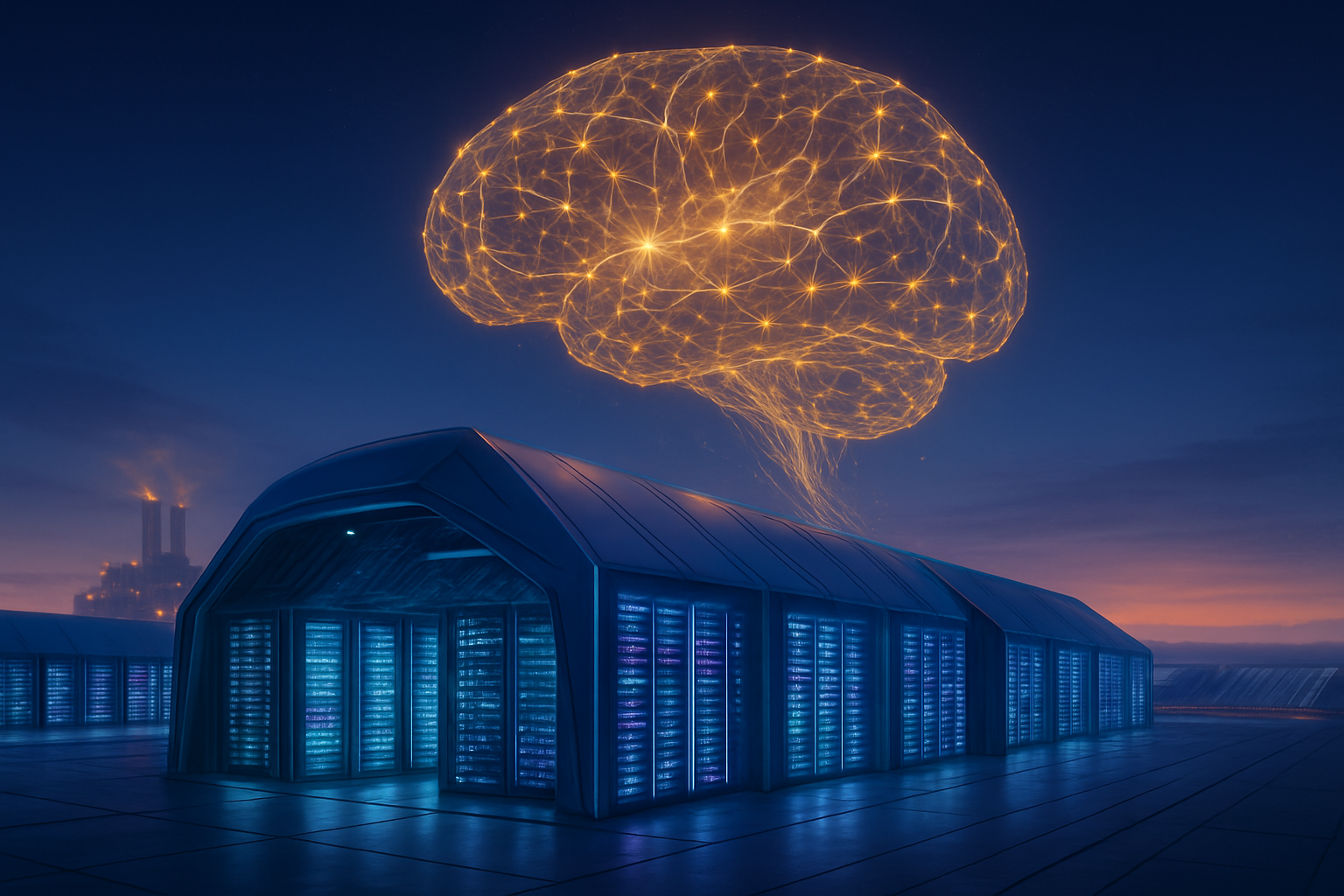
    At the heart of the Meta Compute initiative is the newly completed "Prometheus" facility in New Albany, Ohio. This site represents a radical departure from traditional data center architecture. To bypass the lengthy 24-month construction cycles of concrete facilities, Meta utilized modular, hurricane-proof "tent-style" structures. This innovative "fast-build" approach allowed Meta to bring 1.02 gigawatts (GW) of IT power online in just seven months. The Prometheus cluster is projected to house a staggering 500,000 GPUs, featuring a mix of NVIDIA (NASDAQ: NVDA) GB300 "Clemente" and GV200 "Catalina" systems, making it one of the most powerful concentrated AI clusters in existence.

    Technically, the Meta Compute infrastructure is built to handle the extreme heat and networking demands of Blackwell-class silicon. Each rack houses 72 GPUs, pushing power density to levels that traditional air cooling can no longer manage. Meta has deployed Air-Assisted Liquid Cooling (AALC) and closed-loop direct-to-chip systems to stabilize these massive workloads. For networking, the initiative relies on a Disaggregated Scheduled Fabric (DSF) powered by Arista Networks (NYSE: ANET) 7808 switches and Broadcom (NASDAQ: AVGO) Jericho 3 and Ramon 3 ASICs, ensuring that data can flow between hundreds of thousands of chips with minimal latency.

    This infrastructure is the direct predecessor to the hardware currently training the upcoming Llama 5 model family. While Llama 4—released in April 2025—was trained on clusters exceeding 100,000 H100 GPUs, Llama 5 is expected to utilize the full weight of the Blackwell-integrated Prometheus site. Initial reactions from the AI research community have been split. While many admire the engineering feat of the "AI Tents," some experts, including those within Meta's own AI research labs (FAIR), have voiced concerns about the "Bitter Lesson" of scaling. Rumors have circulated that Chief Scientist Yann LeCun has shifted focus away from the scaling-law obsession, preferring to explore alternative architectures that might not require gigawatt-scale power to achieve reasoning.

    The Battle of the Gigawatts: Competitive Moats and Energy Wars

    The Meta Compute initiative places Meta in direct competition with the most ambitious infrastructure projects in history. Microsoft (NASDAQ: MSFT) and OpenAI are currently developing "Stargate," a $500 billion consortium project aimed at five major sites across the U.S. with a long-term goal of 10 GW. Meanwhile, Amazon (NASDAQ: AMZN) has accelerated "Project Rainier," a 2.2 GW campus in Indiana focused on its custom Trainium 3 chips. Meta’s strategy differs by emphasizing "speed-to-build" and vertical integration through its Meta Training and Inference Accelerator (MTIA) silicon.

    Meta's MTIA v3, a chiplet-based design prioritized for energy efficiency, is now being deployed at scale to reduce the "Nvidia tax" on inference workloads. By running its massive recommendation engines and agentic AI models on in-house silicon, Meta aims to achieve a 40% improvement in "TOPS per Watt" compared to general-purpose GPUs. This vertical integration provides a significant market advantage, allowing Meta to offer its Llama models at lower costs—or entirely for free via open-source—while its competitors must maintain high margins to recoup their hardware investments.

    However, the primary constraint for these tech giants has shifted from chip availability to energy procurement. To power Prometheus and future sites, Meta has entered into historic energy alliances. In January 2026, the company signed major agreements with Vistra (NYSE: VST) and natural gas firm Williams (NYSE: WMB) to build on-site generation facilities. Meta has also partnered with nuclear innovators like Oklo (NYSE: OKLO) and TerraPower to secure 24/7 carbon-free power, a necessity as the company's total energy consumption begins to rival that of mid-sized nations.

    Sovereignty and the Broader AI Landscape

    The formation of Meta Compute also has a significant political dimension. By hiring Dina Powell McCormick, a former U.S. Deputy National Security Advisor, as President and Vice Chair of the division, Meta is positioning its infrastructure as a national asset. This "Sovereign AI" strategy aims to align Meta’s massive compute clusters with U.S. national interests, potentially securing favorable regulatory treatment and energy subsidies. This marks a shift in the AI landscape where compute is no longer just a business resource but a form of geopolitical leverage.

    The broader significance of this move cannot be overstated. We are witnessing the physicalization of the AI revolution. Previous milestones, like the release of GPT-4, were defined by algorithmic breakthroughs. The milestones of 2026 are defined by steel, silicon, and gigawatts. However, this "gigawatt race" brings potential concerns. Critics like Gary Marcus have pointed to the astronomical CAPEX as evidence of a "depreciation bomb," noting that if model architectures shift away from the Transformers for which these clusters are optimized, billions of dollars in hardware could become obsolete overnight.

    Furthermore, the environmental impact of Meta’s 100 GW ambition remains a point of contention. While the company is aggressively pursuing nuclear and solar options, the immediate reliance on natural gas to bridge the gap has drawn criticism from environmental groups. The Meta Compute initiative represents a bet that the societal and economic benefits of "personal superintelligence" will outweigh the immense environmental and financial costs of building the infrastructure required to host it.

    Future Horizons: From Clusters to Personal Superintelligence

    Looking ahead, Meta Compute is designed to facilitate the leap from "Static AI" to "Agentic AI." Near-term developments include the deployment of thousands of specialized MTIA-powered sub-models that can run simultaneously on edge devices and in the cloud to manage a user’s entire digital life. On the horizon, Meta expects to move toward "Llama 6" and "Llama 7," which experts predict will require even more radical shifts in data center design, potentially involving deep-sea cooling or orbital compute arrays to manage the heat of trillion-parameter models.

    The primary challenge remaining is the "data wall." As compute continues to scale, the supply of high-quality human-generated data is becoming exhausted. Meta’s future infrastructure will likely be dedicated as much to generating synthetic training data as it is to training the models themselves. Experts predict that the next two years will determine whether the scaling laws hold true at the gigawatt level or if we will reach a point of diminishing returns where more power no longer translates to significantly more intelligence.

    Closing the Loop on the AI Industrial Revolution

    The launch of the Meta Compute initiative is a defining moment for Meta Platforms and the AI industry at large. It represents the formalization of the "Bitter Lesson"—the idea that the most effective way to improve AI is to simply add more compute. By restructuring the company around this principle, Mark Zuckerberg has doubled down on a future where AI is the primary driver of all human-digital interaction.

    Key takeaways from this development include Meta’s pivot to modular, high-speed construction with its "AI Tents," its deepening vertical integration with MTIA silicon, and its emergence as a major player in the global energy market. As we move into the middle of 2026, the tech industry will be watching closely to see if the "Prometheus" facility can deliver on the promise of Llama 5 and beyond. Whether this $100 billion gamble leads to the birth of true superintelligence or serves as a cautionary tale of infrastructure overreach, it has undeniably set the pace for the next decade of technological competition.


    This content is intended for informational purposes only and represents analysis of current AI developments.

    TokenRing AI delivers enterprise-grade solutions for multi-agent AI workflow orchestration, AI-powered development tools, and seamless remote collaboration platforms.
    For more information, visit https://www.tokenring.ai/.
  • The Great Brain Drain: Meta’s ‘Superintelligence Labs’ Reshapes the AI Power Balance

    The Great Brain Drain: Meta’s ‘Superintelligence Labs’ Reshapes the AI Power Balance

    The landscape of artificial intelligence has undergone a seismic shift as 2025 draws to a close, marked by a massive migration of elite talent from OpenAI to Meta Platforms Inc. (NASDAQ: META). What began as a trickle of departures in late 2024 has accelerated into a full-scale exodus, with Meta’s newly minted "Superintelligence Labs" (MSL) serving as the primary destination for the architects of the generative AI revolution. This talent transfer represents more than just a corporate rivalry; it is a fundamental realignment of power between the pioneer of modern LLMs and a social media titan that has successfully pivoted into an AI-first powerhouse.

    The immediate significance of this shift cannot be overstated. As of December 31, 2025, OpenAI—once the undisputed leader in AI innovation—has seen its original founding team dwindle to just two active members. Meanwhile, Meta has leveraged its nearly bottomless capital reserves and Mark Zuckerberg’s personal "recruiter-in-chief" campaign to assemble what many are calling an "AI Dream Team." This movement has effectively neutralized OpenAI’s talent moat, turning the race for Artificial General Intelligence (AGI) into a high-stakes war of attrition where compute and compensation are the ultimate weapons.

    The Architecture of Meta Superintelligence Labs

    Launched on June 30, 2025, Meta Superintelligence Labs (MSL) represents a total overhaul of the company’s AI strategy. Unlike the previous bifurcated structure of FAIR (Fundamental AI Research) and the GenAI product team, MSL merges research and product development under a single, unified mission: the pursuit of "personal superintelligence." The lab is led by a new guard of tech royalty, including Alexandr Wang—founder of Scale AI—who joined as Meta's Chief AI Officer following a landmark $14.3 billion investment in his company, and Nat Friedman, the former CEO of GitHub.

    The technical core of MSL is built upon the very people who built OpenAI’s most advanced models. In mid-2025, Meta successfully poached the "Zurich Team"—Lucas Beyer, Alexander Kolesnikov, and Xiaohua Zhai—the vision experts OpenAI had originally tapped to lead its European expansion. More critically, Meta secured the services of Shengjia Zhao, a co-creator of ChatGPT and GPT-4, and Trapit Bansal, a key researcher behind OpenAI’s "o1" reasoning models. These hires have allowed Meta to integrate advanced reasoning and "System 2" thinking into its upcoming Llama 4 and Llama 5 architectures, narrowing the gap with OpenAI’s proprietary frontier models.

    This influx of talent has led to a radical departure from Meta's previous AI philosophy. While the company remains committed to open-source "weights" for the developer community, the internal focus at MSL has shifted toward "Behemoth," a rumored 2-trillion-parameter model designed to operate as a ubiquitous, proactive agent across Meta’s ecosystem. The departure of legacy figures like Yann LeCun in November 2025, who left to pursue "world models" after his FAIR team was deprioritized, signaled the end of the academic era at Meta and the beginning of a product-driven superintelligence sprint.

    A New Competitive Frontier

    The aggressive recruitment drive has drastically altered the competitive landscape for Meta and its rivals, most notably Microsoft Corp. (NASDAQ: MSFT). For years, Microsoft relied on its exclusive partnership with OpenAI to maintain an edge in the AI race. However, as Meta "hollows out" OpenAI’s research core, the value of that partnership is being questioned. Meta’s strategy of offering "open" models like Llama has created a massive developer ecosystem that rivals the proprietary reach of Microsoft’s Azure AI.

    Market analysts suggest that Meta is the primary beneficiary of this talent shift. By late 2025, Meta’s capital expenditure reached a record $72 billion, much of it directed toward 2-gigawatt data centers and the deployment of its custom MTIA (Meta Training and Inference Accelerator) chips. With a talent pool that now includes the architects of GPT-4o’s vision and voice capabilities, such as Jiahui Yu and Hongyu Ren, Meta is positioned to dominate the multimodal AI market. This poses a direct threat not only to OpenAI but also to Alphabet Inc. (NASDAQ: GOOGL), as Meta AI begins to replace traditional search and assistant functions for its 3 billion daily users.

    The disruption extends to the startup ecosystem as well. Companies like Anthropic and Perplexity are finding it increasingly difficult to compete for talent when Meta is reportedly offering signing bonuses ranging from $1 million to $100 million. Sam Altman, CEO of OpenAI, has publicly acknowledged the "insane" compensation packages being offered in Menlo Park, which have forced OpenAI to undergo a painful internal restructuring of its equity and profit-sharing models to prevent further attrition.

    The Wider Significance of the Talent War

    The migration of OpenAI’s elite to Meta marks a pivotal moment in the history of technology, signaling the "Big Tech-ification" of AI. The era where a small, mission-driven startup could define the future of human intelligence is being superseded by a period of massive consolidation. When Mark Zuckerberg began personally emailing researchers and hosting them at his Lake Tahoe estate, he wasn't just hiring employees; he was executing a strategic "brain drain" designed to ensure that the most powerful technology in history remains under the control of established tech giants.

    This trend raises significant concerns regarding the concentration of power. As the world moves closer to superintelligence, the fact that a single corporation—controlled by a single individual via dual-class stock—holds the keys to the most advanced reasoning models is a point of intense debate. Furthermore, the shift from OpenAI’s safety-centric "non-profit-ish" roots to Meta’s hyper-competitive, product-first MSL suggests that the "safety vs. speed" debate has been decisively won by speed.

    Comparatively, this exodus is being viewed as the modern equivalent of the "PayPal Mafia" or the early departures from Fairchild Semiconductor. However, unlike those movements, which led to a flourishing of new, independent companies, the 2025 exodus is largely a consolidation of talent into an existing monopoly. The "Superintelligence Labs" represent a new kind of corporate entity: one that possesses the agility of a startup but the crushing scale of a global hegemon.

    The Road to Llama 5 and Beyond

    Looking ahead, the industry is bracing for the release of Llama 5 in early 2026, which is expected to be the first truly "open" model to achieve parity with OpenAI’s GPT-5. With Trapit Bansal and the reasoning team now at Meta, the upcoming models will likely feature unprecedented "deep research" capabilities, allowing AI agents to solve complex multi-step problems in science and engineering autonomously. Meta is also expected to lean heavily into "Personal Superintelligence," where AI models are fine-tuned on a user’s private data across WhatsApp, Instagram, and Facebook to create a digital twin.

    Despite Meta's momentum, significant challenges remain. The sheer cost of training "Behemoth"-class models is testing even Meta’s vast resources, and the company faces mounting regulatory pressure in Europe and the U.S. over the safety of its open-source releases. Experts predict that the next 12 months will see a "counter-offensive" from OpenAI and Microsoft, potentially involving a more aggressive acquisition strategy of smaller AI labs to replenish their depleted talent ranks.

    Conclusion: A Turning Point in AI History

    The mass exodus of OpenAI leadership to Meta’s Superintelligence Labs is a defining event of the mid-2020s. It marks the end of OpenAI’s period of absolute dominance and the resurgence of Meta as the primary architect of the AI future. By combining the world’s most advanced research talent with an unparalleled distribution network and massive compute infrastructure, Mark Zuckerberg has successfully repositioned Meta at the center of the AGI conversation.

    As we move into 2026, the key takeaway is that the "talent moat" has proven to be more porous than many expected. The coming months will be critical as we see whether Meta can translate its high-profile hires into a definitive technical lead. For the industry, the focus will remain on the "Superintelligence Labs" and whether this concentration of brilliance will lead to a breakthrough that benefits society at large or simply reinforces the dominance of the world’s largest social network.


    This content is intended for informational purposes only and represents analysis of current AI developments.

    TokenRing AI delivers enterprise-grade solutions for multi-agent AI workflow orchestration, AI-powered development tools, and seamless remote collaboration platforms.
    For more information, visit https://www.tokenring.ai/.

  • The $1.5 Billion Man: Meta’s Massive Poach of Andrew Tulloch Signals a New Era in the AI Talent Wars

    The $1.5 Billion Man: Meta’s Massive Poach of Andrew Tulloch Signals a New Era in the AI Talent Wars

    In a move that has sent shockwaves through Silicon Valley and redefined the valuation of human capital in the age of artificial intelligence, Meta Platforms, Inc. (NASDAQ: META) has successfully recruited Andrew Tulloch, a co-founder of the elite startup Thinking Machines Lab. The transition, finalized in late 2025, reportedly includes a compensation package worth a staggering $1.5 billion over six years, marking the most expensive individual talent acquisition in the history of the technology industry.

    This aggressive maneuver was not merely a corporate HR success but a personal crusade led by Meta CEO Mark Zuckerberg. After a failed $1 billion bid to acquire Thinking Machines Lab in its entirety earlier this year, Zuckerberg reportedly bypassed traditional recruiting channels, personally messaging Tulloch and other top researchers to pitch them on Meta’s new "Superintelligence Labs" initiative. The successful poaching of Tulloch represents a significant blow to Thinking Machines Lab and underscores the lengths to which Big Tech will go to secure the rare minds capable of architecting the next generation of reasoning-based AI.

    The Technical Pedigree of a Billion-Dollar Researcher

    Andrew Tulloch is widely regarded by his peers as a "generational talent," possessing a unique blend of high-level mathematical theory and large-scale systems engineering. An Australian mathematician and University Medalist from the University of Sydney, Tulloch’s influence on the AI landscape is already foundational. During his initial eleven-year tenure at Meta, he was a key architect of PyTorch, the open-source machine learning framework that has become the industry standard for AI development. His subsequent work at OpenAI on the GPT-4 and the reasoning-focused "O-series" models further cemented his status as a pioneer in "System 2" AI—models that don't just predict the next word but engage in deliberate, logical reasoning.

    The technical significance of Tulloch’s move lies in his expertise in adaptive compute and reasoning architectures. While the previous era of AI was defined by "scaling laws"—simply adding more data and compute—the current frontier is focused on efficiency and logic. Tulloch’s work at Thinking Machines Lab centered on designing models capable of "thinking before they speak," using internal monologues and verification loops to solve complex problems in mathematics and coding. By bringing Tulloch back into the fold, Meta is effectively integrating the blueprint for the next phase of Llama and its proprietary superintelligence projects, aiming to surpass the reasoning capabilities currently offered by rivals.

    Initial reactions from the research community have been a mix of awe and concern. "We are seeing the 'professional athlete-ization' of AI researchers," noted one senior scientist at Google (NASDAQ: GOOGL). "When a single individual is valued at $1.5 billion, it’s no longer about a salary; it’s about the strategic denial of that person’s brainpower to your competitors."

    A Strategic Raid on the "Dream Team"

    The poaching of Tulloch is the climax of a mounting rivalry between Meta and Thinking Machines Lab. Founded by former OpenAI CTO Mira Murati, Thinking Machines Lab emerged in 2025 as the most formidable "frontier" lab, boasting a roster of legends including John Schulman and Lilian Weng. The startup had recently reached a valuation of $50 billion, backed by heavyweights like Nvidia (NASDAQ: NVDA) and Microsoft (NASDAQ: MSFT). However, Meta’s "full-scale raid" has tested the resilience of even the most well-funded startups.

    For Meta, the acquisition of Tulloch is a tactical masterstroke. By offering a package that includes a massive mix of Meta equity and performance-based milestones, Zuckerberg has aligned Tulloch’s personal wealth with the success of Meta’s AI breakthroughs. This move signals a shift in Meta’s strategy: rather than just building open-source tools for the community, the company is aggressively hoarding the specific talent required to build closed-loop, high-reasoning systems that could dominate the enterprise and scientific sectors.

    The competitive implications are dire for smaller AI labs. If Big Tech can simply outspend any startup—offering "mega-deals" that exceed the total funding rounds of many companies—the "brain drain" from innovative startups back to the incumbents could stifle the very diversity that has driven the AI boom. Thinking Machines Lab now faces the daunting task of backfilling a co-founder role that was central to their technical roadmap, even as other tech giants look to follow Zuckerberg’s lead.

    Talent Inflation and the Broader AI Landscape

    The $1.5 billion figure attached to Tulloch’s name is the ultimate symbol of "talent inflation" in the AI sector. It reflects a broader trend where the value of a few dozen "top-tier" researchers outweighs thousands of traditional software engineers. This milestone draws comparisons to the early days of the internet or the semiconductor boom, but with a magnitude of wealth that is unprecedented. In 2025, the "unit of currency" in Silicon Valley has shifted from patents or data to the specific individuals who can navigate the complexities of neural network architecture.

    However, this trend raises significant concerns regarding the concentration of power. As the most capable minds are consolidated within a handful of trillion-dollar corporations, the prospect of "Sovereign AI" or truly independent research becomes more remote. The ethical implications are also under scrutiny; when the development of superintelligence is driven by individual compensation packages tied to corporate stock performance, the safety and alignment of those systems may face immense commercial pressure.

    Furthermore, this event marks the end of the "gentleman’s agreement" that previously existed between major AI labs. The era of respectful poaching has been replaced by what industry insiders call "scorched-earth recruiting," where CEOs like Zuckerberg and Microsoft’s Satya Nadella are personally intervening to disrupt the leadership of their rivals.

    The Future of Superintelligence Labs

    In the near term, all eyes will be on Meta’s "Superintelligence Labs" to see how quickly Tulloch’s influence manifests in their product line. Analysts expect a "Llama 5" announcement in early 2026 that will likely feature the reasoning breakthroughs Tulloch pioneered at Thinking Machines. These advancements are expected to unlock new use cases in autonomous scientific discovery, complex financial modeling, and high-level software engineering—fields where current LLMs still struggle with reliability.

    The long-term challenge for Meta will be retention. In an environment where a $1.5 billion package is the new ceiling, the "next" Andrew Tulloch will undoubtedly demand even more. Meta must also address the internal cultural friction that such massive pay disparities can create among its existing engineering workforce. Experts predict that we will see a wave of "talent-based" IPOs or specialized equity structures designed specifically to keep AI researchers from jumping ship every eighteen months.

    A Watershed Moment for the Industry

    The recruitment of Andrew Tulloch by Meta is more than just a high-profile hire; it is a watershed moment that confirms AI talent is the most valuable commodity on the planet. It highlights the transition of AI development from a collaborative academic pursuit into a high-stakes geopolitical and corporate arms race. Mark Zuckerberg’s personal involvement signals that for the world’s most powerful CEOs, winning the AI war is no longer a task that can be delegated to HR.

    As we move into 2026, the industry will be watching to see if Thinking Machines Lab can recover from this loss and whether other tech giants will attempt to match Meta’s billion-dollar precedent. For now, the message is clear: in the race for artificial general intelligence, the price of victory has just been set at $1.5 billion per person.


    This content is intended for informational purposes only and represents analysis of current AI developments.

    TokenRing AI delivers enterprise-grade solutions for multi-agent AI workflow orchestration, AI-powered development tools, and seamless remote collaboration platforms.
    For more information, visit https://www.tokenring.ai/.