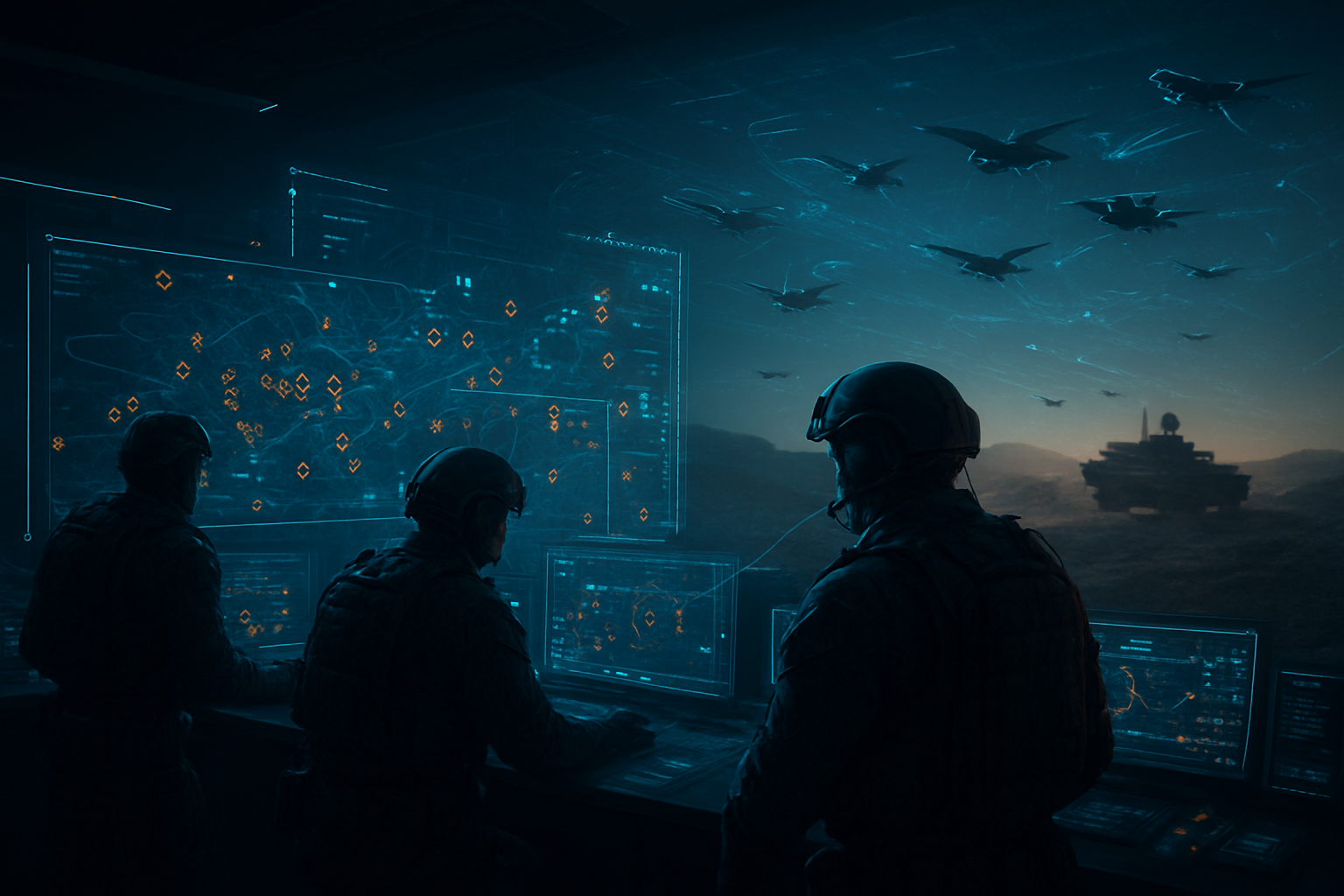
In a demonstration that signals a paradigm shift in modern warfare, the U.S. Department of Defense (DoD) recently concluded its Scarlet Dragon 26-1 exercise, showcasing an unprecedented level of artificial intelligence integration into the "sensor-to-shooter" kill chain. Held from December 1 to 11, 2025, primarily at Fort Liberty, North Carolina, the exercise proved that a small team of just 20 soldiers could effectively manage the targeting workload that previously required 2,000 personnel. By leveraging advanced machine learning, the XVIII Airborne Corps demonstrated the ability to probe and process 1,000 targets per hour, effectively collapsing a tactical cycle that once took half a day into less than sixty seconds.
This milestone marks the maturation of "hyper-war," where the speed of data processing and decision-making becomes the primary determinant of battlefield superiority. As the military transitions from experimental AI to operationalized "AI-enabled" forces, Scarlet Dragon 26-1 serves as a definitive proof of concept for the Joint All-Domain Command and Control (JADC2) initiative. The exercise didn't just test theoretical software; it integrated live satellite feeds, autonomous drones, and long-range artillery into a single, cohesive digital nervous system.
The Technical Backbone: Maven and the 1,000-Target Hour
At the heart of Scarlet Dragon 26-1 is the Maven Smart System, a sophisticated descendant of the once-controversial Project Maven. Developed in collaboration with Palantir Technologies Inc. (NYSE: PLTR), the Maven Smart System acts as the "connective tissue" of the kill chain, utilizing deep learning algorithms to automate the identification and prioritization of targets. In legacy operations, data from various sensors—commercial satellites, high-altitude reconnaissance, and tactical drones—often sat in silos, requiring human analysts to manually verify and hand off coordinates to strike units. During the program's early days in 2020, this "digital target pass" could take up to 743 minutes (over 12 hours). In the 26-1 exercise, that duration was slashed to under one minute.
The technical leap is most evident in the system's throughput capacity. By employing parallel processing and automated computer vision, the AI allows a small team of 20 soldiers to identify and make tactical decisions on 1,000 targets per hour. This capability effectively bypasses the traditional "bottleneck" where human cognitive limits or legacy computer systems would crash under the weight of high-volume data streams. The exercise also debuted "human-machine teaming" protocols where the AI handles four out of the six steps in the kill chain—detection, identification, tracking, and prioritization—while leaving the final "engagement" and "assessment" steps to human commanders, ensuring a "human-in-the-loop" remains for ethical and legal compliance.
Furthermore, the exercise featured the integration of the SGT STOUT, a newly renamed Maneuver Short-Range Air Defense (M-SHORAD) system. Built on a Stryker A1 chassis by General Dynamics (NYSE: GD), the SGT STOUT utilizes a mission equipment package from Leonardo DRS (NASDAQ: DRS) and radar systems from L3Harris Technologies, Inc. (NYSE: LHX) to provide a defensive "bubble" against incoming drones and cruise missiles. The seamless integration of these hardware platforms into the Maven data layer allowed for real-time defensive posture adjustments based on the same AI-driven data that informed offensive operations.
Industry Impact: The Dawn of the AI Defense Titans
The success of Scarlet Dragon 26-1 solidifies the market position of "new-guard" defense tech companies while forcing "old-guard" primes to rapidly adapt. Palantir has emerged as the clear winner, with its software serving as the essential operating system for the Army’s AI ambitions. Similarly, private firm Anduril Industries played a pivotal role by integrating its Lattice Mesh software, which facilitates the movement of tactical sensor data into analyst workflows. This development indicates a shift in DoD procurement, favoring software-first companies that can iterate rapidly over traditional hardware-centric contractors.
The competitive landscape is also shifting for cloud giants. Amazon.com, Inc. (NASDAQ: AMZN) and Microsoft Corp. (NASDAQ: MSFT) provided the massive cloud infrastructure required to process the petabytes of data generated during the exercise. Their involvement underscores that the future of defense is as much about server capacity and edge computing as it is about munitions. Established giants like Lockheed Martin Corporation (NYSE: LMT) and RTX Corporation (NYSE: RTX) are now finding themselves in a position where their hardware—from HIMARS launchers to Hellfire missiles—must be "AI-ready" to remain relevant in a data-centric ecosystem.
The strategic advantage of this technology cannot be overstated. By reducing the personnel requirement for targeting by 99%, the DoD can deploy highly lethal, small units in dispersed environments, a key requirement for potential conflicts in the Indo-Pacific. This "democratization of lethality" means that a single brigade can now exert the same tactical influence as an entire division did two decades ago, fundamentally altering the market demand for large-scale troop transport and logistics in favor of autonomous systems and distributed sensors.
Wider Significance: Ethical Guardrails and Global Strategy
Scarlet Dragon 26-1 fits into a broader global trend of "algorithmic warfare," where AI is used to manage the complexity of the modern battlefield. However, this advancement is not without its controversies. The ability to identify 1,000 targets per hour raises significant concerns regarding the speed of human oversight. Critics argue that at such high speeds, the "human-in-the-loop" may become a "human-on-the-loop," merely rubber-stamping the AI's recommendations without the time to perform due diligence. This acceleration of the kill chain challenges existing international norms regarding the use of force and the accountability of autonomous systems.
Compared to previous AI milestones, such as AlphaGo or the release of GPT-4, Scarlet Dragon 26-1 represents the transition of AI from a "cognitive assistant" to a "kinetic effector." While LLMs have dominated public discourse, the military application of computer vision and sensor fusion is arguably more impactful on global security. The exercise demonstrates that the U.S. is maintaining a lead in the operationalization of AI, potentially deterring adversaries who rely on traditional, slower command structures. However, it also signals the start of a new arms race, where the primary objective is no longer just "who has the biggest bomb," but "who has the fastest algorithm."
Future Horizons: The Rise of the Autonomous Mothership
Looking ahead, the XVIII Airborne Corps is already planning the integration of even more autonomous elements. During Scarlet Dragon 26-1, an experimental "Autonomous Mothership" UAS (Unmanned Aircraft System) was tested, which acted as a carrier and relay for smaller, subordinate drones. This "loitering" network of sensors is expected to become a permanent fixture of the sensor-to-shooter cycle. Near-term developments will likely focus on the Joint Innovation Outpost (JIOP) at Fort Liberty, where soldiers will work side-by-side with tech developers to refine Maven’s algorithms in real-time, based on live field feedback.
The long-term goal is a fully "attritable" force—where low-cost, AI-driven drones can be used in high-risk areas without risking human lives. The challenge remains in "data liquidity"—the ability to move data seamlessly between different branches of the military and international allies. Experts predict that the next iteration of Scarlet Dragon will involve more significant participation from "Five Eyes" partners, testing whether the AI can handle multi-lingual data and varying rules of engagement across different sovereign nations.
Conclusion: A New Chapter in Military History
Scarlet Dragon 26-1 is a landmark event that confirms the arrival of the AI-augmented soldier. By successfully shrinking the kill chain from hours to seconds and allowing a handful of personnel to manage thousands of data points, the U.S. military has fundamentally redefined tactical efficiency. The key takeaway is that the bottleneck in modern warfare is no longer the speed of the missile, but the speed of the mind—and AI is the only tool capable of keeping pace.
As we look toward the remaining months of 2026, the industry should watch for the broader rollout of the Maven Smart System across other combatant commands. The success of this exercise will likely trigger a surge in DoD spending on software and AI-related infrastructure, marking a definitive end to the era of manual battlefield analysis. For the technology industry, Scarlet Dragon 26-1 is a clear signal: the future of national security is written in code.
This content is intended for informational purposes only and represents analysis of current AI developments.
TokenRing AI delivers enterprise-grade solutions for multi-agent AI workflow orchestration, AI-powered development tools, and seamless remote collaboration platforms.
For more information, visit https://www.tokenring.ai/.