Tag: Mercedes-Benz

  • The “Thinking” Car: NVIDIA Launches Alpamayo Platform with 10-Billion Parameter ‘Chain-of-Thought’ AI

    The “Thinking” Car: NVIDIA Launches Alpamayo Platform with 10-Billion Parameter ‘Chain-of-Thought’ AI

    In a landmark announcement at the 2026 Consumer Electronics Show, NVIDIA (NASDAQ: NVDA) has officially unveiled the Alpamayo platform, a revolutionary leap in autonomous vehicle technology that shifts the focus from simple object detection to complex cognitive reasoning. Described by NVIDIA leadership as the "GPT-4 moment for mobility," Alpamayo marks the industry’s first comprehensive transition to "Physical AI"—systems that don't just see the world but understand the causal relationships within it.

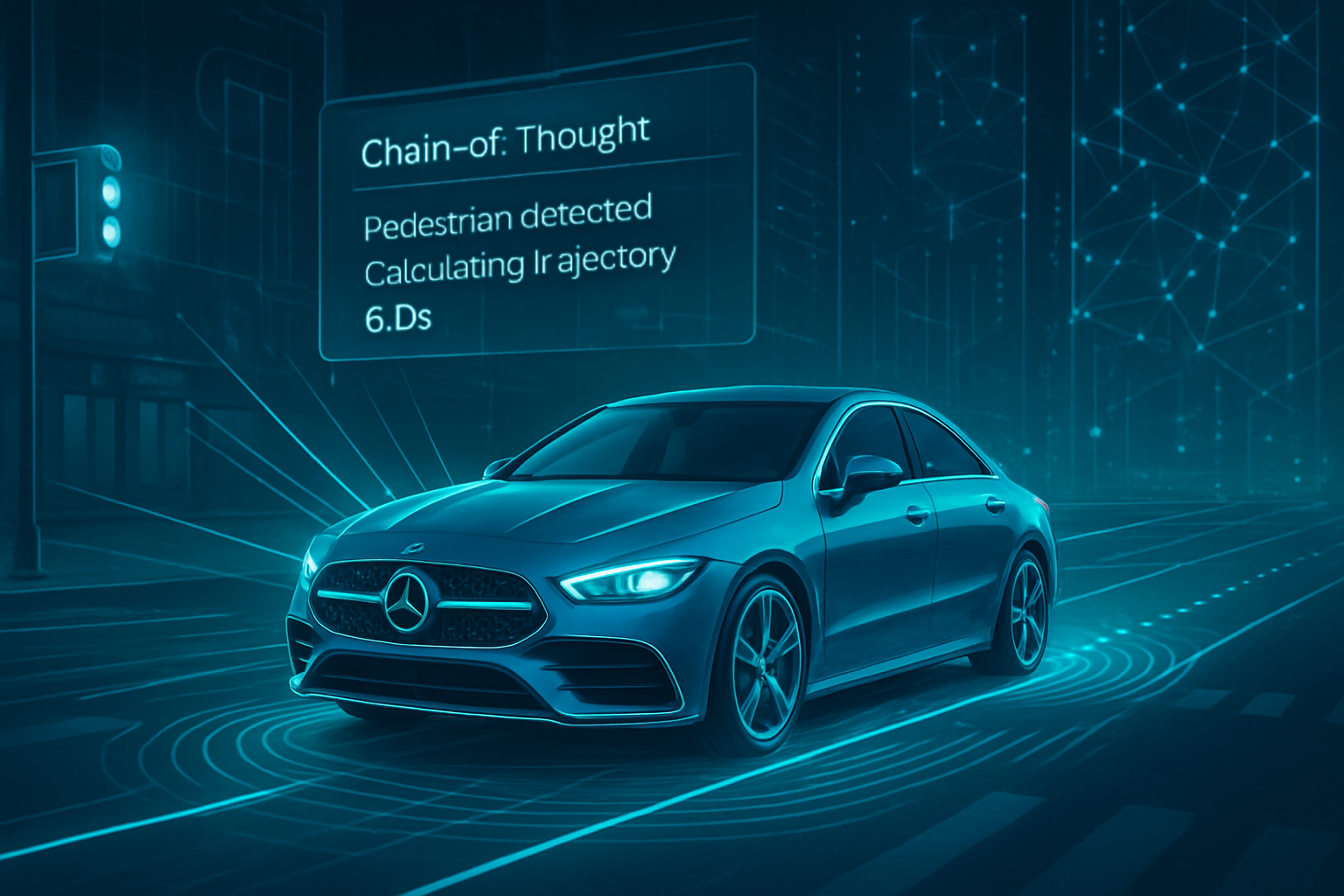
    The platform's debut coincides with its first commercial integration in the 2026 Mercedes-Benz (ETR: MBG) CLA, which will hit U.S. roads this quarter. By moving beyond traditional "black box" neural networks and into the realm of Vision-Language-Action (VLA) models, NVIDIA and Mercedes-Benz are attempting to bridge the gap between Level 2 driver assistance and the long-coveted goal of widespread, safe Level 4 autonomy.

    From Perception to Reasoning: The 10B VLA Breakthrough

    At the heart of the Alpamayo platform lies Alpamayo 1, a flagship 10-billion-parameter Vision-Language-Action model. Unlike previous generations of autonomous software that relied on discrete modules for perception, planning, and control, Alpamayo 1 is an end-to-end transformer-based architecture. It is divided into two specialized components: an 8.2-billion-parameter "Cosmos-Reason" backbone that handles semantic understanding of the environment, and a 2.3-billion-parameter "Action Expert" that translates those insights into a 6-second future trajectory at 10Hz.

    The most significant technical advancement is the introduction of "Chain-of-Thought" (CoT) reasoning, or what NVIDIA calls "Chain-of-Causation." Traditional AI driving systems often fail in "long-tail" scenarios—rare events like a child chasing a ball into the street or a construction worker using non-standard hand signals—because they cannot reason through the why of a situation. Alpamayo solves this by generating internal reasoning traces. For example, if the car slows down unexpectedly, the system doesn't just execute a braking command; it processes the logic: "Observing a ball roll into the street; inferring a child may follow; slowing to 15 mph and covering the brake to mitigate collision risk."

    This shift is powered by the NVIDIA DRIVE AGX Thor system-on-a-chip, built on the Blackwell architecture. Delivering 508 TOPS (Trillions of Operations Per Second), Thor provides the immense computational headroom required to run these massive VLA models in real-time with less than 100ms of latency. This differentiates Alpamayo from legacy approaches by Mobileye (NASDAQ: MBLY) or older Tesla (NASDAQ: TSLA) FSD versions, which traditionally lacked the on-board compute to run high-parameter language-based reasoning alongside vision processing.

    Shaking Up the Autonomous Arms Race

    NVIDIA's decision to launch Alpamayo as an open-source ecosystem is a strategic masterstroke intended to position the company as the "Android of Autonomy." By providing not just the model, but also the AlpaSim simulation framework and over 100 terabytes of curated "Physical AI" datasets, NVIDIA is lowering the barrier to entry for other automakers. This puts significant pressure on vertical competitors like Tesla, whose FSD (Full Self-Driving) stack remains a proprietary "walled garden."

    For Mercedes-Benz, the early adoption of Alpamayo in the CLA provides a massive market advantage in the luxury segment. While the initial release is categorized as a "Level 2++" system—requiring driver supervision—the hardware is fully L4-ready. This allows Mercedes to collect vast amounts of "reasoning data" from real-world fleets, which can then be distilled into smaller, more efficient models. Other major players, including Jaguar Land Rover and Lucid (NASDAQ: LCID), have already signaled their intent to adopt parts of the Alpamayo stack, potentially creating a unified standard for how AI cars "think."

    The Wider Significance: Explainability and the Safety Gap

    The launch of Alpamayo addresses the single biggest hurdle to autonomous vehicle adoption: trust. By making the AI's "thought process" transparent through Chain-of-Thought reasoning, NVIDIA is providing regulators and insurance companies with an audit trail that was previously impossible. In the event of a near-miss or accident, engineers can now look at the model's reasoning trace to understand the logic behind a specific maneuver, moving AI from a "black box" to an "open book."

    This move fits into a broader trend of "Explainable AI" (XAI) that is sweeping the tech industry. As AI agents begin to handle physical tasks—from warehouse robotics to driving—the ability to justify actions in human-readable terms becomes a safety requirement rather than a feature. However, this also raises new concerns. Critics argue that relying on large-scale models could introduce "hallucinations" into driving behavior, where a car might "reason" its way into a dangerous action based on a misunderstood visual cue. NVIDIA has countered this by implementing a "dual-stack" architecture, where a classical safety monitor (NVIDIA Halos) runs in parallel to the AI to veto any kinematically unsafe commands.

    The Horizon: Scaling Physical AI

    In the near term, expect the Alpamayo platform to expand rapidly beyond the Mercedes-Benz CLA. NVIDIA has already hinted at "Alpamayo Mini" models—highly distilled versions of the 10B VLA designed to run on lower-power chips for mid-range and budget vehicles. As more OEMs join the ecosystem, the "Physical AI Open Datasets" will grow exponentially, potentially solving the autonomous driving puzzle through sheer scale of shared data.

    Long-term, the implications of Alpamayo reach far beyond the automotive industry. The "Cosmos-Reason" backbone is fundamentally a physical-world simulator. The same logic used to navigate a busy intersection in a CLA could be adapted for humanoid robots in manufacturing or delivery drones. Experts predict that within the next 24 months, we will see the first "zero-shot" autonomous deployments, where vehicles can navigate entirely new cities they have never been mapped in, simply by reasoning through the environment the same way a human driver would.

    A New Era for the Road

    The launch of NVIDIA Alpamayo and its debut in the Mercedes-Benz CLA represents a pivot point in the history of artificial intelligence. We are moving away from an era where cars were programmed with rules, and into an era where they are taught to think. By combining 10-billion-parameter scale with explainable reasoning, NVIDIA is addressing the complexity of the real world with the nuance it requires.

    The significance of this development cannot be overstated; it is a fundamental redesign of the relationship between machine perception and action. In the coming weeks and months, the industry will be watching the Mercedes-Benz CLA's real-world performance closely. If Alpamayo lives up to its promise of solving the "long-tail" of driving through human-like logic, the path to a truly driverless future may finally be clear.


    This content is intended for informational purposes only and represents analysis of current AI developments.

    TokenRing AI delivers enterprise-grade solutions for multi-agent AI workflow orchestration, AI-powered development tools, and seamless remote collaboration platforms.
    For more information, visit https://www.tokenring.ai/.
  • NVIDIA Alpamayo: Bringing Human-Like Reasoning to Self-Driving Cars

    NVIDIA Alpamayo: Bringing Human-Like Reasoning to Self-Driving Cars

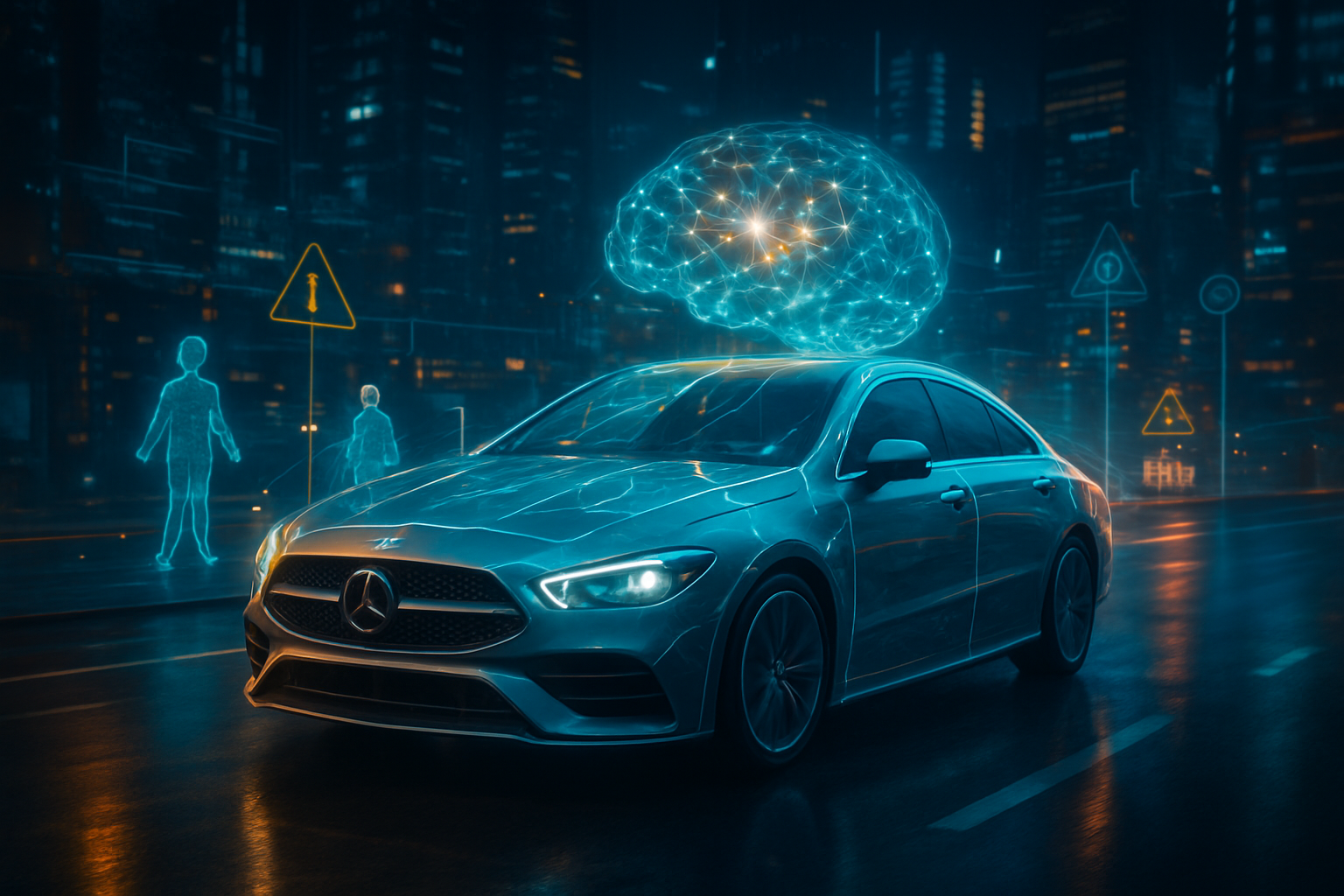
    At the 2026 Consumer Electronics Show (CES) in Las Vegas, NVIDIA (NASDAQ:NVDA) CEO Jensen Huang delivered what many are calling a watershed moment for the automotive industry. The company officially unveiled Alpamayo, a revolutionary family of "Physical AI" models designed to bring human-like reasoning to self-driving cars. Moving beyond the traditional pattern-matching and rule-based systems that have defined autonomous vehicle (AV) development for a decade, Alpamayo introduces a cognitive layer capable of "thinking through" complex road scenarios in real-time. This announcement marks a fundamental shift in how machines interact with the physical world, promising to solve the stubborn "long tail" of rare driving events that have long hindered the widespread adoption of fully autonomous transport.

    The immediate significance of Alpamayo lies in its departure from the "black box" nature of previous end-to-end neural networks. By integrating chain-of-thought reasoning directly into the driving stack, NVIDIA is providing vehicles with the ability to explain their decisions, interpret social cues from pedestrians, and navigate environments they have never encountered before. The announcement was punctuated by a major commercial milestone: a deep, multi-year partnership with Mercedes-Benz Group AG (OTC:MBGYY), which will see the Alpamayo-powered NVIDIA DRIVE platform debut in the all-new Mercedes-Benz CLA starting in the first quarter of 2026.

    A New Architecture: Vision-Language-Action and Reasoning Traces

    Technically, Alpamayo 1 is built on a massive 10-billion-parameter Vision-Language-Action (VLA) architecture. Unlike current systems that translate sensor data directly into steering and braking commands, Alpamayo generates an internal "reasoning trace." This is a step-by-step logical path where the AI identifies objects, assesses their intent, and weighs potential outcomes before executing a maneuver. For example, if the car encounters a traffic officer using unconventional hand signals at a construction site, Alpamayo doesn’t just see an obstacle; it "reasons" that the human figure is directing traffic and interprets the specific gestures based on the context of the surrounding cones and vehicles.

    This approach represents a radical departure from the industry’s previous reliance on massive, brute-forced datasets of every possible driving scenario. Instead of needing to see a million examples of a sinkhole to know how to react, Alpamayo uses causal and physical reasoning to understand that a hole in the road violates the "drivable surface" rule and poses a structural risk to the vehicle. To support these computationally intensive models, NVIDIA also announced the mass production of its Rubin AI platform. The Rubin architecture, featuring the new Vera CPU, is designed to handle the massive token generation required for real-time reasoning at one-tenth the cost and power consumption of previous generations, making it viable for consumer-grade electric vehicles.

    Market Disruption and the Competitive Landscape

    The introduction of Alpamayo creates immediate pressure on other major players in the AV space, most notably Tesla (NASDAQ:TSLA) and Alphabet’s (NASDAQ:GOOGL) Waymo. While Tesla has championed an end-to-end neural network approach with its Full Self-Driving (FSD) software, NVIDIA’s Alpamayo adds a layer of explainability and symbolic reasoning that Tesla’s current architecture lacks. For Mercedes-Benz, the partnership serves as a massive strategic advantage, allowing the legacy automaker to leapfrog competitors in software-defined vehicle capabilities. By integrating Alpamayo into the MB.OS ecosystem, Mercedes is positioning itself as the gold standard for "Level 3 plus" autonomy, where the car can handle almost all driving tasks with a level of nuance previously reserved for human drivers.

    Industry experts suggest that NVIDIA’s decision to open-source the Alpamayo 1 weights on Hugging Face and release the AlpaSim simulation framework on GitHub is a strategic masterstroke. By providing the "teacher model" and the simulation tools to the broader research community, NVIDIA is effectively setting the industry standard for Physical AI. This move could disrupt smaller AV startups that have spent years building proprietary rule-based stacks, as the barrier to entry for high-level reasoning is now significantly lowered for any manufacturer using NVIDIA hardware.

    Solving the Long Tail: The Wider Significance of Physical AI

    The "long tail" of autonomous driving—the infinite variety of rare, unpredictable events like a loose animal on a highway or a confusing detour—has been the primary roadblock to Level 5 autonomy. Alpamayo’s ability to "decompose" a novel, complex scenario into familiar logical components allows it to avoid the "frozen" state that often plagues current AVs when they encounter something outside their training data. This shift from reactive to proactive AI fits into the broader 2026 trend of "General Physical AI," where models are no longer confined to digital screens but are given the "bodies" (cars, robots, drones) to interact with the world.

    However, the move toward reasoning-based AI also brings new concerns regarding safety certification. To address this, NVIDIA and Mercedes-Benz highlighted the NVIDIA Halos safety system. This dual-stack architecture runs the Alpamayo reasoning model alongside a traditional, deterministic safety fallback. If the AI’s reasoning confidence drops below a specific threshold, the Halos system immediately reverts to rigid safety guardrails. This "belt and suspenders" approach is what allowed the new CLA to achieve a EuroNCAP five-star safety rating, a crucial milestone for public and regulatory acceptance of AI-driven transport.

    The Horizon: From Luxury Sedans to Universal Autonomy

    Looking ahead, the Alpamayo family is expected to expand beyond luxury passenger vehicles. NVIDIA hinted at upcoming versions of the model optimized for long-haul trucking and last-mile delivery robots. The near-term focus will be the successful rollout of the Mercedes-Benz CLA in the United States, followed by European and Asian markets later in 2026. Experts predict that as the Alpamayo model "learns" from real-world reasoning traces, the speed of its logic will increase, eventually allowing for "super-human" reaction times that account not just for physics, but for the predicted social behavior of other drivers.

    The long-term challenge remains the "compute gap" between high-end hardware like the Rubin platform and the hardware found in budget-friendly vehicles. While NVIDIA has driven down the cost of token generation, the real-time execution of a 10-billion-parameter model still requires significant onboard power. Future developments will likely focus on "distilling" these massive reasoning models into smaller, more efficient versions that can run on lower-tier NVIDIA DRIVE chips, potentially democratizing human-like reasoning across the entire automotive market by the end of the decade.

    Conclusion: A Turning Point in the History of AI

    NVIDIA’s Alpamayo announcement at CES 2026 represents more than just an incremental update to self-driving software; it is a fundamental re-imagining of how AI perceives and acts within the physical world. By bridging the gap between the linguistic reasoning of Large Language Models and the spatial requirements of driving, NVIDIA has provided a blueprint for the next generation of autonomous systems. The partnership with Mercedes-Benz provides the necessary commercial vehicle to prove this technology on public roads, shifting the conversation from "if" cars can drive themselves to "how well" they can reason through the complexities of human life.

    As we move into the first quarter of 2026, the tech world will be watching the U.S. launch of the Alpamayo-equipped CLA with intense scrutiny. If the system delivers on its promise of handling long-tail scenarios with the grace of a human driver, it will likely be remembered as the moment the "AI winter" for autonomous vehicles finally came to an end. For now, NVIDIA has once again asserted its dominance not just as a chipmaker, but as the primary architect of the world’s most advanced physical intelligences.


    This content is intended for informational purposes only and represents analysis of current AI developments.

    TokenRing AI delivers enterprise-grade solutions for multi-agent AI workflow orchestration, AI-powered development tools, and seamless remote collaboration platforms.
    For more information, visit https://www.tokenring.ai/.