Tag: NVDA

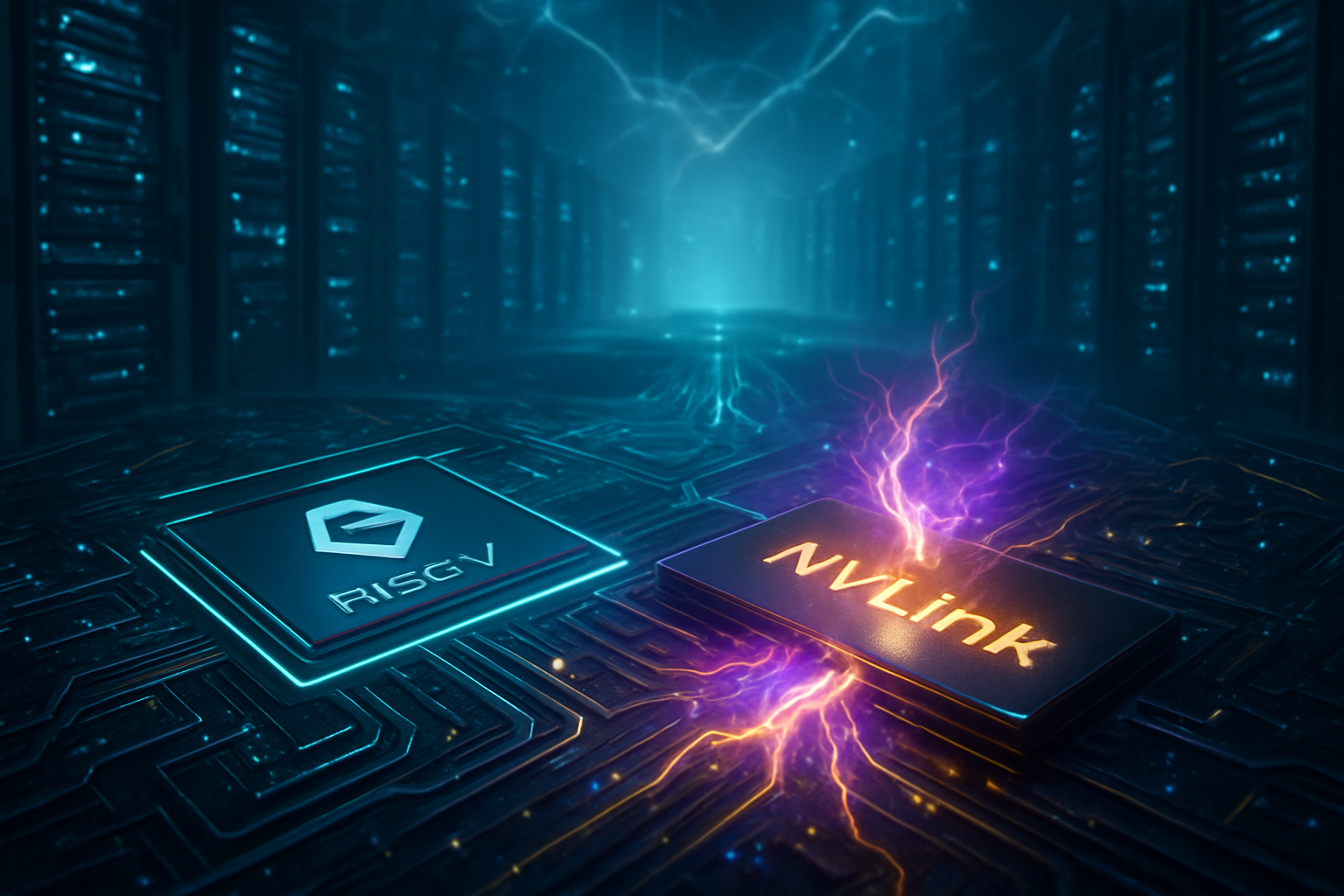
  • The RISC-V Revolution: SiFive and NVIDIA Shatter the Proprietary Glass Ceiling with NVLink Fusion

    The RISC-V Revolution: SiFive and NVIDIA Shatter the Proprietary Glass Ceiling with NVLink Fusion

    In a move that signals a tectonic shift in the semiconductor landscape, SiFive, the leader in RISC-V computing, announced on January 15, 2026, a landmark strategic partnership with NVIDIA (NASDAQ: NVDA) to integrate NVIDIA NVLink Fusion into its high-performance RISC-V processor platforms. This collaboration grants RISC-V "first-class citizen" status within the NVIDIA hardware ecosystem, providing the open-standard architecture with the high-speed, cache-coherent interconnectivity previously reserved for NVIDIA’s own Grace and Vera CPUs.

    The immediate significance of this announcement cannot be overstated. By adopting NVLink-C2C (Chip-to-Chip) technology, SiFive is effectively removing the primary barrier that has kept RISC-V out of the most demanding AI data centers: the lack of a high-bandwidth pipeline to the world’s most powerful GPUs. This integration allows hyperscalers and chip designers to pair highly customizable RISC-V CPU cores with NVIDIA’s industry-leading accelerators, creating a formidable alternative to the proprietary x86 and ARM architectures that have long dominated the server market.

    Technical Synergy: Unlocking the Rubin Architecture

    The technical cornerstone of this partnership is the integration of NVLink Fusion, specifically the NVLink-C2C variant, into SiFive’s next-generation data center-class compute subsystems. Tied to the newly unveiled NVIDIA Rubin platform, this integration utilizes sixth-generation NVLink technology, which boasts a staggering 3.6 TB/s of bidirectional bandwidth per GPU. Unlike traditional PCIe lanes, which often create bottlenecks in AI training workloads, NVLink-C2C provides a fully cache-coherent link, allowing the CPU and GPU to share memory resources with near-zero latency.

    This technical leap enables SiFive processors to tap into the full CUDA-X software stack, including critical libraries like NCCL (NVIDIA Collective Communications Library) for multi-GPU scaling. Previously, RISC-V implementations were often "bolted on" via standard peripheral interfaces, resulting in significant performance penalties during large-scale AI model training and inference. By becoming an NVLink Fusion licensee, SiFive ensures that its silicon can communicate with NVIDIA GPUs with the same efficiency as proprietary designs. Initial designs utilizing this IP are expected to hit the market in 2027, targeting high-performance computing (HPC) and massive-scale AI clusters.

    Industry experts have noted that this differs significantly from previous "open" attempts at interconnectivity. While standard protocols like CXL (Compute Express Link) have made strides, NVLink remains the gold standard for pure AI throughput. The AI research community has reacted with enthusiasm, noting that the ability to "right-size" the CPU using RISC-V’s modular instructions—while maintaining a high-speed link to NVIDIA’s compute power—could lead to unprecedented efficiency in specialized LLM (Large Language Model) environments.

    Disruption in the Data Center: The End of Vendor Lock-in?

    This partnership has immediate and profound implications for the competitive landscape of the semiconductor industry. For years, companies like ARM Holdings (NASDAQ: ARM) have benefited from being the primary alternative to the x86 duopoly of Intel (NASDAQ: INTC) and Advanced Micro Devices (NASDAQ: AMD). However, as ARM has moved toward designing its own complete chips and tightening its licensing terms, tech giants like Meta, Google, and Amazon have sought greater architectural freedom. SiFive’s new capability offers these hyperscalers exactly what they have been asking for: the ability to build fully custom, "AI-native" CPUs that don't sacrifice performance in the NVIDIA ecosystem.

    NVIDIA also stands to benefit strategically. By opening NVLink to SiFive, NVIDIA is hedging its bets against the emergence of UALink (Ultra Accelerator Link), a rival open interconnect standard backed by a coalition of its competitors. By making NVLink available to the RISC-V community, NVIDIA is essentially making its proprietary interconnect the de facto standard for the entire "custom silicon" movement. This move potentially sidelines x86 in AI-native server racks, as the industry shifts toward specialized, co-designed CPU-GPU systems that prioritize energy efficiency and high-bandwidth coherence over legacy compatibility.

    For startups and specialized AI labs, this development lowers the barrier to entry for custom silicon. A startup can now license SiFive’s high-performance cores and, thanks to the NVLink integration, ensure their custom chip will be compatible with the world’s most widely used AI infrastructure on day one. This levels the playing field against larger competitors who have the resources to design complex interconnects from scratch.

    Broader Significance: The Rise of Modular Computing

    The adoption of NVLink by SiFive fits into a broader trend toward the "disaggregation" of the data center. We are moving away from a world of "general-purpose" servers and toward a world of "composable" infrastructure. In this new landscape, the instruction set architecture (ISA) becomes less important than the ability of the components to communicate at light speed. RISC-V, with its open, modular nature, is perfectly suited for this transition, and the NVIDIA partnership provides the high-octane fuel needed for that engine.

    However, this milestone also raises concerns about the future of truly "open" hardware. While RISC-V is an open standard, NVLink is proprietary. Some purists in the open-source community worry that this "fusion" could lead to a new form of "interconnect lock-in," where the CPU is open but its primary method of communication is controlled by a single dominant vendor. Comparisons are already being made to the early days of the PC industry, where open standards were often "extended" by dominant players to maintain market control.

    Despite these concerns, the move is widely seen as a victory for energy efficiency. Data centers are currently facing a crisis of power consumption, and the ability to strip away the legacy "cruft" of x86 in favor of a lean, mean RISC-V design optimized for AI data movement could save megawatts of power at scale. This follows in the footsteps of previous milestones like the introduction of the first GPU-accelerated supercomputers, but with a focus on the CPU's role as an efficient traffic controller rather than a primary workhorse.

    Future Outlook: The Road to 2027 and Beyond

    Looking ahead, the next 18 to 24 months will be a period of intense development as the first SiFive-based "NVLink-Series" processors move through the design and tape-out phases. We expect to see hyperscalers announce their own custom RISC-V/NVIDIA hybrid chips by early 2027, specifically optimized for the "Rubin" and "Vera" generation of accelerators. These chips will likely feature specialized instructions for data pre-processing and vector management, tasks where RISC-V's extensibility shines.

    One of the primary challenges that remain is the software ecosystem. While CUDA support is a massive win, the broader RISC-V software ecosystem for server-side applications still needs to mature to match the decades of optimization found in x86 and ARM. Experts predict that the focus of the RISC-V International foundation will now shift heavily toward standardizing "AI-native" extensions to ensure that the performance gains offered by NVLink are not lost to software inefficiencies.

    In the long term, this partnership may be remembered as the moment the "proprietary vs. open" debate in hardware was finally settled in favor of a hybrid approach. If SiFive and NVIDIA can prove that an open CPU with a proprietary interconnect can outperform the best "all-proprietary" stacks from ARM or Intel, it will rewrite the playbook for how semiconductors are designed and sold for the rest of the decade.

    A New Era for AI Infrastructure

    The partnership between SiFive and NVIDIA marks a watershed moment for the AI industry. By bringing the world’s most advanced interconnect to the world’s most flexible processor architecture, these two companies have cleared a path for a new generation of high-performance, energy-efficient, and highly customizable data centers. The significance of this development lies not just in the hardware specifications, but in the shift in power dynamics it represents—away from legacy architectures and toward a more modular, "best-of-breed" approach to AI compute.

    As we move through 2026, the tech world will be watching closely for the first silicon samples and early performance benchmarks. The success of this integration could determine whether RISC-V becomes the dominant architecture for the AI era or remains a niche alternative. For now, the message is clear: the proprietary stranglehold on the data center has been broken, and the future of AI hardware is more open, and more connected, than ever before.

    Watch for further announcements during the upcoming spring developer conferences, where more specific implementation details of the SiFive/NVIDIA "Rubin" subsystems are expected to be unveiled.


    This content is intended for informational purposes only and represents analysis of current AI developments.

    TokenRing AI delivers enterprise-grade solutions for multi-agent AI workflow orchestration, AI-powered development tools, and seamless remote collaboration platforms.
    For more information, visit https://www.tokenring.ai/.

  • The AI Supercycle: Why Semiconductor Giants TSM, AMAT, and NVDA are Dominating Investor Portfolios

    The AI Supercycle: Why Semiconductor Giants TSM, AMAT, and NVDA are Dominating Investor Portfolios

    The artificial intelligence revolution is not merely a buzzword; it's a profound technological shift underpinned by an unprecedented demand for computational power. At the heart of this "AI Supercycle" are the semiconductor companies that design, manufacture, and equip the world with the chips essential for AI development and deployment. As of October 2025, three titans stand out in attracting significant investor attention: Taiwan Semiconductor Manufacturing Company (NYSE: TSM), Applied Materials (NASDAQ: AMAT), and NVIDIA (NASDAQ: NVDA). Their pivotal roles in enabling the AI era, coupled with strong financial performance and favorable analyst ratings, position them as cornerstone investments for those looking to capitalize on the burgeoning AI landscape.

    This detailed analysis delves into why these semiconductor powerhouses are capturing investor interest, examining their technological leadership, strategic market positioning, and the broader implications for the AI industry. From the intricate foundries producing cutting-edge silicon to the equipment shaping those wafers and the GPUs powering AI models, TSM, AMAT, and NVDA represent critical links in the AI value chain, making them indispensable players in the current technological paradigm.

    The Foundational Pillars of AI: Unpacking Technical Prowess

    The relentless pursuit of more powerful and efficient AI systems directly translates into a surging demand for advanced semiconductor technology. Each of these companies plays a distinct yet interconnected role in fulfilling this demand, showcasing technical capabilities that set them apart.

    Taiwan Semiconductor Manufacturing Company (NYSE: TSM) is the undisputed leader in contract chip manufacturing, serving as the foundational architect for the AI era. Its technological leadership in cutting-edge process nodes is paramount. TSM is currently at the forefront with its 3-nanometer (3nm) technology and is aggressively advancing towards 2-nanometer (2nm), A16 (1.6nm-class), and A14 (1.4nm) processes. These advancements are critical for the next generation of AI processors, allowing for greater transistor density, improved performance, and reduced power consumption. Beyond raw transistor count, TSM's innovative packaging solutions, such as CoWoS (Chip-on-Wafer-on-Substrate), SoIC (System-on-Integrated-Chips), CoPoS (Chip-on-Package-on-Substrate), and CPO (Co-Packaged Optics), are vital for integrating multiple dies and High-Bandwidth Memory (HBM) into powerful AI accelerators. The company is actively expanding its CoWoS capacity, aiming to quadruple output by the end of 2025, to meet the insatiable demand for these complex AI chips.

    Applied Materials (NASDAQ: AMAT) is an equally crucial enabler, providing the sophisticated wafer fabrication equipment necessary to manufacture these advanced semiconductors. As the largest semiconductor wafer fabrication equipment manufacturer globally, AMAT's tools are indispensable for both Logic and DRAM segments, which are fundamental to AI infrastructure. The company's expertise is critical in facilitating major semiconductor transitions, including the shift to Gate-All-Around (GAA) transistors and backside power delivery – innovations that significantly enhance the performance and power efficiency of chips used in AI computing. AMAT's strong etch sales and favorable position for HBM growth underscore its importance, as HBM is a key component of modern AI accelerators. Its co-innovation efforts and new manufacturing systems, like the Kinex Bonding system for hybrid bonding, further cement its role in pushing the boundaries of chip design and production.

    NVIDIA (NASDAQ: NVDA) stands as the undisputed "king of artificial intelligence," dominating the AI chip market with an estimated 92-94% market share for discrete GPUs used in AI computing. NVIDIA's prowess extends beyond hardware; its CUDA software platform provides an optimized ecosystem of tools, libraries, and frameworks for AI development, creating powerful network effects that solidify its position as the preferred platform for AI researchers and developers. The company's latest Blackwell architecture chips deliver significant performance improvements for AI training and inference workloads, further extending its technological lead. With its Hopper H200-powered instances widely available in major cloud services, NVIDIA's GPUs are the backbone of virtually every major AI data center, making it an indispensable infrastructure supplier for the global AI build-out.

    Ripple Effects Across the AI Ecosystem: Beneficiaries and Competitors

    The strategic positioning and technological advancements of TSM, AMAT, and NVDA have profound implications across the entire AI ecosystem, benefiting a wide array of companies while intensifying competitive dynamics.

    Cloud service providers like Amazon (NASDAQ: AMZN) Web Services, Microsoft (NASDAQ: MSFT) Azure, and Google (NASDAQ: GOOGL) Cloud are direct beneficiaries, as they rely heavily on NVIDIA's GPUs and the advanced chips manufactured by TSM (for NVIDIA and other chip designers) to power their AI offerings and expand their AI infrastructure. Similarly, AI-centric startups and research labs such as OpenAI, Google DeepMind, and Meta (NASDAQ: META) AI depend on the availability and performance of these cutting-edge semiconductors to train and deploy their increasingly complex models. Without the foundational technology provided by these three companies, the rapid pace of AI innovation would grind to a halt.

    The competitive landscape for major AI labs and tech companies is significantly shaped by access to these critical components. Companies with strong partnerships and procurement strategies for NVIDIA GPUs and TSM's foundry capacity gain a strategic advantage in the AI race. This can lead to potential disruption for existing products or services that may not be able to leverage the latest AI capabilities due to hardware limitations. For instance, companies that fail to integrate powerful AI models, enabled by these advanced chips, risk falling behind competitors who can offer more intelligent and efficient solutions.

    Market positioning and strategic advantages are also heavily influenced. NVIDIA's dominance, fueled by TSM's manufacturing prowess and AMAT's equipment, allows it to dictate terms in the AI hardware market, creating a high barrier to entry for potential competitors. This integrated value chain ensures that companies at the forefront of semiconductor innovation maintain a strong competitive moat, driving further investment and R&D into next-generation AI-enabling technologies. The robust performance of these semiconductor giants directly translates into accelerated AI development across industries, from healthcare and finance to autonomous vehicles and scientific research.

    Broader Significance: Fueling the Future of AI

    The investment opportunities in TSM, AMAT, and NVDA extend beyond their individual financial performance, reflecting their crucial role in shaping the broader AI landscape and driving global technological trends. These companies are not just participants; they are fundamental enablers of the AI revolution.

    Their advancements fit seamlessly into the broader AI landscape by providing the essential horsepower for everything from large language models (LLMs) and generative AI to sophisticated machine learning algorithms and autonomous systems. The continuous drive for smaller, faster, and more energy-efficient chips directly accelerates AI research and deployment, pushing the boundaries of what AI can achieve. The impacts are far-reaching: AI-powered solutions are transforming industries, improving efficiency, fostering innovation, and creating new economic opportunities globally. This technological progress is comparable to previous milestones like the advent of the internet or mobile computing, with semiconductors acting as the underlying infrastructure.

    However, this rapid growth is not without its concerns. The concentration of advanced semiconductor manufacturing in a few key players, particularly TSM, raises geopolitical risks, as evidenced by ongoing U.S.-China trade tensions and export controls. While TSM's expansion into regions like Arizona aims to mitigate some of these risks, the supply chain remains highly complex and vulnerable to disruptions. Furthermore, the immense computational power required by AI models translates into significant energy consumption, posing environmental and infrastructure challenges that need innovative solutions from the semiconductor industry itself. The ethical implications of increasingly powerful AI, fueled by these chips, also warrant careful consideration.

    The Road Ahead: Future Developments and Challenges

    The trajectory for TSM, AMAT, and NVDA, and by extension, the entire AI industry, points towards continued rapid evolution and expansion. Near-term and long-term developments will be characterized by an intensified focus on performance, efficiency, and scalability.

    Expected near-term developments include the further refinement and mass production of current leading-edge nodes (3nm, 2nm) by TSM, alongside the continuous rollout of more powerful AI accelerator architectures from NVIDIA, building on the Blackwell platform. AMAT will continue to innovate in manufacturing equipment to support these increasingly complex designs, including advancements in advanced packaging and materials engineering. Long-term, we can anticipate the advent of even smaller process nodes (A16, A14, and beyond), potentially leading to breakthroughs in quantum computing and neuromorphic chips designed specifically for AI. The integration of AI directly into edge devices will also drive demand for specialized, low-power AI inference chips.

    Potential applications and use cases on the horizon are vast, ranging from the realization of Artificial General Intelligence (AGI) to widespread enterprise AI adoption, fully autonomous vehicles, personalized medicine, and climate modeling. These advancements will be enabled by the continuous improvement in semiconductor capabilities. However, significant challenges remain, including the increasing cost and complexity of manufacturing at advanced nodes, the need for sustainable and energy-efficient AI infrastructure, and the global talent shortage in semiconductor engineering and AI research. Experts predict that the AI Supercycle will continue for at least the next decade, with these three companies remaining at the forefront, but the pace of "eye-popping" gains might moderate as the market matures.

    A Cornerstone for the AI Future: A Comprehensive Wrap-Up

    In summary, Taiwan Semiconductor Manufacturing Company (NYSE: TSM), Applied Materials (NASDAQ: AMAT), and NVIDIA (NASDAQ: NVDA) are not just attractive investment opportunities; they are indispensable pillars of the ongoing AI revolution. TSM's leadership in advanced chip manufacturing, AMAT's critical role in providing state-of-the-art fabrication equipment, and NVIDIA's dominance in AI GPU design and software collectively form the bedrock upon which the future of artificial intelligence is being built. Their sustained innovation and strategic market positioning have positioned them as foundational enablers, driving the rapid advancements we observe across the AI landscape.

    Their significance in AI history cannot be overstated; these companies are facilitating a technological transformation comparable to the most impactful innovations of the past century. The long-term impact of their contributions will be felt across every sector, leading to more intelligent systems, unprecedented computational capabilities, and new frontiers of human endeavor. While geopolitical risks and the immense energy demands of AI remain challenges, the trajectory of innovation from these semiconductor giants suggests a sustained period of growth and transformative change.

    Investors and industry observers should closely watch upcoming earnings reports, such as TSM's Q3 2025 earnings on October 16, 2025, for further insights into demand trends and capacity expansions. Furthermore, geopolitical developments, particularly concerning trade policies and supply chain resilience, will continue to be crucial factors. As the AI Supercycle continues to accelerate, TSM, AMAT, and NVDA will remain at the epicenter, shaping the technological landscape for years to come.


    This content is intended for informational purposes only and represents analysis of current AI developments.

    TokenRing AI delivers enterprise-grade solutions for multi-agent AI workflow orchestration, AI-powered development tools, and seamless remote collaboration platforms.
    For more information, visit https://www.tokenring.ai/.