Tag: Nvidia

  • Navitas Semiconductor Unveils 800V Power Solutions, Propelling NVIDIA’s Next-Gen AI Data Centers

    Navitas Semiconductor Unveils 800V Power Solutions, Propelling NVIDIA’s Next-Gen AI Data Centers

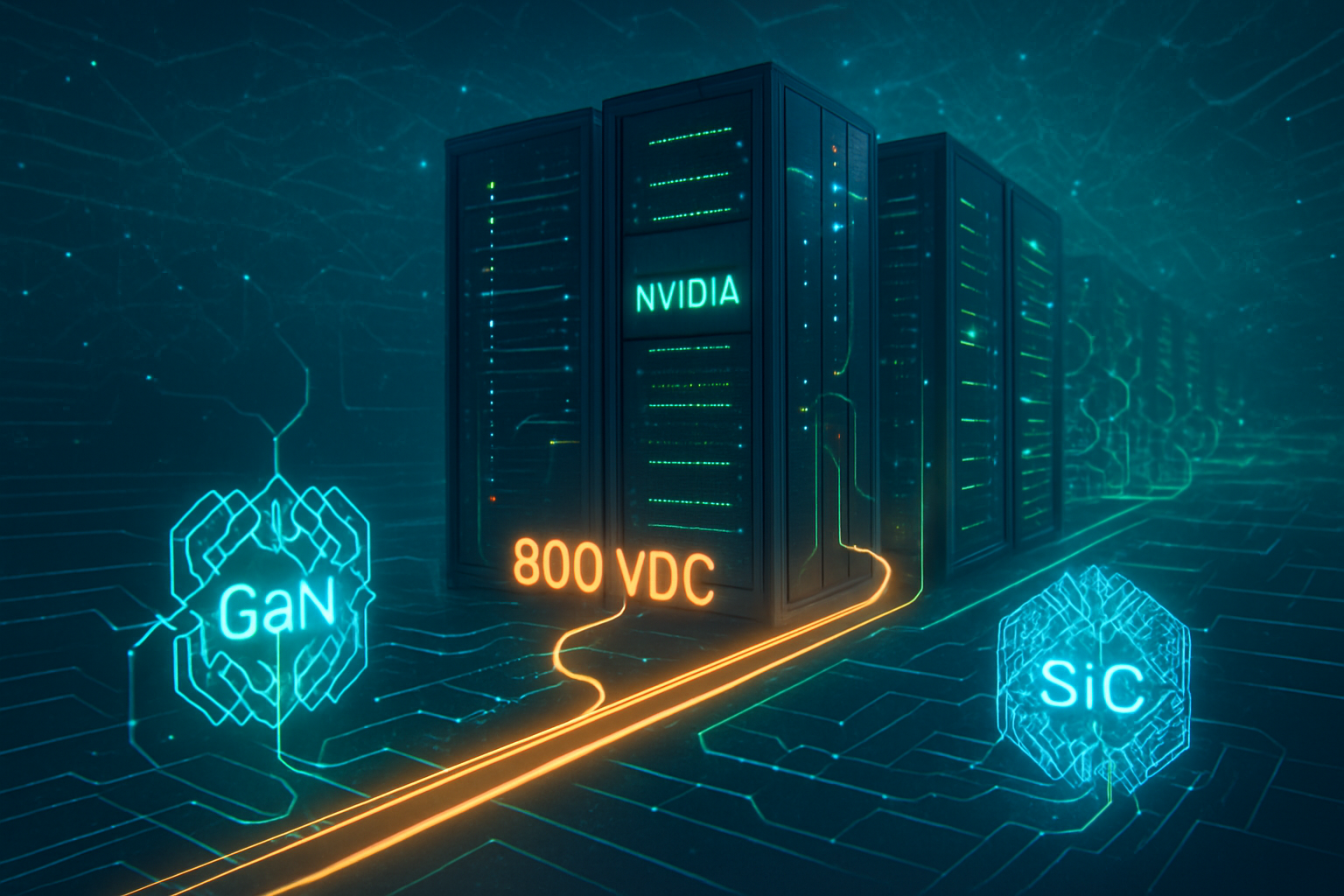
    Navitas Semiconductor (NASDAQ: NVTS) today, October 13, 2025, announced a pivotal advancement in its power chip technology, unveiling new gallium nitride (GaN) and silicon carbide (SiC) devices specifically engineered to support NVIDIA's (NASDAQ: NVDA) groundbreaking 800 VDC power architecture. This development is critical for enabling the next generation of AI computing platforms and "AI factories," which face unprecedented power demands. The immediate significance lies in facilitating a fundamental architectural shift within data centers, moving away from traditional 54V systems to meet the multi-megawatt rack densities required by cutting-edge AI workloads, promising enhanced efficiency, scalability, and reduced infrastructure costs for the rapidly expanding AI sector.

    This strategic move by Navitas is set to redefine power delivery for high-performance AI, ensuring that the physical and economic constraints of powering increasingly powerful AI processors do not impede the industry's relentless pace of innovation. By addressing the core challenge of efficient energy distribution, Navitas's solutions are poised to unlock new levels of performance and sustainability for AI infrastructure globally.

    Technical Prowess: Powering the AI Revolution with GaN and SiC

    Navitas's latest portfolio introduces a suite of high-performance power devices tailored for NVIDIA's demanding AI infrastructure. Key among these are the new 100 V GaN FETs, meticulously optimized for the lower-voltage DC-DC stages found on GPU power boards. These GaN-on-Si field-effect transistors are fabricated using a 200 mm process through a strategic partnership with Power Chip, ensuring scalable, high-volume manufacturing. Designed with advanced dual-sided cooled packages, these FETs directly tackle the critical needs for ultra-high power density and superior thermal management in next-generation AI compute platforms, where individual AI chips can consume upwards of 1000W.

    Complementing the 100 V GaN FETs, Navitas has also enhanced its 650 V GaN portfolio with new high-power GaN FETs and advanced GaNSafe™ power ICs. The GaNSafe™ devices integrate crucial control, drive, sensing, and built-in protection features, offering enhanced robustness and reliability vital for demanding AI infrastructure. These components boast ultra-fast short-circuit protection with a 350 ns response time, 2 kV ESD protection, and programmable slew-rate control, ensuring stable and secure operation in high-stress environments. Furthermore, Navitas continues to leverage its High-Voltage GeneSiC™ SiC MOSFET lineup, providing silicon carbide MOSFETs ranging from 650 V to 6,500 V, which support various stages of power conversion across the broader data center infrastructure.

    This technological leap fundamentally differs from previous approaches by enabling NVIDIA's recently announced 800 VDC power architecture. Unlike traditional 54V in-rack power distribution systems, the 800 VDC architecture allows for direct conversion from 13.8 kVAC utility power to 800 VDC at the data center perimeter. This eliminates multiple conventional AC/DC and DC/DC conversion stages, drastically maximizing energy efficiency and reducing resistive losses. Navitas's solutions are capable of achieving PFC peak efficiencies of up to 99.3%, a significant improvement that directly translates to lower operational costs and a smaller carbon footprint. The shift also reduces copper wire thickness by up to 45% due to lower current, leading to material cost savings and reduced weight.

    Initial reactions from the AI research community and industry experts underscore the critical importance of these advancements. While specific, in-depth reactions to this very recent announcement are still emerging, the consensus emphasizes the pivotal role of wide-bandbandgap (WBG) semiconductors like GaN and SiC in addressing the escalating power and thermal challenges of AI data centers. Experts consistently highlight that power delivery has become a significant bottleneck for AI's growth, with AI workloads consuming substantially more power than traditional computing. The industry widely recognizes NVIDIA's strategic shift to 800 VDC as a necessary architectural evolution, with other partners like ABB (SWX: ABBN) and Infineon (FWB: IFX) also announcing support, reinforcing the widespread need for higher voltage systems to enhance efficiency, scalability, and reliability.

    Strategic Implications: Reshaping the AI Industry Landscape

    Navitas Semiconductor's integral role in powering NVIDIA's 800 VDC AI platforms is set to profoundly impact various players across the AI industry. Hyperscale cloud providers and AI factory operators, including tech giants like Alphabet (NASDAQ: GOOGL), Amazon (NASDAQ: AMZN), Meta Platforms (NASDAQ: META), Microsoft (NASDAQ: MSFT), and Oracle Cloud Infrastructure (NYSE: ORCL), alongside specialized AI infrastructure providers such as CoreWeave, Lambda, Nebius, and Together AI, stand as primary beneficiaries. The enhanced power efficiency, increased power density, and improved thermal performance offered by Navitas's chips will lead to substantial reductions in operational costs—energy, cooling, and maintenance—for these companies. This translates directly to a lower total cost of ownership (TCO) for AI infrastructure, enabling them to scale their AI operations more economically and sustainably.

    AI model developers and researchers will benefit indirectly from the more robust and efficient infrastructure. The ability to deploy higher power density racks means more GPUs can be integrated into a smaller footprint, significantly accelerating training times and enabling the development of even larger and more capable AI models. This foundational improvement is crucial for fueling continued innovation in areas such as generative AI, large language models, and advanced scientific simulations, pushing the boundaries of what AI can achieve.

    For AI hardware manufacturers and data center infrastructure providers, such as HPE (NYSE: HPE), Vertiv (NYSE: VRT), and Foxconn (TPE: 2317), the shift to the 800 VDC architecture necessitates adaptation. Companies that swiftly integrate these new power management solutions, leveraging the superior characteristics of GaN and SiC, will gain a significant competitive advantage. Vertiv, for instance, has already unveiled its 800 VDC MGX reference architecture, demonstrating proactive engagement with this evolving standard. This transition also presents opportunities for startups specializing in cooling, power distribution, and modular data center solutions to innovate within the new architectural paradigm.

    Navitas Semiconductor's collaboration with NVIDIA significantly bolsters its market positioning. As a pure-play wide-bandgap power semiconductor company, Navitas has validated its technology for high-performance, high-growth markets like AI data centers, strategically expanding beyond its traditional strength in consumer fast chargers. This partnership positions Navitas as a critical enabler of this architectural shift, particularly with its specialized 100V GaN FET portfolio and high-voltage SiC MOSFETs. While the power semiconductor market remains highly competitive, with major players like Infineon, STMicroelectronics (NYSE: STM), Texas Instruments (NASDAQ: TXN), and OnSemi (NASDAQ: ON) also developing GaN and SiC solutions, Navitas's specific focus and early engagement with NVIDIA provide a strong foothold. The overall wide-bandgap semiconductor market is projected for substantial growth, ensuring intense competition and continuous innovation.

    Wider Significance: A Foundational Shift for Sustainable AI

    This development by Navitas Semiconductor, enabling NVIDIA's 800 VDC AI platforms, represents more than just a component upgrade; it signifies a fundamental architectural transformation within the broader AI landscape. It directly addresses the most pressing challenge facing the exponential growth of AI: scalable and efficient power delivery. As AI workloads continue to surge, demanding multi-megawatt rack densities that traditional 54V systems cannot accommodate, the 800 VDC architecture becomes an indispensable enabler for the "AI factories" of the future. This move aligns perfectly with the industry trend towards higher power density, greater energy efficiency, and simplified power distribution to support the insatiable demands of AI processors that can exceed 1,000W per chip.

    The impacts on the industry are profound, leading to a complete overhaul of data center design. This shift will result in significant reductions in operational costs for AI infrastructure providers due to improved energy efficiency (up to 5% end-to-end) and reduced cooling requirements. It is also crucial for enabling the next generation of AI hardware, such as NVIDIA's Rubin Ultra platform, by ensuring that these powerful accelerators receive the necessary, reliable power. On a societal level, this advancement contributes significantly to addressing the escalating energy consumption and environmental concerns associated with AI. By making AI infrastructure more sustainable, it helps mitigate the carbon footprint of AI, which is projected to consume a substantial portion of global electricity in the coming years.

    However, this transformative shift is not without its concerns. Implementing 800 VDC systems introduces new complexities related to electrical safety, insulation, and fault management within data centers. There's also the challenge of potential supply chain dependence on specialized GaN and SiC power semiconductors, though Navitas's partnership with Power Chip for 200mm GaN-on-Si production aims to mitigate this. Thermal management remains a critical issue despite improved electrical efficiency, necessitating advanced liquid cooling solutions for ultra-high power density racks. Furthermore, while efficiency gains are crucial, there is a risk of a "rebound effect" (Jevon's paradox), where increased efficiency might lead to even greater overall energy consumption due to expanded AI deployment and usage, placing unprecedented demands on energy grids.

    In terms of historical context, this development is comparable to the pivotal transition from CPUs to GPUs for AI, which provided orders of magnitude improvements in computational power. While not an algorithmic breakthrough itself, Navitas's power chips are a foundational infrastructure enabler, akin to the early shifts to higher voltage (e.g., 12V to 48V) in data centers, but on a far grander scale. It also echoes the continuous development of specialized AI accelerators and the increasing necessity of advanced cooling solutions. Essentially, this power management innovation is a critical prerequisite, allowing the AI industry to overcome physical limitations and continue its rapid advancement and societal impact.

    The Road Ahead: Future Developments in AI Power Management

    In the near term, the focus will be on the widespread adoption and refinement of the 800 VDC architecture, leveraging Navitas's advanced GaN and SiC power devices. Navitas is actively progressing its "AI Power Roadmap," which aims to rapidly increase server power platforms from 3kW to 12kW and beyond. The company has already demonstrated an 8.5kW AI data center PSU powered by GaN and SiC, achieving 98% efficiency and complying with Open Compute Project (OCP) and Open Rack v3 (ORv3) specifications. Expect continued innovation in integrated GaNSafe™ power ICs, offering further advancements in control, drive, sensing, and protection, crucial for the robustness of future AI factories.

    Looking further ahead, the potential applications and use cases for these high-efficiency power solutions extend beyond just hyperscale AI data centers. While "AI factories" remain the primary target, the underlying wide bandgap technologies are also highly relevant for industrial platforms, advanced energy storage systems, and grid-tied inverter projects, where efficiency and power density are paramount. The ability to deliver megawatt-scale power with significantly more compact and reliable solutions will facilitate the expansion of AI into new frontiers, including more powerful edge AI deployments where space and power constraints are even more critical.

    However, several challenges need continuous attention. The exponentially growing power demands of AI will remain the most significant hurdle; even with 800 VDC, the sheer scale of anticipated AI factories will place immense strain on energy grids. The "readiness gap" in existing data center ecosystems, many of which cannot yet support the power demands of the latest NVIDIA GPUs, requires substantial investment and upgrades. Furthermore, ensuring robust and efficient thermal management for increasingly dense AI racks will necessitate ongoing innovation in liquid cooling technologies, such as direct-to-chip and immersion cooling, which can reduce cooling energy requirements by up to 95%.

    Experts predict a dramatic surge in data center power consumption, with Goldman Sachs Research forecasting a 50% increase by 2027 and up to 165% by the end of the decade compared to 2023. This necessitates a "power-first" approach to data center site selection, prioritizing access to substantial power capacity. The integration of renewable energy sources, on-site generation, and advanced battery storage will become increasingly critical to meet these demands sustainably. The evolution of data center design will continue towards higher power densities, with racks reaching up to 30 kW by 2027 and even 120 kW for specific AI training models, fundamentally reshaping the physical and operational landscape of AI infrastructure.

    A New Era for AI Power: Concluding Thoughts

    Navitas Semiconductor's announcement on October 13, 2025, regarding its new GaN and SiC power chips for NVIDIA's 800 VDC AI platforms marks a monumental leap forward in addressing the insatiable power demands of artificial intelligence. The key takeaway is the enablement of a fundamental architectural shift in data center power delivery, moving from the limitations of 54V systems to a more efficient, scalable, and reliable 800 VDC infrastructure. This transition, powered by Navitas's advanced wide bandgap semiconductors, promises up to 5% end-to-end efficiency improvements, significant reductions in copper usage, and simplified power trains, directly supporting NVIDIA's vision of multi-megawatt "AI factories."

    This development's significance in AI history cannot be overstated. While not an AI algorithmic breakthrough, it is a critical foundational enabler that allows the continuous scaling of AI computational power. Without such innovations in power management, the physical and economic limits of data center construction would severely impede the advancement of AI. It represents a necessary evolution, akin to past shifts in computing architecture, but driven by the unprecedented energy requirements of modern AI. This move is crucial for the sustained growth of AI, from large language models to complex scientific simulations, and for realizing the full potential of AI's societal impact.

    The long-term impact will be profound, shaping the future of AI infrastructure to be more efficient, sustainable, and scalable. It will reduce operational costs for AI operators, contribute to environmental responsibility by lowering AI's carbon footprint, and spur further innovation in power electronics across various industries. The shift to 800 VDC is not merely an upgrade; it's a paradigm shift that redefines how AI is powered, deployed, and scaled globally.

    In the coming weeks and months, the industry should closely watch for the implementation of this 800 VDC architecture in new AI factories and data centers, with particular attention to initial performance benchmarks and efficiency gains. Further announcements from Navitas regarding product expansions and collaborations within the rapidly growing 800 VDC ecosystem will be critical. The broader adoption of new industry standards for high-voltage DC power delivery, championed by organizations like the Open Compute Project, will also be a key indicator of this architectural shift's momentum. The evolution of AI hinges on these foundational power innovations, making Navitas's role in this transformation one to watch closely.


    This content is intended for informational purposes only and represents analysis of current AI developments.

    TokenRing AI delivers enterprise-grade solutions for multi-agent AI workflow orchestration, AI-powered development tools, and seamless remote collaboration platforms.
    For more information, visit https://www.tokenring.ai/.

  • The AI Silicon Showdown: Nvidia, Intel, and ARM Battle for the Future of Artificial Intelligence

    The AI Silicon Showdown: Nvidia, Intel, and ARM Battle for the Future of Artificial Intelligence

    The artificial intelligence landscape is currently in the throes of an unprecedented technological arms race, centered on the very silicon that powers its rapid advancements. At the heart of this intense competition are industry titans like Nvidia (NASDAQ: NVDA), Intel (NASDAQ: INTC), and ARM (NASDAQ: ARM), each vying for dominance in the burgeoning AI chip market. This fierce rivalry is not merely about market share; it's a battle for the foundational infrastructure of the next generation of computing, dictating the pace of innovation, the accessibility of AI, and even geopolitical influence.

    The global AI chip market, valued at an estimated $123.16 billion in 2024, is projected to surge to an astonishing $311.58 billion by 2029, exhibiting a compound annual growth rate (CAGR) of 24.4%. This explosive growth is fueled by the insatiable demand for high-performance and energy-efficient processing solutions essential for everything from massive data centers running generative AI models to tiny edge devices performing real-time inference. The immediate significance of this competition lies in its ability to accelerate innovation, drive specialization in chip design, decentralize AI processing, and foster strategic partnerships that will define the technological landscape for decades to come.

    Architectural Arenas: Nvidia's CUDA Citadel, Intel's Open Offensive, and ARM's Ecosystem Expansion

    The core of the AI chip battle lies in the distinct architectural philosophies and strategic ecosystems championed by these three giants. Each company brings a unique approach to addressing the diverse and demanding requirements of modern AI workloads.

    Nvidia maintains a commanding lead, particularly in high-end AI training and data center GPUs, with an estimated 70% to 95% market share in AI accelerators. Its dominance is anchored by a full-stack approach that integrates advanced GPU hardware with the powerful and proprietary CUDA (Compute Unified Device Architecture) software platform. Key GPU models like the Hopper architecture (H100 GPU), with its 80 billion transistors and fourth-generation Tensor Cores, have become industry standards. The H100 boasts up to 80GB of HBM3/HBM3e memory and utilizes fourth-generation NVLink for 900 GB/s GPU-to-GPU interconnect bandwidth. More recently, Nvidia unveiled its Blackwell architecture (B100, B200, GB200 Superchip) in March 2024, designed specifically for the generative AI era. Blackwell GPUs feature 208 billion transistors and promise up to 40x more inference performance than Hopper, with systems like the 72-GPU NVL72 rack-scale system. CUDA, established in 2007, provides a robust ecosystem of AI-optimized libraries (cuDNN, NCCL, RAPIDS) that have created a powerful network effect and a significant barrier to entry for competitors. This integrated hardware-software synergy allows Nvidia to deliver unparalleled performance, scalability, and efficiency, making it the go-to for training massive models.

    Intel is aggressively striving to redefine its position in the AI chip sector through a multifaceted strategy. Its approach combines enhancing its ubiquitous Xeon CPUs with AI capabilities and developing specialized Gaudi accelerators. The latest Xeon 6 P-core processors (Granite Rapids), with up to 128 P-cores and Intel Advanced Matrix Extensions (AMX), are optimized for AI workloads, capable of doubling the performance of previous generations for AI and HPC. For dedicated deep learning, Intel leverages its Gaudi AI accelerators (from Habana Labs). The Gaudi 3, manufactured on TSMC's 5nm process, features eight Matrix Multiplication Engines (MMEs) and 64 Tensor Processor Cores (TPCs), along with 128GB of HBM2e memory. A key differentiator for Gaudi is its native integration of 24 x 200 Gbps RDMA over Converged Ethernet (RoCE v2) ports directly on the chip, enabling scalable communication using standard Ethernet. Intel emphasizes an open software ecosystem with oneAPI, a unified programming model for heterogeneous computing, and the OpenVINO Toolkit for optimized deep learning inference, particularly strong for edge AI. Intel's strategy differs by offering a broader portfolio and an open ecosystem, aiming to be competitive on cost and provide end-to-end AI solutions.

    ARM is undergoing a significant strategic pivot, moving beyond its traditional IP licensing model to directly engage in AI chip manufacturing and design. Historically, ARM licensed its power-efficient architectures (like the Cortex-A series) and instruction sets, enabling partners like Apple (M-series) and Qualcomm to create highly customized SoCs. For infrastructure AI, the ARM Neoverse platform is central, providing high-performance, scalable, and energy-efficient designs for cloud computing and data centers. Major cloud providers like Amazon (Graviton), Microsoft (Azure Cobalt), and Google (Axion) extensively leverage ARM Neoverse for their custom chips. The latest Neoverse V3 CPU shows double-digit performance improvements for ML workloads and incorporates Scalable Vector Extensions (SVE). For edge AI, ARM offers Ethos-U Neural Processing Units (NPUs) like the Ethos-U85, designed for high-performance inference. ARM's unique differentiation lies in its power efficiency, its flexible licensing model that fosters a vast ecosystem of custom designs, and its recent move to design its own full-stack AI chips, which positions it as a direct competitor to some of its licensees while still enabling broad innovation.

    Reshaping the Tech Landscape: Benefits, Disruptions, and Strategic Plays

    The intense competition in the AI chip market is profoundly reshaping the strategies and fortunes of AI companies, tech giants, and startups, creating both immense opportunities and significant disruptions.

    Tech giants and hyperscalers stand to benefit immensely, particularly those developing their own custom AI silicon. Companies like Google (NASDAQ: GOOGL) with its TPUs, Amazon (NASDAQ: AMZN) with Trainium and Inferentia, Microsoft (NASDAQ: MSFT) with Maia and Cobalt, and Meta (NASDAQ: META) with MTIA are driving a trend of vertical integration. By designing in-house chips, these companies aim to optimize performance for their specific workloads, reduce reliance on external suppliers like Nvidia, gain greater control over their AI infrastructure, and achieve better cost-efficiency for their massive AI operations. This allows them to offer specialized AI services to customers, potentially disrupting traditional chipmakers in the cloud AI services market. Strategic alliances are also key, with Nvidia investing $5 billion in Intel, and OpenAI partnering with AMD for its MI450 series chips.

    For specialized AI companies and startups, the intensified competition offers a wider range of hardware options, potentially driving down the significant costs associated with running and deploying AI models. Intel's Gaudi chips, for instance, aim for a better price-to-performance ratio against Nvidia's offerings. This fosters accelerated innovation and reduces dependency on a single vendor, allowing startups to diversify their hardware suppliers. However, they face the challenge of navigating diverse architectures and software ecosystems beyond Nvidia's well-established CUDA. Startups may also find new niches in inference-optimized chips and on-device AI, where cost-effectiveness and efficiency are paramount.

    The competitive implications are vast. Innovation acceleration is undeniable, with companies continuously pushing for higher performance, efficiency, and specialized features. The "ecosystem wars" are intensifying, as competitors like Intel and AMD invest heavily in robust software stacks (oneAPI, ROCm) to challenge CUDA's stronghold. This could lead to pricing pressure on dominant players as more alternatives enter the market. Furthermore, the push for vertical integration by tech giants could fundamentally alter the dynamics for traditional chipmakers. Potential disruptions include the rise of on-device AI (AI PCs, edge computing) shifting processing away from the cloud, the growing threat of open-source architectures like RISC-V to ARM's licensing model, and the increasing specialization of chips for either training or inference. Overall, the market is moving towards a more diversified and competitive landscape, where robust software ecosystems, specialized solutions, and strategic alliances will be critical for long-term success.

    Beyond the Silicon: Geopolitics, Energy, and the AI Epoch

    The fierce competition in the AI chip market extends far beyond technical specifications and market shares; it embodies profound wider significance, shaping geopolitical landscapes, addressing critical concerns, and marking a pivotal moment in the history of artificial intelligence.

    This intense rivalry is a direct reflection of, and a primary catalyst for, the accelerating growth of AI technology. The global AI chip market's projected surge underscores the overwhelming demand for AI-specific chips, particularly GPUs and ASICs, which are now selling for tens of thousands of dollars each. This period highlights a crucial trend: AI progress is increasingly tied to the co-development of hardware and software, moving beyond purely algorithmic breakthroughs. We are also witnessing the decentralization of AI, with the rise of AI PCs and edge AI devices incorporating Neural Processing Units (NPUs) directly into chips, enabling powerful AI capabilities without constant cloud connectivity. Major cloud providers are not just buying chips; they are heavily investing in developing their own custom AI chips (like Google's Trillium, offering 4.7x peak compute performance and 67% more energy efficiency than its predecessor) to optimize workloads and reduce dependency.

    The impacts are far-reaching. It's driving accelerated innovation in chip design, manufacturing processes, and software ecosystems, pushing for higher performance and lower power consumption. It's also fostering market diversification, with breakthroughs in training efficiency reducing reliance on the most expensive chips, thereby lowering barriers to entry for smaller companies. However, this also leads to disruption across the supply chain, as companies like AMD, Intel, and various startups actively challenge Nvidia's dominance. Economically, the AI chip boom is a significant growth driver for the semiconductor industry, attracting substantial investment. Crucially, AI chips have become a matter of national security and tech self-reliance. Geopolitical factors, such as the "US-China chip war" and export controls on advanced AI chips, are fragmenting the global supply chain, with nations aggressively pursuing self-sufficiency in AI technology.

    Despite the benefits, significant concerns loom. Geopolitical tensions and the concentration of advanced chip manufacturing in a few regions create supply chain vulnerabilities. The immense energy consumption required for large-scale AI training, heavily reliant on powerful chips, raises environmental questions, necessitating a strong focus on energy-efficient designs. There's also a risk of market fragmentation and potential commoditization as the market matures. Ethical concerns surrounding the use of AI chip technology in surveillance and military applications also persist.

    This AI chip race marks a pivotal moment, drawing parallels to past technological milestones. It echoes the historical shift from general-purpose computing to specialized graphics processing (GPUs) that laid the groundwork for modern AI. The infrastructure build-out driven by AI chips mirrors the early days of the internet boom, but with added complexity. The introduction of AI PCs, with dedicated NPUs, is akin to the transformative impact of the personal computer itself. In essence, the race for AI supremacy is now inextricably linked to the race for silicon dominance, signifying an era where hardware innovation is as critical as algorithmic advancements.

    The Horizon of Hyper-Intelligence: Future Trajectories and Expert Outlook

    The future of the AI chip market promises continued explosive growth and transformative developments, driven by relentless innovation and the insatiable demand for artificial intelligence capabilities across every sector. Experts predict a dynamic landscape defined by technological breakthroughs, expanding applications, and persistent challenges.

    In the near term (1-3 years), we can expect sustained demand for AI chips at advanced process nodes (3nm and below), with leading chipmakers like TSMC (NYSE: TSM), Samsung, and Intel aggressively expanding manufacturing capacity. The integration and increased production of High Bandwidth Memory (HBM) will be crucial for enhancing AI chip performance. A significant surge in AI server deployment is anticipated, with AI server penetration projected to reach 30% of all servers by 2029. Cloud service providers will continue their massive investments in data center infrastructure to support AI-based applications. There will be a growing specialization in inference chips, which are energy-efficient and high-performing, essential for processing learned models and making real-time decisions.

    Looking further into the long term (beyond 3 years), a significant shift towards neuromorphic computing is gaining traction. These chips, designed to mimic the human brain, promise to revolutionize AI applications in robotics and automation. Greater integration of edge AI will become prevalent, enabling real-time data processing and reducing latency in IoT devices and smart infrastructure. While GPUs currently dominate, Application-Specific Integrated Circuits (ASICs) are expected to capture a larger market share, especially for specific generative AI workloads by 2030, due to their optimal performance in specialized AI tasks. Advanced packaging technologies like 3D system integration, exploration of new materials, and a strong focus on sustainability in chip production will also define the future.

    Potential applications and use cases are vast and expanding. Data centers and cloud computing will remain primary drivers, handling intensive AI training and inference. The automotive sector shows immense growth potential, with AI chips powering autonomous vehicles and ADAS. Healthcare will see advanced diagnostic tools and personalized medicine. Consumer electronics, industrial automation, robotics, IoT, finance, and retail will all be increasingly powered by sophisticated AI silicon. For instance, Google's Tensor processor in smartphones and Amazon's Alexa demonstrate the pervasive nature of AI chips in consumer devices.

    However, formidable challenges persist. Geopolitical tensions and export controls continue to fragment the global semiconductor supply chain, impacting major players and driving a push for national self-sufficiency. The manufacturing complexity and cost of advanced chips, relying on technologies like Extreme Ultraviolet (EUV) lithography, create significant barriers. Technical design challenges include optimizing performance, managing high power consumption (e.g., 500+ watts for an Nvidia H100), and dissipating heat effectively. The surging demand for GPUs could lead to future supply chain risks and shortages. The high energy consumption of AI chips raises environmental concerns, necessitating a strong focus on energy efficiency.

    Experts largely predict Nvidia will maintain its leadership in AI infrastructure, with future GPU generations cementing its technological edge. However, the competitive landscape is intensifying, with AMD making significant strides and cloud providers heavily investing in custom silicon. The demand for AI computing power is often described as "limitless," ensuring exponential growth. While China is rapidly accelerating its AI chip development, analysts predict it will be challenging for Chinese firms to achieve full parity with Nvidia's most advanced offerings by 2030. By 2030, ASICs are predicted to handle the majority of generative AI workloads, with GPUs evolving to be more customized for deep learning tasks.

    A New Era of Intelligence: The Unfolding Impact

    The intense competition within the AI chip market is not merely a cyclical trend; it represents a fundamental re-architecting of the technological world, marking one of the most significant developments in AI history. This "AI chip war" is accelerating innovation at an unprecedented pace, fostering a future where intelligence is not only more powerful but also more pervasive and accessible.

    The key takeaways are clear: Nvidia's dominance, though still formidable, faces growing challenges from an ascendant AMD, an aggressive Intel, and an increasing number of hyperscalers developing their own custom silicon. Companies like Google (NASDAQ: GOOGL) with its TPUs, Amazon (NASDAQ: AMZN) with Trainium, and Microsoft (NASDAQ: MSFT) with Maia are embracing vertical integration to optimize their AI infrastructure and reduce dependency. ARM, traditionally a licensor, is now making strategic moves into direct chip design, further diversifying the competitive landscape. The market is being driven by the insatiable demand for generative AI, emphasizing energy efficiency, specialized processors, and robust software ecosystems that can rival Nvidia's CUDA.

    This development's significance in AI history is profound. It's a new "gold rush" that's pushing the boundaries of semiconductor technology, fostering unprecedented innovation in chip architecture, manufacturing, and software. The trend of vertical integration by tech giants is a major shift, allowing them to optimize hardware and software in tandem, reduce costs, and gain strategic control. Furthermore, AI chips have become a critical geopolitical asset, influencing national security and economic competitiveness, with nations vying for technological independence in this crucial domain.

    The long-term impact will be transformative. We can expect a greater democratization and accessibility of AI, as increased competition drives down compute costs, making advanced AI capabilities available to a broader range of businesses and researchers. This will lead to more diversified and resilient supply chains, reducing reliance on single vendors or regions. Continued specialization and optimization in AI chip design for specific workloads and applications will result in highly efficient AI systems. The evolution of software ecosystems will intensify, with open-source alternatives gaining traction, potentially leading to a more interoperable AI software landscape. Ultimately, this competition could spur innovation in new materials and even accelerate the development of next-generation computing paradigms like quantum chips.

    In the coming weeks and months, watch for: new chip launches and performance benchmarks from all major players, particularly AMD's MI450 series (deploying in 2026 via OpenAI), Google's Ironwood TPU v7 (expected end of 2025), and Microsoft's Maia (delayed to 2026). Monitor the adoption rates of custom chips by hyperscalers and any further moves by OpenAI to develop its own silicon. The evolution and adoption of open-source AI software ecosystems, like AMD's ROCm, will be crucial indicators of future market share shifts. Finally, keep a close eye on geopolitical developments and any further restrictions in the US-China chip trade war, as these will significantly impact global supply chains and the strategies of chipmakers worldwide. The unfolding drama in the AI silicon showdown will undoubtedly shape the future trajectory of AI innovation and its global accessibility.


    This content is intended for informational purposes only and represents analysis of current AI developments.

    TokenRing AI delivers enterprise-grade solutions for multi-agent AI workflow orchestration, AI-powered development tools, and seamless remote collaboration platforms.
    For more information, visit https://www.tokenring.ai/.
  • TSMC’s Arizona Gigafab: A New Dawn for US Chip Manufacturing and Global AI Resilience

    TSMC’s Arizona Gigafab: A New Dawn for US Chip Manufacturing and Global AI Resilience

    The global technology landscape is undergoing a monumental shift, spearheaded by Taiwan Semiconductor Manufacturing Company (TSMC) (NYSE: TSM) and its colossal investment in Arizona. What began as a $12 billion commitment has burgeoned into an unprecedented $165 billion endeavor, poised to redefine the global semiconductor supply chain and dramatically enhance US chip manufacturing capabilities. This ambitious project, now encompassing three advanced fabrication plants (fabs) with the potential for six, alongside advanced packaging facilities and an R&D center, is not merely an expansion; it's a strategic rebalancing act designed to secure the future of advanced computing, particularly for the burgeoning Artificial Intelligence (AI) sector, against a backdrop of increasing geopolitical volatility.

    The immediate significance of TSMC's Arizona complex, known as Fab 21, cannot be overstated. By bringing leading-edge 4nm, 3nm, and eventually 2nm and A16 (1.6nm) chip production to American soil, the initiative directly addresses critical vulnerabilities exposed by a highly concentrated global supply chain. This move aims to foster domestic supply chain resilience, strengthen national security, and ensure that the United States maintains its competitive edge in foundational technologies like AI, high-performance computing (HPC), and advanced communications. With the first fab already achieving high-volume production of 4nm chips in late 2024 with impressive yields, the promise of a robust, domestic advanced semiconductor ecosystem is rapidly becoming a reality, creating thousands of high-tech jobs and anchoring a vital industry within the US.

    The Microscopic Marvels: Technical Prowess of Arizona's Advanced Fabs

    TSMC's Arizona complex is a testament to cutting-edge semiconductor engineering, designed to produce some of the world's most advanced logic chips. The multi-phase development outlines a clear path to leading-edge manufacturing:

    The first fab (Fab 21 Phase 1) commenced high-volume production of 4nm-class chips in the fourth quarter of 2024, with full operational status expected by mid-2025. Notably, initial reports indicate that the yield rates for 4nm production in Arizona are not only comparable to but, in some cases, surpassing those achieved in TSMC's established facilities in Taiwan. This early success underscores the viability of advanced manufacturing in the US. The 4nm process, an optimized version within the 5nm family, is crucial for current generation high-performance processors and mobile SoCs.

    The second fab, whose structure was completed in 2025, is slated to begin volume production using N3 (3nm) process technology by 2028. This facility will also be instrumental in introducing TSMC's N2 (2nm) process technology, featuring next-generation Gate-All-Around (GAA) transistors – a significant architectural shift from the FinFET technology used in previous nodes. GAA transistors are critical for enhanced performance scaling, improved power efficiency, and better current control, all vital for the demanding workloads of modern AI and HPC.

    Further demonstrating its commitment, TSMC broke ground on a third fab in April 2025. This facility is targeted for volume production by the end of the decade (between 2028 and 2030), focusing on N2 and A16 (1.6nm-class) process technologies. The A16 node is set to incorporate "Super Power Rail," TSMC's version of Backside Power Delivery, promising an 8% to 10% increase in chip speed and a 15% to 20% reduction in power consumption at the same speed. While the Arizona fabs are expected to lag Taiwan's absolute bleeding edge by a few years, they will still bring world-class, advanced manufacturing capabilities to the US.

    The chips produced in Arizona will power a vast array of high-demand applications. Key customers like Apple (NASDAQ: AAPL) are already utilizing the Arizona fabs for components such as the A16 Bionic system-on-chip for iPhones and the S9 system-in-package for smartwatches. AMD (NASDAQ: AMD) has committed to sourcing its Ryzen 9000 series CPUs and future EPYC "Venice" processors from these facilities, while NVIDIA (NASDAQ: NVDA) has reportedly begun mass-producing its next-generation Blackwell AI chips at the Arizona site. These fabs will be indispensable for the continued advancement of AI, HPC, 5G/6G communications, and autonomous vehicles, providing the foundational hardware for the next wave of technological innovation.

    Reshaping the Tech Titans: Industry Impact and Competitive Edge

    TSMC's Arizona investment is poised to profoundly impact the competitive landscape for tech giants, AI companies, and even nascent startups, fundamentally altering strategic advantages and market positioning. The availability of advanced manufacturing capabilities on US soil introduces a new dynamic, prioritizing supply chain resilience and national security alongside traditional cost efficiencies.

    Major tech giants are strategically leveraging the Arizona fabs to diversify their supply chains and secure access to cutting-edge silicon. Apple, a long-standing primary customer of TSMC, is already incorporating US-made chips into its flagship products, mitigating risks associated with geopolitical tensions and potential trade disruptions. NVIDIA, a dominant force in AI hardware, is shifting some of its advanced AI chip production to Arizona, a move that signals a significant strategic pivot to meet surging demand and strengthen its supply chain. While advanced packaging like CoWoS currently requires chips to be sent back to Taiwan, the planned advanced packaging facilities in Arizona will eventually create a more localized, end-to-end solution. AMD, too, is committed to sourcing its advanced CPUs and HPC chips from Arizona, even accepting potentially higher manufacturing costs for the sake of supply chain security and reliability, reportedly even shifting some orders from Samsung due to manufacturing consistency concerns.

    For AI companies, both established and emerging, the Arizona fabs are a game-changer. The domestic availability of 4nm, 3nm, 2nm, and A16 process technologies provides the essential hardware backbone for developing the next generation of AI models, advanced robotics, and data center infrastructure. The presence of TSMC's facilities, coupled with partners like Amkor (NASDAQ: AMKR) providing advanced packaging services, helps to establish a more robust, end-to-end AI chip ecosystem within the US. This localized infrastructure can accelerate innovation cycles, reduce design-to-market times for AI chip designers, and provide a more secure supply of critical components, fostering a competitive advantage for US-based AI initiatives.

    While the primary beneficiaries are large-scale clients, the ripple effects extend to startups. The emergence of a robust domestic semiconductor ecosystem in Arizona, complete with suppliers, research institutions, and a growing talent pool, creates an environment conducive to innovation. Startups designing specialized AI chips will have closer access to leading-edge processes, potentially enabling faster prototyping and iteration. However, the higher production costs in Arizona, estimated to be 5% to 30% more expensive than in Taiwan, could pose a challenge for smaller entities with tighter budgets, potentially favoring larger, well-capitalized companies in the short term. This cost differential highlights a trade-off between geopolitical security and economic efficiency, which will continue to shape market dynamics.

    Silicon Nationalism: Broader Implications and Geopolitical Chess Moves

    TSMC's Arizona fabs represent more than just a manufacturing expansion; they embody a profound shift in global technology trends and geopolitical strategy, signaling an an era of "silicon nationalism." This monumental investment reshapes the broader AI landscape, impacts national security, and draws striking parallels to historical technological arms races.

    The decision to build extensive manufacturing operations in Arizona is a direct response to escalating geopolitical tensions, particularly concerning Taiwan's precarious position relative to China. Taiwan's near-monopoly on advanced chip production has long been considered a "silicon shield," deterring aggression due to the catastrophic global economic impact of any disruption. The Arizona expansion aims to diversify this concentration, mitigating the "unacceptable national security risk" posed by an over-reliance on a single geographic region. This move aligns with a broader "friend-shoring" strategy, where nations seek to secure critical supply chains within politically aligned territories, prioritizing resilience over pure cost optimization.

    From a national security perspective, the Arizona fabs are a critical asset. By bringing advanced chip manufacturing to American soil, the US significantly bolsters its technological independence, ensuring a secure domestic source for both civilian and military applications. The substantial backing from the US government through the CHIPS and Science Act underscores this national imperative, aiming to create a more resilient and secure semiconductor supply chain. This strategic localization reduces the vulnerability of the US to potential supply disruptions stemming from geopolitical conflicts or natural disasters in East Asia, thereby safeguarding its competitive edge in foundational technologies like AI and high-performance computing.

    The concept of "silicon nationalism" is vividly illustrated by TSMC's Arizona venture. Nations worldwide are increasingly viewing semiconductors as strategic national assets, driving significant government interventions and investments to localize production. This global trend, where technological independence is prioritized, mirrors historical periods of intense strategic competition, such as the 1960s space race between the US and the Soviet Union. Just as the space race symbolized Cold War technological rivalry, the current "new silicon age" reflects a contemporary geopolitical contest over advanced computing and AI capabilities, with chips at its core. While Taiwan will continue to house TSMC's absolute bleeding-edge R&D and manufacturing, the Arizona fabs significantly reduce the US's vulnerability, partially modifying the dynamics of Taiwan's "silicon shield."

    The Road Ahead: Future Developments and Expert Outlook

    The development of TSMC's Arizona fabs is an ongoing, multi-decade endeavor with significant future milestones and challenges on the horizon. The near-term focus will be on solidifying the operations of the initial fabs, while long-term plans envision an even more expansive and advanced manufacturing footprint.

    In the near term, the ramp-up of the first fab's 4nm production will be closely monitored throughout 2025. Attention will then shift to the second fab, which is targeted to begin 3nm and 2nm production by 2028. The groundbreaking of the third fab in April 2025, slated for N2 and A16 (1.6nm) process technologies by the end of the decade (potentially accelerated to 2027), signifies a continuous push towards bringing the most advanced nodes to the US. Beyond these three, TSMC's master plan for the Arizona campus includes the potential for up to six fabs, two advanced packaging facilities, and an R&D center, creating a truly comprehensive "gigafab" cluster.

    The chips produced in these future fabs will primarily cater to the insatiable demands of high-performance computing and AI. We can expect to see an increasing volume of next-generation AI accelerators, CPUs, and specialized SoCs for advanced mobile devices, autonomous vehicles, and 6G communications infrastructure. Companies like NVIDIA and AMD will likely deepen their reliance on the Arizona facilities for their most critical, high-volume products.

    However, significant challenges remain. Workforce development is paramount; TSMC has faced hurdles with skilled labor shortages and cultural differences in work practices. Addressing these through robust local training programs, partnerships with universities, and effective cultural integration will be crucial for sustained operational efficiency. The higher manufacturing costs in the US, compared to Taiwan, will also continue to be a factor, potentially leading to price adjustments for advanced chips. Furthermore, building a complete, localized upstream supply chain for critical materials like ultra-pure chemicals remains a long-term endeavor.

    Experts predict that TSMC's Arizona fabs will solidify the US as a major hub for advanced chip manufacturing, significantly increasing its share of global advanced IC production. This initiative is seen as a transformative force, fostering a more resilient domestic semiconductor ecosystem and accelerating innovation, particularly for AI hardware startups. While Taiwan is expected to retain its leadership in experimental nodes and rapid technological iteration, the US will gain a crucial strategic counterbalance. The long-term success of this ambitious project hinges on sustained government support through initiatives like the CHIPS Act, ongoing investment in STEM education, and the successful integration of a complex international supply chain within the US.

    The Dawn of a New Silicon Age: A Comprehensive Wrap-up

    TSMC's Arizona investment marks a watershed moment in the history of the semiconductor industry and global technology. What began as a strategic response to supply chain vulnerabilities has evolved into a multi-billion dollar commitment to establishing a robust, advanced chip manufacturing ecosystem on US soil, with profound implications for the future of AI and national security.

    The key takeaways are clear: TSMC's Arizona fabs represent an unprecedented financial commitment, bringing cutting-edge 4nm, 3nm, 2nm, and A16 process technologies to the US, with initial production already achieving impressive yields. This initiative is a critical step in diversifying the global semiconductor supply chain, reshoring advanced manufacturing to the US, and strengthening the nation's technological leadership, particularly in the AI domain. While challenges like higher production costs, workforce integration, and supply chain maturity persist, the strategic benefits for major tech companies like Apple, NVIDIA, and AMD, and the broader AI industry, are undeniable.

    This development's significance in AI history is immense. By securing a domestic source of advanced logic chips, the US is fortifying the foundational hardware layer essential for the continued rapid advancement of AI. This move provides greater stability, reduces geopolitical risks, and fosters closer collaboration between chip designers and manufacturers, accelerating the pace of innovation for AI models, hardware, and applications. It underscores a global shift towards "silicon nationalism," where nations prioritize sovereign technological capabilities as strategic national assets.

    In the long term, the TSMC Arizona fabs are poised to redefine global technology supply chains, making them more resilient and geographically diversified. While Taiwan will undoubtedly remain a crucial center for advanced chip development, the US will emerge as a formidable second hub, capable of producing leading-edge semiconductors. This dual-hub strategy will not only enhance national security but also foster a more robust and innovative domestic technology ecosystem.

    In the coming weeks and months, several key indicators will be crucial to watch. Monitor the continued ramp-up and consistent yield rates of the first 4nm fab, as well as the progress of construction and eventual operational timelines for the 3nm and 2nm/A16 fabs. Pay close attention to how TSMC addresses workforce development challenges and integrates its demanding work culture with American norms. The impact of higher US manufacturing costs on chip pricing and the reactions of major customers will also be critical. Finally, observe the disbursement of CHIPS Act funding and any discussions around future government incentives, as these will be vital for sustaining the growth of this transformative "gigafab" cluster and the wider US semiconductor ecosystem.


    This content is intended for informational purposes only and represents analysis of current AI developments.

    TokenRing AI delivers enterprise-grade solutions for multi-agent AI workflow orchestration, AI-powered development tools, and seamless remote collaboration platforms.
    For more information, visit https://www.tokenring.ai/.

  • China Intensifies AI Chip Crackdown: A New Era of Tech Self-Reliance and Geopolitical Division

    China Intensifies AI Chip Crackdown: A New Era of Tech Self-Reliance and Geopolitical Division

    China Intensifies AI Chip Crackdown: A New Era of Tech Self-Reliance and Geopolitical Division

    In a significant escalation of its strategic pursuit for technological sovereignty, China has dramatically tightened its chip import checks and expanded its crackdown on advanced AI chips, particularly those from leading U.S. manufacturer Nvidia (NASDAQ: NVDA). These recent developments, unfolding around October 2025, signal Beijing's unwavering commitment to reducing its reliance on foreign technology and accelerating its domestic semiconductor industry. The move has immediate and far-reaching implications for global tech companies, the semiconductor industry, and the intricate balance of international geopolitics, cementing a deepening "AI Cold War."

    This intensified scrutiny is not merely a regulatory adjustment but a deliberate and comprehensive strategy to foster self-sufficiency in critical AI hardware. As customs officers deploy at major ports for stringent inspections and domestic tech giants are reportedly instructed to halt orders for Nvidia products, the global tech landscape is being fundamentally reshaped, pushing the world towards a bifurcated technological ecosystem.

    Unpacking the Technical Nuances of China's AI Chip Restrictions

    China's expanded crackdown targets both Nvidia's existing China-specific chips, such as the H20, and newer offerings like the RTX Pro 6000D, which were initially designed to comply with previous U.S. export controls. These chips represent Nvidia's attempts to navigate the complex regulatory environment while retaining access to the lucrative Chinese market.

    The Nvidia H20, based on the Hopper architecture, is a data center GPU tailored for AI inference and large-scale model computation in China. It features 14,592 CUDA Cores, 96GB of HBM3 memory with 4.0 TB/s bandwidth, and a TDP of 350W. While its FP16 AI compute performance is reported up to 900 TFLOPS, some analyses suggest its overall "AI computing power" is less than 15% of the flagship H100. The Nvidia RTX Pro 6000D, a newer AI GPU on the Blackwell architecture, is positioned as a successor for the Chinese market. It boasts 24,064 CUDA Cores, 96 GB GDDR7 ECC memory with 1.79-1.8 TB/s bandwidth, 125 TFLOPS single-precision performance, and 4000 AI TOPS (FP8). Both chips feature "neutered specs" compared to their unrestricted counterparts to adhere to export control thresholds.

    This new phase of restrictions technically differs from previous policies in several key ways. Firstly, China is issuing direct mandates to major domestic tech firms, including Alibaba (NYSE: BABA) and ByteDance, to stop buying and testing Nvidia's China-specific AI GPUs. This is a stronger form of intervention than earlier regulatory guidance. Secondly, rigorous import checks and customs crackdowns are now in place at major ports, a significant shift from previous practices. Thirdly, the scope of scrutiny has broadened from specific Nvidia chips to all advanced semiconductor products, aiming to intercept smuggled high-end chips. Adding another layer of pressure, Chinese regulators have initiated a preliminary anti-monopoly probe into Nvidia. Finally, China has enacted sweeping rare earth export controls with an extraterritorial reach, mandating licenses for exports of Chinese-origin rare earths used in advanced chip manufacturing (14nm logic or below, 256-layer memory or more), even if the final product is made in a third country.

    Initial reactions from the AI research community and industry experts are mixed. Many believe these restrictions will accelerate China's drive for technological self-reliance, bolstering domestic AI chip ecosystems with companies like Huawei's HiSilicon division and Cambricon Technologies (SHA: 688256) gaining momentum. However, analysts like computer scientist Jawad Haj-Yahya suggest Chinese chips still lag behind American counterparts in memory bandwidth, software maturity, and complex analytical functions, though the gap is narrowing. Concerns also persist regarding the long-term effectiveness of U.S. restrictions, with some experts arguing they are "self-defeating" by inadvertently strengthening China's domestic industry. Nvidia CEO Jensen Huang has expressed disappointment but indicated patience, confirming the company will continue to support Chinese customers where possible while developing new China-compatible variants.

    Reshaping the AI Industry: Winners, Losers, and Strategic Shifts

    China's intensifying crackdown on AI chip imports is profoundly reshaping the global technology landscape, creating distinct beneficiaries and challenges for AI companies, tech giants, and startups worldwide. The strategic imperative for domestic self-sufficiency is driving significant shifts in market positioning and competitive dynamics.

    U.S.-based chip designers like Nvidia and Advanced Micro Devices (NASDAQ: AMD) are facing substantial revenue losses and strategic challenges. Nvidia, once holding an estimated 95% share of China's AI chip market, has seen this plummet to around 50% following the bans and anticipates a significant revenue hit. These companies are forced to divert valuable R&D resources to develop "China-specific" downgraded chips, impacting their profitability and global market strategies. More recent U.S. regulations, effective January 2025, introduce a global tiered framework for AI chip access, effectively barring China, Russia, and Iran from advanced AI technology based on a Total Processing Performance (TPP) metric, further disrupting supply chains for equipment manufacturers like ASML (AMS: ASML) and Lam Research (NASDAQ: LRCX).

    Conversely, Chinese tech giants such as Alibaba (NYSE: BABA), ByteDance, and Tencent (HKG: 0700) are under direct governmental pressure to halt orders for Nvidia chips and pivot towards domestic alternatives. While this initially hinders their access to the most advanced hardware, it simultaneously compels them to invest heavily in and develop their own in-house AI chips. This strategic pivot aims to reduce reliance on foreign technology and secure their long-term AI capabilities. Chinese AI startups, facing hardware limitations, are demonstrating remarkable resilience by optimizing software and focusing on efficiency with older hardware, exemplified by companies like DeepSeek, which developed a highly capable AI model with a fraction of the cost of comparable U.S. models.

    The primary beneficiaries of this crackdown are China's domestic AI chip manufacturers. The restrictions have turbo-charged Beijing's drive for technological independence. Huawei (SHE: 002502) is at the forefront, with its Ascend series of AI processors (Ascend 910D, 910C, 910B, and upcoming 950PR, 960, 970), positioning itself as a direct competitor to Nvidia's offerings. Other companies like Cambricon Technologies (SHA: 688256) have reported explosive revenue growth, while Semiconductor Manufacturing International Corp (SMIC) (HKG: 0981), CXMT, Wuhan Xinxin, Tongfu Microelectronics, and Moore Threads are rapidly advancing their capabilities, supported by substantial state funding. Beijing is actively mandating the use of domestic chips, with targets for local options to capture 55% of the Chinese market by 2027 and requiring state-owned computing hubs to source over 50% of their chips domestically by 2025.

    The competitive landscape is undergoing a dramatic transformation, leading to a "splinter-chip" world and a bifurcation of AI development. This era is characterized by techno-nationalism and a global push for supply chain resilience, often at the cost of economic efficiency. Chinese AI labs are increasingly pivoting towards optimizing algorithms and developing more efficient training methods, rather than solely relying on brute-force computing power. Furthermore, the U.S. Senate has passed legislation requiring American AI chipmakers to prioritize domestic customers, potentially strengthening U.S.-based AI labs and startups. The disruption extends to existing products and services, as Chinese tech giants face hurdles in deploying cutting-edge AI models, potentially affecting cloud services and advanced AI applications. Nvidia, in particular, is losing significant market share in China and is forced to re-evaluate its global strategies, with its CEO noting that financial guidance already assumes "China zero" revenue. This shift also highlights China's increasing leverage in critical supply chain elements like rare earths, wielding technology and resource policy as strategic tools.

    The Broader Canvas: Geopolitics, Innovation, and the "Silicon Curtain"

    China's tightening chip import checks and expanded crackdown on Nvidia AI chips are not isolated incidents but a profound manifestation of the escalating technological and geopolitical rivalry, primarily between the United States and China. This development fits squarely into the broader "chip war" initiated by the U.S., which has sought to curb China's access to cutting-edge AI chips and manufacturing equipment since October 2022. Beijing's retaliatory measures and aggressive push for self-sufficiency underscore its strategic imperative to reduce vulnerability to such foreign controls.

    The immediate impact is a forced pivot towards comprehensive AI self-sufficiency across China's technology stack, from hardware to software and infrastructure. Chinese tech giants are now actively developing their own AI chips, with Alibaba unveiling a chip comparable to Nvidia's H20 and Huawei aiming to become a leading supplier with its Ascend series. This "independent and controllable" strategy is driven by national security concerns and the pursuit of economic resilience. While Chinese domestic chips may still lag behind Nvidia's top-tier offerings, their adoption is rapidly accelerating, particularly within state-backed agencies and government-linked data centers. Forecasts suggest locally developed AI chips could capture 55% of the Chinese market by 2027, challenging the long-term effectiveness of U.S. export controls and potentially denying significant revenue to U.S. companies. This trajectory is creating a "Silicon Curtain," leading to a bifurcated global AI landscape with distinct technological ecosystems and parallel supply chains, challenging the historically integrated nature of the tech industry.

    The geopolitical impacts are profound. Advanced semiconductors are now unequivocally considered critical strategic assets, underpinning modern military capabilities, intelligence gathering, and defense systems. The dual-use nature of AI chips intensifies scrutiny, making chip access a direct instrument of national power. The U.S. export controls were explicitly designed to slow China's progress in developing frontier AI capabilities, with the belief that even a short delay could determine who leads in recursively self-improving algorithms, with compounding strategic effects. Taiwan, a major hub for advanced chip manufacturing (Taiwan Semiconductor Manufacturing Company (NYSE: TSM)), remains at the epicenter of this rivalry, its stability a point of immense global tension. Any disruption to Taiwan's semiconductor industry would have catastrophic global technological and economic consequences.

    Concerns for global innovation and economic stability are substantial. The "Silicon Curtain" risks fragmenting AI research and development along national lines, potentially slowing global AI advancement and making it more expensive. Both the U.S. and China are pouring massive investments into developing their own AI chip capabilities, leading to a duplication of efforts that, while fostering domestic industries, may globally reduce efficiency. U.S. chipmakers like Nvidia face significant revenue losses from the Chinese market, impacting their ability to reinvest in future R&D. China's expanded rare earth export restrictions further highlight its leverage over critical supply chain elements, creating an "economic arms race" with echoes of past geopolitical competitions.

    In terms of strategic importance, the current AI chip restrictions are comparable to, and in some ways exceed, previous technological milestones. This era is unique in its explicit "weaponization of hardware," where policy directly dictates chip specifications, forcing companies to intentionally cap capabilities. Advanced chips are the "engines" for AI development and foundational to almost all modern technology, from smartphones to defense systems. AI itself is a "general purpose technology," meaning its pervasive impact across all sectors makes control over its foundational hardware immensely strategic. This period also marks a significant shift towards techno-nationalism, a departure from the globalization of the semiconductor supply chain witnessed in previous decades, signaling a more fundamental reordering of global technology.

    The Road Ahead: Challenges, Innovations, and a Bifurcated Future

    The trajectory of China's AI chip self-reliance and its impact on global tech promises a dynamic and challenging future. Beijing's ambitious strategy, enshrined in its 15th five-year plan (2026-2030), aims not just for import substitution but for pioneering new chip architectures and advancing open-source ecosystems. Chinese tech giants are already embracing domestically developed AI chips, with Tencent Cloud, Alibaba, and Baidu (NASDAQ: BIDU) integrating them into their computing platforms and AI model training.

    In the near term (next 1-3 years), China anticipates a significant surge in domestic chip production, particularly in mature process nodes. Domestic AI chip production is projected to triple next year, with new fabrication facilities boosting capacity for companies like Huawei and SMIC. SMIC intends to double its output of 7-nanometer processors, and Huawei has unveiled a three-year roadmap for its Ascend range, aiming to double computing power annually. Locally developed AI chips are forecasted to capture 55% of the Chinese market by 2027, up from 17% in 2023, driven by mandates for public computing hubs to source over 50% of their chips domestically by 2025.

    Long-term (beyond 3 years), China's strategy prioritizes foundational AI research, energy-efficient "brain-inspired" computing, and the integration of data, algorithms, and computing networks. The focus will be on groundbreaking chip architectures like FDSOI and photonic chips, alongside fostering open-source ecosystems like RISC-V. However, achieving full parity with the most advanced AI chip technologies, particularly from Nvidia, is a longer journey, with experts predicting it could take another five to ten years, or even beyond 2030, to bridge the technological gap in areas like high-bandwidth memory and chip packaging.

    The impact on global tech will be profound: market share erosion for foreign suppliers in China, a bifurcated global AI ecosystem with divergent technological standards, and a redefinition of supply chains forcing multinational firms to navigate increased operational complexity. Yet, this intense competition could also spark unprecedented innovation globally.

    Potential applications and use cases on the horizon, powered by increasingly capable domestic hardware, span industrial automation, smart cities, autonomous vehicles, and advancements in healthcare, education, and public services. There will be a strong focus on ubiquitous edge intelligence for use cases demanding high information processing speed and power efficiency, such as mobile robots.

    Key challenges for China include the performance and ecosystem lag of its chips compared to Nvidia, significant manufacturing bottlenecks in high-bandwidth memory and chip packaging, continued reliance on international suppliers for advanced lithography equipment, and the immense task of scaling production to meet demand. For global tech companies, the challenges involve navigating a fragmented market, protecting market share in China, and building supply chain resilience.

    Expert predictions largely converge on a few points: China's AI development is "too far advanced for the U.S. to fully restrict its aspirations," as noted by Gregory C. Allen of CSIS. While the gap with leading U.S. technology will persist, it is expected to narrow. Nvidia CEO Jensen Huang has warned that restrictions could merely accelerate China's self-development. The consensus is an intensifying tech war that will define the next decade, leading to a bifurcated global technology ecosystem where geopolitical alignment dictates technological sourcing and development.

    A Defining Moment in AI History

    China's tightening chip import checks and expanded crackdown on Nvidia AI chips mark a truly defining moment in the history of artificial intelligence and global technology. This is not merely a trade dispute but a profound strategic pivot by Beijing, driven by national security and an unwavering commitment to technological self-reliance. The immediate significance lies in the active, on-the-ground enforcement at China's borders and direct mandates to domestic tech giants to cease using Nvidia products, pushing them towards indigenous alternatives.

    The key takeaway is the definitive emergence of a "Silicon Curtain," segmenting the global tech world into distinct, and potentially incompatible, ecosystems. This development underscores that control over foundational hardware—the very engines of AI—is now a paramount strategic asset in the global race for AI dominance. While it may initially slow some aspects of global AI progress due to fragmentation and duplication of efforts, it is simultaneously turbo-charging domestic innovation within China, compelling its companies to optimize algorithms and develop resource-efficient solutions.

    The long-term impact on the global tech industry will be a more fragmented, complex, and costly supply chain environment. Multinational firms will be forced to adapt to divergent regulatory landscapes and build redundant supply chains, prioritizing resilience over pure economic efficiency. For companies like Nvidia, this means a significant re-evaluation of strategies for one of their most crucial markets, necessitating innovation in other regions and the development of highly compliant, often downgraded, products. Geopolitically, this intensifies the U.S.-China tech rivalry, transforming advanced chips into direct instruments of national power and leveraging critical resources like rare earths for strategic advantage. The "AI arms race" will continue to shape international alliances and economic structures for decades to come.

    In the coming weeks and months, several critical developments bear watching. We must observe the continued enforcement and potential expansion of Chinese import scrutiny, as well as Nvidia's strategic adjustments, including any new China-compliant chip variants. The progress of Chinese domestic chipmakers like Huawei, Cambricon, and SMIC in closing the performance and ecosystem gap will be crucial. Furthermore, the outcome of U.S. legislative efforts to prioritize domestic AI chip customers and the global response to China's expanded rare earth restrictions will offer further insights into the evolving tech landscape. Ultimately, the ability of China to achieve true self-reliance in advanced chip manufacturing without full access to cutting-edge foreign technology will be the paramount long-term indicator of this era's success.


    This content is intended for informational purposes only and represents analysis of current AI developments.

    TokenRing AI delivers enterprise-grade solutions for multi-agent AI workflow orchestration, AI-powered development tools, and seamless remote collaboration platforms.
    For more information, visit https://www.tokenring.ai/.

  • The AI Investment Quandary: Is the Tech Boom a Bubble Waiting to Burst?

    The AI Investment Quandary: Is the Tech Boom a Bubble Waiting to Burst?

    The artificial intelligence sector is currently experiencing an unprecedented surge in investment and valuation, reminiscent of past technological revolutions. However, this fervent enthusiasm has ignited a heated debate among market leaders and financial institutions: are we witnessing a genuine industrial revolution, or is an AI investment bubble rapidly inflating, poised for a potentially devastating burst? This question carries profound implications for global financial stability, investor confidence, and the future trajectory of technological innovation.

    As of October 9, 2025, the discussion is not merely academic. It's a critical assessment of market sustainability, with prominent voices like the International Monetary Fund (IMF), JPMorgan Chase (NYSE: JPM), and even industry titan Nvidia (NASDAQ: NVDA) weighing in with contrasting, yet equally compelling, perspectives. The immediate significance of this ongoing debate lies in its potential to shape investment strategies, regulatory oversight, and the broader economic outlook for years to come.

    Conflicting Forecasts: The IMF, JPMorgan, and Nvidia on the Brink of a Bubble?

    The core of the AI investment bubble debate centers on the sustainability of current valuations and the potential for a market correction. Warnings from venerable financial institutions clash with the unwavering optimism of key industry players, creating a complex landscape for investors to navigate.

    The International Monetary Fund (IMF), in collaboration with the Bank of England, has expressed significant concern, suggesting that equity market valuations, particularly for AI-centric companies, appear "stretched." Kristalina Georgieva, the IMF Managing Director, has drawn stark parallels between the current AI-driven market surge and the dot-com bubble of the late 1990s, noting that valuations are approaching—and in some cases exceeding—those observed 25 years ago. The IMF's primary concern is that a sharp market correction could lead to tighter global financial conditions, subsequently stifling world economic growth and exposing vulnerabilities, especially in developing economies. This perspective highlights a potential systemic risk, emphasizing the need for prudent assessment by policymakers and investors alike.

    Adding to the cautionary chorus, Jamie Dimon, the CEO of JPMorgan Chase (NYSE: JPM), has voiced considerable apprehension. Dimon, while acknowledging AI's transformative potential, stated he is "far more worried than others" about an AI-driven stock market bubble, predicting a serious market correction could occur within the next six months to two years. He cautioned that despite AI's ultimate payoff, "most people involved won't do well," and a significant portion of current AI investments will "probably be lost." Dimon also cited broader macroeconomic risks, including geopolitical volatility and governmental fiscal strains, as contributing factors to heightened market uncertainty. His specific timeframe and position as head of America's largest bank lend considerable weight to his warnings, urging investors to scrutinize their AI exposures.

    In stark contrast, Jensen Huang, CEO of Nvidia (NASDAQ: NVDA), a company at the epicenter of the AI hardware boom, remains profoundly optimistic. Huang largely dismisses fears of an investment bubble, framing the current market dynamics as an "AI race" and a "new industrial revolution." He points to Nvidia's robust financial performance and long-term growth strategies as evidence of sustainable demand. Huang projects a massive $3 to $4 trillion global AI infrastructure buildout by 2030, driven by what he describes as "exponential growth" in AI computing demand. Nvidia's strategic investments in other prominent AI players, such as OpenAI and xAI, further underscore its confidence in the sector's enduring trajectory. This bullish outlook, coming from a critical enabler of the AI revolution, significantly influences continued investment and development, even as it contributes to the divergence of expert opinions.

    The immediate significance of this debate is multifaceted. It contributes to heightened market volatility as investors grapple with conflicting signals. The frequent comparisons to the dot-com era serve as a powerful cautionary tale, highlighting the risks of speculative excess and potential for significant investor losses. Furthermore, the substantial concentration of market capitalization in a few "Magnificent Seven" tech giants, particularly those heavily involved in AI, makes the overall market susceptible to significant downturns if these companies experience a correction. There are also growing worries about "circular financing" models, where AI companies invest in each other, potentially inflating valuations and creating an inherently fragile ecosystem. Warnings from leaders like Dimon and Goldman Sachs (NYSE: GS) CEO David Solomon suggest that a substantial amount of capital poured into the AI sector may not yield expected returns, potentially leading to significant financial losses for many investors, with some research indicating a high percentage of companies currently seeing zero return on their generative AI investments.

    The Shifting Sands: AI Companies, Tech Giants, and Startups Brace for Impact

    The specter of an AI investment bubble looms large over the technology landscape, promising a significant recalibration of fortunes for pure-play AI companies, established tech giants, and nascent startups alike. The current environment, characterized by soaring valuations and aggressive capital deployment, is poised for a potential "shakeout" that will redefine competitive advantages and market positioning.

    Pure-play AI companies, particularly those developing foundational models like large language models (LLMs) and sophisticated AI agents, have seen their valuations skyrocket. Firms such as OpenAI and Anthropic have experienced exponential growth in valuation, often without yet achieving consistent profitability. A market correction would severely test these inflated figures, forcing a drastic reassessment, especially for companies lacking clear, robust business models or demonstrable pathways to profitability. Many are currently operating at significant annual losses, and a downturn could lead to widespread consolidation, acquisitions, or even collapse for those built on purely speculative foundations.

    For the tech giants—the "Magnificent Seven" including Microsoft (NASDAQ: MSFT), Amazon (NASDAQ: AMZN), Alphabet (NASDAQ: GOOGL), Meta Platforms (NASDAQ: META), Apple (NASDAQ: AAPL), Nvidia (NASDAQ: NVDA), and Tesla (NASDAQ: TSLA)—the impact would be multifaceted. As the primary drivers of the AI boom, these companies have invested hundreds of billions in AI infrastructure and research. While their diversified revenue streams and strong earnings have, to some extent, supported their elevated valuations, a correction would still resonate profoundly. Chipmakers like Nvidia (NASDAQ: NVDA) and Advanced Micro Devices (NASDAQ: AMD), key enablers of the AI revolution, face scrutiny over "circular business relationships" where they invest in AI startups that subsequently purchase their chips, potentially inflating revenue. Cloud providers such as Amazon Web Services (AWS) (NASDAQ: AMZN), Microsoft Azure (NASDAQ: MSFT), and Google Cloud (NASDAQ: GOOGL) have poured massive capital into AI data centers; a correction might lead to a slowdown in planned expenditure, potentially improving margins but also raising questions about the long-term returns on these colossal investments. Diversified tech giants with robust free cash flow and broad market reach are generally better positioned to weather a downturn, potentially acquiring undervalued AI assets.

    AI startups, often fueled by venture capital and corporate giants, are particularly vulnerable. The current environment has fostered a proliferation of AI "unicorns" (companies valued at $1 billion or more), many with unproven business models. A market correction would inevitably lead to a tightening of venture funding, forcing many weaker startups into consolidation or outright failure. Valuations would shift dramatically from speculative hype to tangible returns, demanding clear revenue streams, defensible market positions, and strong unit economics. Investors will demand proof of product-market fit and sustainable growth, moving away from companies valued solely on future promise.

    In this environment, companies with strong fundamentals and clear monetization paths stand to benefit most, demonstrating real-world applications and consistent profitability. Established tech giants with diversified portfolios can leverage their extensive resources to absorb shocks and strategically acquire innovative but struggling AI ventures. Companies providing essential "picks and shovels" for the AI buildout, especially those with strong technological moats like Nvidia's CUDA platform, could still fare well, albeit with more realistic valuations. Conversely, speculative AI startups, companies heavily reliant on "circular financing," and those slow to adapt or integrate AI effectively will face significant disruption. The market will pivot from an emphasis on building vast AI infrastructure to proving clear monetization paths and delivering measurable return on investment (ROI). This shift will favor companies that can effectively execute their AI strategies, integrate AI into core products, and demonstrate real business impact over those relying on narrative or experimental projects. Consolidation and M&A activity are expected to surge, while operational resilience, capital discipline, and a focus on niche, high-value enterprise solutions will become paramount for survival and long-term success.

    Beyond the Hype: The Wider Significance in the AI Landscape

    The ongoing AI investment bubble debate is more than just a financial discussion; it represents a critical juncture for the broader AI landscape, influencing economic stability, resource allocation, and the very trajectory of technological innovation. This discussion is deeply embedded in the current AI "supercycle," a period of intense investment and rapid advancement fueled by the transformative potential of artificial intelligence across virtually every industry.

    The debate's wider significance stems from AI's outsized influence on the global economy. As of mid-2025, AI spending is observed to be a primary driver of economic growth, with some estimates attributing a significant portion of GDP growth to AI in major economies. AI-related stocks have disproportionately contributed to benchmark index returns, earnings growth, and capital spending since the advent of generative AI tools like ChatGPT in late 2022. This enormous leverage means that any significant correction in AI valuations could have profound ripple effects, extending far beyond the tech sector to impact global economic growth and financial markets. The Bank of England has explicitly warned of a "sudden correction" due to these stretched valuations, underscoring the systemic risk.

    Concerns about economic instability are paramount. A burst AI bubble could trigger a sharp market correction, leading to tighter financial conditions globally and a significant drag on economic growth, potentially culminating in a recession. The high concentration of AI-related stocks in major indexes means that a downturn could severely impact broader investor portfolios, including pension and retirement funds. Furthermore, the immense demand for computing power required to train and run advanced AI models is creating significant resource strains, including massive electricity and water consumption for data centers, and a scramble for critical minerals. This demand raises environmental concerns, intensifies competition for resources, and could even spark geopolitical tensions.

    The debate also highlights a tension between genuine innovation and speculative excess. While robust investment can accelerate groundbreaking research and development, unchecked speculation risks diverting capital and talent towards unproven or unsustainable ventures. If the lofty expectations for AI's immediate impact fail to materialize into widespread, tangible returns, investor confidence could erode, potentially hindering the development of genuinely impactful applications. There are also growing ethical and regulatory considerations; a market correction, particularly if it causes societal disruption, could prompt policymakers to implement stricter safeguards or ethical guidelines for AI development and investment.

    Historically, the current situation draws frequent comparisons to the dot-com bubble of the late 1990s and early 2000s. Similarities include astronomical valuations for companies with limited profitability, an investment frenzy driven by a "fear of missing out" (FOMO), and a high concentration of market capitalization in a few tech giants. Some analysts even suggest the current AI bubble could be significantly larger than the dot-com era. However, a crucial distinction often made by institutions like Goldman Sachs (NYSE: GS) is that today's leading AI players (e.g., Microsoft (NASDAQ: MSFT), Alphabet (NASDAQ: GOOGL), Amazon (NASDAQ: AMZN), Nvidia (NASDAQ: NVDA)) possess strong balance sheets, robust cash flows, and highly profitable legacy businesses, unlike many of the unprofitable startups during the dot-com bust. Other comparisons include the 2008 global real estate bubble, with concerns about big tech's increasing reliance on debt for AI infrastructure mirroring the debt preceding that crisis, and the telecom boom of the 1990s in terms of rapid infrastructure investment.

    Amazon (NASDAQ: AMZN) founder Jeff Bezos has offered a nuanced perspective, suggesting that the current AI phenomenon might be an "industrial bubble" rather than a purely financial one. In an industrial bubble, even if valuations correct, the underlying technological advancements and infrastructure investments can leave behind valuable, transformative assets, much like the fiber optic networks laid during the internet bubble eventually enabled today's digital economy. This perspective suggests that while speculative ventures may fail, the fundamental progress in AI and the buildout of its supporting infrastructure could still yield profound long-term societal benefits, mitigating the severity of a "bust" compared to purely financial bubbles where capital is largely destroyed. Ultimately, how this debate resolves will shape not only financial markets but also the pace and direction of AI innovation, its integration into the global economy, and the allocation of crucial resources worldwide.

    The Road Ahead: Navigating AI's Future Amidst Uncertainty

    The trajectory of AI investment and development in the coming years is poised to be a complex interplay of continued innovation, market corrections, and the challenging work of translating speculative potential into tangible value. As the debate over an AI investment bubble intensifies, experts offer varied outlooks for both the near and long term.

    In the near term, many analysts and market leaders anticipate a significant recalibration. Figures like Amazon (NASDAQ: AMZN) founder Jeff Bezos, while optimistic about AI's long-term impact, have characterized the current surge as an "industrial bubble," acknowledging the potential for market overheating due to the sheer volume of capital flowing into numerous, often unproven, startups. OpenAI CEO Sam Altman has similarly described the market as "frothy." Predictions of a potential market burst or "reset" are emerging, with some suggesting a correction as early as late 2025. This could be triggered by disappointing returns on AI investments, a high failure rate among pilot projects (an MIT study noted 95% of generative AI pilot projects failing to increase revenue), and a broader market recognition of excessive valuations. Goldman Sachs (NYSE: GS) CEO David Solomon anticipates a "reset" in AI-driven stock valuations, warning that a significant portion of deployed capital may not deliver expected returns. Some even contend that the current AI bubble surpasses the scale of the dot-com bubble and the 2008 real estate crisis, raising concerns about a severe economic downturn.

    Despite these near-term cautions, the long-term outlook for AI remains overwhelmingly positive among most industry leaders. The consensus is that AI's underlying technological advancement is unstoppable, regardless of market volatility. Global AI investments are projected to exceed $2.8 trillion by 2029, with major tech companies continuing to pour hundreds of billions into building massive data centers and acquiring advanced chips. Jeff Bezos, while acknowledging the "industrial bubble," believes the intense competition and heavy investment will ultimately yield "gigantic" benefits for society, even if many individual projects fail. Deutsche Bank (NYSE: DB) advises a long-term holding strategy, emphasizing the difficulty of timing market corrections in the face of this "capital wave." Forrester Research's Bernhard Schaffrik predicts that while corrections may occur, generative AI is too popular to disappear, and "competent artificial general intelligence" could emerge between 2026 and 2030.

    The horizon for potential applications and use cases is vast and transformative, spanning numerous industries:

    • Healthcare: AI is set to revolutionize diagnosis, drug discovery, and personalized patient care.
    • Automation and Robotics: AI-powered robots will perform complex manufacturing tasks, streamline logistics, and enhance customer service.
    • Natural Language Processing (NLP) and Computer Vision: These core AI technologies will advance autonomous vehicles, medical diagnostics, and sophisticated translation tools.
    • Multimodal AI: Integrating text, voice, images, and video, this promises more intuitive interactions and advanced virtual assistants.
    • Financial Services: AI will enhance fraud detection, credit risk assessment, and personalized investment recommendations.
    • Education: AI can customize learning experiences and automate administrative tasks.
    • Environmental Monitoring and Conservation: AI models, utilizing widespread sensors, will predict and prevent ecological threats and aid in conservation efforts.
    • Auto-ML and Cloud-based AI: These platforms will become increasingly user-friendly and accessible, democratizing AI development.

    However, several significant challenges must be addressed for AI to reach its full potential and for investments to yield sustainable returns. The high costs associated with talent acquisition, advanced hardware, software, and ongoing maintenance remain a major hurdle. Data quality and scarcity are persistent obstacles, as obtaining high-quality, relevant, and diverse datasets for training effective models remains difficult. The computational expense and energy consumption of deep learning models necessitate a focus on "green AI"—more efficient systems that operate with less power. The "black box" problem of AI, where algorithms lack transparency and explainability, erodes trust, especially in critical applications. Ethical concerns regarding bias, privacy, and accountability are paramount and require careful navigation. Finally, the challenge of replacing outdated infrastructure and integrating new AI systems into existing workflows, coupled with a significant talent gap, will continue to demand strategic attention and investment.

    Expert predictions on what happens next range from immediate market corrections to a sustained, transformative AI era. While some anticipate a "drawdown" within the next 12-24 months, driven by unmet expectations and overvalued companies, others, like Jeff Bezos, believe that even if it's an "industrial bubble," the resulting infrastructure will create a lasting legacy. Most experts concur that AI technology is here to stay and will profoundly impact various sectors. The immediate future may see market volatility and corrections as the hype meets reality, but the long-term trajectory points towards continued, transformative development and deployment of AI applications, provided key challenges related to cost, data, efficiency, and ethics are effectively addressed. There's also a growing interest in moving towards smaller, more efficient AI models that can approximate the performance of massive ones, making AI more accessible and deployable.

    The AI Investment Conundrum: A Comprehensive Wrap-Up

    The fervent debate surrounding a potential AI investment bubble encapsulates the profound hopes and inherent risks associated with a truly transformative technology. As of October 9, 2025, the market is grappling with unprecedented valuations, massive capital expenditures, and conflicting expert opinions, making it one of the most significant economic discussions of our time.

    Key Takeaways:
    On one side, proponents of an AI investment bubble point to several alarming indicators. Valuations for many AI companies remain extraordinarily high, often with limited proven revenue models or profitability. For instance, some analyses suggest AI companies need to generate $40 billion in annual revenue to justify current investments, while actual output hovers around $15-$20 billion. The scale of capital expenditure by tech giants on AI infrastructure, including data centers and advanced chips, is staggering, with estimates suggesting $2 trillion from 2025 to 2028, much of it financed through new debt. Deals involving "circular financing," where AI companies invest in each other (e.g., Nvidia (NASDAQ: NVDA) investing in OpenAI, which then buys Nvidia chips), raise concerns about artificially inflated ecosystems. Comparisons to the dot-com bubble are frequent, with current US equity valuations nearing 1999-2000 highs and market concentration in the "Magnificent Seven" tech stocks echoing past speculative frenzies. Studies indicating that 95% of AI investments fail to yield measurable returns, coupled with warnings from leaders like Goldman Sachs (NYSE: GS) CEO David Solomon about significant capital failing to generate returns, reinforce the bubble narrative.

    Conversely, arguments against a traditional financial bubble emphasize AI's fundamental, transformative power. Many, including Amazon (NASDAQ: AMZN) founder Jeff Bezos, categorize the current phenomenon as an "industrial bubble." This distinction suggests that even if speculative valuations collapse, the underlying technology and infrastructure built (much like the fiber optic networks from the internet bubble) will leave a valuable, lasting legacy that drives long-term societal benefits. Unlike the dot-com era, many of the leading tech firms driving AI investment are highly profitable, cash-rich, and better equipped to manage risks. Nvidia (NASDAQ: NVDA) CEO Jensen Huang maintains that AI demand is growing "substantially" and the boom is still in its early stages. Analysts project AI could contribute over $15 trillion to global GDP by 2030, underscoring its immense economic potential. Deutsche Bank (NYSE: DB) advises against attempting to time the market, highlighting the difficulty in identifying bubbles and the proximity of best and worst trading days, recommending a long-term investment strategy.

    Significance in AI History:
    The period since late 2022, marked by the public emergence of generative AI, represents an unprecedented acceleration in AI interest and funding. This era is historically significant because it has:

    • Democratized AI: Shifting AI from academic research to widespread public and commercial application, demonstrating human-like capabilities in knowledge and creativity.
    • Spurred Infrastructure Development: Initiated massive global capital expenditures in computing power, data centers, and advanced chips, laying a foundational layer for future AI capabilities.
    • Elevated Geopolitical Importance: Positioned AI development as a central pillar of economic and strategic competition among nations, with governments heavily investing in research and infrastructure.
    • Highlighted Critical Challenges: Brought to the forefront urgent societal, ethical, and economic challenges, including concerns about job displacement, immense energy demands, intellectual property issues, and the need for robust regulatory frameworks.

    Final Thoughts on Long-Term Impact:
    Regardless of whether the current situation is ultimately deemed a traditional financial bubble or an "industrial bubble," the long-term impact of the AI investment surge is expected to be profound and transformative. Even if a market correction occurs, the significant investments in AI infrastructure, research, and development will likely leave a robust technological foundation that will continue to drive innovation across all sectors. AI is poised to permeate and revolutionize every industry globally, creating new business models and enhancing productivity. The market will likely see intensified competition and eventual consolidation, with only a few dominant players emerging as long-term winners. However, this transformative journey will also involve navigating complex societal issues such as significant job displacement, the need for new regulatory frameworks, and addressing the immense energy consumption of AI. The underlying AI technology will continue to evolve in ways currently difficult to imagine, making long-term adaptability crucial for businesses and investors.

    What to Watch For in the Coming Weeks and Months:
    Observers should closely monitor several key indicators:

    • Translation of Investment into Revenue and Profitability: Look for clear evidence that massive AI capital expenditures are generating substantial and sustainable revenue and profit growth in corporate earnings reports.
    • Sustainability of Debt Financing: Watch for continued reliance on debt to fund AI infrastructure and any signs of strain on companies' balance sheets, particularly regarding interest costs and the utilization rates of newly built data centers.
    • Real-World Productivity Gains: Seek tangible evidence of AI significantly boosting productivity and efficiency across a wider range of industries, moving beyond early uneven results.
    • Regulatory Landscape: Keep an eye on legislative and policy developments regarding AI, especially concerning intellectual property, data privacy, and potential job displacement, as these could influence innovation and market dynamics.
    • Market Sentiment and Valuations: Monitor changes in investor sentiment, market concentration, and valuations, particularly for leading AI-related stocks.
    • Technological Breakthroughs and Limitations: Observe advancements in AI models and infrastructure, as well as any signs of diminishing returns for current large language models or emerging solutions to challenges like power consumption and data scarcity.
    • Shift to Applications: Pay attention to a potential shift in investment focus from foundational models and infrastructure to specific, real-world AI applications and industrial adoption, which could indicate a maturing market.

    This content is intended for informational purposes only and represents analysis of current AI developments.

    TokenRing AI delivers enterprise-grade solutions for multi-agent AI workflow orchestration, AI-powered development tools, and seamless remote collaboration platforms.
    For more information, visit https://www.tokenring.ai/.
  • Cisco Unleashes Silicon One P200: A New Era for Long-Distance AI Data Center Connectivity

    Cisco Unleashes Silicon One P200: A New Era for Long-Distance AI Data Center Connectivity

    San Jose, CA – October 8, 2025 – In a move set to redefine the architecture of artificial intelligence (AI) infrastructure, Cisco Systems (NASDAQ: CSCO) today announced the launch of its groundbreaking Silicon One P200 chip and the accompanying Cisco 8223 router. This powerful combination is specifically engineered to seamlessly connect geographically dispersed AI data centers, enabling them to operate as a single, unified supercomputer. The announcement marks a pivotal moment for the burgeoning AI industry, addressing critical challenges in scalability, power efficiency, and the sheer computational demands of next-generation AI workloads.

    The immediate significance of this development cannot be overstated. As AI models grow exponentially in size and complexity, the ability to distribute training and inference across multiple data centers becomes paramount, especially as companies seek locations with abundant and affordable power. The Silicon One P200 and 8223 router are designed to shatter the limitations of traditional networking, promising to unlock unprecedented levels of performance and efficiency for hyperscalers and enterprises building their AI foundations.

    Technical Marvel: Unifying AI Across Vast Distances

    The Cisco Silicon One P200 is a cutting-edge deep-buffer routing chip, delivering an astounding 51.2 Terabits per second (Tbps) of routing performance. This single chip consolidates the functionality that previously required 92 separate chips, leading to a remarkable 65% reduction in power consumption compared to existing comparable routers. This efficiency is critical for the energy-intensive nature of AI infrastructure, where power has become a primary constraint on growth.

    Powering the new Cisco 8223 routing system, the P200 enables this 3-rack-unit (3RU) fixed Ethernet router to provide 51.2 Tbps of capacity with 64 ports of 800G connectivity. The 8223 is capable of processing over 20 billion packets per second and performing over 430 billion lookups per second. A key differentiator is its support for coherent optics, allowing for long-distance data center interconnect (DCI) and metro applications, extending connectivity up to 1,000 kilometers. This "scale-across" capability is a radical departure from previous approaches that primarily focused on scaling "up" (within a single system) or "out" (within a single data center).

    Initial reactions from the AI research community and industry experts have been overwhelmingly positive. Dave Maltz, Corporate Vice President of Azure Networking at Microsoft (NASDAQ: MSFT), affirmed the importance of this innovation, noting, "The increasing scale of the cloud and AI requires faster networks with more buffering to absorb bursts of data." Microsoft and Alibaba (NYSE: BABA) are among the initial customers adopting this new technology. This unified architecture, which simplifies routing and switching functions into a single solution, challenges competitors like Broadcom (NASDAQ: AVGO), which often relies on separate chip families for different network roles. Cisco aims to deliver its technology to customers ahead of Broadcom's Jericho networking chip, emphasizing its integrated security, deep programmability (including P4 support), and superior power efficiency.

    Reshaping the AI Industry Landscape

    Cisco's Silicon One P200 and 8223 router are poised to significantly impact AI companies, tech giants, and startups alike. Hyperscalers and cloud providers, such as Microsoft Azure and Alibaba, stand to benefit immensely, as their massive AI workloads and distributed data center strategies align perfectly with the P200's capabilities. The ability to seamlessly connect AI clusters hundreds or thousands of miles apart allows these giants to optimize resource utilization, reduce operational costs, and build more resilient AI infrastructures.

    The competitive implications are substantial. Cisco's aggressive push directly challenges Broadcom, a major player in AI networking, by offering a unified, power-efficient, and highly scalable alternative. While Broadcom's Jericho chip also targets multi-site AI connectivity, Cisco's Silicon One architecture aims for operational simplicity and a consistent chip family across various network roles. Furthermore, Cisco's strategic partnership with Nvidia (NASDAQ: NVDA), where Cisco Silicon One is integrated into Nvidia's Spectrum-X platform for Ethernet AI networking, solidifies its position and offers an end-to-end Ethernet solution that could disrupt the traditional dominance of InfiniBand in high-performance AI clusters.

    This development could lead to a significant disruption of traditional AI networking architectures. The P200's focus on "scale-across" distributed AI workloads challenges older "scale-up" and "scale-out" methodologies. The substantial reduction in power consumption (65% less than prior generations for the 8223) sets a new benchmark for energy efficiency, potentially forcing other networking vendors to accelerate their own efforts in this critical area. Cisco's market positioning is bolstered by its unified architecture, exceptional performance, integrated security features, and strategic partnerships, providing a compelling advantage in the rapidly expanding AI infrastructure market.

    A Wider Lens: AI's Networked Future

    The launch of the Silicon One P200 and 8223 router fits squarely into the broader AI landscape, addressing several critical trends. The insatiable demand for distributed AI, driven by the exponential growth of AI models, necessitates the very "scale-across" architecture that Cisco is championing. As AI compute requirements outstrip the capacity of even the largest single data centers, the ability to connect facilities across vast geographies becomes a fundamental requirement for continued AI advancement.

    This innovation also accelerates the ongoing shift from InfiniBand to Ethernet for AI workloads. While InfiniBand has historically dominated high-performance computing, Ethernet, augmented by technologies like Cisco Silicon One, is proving capable of delivering the low latency and lossless transmission required for AI training at massive scale. The projected growth of Ethernet in AI back-end networks, potentially reaching nearly $80 billion in data center switch sales over the next five years, underscores the significance of this transition.

    Impacts on AI development include unmatched performance and scalability, significantly reducing networking bottlenecks that have historically limited the size and complexity of AI models. The integrated security features, including line-rate encryption with post-quantum resilient algorithms, are crucial for protecting sensitive AI workloads and data distributed across various locations. However, potential concerns include vendor lock-in, despite Cisco's support for open-source SONiC, and the inherent complexity of deploying and managing such advanced systems, which may require specialized expertise. Compared to previous networking milestones, which focused on general connectivity and scalability, the P200 and 8223 represent a targeted, purpose-built solution for the unique and extreme demands of the AI era.

    The Road Ahead: What's Next for AI Networking

    In the near term, the Cisco 8223 router, powered by the P200, is already shipping to initial hyperscalers, validating its immediate readiness for the most demanding AI environments. The focus will be on optimizing these deployments and ensuring seamless integration with existing AI compute infrastructure. Long-term, Cisco envisions Silicon One as a unified networking architecture that will underpin its routing product roadmap for the next decade, providing a future-proof foundation for AI growth and efficiency across various network segments. Its programmability will allow adaptation to new protocols and emerging AI workloads without costly hardware upgrades.

    Potential new applications and use cases extend beyond hyperscalers to include robust data center interconnect (DCI) and metro applications, connecting AI clusters across urban and regional distances. The broader Silicon One portfolio is also set to impact service provider access and edge, as well as enterprise and campus environments, all requiring AI-ready networking. Future 5G industrial routers and gateways could also leverage these capabilities for AI at the IoT edge.

    However, widespread adoption faces challenges, including persistent security concerns, the prevalence of outdated network infrastructure, and a significant "AI readiness gap" in many organizations. The talent shortage in managing AI-driven networks and the need for real-world validation of performance at scale are also hurdles. Experts predict that network modernization is no longer optional but critical for AI deployment, driving a mandatory shift to "scale-across" architectures. They foresee increased investment in networking, the emergence of AI-driven autonomous networks, intensified competition, and the firm establishment of Ethernet as the preferred foundation for AI networking, eventually leading to standards like "Ultra Ethernet."

    A Foundational Leap for the AI Era

    Cisco's launch of the Silicon One P200 chip and the 8223 router marks a foundational leap in AI history. By directly addressing the most pressing networking challenges of the AI era—namely, connecting massive, distributed AI data centers with unprecedented performance, power efficiency, and security—Cisco has positioned itself as a critical enabler of future AI innovation. This development is not merely an incremental improvement but a strategic architectural shift that will empower the next generation of AI models and applications.

    The long-term impact on the tech industry will be profound, accelerating AI innovation, transforming network engineering roles, and ushering in an era of unprecedented automation and efficiency. For society, this means faster, more reliable, and more secure AI services across all sectors, from healthcare to autonomous systems, and new generative AI capabilities. The environmental benefits of significantly reduced power consumption in AI infrastructure are also a welcome outcome.

    In the coming weeks and months, the industry will be closely watching the market adoption of these new solutions by hyperscalers and enterprises. Responses from competitors like Broadcom and Marvell, as well as the continued evolution of Cisco's AI-native security (Hypershield) and AgenticOps initiatives, will be key indicators of the broader trajectory. Cisco's bold move underscores the network's indispensable role as the backbone of the AI revolution, and its impact will undoubtedly ripple across the technological landscape for years to come.


    This content is intended for informational purposes only and represents analysis of current AI developments.

    TokenRing AI delivers enterprise-grade solutions for multi-agent AI workflow orchestration, AI-powered development tools, and seamless remote collaboration platforms. For more information, visit https://www.tokenring.ai/.

  • Dell’s AI-Fueled Ascent: A Glimpse into the Future of Infrastructure

    Dell’s AI-Fueled Ascent: A Glimpse into the Future of Infrastructure

    Round Rock, TX – October 7, 2025 – Dell Technologies (NYSE: DELL) today unveiled a significantly boosted financial outlook, nearly doubling its annual profit growth target and dramatically increasing revenue projections, all thanks to the insatiable global demand for Artificial Intelligence (AI) infrastructure. This announcement, made during a pivotal meeting with financial analysts, underscores a transformative shift in the tech industry, where the foundational hardware supporting AI development is becoming a primary driver of corporate growth and market valuation. Dell's robust performance signals a new era of infrastructure investment, positioning the company at the forefront of the AI revolution.

    The revised forecasts paint a picture of aggressive expansion, with Dell now expecting earnings per share to climb at least 15% each year, a substantial leap from its previous 8% estimate. Annual sales are projected to grow between 7% and 9% over the next four years, replacing an earlier forecast of 3% to 4%. This optimistic outlook is a direct reflection of the unprecedented need for high-performance computing, storage, and networking solutions essential for training and deploying complex AI models, indicating that the foundational layers of AI are now a booming market.

    The Technical Backbone of the AI Revolution

    Dell's surge is directly attributable to its Infrastructure Solutions Group (ISG), which is experiencing exponential growth, with compounded annual revenue growth now projected at an impressive 11% to 14% over the long term. This segment, encompassing servers, storage, and networking, is the engine powering the AI boom. The company’s AI-optimized servers, designed to handle the immense computational demands of AI workloads, are at the heart of this success. These servers typically integrate cutting-edge Graphics Processing Units (GPUs) from industry leaders like Nvidia (NASDAQ: NVDA) and Advanced Micro Devices (NASDAQ: AMD), along with specialized AI accelerators, high-bandwidth memory, and robust cooling systems to ensure optimal performance and reliability for continuous AI operations.

    What sets Dell's current offerings apart from previous enterprise hardware is their hyper-specialization for AI. While traditional servers were designed for general-purpose computing, AI servers are architected from the ground up to accelerate parallel processing, a fundamental requirement for deep learning and neural network training. This includes advanced interconnects like NVLink and InfiniBand for rapid data transfer between GPUs, scalable storage solutions optimized for massive datasets, and sophisticated power management to handle intense workloads. Dell's ability to deliver these integrated, high-performance systems at scale, coupled with its established supply chain and global service capabilities, provides a significant advantage in a market where time-to-deployment and reliability are paramount.

    Initial reactions from the AI research community and industry experts have been overwhelmingly positive, highlighting Dell's strategic foresight in pivoting towards AI infrastructure. Analysts commend Dell's agility in adapting its product portfolio to meet emerging demands, noting that the company's comprehensive ecosystem, from edge to core to cloud, makes it a preferred partner for enterprises embarking on large-scale AI initiatives. The substantial backlog of $11.7 billion in AI server orders at the close of Q2 FY26 underscores the market's confidence and the critical role Dell plays in enabling the next generation of AI innovation.

    Reshaping the AI Competitive Landscape

    Dell's bolstered position has significant implications for the broader AI ecosystem, benefiting not only the company itself but also its key technology partners and the AI companies it serves. Companies like Nvidia (NASDAQ: NVDA) and AMD (NASDAQ: AMD), whose high-performance GPUs and CPUs are integral components of Dell's AI servers, stand to gain immensely from this increased demand. Their continued innovation in chip design directly fuels Dell's ability to deliver cutting-edge solutions, creating a symbiotic relationship that drives mutual growth. Furthermore, software providers specializing in AI development, machine learning platforms, and data management solutions will see an expanded market as more enterprises acquire the necessary hardware infrastructure.

    The competitive landscape for major AI labs and tech giants is also being reshaped. Companies like Elon Musk's xAI and cloud providers such as CoreWeave, both noted Dell customers, benefit directly from access to powerful, scalable AI infrastructure. This enables them to accelerate model training, deploy more sophisticated applications, and bring new AI services to market faster. For other hardware manufacturers, Dell's success presents a challenge, demanding similar levels of innovation, supply chain efficiency, and customer integration to compete effectively. The emphasis on integrated solutions, rather than just individual components, means that companies offering holistic AI infrastructure stacks will likely hold a strategic advantage.

    Potential disruption to existing products or services could arise as the cost and accessibility of powerful AI infrastructure improve. This could democratize AI development, allowing more startups and smaller enterprises to compete with established players. Dell's market positioning as a comprehensive infrastructure provider, offering everything from servers to storage to services, gives it a unique strategic advantage. It can cater to diverse needs, from on-premise data centers to hybrid cloud environments, ensuring that enterprises have the flexibility and scalability required for their evolving AI strategies. The ability to fulfill massive orders and provide end-to-end support further solidifies its critical role in the AI supply chain.

    Broader Significance and the AI Horizon

    Dell's remarkable growth in AI infrastructure is not an isolated event but a clear indicator of the broader AI landscape's maturity and accelerating expansion. It signifies a transition from experimental AI projects to widespread enterprise adoption, where robust, scalable, and reliable hardware is a non-negotiable foundation. This trend fits into the larger narrative of digital transformation, where AI is no longer a futuristic concept but a present-day imperative for competitive advantage across industries, from healthcare to finance to manufacturing. The massive investments by companies like Dell underscore the belief that AI will fundamentally reshape global economies and societies.

    The impacts are far-reaching. On one hand, it drives innovation in hardware design, pushing the boundaries of computational power and energy efficiency. On the other, it creates new opportunities for skilled labor in AI development, data science, and infrastructure management. However, potential concerns also arise, particularly regarding the environmental impact of large-scale AI data centers, which consume vast amounts of energy. The ethical implications of increasingly powerful AI systems also remain a critical area of discussion and regulation. This current boom in AI infrastructure can be compared to previous technology milestones, such as the dot-com era's internet infrastructure build-out or the rise of cloud computing, both of which saw massive investments in foundational technologies that subsequently enabled entirely new industries and services.

    This period marks a pivotal moment, signaling that the theoretical promises of AI are now being translated into tangible, hardware-dependent realities. The sheer volume of AI server sales—projected to reach $15 billion in FY26 and potentially $20 billion—highlights the scale of this transformation. It suggests that the AI industry is moving beyond niche applications to become a pervasive technology integrated into nearly every aspect of business and daily life.

    Charting Future Developments and Beyond

    Looking ahead, the trajectory for AI infrastructure is one of continued exponential growth and diversification. Near-term developments will likely focus on even greater integration of specialized AI accelerators, moving beyond GPUs to include custom ASICs (Application-Specific Integrated Circuits) and FPGAs (Field-Programmable Gate Arrays) designed for specific AI workloads. We can expect advancements in liquid cooling technologies to manage the increasing heat generated by high-density AI server racks, along with more sophisticated power delivery systems. Long-term, the focus will shift towards more energy-efficient AI hardware, potentially incorporating neuromorphic computing principles that mimic the human brain's structure for drastically reduced power consumption.

    Potential applications and use cases on the horizon are vast and transformative. Beyond current AI training and inference, enhanced infrastructure will enable real-time, multimodal AI, powering advanced robotics, autonomous systems, hyper-personalized customer experiences, and sophisticated scientific simulations. We could see the emergence of "AI factories" – massive data centers dedicated solely to AI model development and deployment. However, significant challenges remain. Scaling AI infrastructure while managing energy consumption, ensuring data privacy and security, and developing sustainable supply chains for rare earth minerals used in advanced chips are critical hurdles. The talent gap in AI engineering and operations also needs to be addressed to fully leverage these capabilities.

    Experts predict that the demand for AI infrastructure will continue unabated for the foreseeable future, driven by the increasing complexity of AI models and the expanding scope of AI applications. The focus will not just be on raw power but also on efficiency, sustainability, and ease of deployment. The next wave of innovation will likely involve greater software-defined infrastructure for AI, allowing for more flexible and dynamic allocation of resources to meet fluctuating AI workload demands.

    A New Era of AI Infrastructure: Dell's Defining Moment

    Dell's boosted outlook and surging growth estimates underscore a profound shift in the technological landscape: the foundational infrastructure for AI is now a dominant force in the global economy. The company's strategic pivot towards AI-optimized servers, storage, and networking solutions has positioned it as an indispensable enabler of the artificial intelligence revolution. With projected AI server sales soaring into the tens of billions, Dell's performance serves as a clear barometer for the accelerating pace of AI adoption and its deep integration into enterprise operations worldwide.

    This development marks a significant milestone in AI history, highlighting that the era of conceptual AI is giving way to an era of practical, scalable, and hardware-intensive AI. It demonstrates that while the algorithms and models capture headlines, the underlying compute power is the unsung hero, making these advancements possible. The long-term impact of this infrastructure build-out will be transformative, laying the groundwork for unprecedented innovation across all sectors, from scientific discovery to everyday consumer applications.

    In the coming weeks and months, watch for continued announcements from major tech companies regarding their AI infrastructure investments and partnerships. The race to provide the fastest, most efficient, and most scalable AI hardware is intensifying, and Dell's current trajectory suggests it will remain a key player at the forefront of this critical technological frontier. The future of AI is being built today, one server rack at a time, and Dell is supplying the blueprints and the bricks.


    This content is intended for informational purposes only and represents analysis of current AI developments.

    TokenRing AI delivers enterprise-grade solutions for multi-agent AI workflow orchestration, AI-powered development tools, and seamless remote collaboration platforms. For more information, visit https://www.tokenring.ai/.

  • Silicon’s New Frontier: How Next-Gen Chips Are Forging the Future of AI

    Silicon’s New Frontier: How Next-Gen Chips Are Forging the Future of AI

    The burgeoning field of artificial intelligence, particularly the explosive growth of deep learning, large language models (LLMs), and generative AI, is pushing the boundaries of what traditional computing hardware can achieve. This insatiable demand for computational power has thrust semiconductors into a critical, central role, transforming them from mere components into the very bedrock of next-generation AI. Without specialized silicon, the advanced AI models we see today—and those on the horizon—would simply not be feasible, underscoring the immediate and profound significance of these hardware advancements.

    The current AI landscape necessitates a fundamental shift from general-purpose processors to highly specialized, efficient, and secure chips. These purpose-built semiconductors are the crucial enablers, providing the parallel processing capabilities, memory innovations, and sheer computational muscle required to train and deploy AI models with billions, even trillions, of parameters. This era marks a symbiotic relationship where AI breakthroughs drive semiconductor innovation, and in turn, advanced silicon unlocks new AI capabilities, creating a self-reinforcing cycle that is reshaping industries and economies globally.

    The Architectural Blueprint: Engineering Intelligence at the Chip Level

    The technical advancements in AI semiconductor hardware represent a radical departure from conventional computing, focusing on architectures specifically designed for the unique demands of AI workloads. These include a diverse array of processing units and sophisticated design considerations.

    Specific Chip Architectures:

    • Graphics Processing Units (GPUs): Originally designed for graphics rendering, GPUs from companies like NVIDIA (NASDAQ: NVDA) have become indispensable for AI due to their massively parallel architectures. Modern GPUs, such as NVIDIA's Hopper H100 and upcoming Blackwell Ultra, incorporate specialized units like Tensor Cores, which are purpose-built to accelerate the matrix operations central to neural networks. This design excels at the simultaneous execution of thousands of simpler operations, making them ideal for deep learning training and inference.
    • Application-Specific Integrated Circuits (ASICs): ASICs are custom-designed chips tailored for specific AI tasks, offering superior efficiency, lower latency, and reduced power consumption. Google's (NASDAQ: GOOGL) Tensor Processing Units (TPUs) are prime examples, utilizing systolic array architectures to optimize neural network processing. ASICs are increasingly developed for both compute-intensive AI training and real-time inference.
    • Neural Processing Units (NPUs): Predominantly used for edge AI, NPUs are specialized accelerators designed to execute trained AI models with minimal power consumption. Found in smartphones, IoT devices, and autonomous vehicles, they feature multiple compute units optimized for matrix multiplication and convolution, often employing low-precision arithmetic (e.g., INT4, INT8) to enhance efficiency.
    • Neuromorphic Chips: Representing a paradigm shift, neuromorphic chips mimic the human brain's structure and function, processing information using spiking neural networks and event-driven processing. Key features include in-memory computing, which integrates memory and processing to reduce data transfer and energy consumption, addressing the "memory wall" bottleneck. IBM's TrueNorth and Intel's (NASDAQ: INTC) Loihi are leading examples, promising ultra-low power consumption for pattern recognition and adaptive learning.

    Processing Units and Design Considerations:
    Beyond the overarching architectures, specific processing units like NVIDIA's CUDA Cores, Tensor Cores, and NPU-specific Neural Compute Engines are vital. Design considerations are equally critical. Memory bandwidth, for instance, is often more crucial than raw memory size for AI workloads. Technologies like High Bandwidth Memory (HBM, HBM3, HBM3E) are indispensable, stacking multiple DRAM dies to provide significantly higher bandwidth and lower power consumption, alleviating the "memory wall" bottleneck. Interconnects like PCIe (with advancements to PCIe 7.0), CXL (Compute Express Link), NVLink (NVIDIA's proprietary GPU-to-GPU link), and the emerging UALink (Ultra Accelerator Link) are essential for high-speed communication within and across AI accelerator clusters, enabling scalable parallel processing. Power efficiency is another major concern, with specialized hardware, quantization, and in-memory computing strategies aiming to reduce the immense energy footprint of AI. Lastly, advances in process nodes (e.g., 5nm, 3nm, 2nm) allow for more transistors, leading to faster, smaller, and more energy-efficient chips.

    These advancements fundamentally differ from previous approaches by prioritizing massive parallelism over sequential processing, addressing the Von Neumann bottleneck through integrated memory/compute designs, and specializing hardware for AI tasks rather than relying on general-purpose versatility. The AI research community and industry experts have largely reacted with enthusiasm, acknowledging the "unprecedented innovation" and "critical enabler" role of these chips. However, concerns about the high cost and significant energy consumption of high-end GPUs, as well as the need for robust software ecosystems to support diverse hardware, remain prominent.

    The AI Chip Arms Race: Reshaping the Tech Industry Landscape

    The advancements in AI semiconductor hardware are fueling an intense "AI Supercycle," profoundly reshaping the competitive landscape for AI companies, tech giants, and startups. The global AI chip market is experiencing explosive growth, with projections of it reaching $110 billion in 2024 and potentially $1.3 trillion by 2030, underscoring its strategic importance.

    Beneficiaries and Competitive Implications:

    • NVIDIA (NASDAQ: NVDA): Remains the undisputed market leader, holding an estimated 80-85% market share. Its powerful GPUs (e.g., Hopper H100, GH200) combined with its dominant CUDA software ecosystem create a significant moat. NVIDIA's continuous innovation, including the upcoming Blackwell Ultra GPUs, drives massive investments in AI infrastructure. However, its dominance is increasingly challenged by hyperscalers developing custom chips and competitors like AMD.
    • Tech Giants (Google, Microsoft, Amazon): These cloud providers are not just consumers but also significant developers of custom silicon.
      • Google (NASDAQ: GOOGL): A pioneer with its Tensor Processing Units (TPUs), Google leverages these specialized accelerators for its internal AI products (Gemini, Imagen) and offers them via Google Cloud, providing a strategic advantage in cost-performance and efficiency.
      • Microsoft (NASDAQ: MSFT): Is increasingly relying on its own custom chips, such as Azure Maia accelerators and Azure Cobalt CPUs, for its data center AI workloads. The Maia 100, with 105 billion transistors, is designed for large language model training and inference, aiming to cut costs, reduce reliance on external suppliers, and optimize its entire system architecture for AI. Microsoft's collaboration with OpenAI on Maia chip design further highlights this vertical integration.
      • Amazon (NASDAQ: AMZN): AWS has heavily invested in its custom Inferentia and Trainium chips, designed for AI inference and training, respectively. These chips offer significantly better price-performance compared to NVIDIA GPUs, making AWS a strong alternative for cost-effective AI solutions. Amazon's partnership with Anthropic, where Anthropic trains and deploys models on AWS using Trainium and Inferentia, exemplifies this strategic shift.
    • AMD (NASDAQ: AMD): Has emerged as a formidable challenger to NVIDIA, with its Instinct MI450X GPU built on TSMC's (NYSE: TSM) 3nm node offering competitive performance. AMD projects substantial AI revenue and aims to capture 15-20% of the AI chip market by 2030, supported by its ROCm software ecosystem and a multi-billion dollar partnership with OpenAI.
    • Intel (NASDAQ: INTC): Is working to regain its footing in the AI market by expanding its product roadmap (e.g., Hala Point for neuromorphic research), investing in its foundry services (Intel 18A process), and optimizing its Xeon CPUs and Gaudi AI accelerators. Intel has also formed a $5 billion collaboration with NVIDIA to co-develop AI-centric chips.
    • Startups: Agile startups like Cerebras Systems (wafer-scale AI processors), Hailo and Kneron (edge AI acceleration), and Celestial AI (photonic computing) are focusing on niche AI workloads or unique architectures, demonstrating potential disruption where larger players may be slower to adapt.

    This environment fosters increased competition, as hyperscalers' custom chips challenge NVIDIA's pricing power. The pursuit of vertical integration by tech giants allows for optimized system architectures, reducing dependence on external suppliers and offering significant cost savings. While software ecosystems like CUDA remain a strong competitive advantage, partnerships (e.g., OpenAI-AMD) could accelerate the development of open-source, hardware-agnostic AI software, potentially eroding existing ecosystem advantages. Success in this evolving landscape will hinge on innovation in chip design, robust software development, secure supply chains, and strategic partnerships.

    Beyond the Chip: Broader Implications and Societal Crossroads

    The advancements in AI semiconductor hardware are not merely technical feats; they are fundamental drivers reshaping the entire AI landscape, offering immense potential for economic growth and societal progress, while simultaneously demanding urgent attention to critical concerns related to energy, accessibility, and ethics. This era is often compared in magnitude to the internet boom or the mobile revolution, marking a new technological epoch.

    Broader AI Landscape and Trends:
    These specialized chips are the "lifeblood" of the evolving AI economy, facilitating the development of increasingly sophisticated generative AI and LLMs, powering autonomous systems, enabling personalized medicine, and supporting smart infrastructure. AI is now actively revolutionizing semiconductor design, manufacturing, and supply chain management, creating a self-reinforcing cycle. Emerging technologies like Wide-Bandgap (WBG) semiconductors, neuromorphic chips, and even nascent quantum computing are poised to address escalating computational demands, crucial for "next-gen" agentic and physical AI.

    Societal Impacts:

    • Economic Growth: AI chips are a major driver of economic expansion, fostering efficiency and creating new market opportunities. The semiconductor industry, partly fueled by generative AI, is projected to reach $1 trillion in revenue by 2030.
    • Industry Transformation: AI-driven hardware enables solutions for complex challenges in healthcare (medical imaging, predictive analytics), automotive (ADAS, autonomous driving), and finance (fraud detection, algorithmic trading).
    • Geopolitical Dynamics: The concentration of advanced semiconductor manufacturing in a few regions, notably Taiwan, has intensified geopolitical competition between nations like the U.S. and China, highlighting chips as a critical linchpin of global power.

    Potential Concerns:

    • Energy Consumption and Environmental Impact: AI technologies are extraordinarily energy-intensive. Data centers, housing AI infrastructure, consume an estimated 3-4% of the United States' total electricity, projected to surge to 11-12% by 2030. A single ChatGPT query can consume roughly ten times more electricity than a typical Google search, and AI accelerators alone are forecasted to increase CO2 emissions by 300% between 2025 and 2029. Addressing this requires more energy-efficient chip designs, advanced cooling, and a shift to renewable energy.
    • Accessibility: While AI can improve accessibility, its current implementation often creates new barriers for users with disabilities due to algorithmic bias, lack of customization, and inadequate design.
    • Ethical Implications:
      • Data Privacy: The capacity of advanced AI hardware to collect and analyze vast amounts of data raises concerns about breaches and misuse.
      • Algorithmic Bias: Biases in training data can be amplified by hardware choices, leading to discriminatory outcomes.
      • Security Vulnerabilities: Reliance on AI-powered devices creates new security risks, requiring robust hardware-level security features.
      • Accountability: The complexity of AI-designed chips can obscure human oversight, making accountability challenging.
      • Global Equity: High costs can concentrate AI power among a few players, potentially widening the digital divide.

    Comparisons to Previous AI Milestones:
    The current era differs from past breakthroughs, which primarily focused on software algorithms. Today, AI is actively engineering its own physical substrate through AI-powered Electronic Design Automation (EDA) tools. This move beyond traditional Moore's Law scaling, with an emphasis on parallel processing and specialized architectures, is seen as a natural successor in the post-Moore's Law era. The industry is at an "AI inflection point," where established business models could become liabilities, driving a push for open-source collaboration and custom silicon, a significant departure from older paradigms.

    The Horizon: AI Hardware's Evolving Future

    The future of AI semiconductor hardware is a dynamic landscape, driven by an insatiable demand for more powerful, efficient, and specialized processing capabilities. Both near-term and long-term developments promise transformative applications while grappling with considerable challenges.

    Expected Near-Term Developments (1-5 years):
    The near term will see a continued proliferation of specialized AI accelerators (ASICs, NPUs) beyond general-purpose GPUs, with tech giants like Google, Amazon, and Microsoft investing heavily in custom silicon for their cloud AI workloads. Edge AI hardware will become more powerful and energy-efficient for local processing in autonomous vehicles, IoT devices, and smart cameras. Advanced packaging technologies like HBM and CoWoS will be crucial for overcoming memory bandwidth limitations, with TSMC (NYSE: TSM) aggressively expanding production. Focus will intensify on improving energy efficiency, particularly for inference tasks, and continued miniaturization to 3nm and 2nm process nodes.

    Long-Term Developments (Beyond 5 years):
    Further out, more radical transformations are expected. Neuromorphic computing, mimicking the brain for ultra-low power efficiency, will advance. Quantum computing integration holds enormous potential for AI optimization and cryptography, with hybrid quantum-classical architectures emerging. Silicon photonics, using light for operations, promises significant efficiency gains. In-memory and near-memory computing architectures will address the "memory wall" by integrating compute closer to memory. AI itself will play an increasingly central role in automating chip design, manufacturing, and supply chain optimization.

    Potential Applications and Use Cases:
    These advancements will unlock a vast array of new applications. Data centers will evolve into "AI factories" for large-scale training and inference, powering LLMs and high-performance computing. Edge computing will become ubiquitous, enabling real-time processing in autonomous systems (drones, robotics, vehicles), smart cities, IoT, and healthcare (wearables, diagnostics). Generative AI applications will continue to drive demand for specialized chips, and industrial automation will see AI integrated for predictive maintenance and process optimization.

    Challenges and Expert Predictions:
    Significant challenges remain, including the escalating costs of manufacturing and R&D (fabs costing up to $20 billion), immense power consumption and heat dissipation (high-end GPUs demanding 700W), the persistent "memory wall" bottleneck, and geopolitical risks to the highly interconnected supply chain. The complexity of chip design at nanometer scales and a critical talent shortage also pose hurdles.

    Experts predict sustained market growth, with the global AI chip market surpassing $150 billion in 2025. Competition will intensify, with custom silicon from hyperscalers challenging NVIDIA's dominance. Leading figures like OpenAI's Sam Altman and Google's Sundar Pichai warn that current hardware is a significant bottleneck for achieving Artificial General Intelligence (AGI), underscoring the need for radical innovation. AI is predicted to become the "backbone of innovation" within the semiconductor industry itself, automating design and manufacturing. Data centers will transform into "AI factories" with compute-centric architectures, employing liquid cooling and higher voltage systems. The long-term outlook also includes the continued development of neuromorphic, quantum, and photonic computing paradigms.

    The Silicon Supercycle: A New Era for AI

    The critical role of semiconductors in enabling next-generation AI hardware marks a pivotal moment in technological history. From the parallel processing power of GPUs and the task-specific efficiency of ASICs and NPUs to the brain-inspired designs of neuromorphic chips, specialized silicon is the indispensable engine driving the current AI revolution. Design considerations like high memory bandwidth, advanced interconnects, and aggressive power efficiency measures are not just technical details; they are the architectural imperatives for unlocking the full potential of advanced AI models.

    This "AI Supercycle" is characterized by intense innovation, a competitive landscape where tech giants are increasingly designing their own chips, and a strategic shift towards vertical integration and customized solutions. While NVIDIA (NASDAQ: NVDA) currently dominates, the strategic moves by AMD (NASDAQ: AMD), Intel (NASDAQ: INTC), Google (NASDAQ: GOOGL), Microsoft (NASDAQ: MSFT), and Amazon (NASDAQ: AMZN) signal a more diversified and competitive future. The wider significance extends beyond technology, impacting economies, geopolitics, and society, demanding careful consideration of energy consumption, accessibility, and ethical implications.

    Looking ahead, the relentless pursuit of specialized, energy-efficient, and high-performance solutions will define the future of AI hardware. From near-term advancements in packaging and process nodes to long-term explorations of quantum and neuromorphic computing, the industry is poised for continuous, transformative change. The challenges are formidable—cost, power, memory bottlenecks, and supply chain risks—but the immense potential of AI ensures that innovation in its foundational hardware will remain a top priority. What to watch for in the coming weeks and months are further announcements of custom silicon from major cloud providers, strategic partnerships between chipmakers and AI labs, and continued breakthroughs in energy-efficient architectures, all pointing towards an ever more intelligent and hardware-accelerated future.

    This content is intended for informational purposes only and represents analysis of current AI developments.

    TokenRing AI delivers enterprise-grade solutions for multi-agent AI workflow orchestration, AI-powered development tools, and seamless remote collaboration platforms.
    For more information, visit https://www.tokenring.ai/.

  • The AI Supercycle: Unpacking the Trillion-Dollar Semiconductor Surge Fueling the Future of Intelligence

    The AI Supercycle: Unpacking the Trillion-Dollar Semiconductor Surge Fueling the Future of Intelligence

    As of October 2025, the global semiconductor market is not just experiencing a boom; it's undergoing a profound, structural transformation dubbed the "AI Supercycle." This unprecedented surge, driven by the insatiable demand for artificial intelligence, is repositioning semiconductors as the undisputed lifeblood of a burgeoning global AI economy. With global semiconductor sales projected to hit approximately $697 billion in 2025—an impressive 11% year-over-year increase—the industry is firmly on an ambitious trajectory towards a staggering $1 trillion valuation by 2030, and potentially even $2 trillion by 2040.

    The immediate significance of this trend cannot be overstated. The massive capital flowing into the sector signals a fundamental re-architecture of global technological infrastructure. Investors, governments, and tech giants are pouring hundreds of billions into expanding manufacturing capabilities and developing next-generation AI-specific hardware, recognizing that the very foundation of future AI advancements rests squarely on the shoulders of advanced silicon. This isn't merely a cyclical market upturn; it's a strategic global race to build the computational backbone for the age of artificial intelligence.

    Investment Tides and Technological Undercurrents in the Silicon Sea

    The detailed technical coverage of current investment trends reveals a highly dynamic landscape. Companies are slated to inject around $185 billion into capital expenditures in 2025, primarily to boost global manufacturing capacity by a significant 7%. However, this investment isn't evenly distributed; it's heavily concentrated among a few titans, notably Taiwan Semiconductor Manufacturing Company (TSMC) (NYSE: TSM) and Micron Technology (NASDAQ: MU). Excluding these major players, overall semiconductor CapEx for 2025 would actually show a 10% decrease from 2024, highlighting the targeted nature of AI-driven investment.

    Crucially, strategic government funding initiatives are playing a pivotal role in shaping this investment landscape. Programs such as the U.S. CHIPS and Science Act, Europe's European Chips Act, and similar efforts across Asia are channeling hundreds of billions into private-sector investments. These acts aim to bolster supply chain resilience, mitigate geopolitical risks, and secure technological leadership, further accelerating the semiconductor industry's expansion. This blend of private capital and public policy is creating a robust, if geographically fragmented, investment environment.

    Major semiconductor-focused Exchange Traded Funds (ETFs) reflect this bullish sentiment. The VanEck Semiconductor ETF (SMH), for instance, has demonstrated robust performance, climbing approximately 39% year-to-date as of October 2025, and earning a "Moderate Buy" rating from analysts. Its strong performance underscores investor confidence in the sector's long-term growth prospects, driven by the relentless demand for high-performance computing, memory solutions, and, most critically, AI-specific chips. This sustained upward momentum in ETFs indicates a broad market belief in the enduring nature of the AI Supercycle.

    Nvidia and TSMC: Architects of the AI Era

    The impact of these trends on AI companies, tech giants, and startups is profound, with Nvidia (NASDAQ: NVDA) and TSMC (NYSE: TSM) standing at the epicenter. Nvidia has solidified its position as the world's most valuable company, with its market capitalization soaring past an astounding $4.5 trillion by early October 2025, and its stock climbing approximately 39% year-to-date. An astonishing 88% of Nvidia's latest quarterly revenue, with data center revenue accounting for nearly 90% of the total, is now directly attributable to AI sales, driven by overwhelming demand for its GPUs from cloud service providers and enterprises. The company's strategic moves, including the unveiling of NVLink Fusion for flexible AI system building, Mission Control for data center management, and a shift towards a more open AI infrastructure ecosystem, underscore its ambition to maintain its estimated 80% share of the enterprise AI chip market. Furthermore, Nvidia's next-generation Blackwell AI chips (GeForce RTX 50 Series), boasting 92 billion transistors and 3,352 trillion AI operations per second, are already securing over 70% of TSMC's advanced chip packaging capacity for 2025.

    TSMC, the undisputed global leader in foundry services, crossed the $1 trillion market capitalization threshold in July 2025, with AI-related applications contributing a substantial 60% to its Q2 2025 revenue. The company is dedicating approximately 70% of its 2025 capital expenditures to advanced process technologies, demonstrating its commitment to staying at the forefront of chip manufacturing. To meet the surging demand for AI chips, TSMC is aggressively expanding its CoWoS (Chip-on-Wafer-on-Substrate) advanced packaging production capacity, aiming to quadruple it from approximately 36,000 wafers per month to 90,000 by the end of 2025, and further to 130,000 per month by 2026. This monumental expansion, coupled with plans for volume production of its cutting-edge 2nm process in late 2025 and the construction of nine new facilities globally, cements TSMC's critical role as the foundational enabler of the AI chip ecosystem.

    While Nvidia and TSMC dominate, the competitive landscape is evolving. Other major players like Advanced Micro Devices (NASDAQ: AMD) and Intel Corporation (NASDAQ: INTC) are aggressively pursuing their own AI chip strategies, while hyperscalers such as Alphabet (NASDAQ: GOOGL) (with its TPUs), Amazon (NASDAQ: AMZN) (with Trainium), and Microsoft (NASDAQ: MSFT) (with Maia) are developing custom silicon. This competitive pressure is expected to see these challengers collectively capture 15-20% of the AI chip market, potentially disrupting Nvidia's near-monopoly and offering diverse options for AI labs and startups. The intense focus on custom and specialized AI hardware signifies a strategic advantage for companies that can optimize their AI models directly on purpose-built silicon, potentially leading to significant performance and cost efficiencies.

    The Broader Canvas: AI's Demand for Silicon Innovation

    The wider significance of these semiconductor investment trends extends deep into the broader AI landscape. Investor sentiment remains overwhelmingly optimistic, viewing the industry as undergoing a fundamental re-architecture driven by the "AI Supercycle." This period is marked by an accelerating pace of technological advancements, essential for meeting the escalating demands of AI workloads. Beyond traditional CPUs and general-purpose GPUs, specialized chip architectures are emerging as critical differentiators.

    Key innovations include neuromorphic computing, exemplified by Intel's Loihi 2 and IBM's TrueNorth, which mimic the human brain for ultra-low power consumption and efficient pattern recognition. Advanced packaging technologies like TSMC's CoWoS and Applied Materials' Kinex hybrid bonding system are crucial for integrating multiple chiplets into complex, high-performance AI systems, optimizing for power, performance, and cost. High-Bandwidth Memory (HBM) is another critical component, with its market revenue projected to reach $21 billion in 2025, a 70% year-over-year increase, driven by intense focus from companies like Samsung (KRX: 005930) on HBM4 development. The rise of Edge AI and distributed processing is also significant, with AI-enabled PCs expected to constitute 43% of all shipments by the end of 2025, as companies like Microsoft and Apple (NASDAQ: AAPL) integrate AI directly into operating systems and devices. Furthermore, innovations in cooling solutions, such as Microsoft's microfluidics breakthrough, are becoming essential for managing the immense heat generated by powerful AI chips, and AI itself is increasingly being used as a tool in chip design, accelerating innovation cycles.

    Despite the euphoria, potential concerns loom. Some analysts predict a possible slowdown in AI chip demand growth between 2026 and 2027 as hyperscalers might moderate their initial massive infrastructure investments. Geopolitical influences, skilled worker shortages, and the inherent complexities of global supply chains also present ongoing challenges. However, the overarching comparison to previous technological milestones, such as the internet boom or the mobile revolution, positions the current AI-driven semiconductor surge as a foundational shift with far-reaching societal and economic impacts. The ability of the industry to navigate these challenges will determine the long-term sustainability of the AI Supercycle.

    The Horizon: Anticipating AI's Next Silicon Frontier

    Looking ahead, the global AI chip market is forecast to surpass $150 billion in sales in 2025, with some projections reaching nearly $300 billion by 2030, and data center AI chips potentially exceeding $400 billion. The data center market, particularly for GPUs, HBM, SSDs, and NAND, is expected to be the primary growth engine, with semiconductor sales in this segment projected to grow at an impressive 18% Compound Annual Growth Rate (CAGR) from $156 billion in 2025 to $361 billion by 2030. This robust outlook highlights the sustained demand for specialized hardware to power increasingly complex AI models and applications.

    Expected near-term and long-term developments include continued innovation in specialized chip architectures, with a strong emphasis on energy efficiency and domain-specific acceleration. Emerging technologies such as photonic computing, quantum computing components, and further advancements in heterogeneous integration are on the horizon, promising even greater computational power. Potential applications and use cases are vast, spanning from fully autonomous systems and hyper-personalized AI services to scientific discovery and advanced robotics.

    However, significant challenges need to be addressed. Scaling manufacturing to meet demand, managing the escalating power consumption and heat dissipation of advanced chips, and controlling the spiraling costs of fabrication are paramount. Experts predict that while Nvidia will likely maintain its leadership, competition will intensify, with AMD, Intel, and custom silicon from hyperscalers potentially capturing a larger market share. Some analysts also caution about a potential "first plateau" in AI chip demand between 2026-2027 and a "second critical period" around 2028-2030 if profitable use cases don't sufficiently develop to justify the massive infrastructure investments. The industry's ability to demonstrate tangible returns on these investments will be crucial for sustaining momentum.

    The Enduring Legacy of the Silicon Supercycle

    In summary, the current investment trends in the semiconductor market unequivocally signal the reality of the "AI Supercycle." This period is characterized by unprecedented capital expenditure, strategic government intervention, and a relentless drive for technological innovation, all fueled by the escalating demands of artificial intelligence. Key players like Nvidia and TSMC are not just beneficiaries but are actively shaping this new era through their dominant market positions, massive investments in R&D, and aggressive capacity expansions. Their strategic moves in advanced packaging, next-generation process nodes, and integrated AI platforms are setting the pace for the entire industry.

    The significance of this development in AI history is monumental, akin to the foundational shifts brought about by the internet and mobile revolutions. Semiconductors are no longer just components; they are the strategic assets upon which the global AI economy will be built, enabling breakthroughs in machine learning, large language models, and autonomous systems. The long-term impact will be a fundamentally reshaped technological landscape, with AI deeply embedded across all industries and aspects of daily life.

    What to watch for in the coming weeks and months includes continued announcements regarding manufacturing capacity expansions, the rollout of new chip architectures from competitors, and further strategic partnerships aimed at solidifying market positions. Investors should also pay close attention to the development of profitable AI use cases that can justify the massive infrastructure investments and to any shifts in geopolitical dynamics that could impact global supply chains. The AI Supercycle is here, and its trajectory will define the future of intelligence.


    This content is intended for informational purposes only and represents analysis of current AI developments.

    TokenRing AI delivers enterprise-grade solutions for multi-agent AI workflow orchestration, AI-powered development tools, and seamless remote collaboration platforms.
    For more information, visit https://www.tokenring.ai/.

  • Meta Eyes Rivos Acquisition: A Bold Leap Towards AI Silicon Independence and Nvidia Decoupling

    Meta Eyes Rivos Acquisition: A Bold Leap Towards AI Silicon Independence and Nvidia Decoupling

    In a move poised to reshape the landscape of artificial intelligence hardware, Meta Platforms (NASDAQ: META) is reportedly in advanced discussions to acquire Rivos, a promising AI chip startup. Emerging just days ago, around September 30, 2025, these rumors, initially reported by Bloomberg News and subsequently corroborated by other tech outlets, signal a pivotal moment for the social media giant. This potential acquisition is not merely about expanding Meta's portfolio; it represents a strategic, aggressive push to bolster its internal AI silicon program, significantly reduce its multi-billion-dollar reliance on Nvidia (NASDAQ: NVDA) GPUs, and gain tighter control over its burgeoning AI infrastructure. The implications of such a deal could reverberate across the tech industry, intensifying the race for AI hardware supremacy.

    Meta's reported frustrations with the pace of its own Meta Training and Inference Accelerator (MTIA) chip development have fueled this pursuit. CEO Mark Zuckerberg is said to be keen on accelerating the company's capabilities in custom silicon, viewing it as critical to powering everything from its vast social media algorithms to its ambitious metaverse projects. By integrating Rivos's expertise and technology, Meta aims to fast-track its journey towards AI hardware independence, optimize performance for its unique workloads, and ultimately achieve substantial long-term cost savings.

    The Technical Core: Rivos's RISC-V Prowess Meets Meta's MTIA Ambitions

    The heart of Meta's interest in Rivos lies in the startup's specialized expertise in designing GPUs and AI accelerators built upon the open-source RISC-V instruction set architecture. Unlike proprietary architectures from companies like Arm, Intel (NASDAQ: INTC), or AMD (NASDAQ: AMD), RISC-V offers unparalleled flexibility, customization, and potentially lower licensing costs, making it an attractive foundation for companies seeking to build highly tailored silicon. Rivos has reportedly focused on developing full-stack AI systems around this architecture, providing not just chip designs but also the necessary software and tools to leverage them effectively.

    This technical alignment is crucial for Meta's ongoing MTIA project. The MTIA chips, which Meta has been developing in-house, reportedly in collaboration with Broadcom (NASDAQ: AVGO), are also believed to be based on the RISC-V standard. While MTIA chips have seen limited deployment within Meta's data centers, operating in tandem with Nvidia GPUs, the integration of Rivos's advanced RISC-V designs and engineering talent could provide a significant accelerant. It could enable Meta to rapidly iterate on its MTIA designs, enhancing their performance, efficiency, and scalability for tasks ranging from content ranking and recommendation engines to advanced AI model training. This move signals a deeper commitment to a modular, open-source approach to hardware, potentially diverging from the more closed ecosystems of traditional chip manufacturers.

    The acquisition would allow Meta to differentiate its AI hardware strategy from existing technologies, particularly those offered by Nvidia. While Nvidia's CUDA platform and powerful GPUs remain the industry standard for AI training, Meta's tailored RISC-V-based MTIA chips, enhanced by Rivos, could offer superior performance-per-watt and cost-effectiveness for its specific, massive-scale inference and potentially even training workloads. This is not about outright replacing Nvidia overnight, but about building a complementary, highly optimized internal infrastructure that reduces dependency and provides strategic leverage. The industry is closely watching to see how this potential synergy will manifest in Meta's next generation of data centers, where custom silicon could redefine the balance of power.

    Reshaping the AI Hardware Battleground

    Should the acquisition materialize, Meta Platforms stands to be the primary beneficiary. The influx of Rivos's specialized talent and intellectual property would significantly de-risk and accelerate Meta's multi-year effort to develop its own custom AI silicon. This would translate into greater control over its technology stack, improved operational efficiency, and potentially billions in cost savings by reducing its reliance on costly third-party GPUs. Furthermore, having purpose-built chips could give Meta a competitive edge in deploying cutting-edge AI features faster and more efficiently across its vast ecosystem, from Instagram to the metaverse.

    For Nvidia, the implications are significant, though not immediately catastrophic. Meta is one of Nvidia's largest customers, spending billions annually on its GPUs. While Meta's "dual-track approach"—continuing to invest in Nvidia platforms for immediate needs while building its own chips for long-term independence—suggests a gradual shift, a successful Rivos integration would undeniably reduce Nvidia's market share within Meta's infrastructure over time. This intensifies the competitive pressure on Nvidia, pushing it to innovate further and potentially explore new market segments or deeper partnerships with other hyperscalers. The move underscores a broader trend among tech giants to internalize chip development, a challenge Nvidia has been proactively addressing by diversifying its offerings and software ecosystem.

    The ripple effect extends to other tech giants and chip startups. Companies like Google (NASDAQ: GOOGL), Amazon (NASDAQ: AMZN), and Microsoft (NASDAQ: MSFT) have already invested heavily in their own custom AI chips (TPUs, Inferentia/Trainium, Maia/Athena respectively). Meta's potential Rivos acquisition signals an escalation in this "in-house silicon" arms race, validating the strategic importance of custom hardware for AI leadership. For smaller chip startups, this could be a mixed bag: while Rivos's acquisition highlights the value of specialized AI silicon expertise, it also means one less independent player in the ecosystem, potentially leading to increased consolidation. The market positioning of companies like Cerebras Systems or Graphcore, which offer alternative AI accelerators, might also be indirectly affected as hyperscalers increasingly build their own solutions.

    The Broader AI Canvas: Independence, Innovation, and Concerns

    Meta's potential acquisition of Rivos fits squarely into a broader and accelerating trend within the AI landscape: the strategic imperative for major tech companies to develop their own custom silicon. This shift is driven by the insatiable demand for AI compute, the limitations of general-purpose GPUs for highly specific workloads, and the desire for greater control over performance, cost, and supply chains. It represents a maturation of the AI industry, where hardware innovation is becoming as critical as algorithmic breakthroughs. The move could foster greater innovation in chip design, particularly within the open-source RISC-V ecosystem, as more resources are poured into developing tailored solutions for diverse AI applications.

    However, this trend also raises potential concerns. The increasing vertical integration by tech giants could lead to a more fragmented hardware landscape, where specialized chips are optimized for specific ecosystems, potentially hindering interoperability and the broader adoption of universal AI development tools. There's also a risk of talent drain from the broader semiconductor industry into these massive tech companies, concentrating expertise and potentially limiting the growth of independent chip innovators. Comparisons to previous AI milestones, such as the rise of deep learning or the proliferation of cloud AI services, highlight that foundational hardware shifts often precede significant advancements in AI capabilities and applications.

    The impacts extend beyond just performance and cost. Greater independence in silicon development can offer significant geopolitical advantages, reducing reliance on external supply chains and enabling more resilient infrastructure. It also allows Meta to tightly integrate hardware and software, potentially unlocking new efficiencies and capabilities that are difficult to achieve with off-the-shelf components. The adoption of RISC-V, in particular, could democratize chip design in the long run, offering an alternative to proprietary architectures and fostering a more open hardware ecosystem, even as large players like Meta leverage it for their own strategic gain.

    Charting the Future of Meta's AI Silicon Journey

    In the near term, the integration of Rivos's team and technology into Meta's AI division will be paramount. We can expect an acceleration in the development and deployment of next-generation MTIA chips, potentially leading to more widespread use within Meta's data centers for both inference and, eventually, training workloads. The collaboration could yield more powerful and efficient custom accelerators tailored for Meta's specific needs, such as powering the complex simulations of the metaverse, enhancing content moderation, or refining recommendation algorithms across its social platforms.

    Longer term, this acquisition positions Meta to become a formidable player in AI hardware, potentially challenging Nvidia's dominance in specific segments. The continuous refinement of custom silicon could lead to entirely new classes of AI applications and use cases that are currently cost-prohibitive or technically challenging with general-purpose hardware. Challenges that need to be addressed include the complexities of integrating Rivos's technology and culture, scaling up production of custom chips, and building a robust software ecosystem around the new hardware to ensure developer adoption and ease of use. Experts predict that other hyperscalers will likely double down on their own custom silicon efforts, intensifying the competition and driving further innovation in the AI chip space. The era of generic hardware for every AI task is rapidly fading, replaced by a specialized, purpose-built approach.

    A New Era of AI Hardware Autonomy Dawns

    Meta's reported exploration of acquiring Rivos marks a significant inflection point in its strategic pursuit of AI autonomy. The key takeaway is clear: major tech companies are no longer content to be mere consumers of AI hardware; they are becoming active architects of their own silicon destiny. This move underscores Meta's deep commitment to controlling its technological stack, reducing financial and supply chain dependencies on external vendors like Nvidia, and accelerating its AI ambitions across its diverse product portfolio, from social media to the metaverse.

    This development is likely to be remembered as a critical moment in AI history, symbolizing the shift towards vertical integration in the AI industry. It highlights the growing importance of custom silicon as a competitive differentiator and a foundational element for future AI breakthroughs. The long-term impact will likely see a more diversified and specialized AI hardware market, with hyperscalers driving innovation in purpose-built chips, potentially leading to more efficient, powerful, and cost-effective AI systems.

    In the coming weeks and months, the industry will be watching for official announcements regarding the Rivos acquisition, details on the integration strategy, and early benchmarks of Meta's accelerated MTIA program. The implications for Nvidia, the broader semiconductor market, and the trajectory of AI innovation will be a central theme in tech news, signaling a new era where hardware independence is paramount for AI leadership.

    This content is intended for informational purposes only and represents analysis of current AI developments.
    TokenRing AI delivers enterprise-grade solutions for multi-agent AI workflow orchestration, AI-powered development tools, and seamless remote collaboration platforms.
    For more information, visit https://www.tokenring.ai/.