In a significant move poised to reshape the landscape of artificial intelligence infrastructure, Hewlett Packard Enterprise (NYSE: HPE) has announced an expanded partnership with Advanced Micro Devices (NASDAQ: AMD), committing to adopt AMD’s innovative "Helios" rack architecture for its AI systems beginning in 2026. This strategic collaboration is set to accelerate the development and deployment of open, scalable AI solutions, building on a decade of joint innovation in high-performance computing (HPC). The integration of the AMD "Helios" platform into HPE's portfolio signals a strong push towards standardized, high-performance AI infrastructure designed to meet the escalating demands of next-generation AI workloads.
This partnership is not merely an incremental upgrade but a foundational shift, promising to deliver turnkey, rack-scale AI systems capable of handling the most intensive training and inference tasks. By embracing the "Helios" architecture, HPE positions itself at the forefront of providing solutions that simplify the complexity of large-scale AI cluster deployments, offering a compelling alternative to proprietary systems and fostering an environment of greater flexibility and reduced vendor lock-in within the rapidly evolving AI market.
A Deep Dive into the Helios Architecture: Powering Tomorrow's AI
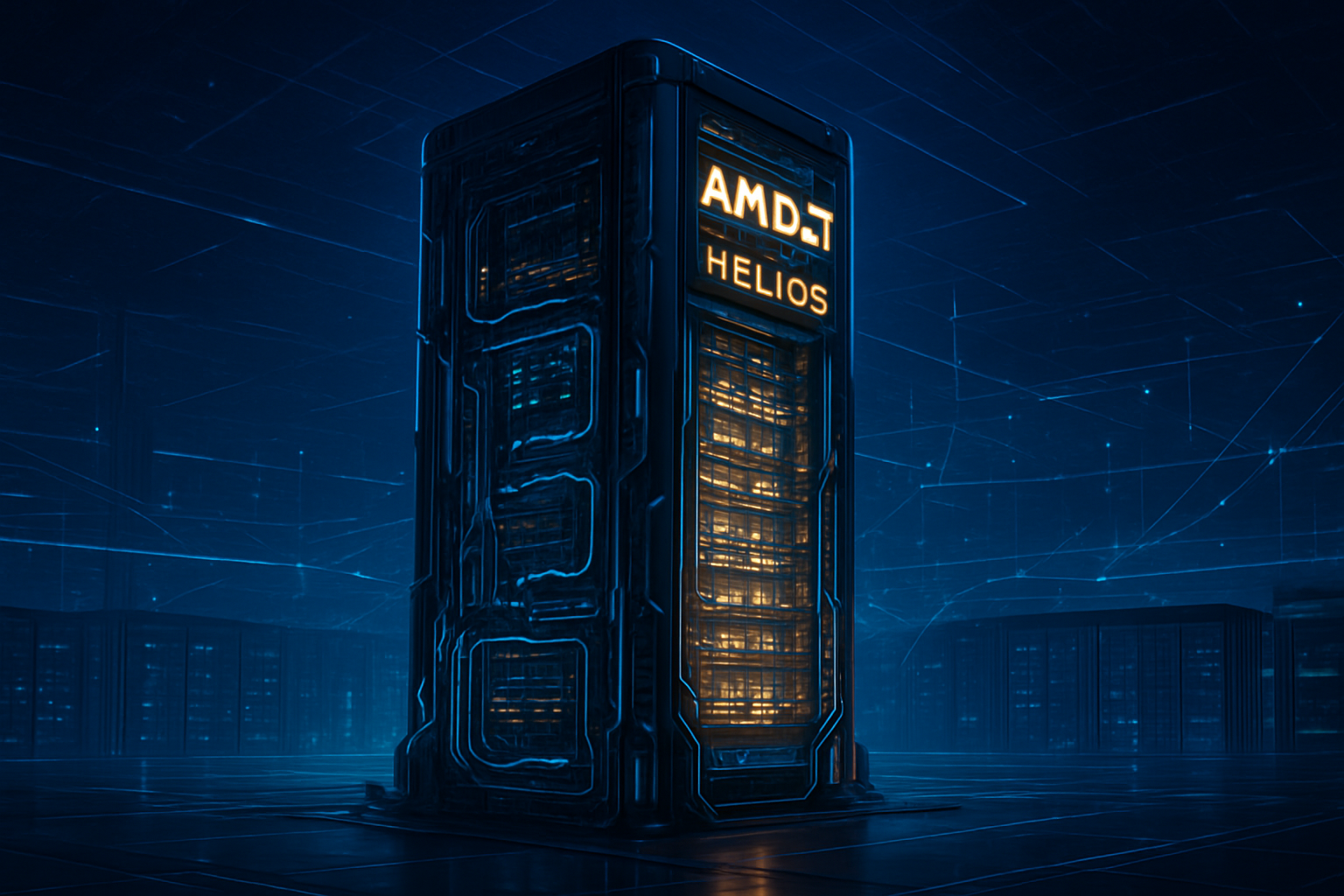
The AMD "Helios" rack-scale AI architecture represents a comprehensive, full-stack platform engineered from the ground up for demanding AI and HPC workloads. At its core, "Helios" is built on the Open Compute Project (OCP) Open Rack Wide (ORW) design, a double-wide standard championed by Meta, which optimizes power delivery, enhances liquid cooling capabilities, and improves serviceability—all critical factors for the immense power and thermal requirements of advanced AI systems. HPE's implementation will further differentiate this offering by integrating its own purpose-built HPE Juniper Networking scale-up Ethernet switch, developed in collaboration with Broadcom (NASDAQ: AVGO). This switch leverages Broadcom's Tomahawk 6 network silicon and supports the Ultra Accelerator Link over Ethernet (UALoE) standard, promising high-bandwidth, low-latency connectivity across vast AI clusters.
Technologically, the "Helios" platform is a powerhouse, featuring AMD Instinct MI455X GPUs (and generally MI450 Series GPUs) which utilize the cutting-edge AMD CDNA™ architecture. Each MI450 Series GPU boasts up to 432 GB of HBM4 memory and an astonishing 19.6 TB/s of memory bandwidth, providing unparalleled capacity for data-intensive AI models. Complementing these GPUs are next-generation AMD EPYC™ "Venice" CPUs, designed to sustain maximum performance across the entire rack. For networking, AMD Pensando™ advanced networking, specifically Pensando Vulcano NICs, facilitates robust scale-out capabilities. The HPE Juniper Networking switch, being the first to optimize AI workloads over standard Ethernet using the UALoE, marks a significant departure from proprietary interconnects like Nvidia's NVLink or InfiniBand, offering greater openness and faster feature updates. The entire system is unified and made accessible through the open ROCm™ software ecosystem, promoting flexibility and innovation. A single "Helios" rack, equipped with 72 MI455X GPUs, is projected to deliver up to 2.9 exaFLOPS of FP4 performance, 260 TB/s of aggregated scale-up bandwidth, 31 TB of total HBM4 memory, and 1.4 PB/s of aggregate memory bandwidth, making it capable of trillion-parameter training and large-scale AI inference.
Initial reactions from the AI research community and industry experts highlight the importance of AMD's commitment to open standards. This approach is seen as a crucial step in democratizing AI infrastructure, reducing the barriers to entry for smaller players, and fostering greater innovation by moving away from single-vendor ecosystems. The sheer computational density and memory bandwidth of the "Helios" architecture are also drawing significant attention, as they directly address some of the most pressing bottlenecks in training increasingly complex AI models.
Reshaping the AI Competitive Landscape
This expanded partnership between HPE and AMD carries profound implications for AI companies, tech giants, and startups alike. Companies seeking to deploy large-scale AI infrastructure, particularly cloud service providers (including emerging "neoclouds") and large enterprises, stand to benefit immensely. The "Helios" architecture, offered as a turnkey solution by HPE, simplifies the procurement, deployment, and management of massive AI clusters, potentially accelerating their time to market for new AI services and products.
Competitively, this collaboration positions HPE and AMD as a formidable challenger to market leaders, most notably Nvidia (NASDAQ: NVDA), whose proprietary solutions like the DGX GB200 NVL72 and Vera Rubin platforms currently dominate the high-end AI infrastructure space. The "Helios" platform, with its focus on open standards and competitive performance metrics, offers a compelling alternative that could disrupt Nvidia's established market share, particularly among customers wary of vendor lock-in. By providing a robust, open-standard solution, AMD aims to carve out a significant portion of the rapidly growing AI hardware market. This could lead to increased competition, potentially driving down costs and accelerating innovation across the industry. Startups and smaller AI labs, which might struggle with the cost and complexity of proprietary systems, could find the open and scalable nature of the "Helios" platform more accessible, fostering a more diverse and competitive AI ecosystem.
Broader Significance in the AI Evolution
The HPE and AMD partnership, centered around the "Helios" architecture, fits squarely into the broader AI landscape's trend towards more open, scalable, and efficient infrastructure. It addresses the critical need for systems that can handle the exponential growth in AI model size and complexity. The emphasis on OCP Open Rack Wide and UALoE standards is a testament to the industry's growing recognition that proprietary interconnects, while powerful, can stifle innovation and create bottlenecks in a rapidly evolving field. This move aligns with a wider push for interoperability and choice, allowing organizations to integrate components from various vendors without being locked into a single ecosystem.
The impacts extend beyond just hardware and software. By simplifying the deployment of large-scale AI clusters, "Helios" could democratize access to advanced AI capabilities, making it easier for a wider range of organizations to develop and deploy sophisticated AI applications. Potential concerns, however, might include the adoption rate of new open standards and the initial integration challenges for early adopters. Nevertheless, the strategic importance of this collaboration is underscored by its role in advancing sovereign AI and HPC initiatives. For instance, the AMD "Helios" platform will power "Herder," a new supercomputer for the High-Performance Computing Center Stuttgart (HLRS) in Germany, built on the HPE Cray Supercomputing GX5000 platform. This initiative, utilizing AMD Instinct MI430X GPUs and next-generation AMD EPYC "Venice" CPUs, will significantly advance HPC and sovereign AI research across Europe, demonstrating the platform's capability to support hybrid HPC/AI workflows and its comparison to previous AI milestones that often relied on more closed architectures.
The Horizon: Future Developments and Predictions
Looking ahead, the adoption of AMD's "Helios" rack architecture by HPE for its 2026 AI systems heralds a new era of open, scalable AI infrastructure. Near-term developments will likely focus on the meticulous integration and optimization of the "Helios" platform within HPE's diverse offerings, ensuring seamless deployment for early customers. We can expect to see further enhancements to the ROCm software ecosystem to fully leverage the capabilities of the "Helios" hardware, along with continued development of the UALoE standard to ensure robust, high-performance networking across even larger AI clusters.
In the long term, this collaboration is expected to drive the proliferation of standards-based AI supercomputing, making it more accessible for a wider range of applications, from advanced scientific research and drug discovery to complex financial modeling and hyper-personalized consumer services. Experts predict that the move towards open rack architectures and standardized interconnects will foster greater competition and innovation, potentially accelerating the pace of AI development across the board. Challenges will include ensuring broad industry adoption of the UALoE standard and continuously scaling the platform to meet the ever-increasing demands of future AI models, which are predicted to grow in size and complexity exponentially. The success of "Helios" could set a precedent for future AI infrastructure designs, emphasizing modularity, interoperability, and open access.
A New Chapter for AI Infrastructure
The expanded partnership between Hewlett Packard Enterprise and Advanced Micro Devices, with HPE's commitment to adopting the AMD "Helios" rack architecture for its 2026 AI systems, marks a pivotal moment in the evolution of AI infrastructure. This collaboration champions an open, scalable, and high-performance approach, offering a compelling alternative to existing proprietary solutions. Key takeaways include the strategic importance of open standards (OCP Open Rack Wide, UALoE), the formidable technical specifications of the "Helios" platform (MI450 Series GPUs, EPYC "Venice" CPUs, ROCm software), and its potential to democratize access to advanced AI capabilities.
This development is significant in AI history as it represents a concerted effort to break down barriers to innovation and reduce vendor lock-in, fostering a more competitive and flexible ecosystem for AI development and deployment. The long-term impact could be a paradigm shift in how large-scale AI systems are designed, built, and operated globally. In the coming weeks and months, industry watchers will be keen to observe further technical details, early customer engagements, and the broader market's reaction to this powerful new contender in the AI infrastructure race, particularly as 2026 approaches and the first "Helios"-powered HPE systems begin to roll out.
This content is intended for informational purposes only and represents analysis of current AI developments.
TokenRing AI delivers enterprise-grade solutions for multi-agent AI workflow orchestration, AI-powered development tools, and seamless remote collaboration platforms.
For more information, visit https://www.tokenring.ai/.