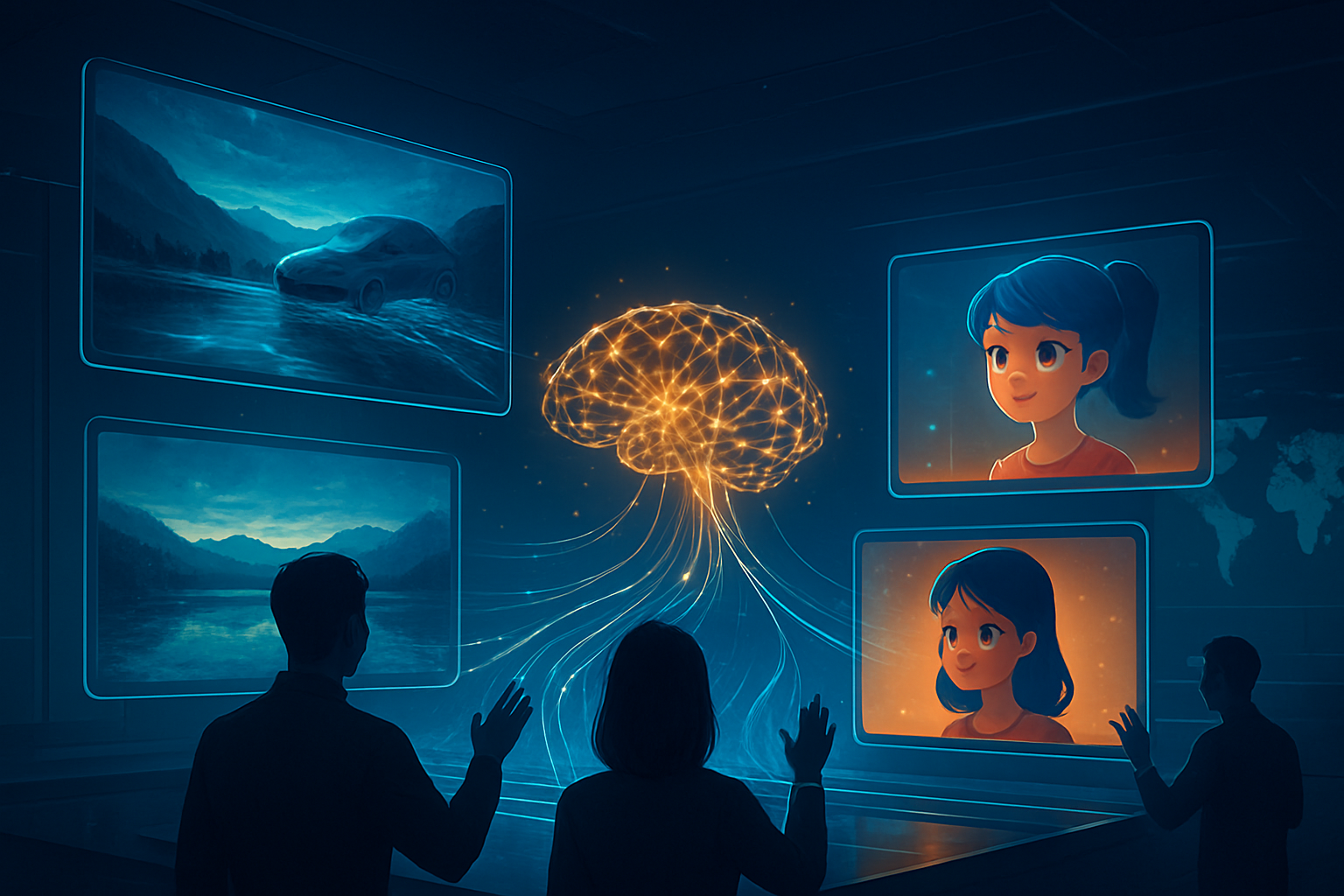
The landscape of visual media has reached a definitive tipping point. As of January 2026, the "Cinematic Turing Test"—the ability for an audience to be unable to distinguish between AI-generated footage and traditional cinematography—has not just been passed; it has been integrated into the very fabric of Hollywood and global advertising. The release of OpenAI’s Sora 2 and Google’s (NASDAQ: GOOGL) Veo 3.1 has transformed video generation from a digital novelty into a high-fidelity industrial tool, setting new benchmarks for photorealism that were considered impossible only twenty-four months ago.
This shift marks a fundamental era of "Generative Realism," where the constraints of physical production—location scouting, lighting setups, and even gravity—are no longer the primary barriers to entry for high-end filmmaking. With major studios and global ad conglomerates like WPP (NYSE: WPP) now formalizing multi-million dollar partnerships with AI labs, the industry is grappling with a new reality where a single prompt can manifest 4K footage that possesses the texture, depth, and emotional resonance of a $200 million blockbuster.
Technical Mastery: Physics, Pixels, and Photorealism
The current technological lead is held by two distinct philosophies of video generation. OpenAI’s Sora 2 has pivoted toward what engineers call "Physics Intelligence." Unlike early generative models that often struggled with fluid dynamics or complex collisions, Sora 2 utilizes a refined world-model architecture that understands the weight and momentum of objects. In a demo released earlier this month, Sora 2 successfully rendered a 25-second sequence of a glass shattering on a marble floor, capturing the refractive properties of every shard with 98% accuracy compared to real-world physics engines. This differs from previous iterations by moving beyond simple pixel prediction to a deep understanding of 3D space and temporal consistency, effectively acting as a "neural game engine" rather than just a video generator.
Google’s Veo 3.1, launched in mid-January 2026, approaches the challenge through the lens of "Agency-Grade Reconstruction." While Sora focuses on physics, Veo 3.1 has set the gold standard for high-resolution output, offering native 4K upscaling that reconstructs micro-textures like skin pores, fabric weaves, and atmospheric haze. Its "Scene Extension" technology is particularly revolutionary, allowing creators to chain 8-second base clips into seamless narratives exceeding two minutes while maintaining perfect environmental continuity. This is a massive leap from the "hallucinatory" shifts that plagued 2024-era models, where backgrounds would often morph or disappear between frames.
Industry experts and researchers at the Artificial Analysis Video Arena have noted that the competitive gap is closing. While Runway’s Gen-4.5 currently holds the top Elo rating for creative control, Google’s Veo 3.1 has taken the lead in "Prompt Adherence," or the model’s ability to follow complex, multi-layered directorial instructions. The integration of 48 FPS (frames per second) support in Kling AI 2.6, developed by Kuaishou (HKG: 1024), has also pushed the industry toward smoother, more lifelike motion, particularly in high-action sequences where previous models would "blur" or "ghost" the subjects.
The most significant technical advancement of 2026, however, is the "Character Cameo" system introduced by OpenAI. This feature allows filmmakers to upload a single reference image of an actor—or a synthetic character—and maintain their identity with 100% consistency across different environments, lighting conditions, and angles. This solved the "continuity crisis" that had previously prevented AI video from being used for serialized storytelling, effectively turning AI into a reliable digital actor that never misses a mark.
The New Power Players: Partnerships and Market Disruption
The market for AI video has bifurcated into two sectors: "Cinematic Realism" for entertainment and "Utility Production" for advertising. Alphabet Inc. (NASDAQ: GOOGL) secured a dominant position in the latter through a $400 million partnership with WPP. This deal allows WPP’s global network of agencies to use Veo 3.1 to automate the production of localized advertisements, generating thousands of variations of a single campaign tailored to different cultural aesthetics and languages in seconds. This has placed immense pressure on traditional mid-tier production houses, which are finding it increasingly difficult to compete with the speed and cost-efficiency of AI-driven creative workflows.
OpenAI, backed by Microsoft (NASDAQ: MSFT), has taken a more "content-first" approach, signing a landmark $1 billion licensing deal with The Walt Disney Company (NYSE: DIS). This agreement permits Sora 2 users to legally generate content using a curated library of Disney-owned intellectual property, from Star Wars to Marvel. This move is a strategic masterstroke, addressing the copyright concerns that have haunted generative AI while simultaneously creating a new category of "Prosumer IP" where fans can create high-quality, authorized shorts that Disney can then curate for its streaming platforms.
The competitive implications for independent AI startups like Runway and Pika are stark. While these companies remain the favorites of professional VFX artists due to their granular "Motion Brush" and "Camera Control" tools, they are being squeezed by the massive compute resources and IP portfolios of the tech giants. However, the rise of Kling AI 2.6 has introduced a formidable international competitor. By offering simultaneous audio-visual generation—where sound effects and dialogue are generated in sync with the visuals—Kling has captured a significant portion of the social media and short-form content market, particularly in Asia and Europe.
Strategically, Google’s advantage lies in its ecosystem. By integrating Veo 3.1 directly into YouTube’s creator studio, Google has democratized high-end production for millions of creators. This vertical integration—from the AI model to the cloud infrastructure to the distribution platform—creates a moat that is difficult for even OpenAI to cross. In response, OpenAI has focused on "Model Quality," positioning Sora as the prestige tool for the next generation of digital-native auteurs.
The Ethical and Social Ripple Effects
The broader significance of these developments extends far beyond the film set. We are witnessing the realization of the "Post-Truth" era in visual media, where the cost of creating a perfect deception has dropped to near zero. While the industry celebrates the creative potential of Sora 2 and Veo 3.1, cybersecurity experts are sounding alarms. The ability to generate hyper-realistic video of public figures in any scenario has necessitated the rapid deployment of safety technologies like C2PA metadata and Google’s SynthID watermarking. These tools are now mandatory in most Western jurisdictions, yet "jailbroken" models from less-regulated regions continue to pose a threat to information integrity.
From a labor perspective, the impact is profound. The 2025-2026 period has seen a massive restructuring of the Visual Effects (VFX) industry. While senior creative directors are thriving by using AI to amplify their vision, entry-level roles in rotoscoping, background plate generation, and basic 3D modeling are being rapidly automated. This has led to renewed tensions with labor unions, as organizations like IATSE and the SAG-AFTRA have pushed for even stricter "Digital Twin" protections and AI-revenue-sharing models to protect workers whose likenesses or artistic styles are used to train these increasingly capable systems.
Comparisons to previous AI milestones are inevitable. If 2023 was the "GPT-3 moment" for text, 2026 is the "GPT-4 moment" for video. The jump from the grainy, flickering clips of 2023 to the stable, 4K, physics-accurate narratives of today is arguably the fastest evolution of any medium in human history. This rapid progression has forced a global conversation about the nature of "art." When a machine can render a masterpiece in seconds, the value of the human element shifts from "execution" to "curation" and "intent."
Furthermore, the environmental impact of these models cannot be ignored. The compute power required to generate 4K video at scale is immense. Both Google and Microsoft have had to accelerate their investments in nuclear and renewable energy to power the massive H100 and B200 GPU clusters necessary to sustain the "Generative Video" boom. This has turned AI video into not just a creative battle, but an energy and infrastructure race.
The Horizon: Interactive and Real-Time Video
The next frontier for AI video is already visible: real-time interactivity. Near-term developments expected in late 2026 and early 2027 point toward "Generative Gaming," where environments and cinematics are not pre-rendered but generated on-the-fly based on player input. Experts at NVIDIA (NASDAQ: NVDA) predict that the same architectures powering Veo 3.1 will soon be capable of sustaining 60 FPS interactive streams, effectively merging the worlds of cinema and video games into a single, fluid experience.
Another burgeoning application is the integration of AI video into Spatial Computing and VR/AR. Companies like Apple (NASDAQ: AAPL) are reportedly exploring ways to use Sora-like models to generate "Immersive Environments" for the Vision Pro, allowing users to step into any scene they can describe. The challenge remains the "Latency Wall"—the time it takes for a model to process a prompt and output a frame. While current models take minutes to render a high-quality clip, the push toward "Instant Video" is the industry’s current "Holy Grail."
Despite the progress, significant hurdles remain. Hand-eye coordination, complex social interactions between multiple characters, and long-term narrative "memory" (keeping track of a character’s scars or clothing over an entire feature-length film) are still areas where human animators hold the edge. However, if the trajectory of the last two years is any indication, these "last mile" problems may be solved sooner than many expect.
A New Era of Expression
The rise of Sora and Veo 3.1 marks a definitive chapter in AI history. We have moved past the era of "AI as a gimmick" into an era where AI is the primary engine of visual culture. The key takeaway from early 2026 is that the barrier between imagination and screen has been almost entirely removed. Whether you are a solo creator in a bedroom or a director at a major studio, the tools to create world-class cinema are now accessible via a dialogue box.
This development is as significant as the invention of the motion picture camera or the transition from silent film to "talkies." It fundamentally reorders how stories are told, who gets to tell them, and how we verify what we see with our own eyes. As we look toward the remainder of 2026, the industry will be watching for the first "AI-native" feature film to win a major award and for the continued evolution of safety standards to keep pace with these near-magical capabilities. The revolution isn't just coming; it's already in 4K.
This content is intended for informational purposes only and represents analysis of current AI developments.
TokenRing AI delivers enterprise-grade solutions for multi-agent AI workflow orchestration, AI-powered development tools, and seamless remote collaboration platforms.
For more information, visit https://www.tokenring.ai/.