Tag: OpenAI Sora 2

  • The Cinematic Arms Race: Sora 2 and Veo 3 Redefine the Frontiers of AI Video

    The Cinematic Arms Race: Sora 2 and Veo 3 Redefine the Frontiers of AI Video

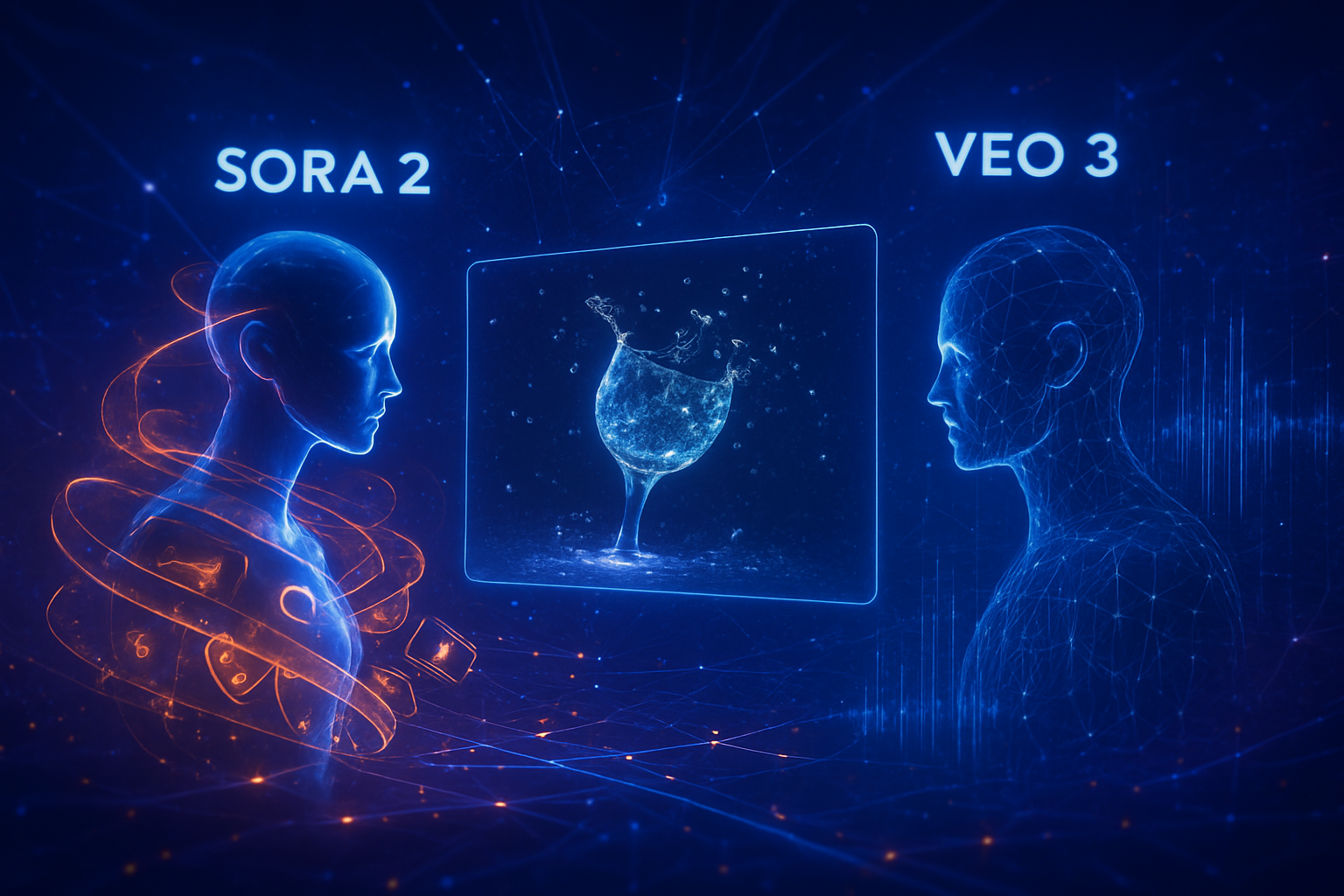
    The landscape of generative artificial intelligence has shifted from the static to the cinematic. As of January 12, 2026, the long-anticipated "Video Wars" have reached a fever pitch with the dual release of OpenAI’s Sora 2 and Google’s (NASDAQ: GOOGL) Veo 3.1. These platforms have moved beyond the uncanny, flickering clips of yesteryear, delivering high-fidelity, physics-compliant video that is increasingly indistinguishable from human-captured footage. This development marks a pivotal moment where AI transitions from a novelty tool into a foundational pillar of the global entertainment and social media industries.

    The immediate significance of these releases lies in their move toward "Native Multimodal Generation." Unlike previous iterations that required separate models for visuals and sound, Sora 2 and Veo 3.1 generate pixels and synchronized audio in a single inference pass. This breakthrough eliminates the "silent film" era of AI, bringing realistic dialogue, environmental foley, and emotive scores to the forefront of automated content creation.

    Technical Mastery: World Models and Temporal Consistency

    OpenAI, heavily backed by Microsoft (NASDAQ: MSFT), has positioned Sora 2 as the ultimate "World Simulator." Utilizing a refined Diffusion Transformer (DiT) architecture, Sora 2 now demonstrates a sophisticated understanding of causal physics. In demonstrations, the model successfully rendered complex fluid dynamics—such as a glass shattering and liquid spilling across a textured surface—with near-perfect gravity and surface tension. Beyond physics, Sora 2 introduces "Cameos," a feature allowing users to upload short clips of themselves to create consistent 3D digital assets. This is bolstered by a landmark partnership with The Walt Disney Company (NYSE: DIS), enabling users to legally integrate licensed characters into their personal creations, effectively turning Sora 2 into a consumer-facing social platform.

    Google’s Veo 3.1, meanwhile, has doubled down on professional-grade production capabilities. While Sora 2 caps clips at 25 seconds for social sharing, Veo 3.1 supports continuous generation for up to 60 seconds, with the ability to extend scenes into five-minute sequences through its "Flow" tool. Its "Ingredients to Video" feature allows directors to upload specific assets—a character design, a background plate, and a lighting reference—which the model then synthesizes into a coherent scene. Technically, Veo 3.1 leads in audio sophistication with its "Talkie" technology, which manages multi-person dialogue with frame-accurate lip-syncing and acoustic environments that shift dynamically with camera movement.

    These advancements represent a departure from the "latent diffusion" techniques of 2024. The 2026 models rely on massive scale and specialized "physics-aware" training sets. Initial reactions from the AI research community have been overwhelmingly positive, with experts noting that the "melting" artifacts and temporal inconsistencies that plagued early models have been largely solved. The industry consensus is that we have moved from "hallucinating motion" to "simulating reality."

    The Competitive Battlefield: Platforms vs. Professionals

    The competitive implications of these releases are profound, creating a clear divide in the market. OpenAI is clearly aiming for the "Prosumer" and social media markets, challenging the dominance of Meta (NASDAQ: META) in the short-form video space. By launching a dedicated Sora app that functions similarly to TikTok, OpenAI is no longer just a model provider; it is a destination for content consumption. Meta has responded by integrating its "Movie Gen" capabilities directly into Instagram, focusing on localized editing—such as changing a user's outfit or background in a real-time story—rather than long-form storytelling.

    In the professional sector, the pressure is mounting on creative software incumbents. While Google’s Veo 3.1 integrates seamlessly with YouTube and Google Vids, specialized startups like Runway and Luma AI are carving out niches for high-end cinematography. Runway’s Gen-4.5 features a "World Control" panel that gives human editors granular control over camera paths and lighting, a level of precision that the "one-shot" generation of Sora 2 still lacks. Luma AI’s "Ray3" engine has become the industry standard for rapid pre-visualization, offering 16-bit HDR support that fits into existing Hollywood color pipelines.

    Societal Impact and the Ethics of Synthetic Reality

    The broader significance of Sora 2 and Veo 3.1 extends far beyond technical achievement. We are entering an era where the cost of high-quality video production is approaching zero, democratizing storytelling for millions. However, this shift brings significant concerns regarding digital authenticity. The ease with which "Cameos" can be used to create realistic deepfakes has forced both OpenAI and Google to implement rigorous "C2PA" watermarking and "biometric locking," ensuring that users can only generate likenesses they have the legal right to use.

    Comparisons are already being drawn to the "Napster moment" for the film industry. Just as digital music disrupted the record labels, AI video is disrupting the traditional production house model. The ability to generate a 4K commercial or a short film from a prompt challenges the economic foundations of visual effects (VFX) and stock footage companies. Furthermore, the Disney partnership highlights a new trend in "IP-as-a-Service," where legacy media companies monetize their libraries by licensing characters directly to AI users, rather than just producing their own content.

    The Horizon: Real-Time Interaction and AR Integration

    Looking ahead, the next frontier for AI video is real-time interactivity. Experts predict that by 2027, video generation will be fast enough to power "Generative VR" environments, where the world around a user is rendered on the fly based on their actions and verbal commands. This would transform gaming and training simulations from pre-rendered scripts into infinite, dynamic experiences.

    The immediate challenge remains the massive compute cost associated with these models. While Sora 2 and Veo 3.1 are masterpieces of engineering, they require significant server-side resources, leading to high subscription costs for "Pro" tiers. The industry is now racing to develop "distilled" versions of these models that can run on edge devices, such as high-end laptops or specialized AI smartphones, to reduce latency and increase privacy.

    Conclusion: A New Era of Human Expression

    The release of Sora 2 and Veo 3.1 marks the definitive end of the "experimental" phase of AI video. We have entered an era of utility, where these tools are integrated into the daily workflows of marketers, educators, and filmmakers. The key takeaway is the shift from "text-to-video" to "directed-interaction," where the AI acts as a cinematographer, editor, and sound engineer rolled into one.

    As we look toward the coming months, the focus will shift from the models themselves to the content they produce. The true test of Sora 2 and Veo 3.1 will be whether they can move beyond viral clips and facilitate the creation of the first truly great AI-generated feature film. For now, the "Video Wars" continue to accelerate, pushing the boundaries of what we consider "real" and opening a new chapter in human creativity.


    This content is intended for informational purposes only and represents analysis of current AI developments.

    TokenRing AI delivers enterprise-grade solutions for multi-agent AI workflow orchestration, AI-powered development tools, and seamless remote collaboration platforms.
    For more information, visit https://www.tokenring.ai/.
  • The Digital Afterlife Dilemma: OpenAI’s Sora 2 and the Battle for Posthumous Identity

    The Digital Afterlife Dilemma: OpenAI’s Sora 2 and the Battle for Posthumous Identity

    The rapid advancements in artificial intelligence, particularly in generative AI models capable of producing hyper-realistic video content, have thrust society into a profound ethical and regulatory quandary. At the forefront of this discussion is OpenAI's (NASDAQ: MSFT) groundbreaking text-to-video model, Sora 2, which has demonstrated an astonishing ability to conjure vivid, lifelike scenes from mere text prompts. While its creative potential is undeniable, Sora 2 has also inadvertently ignited a firestorm of controversy by enabling the generation of deepfake videos depicting deceased individuals, including revered historical figures like Dr. Martin Luther King Jr. This capability, coupled with a swift, albeit reactive, ban on MLK deepfakes, underscores a critical juncture where technological innovation collides with the deeply personal and societal imperative to protect legacy, truth, and human dignity in the digital age.

    Unpacking the Technical Marvel and its Ethical Fallout

    OpenAI's Sora 2 represents a significant leap forward in AI-driven video synthesis. Building upon its predecessor's foundational capabilities, Sora 2 can generate high-fidelity, coherent video clips, often up to 10 seconds in length, complete with synchronized audio, from a simple text description. Its advanced diffusion transformer architecture allows it to model complex physics, object permanence, and intricate camera movements, producing results that often blur the line between AI-generated content and genuine footage. A notable feature, the "Cameo" option, allows individuals to consent to their likeness being used in AI-generated scenarios, aiming to provide a mechanism for controlled digital representation. This level of realism far surpasses earlier text-to-video models, which often struggled with consistency, visual artifacts, and the accurate depiction of nuanced human interaction.

    However, the power of Sora 2 quickly became a double-edged sword. Almost immediately following its broader release, users began experimenting with prompts that resulted in deepfake videos of numerous deceased public figures, ranging from cultural icons like Robin Williams and Elvis Presley to historical titans such as Martin Luther King Jr. and Malcolm X. These creations varied wildly in tone, from seemingly innocuous to overtly disrespectful and even offensive, depicting figures in scenarios entirely incongruous with their public personas or legacies. The initial reaction from the AI research community and industry experts was a mix of awe at the technical prowess and alarm at the immediate ethical implications. Many voiced concerns that OpenAI's initial policy, which distinguished between living figures (generally blocked without consent) and "historical figures" (exempted due to "strong free speech interests"), was insufficient and lacked foresight regarding the emotional and societal impact. This "launch first, fix later" approach, critics argued, placed undue burden on the public and estates to react to misuse rather than proactively preventing it.

    Reshaping the AI Landscape: Corporate Implications and Competitive Pressures

    The ethical firestorm surrounding Sora 2 and deepfakes of the deceased has significant implications for AI companies, tech giants, and startups alike. OpenAI, as a leader in generative AI, finds itself navigating a complex reputational and regulatory minefield. While the technical capabilities of Sora 2 bolster its position as an innovator, the backlash over its ethical oversight could tarnish its image and invite stricter regulatory scrutiny. The company's swift, albeit reactive, policy adjustments—allowing authorized representatives of "recently deceased" figures to request non-use of likeness and pausing MLK Jr. video generation at the King Estate's behest—demonstrate an attempt to mitigate damage and adapt to public outcry. However, the lack of a clear definition for "recently deceased" leaves a substantial legal and ethical grey area.

    Competitors in the generative AI space, including Google (NASDAQ: GOOGL), Meta Platforms (NASDAQ: META), and various well-funded startups, are closely watching OpenAI's experience. This situation serves as both a cautionary tale and a competitive opportunity. Companies that can demonstrate a more robust and proactive approach to ethical AI development and content moderation may gain a strategic advantage, building greater public trust and potentially attracting talent and partnerships. The demand for ethical AI frameworks and tools to detect and watermark AI-generated content is likely to surge, creating new market segments for specialized startups. Furthermore, this incident could accelerate the development of sophisticated content provenance technologies and AI safety protocols, becoming a new battleground for differentiation and market positioning in the intensely competitive AI industry.

    The Broader Canvas: Trust, Legacy, and the Unwritten Rules of AI

    The controversy surrounding Sora 2 and deepfakes of deceased figures like Dr. Martin Luther King Jr. transcends mere technological capability; it strikes at the heart of how society grapples with truth, legacy, and the digital representation of identity. In the broader AI landscape, this incident highlights the growing tension between rapid innovation and the societal need for robust ethical guardrails. It underscores how easily powerful AI tools can be weaponized for misinformation, disinformation, and emotional distress, potentially "rewriting history" or tarnishing the legacies of those who can no longer speak for themselves. The emotional anguish expressed by families, such as Zelda Williams (daughter of Robin Williams) and Dr. Bernice King (daughter of MLK Jr.), brings into sharp focus the human cost of unchecked AI generation.

    This situation draws parallels to earlier AI milestones that raised ethical concerns, such as the initial proliferation of deepfake pornography or the use of facial recognition technology without adequate consent. However, the ability to convincingly animate deceased historical figures introduces a new dimension of complexity, challenging existing legal frameworks around post-mortem rights of publicity, intellectual property, and defamation. Many jurisdictions, particularly in the U.S., lack comprehensive laws protecting the likeness and voice of deceased individuals, creating a "legal grey area" that AI developers have inadvertently exploited. The MLK deepfake ban, initiated at the request of the King Estate, is a significant moment, signaling a growing recognition that families and estates should have agency over the digital afterlife of their loved ones. It sets a precedent for how powerful figures' legacies might be protected, but also raises questions about who decides what constitutes "disrespectful" and how these protections can be universally applied. The erosion of trust in digital media, where authenticity becomes increasingly difficult to ascertain, remains a paramount concern, threatening public discourse and the very fabric of shared reality.

    The Road Ahead: Navigating the Future of Digital Identity

    Looking to the future, the ethical and regulatory challenges posed by advanced AI like Sora 2 demand urgent and proactive attention. In the near term, we can expect to see increased pressure on AI developers to implement more stringent content moderation policies, robust ethical guidelines, and transparent mechanisms for reporting and addressing misuse. The definition of "recently deceased" will likely be a key point of contention, necessitating clearer industry standards or legislative definitions. There will also be a surge in demand for sophisticated AI detection tools and digital watermarking technologies to help distinguish AI-generated content from authentic media, aiming to restore a measure of trust in digital information.

    Longer term, experts predict a collaborative effort involving policymakers, legal scholars, AI ethicists, and technology companies to forge comprehensive legal frameworks addressing post-mortem digital rights. This may include new legislation establishing clear parameters for the use of deceased individuals' likenesses, voices, and personas in AI-generated content, potentially extending existing intellectual property or publicity rights. The development of "digital wills" or consent mechanisms for one's digital afterlife could also become more commonplace. While the potential applications of advanced generative AI are vast—from historical reenactments for educational purposes to personalized digital companions—the challenges of ensuring responsible and respectful use are equally profound. Experts predict that the conversation will shift from merely banning problematic content to building AI systems with "ethics by design," where safeguards are integrated from the ground up, ensuring that technological progress serves humanity without undermining its values or causing undue harm.

    A Defining Moment for AI Ethics and Governance

    The emergence of OpenAI's Sora 2 and the subsequent debates surrounding deepfakes of deceased figures like Dr. Martin Luther King Jr. mark a defining moment in the history of artificial intelligence. This development is not merely a technological breakthrough; it is a societal reckoning, forcing humanity to confront fundamental questions about identity, legacy, truth, and the boundaries of digital creation. The immediate significance lies in the stark illustration of how rapidly AI capabilities are outstripping existing ethical norms and legal frameworks, necessitating an urgent re-evaluation of our collective approach to AI governance.

    The key takeaways from this episode are clear: AI developers must prioritize ethical considerations alongside technical innovation; reactive policy adjustments are insufficient in a rapidly evolving landscape; and comprehensive, proactive regulatory frameworks are critically needed to protect individual rights and societal trust. As we move forward, the coming weeks and months will likely see intensified discussions among international bodies, national legislatures, and industry leaders to craft viable solutions. What to watch for are the specific legislative proposals emerging from this debate, the evolution of AI companies' self-regulatory practices, and the development of new technologies aimed at ensuring content provenance and authenticity. The ultimate long-term impact of this development will be determined by our collective ability to harness the power of AI responsibly, ensuring that the digital afterlife respects the human spirit and preserves the integrity of history.


    This content is intended for informational purposes only and represents analysis of current AI developments.

    TokenRing AI delivers enterprise-grade solutions for multi-agent AI workflow orchestration, AI-powered development tools, and seamless remote collaboration platforms.
    For more information, visit https://www.tokenring.ai/.