
Tag: OpenAI

  • The Magic Kingdom Meets the Neural Network: Disney and OpenAI’s $1 Billion Content Revolution

    The Magic Kingdom Meets the Neural Network: Disney and OpenAI’s $1 Billion Content Revolution

    In a move that signals a seismic shift in how Hollywood manages intellectual property in the age of artificial intelligence, The Walt Disney Company (NYSE: DIS) and OpenAI announced a landmark $1 billion licensing and equity agreement on December 11, 2025. This historic partnership, the largest of its kind to date, transforms Disney from a cautious observer of generative AI into a primary architect of its consumer-facing future. By integrating Disney’s vast library of characters directly into OpenAI’s creative tools, the deal aims to legitimize the use of iconic IP while establishing a new gold standard for corporate control over AI-generated content.

    The immediate significance of this announcement cannot be overstated. For years, the relationship between major studios and AI developers has been defined by litigation and copyright disputes. This agreement effectively ends that era for Disney, replacing "cease and desist" letters with a lucrative "pay-to-play" model. As part of the deal, Disney has taken a $1 billion equity stake in OpenAI, signaling a deep strategic alignment that goes beyond simple content licensing. For OpenAI, the partnership provides the high-quality, legally cleared training data and brand recognition necessary to maintain its lead in an increasingly competitive market.

    A New Creative Sandbox: Sora and ChatGPT Integration

    Starting in early 2026, users of OpenAI’s Sora video generation platform and ChatGPT’s image generation tools will gain the ability to create original content featuring over 200 of Disney’s most iconic characters. The technical implementation involves a specialized "Disney Layer" within OpenAI’s models, trained on high-fidelity assets from Disney’s own archives. This ensures that a user-generated video of Mickey Mouse or a Star Wars X-Wing maintains the exact visual specifications, color palettes, and movement physics defined by Disney’s animators. The initial rollout will include legendary figures from the classic Disney vault, Pixar favorites, Marvel superheroes like Iron Man and Black Panther, and Star Wars staples such as Yoda and Darth Vader.

    However, the agreement comes with strict technical and legal guardrails designed to protect human talent. A critical exclusion in the deal is the use of talent likenesses and voices. To avoid the ethical and legal quagmires associated with "deepfakes" and to maintain compliance with labor agreements, users will be unable to generate content featuring the faces or voices of real-life actors. For instance, while a user can generate a cinematic shot of Iron Man in full armor, the model is hard-coded to prevent the generation of Robert Downey Jr.’s face or voice. This "mask-and-suit" policy ensures that the characters remain distinct from the human performers who portray them in live-action.

    The AI research community has viewed this development as a masterclass in "constrained creativity." Experts note that by providing OpenAI with a closed-loop dataset of 3D models and animation cycles, Disney is effectively teaching the AI the "rules" of its universe. This differs from previous approaches where AI models were trained on scraped internet data of varying quality. The result is expected to be a dramatic increase in the consistency and "on-model" accuracy of AI-generated characters, a feat that has historically been difficult for general-purpose generative models to achieve.

    Market Positioning and the "Carrot-and-Stick" Strategy

    The financial and strategic implications of this deal extend far beyond the $1 billion price tag. For Disney, the move is a brilliant "carrot-and-stick" maneuver. Simultaneously with the OpenAI announcement, Disney reportedly issued a massive cease-and-desist order against Alphabet Inc. (NASDAQ: GOOGL), demanding that the tech giant stop using Disney-owned IP to train its Gemini models without compensation. By rewarding OpenAI with a license while threatening Google with litigation, Disney is forcing the hand of every major AI developer: pay for the right to use the Magic Kingdom, or face the full weight of its legal department.

    Microsoft (NASDAQ: MSFT), as OpenAI’s primary partner, stands to benefit significantly from this arrangement. The integration of Disney IP into the OpenAI ecosystem makes the Microsoft-backed platform the exclusive home for "official" fan-generated Disney content, potentially drawing millions of users away from competitors like Meta (NASDAQ: META) or Midjourney. For startups in the AI space, the deal sets a high barrier to entry; the "Disney tax" for premium training data may become a standard cost of doing business, potentially squeezing out smaller players who cannot afford billion-dollar licensing fees.

    Market analysts have reacted positively to the news, with Disney’s stock seeing a notable uptick in the days following the announcement. Investors view the equity stake in OpenAI as a hedge against the disruption of traditional media. If AI is going to change how movies are made, Disney now owns a piece of the engine driving that change. Furthermore, Disney plans to use OpenAI’s enterprise tools to enhance its own internal productions and the Disney+ streaming experience, creating a more personalized and interactive interface for its global audience.

    The Wider Significance: A Paradigm Shift in IP Management

    This partnership marks a turning point in the broader AI landscape, signaling the end of the "Wild West" era of generative AI. By creating a legal framework for fan-generated content, Disney is acknowledging that the "genie is out of the bottle." Rather than trying to ban AI-generated fan art and videos, Disney is choosing to monetize and curate them. This mirrors the music industry’s eventual embrace of streaming after years of fighting digital piracy, but on a much more complex and technologically advanced scale.

    However, the deal has not been without its detractors. The Writers Guild of America (WGA) and other creative unions have expressed concern that this deal effectively "sanctions the theft of creative work" by allowing AI to mimic the styles and worlds built by human writers and artists. There are also significant concerns regarding child safety and brand integrity. Advocacy groups like Fairplay have criticized the move, arguing that inviting children to interact with AI-generated versions of their favorite characters could lead to unpredictable and potentially harmful interactions.

    Despite these concerns, the Disney-OpenAI deal is being compared to the 2006 acquisition of Pixar in terms of its long-term impact on the company’s DNA. It represents a move toward "participatory storytelling," where the boundary between the creator and the audience begins to blur. For the first time, a fan won't just watch a Star Wars movie; they will have the tools to create a high-quality, "official" scene within that universe, provided they stay within the established guardrails.

    The Horizon: Interactive Storytelling and the 2026 Rollout

    Looking ahead, the near-term focus will be the "Early 2026" rollout of Disney assets within Sora and ChatGPT. OpenAI is expected to release a series of "Creative Kits" tailored to different Disney franchises, allowing users to experiment with specific art styles—ranging from the hand-drawn aesthetic of the 1940s to the hyper-realistic CGI of modern Marvel films. Beyond simple video generation, experts predict that this technology will eventually power interactive Disney+ experiences where viewers can influence the direction of a story in real-time.

    The long-term challenges remain technical and ethical. Ensuring that the AI does not generate "off-brand" or inappropriate content featuring Mickey Mouse will require a massive investment in safety filters and human-in-the-loop moderation. Furthermore, as the technology evolves, the pressure to include talent likenesses and voices will only grow, potentially leading to a new round of negotiations with SAG-AFTRA and other talent guilds. The industry will be watching closely to see if Disney can maintain its "family-friendly" image in a world where anyone can be a director.

    A New Chapter for the Digital Age

    The $1 billion agreement between Disney and OpenAI is more than just a business deal; it is a declaration of the future of entertainment. By bridging the gap between one of the world’s oldest storytelling powerhouses and the vanguard of artificial intelligence, both companies are betting that the future of creativity is collaborative, digital, and deeply integrated with AI. The key takeaways from this announcement are clear: IP is the new currency of the AI age, and those who own the most iconic stories will hold the most power.

    As we move into 2026, the significance of this development in AI history will become even more apparent. It serves as a blueprint for how legacy media companies can survive and thrive in an era of technological disruption. While the risks are substantial, the potential for a new era of "democratized" high-end storytelling is unprecedented. In the coming weeks and months, the tech world will be watching for the first beta tests of the Disney-Sora integration, which will likely set the tone for the next decade of digital media.


    This content is intended for informational purposes only and represents analysis of current AI developments.

    TokenRing AI delivers enterprise-grade solutions for multi-agent AI workflow orchestration, AI-powered development tools, and seamless remote collaboration platforms.
    For more information, visit https://www.tokenring.ai/.

  • OpenAI Unveils GPT-5.2-Codex: A New Frontier in Autonomous Engineering and Defensive Cyber-Security

    OpenAI Unveils GPT-5.2-Codex: A New Frontier in Autonomous Engineering and Defensive Cyber-Security

    On December 18, 2025, OpenAI shattered the ceiling of automated software development with the release of GPT-5.2-Codex. This specialized variant of the GPT-5.2 model family marks a definitive shift from passive coding assistants to truly autonomous agents capable of managing complex, multi-step engineering workflows. By integrating high-level reasoning with a deep understanding of live system environments, OpenAI aims to redefine the role of the software engineer from a manual coder to a high-level orchestrator of AI-driven development.

    The immediate significance of this release lies in its "agentic" nature. Unlike its predecessors, GPT-5.2-Codex does not just suggest snippets of code; it can independently plan, execute, and verify entire project migrations and system refactors. This capability has profound implications for the speed of digital transformation across global industries, promising to reduce technical debt at a scale previously thought impossible. However, the release also signals a heightened focus on the dual-use nature of AI, as OpenAI simultaneously launched a restricted pilot program specifically for defensive cybersecurity professionals to manage the model’s unprecedented offensive and defensive potential.

    Breaking the Benchmarks: The Technical Edge of GPT-5.2-Codex

    Technically, GPT-5.2-Codex is built on a specialized architecture that prioritizes "long-horizon" tasks—engineering problems that require hours or even days of sustained reasoning. A cornerstone of this advancement is a new feature called Context Compaction. This technology allows the model to automatically summarize and compress older parts of a project’s context into token-efficient snapshots, enabling it to maintain a coherent "mental map" of massive codebases without the performance degradation typically seen in large-context models. Furthermore, the model has been optimized for Windows-native environments, addressing a long-standing gap where previous versions were predominantly Linux-centric.

    The performance metrics released by OpenAI confirm its dominance in autonomous tasks. GPT-5.2-Codex achieved a staggering 56.4% on SWE-bench Pro, a benchmark that requires models to resolve real-world GitHub issues by navigating complex repositories and generating functional patches. This outperformed the base GPT-5.2 (55.6%) and significantly gapped the previous generation’s GPT-5.1 (50.8%). Even more impressive was its performance on Terminal-Bench 2.0, where it scored 64.0%. This benchmark measures a model's ability to operate in live terminal environments—compiling code, configuring servers, and managing dependencies—proving that the AI can now handle the "ops" in DevOps with high reliability.

    Initial reactions from the AI research community have been largely positive, though some experts noted that the jump from the base GPT-5.2 model was incremental. However, the specialized "Codex-Max" tuning appears to have solved specific edge cases in multimodal engineering. The model can now interpret technical diagrams, UI mockups, and even screenshots of legacy systems, translating them directly into functional prototypes. This bridge between visual design and functional code represents a major leap toward the "no-code" future for enterprise-grade software.

    The Battle for the Enterprise: Microsoft, Google, and the Competitive Landscape

    The release of GPT-5.2-Codex has sent shockwaves through the tech industry, forcing major players to recalibrate their AI strategies. Microsoft (NASDAQ: MSFT), OpenAI’s primary partner, has moved quickly to integrate these capabilities into its GitHub Copilot ecosystem. However, Microsoft executives, including CEO Satya Nadella, have been careful to frame the update as a tool for human empowerment rather than replacement. Mustafa Suleyman, CEO of Microsoft AI, emphasized a cautious approach, suggesting that while the productivity gains are immense, the industry must remain vigilant about the existential risks posed by increasingly autonomous systems.

    The competition is fiercer than ever. On the same day as the Codex announcement, Alphabet Inc. (NASDAQ: GOOGL) released Gemini 3 Flash, a direct competitor designed for speed and efficiency in code reviews. Early independent testing suggests that Gemini 3 Flash may actually outperform GPT-5.2-Codex in specific vulnerability detection tasks, finding more bugs in a controlled 50-file test set. This rivalry was further highlighted when Marc Benioff, CEO of Salesforce (NYSE: CRM), publicly announced a shift from OpenAI’s tools to Google’s Gemini 3, citing superior reasoning speed and enterprise integration.

    This competitive pressure is driving a "race to the bottom" on latency and a "race to the top" on reasoning capabilities. For startups and smaller AI labs, the high barrier to entry for training models of this scale means many are pivoting toward building specialized "agent wrappers" around these foundation models. The market positioning of GPT-5.2-Codex as a "dependable partner" suggests that OpenAI is looking to capture the high-end professional market, where reliability and complex problem-solving are more valuable than raw generation speed.

    The Cybersecurity Frontier and the "Dual-Use" Dilemma

    Perhaps the most controversial aspect of the GPT-5.2-Codex release is its role in cybersecurity. OpenAI introduced the "Cyber Trusted Access" pilot program, an invite-only initiative for vetted security professionals. This program provides access to a more "permissive" version of the model, specifically tuned for defensive tasks like malware analysis and authorized red-teaming. OpenAI showcased a case study where a security engineer used a precursor of the model to identify critical vulnerabilities in React Server Components just a week before the official release, demonstrating a level of proficiency that rivals senior human researchers.

    However, the wider significance of this development is clouded by concerns over "dual-use risk." The same agentic reasoning that allows GPT-5.2-Codex to patch a system could, in the wrong hands, be used to automate the discovery and exploitation of zero-day vulnerabilities. In specialized Capture-the-Flag (CTF) challenges, the model’s proficiency jumped from 27% in the base GPT-5 to over 76% in the Codex-Max variant. This leap has sparked a heated debate within the cybersecurity community about whether releasing such powerful tools—even under a pilot program—lowers the barrier for entry for state-sponsored and criminal cyber-actors.

    Comparatively, this milestone is being viewed as the "GPT-3 moment" for cybersecurity. Just as GPT-3 changed the world’s understanding of natural language, GPT-5.2-Codex is changing the understanding of autonomous digital defense. The impact on the labor market for junior security analysts could be immediate, as the AI takes over the "grunt work" of log analysis and basic bug hunting, leaving only the most complex strategic decisions to human experts.

    The Road Ahead: Long-Horizon Tasks and the Future of Work

    Looking forward, the trajectory for GPT-5.2-Codex points toward even greater autonomy. Experts predict that the next iteration will focus on "cross-repo reasoning," where the AI can manage dependencies across dozens of interconnected microservices simultaneously. The near-term development of "self-healing" infrastructure—where the AI detects a server failure, identifies the bug in the code, writes a patch, and deploys it without human intervention—is no longer a matter of "if" but "when."

    However, significant challenges remain. The "black box" nature of AI reasoning makes it difficult for human developers to trust the model with mission-critical systems. Addressing the "explainability" of AI-generated patches will be a major focus for OpenAI in 2026. Furthermore, as AI models begin to write the majority of the world's code, the risk of "model collapse"—where future AIs are trained on the output of previous AIs, leading to a loss of creative problem-solving—remains a theoretical but persistent concern for the research community.

    A New Chapter in the AI Revolution

    The release of GPT-5.2-Codex on December 18, 2025, will likely be remembered as the point when AI moved from a tool that helps us work to an agent that works with us. By setting new records on SWE-bench Pro and Terminal-Bench 2.0, OpenAI has proven that the era of autonomous engineering is here. The dual-pronged approach of high-end engineering capabilities and a restricted cybersecurity pilot program shows a company trying to balance rapid innovation with the heavy responsibility of safety.

    As we move into 2026, the industry will be watching closely to see how the "Cyber Trusted Access" program evolves and whether the competitive pressure from Google and others will lead to a broader release of these powerful capabilities. For now, GPT-5.2-Codex stands as a testament to the incredible pace of AI development, offering a glimpse into a future where the only limit to software creation is the human imagination, not the manual labor of coding.


    This content is intended for informational purposes only and represents analysis of current AI developments.

    TokenRing AI delivers enterprise-grade solutions for multi-agent AI workflow orchestration, AI-powered development tools, and seamless remote collaboration platforms.
    For more information, visit https://www.tokenring.ai/.
  • The ‘Garlic’ Offensive: OpenAI Launches GPT-5.2 Series to Reclaim AI Dominance

    The ‘Garlic’ Offensive: OpenAI Launches GPT-5.2 Series to Reclaim AI Dominance

    On December 11, 2025, OpenAI shattered the growing industry narrative of a "plateau" in large language models with the surprise release of the GPT-5.2 series, internally codenamed "Garlic." This launch represents the most significant architectural pivot in the company's history, moving away from a single monolithic model toward a tiered ecosystem designed specifically for the high-stakes world of professional knowledge work. The release comes at a critical juncture for the San Francisco-based lab, arriving just weeks after internal reports of a "Code Red" crisis triggered by surging competition from rival labs.

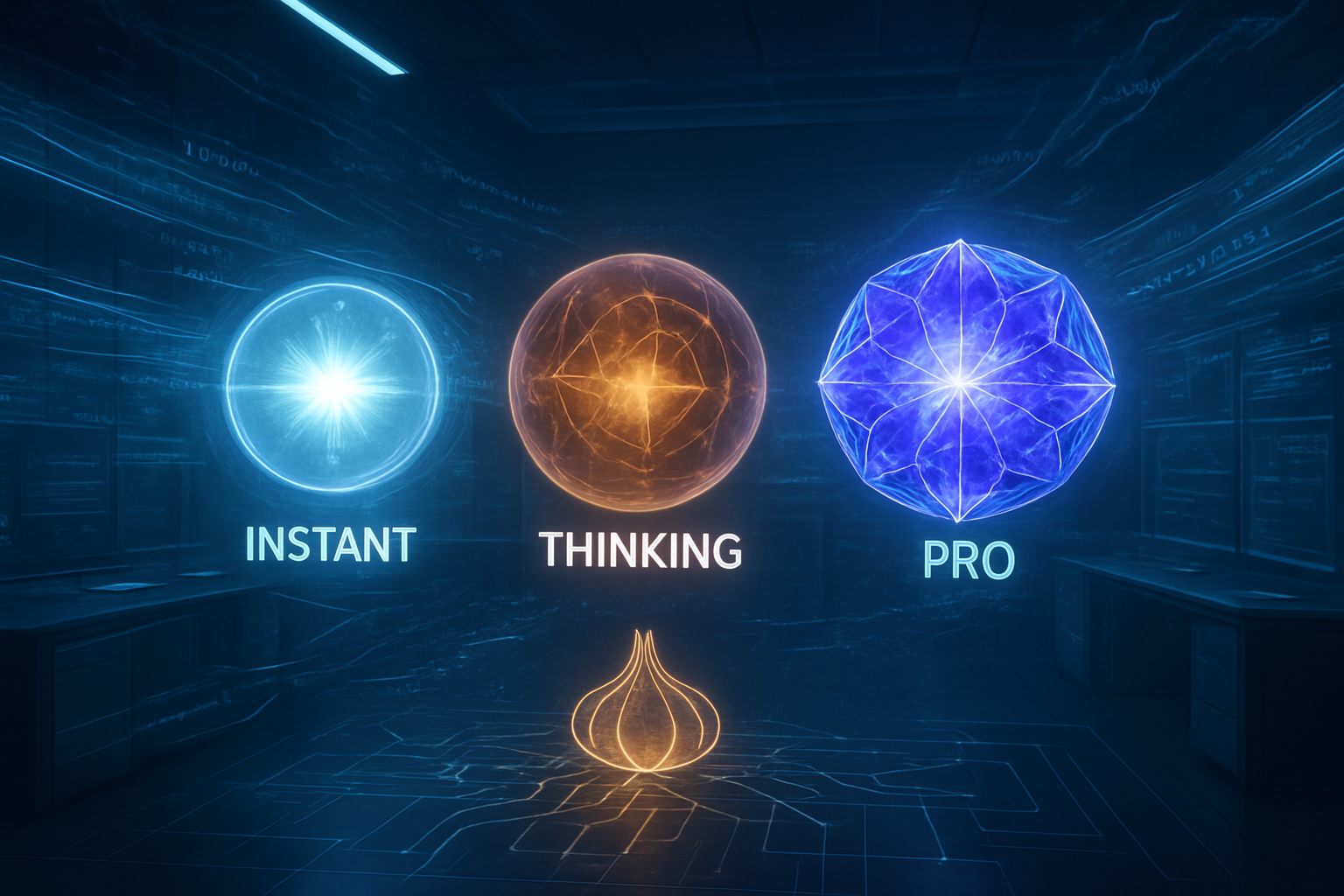
    The GPT-5.2 lineup is divided into three distinct iterations: Instant, Thinking, and Pro. While the Instant model focuses on the low-latency needs of daily interactions, it is the Thinking and Pro models that have sent shockwaves through the research community. By integrating advanced reasoning-effort settings that allow the model to "deliberate" before responding, OpenAI has achieved what many thought was years away: a perfect 100% score on the American Invitational Mathematics Examination (AIME) 2025 benchmark. This development signals a shift from AI as a conversational assistant to AI as a verifiable reasoning engine capable of tackling the world's most complex intellectual challenges.

    Technical Breakthroughs: The Architecture of Deliberation

    The GPT-5.2 series marks a departure from the traditional "next-token prediction" paradigm, leaning heavily into reinforcement learning and "Chain-of-Thought" processing. The Thinking model is specifically engineered to handle "Artifacts"—complex, multi-layered digital objects such as dynamic financial models, interactive software prototypes, and 100-page legal briefs. Unlike its predecessors, GPT-5.2 Thinking can pause its output for several minutes to verify its internal logic, effectively debugging its own reasoning before the user ever sees a result. This "system 2" thinking approach has allowed the model to achieve a 55.6% success rate on the SWE-bench Pro, a benchmark for real-world software engineering that had previously stymied even the most advanced coding assistants.

    For those requiring the absolute ceiling of machine intelligence, the GPT-5.2 Pro model offers a "research-grade" experience. Available via a new $200-per-month subscription tier, the Pro version can engage in reasoning tasks for over an hour, processing vast amounts of data to solve high-stakes problems where the margin for error is zero. In technical evaluations, the Pro model reached a historic 54.2% on the ARC-AGI-2 benchmark, crossing the 50% threshold for the first time in history and moving the industry significantly closer to the elusive goal of Artificial General Intelligence (AGI).

    This technical leap is further supported by a massive 400,000-token context window, allowing professional users to upload entire codebases or multi-year financial histories for analysis. Initial reactions from the AI research community have been a mix of awe and scrutiny. While many praise the unprecedented reasoning capabilities, some experts have noted that the model's tone has become significantly more formal and "colder" than the GPT-5.1 release, a deliberate choice by OpenAI to prioritize professional utility over social charm.

    The 'Code Red' Response: A Shifting Competitive Landscape

    The launch of "Garlic" was not merely a scheduled update but a strategic counter-strike. In late 2024 and early 2025, OpenAI faced an existential threat as Alphabet Inc. (NASDAQ: GOOGL) released Gemini 3 Pro and Anthropic (Private) debuted Claude Opus 4.5. Both models had begun to outperform GPT-5.1 in key areas of creative writing and coding, leading to a reported dip in ChatGPT's market share. In response, OpenAI CEO Sam Altman reportedly declared a "Code Red," pausing non-essential projects—including a personal assistant codenamed "Pulse"—to focus the company's entire engineering might on GPT-5.2.

    The strategic importance of this release was underscored by the simultaneous announcement of a $1 billion equity investment from The Walt Disney Company (NYSE: DIS). This landmark partnership positions Disney as a primary customer, utilizing GPT-5.2 to orchestrate complex creative workflows and becoming the first major content partner for Sora, OpenAI's video generation tool. This move provides OpenAI with a massive influx of capital and a prestigious enterprise sandbox, while giving Disney a significant technological lead in the entertainment industry.

    Other major tech players are already pivoting to integrate the new models. Shopify Inc. (NYSE: SHOP) and Zoom Video Communications, Inc. (NASDAQ: ZM) were announced as early enterprise testers, reporting that the agentic reasoning of GPT-5.2 allows for the automation of multi-step projects that previously required human oversight. For Microsoft Corp. (NASDAQ: MSFT), OpenAI’s primary partner, the success of GPT-5.2 reinforces the value of their multi-billion dollar investment, as these capabilities are expected to be integrated into the next generation of Copilot Pro tools.

    Redefining Knowledge Work and the Broader AI Landscape

    The most profound impact of GPT-5.2 may be its focus on the "professional knowledge worker." OpenAI introduced a new evaluation metric alongside the launch called GDPval, which measures AI performance across 44 occupations that contribute significantly to the global economy. GPT-5.2 achieved a staggering 70.9% win rate against human experts in these fields, compared to just 38.8% for the original GPT-5. This suggests that the era of AI as a simple "copilot" is evolving into an era of AI as an autonomous "agent" capable of executing end-to-end projects with minimal intervention.

    However, this leap in capability brings a new set of concerns. The cost of the Pro tier and the increased API pricing ($1.75 per 1 million input tokens) have raised questions about a growing "intelligence divide," where only the largest corporations and wealthiest individuals can afford the most capable reasoning engines. Furthermore, the model's ability to solve complex mathematical and engineering problems with 100% accuracy raises significant questions about the future of STEM education and the long-term value of human-led technical expertise.

    Compared to previous milestones like the launch of GPT-4 in 2023, the GPT-5.2 release feels less like a magic trick and more like a professional tool. It marks the transition of LLMs from being "good at everything" to being "expert at the difficult." The industry is now watching closely to see if the "Garlic" offensive will be enough to maintain OpenAI's lead as Google and Anthropic prepare their own responses for the 2026 cycle.

    The Road Ahead: Agentic Workflows and the AGI Horizon

    Looking forward, the success of the GPT-5.2 series sets the stage for a 2026 dominated by "agentic workflows." Experts predict that the next 12 months will see a surge in specialized AI agents that use the Thinking and Pro models as their "brains" to navigate the real world—managing supply chains, conducting scientific research, and perhaps even drafting legislation. The ability of GPT-5.2 to use tools independently and verify its own work is the foundational layer for these autonomous systems.

    Challenges remain, however, particularly in the realm of energy consumption and the "hallucination of logic." While GPT-5.2 has largely solved fact-based hallucinations, researchers warn that "reasoning hallucinations"—where a model follows a flawed but internally consistent logic path—could still occur in highly novel scenarios. Addressing these edge cases will be the primary focus of the rumored GPT-6 development, which is expected to begin in earnest now that the "Code Red" has subsided.

    Conclusion: A New Benchmark for Intelligence

    The launch of GPT-5.2 "Garlic" on December 11, 2025, will likely be remembered as the moment OpenAI successfully pivoted from a consumer-facing AI company to an enterprise-grade reasoning powerhouse. By delivering a model that can solve AIME-level math with perfect accuracy and provide deep, deliberative reasoning, they have raised the bar for what is expected of artificial intelligence. The introduction of the Instant, Thinking, and Pro tiers provides a clear roadmap for how AI will be consumed in the future: as a scalable resource tailored to the complexity of the task at hand.

    As we move into 2026, the tech industry will be defined by how well companies can integrate these "reasoning engines" into their daily operations. With the backing of giants like Disney and Microsoft, and a clear lead in the reasoning benchmarks, OpenAI has once again claimed the center of the AI stage. Whether this lead is sustainable in the face of rapid innovation from Google and Anthropic remains to be seen, but for now, the "Garlic" offensive has successfully changed the conversation from "Can AI think?" to "How much are you willing to pay for it to think for you?"


    This content is intended for informational purposes only and represents analysis of current AI developments.

    TokenRing AI delivers enterprise-grade solutions for multi-agent AI workflow orchestration, AI-powered development tools, and seamless remote collaboration platforms.
    For more information, visit https://www.tokenring.ai/.

  • The Grade Gap: AI Instruction Outperforms Human Teachers in Controversial New Studies

    The Grade Gap: AI Instruction Outperforms Human Teachers in Controversial New Studies

    As we approach the end of 2025, a seismic shift in the educational landscape has sparked a fierce national debate: is the human teacher becoming obsolete in the face of algorithmic precision? Recent data from pilot programs across the United States and the United Kingdom suggest that students taught by specialized AI systems are not only keeping pace with their peers but are significantly outperforming them in core subjects like physics, mathematics, and literacy. This "performance gap" has ignited a firestorm among educators, parents, and policymakers who question whether these higher grades represent a breakthrough in cognitive science or a dangerous shortcut toward the dehumanization of learning.

    The immediate significance of these findings cannot be overstated. With schools facing chronic teacher shortages and ballooning classroom sizes, the promise of a "1-to-1 tutor for every child" is no longer a futuristic dream but a data-backed reality. However, as the controversial claim that AI instruction produces better grades gains traction, it forces a fundamental reckoning with the purpose of education. If a machine can deliver a 65% rise in test scores, as some 2025 reports suggest, the traditional role of the educator as the primary source of knowledge is being systematically dismantled.

    The Technical Edge: Precision Pedagogy and the "2x" Learning Effect

    The technological backbone of this shift lies in the evolution of Large Language Models (LLMs) into specialized "tutors" capable of real-time pedagogical adjustment. In late 2024, a landmark study at Harvard University utilized a custom bot named "PS2 Pal," powered by OpenAI’s GPT-4, to teach physics. The results were staggering: students using the AI tutor learned twice as much in 20% less time compared to those in traditional active-learning classrooms. Unlike previous generations of "educational software" that relied on static branching logic, these new systems use sophisticated "Chain-of-Thought" reasoning to diagnose a student's specific misunderstanding and pivot their explanation style instantly.

    In Newark Public Schools, the implementation of Khanmigo, an AI tool developed by Khan Academy and supported by Microsoft (NASDAQ: MSFT), has demonstrated the power of "precision pedagogy." In a pilot involving 8,000 students, Newark reported that learners using the AI achieved three times the state average increase in math proficiency. The technical advantage here is the AI’s ability to monitor every keystroke and provide "micro-interventions" that a human teacher, managing 30 students at once, simply cannot provide. These systems do not just give answers; they are programmed to "scaffold" learning—asking leading questions that force the student to arrive at the solution themselves.

    However, the AI research community remains divided on the "logic" behind these grades. A May 2025 study from the University of Georgia’s AI4STEM Education Center found that while AI (specifically models like Mixtral) can grade assignments with lightning speed, its underlying reasoning is often flawed. Without strict human-designed rubrics, the AI was found to use "shortcuts," such as identifying key vocabulary words rather than evaluating the logical flow of an argument. This suggests that while the AI is highly effective at optimizing for specific test metrics, its ability to foster deep, conceptual understanding remains a point of intense technical scrutiny.

    The EdTech Arms Race: Market Disruption and the "Elite AI" Tier

    The commercial implications of AI outperforming human instruction have triggered a massive realignment in the technology sector. Alphabet Inc. (NASDAQ: GOOGL) has responded by integrating "Gems" and "Guided Learning" features into Google Workspace for Education, positioning itself as the primary infrastructure for "AI-first" school districts. Meanwhile, established educational publishers like Pearson (NYSE: PSO) are pivoting from textbooks to "Intelligence-as-a-Service," fearing that their traditional content libraries will be rendered irrelevant by generative models that can create personalized curriculum on the fly.

    This development has created a strategic advantage for companies that can bridge the gap between "raw AI" and "pedagogical safety." Startups that focus on "explainable AI" for education are seeing record-breaking venture capital rounds, as school boards demand transparency in how grades are being calculated. The competitive landscape is no longer about who has the largest LLM, but who has the most "teacher-aligned" model. Major AI labs are now competing to sign exclusive partnerships with state departments of education, effectively turning the classroom into the next great frontier for data acquisition and model training.

    There is also a growing concern regarding the emergence of a "digital divide" in educational quality. In London, David Game College launched a "teacherless" GCSE program with a tuition fee of approximately £27,000 ($35,000) per year. This "Elite AI" tier offers highly optimized, bespoke instruction that guarantees high grades, while under-funded public schools may be forced to use lower-tier, automated systems that lack human oversight. Critics argue that this market positioning could lead to a two-tiered society where the wealthy pay for human mentorship and the poor are relegated to "algorithmic instruction."

    The Ethical Quandary: Grade Inflation or Genuine Intelligence?

    The wider significance of AI-led instruction touches on the very heart of the human experience. Critics, including Rose Luckin, a professor at University College London, argue that the "precision and accuracy" touted by AI proponents risk "dehumanizing the process of learning." Education is not merely the transfer of data; it is a social process involving empathy, mentorship, and the development of interpersonal skills. By optimizing for grades, we may be inadvertently stripping away the "human touch" that inspires curiosity and resilience.

    Furthermore, the controversy over "grade inflation" looms large. Many educators worry that the higher grades produced by AI are a result of "hand-holding." If an AI tutor provides just enough hints to get a student through a problem, the student may achieve a high score on a standardized test but fail to retain the knowledge long-term. This mirrors previous milestones in AI, such as the emergence of calculators or Wikipedia, but at a far more profound level. We are no longer just automating a task; we are automating the process of thinking.

    There are also significant concerns regarding the "black box" nature of AI grading. If a student receives a lower grade from an algorithm, the lack of transparency in how that decision was reached can lead to a breakdown in trust between students and the educational system. The Center for Democracy and Technology reported in October 2025 that 70% of teachers worry AI is weakening critical thinking, while 50% of students feel "less connected" to their learning environment. The trade-off for higher grades may be a profound sense of intellectual alienation.

    The Future of Education: The Hybrid "Teacher-Architect"

    Looking ahead, the consensus among forward-thinking researchers like Ethan Mollick of Wharton is that the future will not be "AI vs. Human" but a hybrid model. In this "Human-in-the-Loop" system, AI handles the rote tasks—grading, basic instruction, and personalized drills—while human teachers are elevated to the role of "architects of learning." This shift would allow educators to focus on high-level mentorship, social-emotional learning, and complex project-based work that AI still struggles to facilitate.

    In the near term, we can expect to see the "National Academy of AI Instruction"—a joint venture between teachers' unions and tech giants—establish new standards for how AI and humans interact in the classroom. The challenge will be ensuring that AI remains a tool for empowerment rather than a replacement for human judgment. Potential applications on the horizon include AI-powered "learning VR" environments where students can interact with historical figures or simulate complex scientific experiments, all guided by an AI that knows their specific learning style.

    However, several challenges remain. Data privacy, the risk of algorithmic bias, and the potential for "learning loss" during the transition period are all hurdles that must be addressed. Experts predict that the next three years will see a "great sorting" of educational philosophies, as some schools double down on traditional human-led models while others fully embrace the "automated classroom."

    A New Chapter in Human Learning

    The claim that AI instruction produces better grades than human teachers is more than just a statistical anomaly; it is a signal that the industrial model of education is reaching its end. While the data from Harvard and Newark provides a compelling case for the efficiency of AI, the controversy surrounding these findings reminds us that education is a deeply human endeavor. The "Grade Gap" is a wake-up call for society to define what we truly value: the "A" on the report card, or the mind behind it.

    As we move into 2026, the significance of this development in AI history will likely be viewed as the moment the technology moved from being a "tool" to being a "participant" in human development. The long-term impact will depend on our ability to integrate these powerful systems without losing the mentorship and inspiration that only a human teacher can provide. For now, the world will be watching the next round of state assessment scores to see if the AI-led "performance gap" continues to widen, and what it means for the next generation of learners.


    This content is intended for informational purposes only and represents analysis of current AI developments.

    TokenRing AI delivers enterprise-grade solutions for multi-agent AI workflow orchestration, AI-powered development tools, and seamless remote collaboration platforms.
    For more information, visit https://www.tokenring.ai/.
  • The Perfection Paradox: Why Waiting for ‘Flawless’ AI is the Greatest Risk of 2026

    The Perfection Paradox: Why Waiting for ‘Flawless’ AI is the Greatest Risk of 2026

    As we approach the end of 2025, the global discourse surrounding artificial intelligence has reached a critical inflection point. For years, the debate was binary: "move fast and break things" versus "pause until it’s safe." However, as of December 18, 2025, a new consensus is emerging among industry leaders and pragmatists alike. The "Safety-Innovation Paradox" suggests that the pursuit of a perfectly aligned, zero-risk AI may actually be the most dangerous path forward, as it leaves urgent global crises—from oncological research to climate mitigation—without the tools necessary to solve them.

    The immediate significance of this shift is visible in the recent strategic pivots of the world’s most powerful AI labs. Rather than waiting for a theoretical "Super-Alignment" breakthrough, companies are moving toward a model of hyper-iteration. By deploying "good enough" systems within restricted environments and using real-world feedback to harden safety protocols, the industry is proving that safety is not a destination to be reached before launch, but a continuous operational discipline that can only be perfected through use.

    The Technical Shift: From Static Models to Agentic Iteration

    The technical landscape of late 2025 is dominated by "Inference-Time Scaling" and "Agentic Workflows," a significant departure from the static chatbot era of 2023. Models like Alphabet Inc. (NASDAQ: GOOGL)’s Gemini 3 Pro and the rumored GPT-5.2 from OpenAI are no longer just predicting the next token; they are reasoning across multiple steps to execute complex tasks. This shift has necessitated a change in how we view safety. Technical specifications for these models now include "Self-Correction Layers"—secondary AI agents that monitor the primary model’s reasoning in real-time, catching hallucinations before they reach the user.

    This differs from previous approaches which relied heavily on pre-training filters and static Reinforcement Learning from Human Feedback (RLHF). In the current paradigm, safety is dynamic. For instance, NVIDIA Corporation (NASDAQ: NVDA) has recently pioneered "Red-Teaming-as-a-Service," where specialized AI agents continuously stress-test enterprise models in a "sandbox" to identify edge-case failures that human testers would never find. Initial reactions from the research community have been cautiously optimistic, with many experts noting that these "active safety" measures are more robust than the "passive" guardrails of the past.

    The Corporate Battlefield: Strategic Advantages of the 'Iterative' Leaders

    The move away from waiting for perfection has created clear winners in the tech sector. Microsoft (NASDAQ: MSFT) and its partner OpenAI have maintained a dominant market position by embracing a "versioning" strategy that allows them to push updates weekly. This iterative approach has allowed them to capture the enterprise market, where businesses are more interested in incremental productivity gains than in a hypothetical "perfect" assistant. Meanwhile, Meta Platforms, Inc. (NASDAQ: META) continues to disrupt the landscape by open-sourcing its Llama 4 series, arguing that "open iteration" is the fastest path to both safety and utility.

    The competitive implications are stark. Major AI labs that hesitated to deploy due to regulatory fears are finding themselves sidelined. The market is increasingly rewarding "operational resilience"—the ability of a company to deploy a model, identify a flaw, and patch it within hours. This has put pressure on traditional software vendors who are used to long development cycles. Startups that focus on "AI Orchestration" are also benefiting, as they provide the connective tissue that allows enterprises to swap out "imperfect" models as better iterations become available.

    Wider Significance: The Human Cost of Regulatory Stagnation

    The broader AI landscape in late 2025 is grappling with the reality of the EU AI Act’s implementation. While the Act successfully prohibited high-risk biometric surveillance earlier this year, the European Commission recently proposed a 16-month delay for "High-Risk" certifications in healthcare and aviation. This delay highlights the "Perfection Paradox": by waiting for perfect technical standards, we are effectively denying hospitals the AI tools that could reduce diagnostic errors today.

    Comparisons to previous milestones, such as the early days of the internet or the development of the first vaccines, are frequent. History shows that waiting for a technology to be 100% safe often results in a higher "cost of inaction." In 2025, AI-driven climate models from DeepMind have already improved wind power prediction by 40%. Had these models been held back for another year of safety testing, the economic and environmental loss would have been measured in billions of dollars and tons of carbon. The concern is no longer just "what if the AI goes wrong?" but "what happens if we don't use it?"

    Future Outlook: Toward Self-Correcting Ecosystems

    Looking toward 2026, experts predict a shift from "Model Safety" to "System Safety." We are moving toward a future where AI systems are not just tools, but ecosystems that monitor themselves. Near-term developments include the widespread adoption of "Verifiable AI," where models provide a mathematical proof for their outputs in high-stakes environments like legal discovery or medical prescriptions.

    The challenges remain significant. "Model Collapse"—where AI models trained on AI-generated data begin to degrade—is a looming threat that requires constant fresh data injection. However, the predicted trend is one of "narrowing the gap." As AI agents become more specialized, the risks become more manageable. Analysts expect that by late 2026, the debate over "perfect AI" will be seen as a historical relic, replaced by a sophisticated framework of "Continuous Risk Management" that mirrors the safety protocols used in modern aviation.

    A New Era of Pragmatic Progress

    The key takeaway of 2025 is that AI development is a journey, not a destination. The transition from "waiting for perfection" to "iterative deployment" marks the maturity of the industry. We have moved past the honeymoon phase of awe and the subsequent "trough of disillusionment" regarding safety risks, arriving at a pragmatic middle ground. This development is perhaps the most significant milestone in AI history since the introduction of the transformer architecture, as it signals the integration of AI into the messy, imperfect fabric of the real world.

    In the coming weeks and months, watch for how regulators respond to the "Self-Correction" technical trend. If the EU and the U.S. move toward certifying processes rather than static models, we will see a massive acceleration in AI adoption. The era of the "perfect" AI may never arrive, but the era of "useful, safe-enough, and rapidly improving" AI is already here.


    This content is intended for informational purposes only and represents analysis of current AI developments.

    TokenRing AI delivers enterprise-grade solutions for multi-agent AI workflow orchestration, AI-powered development tools, and seamless remote collaboration platforms.
    For more information, visit https://www.tokenring.ai/.
  • OpenAI Launches Global ‘Academy for News Organizations’ to Reshape the Future of Journalism

    OpenAI Launches Global ‘Academy for News Organizations’ to Reshape the Future of Journalism

    In a move that signals a deepening alliance between the creators of artificial intelligence and the traditional media industry, OpenAI officially launched the "OpenAI Academy for News Organizations" on December 17, 2025. Unveiled during the AI and Journalism Summit in New York—a collaborative event held with the Brown Institute for Media Innovation and Hearst—the Academy is a comprehensive, free digital learning hub designed to equip journalists and media executives with the technical skills and strategic frameworks necessary to integrate AI into their daily operations.

    The launch comes at a critical juncture for the media industry, which has struggled with declining revenues and the disruptive pressure of generative AI. By offering a structured curriculum and technical toolkits, OpenAI aims to position its technology as a foundational pillar for media sustainability rather than a threat to its existence. The initiative marks a significant shift from simple licensing deals to a more integrated "ecosystem" approach, where OpenAI provides the very infrastructure upon which the next generation of newsrooms will be built.

    Technical Foundations: From Prompt Engineering to the MCP Kit

    The OpenAI Academy for News Organizations is structured as a multi-tiered learning environment, offering everything from basic literacy to advanced engineering tracks. At its core is the AI Essentials for Journalists course, which focuses on practical editorial applications such as document analysis, automated transcription, and investigative research. However, the more significant technical advancement lies in the Technical Track for Builders, which introduces the OpenAI MCP Kit. This kit utilizes the Model Context Protocol (MCP)—an industry-standard open-source protocol—to allow newsrooms to securely connect Large Language Models (LLMs) like GPT-4o directly to their proprietary Content Management Systems (CMS) and historical archives.

    Beyond theoretical training, the Academy provides "Solution Packs" and open-source projects that newsrooms can clone and customize. Notable among these are the Newsroom Archive GPT, developed in collaboration with Sahan Journal, which uses a WordPress API integration to allow editorial teams to query decades of reporting using natural language. Another key offering is the Fundraising GPT suite, pioneered by the Centro de Periodismo Investigativo, which assists non-profit newsrooms in drafting grant applications and personalizing donor outreach. These tools represent a shift toward "agentic" workflows, where AI does not just generate text but interacts with external data systems to perform complex administrative and research tasks.

    The technical curriculum also places a heavy emphasis on Governance Frameworks. OpenAI is providing templates for internal AI policies that address the "black box" nature of LLMs, offering guidance on how newsrooms should manage attribution, fact-checking, and the mitigation of "hallucinations." This differs from previous AI training programs by being hyper-specific to the journalistic workflow, moving away from generic productivity tips and toward deep integration with the specialized data stacks used by modern media companies.

    Strategic Alliances and the Competitive Landscape

    The launch of the Academy is a strategic win for OpenAI’s key partners, including News Corp (NASDAQ: NWSA), Hearst, and Axel Springer. These organizations, which have already signed multi-year licensing deals with OpenAI, now have a dedicated pipeline for training their staff and optimizing their use of OpenAI’s API. By embedding its technology into the workflow of these giants, OpenAI is creating a high barrier to entry for competitors. Microsoft Corp. (NASDAQ: MSFT), as OpenAI’s primary cloud and technology partner, stands to benefit significantly as these newsrooms scale their AI operations on the Azure platform.

    This development places increased pressure on Alphabet Inc. (NASDAQ: GOOGL), whose Google News Initiative has long been the primary source of tech-driven support for newsrooms. While Google has focused on search visibility and advertising tools, OpenAI is moving directly into the "engine room" of content creation and business operations. For startups in the AI-for-media space, the Academy represents both a challenge and an opportunity; while OpenAI is providing the foundational tools for free, it creates a standardized environment where specialized startups can build niche applications that are compatible with the Academy’s frameworks.

    However, the Academy also serves as a defensive maneuver. By fostering a collaborative environment, OpenAI is attempting to mitigate the fallout from ongoing legal battles. While some publishers have embraced the Academy, others remain locked in high-stakes litigation over copyright. The strategic advantage for OpenAI here is "platform lock-in"—the more a newsroom relies on OpenAI-specific GPTs and MCP integrations for its daily survival, the harder it becomes to pivot to a competitor or maintain a purely adversarial legal stance.

    A New Chapter for Media Sustainability and Ethical Concerns

    The broader significance of the OpenAI Academy lies in its attempt to solve the "sustainability crisis" of local and investigative journalism. By partnering with the American Journalism Project (AJP), OpenAI is targeting smaller, resource-strapped newsrooms that lack the capital to hire dedicated AI research teams. The goal is to use AI to automate "rote" tasks—such as SEO tagging, newsletter formatting, and data cleaning—thereby freeing up human journalists to focus on original reporting. This follows a trend where AI is seen not as a replacement for reporters, but as a "force multiplier" for a shrinking workforce.

    Despite these benefits, the initiative has sparked significant concern within the industry. Critics, including some affiliated with the Columbia Journalism Review, argue that the Academy is a form of "regulatory capture." By providing the training and the tools, OpenAI is effectively setting the standards for what "ethical AI journalism" looks like, potentially sidelining independent oversight. There are also deep-seated fears regarding the long-term impact on the "information ecosystem." If AI models are used to summarize news, there is a risk that users will never click through to the original source, further eroding the ad-based revenue models that the Academy claims to be protecting.

    Furthermore, the shadow of the lawsuit from The New York Times Company (NYSE: NYT) looms large. While the Academy offers "Governance Frameworks," it does not solve the fundamental dispute over whether training AI on copyrighted news content constitutes "fair use." For many in the industry, the Academy feels like a "peace offering" that addresses the symptoms of media decline without resolving the underlying conflict over the value of the intellectual property that makes these AI models possible in the first place.

    The Horizon: AI-First Newsrooms and Autonomous Reporting

    In the near term, we can expect a wave of "AI-first" experimental newsrooms to emerge from the Academy’s first cohort. These organizations will likely move beyond simple chatbots to deploy autonomous agents capable of monitoring public records, alerting reporters to anomalies in real-time, and automatically generating multi-platform summaries of breaking news. We are also likely to see the rise of highly personalized news products, where AI adapts the tone, length, and complexity of a story based on an individual subscriber's reading habits and expertise level.

    However, the path forward is fraught with technical and ethical challenges. The "hallucination" problem remains a significant hurdle for news organizations where accuracy is the primary currency. Experts predict that the next phase of development will focus on "Verifiable AI," where models are forced to provide direct citations for every claim they make, linked back to the newsroom’s own verified archive. Addressing the "transparency gap"—ensuring that readers know exactly when and how AI was used in a story—will be the defining challenge for the Academy’s graduates in 2026 and beyond.

    Summary and Final Thoughts

    The launch of the OpenAI Academy for News Organizations represents a landmark moment in the evolution of the media. It is a recognition that the future of journalism is inextricably linked to the development of artificial intelligence. By providing free access to advanced tools like the MCP Kit and specialized GPTs, OpenAI is attempting to bridge a widening digital divide between tech-savvy global outlets and local newsrooms.

    The key takeaway from this announcement is that AI is no longer a peripheral tool for media; it is becoming the central operating system. Whether this leads to a renaissance of sustainable, high-impact journalism or a further consolidation of power in the hands of a few tech giants remains to be seen. In the coming weeks, the industry will be watching closely to see how the first "Solution Packs" are implemented and whether the Academy can truly foster a spirit of collaboration that outweighs the ongoing tensions over copyright and the future of truth in the digital age.


    This content is intended for informational purposes only and represents analysis of current AI developments.

    TokenRing AI delivers enterprise-grade solutions for multi-agent AI workflow orchestration, AI-powered development tools, and seamless remote collaboration platforms.
    For more information, visit https://www.tokenring.ai/.

  • The Trillion-Dollar Nexus: OpenAI’s Funding Surge and the Race for Global AI Sovereignty

    The Trillion-Dollar Nexus: OpenAI’s Funding Surge and the Race for Global AI Sovereignty

    SAN FRANCISCO — December 18, 2025 — OpenAI is currently navigating a transformative period that is reshaping the global technology landscape, as the company enters the final stages of a historic $100 billion funding round. This massive capital injection, which values the AI pioneer at a staggering $750 billion, is not merely a play for software dominance but the cornerstone of a radical shift toward vertical integration. By securing unprecedented levels of investment from entities like SoftBank Group Corp. (OTC:SFTBY), Thrive Capital, and a strategic $10 billion-plus commitment from Amazon.com, Inc. (NASDAQ:AMZN), OpenAI is positioning itself to bridge the "electron gap" and the chronic shortage of high-performance semiconductors that have defined the AI era.

    The immediate significance of this development lies in the decoupling of OpenAI from its total reliance on merchant silicon. While the company remains a primary customer of NVIDIA Corporation (NASDAQ:NVDA), this new funding is being funneled into "Stargate LLC," a multi-national joint venture designed to build "gigawatt-scale" data centers and proprietary AI chips. This move signals the end of the "software-only" era for AI labs, as Sam Altman’s vision for AI infrastructure begins to dictate the roadmap for the entire semiconductor industry, forcing a realignment of global supply chains and energy policies.

    The Architecture of "Stargate": Custom Silicon and Gigawatt-Scale Compute

    At the heart of OpenAI’s infrastructure push is a custom Application-Specific Integrated Circuit (ASIC) co-developed with Broadcom Inc. (NASDAQ:AVGO). Unlike the general-purpose power of NVIDIA’s upcoming Rubin architecture, the OpenAI-Broadcom chip is a "bespoke" inference engine built on Taiwan Semiconductor Manufacturing Company’s (NYSE:TSM) 3nm process. Technical specifications reveal a systolic array design optimized for the dense matrix multiplications inherent in Transformer-based models like the recently teased "o2" reasoning engine. By stripping away the flexibility required for non-AI workloads, OpenAI aims to reduce the power consumption per token by an estimated 30% compared to off-the-shelf hardware.

    The physical manifestation of this vision is "Project Ludicrous," a 1.2-gigawatt data center currently under construction in Abilene, Texas. This site is the first of many planned under the Stargate LLC umbrella, a partnership that now includes Oracle Corporation (NYSE:ORCL) and the Abu Dhabi-backed MGX. These facilities are being designed with liquid-cooling at their core to handle the 1,800W thermal design power (TDP) of modern AI racks. Initial reactions from the research community have been a mix of awe and concern; while the scale promises a leap toward Artificial General Intelligence (AGI), experts warn that the sheer concentration of compute power in a single entity’s hands creates a "compute moat" that may be insurmountable for smaller rivals.

    A New Semiconductor Order: Winners, Losers, and Strategic Pivots

    The ripple effects of OpenAI’s funding and infrastructure plans are being felt across the "Magnificent Seven" and the broader semiconductor market. Broadcom has emerged as a primary beneficiary, now controlling nearly 89% of the custom AI ASIC market as it helps OpenAI, Meta Platforms, Inc. (NASDAQ:META), and Alphabet Inc. (NASDAQ:GOOGL) design their own silicon. Meanwhile, NVIDIA has responded to the threat of custom chips by accelerating its product cycle to a yearly cadence, moving from Blackwell to the Rubin (R100) platform in record time to maintain its performance lead in training-heavy workloads.

    For tech giants like Amazon and Microsoft Corporation (NASDAQ:MSFT), the relationship with OpenAI has become increasingly complex. Amazon’s $10 billion investment is reportedly tied to OpenAI’s adoption of Amazon’s Trainium chips, a strategic move by the e-commerce giant to ensure its own silicon finds a home in the world’s most advanced AI models. Conversely, Microsoft, while still a primary partner, is seeing OpenAI diversify its infrastructure through Stargate LLC to avoid vendor lock-in. This "multi-vendor" strategy has also provided a lifeline to Advanced Micro Devices, Inc. (NASDAQ:AMD), whose MI300X and MI350 series chips are being used as critical bridging hardware until OpenAI’s custom silicon reaches mass production in late 2026.

    The Electron Gap and the Geopolitics of Intelligence

    Beyond the chips themselves, Sam Altman’s vision has highlighted a looming crisis in the AI landscape: the "electron gap." As OpenAI aims for 100 GW of new energy capacity per year to fuel its scaling laws, the company has successfully lobbied the U.S. government to treat AI infrastructure as a national security priority. This has led to a resurgence in nuclear energy investment, with startups like Oklo Inc. (NYSE:OKLO)—where Altman serves as chairman—breaking ground on fission sites to power the next generation of data centers. The transition to a Public Benefit Corporation (PBC) in October 2025 was a key prerequisite for this, allowing OpenAI to raise the trillions needed for energy and foundries without the constraints of a traditional profit cap.

    This massive scaling effort is being compared to the Manhattan Project or the Apollo program in its scope and national significance. However, it also raises profound environmental and social concerns. The 10 GW of power OpenAI plans to consume by 2029 is equivalent to the energy usage of several small nations, leading to intense scrutiny over the carbon footprint of "reasoning" models. Furthermore, the push for "Sovereign AI" has sparked a global arms race, with the UK, UAE, and Australia signing deals for their own Stargate-class data centers to ensure they are not left behind in the transition to an AI-driven economy.

    The Road to 2026: What Lies Ahead for AI Infrastructure

    Looking toward 2026, the industry expects the first "silicon-validated" results from the OpenAI-Broadcom partnership. If these custom chips deliver the promised efficiency gains, it could lead to a permanent shift in how AI is monetized, significantly lowering the "cost-per-query" and enabling widespread integration of high-reasoning agents in consumer devices. However, the path is fraught with challenges, most notably the advanced packaging bottleneck at TSMC. The global supply of CoWoS (Chip-on-Wafer-on-Substrate) remains the single greatest constraint on OpenAI’s ambitions, and any geopolitical instability in the Taiwan Strait could derail the entire $1.4 trillion infrastructure plan.

    In the near term, the AI community is watching for the official launch of GPT-5, which is expected to be the first model trained on a cluster of over 100,000 H100/B200 equivalents. Analysts predict that the success of this model will determine whether the massive capital expenditures of 2025 were a visionary investment or a historic overreach. As OpenAI prepares for a potential IPO in late 2026, the focus will shift from "how many chips can they buy" to "how efficiently can they run the chips they have."

    Conclusion: The Dawn of the Infrastructure Era

    The ongoing funding talks and infrastructure maneuvers of late 2025 mark a definitive turning point in the history of artificial intelligence. OpenAI is no longer just an AI lab; it is becoming a foundational utility company for the cognitive age. By integrating chip design, energy production, and model development, Sam Altman is attempting to build a vertically integrated empire that rivals the industrial titans of the 20th century. The significance of this development cannot be overstated—it represents a bet that the future of the global economy will be written in silicon and powered by nuclear-backed data centers.

    As we move into 2026, the key metrics to watch will be the progress of "Project Ludicrous" in Texas and the stability of the burgeoning partnership between OpenAI and the semiconductor giants. Whether this trillion-dollar gamble leads to the realization of AGI or serves as a cautionary tale of "compute-maximalism," one thing is certain: the relationship between AI funding and hardware demand has fundamentally altered the trajectory of the tech industry.


    This content is intended for informational purposes only and represents analysis of current AI developments.

    TokenRing AI delivers enterprise-grade solutions for multi-agent AI workflow orchestration, AI-powered development tools, and seamless remote collaboration platforms.
    For more information, visit https://www.tokenring.ai/.

  • Broadcom’s 20% AI Correction: Why the ‘Plumbing of the Internet’ Just Hit a Major Speed Bump

    Broadcom’s 20% AI Correction: Why the ‘Plumbing of the Internet’ Just Hit a Major Speed Bump

    As of December 18, 2025, the semiconductor landscape is grappling with a paradox: Broadcom Inc. (NASDAQ: AVGO) is reporting record-breaking demand for its artificial intelligence infrastructure, yet its stock has plummeted more than 20% from its December 9 all-time high of $414.61. This sharp correction, which has seen shares retreat to the $330 range in just over a week, has sent shockwaves through the tech sector. While the company’s Q4 fiscal 2025 earnings beat expectations, a confluence of "margin anxiety," a "sell the news" reaction to a massive OpenAI partnership, and broader valuation concerns have triggered a significant reset for the networking giant.

    The immediate significance of this dip lies in the growing tension between Broadcom’s market-share dominance and its shifting profitability profile. As the primary provider of custom AI accelerators (XPUs) and high-end Ethernet switching for hyperscalers like Google (NASDAQ: GOOGL) and Meta Platforms, Inc. (NASDAQ: META), Broadcom is the undisputed "plumbing" of the AI revolution. However, the transition from selling high-margin individual chips to complex, integrated system-level solutions has introduced a new variable: margin compression. Investors are now forced to decide if the current 21% discount represents a generational entry point or the first crack in the "AI infrastructure supercycle."

    The Technical Engine: Tomahawk 6 and the Custom Silicon Pivot

    The technical catalyst behind Broadcom's current market position—and its recent volatility—is the aggressive rollout of its next-generation networking stack. In late 2025, Broadcom began volume shipping the Tomahawk 6 (TH6-Davisson), the world’s first 102.4 Tbps Ethernet switch. This chip doubles the bandwidth of its predecessor and, for the first time, widely implements Co-Packaged Optics (CPO). By integrating optical components directly onto the silicon package, Broadcom has managed to slash power consumption in 100,000+ GPU clusters—a critical requirement as data centers hit the "power wall."

    Beyond networking, Broadcom’s custom ASIC (Application-Specific Integrated Circuit) business has become its primary growth engine. The company now holds an estimated 89% market share in this space, co-developing "XPUs" that are optimized for specific AI workloads. Unlike general-purpose GPUs from NVIDIA Corporation (NASDAQ: NVDA), these custom chips are architected for maximum efficiency in inference—the process of running AI models. The recent technical milestone of the Ultra Ethernet Consortium (UEC) 1.0 specification has further empowered Broadcom, allowing its Ethernet fabric to achieve sub-2ms latency, effectively neutralizing the performance advantage previously held by Nvidia’s proprietary InfiniBand interconnect.

    However, these technical triumphs come with a financial caveat. To win the "inference war," Broadcom has moved toward delivering full-rack solutions that include lower-margin third-party components like High Bandwidth Memory (HBM4). This shift led to management's guidance of a 100-basis-point gross margin compression for early 2026. While the technical community views the move to integrated systems as a brilliant strategic "lock-in" play, the financial community reacted with "margin jitters," viewing the dip in percentage points as a potential sign of waning pricing power.

    The Hyperscale Impact: OpenAI, Meta, and the 'Nvidia Tax'

    The ripple effects of Broadcom’s stock dip are being felt across the "Magnificent Seven" and the broader AI lab ecosystem. The most significant development of late 2025 was the confirmation of a landmark 10-gigawatt (GW) deal with OpenAI. This multi-year partnership aims to co-develop custom accelerators and networking for OpenAI’s future AGI-class models. While the deal is projected to yield up to $150 billion in revenue through 2029, the market’s "sell the news" reaction suggests that investors are weary of the long lead times—meaningful revenue from the OpenAI deal isn't expected to hit the balance sheet until 2027.

    For competitors like Marvell Technology, Inc. (NASDAQ: MRVL), Broadcom’s dip is a double-edged sword. While Marvell is growing faster from a smaller base, Broadcom’s scale remains a massive barrier to entry. Broadcom’s current AI backlog stands at a staggering $73 billion, nearly ten times Marvell's total annual revenue. This backlog provides a safety net for Broadcom, even as its stock price wavers. By providing a credible, open-standard alternative to Nvidia’s vertically integrated "walled garden," Broadcom has become the preferred partner for tech giants looking to avoid the "Nvidia tax"—the high premium and supply constraints associated with the H200 and Blackwell series.

    The strategic advantage for companies like Google and Meta is clear: by using Broadcom’s custom silicon, they can optimize hardware for their specific software stacks (like Google’s TPU v7), resulting in a lower "cost per token." This efficiency is becoming the primary metric for success as the industry shifts from training massive models to serving them to billions of users at scale.

    Wider Significance: The Great Networking War and the AI Landscape

    Broadcom’s 20% correction marks a pivotal moment in the broader AI landscape, signaling a shift from speculative hype to "execution reality." For the past two years, the market has rewarded any company associated with AI infrastructure with sky-high valuations. Broadcom’s peak 42x forward earnings multiple was a testament to this optimism. However, the mid-December 2025 correction suggests that the market is beginning to differentiate between "growth at any cost" and "sustainable margin growth."

    A major trend highlighted by this event is the definitive victory of Ethernet over InfiniBand for large-scale AI inference. As clusters grow toward the "one million XPU" mark, the economics of proprietary networking like Nvidia’s InfiniBand become untenable. Broadcom’s push for open standards via the Ultra Ethernet Consortium has successfully commoditized high-performance networking, making it accessible to a wider range of players. This democratization of high-speed interconnects is essential for the next phase of AI development, where smaller labs and startups will need to compete with the compute-rich giants.

    Furthermore, Broadcom’s situation mirrors previous tech milestones, such as the transition from mainframe to client-server or the early days of cloud infrastructure. In each case, the "plumbing" providers initially saw margin compression as they scaled, only to emerge as high-margin monopolies once the infrastructure became indispensable. Industry experts from firms like JP Morgan and Goldman Sachs argue that the current dip is a "tactical buying opportunity," as the absolute dollar growth in Broadcom’s AI business far outweighs the percentage-point dip in gross margins.

    Future Horizons: 1-Million-XPU Clusters and the Road to 2027

    Looking ahead, Broadcom’s roadmap focuses on the "scale-out" architecture required for Artificial General Intelligence (AGI). Expected developments in 2026 include the launch of the Jericho 4 routing series, designed to handle the massive data flows of clusters exceeding one million accelerators. These clusters will likely be powered by the 3nm and 2nm processes from Taiwan Semiconductor Manufacturing Company (NYSE: TSM), with whom Broadcom maintains a deep strategic partnership.

    The most anticipated milestone is the H2 2026 deployment of the OpenAI custom chips. If these accelerators perform as expected, they could fundamentally change the economics of AI, potentially reducing the cost of running advanced models by as much as 40%. However, challenges remain. The integration of Co-Packaged Optics (CPO) is technically difficult and requires a complete overhaul of data center cooling and maintenance protocols. Furthermore, the geopolitical landscape remains a wildcard, as any further restrictions on high-end silicon exports could disrupt Broadcom's global supply chain.

    Experts predict that Broadcom will continue to trade with high volatility throughout 2026 as the market digests the massive $73 billion backlog. The key metric to watch will not be the stock price, but the "cost per token" achieved by Broadcom’s custom silicon partners. If Broadcom can prove that its system-level approach leads to superior ROI for hyperscalers, the current 20% dip will likely be remembered as a minor blip in a decade-long expansion.

    Summary and Final Thoughts

    Broadcom’s recent 20% stock correction is a complex event that blends technical evolution with financial recalibration. While "margin anxiety" and valuation concerns have cooled investor enthusiasm in the short term, the company’s underlying fundamentals—driven by the Tomahawk 6, the OpenAI partnership, and a dominant position in the custom ASIC market—remain robust. Broadcom has successfully positioned itself as the open-standard alternative to the Nvidia ecosystem, a strategic move that is now yielding a $73 billion backlog.

    In the history of AI, this period may be seen as the "Inference Inflection Point," where the focus shifted from building the biggest models to building the most efficient ones. Broadcom’s willingness to sacrifice short-term margin percentages for long-term system-level lock-in is a classic Hock Tan strategy that has historically rewarded patient investors.

    As we move into 2026, the industry will be watching for the first results of the Tomahawk 6 deployments and any updates on the OpenAI silicon timeline. For now, the "plumbing of the internet" is undergoing a major upgrade, and while the installation is proving expensive, the finished infrastructure promises to power the next generation of human intelligence.


    This content is intended for informational purposes only and represents analysis of current AI developments.

    TokenRing AI delivers enterprise-grade solutions for multi-agent AI workflow orchestration, AI-powered development tools, and seamless remote collaboration platforms.
    For more information, visit https://www.tokenring.ai/.

  • OpenAI Unleashes GPT Image 1.5, Igniting a New Era in Visual AI

    OpenAI Unleashes GPT Image 1.5, Igniting a New Era in Visual AI

    San Francisco, CA – December 16, 2025 – OpenAI has officially launched GPT Image 1.5, its latest and most advanced image generation model, marking a significant leap forward in the capabilities of generative artificial intelligence. Released today, December 16, 2025, this new iteration is now integrated into ChatGPT and accessible via its API, promising unprecedented speed, precision, and control over visual content creation. The announcement intensifies the already fierce competition in the AI image generation landscape, particularly against rivals like Google (NASDAQ: GOOGL), and is poised to reshape how creative professionals and businesses approach visual design and content production.

    GPT Image 1.5 arrives as a direct response to the accelerating pace of innovation in multimodal AI, aiming to set a new benchmark for production-quality visuals and highly controllable creative workflows. Its immediate significance lies in its potential to democratize sophisticated image creation, making advanced AI-driven editing and generation tools available to a broader audience while simultaneously pushing the boundaries of what is achievable in terms of realism, accuracy, and efficiency in AI-generated imagery.

    Technical Prowess and Competitive Edge

    GPT Image 1.5 builds upon OpenAI's previous efforts, succeeding the GPT Image 1 model, with a focus on delivering major improvements across several critical areas. Technically, the model boasts up to four times faster image generation, drastically cutting down feedback cycles for users. Its core strength lies in its precise editing capabilities, allowing for granular control to add, subtract, combine, blend, and transpose elements within images. Crucially, it is engineered to maintain details such as lighting, composition, and facial appearance during edits, ensuring consistency that was often a challenge in earlier models where minor tweaks could lead to a complete reinterpretation of the image.

    A standout feature is GPT Image 1.5's enhanced instruction following, demonstrating superior adherence to user prompts and complex directives, which translates into more accurate and desired outputs. Furthermore, it exhibits significantly improved text rendering within generated images, handling denser and smaller text with greater reliability—a critical advancement for applications requiring legible text in visuals. For developers, OpenAI (NASDAQ: OPENAI) has made GPT Image 1.5 available through its API at a 20% reduced cost for image inputs and outputs compared to its predecessor, gpt-image-1, making high-quality image generation more accessible for a wider range of applications and businesses. The model also introduces a dedicated "Images" interface within ChatGPT, offering a more intuitive "creative studio" experience with preset filters and trending prompts.

    This release directly challenges Google's formidable Gemini image generation models, specifically Gemini 2.5 Flash Image (codenamed "Nano Banana"), launched in August 2025, and Gemini 3 Pro Image (codenamed "Nano Banana Pro"), released in November 2025. While Google's models were lauded for multi-image fusion, character consistency, and advanced visual design, GPT Image 1.5 emphasizes superior instruction adherence, precise detail preservation for logos and faces, and enhanced text rendering. Nano Banana Pro, in particular, offers higher resolution outputs (up to 4K) and multilingual text rendering with a variety of stylistic options, along with SynthID watermarking for provenance—a feature not explicitly detailed for GPT Image 1.5. However, GPT Image 1.5's speed and cost-effectiveness for API users present a strong counter-argument. Initial reactions from the AI research community and industry experts highlight GPT Image 1.5's potential as a "game-changer" for professionals due to its realism, text integration, and refined editing, intensifying the "AI arms race" in multimodal capabilities.

    Reshaping the AI Industry Landscape

    The introduction of GPT Image 1.5 is set to profoundly impact AI companies, tech giants, and startups alike. OpenAI (NASDAQ: OPENAI) itself stands to solidify its leading position in the generative AI space, enhancing its DALL-E product line and attracting more developers and enterprise clients to its API services. This move reinforces its ecosystem and demonstrates continuous innovation, strategically positioning it against competitors. Cloud computing providers like Amazon (AWS), Microsoft (Azure), and Google Cloud will see increased demand for computational resources, while hardware manufacturers, particularly those producing advanced GPUs such as NVIDIA (NASDAQ: NVDA), will experience a surge in demand for their specialized AI accelerators. Creative industries, including marketing, advertising, gaming, and entertainment, are poised to benefit immensely from accelerated content creation and reduced costs.

    For tech giants like Google (NASDAQ: GOOGL), the release intensifies the competitive pressure. Google will likely accelerate its internal research and development, potentially fast-tracking an equivalent or superior model, or focusing on differentiating factors like integration with its extensive cloud services and Android ecosystem. The competition could also spur Google to acquire promising AI image startups or invest heavily in specific application areas.

    Startups in the AI industry face both significant challenges and unprecedented opportunities. Those building foundational image generation models will find it difficult to compete with OpenAI's resources. However, application-layer startups focusing on specialized tools for content creation, e-commerce (e.g., AI-powered product visualization), design, architecture, education, and accessibility stand to benefit significantly. These companies can thrive by building unique user experiences and domain-specific workflows on top of GPT Image 1.5's core capabilities, much like software companies build on cloud infrastructure. This development could disrupt traditional stock photo agencies by reducing demand for generic imagery and force graphic design tools like Adobe Photoshop (NASDAQ: ADBE) and Canva to innovate on advanced editing, collaborative features, and professional workflows, rather than competing directly on raw image generation. Entry-level design services might also face increased competition from AI-powered tools enabling clients to generate their own assets.

    Wider Significance and Societal Implications

    GPT Image 1.5 fits seamlessly into the broader AI landscape defined by the dominance of multimodal AI, the rise of agentic AI, and continuous advancements in self-training and inference scaling. By December 2025, AI is increasingly integrated into everyday applications, and GPT Image 1.5 will accelerate this trend, becoming an indispensable tool across various sectors. Its enhanced capabilities will revolutionize content creation, marketing, research and development, and education, enabling faster, more efficient, and hyper-personalized visual content generation. It will also foster the emergence of new professional roles such as "prompt engineers" and "AI directors" who can effectively leverage these advanced tools.

    However, this powerful technology amplifies existing ethical and societal concerns. The ability to generate highly realistic images exacerbates the risk of misinformation and deepfakes, potentially impacting public trust and individual reputations. If trained on biased datasets, GPT Image 1.5 could perpetuate and amplify societal biases. Questions of copyright and intellectual property for AI-generated content will intensify, and concerns about data privacy, job displacement for visual content creators, and the environmental impact of training large models remain paramount. Over-reliance on AI might also diminish human creativity and critical thinking, highlighting the need for clear accountability.

    Comparing GPT Image 1.5 to previous AI milestones reveals its evolutionary significance. It surpasses early image generation efforts like GANs, DALL-E 1, Midjourney, and Stable Diffusion by offering more nuanced control, higher fidelity, and deeper contextual understanding, moving beyond simple text-to-image synthesis. While GPT-3 and GPT-4 brought breakthroughs in language understanding and multimodal input, GPT Image 1.5 is distinguished by its native and advanced image generation capabilities, producing sophisticated visuals with high precision. In the context of cutting-edge multimodal models like Google's Gemini and OpenAI's GPT-4o, GPT Image 1.5 signifies a specialized iteration that pushes the boundaries of visual generation and manipulation beyond general multimodal capabilities, offering unparalleled control over image details and creative elements.

    The Road Ahead: Future Developments and Challenges

    In the near term, following the release of GPT Image 1.5, expected developments will focus on further refining its core strengths. This includes even more precise instruction following and editing, perfecting text rendering within images for diverse applications, and advanced multi-turn and contextual understanding to maintain coherence across ongoing visual conversations. Seamless multimodal integration will deepen, enabling the generation of comprehensive content that combines various media types effortlessly.

    Longer term, experts predict a future where multimodal AI systems like GPT Image 1.5 evolve to possess emotional intelligence, capable of interpreting tone and mood for more human-like interactions. This will pave the way for sophisticated AI-powered companions, unified work assistants, and next-generation search engines that dynamically combine images, voice, and written queries. The vision extends to advanced generative AI for video and 3D content, pushing the boundaries of digital art and immersive experiences, with models like OpenAI's Sora already demonstrating early potential in video generation.

    Potential applications span creative industries (advertising, fashion, art, visual storytelling), healthcare (medical imaging analysis, drug discovery), e-commerce (product image generation, personalized recommendations), education (rich, illustrative content), accessibility (real-time visual descriptions), human-computer interaction, and security (image recognition and content moderation).

    However, significant challenges remain. Data alignment and synchronization across different modalities, computational costs, and model complexity for robust generalization are technical hurdles. Ensuring data quality and consistency, mitigating bias, and addressing ethical considerations are crucial for responsible deployment. Furthermore, bridging the gap between flexible generation and reliable, precise control, along with fostering transparency about model architectures and training data, are essential for the continued progress and societal acceptance of such powerful AI systems. Gartner predicts that 40% of generative AI solutions will be multimodal by 2027, underscoring the rapid shift towards integrated AI experiences. Experts also foresee the rise of "AI teammates" across business functions and accelerated enterprise adoption of generative AI in 2025.

    A New Chapter in AI History

    The release of OpenAI's GPT Image 1.5 on December 16, 2025, marks a pivotal moment in the history of artificial intelligence. It represents a significant step towards the maturation of generative AI, particularly in the visual domain, by consolidating multimodal capabilities, advancing agentic intelligence, and pushing the boundaries of creative automation. Its enhanced speed, precision editing, and improved text rendering capabilities promise to democratize high-quality image creation and empower professionals across countless industries.

    The immediate weeks and months will be crucial for observing the real-world adoption and impact of GPT Image 1.5. We will be watching for how quickly developers integrate its API, the innovative applications that emerge, and the competitive responses from other tech giants. The ongoing dialogue around ethical AI, copyright, and job displacement will intensify, necessitating thoughtful regulation and responsible development. Ultimately, GPT Image 1.5 is not just another model release; it's a testament to the relentless pace of AI innovation and a harbinger of a future where AI becomes an even more indispensable creative and analytical partner, reshaping our visual world in profound ways.


    This content is intended for informational purposes only and represents analysis of current AI developments.

    TokenRing AI delivers enterprise-grade solutions for multi-agent AI workflow orchestration, AI-powered development tools, and seamless remote collaboration platforms.
    For more information, visit https://www.tokenring.ai/.
  • Disney and OpenAI Forge Historic Alliance: A New Era for Entertainment and AI

    Disney and OpenAI Forge Historic Alliance: A New Era for Entertainment and AI

    In a groundbreaking move poised to redefine the landscape of entertainment and artificial intelligence, The Walt Disney Company (NYSE: DIS) and OpenAI announced a landmark three-year licensing agreement and strategic partnership on December 11, 2025. This historic collaboration sees Disney making a significant $1 billion equity investment in OpenAI, signaling a profound shift in how a major entertainment powerhouse is embracing generative AI. The deal grants OpenAI's cutting-edge generative AI video platform, Sora, and ChatGPT Images the ability to utilize over 200 iconic animated, masked, and creature characters, along with associated costumes, props, vehicles, and iconic environments, from Disney’s vast intellectual property (IP) catalog, including Disney, Marvel, Pixar, and Star Wars.

    This partnership is not merely a licensing deal; it represents a proactive strategy by Disney to monetize its extensive IP and integrate advanced AI into its core operations and fan engagement strategies. Crucially, the agreement explicitly excludes the use of talent likenesses or voices, addressing a key concern within the entertainment industry regarding AI and performer rights. For OpenAI, this deal provides unparalleled access to globally recognized characters, significantly enhancing the appeal and capabilities of its generative models, while also providing substantial financial backing and industry validation. The immediate significance lies in establishing a new paradigm for content creation, fan interaction, and the responsible integration of AI within creative fields, moving away from a purely litigious stance to one of strategic collaboration.

    Technical Unveiling: Sora and ChatGPT Reimagine Disney Universes

    The technical backbone of this partnership hinges on the advanced capabilities of OpenAI’s generative AI models, Sora and ChatGPT Images, now empowered with a vast library of Disney's intellectual property. This allows for unprecedented user-generated content, all within a licensed and controlled environment.

    Sora, OpenAI's text-to-video AI model, will enable users to generate short, user-prompted social videos, up to 60 seconds long and in 1080p resolution, featuring the licensed Disney characters. Sora's sophisticated diffusion model transforms static noise into coherent, sequenced images, capable of producing realistic and imaginative scenes with consistent character style and complex motion. This means fans could prompt Sora to create a video of Mickey Mouse exploring a Star Wars spaceship or Iron Man flying through a Pixar-esque landscape. A curated selection of these fan-generated Sora videos will also be available for streaming on Disney+ (NYSE: DIS), offering a novel content stream.

    Concurrently, ChatGPT Images, powered by models like DALL-E or the advanced autoregressive capabilities of GPT-4o, will allow users to generate still images from text prompts, incorporating the same licensed Disney IP. This capability extends to creating new images, applying specific artistic styles, and comprehending nuanced instructions regarding lighting, composition, mood, and storytelling, all while featuring beloved characters like Cinderella or Luke Skywalker. The generative capabilities are slated to roll out in early 2026.

    This deal marks a significant departure from previous approaches in content creation and AI integration. Historically, entertainment studios, including Disney, have primarily engaged in legal battles with AI companies over the unauthorized use of their copyrighted material for training AI models. This partnership, however, signals a strategic embrace of AI through collaboration, establishing a precedent for how creative industries and AI developers can work together to foster innovation while attempting to safeguard intellectual property and creator rights. It essentially creates a "controlled creative sandbox," allowing unprecedented fan experimentation with shorts, remixes, and new concepts without infringing on copyrights, thereby legitimizing fan-created content.

    Reshaping the AI and Entertainment Landscape: Winners and Disruptions

    The Disney-OpenAI alliance sends a powerful ripple through the AI, technology, and entertainment industries, reshaping competitive dynamics and offering strategic advantages while posing potential disruptions.

    For Disney (NYSE: DIS): This deal solidifies Disney's position as a pioneer in integrating generative AI into its vast IP catalog, setting a precedent for how traditional media companies can leverage AI. It promises enhanced fan engagement and new content streams, with curated fan-created Sora videos potentially expanding Disney+ offerings and driving subscriber engagement. Internally, deploying ChatGPT for employees and utilizing OpenAI's APIs for new products and tools signals a deeper integration of AI into Disney's operations and content development workflows. Crucially, by proactively partnering, Disney gains a degree of control over how its IP is used within a prominent generative AI platform, potentially mitigating unauthorized use while monetizing new forms of digital engagement.

    For OpenAI: Partnering with a global entertainment powerhouse like Disney provides immense legitimacy and industry validation for OpenAI’s generative AI technologies, particularly Sora. It grants OpenAI access to an unparalleled library of globally recognized characters, offering its models rich, diverse, and officially sanctioned material, thus providing a unique competitive edge. Disney’s $1 billion equity investment also provides OpenAI with substantial capital for research, development, and scaling. This collaboration could also help establish new standards and best practices for responsible AI use in creative industries, particularly regarding copyright and creator rights.

    Impact on Other AI Companies: Other generative AI companies, especially those focusing on video and image generation, will face increased pressure to secure similar licensing agreements with major content owners. The Disney-OpenAI deal sets a new bar, indicating that top-tier IP holders expect compensation and control. AI models relying solely on publicly available or unethically sourced data could find themselves at a competitive disadvantage. This might lead to a greater focus on niche content, original AI-generated IP, or specialized enterprise solutions for these companies.

    Impact on Tech Giants: Tech giants with their own AI divisions (e.g., Alphabet (NASDAQ: GOOGL) with DeepMind/Gemini, Meta Platforms (NASDAQ: META) with Llama, Amazon (NASDAQ: AMZN) with AWS/AI initiatives) will likely intensify their efforts to forge similar partnerships with entertainment companies. The race to integrate compelling, licensed content into their AI offerings will accelerate. Some might even double down on developing their own original content or acquiring studios to gain direct control over IP.

    Impact on Startups: AI startups offering specialized tools for IP management, content authentication, ethical AI deployment, or AI-assisted creative workflows could see increased demand. However, startups directly competing with Sora in text-to-video or text-to-image generation will face a steeper climb due to the lack of instantly recognizable and legally clear IP. This deal also intensifies scrutiny on data sourcing for all generative AI startups.

    The competitive implications extend to the potential for new entertainment formats, where fans actively participate in creating stories, blurring the lines between professional creators, fans, and AI. This could disrupt traditional passive consumption models and redefine the role of a "creator."

    A Landmark in AI's Creative Evolution: Broader Significance and Concerns

    The Disney-OpenAI deal is a watershed moment, not just for the involved parties, but for the broader artificial intelligence landscape and the creative industries at large. It signifies a profound shift in how major content owners are approaching generative AI, moving from a defensive, litigious stance to a proactive, collaborative one.

    This collaboration fits squarely into the accelerating trend of generative AI adoption across various sectors, particularly media and entertainment. As studios face increasing pressure to produce more content faster and more cost-effectively, AI offers solutions for streamlining production, from pre-production planning to post-production tasks like visual effects and localization. Furthermore, the deal underscores the growing emphasis on hyper-personalization in content consumption, as AI-driven algorithms aim to deliver tailored experiences. Disney's move also highlights AI's evolution from a mere automation tool to a creative partner, capable of assisting in scriptwriting, visual asset creation, and even music composition, thereby pushing the boundaries of imagination.

    However, this groundbreaking partnership is not without its concerns. A primary worry among artists, writers, and actors is the potential for AI to displace jobs, devalue human creativity, and lead to a proliferation of "AI slop." Unions like the Writers Guild of America (WGA) have already expressed apprehension, viewing the deal as potentially undermining the value of creative work and sanctioning the use of content for AI training without clear compensation. While Disney CEO Bob Iger has stressed that the partnership is not a threat to human creators and includes strict guardrails against using actors' real faces or voices, these anxieties remain prevalent.

    The deal, while a licensing agreement, also intensifies the broader intellectual property and copyright challenges facing the AI industry. It sets a precedent for future licensing, but it doesn't resolve all ongoing legal disputes concerning AI models trained on copyrighted material without explicit permission. There are also concerns about maintaining brand integrity and content quality amidst a surge of user-generated AI content, and the ever-present ethical challenge of ensuring responsible AI use to prevent misinformation or the generation of harmful content, despite both companies' stated commitments.

    Compared to previous AI milestones in creative fields, such as early AI-generated art or music, or AI's integration into production workflows for efficiency, the Disney-OpenAI deal stands out due to its unprecedented scale and scope. It's the first time a major entertainment company has embraced generative AI at this level, involving a massive, fiercely protected IP catalog. This moves beyond simply aiding creators or personalizing existing content to allowing a vast audience to actively generate new content featuring iconic characters, albeit within defined parameters. It represents a "structural redefinition" of IP monetization and creative possibilities, setting a new standard for immersive entertainment and marking a pivotal step in Hollywood's embrace of generative AI.

    The Horizon: Future Developments and Expert Outlook

    The Disney-OpenAI partnership is not merely a static agreement; it's a launchpad for dynamic future developments that are expected to unfold in both the near and long term, fundamentally reshaping how Disney creates, distributes, and engages with its audience.

    In the near term (early 2026 onwards), the most immediate impact will be the rollout of user-generated content. Fans will gain the ability to create short social videos and images featuring Disney, Marvel, Pixar, and Star Wars characters through Sora and ChatGPT Images. This will be accompanied by the integration of curated fan-created Sora videos on Disney+ (NYSE: DIS), offering subscribers a novel and interactive content experience. Internally, Disney plans to deploy ChatGPT for its employees to enhance productivity and will leverage OpenAI's APIs to develop new internal products and tools across its ecosystem. A critical focus will remain on the responsible AI framework, ensuring user safety and upholding creator rights, especially with the explicit exclusion of talent likenesses and voices.

    Looking further into the long term, this collaboration is poised to foster enhanced storytelling and production workflows within Disney. OpenAI's APIs could be leveraged to build innovative tools that assist in generating story arcs, exploring character variations, and streamlining the entire production pipeline from concept art to final animation. This could lead to new narrative formats and more immersive experiences for audiences, driven by advanced AI understanding. Furthermore, the partnership could accelerate the development of sophisticated, AI-driven interactive experiences within Disney's theme parks, building upon existing AI integrations for personalization. Disney's broader AI strategy emphasizes human-AI collaboration, with the aim of augmenting human creativity rather than replacing it, signaling a commitment to an ethics-first, human-centered approach.

    Potential applications and use cases on the horizon are vast. Beyond deepened fan interaction and personalized content, generative AI could revolutionize content prototyping and development, allowing filmmakers and animators to rapidly iterate on scenes and visual styles, potentially reducing pre-production time and costs. AI could also be instrumental in generating diverse marketing materials and promotional campaigns across various platforms, optimizing for different audiences.

    However, significant challenges remain. The ongoing debate around copyright and intellectual property in the age of AI, coupled with potential creator backlash and ethical concerns regarding job displacement and fair compensation, will require continuous navigation. Maintaining Disney's brand integrity and content quality amidst the proliferation of user-generated AI content will also be crucial. Furthermore, like all AI systems, OpenAI's models may exhibit inherent biases or limitations, necessitating continuous monitoring and refinement.

    Experts widely predict this collaboration to be a transformative event. It's seen as a "landmark agreement" that will fundamentally reshape content creation in Hollywood, with Disney asserting control over AI's future rather than being passively disrupted. The partnership is anticipated to set "meaningful standards for responsible AI in entertainment" concerning content licensing, user safety, and creator rights. While concerns about job displacement are valid, the long-term outlook emphasizes a shift towards "human-centered AI," where AI tools augment human creativity, empowering artists and storytellers with new capabilities. This deal signals increased collaboration between major content owners and AI developers, while also intensifying competition among AI companies vying for similar partnerships. OpenAI's CEO, Sam Altman, framed the deal as proof that AI companies and creative leaders can work together responsibly.

    A New Chapter: The Significance of Disney-OpenAI

    The alliance between The Walt Disney Company (NYSE: DIS) and OpenAI marks an undeniable turning point in the annals of both artificial intelligence and the entertainment industry. It is a strategic gambit that fundamentally redefines the relationship between content creators and cutting-edge AI technology, moving beyond the often-adversarial dynamic of the past to a model of proactive collaboration and licensed innovation.

    The key takeaways from this monumental deal are multi-faceted. Firstly, it signifies Disney's strategic pivot from primarily litigating against AI companies for intellectual property infringement to actively embracing and monetizing its vast IP through a controlled, collaborative framework. Secondly, it validates OpenAI's generative AI capabilities, particularly Sora, by securing a partnership with one of the world's most recognized and valuable content libraries. Thirdly, it ushers in a new era of fan engagement, allowing unprecedented, licensed user-generated content featuring iconic characters, which could revolutionize how audiences interact with beloved franchises. Lastly, it sets a crucial precedent for responsible AI deployment in creative fields, emphasizing safeguards against talent likenesses and voices, and a commitment to user safety and creator rights.

    In the grand tapestry of AI history, this development stands as a significant milestone, comparable to the early integration of CGI in filmmaking or the rise of streaming platforms. It's not merely an incremental advancement but a structural redefinition of how IP can be leveraged and how creative content can be generated and consumed. It elevates generative AI from a tool of internal efficiency to a core component of fan-facing experiences and strategic monetization.

    Looking ahead, the coming weeks and months will be critical. We will be watching closely for the initial rollout of fan-generated content in early 2026, observing user adoption, the quality of generated content, and the effectiveness of the implemented safety and moderation protocols. The reactions from other major studios and tech giants will also be telling, as they navigate the pressure to forge similar partnerships or accelerate their own in-house AI content strategies. Furthermore, the ongoing dialogue with creative unions like the WGA and SAG-AFTRA regarding creator rights, compensation, and the long-term impact on employment will remain a central theme. This deal is not just about technology; it's about the future of storytelling, creativity, and the delicate balance between innovation and ethical responsibility.


    This content is intended for informational purposes only and represents analysis of current AI developments.

    TokenRing AI delivers enterprise-grade solutions for multi-agent AI workflow orchestration, AI-powered development tools, and seamless remote collaboration platforms.
    For more information, visit https://www.tokenring.ai/.