Tag: Optical I/O

  • The Dawn of the Optical Era: Silicon Photonics and the End of the AI Energy Crisis

    The Dawn of the Optical Era: Silicon Photonics and the End of the AI Energy Crisis

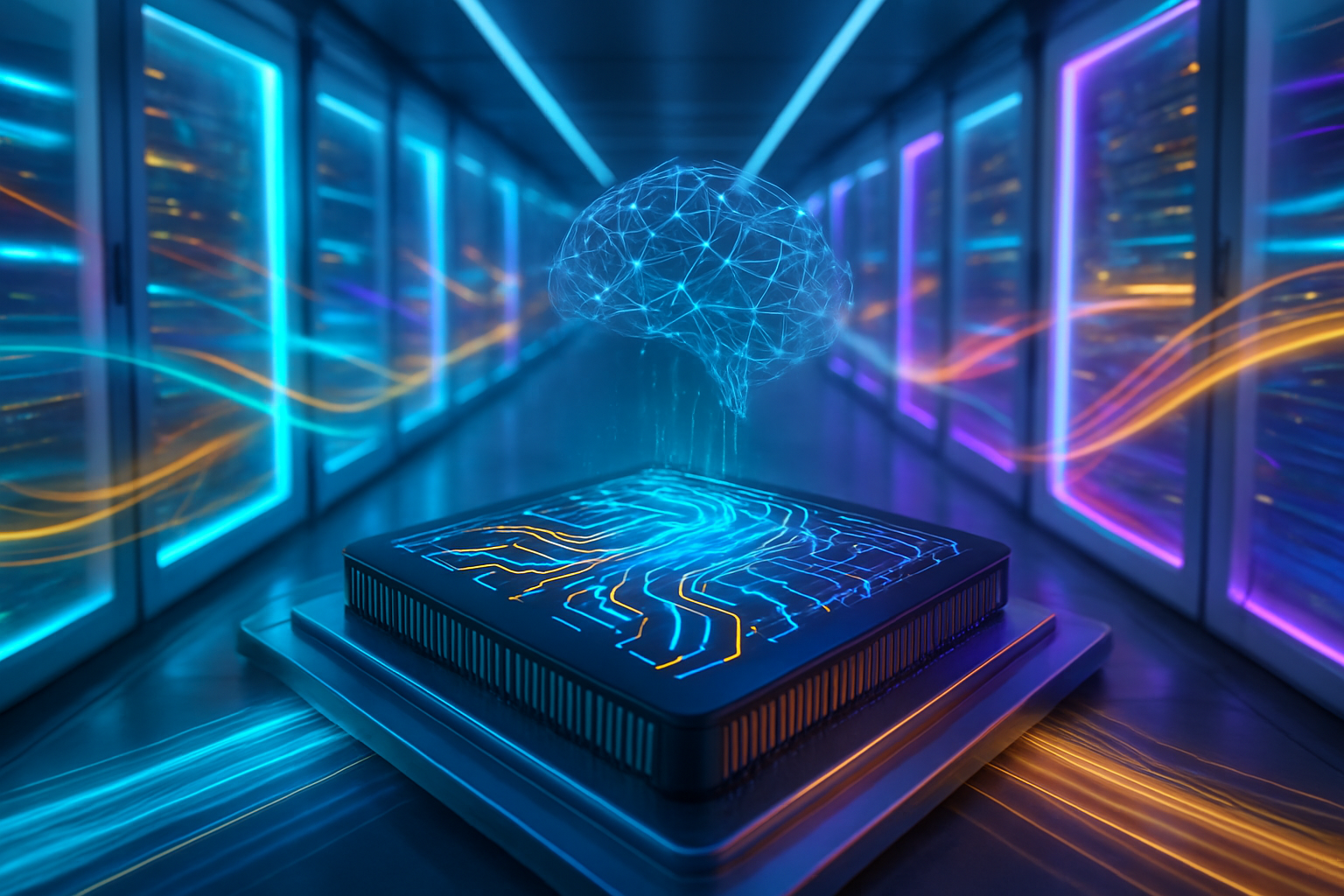
    As of January 2026, the artificial intelligence industry has reached a pivotal infrastructure milestone: the definitive transition from copper-based electrical interconnects to light-based communication. For years, the "Copper Wall"—the physical limit at which electrical signals traveling through metal wires become too hot and inefficient to scale—threatened to stall the growth of massive AI models. Today, that wall has been dismantled. The shift toward Optical I/O (Input/Output) and Photonic Integrated Circuits (PICs) is no longer a future-looking experimental venture; it has become the mandatory standard for the world's most advanced data centers.

    By replacing traditional electricity with light for chip-to-chip communication, the industry has successfully decoupled bandwidth growth from energy consumption. This transformation is currently enabling the deployment of "Million-GPU" clusters that would have been thermally and electrically impossible just two years ago. As the infrastructure for 2026 matures, Silicon Photonics has emerged as the primary solution to the AI data center energy crisis, reducing the power required for data movement by over 70% and fundamentally changing how supercomputers are built.

    The technical shift driving this revolution centers on Co-Packaged Optics (CPO) and the arrival of 1.6 Terabit (1.6T) optical modules as the new industry backbone. In the previous era, data moved between processors via copper traces on circuit boards, which generated immense heat due to electrical resistance. In 2026, companies like NVIDIA (NASDAQ: NVDA) and Broadcom (NASDAQ: AVGO) are shipping systems where optical engines are integrated directly onto the chip package. This allows data to be converted into light pulses immediately at the "shoreline" of the processor, traveling through fiber optics with almost zero resistance or signal degradation.

    Current specifications for 2026-era optical I/O are staggering compared to the benchmarks of 2024. While traditional electrical interconnects consumed roughly 15 to 20 picojoules per bit (pJ/bit), current Photonic Integrated Circuits have pushed this efficiency to below 5 pJ/bit. Furthermore, the bandwidth density has skyrocketed; while copper was limited to approximately 200 Gbps per millimeter of chip edge, optical I/O now supports over 2.5 Tbps per millimeter. This allows for massive throughput without the massive footprint. The integration of Thin-Film Lithium Niobate (TFLN) modulators has further enabled these speeds, offering bandwidths exceeding 110 GHz at drive voltages lower than 1V.

    The initial reaction from the AI research community has been one of relief. Experts at leading labs had warned that power constraints would force a "compute plateau" by 2026. However, the successful scaling of optical interconnects has allowed the scaling laws of large language models to continue unabated. By moving the optical engine inside the package—a feat of heterogeneous integration led by Intel (NASDAQ: INTC) and its Optical Compute Interconnect (OCI) chiplets—the industry has solved the "I/O bottleneck" that previously throttled GPU performance during large-scale training runs.

    This shift has reshaped the competitive landscape for tech giants and silicon manufacturers alike. NVIDIA (NASDAQ: NVDA) has solidified its dominance with the full-scale production of its Rubin GPU architecture, which utilizes the Quantum-X800 CPO InfiniBand platform. By integrating optical interfaces directly into its switches and GPUs, NVIDIA has dropped per-port power consumption from 30W to just 9W, a strategic advantage that makes its hardware the most energy-efficient choice for hyperscalers like Microsoft (NASDAQ: MSFT) and Google.

    Meanwhile, Broadcom (NASDAQ: AVGO) has emerged as a critical gatekeeper of the optical era. Its "Davisson" Tomahawk 6 switch, built using TSMC (NYSE: TSM) Compact Universal Photonic Engine (COUPE) technology, has become the default networking fabric for Tier-1 AI clusters. This has placed immense pressure on legacy networking providers who failed to pivot toward photonics quickly enough. For startups like Lightmatter and Ayar Labs, 2026 represents a "graduation" year; their once-niche optical chiplets and laser sources are now being integrated into custom ASICs for nearly every major cloud provider.

    The strategic advantage of adopting PICs is now a matter of economic survival. Companies that can operate data centers with 70% less interconnect power can afford to scale their compute capacity significantly faster than those tethered to copper. This has led to a market "supercycle" where 1.6T optical module shipments are projected to reach 20 million units by the end of the year. The competitive focus has shifted from "who has the fastest chip" to "who can move the most data with the least heat."

    The wider significance of the transition to Silicon Photonics cannot be overstated. It marks a fundamental shift in the physics of computing. For decades, the industry followed Moore’s Law by shrinking transistors, but the energy cost of moving data between those transistors was often ignored. In 2026, the data center has become the "computer," and the optical interconnect is its nervous system. This transition is a critical component of global sustainability efforts, as AI energy demands had previously been projected to consume an unsustainable percentage of the world's power grid.

    Comparisons are already being made to the introduction of the transistor itself or the shift from vacuum tubes to silicon. Just as those milestones allowed for the miniaturization of logic, photonics allows for the "extension" of logic across thousands of nodes with near-zero latency. This effectively turns a massive data center into a single, coherent supercomputer. However, this breakthrough also brings concerns regarding the complexity of manufacturing. The precision required to align fiber optics with silicon at a sub-micron scale is immense, leading to a new hierarchy in the semiconductor supply chain where specialized packaging firms hold significant power.

    Furthermore, this development has geopolitical implications. As optical I/O becomes the standard, the ability to manufacture advanced PICs has become a national security priority. The reliance on specialized materials like Thin-Film Lithium Niobate and the advanced packaging facilities of TSMC (NYSE: TSM) has created new chokepoints in the global AI race, prompting increased government investment in domestic photonics manufacturing in the US and Europe.

    Looking ahead, the roadmap for Silicon Photonics suggests that the current 1.6T standard is only the beginning. Research into 3.2T and 6.4T modules is already well underway, with expectations for commercial deployment by late 2027. Experts predict the next frontier will be "Plasmonic Modulators"—devices 100 times smaller than current photonic components—which could allow optical I/O to be placed not just at the edge of a chip, but directly on top of the compute logic in a 3D-stacked configuration.

    Potential applications extend beyond just data centers. On the horizon, we are seeing the first prototypes of "Optical Compute," where light is used not just to move data, but to perform the mathematical calculations themselves. If successful, this could lead to another order-of-magnitude leap in AI efficiency. However, challenges remain, particularly in the longevity of the laser sources used to drive these optical engines. Improving the reliability and "mean time between failures" for these lasers is a top priority for researchers in 2026.

    The transition to Optical I/O and Photonic Integrated Circuits represents the most significant architectural shift in data center history since the move to liquid cooling. By using light to solve the energy crisis, the industry has bypassed the physical limitations of electricity, ensuring that the AI revolution can continue its rapid expansion. The key takeaway of early 2026 is clear: the future of AI is no longer just silicon and electrons—it is silicon and photons.

    As we move further into the year, the industry will be watching for the first "Million-GPU" deployments to go fully online. These massive clusters will serve as the ultimate proving ground for the reliability and scalability of Silicon Photonics. For investors and tech enthusiasts alike, the "Optical Supercycle" is the defining trend of the 2026 technology landscape, marking the moment when light finally replaced copper as the lifeblood of global intelligence.


    This content is intended for informational purposes only and represents analysis of current AI developments.

    TokenRing AI delivers enterprise-grade solutions for multi-agent AI workflow orchestration, AI-powered development tools, and seamless remote collaboration platforms.
    For more information, visit https://www.tokenring.ai/.
  • The Era of Light: Silicon Photonics Shatters the ‘Memory Wall’ as AI Scaling Hits the Copper Ceiling

    The Era of Light: Silicon Photonics Shatters the ‘Memory Wall’ as AI Scaling Hits the Copper Ceiling

    As of January 2026, the artificial intelligence industry has officially entered what architects are calling the "Era of Light." For years, the rapid advancement of Large Language Models (LLMs) was threatened by two looming physical barriers: the "memory wall"—the bottleneck where data cannot move fast enough between processors and memory—and the "copper wall," where traditional electrical wiring began to fail under the sheer volume of data required for trillion-parameter models. This week, a series of breakthroughs in Silicon Photonics (SiPh) and Optical I/O (Input/Output) have signaled the end of these constraints, effectively decoupling the physical location of hardware from its computational performance.

    The shift is represented most poignantly by the mass commercialization of Co-Packaged Optics (CPO) and optical memory pooling. By replacing copper wires with laser-driven light signals directly on the chip package, industry giants have managed to reduce interconnect power consumption by over 70% while simultaneously increasing bandwidth density by a factor of ten. This transition is not merely an incremental upgrade; it is a fundamental architectural reset that allows data centers to operate as a single, massive "planet-scale" computer rather than a collection of isolated server racks.

    The Technical Breakdown: Moving Beyond Electrons

    The core of this advancement lies in the transition from pluggable optics to integrated optical engines. In the previous era, data was moved via copper traces on a circuit board to an optical transceiver at the edge of the rack. At the current 224 Gbps signaling speeds, copper loses its integrity after less than a meter, and the heat generated by electrical resistance becomes unmanageable. The latest technical specifications for January 2026 show that Optical I/O, pioneered by firms like Ayar Labs and Celestial AI (recently acquired by Marvell (NASDAQ: MRVL)), has achieved energy efficiencies of 2.4 to 5 picojoules per bit (pJ/bit), a staggering improvement over the 12–15 pJ/bit required by 2024-era copper systems.

    Central to this breakthrough is the "Optical Compute Interconnect" (OCI) chiplet. Intel (NASDAQ: INTC) has begun high-volume manufacturing of these chiplets using its new glass substrate technology in Arizona. These glass substrates provide the thermal and physical stability necessary to bond photonic engines directly to high-power AI accelerators. Unlike previous approaches that relied on external lasers, these new systems feature "multi-wavelength" light sources that can carry terabits of data across a single fiber-optic strand with latencies below 10 nanoseconds.

    Initial reactions from the AI research community have been electric. Dr. Arati Prabhakar, leading a consortium of high-performance computing (HPC) experts, noted that the move to optical fabrics has "effectively dissolved the physical boundaries of the server." By achieving sub-300ns latency for cross-rack communication, researchers can now train models with tens of trillions of parameters across "million-GPU" clusters without the catastrophic performance degradation that previously plagued large-scale distributed training.

    The Market Landscape: A New Hierarchy of Power

    This shift has created clear winners and losers in the semiconductor space. NVIDIA (NASDAQ: NVDA) has solidified its dominance with the unveiling of the Vera Rubin platform. The Rubin architecture utilizes NVLink 6 and the Spectrum-6 Ethernet switch, the latter of which is the world’s first to fully integrate Spectrum-X Ethernet Photonics. By moving to an all-optical backplane, NVIDIA has managed to double GPU-to-GPU bandwidth to 3.6 TB/s while significantly lowering the total cost of ownership for cloud providers by slashing cooling requirements.

    Broadcom (NASDAQ: AVGO) remains the titan of the networking layer, now shipping its Tomahawk 6 "Davisson" switch in massive volumes. This 102.4 Tbps switch utilizes TSMC (NYSE: TSM) "COUPE" (Compact Universal Photonic Engine) technology, which heterogeneously integrates optical engines and silicon into a single 3D package. This integration has forced traditional networking companies like Cisco (NASDAQ: CSCO) to pivot aggressively toward silicon-proven optical solutions to avoid being marginalized in the AI-native data center.

    The strategic advantage now belongs to those who control the "Scale-Up" fabric—the interconnects that allow thousands of GPUs to work as one. Marvell’s (NASDAQ: MRVL) acquisition of Celestial AI has positioned them as the primary provider of optical memory appliances. These devices provide up to 33TB of shared HBM4 capacity, allowing any GPU in a data center to access a massive pool of memory as if it were on its own local bus. This "disaggregated" approach is a nightmare for legacy server manufacturers but a boon for hyperscalers like Amazon and Google, who are desperate to maximize the utilization of their expensive silicon.

    Wider Significance: Environmental and Architectural Rebirth

    The rise of Silicon Photonics is about more than just speed; it is the industry’s most viable answer to the environmental crisis of AI energy consumption. Data centers were on a trajectory to consume an unsustainable percentage of global electricity by 2030. However, the 70% reduction in interconnect power offered by optical I/O provides a necessary "reset" for the industry’s carbon footprint. By moving data with light instead of heat-generating electrons, the energy required for data movement—which once accounted for 30% of a cluster’s power—has been drastically curtailed.

    Historically, this milestone is being compared to the transition from vacuum tubes to transistors. Just as the transistor allowed for a scale of complexity that was previously impossible, Silicon Photonics allows for a scale of data movement that finally matches the computational potential of modern neural networks. The "Memory Wall," a term coined in the mid-1990s, has been the single greatest hurdle in computer architecture for thirty years. To see it finally "shattered" by light-based memory pooling is a moment that will likely define the next decade of computing history.

    However, concerns remain regarding the "Yield Wars." The 3D stacking of silicon, lasers, and optical fibers is incredibly complex. As TSMC, Samsung (KOSPI: 005930), and Intel compete for dominance in these advanced packaging techniques, any slip in manufacturing yields could cause massive supply chain disruptions for the world's most critical AI infrastructure.

    The Road Ahead: Planet-Scale Compute and Beyond

    In the near term, we expect to see the "Optical-to-the-XPU" movement accelerate. Within the next 18 to 24 months, we anticipate the release of AI chips that have no electrical I/O whatsoever, relying entirely on fiber optic connections for both power delivery and data. This will enable "cold racks," where high-density compute can be submerged in dielectric fluid or specialized cooling environments without the interference caused by traditional copper cabling.

    Long-term, the implications for AI applications are profound. With the memory wall removed, we are likely to see a surge in "long-context" AI models that can process entire libraries of data in their active memory. Use cases in drug discovery, climate modeling, and real-time global economic simulation—which require massive, shared datasets—will become feasible for the first time. The challenge now shifts from moving the data to managing the sheer scale of information that can be accessed at light speed.

    Experts predict that the next major hurdle will be "Optical Computing" itself—using light not just to move data, but to perform the actual matrix multiplications required for AI. While still in the early research phases, the success of Silicon Photonics in I/O has proven that the industry is ready to embrace photonics as the primary medium of the information age.

    Conclusion: The Light at the End of the Tunnel

    The emergence of Silicon Photonics and Optical I/O represents a landmark achievement in the history of technology. By overcoming the twin barriers of the memory wall and the copper wall, the semiconductor industry has cleared the path for the next generation of artificial intelligence. Key takeaways include the dramatic shift toward energy-efficient, high-bandwidth optical fabrics and the rise of memory pooling as a standard for AI infrastructure.

    As we look toward the coming weeks and months, the focus will shift from these high-level announcements to the grueling reality of manufacturing scale. Investors and engineers alike should watch the quarterly yield reports from major foundries and the deployment rates of the first "Vera Rubin" clusters. The era of the "Copper Data Center" is ending, and in its place, a faster, cooler, and more capable future is being built on a foundation of light.


    This content is intended for informational purposes only and represents analysis of current AI developments.

    TokenRing AI delivers enterprise-grade solutions for multi-agent AI workflow orchestration, AI-powered development tools, and seamless remote collaboration platforms.
    For more information, visit https://www.tokenring.ai/.

  • The Speed of Light: Marvell’s Acquisition of Celestial AI Signals the End of the Copper Era in AI Computing

    The Speed of Light: Marvell’s Acquisition of Celestial AI Signals the End of the Copper Era in AI Computing

    In a move that marks a fundamental shift in the architecture of artificial intelligence, Marvell Technology (NASDAQ: MRVL) announced on December 2, 2025, a definitive agreement to acquire the silicon photonics trailblazer Celestial AI for a total potential value of over $5.5 billion. This acquisition, expected to close in the first quarter of 2026, represents the most significant bet yet on the transition from copper-based electrical signals to light-based optical interconnects within the heart of the data center. By integrating Celestial AI’s "Photonic Fabric" technology, Marvell is positioning itself to dismantle the "Memory Wall" and "Power Wall" that have threatened to stall the progress of large-scale AI models.

    The immediate significance of this deal cannot be overstated. As AI clusters scale toward a million GPUs, the physical limitations of copper—the "Copper Cliff"—have become the primary bottleneck for performance and energy efficiency. Conventional copper wires generate excessive heat and suffer from signal degradation over short distances, forcing engineers to use power-hungry chips to boost signals. Marvell’s absorption of Celestial AI’s technology effectively replaces these electrons with photons, allowing for nearly instantaneous data transfer between processors and memory at a fraction of the power, fundamentally changing how AI hardware is designed and deployed.

    Breaking the Copper Wall: The Photonic Fabric Breakthrough

    At the technical core of this development is Celestial AI’s proprietary Photonic Fabric™, an architecture that moves optical I/O (Input/Output) from the edge of the circuit board directly into the silicon package. Traditionally, optical components were "pluggable" modules located at the periphery, requiring long electrical traces to reach the processor. Celestial AI’s Optical Multi-Chip Interconnect Bridge (OMIB) utilizes 3D optical co-packaging, allowing light-based data paths to sit directly atop the compute die. This "in-package" optics approach frees up the valuable "beachfront property" on the edges of the chip, which can now be dedicated entirely to High Bandwidth Memory (HBM).

    This shift differs from previous approaches by eliminating the need for power-hungry Digital Signal Processors (DSPs) traditionally required for optical-to-electrical conversion. The Photonic Fabric utilizes a "linear-drive" method, achieving nanosecond-class latency and reducing interconnect power consumption by over 80%. While copper interconnects typically consume 50–55 picojoules per bit (pJ/bit) at scale, Marvell’s new photonic architecture operates at approximately 2.4 pJ/bit. This efficiency is critical as the industry moves toward 2nm process nodes, where every milliwatt of power saved in data transfer can be redirected toward actual computation.

    Initial reactions from the AI research community and industry experts have been overwhelmingly positive, with many describing the move as the "missing link" for the next generation of AI supercomputing. Dr. Arati Prabhakar, an industry analyst specializing in semiconductor physics, noted that "moving optics into the package is no longer a luxury; it is a physical necessity for the post-GPT-5 era." By supporting emerging standards like UALink (Ultra Accelerator Link) and CXL 3.1, Marvell is providing an open-standard alternative to proprietary interconnects, a move that has been met with enthusiasm by researchers looking for more flexible cluster architectures.

    A New Battleground: Marvell vs. the Proprietary Giants

    The acquisition places Marvell Technology (NASDAQ: MRVL) in a direct competitive collision with NVIDIA (NASDAQ: NVDA), whose proprietary NVLink technology has long been the gold standard for high-speed GPU interconnectivity. By offering an optical fabric that is compatible with industry-standard protocols, Marvell is giving hyperscalers like Amazon (NASDAQ: AMZN) and Alphabet (NASDAQ: GOOGL) a way to build massive AI clusters without being "locked in" to a single vendor’s ecosystem. This strategic positioning allows Marvell to act as the primary architect for the connectivity layer of the AI stack, potentially disrupting the dominance of integrated hardware providers.

    Other major players in the networking space, such as Broadcom (NASDAQ: AVGO), are also feeling the heat. While Broadcom has led in traditional Ethernet switching, Marvell’s integration of Celestial AI’s 3D-stacked optics gives them a head start in "Scale-Up" networking—the ultra-fast connections between individual GPUs and memory pools. This capability is essential for "disaggregated" computing, where memory and compute are no longer tethered to the same physical board but can be pooled across a rack via light, allowing for much more efficient resource utilization in the data center.

    For AI startups and smaller chip designers, this breakthrough lowers the barrier to entry for high-performance computing. By utilizing Marvell’s custom ASIC (Application-Specific Integrated Circuit) platforms integrated with Photonic Fabric chiplets, smaller firms can design specialized AI accelerators that rival the performance of industry giants. This democratization of high-speed interconnects could lead to a surge in specialized "Super XPUs" tailored for specific tasks like real-time video synthesis or complex biological modeling, further diversifying the AI hardware landscape.

    The Wider Significance: Sustainability and the Scaling Limit

    Beyond the competitive maneuvering, the shift to silicon photonics addresses the growing societal concern over the environmental impact of AI. Data centers are currently on a trajectory to consume a massive percentage of the world’s electricity, with a significant portion of that energy wasted as heat generated by electrical resistance in copper wires. By slashing interconnect power by 80%, the Marvell-Celestial AI breakthrough offers a rare "green" win in the AI arms race. This reduction in heat also simplifies cooling requirements, potentially allowing for denser, more powerful data centers in urban areas where power and space are at a premium.

    This milestone is being compared to the transition from vacuum tubes to transistors in the mid-20th century. Just as the transistor allowed for a leap in miniaturization and efficiency, the move to silicon photonics allows for a leap in "cluster-scale" computing. We are moving away from the "box-centric" model, where a single server is the unit of compute, toward a "fabric-centric" model where the entire data center functions as one giant, light-speed brain. This shift is essential for training the next generation of foundation models, which are expected to require hundreds of trillions of parameters—a scale that copper simply cannot support.

    However, the transition is not without its concerns. The complexity of manufacturing 3D-stacked optical components is significantly higher than traditional silicon, raising questions about yield rates and supply chain stability. There is also the challenge of laser reliability; unlike transistors, lasers can degrade over time, and integrating them directly into the processor package makes them difficult to replace. The industry will need to develop new testing and maintenance protocols to ensure that these light-driven supercomputers can operate reliably for years at a time.

    Looking Ahead: The Era of the Super XPU

    In the near term, the industry can expect to see the first "Super XPUs" featuring integrated optical I/O hitting the market by early 2027. These chips will likely debut in the custom silicon projects of major hyperscalers before becoming more widely available. The long-term development will likely focus on "Co-Packaged Optics" (CPO) becoming the standard for all high-performance silicon, eventually trickling down from AI data centers to high-end workstations and perhaps even consumer-grade edge devices as the technology matures and costs decrease.

    The next major challenge for Marvell and its competitors will be the integration of these optical fabrics with "optical computing" itself—using light not just to move data, but to perform calculations. While still in the experimental phase, the marriage of optical interconnects and optical processing could lead to a thousand-fold increase in AI efficiency. Experts predict that the next five years will be defined by this "Photonic Revolution," as the industry works to replace every remaining electrical bottleneck with a light-based alternative.

    Conclusion: A Luminous Path Forward

    The acquisition of Celestial AI by Marvell Technology (NASDAQ: MRVL) is more than just a corporate merger; it is a declaration that the era of copper in high-performance computing is drawing to a close. By successfully integrating photons into the silicon package, Marvell has provided the roadmap for scaling AI beyond the physical limits of electricity. The key takeaways are clear: latency is being measured in nanoseconds, power consumption is being slashed by orders of magnitude, and the very architecture of the data center is being rewritten in light.

    This development will be remembered as a pivotal moment in AI history, the point where hardware finally caught up with the soaring ambitions of software. As we move into 2026 and beyond, the industry will be watching closely to see how quickly Marvell can scale this technology and how its competitors respond. For now, the path to artificial general intelligence looks increasingly luminous, powered by a fabric of light that promises to connect the world's most powerful minds—both human and synthetic—at the speed of thought.


    This content is intended for informational purposes only and represents analysis of current AI developments.

    TokenRing AI delivers enterprise-grade solutions for multi-agent AI workflow orchestration, AI-powered development tools, and seamless remote collaboration platforms.
    For more information, visit https://www.tokenring.ai/.