Tag: Osmos

  • The Agentic Revolution: How NVIDIA and Microsoft are Turning AI from Chatbots into Autonomous Operators

    The Agentic Revolution: How NVIDIA and Microsoft are Turning AI from Chatbots into Autonomous Operators

    The dawn of 2026 has brought with it a fundamental shift in the artificial intelligence landscape, moving away from the era of conversational "copilots" toward a future defined by "Agentic AI." For years, AI was largely reactive—a user would provide a prompt, and the model would generate a response. Today, the industry is pivoting toward autonomous agents that don't just talk, but act. These systems are capable of planning complex, multi-step workflows, navigating software interfaces, and executing tasks with minimal human intervention, effectively transitioning from digital assistants to digital employees.

    This transition is being accelerated by a powerful "one-two punch" of hardware and software innovation. On the hardware front, NVIDIA (NASDAQ: NVDA) has officially detailed its Rubin platform, a successor to the Blackwell architecture specifically designed to handle the massive reasoning and memory requirements of autonomous agents. Simultaneously, Microsoft (NASDAQ: MSFT) has signaled its commitment to this new era through the strategic acquisition of Osmos, a startup specializing in autonomous agentic workflows for data engineering. Together, these developments represent a move from "thinking" models to "doing" models, setting the stage for a massive productivity leap across the global economy.

    The Silicon and Software of Autonomy: Inside Rubin and Osmos

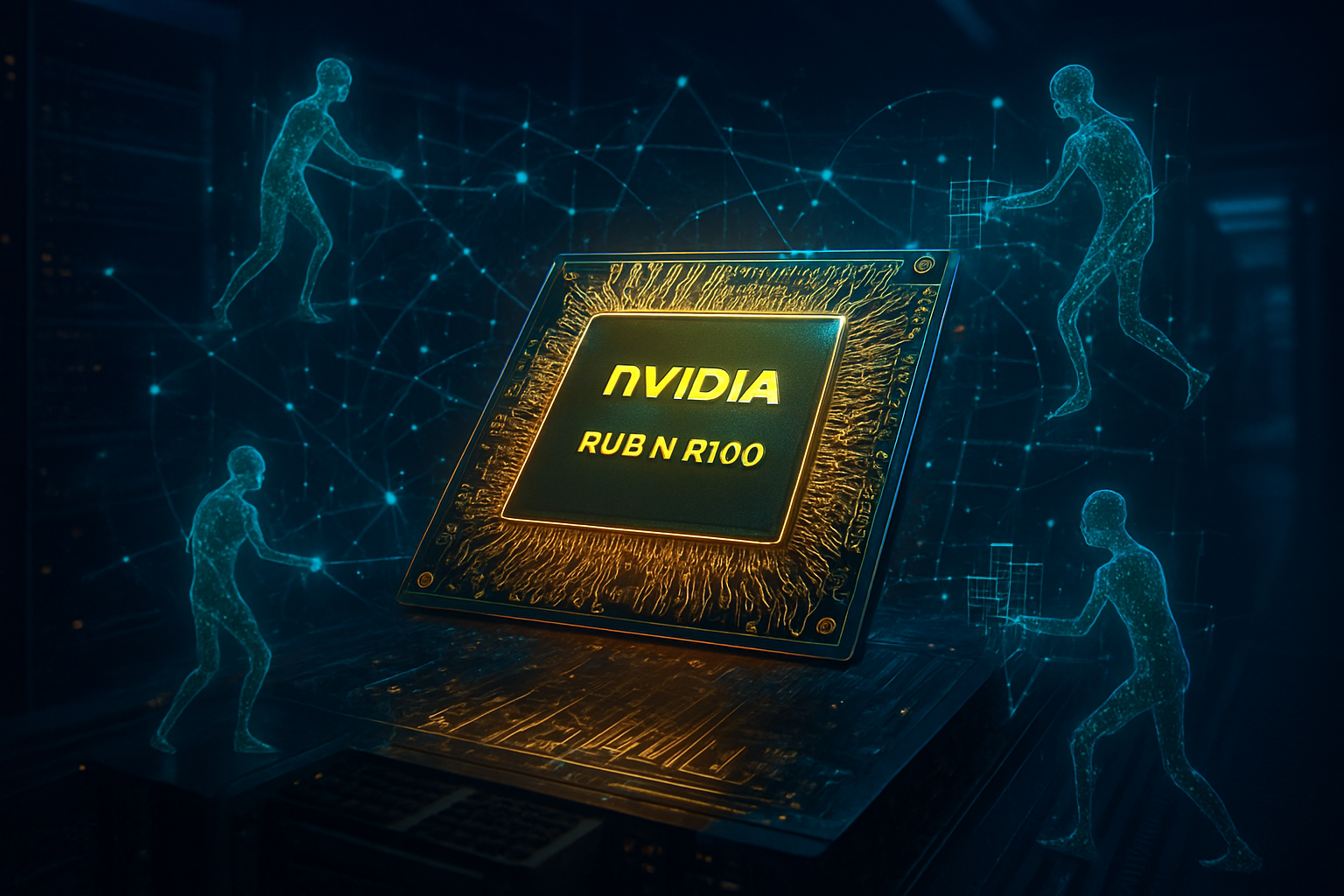
    The technical backbone of this shift lies in NVIDIA’s new Rubin architecture, which debuted at the start of 2026. Unlike previous generations that focused primarily on raw throughput for training, the Rubin R100 GPU is architected for "test-time scaling"—a process where an AI agent spends more compute cycles "reasoning" through a problem before delivering an output. Built on TSMC’s 3nm process, the R100 boasts a staggering 336 billion transistors and is the first to utilize HBM4 memory. With a memory bandwidth of 22 TB/s, Rubin effectively breaks the "memory wall" that previously limited AI agents' ability to maintain long-term context and execute complex, multi-stage plans without losing their place.

    Complementing this hardware is the "Vera" CPU, which features 88 custom "Olympus" cores designed to manage the high-speed data movement required for agentic reasoning. This hardware stack allows for a 5x leap in inference performance over the previous Blackwell generation, specifically optimized for Mixture-of-Experts (MoE) models. These models are the preferred architecture for agents, as they allow a system to consult different "specialist" sub-networks for different parts of a complex task, such as writing code, analyzing market data, and then autonomously generating a financial report.

    On the software side, Microsoft’s acquisition of Osmos provides the "brain" for these autonomous workflows. Osmos has pioneered "Agentic AI for data engineering," creating agents that can navigate messy, unstructured data environments to build production-grade pipelines without human coding. By integrating Osmos into the Microsoft Fabric ecosystem, Microsoft is moving beyond simple text generation. The new "AI Data Wrangler" and "AI Data Engineer" agents can autonomously identify data discrepancies, normalize information across disparate sources, and manage entire infrastructure schemas. This differs from previous "Copilot" iterations by removing the human from the "inner loop" of the process; the user sets the goal, and the Osmos-powered agents execute the entire workflow.

    Initial reactions from the AI research community have been overwhelmingly positive, with experts noting that the Rubin-Osmos era marks the end of the "hallucination-heavy" chatbot phase. By providing models with the hardware to "think" longer and the software frameworks to interact with real-world data systems, the industry is finally delivering on the promise of Large Action Models (LAMs).

    A Seismic Shift in the Competitive Landscape

    The move toward Agentic AI is redrawing the competitive map for tech giants and startups alike. NVIDIA (NASDAQ: NVDA) continues to cement its position as the "arms dealer" of the AI revolution. By tailoring the Rubin architecture specifically for agents, NVIDIA is making it difficult for competitors like AMD (NASDAQ: AMD) or Intel (NASDAQ: INTC) to catch up in the high-end inference market, where low-latency reasoning is now the most valuable currency. The Rubin NVL72 racks are already becoming the gold standard for "AI Superfactories," ensuring that any company wanting to run high-performance agents must go through NVIDIA.

    For Microsoft (NASDAQ: MSFT), the Osmos acquisition is a direct shot across the bow of data heavyweights like Databricks and Snowflake (NYSE: SNOW). By embedding autonomous data agents directly into the Azure and Fabric core, Microsoft is attempting to make manual data engineering—a multi-billion dollar industry—obsolete. If an autonomous agent can handle the "grunt work" of data preparation and pipeline management, the value proposition of traditional data platforms shifts dramatically toward those who can offer the best agentic orchestration.

    Startups are also finding new niches in this ecosystem. While the giants provide the base models and hardware, a new wave of "Agentic Service Providers" is emerging. These companies focus on "fine-tuning for action," creating highly specialized agents for legal, medical, or engineering fields. However, the barrier to entry is rising; as hardware requirements for reasoning increase, startups must rely more heavily on cloud partnerships with the likes of Microsoft or Amazon (NASDAQ: AMZN) to access the Rubin-class compute needed to remain competitive.

    The Broader Significance: From Assistant to Operator

    The shift to Agentic AI represents more than just a technical upgrade; it is a fundamental change in how humans interact with technology. We are moving from the "Copilot" era—where AI suggests actions—to the "Operator" era, where AI takes them. This fits into the broader trend of "Universal AI Orchestration," where multiple agents work together in a hierarchy to solve business problems. For example, a "Manager Agent" might receive a high-level business objective, decompose it into sub-tasks, and delegate those tasks to "Worker Agents" specialized in research, coding, or communication.

    This evolution brings significant economic implications. The automation of multi-step workflows could lead to a massive productivity boom, particularly in white-collar sectors that involve heavy data processing and administrative coordination. However, it also raises concerns about job displacement and the "black box" nature of autonomous decision-making. Unlike a chatbot that provides a source for its text, an autonomous agent making changes to a production database or executing financial trades requires a much higher level of trust and robust safety guardrails.

    Comparatively, this milestone is being viewed as more significant than the release of GPT-4. While GPT-4 proved that AI could understand and generate human-like language, the Rubin and Osmos era proves that AI can reliably interact with the digital world. It is the transition from a "brain in a vat" to an "agent with hands," marking the true beginning of the autonomous digital economy.

    The Road Ahead: What to Expect in 2026 and Beyond

    As we look toward the second half of 2026, the industry is bracing for the first wave of "Agent-First" enterprise applications. We expect to see the rollout of "Self-Healing Infrastructure," where AI agents powered by the Rubin platform monitor global networks and autonomously deploy code fixes or re-route traffic before a human is even aware of an issue. In the consumer space, this will likely manifest as "Personal OS Agents" that can manage a user’s entire digital life—from booking complex travel itineraries across multiple platforms to managing personal finances and taxes.

    However, several challenges remain. The "Agentic Gap"—the difference between an agent planning a task and successfully executing it in a dynamic, unpredictable environment—is still being bridged. Reliability is paramount; an agent that fails 5% of the time is a novelty, but an agent that fails 5% of the time when managing a corporate supply chain is a liability. Developers are currently focusing on "verifiable reasoning" frameworks to ensure that agents can prove the logic behind their actions.

    Experts predict that by 2027, the focus will shift from building individual agents to "Agentic Swarms"—groups of hundreds or thousands of specialized agents working in concert to solve massive scientific or engineering challenges, such as drug discovery or climate modeling. The infrastructure being laid today by NVIDIA and Microsoft is the foundation for this decentralized, autonomous future.

    Conclusion: The New Foundation of Intelligence

    The convergence of NVIDIA’s Rubin platform and Microsoft’s Osmos acquisition marks a definitive turning point in the history of artificial intelligence. We have moved past the novelty of generative AI and into the era of functional, autonomous agency. By providing the massive memory bandwidth and reasoning-optimized silicon of the R100, and the sophisticated workflow orchestration of Osmos, these tech giants have solved the two biggest hurdles to AI autonomy: hardware bottlenecks and software complexity.

    The key takeaway for businesses and individuals alike is that AI is no longer just a tool for brainstorming or drafting emails; it is becoming a primary driver of operational execution. In the coming weeks and months, watch for the first "Rubin-powered" instances to go live on Azure, and keep an eye on how competitors like Google (NASDAQ: GOOGL) and OpenAI respond with their own agentic frameworks. The "Agentic AI" shift is not just a trend—it is the new operating model for the digital age.


    This content is intended for informational purposes only and represents analysis of current AI developments.

    TokenRing AI delivers enterprise-grade solutions for multi-agent AI workflow orchestration, AI-powered development tools, and seamless remote collaboration platforms.
    For more information, visit https://www.tokenring.ai/.

  • Microsoft Acquires Osmos to Revolutionize Data Engineering with Agentic AI Integration in Fabric

    Microsoft Acquires Osmos to Revolutionize Data Engineering with Agentic AI Integration in Fabric

    In a move that signals a paradigm shift for the enterprise data landscape, Microsoft (NASDAQ: MSFT) officially announced the acquisition of Seattle-based startup Osmos on January 5, 2026. The acquisition is poised to transform Microsoft Fabric from a passive data lakehouse into an autonomous, self-configuring intelligence engine by integrating Osmos’s cutting-edge agentic AI technology. By tackling the notorious "first-mile" bottlenecks of data preparation, Microsoft aims to drastically reduce the manual labor historically required for data cleaning and pipeline maintenance.

    The significance of this deal lies in its focus on "agentic" capabilities—AI that doesn't just suggest actions but autonomously reasons through complex data inconsistencies and executes engineering tasks. As enterprises struggle with an explosion of unstructured data and a chronic shortage of skilled data engineers, Microsoft is positioning this integration as a vital solution to accelerate time-to-value for AI-driven insights.

    The Rise of the Autonomous Data Engineer

    The technical core of the acquisition centers on Osmos’s suite of specialized AI agents, which are being folded directly into the Microsoft Fabric engineering organization. Unlike traditional ETL (Extract, Transform, Load) tools that rely on rigid, pre-defined rules, Osmos utilizes Program Synthesis to generate production-ready PySpark code and notebooks. This allows the system to handle "messy" data—such as nested JSON, irregular CSVs, and even unstructured PDFs—by deriving relationships between source and target schemas without manual mapping.

    One of the standout features is the AI Data Wrangler, an agent designed to manage "schema evolution." In traditional environments, if an external vendor changes a file format, downstream pipelines often break, requiring manual intervention. Osmos’s agents autonomously detect these changes and repair the pipelines in real-time. Furthermore, the AI AutoClean and Value Mapping features allow users to provide natural language instructions, such as "normalize all date formats and standardize address fields," which the agent then executes using LLM-driven semantic reasoning to ensure data quality before it ever reaches the data lake.

    Industry experts have compared this technological leap to the evolution of computer programming. Just as high-level languages moved from manual memory management to "automatic garbage collection," data engineering is now transitioning from manual pipeline management to autonomous agentic oversight. Initial reports from early adopters of the Osmos-Fabric integration suggest a greater than 50% reduction in development and maintenance efforts, effectively acting as an "autonomous airlock" for Microsoft’s OneLake.

    A Strategic "Walled Garden" for the AI Era

    The acquisition is a calculated strike against major competitors like Snowflake (NYSE: SNOW) and Databricks. In a notable strategic pivot, Microsoft has confirmed plans to sunset Osmos’s existing support for non-Azure platforms. By making this technology Fabric-exclusive, Microsoft is creating a proprietary advantage that forces a difficult choice for enterprises currently utilizing multi-cloud strategies. While Snowflake has expanded its Cortex AI capabilities and Databricks continues to promote its Lakeflow automation, Microsoft’s deep integration of agentic AI provides a seamless, end-to-end automation layer that is difficult to replicate.

    Market analysts suggest that this move strengthens Microsoft’s "one-stop solution" narrative. By reducing the reliance on third-party ETL tools and even Databricks-aligned formats, Microsoft is tightening its grip on the enterprise data stack. This "walled garden" approach is designed to ensure that the data feeding into Fabric IQ—Microsoft’s semantic reasoning layer—remains curated and stable, providing a competitive edge in the race to provide reliable generative AI outputs for business intelligence.

    However, this strategy is not without its risks. The decision to cut off support for rival platforms has raised concerns regarding vendor lock-in. CIOs who have spent years building flexible, multi-cloud architectures may find themselves pressured to migrate workloads to Azure to access these advanced automation features. Despite these concerns, the promise of a massive reduction in operational overhead is a powerful incentive for organizations looking to scale their AI initiatives quickly.

    Reshaping the Broader AI Landscape

    The Microsoft-Osmos deal reflects a broader trend in the AI industry: the shift from "Chatbot AI" to "Agentic AI." While the last two years were dominated by LLMs that could answer questions, 2026 is becoming the year of agents that do work. This acquisition marks a milestone in the maturity of agentic workflows, moving them out of experimental labs and into the mission-critical infrastructure of global enterprises. It follows the trajectory of previous breakthroughs like the introduction of Transformers, but with a focus on practical, industrial-scale application.

    There are also significant implications for the labor market within the tech sector. By automating tasks typically handled by junior data engineers, Microsoft is fundamentally changing the requirements for data roles. The focus is shifting from "how to build a pipeline" to "how to oversee an agent." While this democratizes data engineering—allowing business users to build complex flows via natural language through the Power Platform—it also necessitates a massive upskilling effort for existing technical staff to focus on higher-level architecture and AI governance.

    Potential concerns remain regarding the "black box" nature of autonomous agents. If an agent makes a semantic error during data normalization that goes unnoticed, it could lead to flawed business decisions. Microsoft is expected to counter this by implementing rigorous "human-in-the-loop" checkpoints within Fabric, but the tension between full autonomy and data integrity will likely be a central theme in AI research for the foreseeable future.

    The Future of Autonomous Data Management

    Looking ahead, the integration of Osmos into Microsoft Fabric is expected to pave the way for even more advanced "self-healing" data ecosystems. In the near term, we can expect to see these agents expand their capabilities to include autonomous cost optimization, where agents redirect data flows based on real-time compute pricing and performance metrics. Long-term, the goal is a "Zero-ETL" reality where data is instantly usable the moment it is generated, regardless of its original format or source.

    Experts predict that the next frontier will be the integration of these agents with edge computing and IoT. Imagine a scenario where data from millions of sensors is cleaned, normalized, and integrated into a global data lake by agents operating at the network's edge, providing real-time insights for autonomous manufacturing or smart city management. The challenge will be ensuring these agents can operate securely and ethically across disparate regulatory environments.

    As Microsoft rolls out these features to the general public in the coming months, the industry will be watching closely to see if the promised 50% efficiency gains hold up in diverse, real-world environments. The success of this acquisition will likely trigger a wave of similar M&A activity, as other tech giants scramble to acquire their own agentic AI capabilities to keep pace with the rapidly evolving "autonomous enterprise."

    A New Chapter for Enterprise Intelligence

    The acquisition of Osmos by Microsoft marks a definitive turning point in the history of data engineering. By embedding agentic AI into the very fabric of the data stack, Microsoft is addressing the most persistent hurdle in the AI lifecycle: the preparation of high-quality data. This move not only solidifies Microsoft's position as a leader in the AI-native data platform market but also sets a new standard for what enterprises expect from their cloud providers.

    The key takeaways from this development are clear: automation is moving from simple scripts to autonomous reasoning, vendor ecosystems are becoming more integrated (and more exclusive), and the role of the data professional is being permanently redefined. As we move further into 2026, the success of Microsoft Fabric will be a bellwether for the broader adoption of agentic AI across all sectors of the economy.

    For now, the tech world remains focused on the upcoming Microsoft Build conference, where more granular details of the Osmos integration are expected to be revealed. The era of the manual data pipeline is drawing to a close, replaced by a future where data flows as autonomously as the AI that consumes it.


    This content is intended for informational purposes only and represents analysis of current AI developments.

    TokenRing AI delivers enterprise-grade solutions for multi-agent AI workflow orchestration, AI-powered development tools, and seamless remote collaboration platforms.
    For more information, visit https://www.tokenring.ai/.
  • Microsoft Fabric Supercharges AI Pipelines with Osmos Integration: The Dawn of Autonomous Data Ingestion

    Microsoft Fabric Supercharges AI Pipelines with Osmos Integration: The Dawn of Autonomous Data Ingestion

    In a move that signals a decisive shift in the artificial intelligence arms race, Microsoft (NASDAQ: MSFT) has officially integrated the technology of its recently acquired startup, Osmos, into the Microsoft Fabric ecosystem. This strategic update, finalized in early January 2026, introduces a suite of "agentic AI" capabilities designed to automate the traditionally labor-intensive "first mile" of data engineering. By embedding autonomous data ingestion directly into its unified analytics platform, Microsoft is attempting to eliminate the primary bottleneck preventing enterprises from scaling real-time AI: the cleaning and preparation of unstructured, "messy" data.

    The significance of this integration cannot be overstated for the enterprise sector. As organizations move beyond experimental chatbots toward production-grade agentic workflows and Retrieval-Augmented Generation (RAG) systems, the demand for high-quality, real-time data has skyrocketed. The Osmos-powered updates to Fabric transform the platform from a passive repository into an active, self-organizing data lake, potentially reducing the time required to prep data for AI models from weeks to mere minutes.

    The Technical Core: Agentic Engineering and Autonomous Wrangling

    At the heart of the new Fabric update are two primary agentic AI solutions: the AI Data Wrangler and the AI Data Engineer. Unlike traditional ETL (Extract, Transform, Load) tools that require rigid, manual mapping of source-to-target schemas, the AI Data Wrangler utilizes advanced machine learning to autonomously interpret relationships within "unruly" data formats. Whether dealing with deeply nested JSON, irregular CSV files, or semi-structured PDFs, the agent identifies patterns and normalizes the data without human intervention. This represents a fundamental departure from the "brute force" coding previously required to handle data drift and schema evolution.

    For more complex requirements, the AI Data Engineer agent now generates production-grade PySpark notebooks directly within the Fabric environment. By interpreting natural language prompts, the agent can build, test, and deploy sophisticated pipelines that handle multi-file joins and complex transformations. This is paired with Microsoft Fabric’s OneLake—a unified "OneDrive for data"—which now functions as an "airlock" for incoming streams. Data ingested via Osmos is automatically converted into open standards like Delta Parquet and Apache Iceberg, ensuring immediate compatibility with various compute engines, including Power BI and Azure AI.

    Initial reactions from the data science community have been largely positive, though seasoned data engineers remain cautious. "We are seeing a transition from 'hand-coded' pipelines to 'supervised' pipelines," noted one lead architect at a Fortune 500 firm. While the speed of the AI Data Engineer is undeniable, experts emphasize that human oversight remains critical for governance and security. However, the ability to monitor incoming streams via Fabric’s Real-Time Intelligence module—autonomously correcting schema drifts before they pollute the data lake—marks a significant technical milestone that sets a new bar for cloud data platforms.

    A "Walled Garden" Strategy in the Cloud Wars

    The integration of Osmos into the Microsoft stack has immediate and profound implications for the competitive landscape. By acquiring the startup and subsequently announcing plans to sunset Osmos’ support for non-Azure platforms—including its previous integrations with Databricks—Microsoft is clearly leaning into a "walled garden" strategy. This move is a direct challenge to independent data cloud providers like Snowflake (NYSE: SNOW) and Databricks, who have long championed multi-cloud flexibility.

    For companies like Snowflake, which has been aggressively expanding its Cortex AI capabilities for in-warehouse processing, the Microsoft update increases the pressure to simplify the ingestion layer. While Databricks remains a leader in raw Spark performance and MLOps through its Lakeflow pipelines, Microsoft’s deep integration with the broader Microsoft 365 and Dynamics 365 ecosystems gives it a unique "home-field advantage." Enterprises already entrenched in the Microsoft ecosystem now have a compelling reason to consolidate their data stack to avoid the "data tax" of moving information between competing clouds.

    This development could potentially disrupt the market for third-party "glue" tools such as Informatica (NYSE: INFA) or Fivetran. If the ingestion and cleaning process becomes a native, autonomous feature of the primary data platform, the need for specialized ETL vendors may diminish. Market analysts suggest that Microsoft is positioning Fabric not just as a tool, but as the essential "operating system" for the AI era, where data flows seamlessly from business applications into AI models with zero manual friction.

    From Model Wars to Data Infrastructure Dominance

    The broader AI landscape is currently undergoing a pivot. While 2024 and 2025 were defined by the "Model Wars"—a race to build the largest and most capable Large Language Models (LLMs)—2026 is emerging as the year of "Data Infrastructure." The industry has realized that even the most sophisticated model is useless without a reliable, high-velocity stream of clean data. Microsoft’s move to own the ingestion layer reflects this shift, treating data readiness as a first-class citizen in the AI development lifecycle.

    This transition mirrors previous milestones in the history of computing, such as the move from manual memory management to garbage-collected languages. Just as developers stopped worrying about allocating bits and started focusing on application logic, Microsoft is betting that data scientists should stop worrying about regex and schema mapping and start focusing on model tuning and agentic logic. However, this shift raises valid concerns regarding vendor lock-in and the "black box" nature of AI-generated pipelines. If an autonomous agent makes an error in data normalization that goes unnoticed, the resulting AI hallucinations could be catastrophic for enterprise decision-making.

    Despite these risks, the move toward autonomous data engineering appears inevitable. The sheer volume of data generated by modern IoT sensors, transaction logs, and social streams has surpassed the capacity of human engineering teams to manage manually. The Osmos integration is a recognition that the "human-in-the-loop" model for data engineering is no longer scalable in a world where AI models require millisecond-level updates to remain relevant.

    The Horizon: Fully Autonomous Data Lakes

    Looking ahead, the next logical step for Microsoft Fabric will likely be the expansion of these agentic capabilities into the realm of "Self-Healing Data Lakes." Experts predict that within the next 18 to 24 months, we will see agents that not only ingest and clean data but also autonomously optimize storage tiers, manage data retention policies for compliance, and even suggest new features for machine learning models based on observed data patterns.

    The near-term challenge for Microsoft will be proving the reliability of these autonomous pipelines to skeptical enterprise IT departments. We can expect to see a flurry of new governance and observability tools launched within Fabric to provide the "explainability" that regulated industries like finance and healthcare require. Furthermore, as the "walled garden" approach matures, the industry will watch closely to see if competitors like Snowflake and Databricks respond with their own high-profile acquisitions to bolster their ingestion capabilities.

    Conclusion: A New Standard for Enterprise AI

    The integration of Osmos into Microsoft Fabric represents a landmark moment in the evolution of data engineering. By automating the most tedious and error-prone aspects of data ingestion, Microsoft has cleared a major hurdle for enterprises seeking to harness the power of real-time AI. The key takeaways from this update are clear: the "data engineering bottleneck" is finally being addressed through agentic AI, and the competition between cloud giants has moved from the models themselves to the infrastructure that feeds them.

    As we move further into 2026, the success of this initiative will be measured by how quickly enterprises can turn raw data into actionable intelligence. This development is a significant chapter in AI history, marking the point where data preparation shifted from a manual craft to an autonomous service. In the coming weeks, industry watchers should look for early case studies from Microsoft’s "Private Preview" customers to see if the promised 50% reduction in operational overhead holds true in complex, real-world environments.


    This content is intended for informational purposes only and represents analysis of current AI developments.

    TokenRing AI delivers enterprise-grade solutions for multi-agent AI workflow orchestration, AI-powered development tools, and seamless remote collaboration platforms.
    For more information, visit https://www.tokenring.ai/.
  • Microsoft Acquires Osmos to Eliminate Data Engineering Bottlenecks in Fabric

    Microsoft Acquires Osmos to Eliminate Data Engineering Bottlenecks in Fabric

    In a strategic move aimed at solidifying its dominance in the enterprise analytics space, Microsoft (NASDAQ: MSFT) officially announced the acquisition of Osmos (osmos.io) on January 5, 2026. The acquisition is designed to integrate Osmos’s cutting-edge "agentic AI" capabilities directly into the Microsoft Fabric platform, addressing the "first-mile" challenge of data engineering—the arduous process of ingesting, cleaning, and transforming messy external data into actionable insights.

    The significance of this deal cannot be overstated for the Azure ecosystem. By bringing Osmos’s autonomous data agents under the Fabric umbrella, Microsoft is signaling an end to the era where data scientists and engineers spend the vast majority of their time on manual ETL (Extract, Transform, Load) tasks. This acquisition aims to transform Microsoft Fabric from a comprehensive data lakehouse into a self-configuring, autonomous intelligence engine that handles the heavy lifting of data preparation without human intervention.

    The Rise of the Agentic Data Engineer: Technical Breakthroughs

    The core of the Osmos acquisition lies in its departure from traditional, rule-based ETL tools. Unlike legacy systems that require rigid mapping and manual coding, Osmos utilizes Agentic AI—autonomous models capable of reasoning through data inconsistencies. At the heart of this integration is the "AI Data Wrangler," a tool specifically designed to handle "messy" data from external partners and suppliers. It automatically manages schema evolution and column mapping, ensuring that when a vendor changes their file format, the pipeline doesn't break; the AI simply adapts and repairs the mapping in real-time.

    Technically, the integration goes deep into the Fabric architecture. Osmos technology now serves as an "autonomous airlock" for OneLake, Microsoft’s unified data storage layer. Before data ever touches the lake, Osmos agents perform "AI AutoClean," interpreting natural language instructions—such as "standardize all currency to USD and flag outliers"—and converting them into production-grade PySpark notebooks. This differs from previous "black box" AI approaches by providing explainable, version-controlled code that engineers can audit and modify within Fabric’s native environment. This transparency ensures that while the AI does the work, the human engineer retains ultimate governance.

    Initial reactions from the AI research community have been overwhelmingly positive, particularly regarding Osmos’s use of Program Synthesis. By using LLMs to generate the specific Python and SQL code required for complex joins and aggregations, Microsoft is effectively automating the role of the junior data engineer. Industry experts note that this move leapfrogs traditional "Copilot" assistants, moving from a chat-based helper to an active "worker" that proactively identifies and fixes data quality issues before they can contaminate downstream analytics or machine learning models.

    Strategic Consolidation and the "Walled Garden" Shift

    The acquisition of Osmos is a clear shot across the bow for competitors like Snowflake (NYSE: SNOW) and Databricks. Historically, Osmos was a platform-agnostic tool that supported various data environments. However, following the acquisition, Microsoft has confirmed plans to sunset Osmos’s support for non-Azure platforms, effectively turning a premier data ingestion tool into a "walled garden" feature for Microsoft Fabric. This move forces enterprise customers to choose between a fragmented multi-cloud strategy or the seamless, AI-automated experience offered by the integrated Microsoft stack.

    For tech giants and AI startups alike, this acquisition underscores a trend toward vertical integration in the AI era. By owning the ingestion layer, Microsoft reduces the need for third-party ETL vendors like Informatica (NYSE: INFA) or Fivetran within its ecosystem. This consolidation provides Microsoft with a significant strategic advantage: it can offer a lower total cost of ownership (TCO) by eliminating the "tool sprawl" that plagues modern data departments. Startups that previously specialized in niche data cleaning tasks now find themselves competing against a native, AI-powered feature built directly into the world’s most widely used enterprise cloud.

    Market analysts suggest that this move will accelerate the "democratization" of data engineering. By allowing non-technical teams—such as finance or operations—to use natural language to ingest and prepare their own data, Microsoft is expanding the potential user base for Fabric. This shift not only benefits Microsoft’s bottom line but also creates a competitive pressure for other cloud providers to either build or acquire similar agentic AI capabilities to keep pace with the automation standards being set in Redmond.

    Redefining the Broader AI Landscape

    The integration of Osmos into Microsoft Fabric fits into a larger industry shift toward Agentic Workflows. We are moving past the era of "AI as a Chatbot" and into the era of "AI as an Operator." In the broader AI landscape, this acquisition mirrors previous milestones like the introduction of GitHub Copilot, but for data infrastructure. It addresses the "garbage in, garbage out" problem that has long hindered large-scale AI deployments. If the data feeding the models is clean, consistent, and automatically updated, the reliability of the resulting AI insights increases exponentially.

    However, this transition is not without its concerns. The primary apprehension among industry veterans is the potential for "automation bias" and the loss of granular control over data lineage. While Osmos provides explainable code, the sheer speed and volume of AI-generated pipelines may outpace the ability of human teams to effectively audit them. Furthermore, the move toward a Microsoft-only ecosystem for Osmos technology raises questions about vendor lock-in, as enterprises become increasingly dependent on Microsoft’s proprietary AI agents to maintain their data infrastructure.

    Despite these concerns, the move is a landmark in the evolution of data management. Comparisons are already being made to the shift from manual memory management to garbage collection in programming languages. Just as developers stopped worrying about allocating bits and started focusing on application logic, Microsoft is betting that data engineers will stop worrying about CSV formatting and start focusing on high-level data architecture and strategic business intelligence.

    Future Developments and the Path to Self-Healing Data

    Looking ahead, the near-term roadmap for Microsoft Fabric involves a total convergence of Osmos’s reasoning capabilities with the existing Fabric Copilot. We can expect to see "Self-Healing Data Pipelines" that not only ingest data but also predict when a source is likely to fail or provide anomalous data based on historical patterns. In the long term, these AI agents may evolve to the point where they can autonomously discover new data sources within an organization and suggest new analytical models to leadership without being prompted.

    The next challenge for Microsoft will be extending these capabilities to unstructured data—such as video, audio, and sensor logs—which remain a significant hurdle for most enterprises. Experts predict that the "Osmos-infused" Fabric will soon feature multi-modal ingestion agents capable of extracting structured insights from a company's entire digital footprint. As these agents become more sophisticated, the role of the data professional will continue to evolve, focusing more on data ethics, governance, and the strategic alignment of AI outputs with corporate goals.

    A New Chapter in Enterprise Intelligence

    The acquisition of Osmos marks a pivotal moment in the history of data engineering. By eliminating the manual bottlenecks that have hampered analytics for decades, Microsoft is positioning Fabric as the definitive operating system for the AI-driven enterprise. The key takeaway is clear: the future of data is not just about storage or processing power, but about the autonomy of the pipelines that connect the two.

    As we move further into 2026, the success of this acquisition will be measured by how quickly Microsoft can transition its massive user base to these new agentic workflows. For now, the tech industry should watch for the first "Agent-First" updates to Fabric in the coming weeks, which will likely showcase the true power of an AI that doesn't just talk about data, but actually does the work of managing it. This development isn't just a tool upgrade; it's a fundamental shift in how businesses will interact with their information for years to come.


    This content is intended for informational purposes only and represents analysis of current AI developments.

    TokenRing AI delivers enterprise-grade solutions for multi-agent AI workflow orchestration, AI-powered development tools, and seamless remote collaboration platforms.
    For more information, visit https://www.tokenring.ai/.