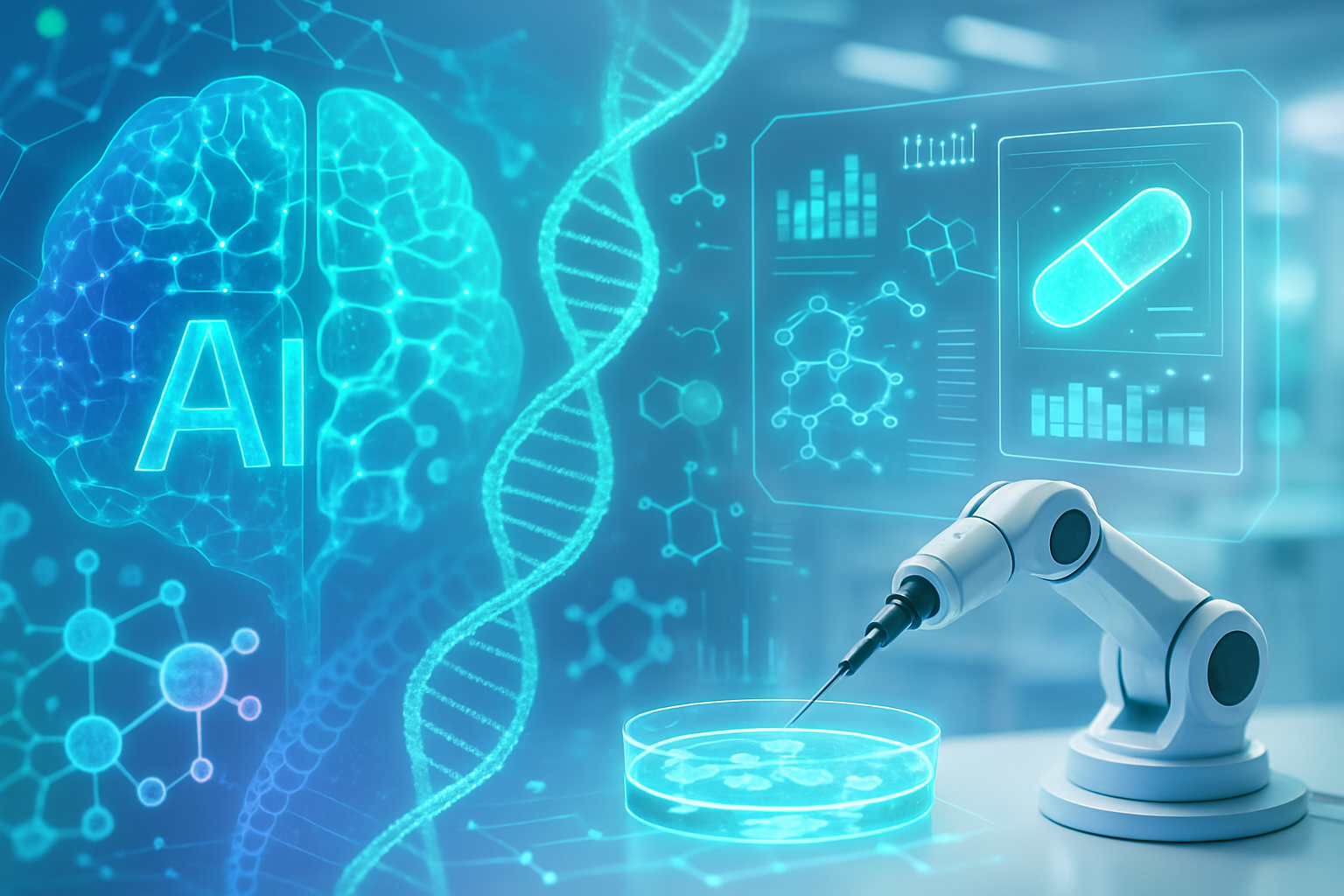
In a groundbreaking strategic pivot, pharmaceutical giant Pfizer (NYSE: PFE) is aggressively integrating artificial intelligence (AI), machine learning (ML), and advanced data science across its entire value chain. This comprehensive AI overhaul, solidified by numerous partnerships and internal initiatives throughout 2024 and 2025, signals a profound shift in how drugs are discovered, developed, manufactured, and brought to market. The company's commitment to AI is not merely an incremental improvement but a fundamental reimagining of its operational framework, promising to dramatically accelerate the pace of medical innovation and redefine industry benchmarks for efficiency and personalized medicine.
Pfizer's concerted drive into AI represents a significant milestone for the pharmaceutical industry, positioning the company at the forefront of a technological revolution that stands to deliver life-saving therapies faster and more cost-effectively. With ambitious goals to expand profit margins, simplify operations, and achieve substantial cost savings by 2027, the company's AI strategy is poised to yield both scientific breakthroughs and considerable financial returns. This proactive embrace of cutting-edge AI technologies underscores a broader industry trend towards data-driven drug development, but Pfizer's scale and strategic depth set a new precedent for what's possible.
Technical Deep Dive: Pfizer's AI-Powered R&D Engine
Pfizer's AI strategy is characterized by a multi-pronged approach, combining strategic external collaborations with robust internal development. A pivotal partnership announced in October 2024 with the Ignition AI Accelerator, involving tech titan NVIDIA (NASDAQ: NVDA), Tribe, and Digital Industry Singapore (DISG), aims to leverage advanced AI to expedite drug discovery, enhance operational efficiency, and optimize manufacturing processes, leading to improved yields and reduced cycle times. This collaboration highlights a focus on leveraging high-performance computing and specialized AI infrastructure.
Further bolstering its R&D capabilities, Pfizer expanded its collaboration with XtalPi in June 2025, a company renowned for integrating AI and robotics. This partnership is dedicated to developing an advanced AI-based drug discovery platform with next-generation molecular modeling capabilities. The goal is to significantly enhance predictive accuracy and throughput, particularly within Pfizer's proprietary small molecule chemical space. XtalPi's technology previously played a critical role in the rapid development of Pfizer's oral COVID-19 treatment, Paxlovid, showcasing the tangible impact of AI in accelerating drug timelines from years to as little as 30 days. This contrasts sharply with traditional, often serendipitous, and labor-intensive drug discovery methods, which typically involve extensive manual screening and experimentation.
Beyond molecular modeling, Pfizer is also investing in AI for data integration and contextualization. A multi-year partnership with Data4Cure, announced in March 2025, focuses on advanced analytics, knowledge graphs, and Large Language Models (LLMs) to integrate and contextualize vast amounts of public and internal biomedical data. This initiative is particularly aimed at informing drug development in oncology, enabling consistent data analysis and continuous insight generation for researchers. Additionally, an April 2024 collaboration with the Research Center for Molecular Medicine (CeMM) resulted in a novel AI-driven drug discovery method, published in Science, which measures how hundreds of small molecules bind to thousands of human proteins, creating a publicly available catalog for new drug development and fostering open science. Internally, Pfizer's "Charlie" AI platform, launched in February 2024, exemplifies the application of generative AI beyond R&D, assisting with fact-checking, legal reviews, and content creation, streamlining internal communication and compliance processes.
Competitive Implications and Market Dynamics
Pfizer's aggressive embrace of AI has significant competitive implications, setting a new bar for pharmaceutical innovation and potentially disrupting existing market dynamics. Companies with robust AI capabilities, such as XtalPi and Data4Cure, stand to benefit immensely from these high-profile partnerships, validating their technologies and securing long-term growth opportunities. Tech giants like NVIDIA, whose hardware and software platforms are foundational to advanced AI, will see increased demand as pharmaceutical companies scale their AI infrastructure.
For major AI labs and other tech companies, Pfizer's strategy underscores the growing imperative to specialize in life sciences applications. Those that can develop AI solutions tailored to complex biological data, drug design, clinical trial optimization, and manufacturing stand to gain significant market share. Conversely, pharmaceutical companies that lag in AI adoption risk falling behind in the race for novel therapies, facing longer development cycles, higher costs, and reduced competitiveness. Pfizer's success in leveraging AI for cost reduction, targeting an additional $1.2 billion in savings by the end of 2027 through enhanced digital enablement, including AI and automation, further pressures competitors to seek similar efficiencies.
The potential disruption extends to contract research organizations (CROs) and traditional R&D service providers. As AI streamlines clinical trials (e.g., through Pfizer's expanded collaboration with Saama for AI-driven solutions across its R&D portfolio) and automates data review, the demand for conventional, labor-intensive services may shift towards AI-powered platforms and analytical tools. This necessitates an evolution in business models for service providers to integrate AI into their offerings. Pfizer's strong market positioning, reinforced by a May 2024 survey indicating physicians view it as a leader in applying AI/ML in drug discovery and a trusted entity for safely bringing drugs to market using these technologies, establishes a strategic advantage that will be challenging for competitors to quickly replicate.
Wider Significance in the AI Landscape
Pfizer's comprehensive AI integration fits squarely into the broader trend of AI's expansion into mission-critical, highly regulated industries. This move signifies a maturation of AI technologies, demonstrating their readiness to tackle complex scientific challenges beyond traditional tech sectors. The emphasis on accelerating drug discovery and development aligns with a global imperative to address unmet medical needs more rapidly and efficiently.
The impacts are far-reaching. On the positive side, AI-driven drug discovery promises to unlock new therapeutic avenues, potentially leading to cures for currently intractable diseases. By enabling precision medicine, AI can tailor treatments to individual patient profiles, maximizing efficacy and minimizing adverse effects. This shift represents a significant leap from the "one-size-fits-all" approach to healthcare. However, potential concerns also arise, particularly regarding data privacy, algorithmic bias in drug development, and the ethical implications of AI-driven decision-making in healthcare. Ensuring the transparency, explainability, and fairness of AI models used in drug discovery and clinical trials will be paramount.
Comparisons to previous AI milestones, such as AlphaFold's breakthrough in protein folding, highlight a continuing trajectory of AI revolutionizing fundamental scientific understanding. Pfizer's efforts move beyond foundational science to practical application, demonstrating how AI can translate theoretical knowledge into tangible medical products. This marks a transition from AI primarily being a research tool to becoming an integral part of industrial-scale R&D and manufacturing processes, setting a precedent for other heavily regulated industries like aerospace, finance, and energy to follow suit.
Future Developments on the Horizon
Looking ahead, the near-term will likely see Pfizer further scale its AI initiatives, integrating the "Charlie" AI platform more deeply across its content supply chain and expanding its partnerships for specific drug targets. The Flagship Pioneering "Innovation Supply Chain" partnership, established in July 2024 to co-develop 10 drug candidates, is expected to yield initial preclinical candidates, demonstrating the effectiveness of an AI-augmented venture model in pharma. The focus will be on demonstrating measurable success in shortening drug development timelines and achieving the projected cost savings from its "Realigning Our Cost Base Program."
In the long term, experts predict that AI will become fully embedded in every stage of the pharmaceutical lifecycle, from initial target identification and compound synthesis to clinical trial design, patient recruitment, regulatory submissions, and even post-market surveillance (pharmacovigilance, where Pfizer has used AI since 2014). We can expect to see AI-powered "digital twins" of patients used to simulate drug responses, further refining personalized medicine. Challenges remain, particularly in integrating disparate datasets, ensuring data quality, and addressing the regulatory frameworks that need to evolve to accommodate AI-driven drug approvals. The ethical considerations around AI in healthcare will also require continuous dialogue and the development of robust governance structures. Experts anticipate a future where AI not only accelerates drug discovery but also enables the proactive identification of disease risks and the development of preventative interventions, fundamentally transforming healthcare from reactive to predictive.
A New Chapter in Pharmaceutical Innovation
Pfizer's aggressive embrace of AI marks a pivotal moment in the history of pharmaceutical innovation. By strategically deploying AI across drug discovery, development, manufacturing, and operational efficiency, the company is not just optimizing existing processes but fundamentally reshaping its future. Key takeaways include the dramatic acceleration of drug discovery timelines, significant cost reductions, the advancement of precision medicine, and the establishment of new industry benchmarks for AI adoption.
This development signifies AI's undeniable role as a transformative force in healthcare. The long-term impact will be measured not only in financial gains but, more importantly, in the faster delivery of life-saving medicines to patients worldwide. As Pfizer continues to integrate AI, the industry will be watching closely for further breakthroughs, particularly in how these technologies translate into tangible patient outcomes and new therapeutic modalities. The coming weeks and months will offer crucial insights into the initial successes of these partnerships and internal programs, solidifying Pfizer's position at the vanguard of the AI-powered pharmaceutical revolution.
This content is intended for informational purposes only and represents analysis of current AI developments.
TokenRing AI delivers enterprise-grade solutions for multi-agent AI workflow orchestration, AI-powered development tools, and seamless remote collaboration platforms.
For more information, visit https://www.tokenring.ai/.