
Tag: Physical AI

  • The Physical AI Revolution: How NVIDIA Cosmos Became the Operating System for the Real World

    The Physical AI Revolution: How NVIDIA Cosmos Became the Operating System for the Real World

    In a landmark shift that has redefined the trajectory of robotics and autonomous systems, NVIDIA (NASDAQ: NVDA) has solidified its dominance in the burgeoning field of "Physical AI." At the heart of this transformation is the NVIDIA Cosmos platform, a sophisticated suite of World Foundation Models (WFMs) that allows machines to perceive, reason about, and interact with the physical world with unprecedented nuance. Since its initial unveiling at CES 2025, Cosmos has rapidly evolved into the foundational "operating system" for the industry, solving the critical data scarcity problem that previously hindered the development of truly intelligent robots.

    The immediate significance of Cosmos lies in its ability to bridge the "sim-to-real" gap—the notorious difficulty of moving an AI trained in a digital environment into the messy, unpredictable real world. By providing a generative AI layer that understands physics and causality, NVIDIA has effectively given machines a form of "digital common sense." As of January 2026, the platform is no longer just a research project; it is the core infrastructure powering a new generation of humanoid robots, autonomous delivery fleets, and Level 4 vehicle systems that are beginning to appear in urban centers across the globe.

    Mastering the "Digital Matrix": Technical Specifications and Innovations

    The NVIDIA Cosmos platform represents a departure from traditional simulation methods. While previous tools like NVIDIA Isaac Sim provided high-fidelity rendering and physics engines, Cosmos introduces a generative AI layer—the World Foundation Model. This model doesn't just render a scene; it "imagines" future states of the world. The technical stack is built on four pillars: the Cosmos Tokenizer, which compresses video data 8x more efficiently than previous standards; the Cosmos Curator, a GPU-accelerated pipeline capable of processing 20 million hours of video in a fraction of the time required by CPU-based systems; and the Cosmos Guardrails for safety.

    Central to the platform are three specialized model variants: Cosmos Predict, Cosmos Transfer, and Cosmos Reason. Predict serves as the robot’s "imagination," forecasting up to 30 seconds of high-fidelity physical outcomes based on potential actions. Transfer acts as the photorealistic bridge, converting structured 3D data into sensor-perfect video for training. Most notably, Cosmos Reason 2, unveiled earlier this month at CES 2026, is a vision-language model (VLM) with advanced spatio-temporal awareness. Unlike "black box" systems, Cosmos Reason can explain its logic in natural language, detailing why a robot chose to avoid a specific path or how it anticipates a collision before it occurs.

    This architectural approach differs fundamentally from the "cyber-centric" models like GPT-4 or Claude. While those models excel at processing text and code, they lack an inherent understanding of gravity, friction, and object permanence. Cosmos models are trained on over 9,000 trillion tokens of physical data, including human-robot interactions and industrial environments. The recent transition to the Vera Rubin GPU architecture has further supercharged these capabilities, delivering a 12x improvement in tokenization speed and enabling real-time world generation on edge devices.

    The Strategic Power Move: Reshaping the Competitive Landscape

    NVIDIA’s strategy with Cosmos is frequently compared to the "Android" model of the mobile era. By providing a high-level intelligence layer to the entire industry, NVIDIA has positioned itself as the indispensable partner for nearly every major player in robotics. Startups like Figure AI and Agility Robotics have pivoted to integrate the Cosmos and Isaac GR00T stacks, moving away from more restricted partnerships. This "horizontal" approach contrasts sharply with Tesla (NASDAQ: TSLA), which continues to pursue a "vertical" strategy, relying on its proprietary end-to-end neural networks and massive fleet of real-world vehicles.

    The competition is no longer just about who has the best hardware, but who has the best "World Model." While OpenAI remains a titan in digital reasoning, its Sora 2 video generation model now faces direct competition from Cosmos in the physical realm. Industry analysts note that NVIDIA’s "Three-Computer Strategy"—owning the cloud training (DGX), the digital twin (Omniverse), and the onboard inference (Thor/Rubin)—has created a massive ecosystem lock-in. Even as competitors like Waymo (NASDAQ: GOOGL) maintain a lead in safe, rule-based deployments, the industry trend is shifting toward the generative reasoning pioneered by Cosmos.

    The strategic implications reached a fever pitch in late 2025 when Uber (NYSE: UBER) announced a massive partnership with NVIDIA to deploy a global fleet of 100,000 Level 4 robotaxis. By utilizing the Cosmos "Data Factory," Uber can simulate millions of rare edge cases—such as extreme weather or erratic pedestrian behavior—without the need for billions of miles of risky real-world testing. This has effectively allowed legacy manufacturers like Mercedes-Benz and BYD to leapfrog years of R&D, turning them into credible competitors to Tesla's Full Self-Driving (FSD) dominance.

    Beyond the Screen: The Wider Significance of Physical AI

    The rise of the Cosmos platform marks the transition from "Cyber AI" to "Embodied AI." If the previous era of AI was about organizing the world's information, this era is about organizing the world's actions. By creating an internal simulator that respects the laws of physics, NVIDIA is moving the industry toward machines that can truly coexist with humans in unconstrained environments. This development is seen as the "ChatGPT moment for robotics," providing the generalist foundation that was previously missing.

    However, this breakthrough is not without its concerns. The energy requirements for training and running these world models are astronomical. Environmental critics point out that the massive compute power of the Rubin GPU architecture comes with a significant carbon footprint, sparking a debate over the sustainability of "Generalist AI." Furthermore, the "Liability Trap" remains a contentious issue; while NVIDIA provides the intelligence, the legal and ethical responsibility for accidents in the physical world remains with the vehicle and robot manufacturers, leading to complex regulatory discussions in Washington and Brussels.

    Comparisons to previous milestones are telling. Where DeepBlue's victory over Garry Kasparov proved AI could master logic, and AlexNet proved it could master perception, Cosmos proves that AI can master the physical intuition of a toddler—the ability to understand that if a ball rolls into the street, a child might follow. This "common sense" layer is the missing piece of the puzzle for Level 5 autonomy and the widespread adoption of humanoid assistants in homes and hospitals.

    The Road Ahead: What’s Next for Cosmos and Alpamayo

    Looking toward the near future, the integration of the Alpamayo model—a reasoning-based vision-language-action (VLA) model built on Cosmos—is expected to be the next major milestone. Experts predict that by late 2026, we will see the first commercial deployments of robots that can perform complex, multi-stage tasks in homes, such as folding laundry or preparing simple meals, based purely on natural language instructions. The "Data Flywheel" effect will only accelerate as more robots are deployed, feeding real-world interaction data back into the Cosmos Curator.

    One of the primary challenges that remains is the "last-inch" precision in manipulation. While Cosmos can predict physical outcomes, the hardware must still execute them with high fidelity. We are likely to see a surge in specialized "tactile" foundation models that focus specifically on the sense of touch, integrating directly with the Cosmos reasoning engine. As inference costs continue to drop with the refinement of the Rubin architecture, the barrier to entry for Physical AI will continue to fall, potentially leading to a "Cambrian Explosion" of robotic forms and functions.

    Conclusion: A $5 Trillion Milestone

    The ascent of NVIDIA to a $5 trillion market cap in early 2026 is perhaps the clearest indicator of the Cosmos platform's impact. NVIDIA is no longer just a chipmaker; it has become the architect of a new reality. By providing the tools to simulate the world, they have unlocked the ability for machines to navigate it. The key takeaway from the last year is that the path to true artificial intelligence runs through the physical world, and NVIDIA currently owns the map.

    As we move further into 2026, the industry will be watching the scale of the Uber-NVIDIA robotaxi rollout and the performance of the first "Cosmos-native" humanoid robots in industrial settings. The long-term impact of this development will be measured by how seamlessly these machines integrate into our daily lives. While the technical hurdles are still significant, the foundation laid by the Cosmos platform suggests that the age of Physical AI has not just arrived—it is already accelerating.


    This content is intended for informational purposes only and represents analysis of current AI developments.

    TokenRing AI delivers enterprise-grade solutions for multi-agent AI workflow orchestration, AI-powered development tools, and seamless remote collaboration platforms.
    For more information, visit https://www.tokenring.ai/.
  • From Prototypes to Production: Tesla’s Optimus Humanoid Robots Take Charge of the Factory Floor

    From Prototypes to Production: Tesla’s Optimus Humanoid Robots Take Charge of the Factory Floor

    As of January 16, 2026, the transition of artificial intelligence from digital screens to physical labor has reached a historic turning point. Tesla (NASDAQ: TSLA) has officially moved its Optimus humanoid robots beyond the research-and-development phase, deploying over 1,000 units across its global manufacturing footprint to handle autonomous parts processing. This development marks the dawn of the "Physical AI" era, where neural networks no longer just predict the next word in a sentence, but the next precise physical movement required to assemble complex machinery.

    The deployment, centered primarily at Gigafactory Texas and the Fremont facility, represents the first large-scale commercial application of general-purpose humanoid robotics in a high-speed manufacturing environment. While robots have existed in car factories for decades, they have historically been bolted to the floor and programmed for repetitive, singular tasks. In contrast, the Optimus units now roaming Tesla’s 4680 battery cell lines are navigating unscripted environments, identifying misplaced components, and performing intricate kitting tasks that previously required human manual dexterity.

    The Rise of Optimus Gen 3: Technical Mastery of Physical AI

    The shift to autonomous factory work has been driven by the introduction of the Optimus Gen 3 (V3) platform, which entered production-intent testing in late 2025. Unlike the Gen 2 models seen in previous years, the V3 features a revolutionary 22-degree-of-freedom (DoF) hand assembly. By moving the heavy actuators to the forearms and using a tendon-driven system, Tesla engineers have achieved a level of hand dexterity that rivals human capability. These hands are equipped with integrated tactile sensors that allow the robot to "feel" the pressure it applies, enabling it to handle fragile plastic clips or heavy metal brackets with equal precision.

    Underpinning this hardware is the FSD-v15 neural architecture, a direct evolution of the software used in Tesla’s electric vehicles. This "Physical AI" stack treats the robot as a vehicle with legs and hands, utilizing end-to-end neural networks to translate visual data from its eight-camera system directly into motor commands. This differs fundamentally from previous robotics approaches that relied on "inverse kinematics" or rigid pre-programming. Instead, Optimus learns by observation; by watching video data of human workers, the robot can now generalize a task—such as sorting battery cells—in hours rather than weeks of coding.

    Initial reactions from the AI research community have been overwhelmingly positive, though some experts remain cautious about the robot’s reliability in high-stress scenarios. Dr. James Miller, a robotics researcher at Stanford, noted that "Tesla has successfully bridged the 'sim-to-real' gap that has plagued robotics for twenty years. By using their massive fleet of cars to train a world-model for spatial awareness, they’ve given Optimus an innate understanding of the physical world that competitors are still trying to simulate in virtual environments."

    A New Industrial Arms Race: Market Impact and Competitive Shifts

    The move toward autonomous humanoid labor has ignited a massive competitive shift across the tech sector. While Tesla (NASDAQ: TSLA) holds a lead in vertical integration—manufacturing its own actuators, sensors, and the custom inference chips that power the robots—it is not alone in the field. This development has fortified a massive demand for AI-capable hardware, benefiting semiconductor giants like NVIDIA (NASDAQ: NVDA), which has positioned itself as the "operating system" for the rest of the robotics industry through its Project GR00T and Isaac Lab platforms.

    Competitors like Figure AI, backed by Microsoft (NASDAQ: MSFT) and OpenAI, have responded by accelerating the rollout of their Figure 03 model. While Tesla uses its own internal factories as a proving ground, Figure and Agility Robotics have partnered with major third-party logistics firms and automakers like BMW and GXO Logistics. This has created a bifurcated market: Tesla is building a closed-loop ecosystem of "Robots building Robots," while the NVIDIA-Microsoft alliance is creating an open-platform model for the rest of the industrial world.

    The commercialization of Optimus is also disrupting the traditional robotics market. Companies that specialized in specialized, single-task robotic arms are now facing a reality where a $20,000 to $30,000 general-purpose humanoid could replace five different specialized machines. Market analysts suggest that Tesla’s ability to scale this production could eventually make the Optimus division more valuable than its automotive business, with a target production ramp of 50,000 units by the end of 2026.

    Beyond the Factory Floor: The Significance of Large Behavior Models

    The deployment of Optimus represents a shift in the broader AI landscape from Large Language Models (LLMs) to what researchers are calling Large Behavior Models (LBMs). While LLMs like GPT-4 mastered the world of information, LBMs are mastering the world of physics. This is a milestone comparable to the "ChatGPT moment" of 2022, but with tangible, physical consequences. The ability for a machine to autonomously understand gravity, friction, and object permanence marks a leap toward Artificial General Intelligence (AGI) that can interact with the human world on our terms.

    However, this transition is not without concerns. The primary debate in early 2026 revolves around the impact on the global labor force. As Optimus begins taking over "Dull, Dirty, and Dangerous" jobs, labor unions and policymakers are raising questions about the speed of displacement. Unlike previous waves of automation that replaced specific manual tasks, the general-purpose nature of humanoid AI means it can theoretically perform any task a human can, leading to calls for "robot taxes" and enhanced social safety nets as these machines move from factories into broader society.

    Comparisons are already being drawn between the introduction of Optimus and the industrial revolution. For the first time, the cost of labor is becoming decoupled from the cost of living. If a robot can work 24 hours a day for the cost of electricity and a small amortized hardware fee, the economic output per human could skyrocket, but the distribution of that wealth remains a central geopolitical challenge.

    The Horizon: From Gigafactories to Households

    Looking ahead, the next 24 months will focus on refining the "General Purpose" aspect of Optimus. Tesla is currently breaking ground on a dedicated "Optimus Megafactory" at its Austin campus, designed to produce up to one million robots per year. While the current focus is strictly industrial, the long-term goal remains a household version of the robot. Early 2027 is the whispered target for a "Home Edition" capable of performing chores like laundry, dishwashing, and grocery fetching.

    The immediate challenges remain hardware longevity and energy density. While the Gen 3 models can operate for roughly 8 to 10 hours on a single charge, the wear and tear on actuators during continuous 24/7 factory operation is a hurdle Tesla is still clearing. Experts predict that as the hardware stabilizes, we will see the "App Store of Robotics" emerge, where developers can create and sell specialized "behaviors" for the robot—ranging from elder care to professional painting.

    A New Chapter in Human History

    The sight of Optimus robots autonomously handling parts on the factory floor is more than a manufacturing upgrade; it is a preview of a future where human effort is no longer the primary bottleneck of productivity. Tesla’s success in commercializing physical AI has validated the company's "AI-first" pivot, proving that the same technology that navigates a car through a busy intersection can navigate a robot through a crowded factory.

    As we move through 2026, the key metrics to watch will be the "failure-free" hours of these robot fleets and the speed at which Tesla can reduce the Bill of Materials (BoM) to reach its elusive $20,000 price point. The milestone reached today is clear: the robots are no longer coming—they are already here, and they are already at work.


    This content is intended for informational purposes only and represents analysis of current AI developments.

    TokenRing AI delivers enterprise-grade solutions for multi-agent AI workflow orchestration, AI-powered development tools, and seamless remote collaboration platforms.
    For more information, visit https://www.tokenring.ai/.
  • Nvidia Unveils Nemotron 3: The ‘Agentic’ Brain Powering a New Era of Physical AI at CES 2026

    Nvidia Unveils Nemotron 3: The ‘Agentic’ Brain Powering a New Era of Physical AI at CES 2026

    At the 2026 Consumer Electronics Show (CES), NVIDIA (NASDAQ: NVDA) redefined the boundaries of artificial intelligence by unveiling the Nemotron 3 family of open models. Moving beyond the text-and-image paradigms of previous years, the new suite is specifically engineered for "agentic AI"—autonomous systems capable of multi-step reasoning, tool use, and complex decision-making. This launch marks a pivotal shift for the tech giant as it transitions from a provider of general-purpose large language models (LLMs) to the architect of a comprehensive "Physical AI" ecosystem.

    The announcement signals Nvidia's ambition to move AI off the screen and into the physical world. By integrating the Nemotron 3 reasoning engine with its newly announced Cosmos world foundation models and Rubin hardware platform, Nvidia is providing the foundational software and hardware stack for the next generation of humanoid robots, autonomous vehicles, and industrial automation systems. The immediate significance is clear: Nvidia is no longer just selling the "shovels" for the AI gold rush; it is now providing the brains and the bodies for the autonomous workforce of the future.

    Technical Mastery: The Hybrid Mamba-Transformer Architecture

    The Nemotron 3 family represents a significant technical departure from the industry-standard Transformer-only models. Built on a sophisticated Hybrid Mamba-Transformer Mixture-of-Experts (MoE) architecture, these models combine the high-reasoning accuracy of Transformers with the low-latency and long-context efficiency of Mamba-2. The family is tiered into three primary sizes: the 30B Nemotron 3 Nano for local edge devices, the 100B Nemotron 3 Super for enterprise automation, and the massive 500B Nemotron 3 Ultra, which sets new benchmarks for complex scientific planning and coding.

    One of the most striking technical features is the massive 1-million-token context window, allowing agents to ingest and "remember" entire technical manuals or weeks of operational data in a single pass. Furthermore, Nvidia has introduced granular "Reasoning Controls," including a "Thinking Budget" that allows developers to toggle between high-speed responses and deep-reasoning modes. This flexibility is essential for agentic workflows where a robot might need to react instantly to a physical hazard but spend several seconds planning a complex assembly task. Initial reactions from the AI research community have been overwhelmingly positive, with experts noting that the 4x throughput increase over Nemotron 2, when paired with the new Rubin GPUs, effectively solves the latency bottleneck that previously plagued real-time agentic AI.

    Strategic Dominance: Reshaping the Competitive Landscape

    The release of Nemotron 3 as an open-model family places significant pressure on proprietary AI labs like OpenAI and Google (NASDAQ: GOOGL). By offering state-of-the-art (SOTA) reasoning capabilities that are optimized to run with maximum efficiency on Nvidia hardware, the company is incentivizing developers to build within its ecosystem rather than relying on closed APIs. This strategy directly benefits enterprise giants like Siemens (OTC: SIEGY), which has already announced plans to integrate Nemotron 3 into its industrial design software to create AI agents that assist in complex semiconductor and PCB layout.

    For startups and smaller AI labs, the availability of these high-performance open models lowers the barrier to entry for developing sophisticated agents. However, the true competitive advantage lies in Nvidia's vertical integration. Because Nemotron 3 is specifically tuned for the Rubin platform—utilizing the new Vera CPU and BlueField-4 DPU for optimized data movement—competitors who lack integrated hardware stacks may find it difficult to match the performance-to-cost ratio Nvidia is now offering. This positioning turns Nvidia into a "one-stop shop" for Physical AI, potentially disrupting the market for third-party orchestration layers and middleware.

    The Physical AI Vision: Bridging the Digital-Physical Divide

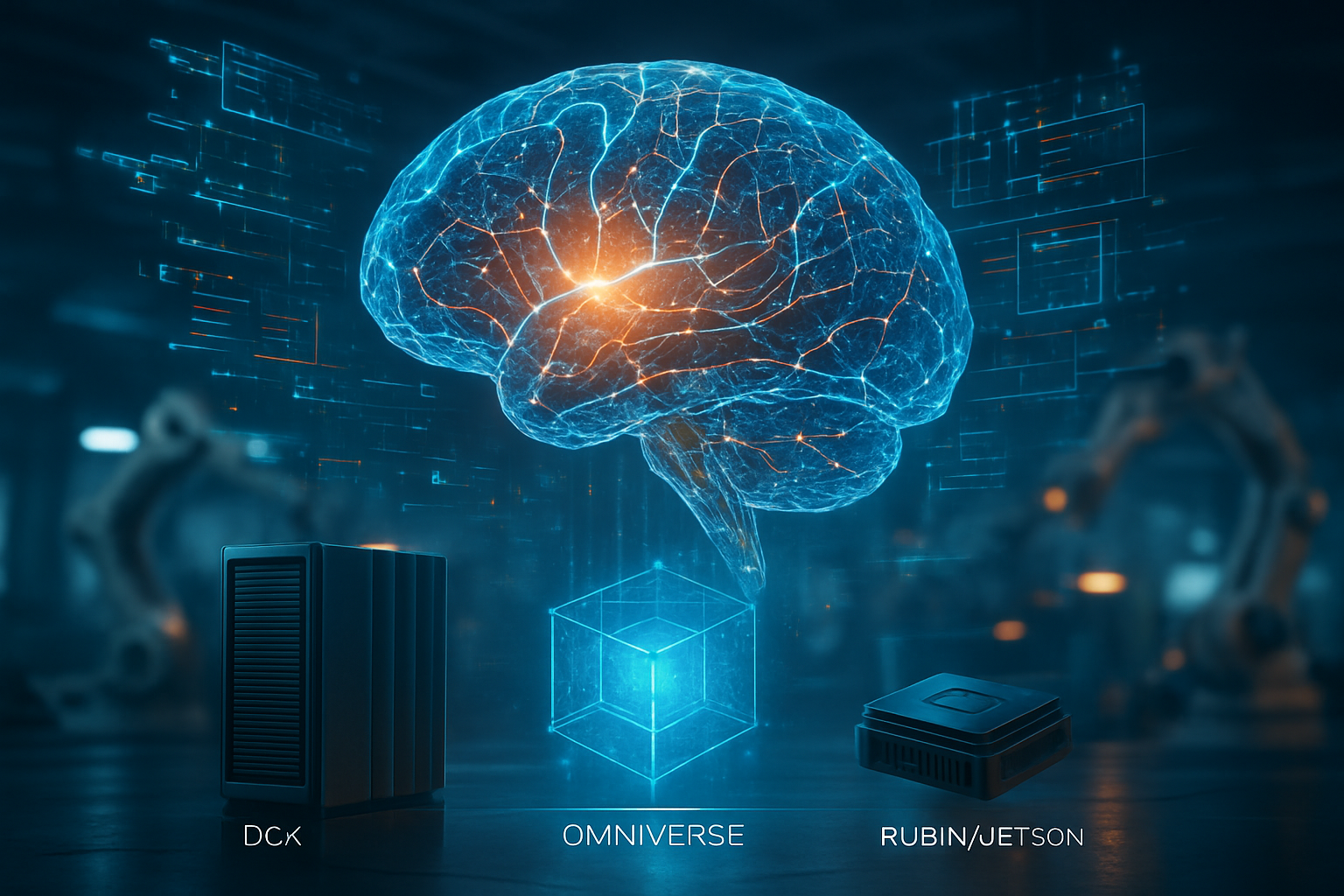
    The "Physical AI" strategy announced at CES 2026 is perhaps the most ambitious roadmap in Nvidia's history. It is built on a "three-computer" architecture: the DGX for training, Omniverse for simulation, and Jetson or DRIVE for real-time operation. Within this framework, Nemotron 3 serves as the "logic" or the brain, while the new NVIDIA Cosmos models act as the "intuition." Cosmos models are world foundation models designed to understand physics—predicting how objects fall, slide, or interact—which allows robots to navigate the real world with human-like common sense.

    This integration is a milestone in the broader AI landscape, moving beyond the "stochastic parrot" critique of early LLMs. By grounding reasoning in physical reality, Nvidia is addressing one of the most significant hurdles in robotics: the "sim-to-real" gap. Unlike previous breakthroughs that focused on digital intelligence, such as GPT-4, the combination of Nemotron and Cosmos allows for "Physical Common Sense," where an AI doesn't just know how to describe a hammer but understands the weight, trajectory, and force required to use one. This shift places Nvidia at the forefront of the "General Purpose Robotics" trend that many believe will define the late 2020s.

    The Road Ahead: Humanoids and Autonomous Realities

    Looking toward the near-term future, the most immediate applications of the Nemotron-Cosmos stack will be seen in humanoid robotics and autonomous transport. Nvidia’s Isaac GR00T N1.6—a Vision-Language-Action (VLA) model—is already utilizing Nemotron 3 to enable robots to perform bimanual manipulation and navigate dynamic, crowded workspaces. In the automotive sector, the new Alpamayo 1 model, developed in partnership with Mercedes-Benz (OTC: MBGYY), uses Nemotron's chain-of-thought reasoning to allow self-driving cars to explain their decisions to passengers, such as slowing down for a distracted pedestrian.

    Despite the excitement, significant challenges remain, particularly regarding the safety and reliability of autonomous agents in unconstrained environments. Experts predict that the next two years will be focused on "alignment for action," ensuring that agentic AI follows strict safety protocols when interacting with humans. As these models become more autonomous, the industry will likely see a surge in demand for "Inference Context Memory Storage" and other hardware-level solutions to manage the massive data flows required by multi-agent systems.

    A New Chapter in the AI Revolution

    Nvidia’s announcements at CES 2026 represent a definitive closing of the chapter on "Chatbot AI" and the opening of the era of "Agentic Physical AI." The Nemotron 3 family provides the necessary reasoning depth, while the Cosmos models provide the physical grounding, creating a holistic system that can finally interact with the world in a meaningful way. This development is likely to be remembered as the moment when AI moved from being a tool we talk to, to a partner that works alongside us.

    As we move into the coming months, the industry will be watching closely to see how quickly these models are adopted by the robotics and automotive sectors. With the Rubin platform entering full production and partnerships with global leaders already in place, Nvidia has set a high bar for the rest of the tech industry. The long-term impact of this development could be a fundamental shift in global productivity, as autonomous agents begin to take on roles in manufacturing, logistics, and even domestic care that were once thought to be decades away.


    This content is intended for informational purposes only and represents analysis of current AI developments.

    TokenRing AI delivers enterprise-grade solutions for multi-agent AI workflow orchestration, AI-powered development tools, and seamless remote collaboration platforms.
    For more information, visit https://www.tokenring.ai/.
  • Beyond Blackwell: Inside Nvidia’s ‘Vera Rubin’ Revolution and the War on ‘Computation Inflation’

    Beyond Blackwell: Inside Nvidia’s ‘Vera Rubin’ Revolution and the War on ‘Computation Inflation’

    As the artificial intelligence landscape shifts from simple chatbots to complex agentic reasoning and physical robotics, Nvidia (NASDAQ: NVDA) has officially moved into full production of its next-generation "Vera Rubin" platform. Named after the pioneering astronomer who provided the first evidence of dark matter, the Rubin architecture is more than just a faster chip; it represents a fundamental pivot in the company’s roadmap. By shifting to a relentless one-year product cycle, Nvidia is attempting to outpace a phenomenon CEO Jensen Huang calls "computation inflation," where the exponential growth of AI model complexity threatens to outstrip the physical and economic limits of current hardware.

    The arrival of the Vera Rubin platform in early 2026 marks the end of the two-year "Moore’s Law" cadence that defined the semiconductor industry for decades. With the R100 GPU and the custom "Vera" CPU at its core, Nvidia is positioning itself not just as a chipmaker, but as the architect of the "AI Factory." This transition is underpinned by a strategic technical shift toward High-Bandwidth Memory (HBM4) integration, involving a high-stakes partnership with Samsung Electronics (KRX: 005930) to secure the massive volumes of silicon required to power the next trillion-parameter frontier.

    The Silicon of 2026: R100, Vera CPUs, and the HBM4 Breakthrough

    At the heart of the Vera Rubin platform is the R100 GPU, a marvel of engineering fabricated on Taiwan Semiconductor Manufacturing Company's (NYSE: TSM) enhanced 3nm (N3P) process. Moving away from the monolithic designs of the past, the R100 utilizes a modular chiplet architecture on a massive 100x100mm substrate. This design allows for approximately 336 billion transistors—a 1.6x increase over the previous Blackwell generation—delivering a staggering 50 PFLOPS of FP4 inference performance per GPU. To put this in perspective, a single rack of Rubin-powered servers (the NVL144) can now reach 3.6 ExaFLOPS of compute, effectively turning a single data center row into a supercomputer that would have been unimaginable just three years ago.

    The most critical technical leap, however, is the integration of HBM4 memory. As AI models grow, they hit a "memory wall" where the speed of data transfer between the processor and memory becomes the primary bottleneck. Rubin addresses this by featuring 288GB of HBM4 memory per GPU, providing a bandwidth of up to 22 TB/s. This is achieved through an eighth-stack configuration and a widened 2,048-bit memory interface, nearly doubling the throughput of the Blackwell Ultra refresh. To ensure a steady supply of these advanced modules, Nvidia has deepened its collaboration with Samsung, which is utilizing its 6th-generation 10nm-class (1c) DRAM process to produce HBM4 chips that are 40% more energy-efficient than their predecessors.

    Beyond the GPU, Nvidia is introducing the Vera CPU, the successor to the Grace processor. Unlike Grace, which relied on standard Arm Neoverse cores, Vera features 88 custom "Olympus" Arm cores designed specifically for agentic AI workflows. These cores are optimized for the complex "thinking" chains required by autonomous agents that must plan and reason before acting. Coupled with the new BlueField-4 DPU for high-speed networking and the sixth-generation NVLink 6 interconnect—which offers 3.6 TB/s of bidirectional bandwidth—the Rubin platform functions as a unified, vertically integrated system rather than a collection of disparate parts.

    Reshaping the Competitive Landscape: The AI Factory Arms Race

    The shift to an annual update cycle is a strategic masterstroke designed to keep competitors like Advanced Micro Devices (NASDAQ: AMD) and Intel (NASDAQ: INTC) in a perpetual state of catch-up. While AMD’s Instinct MI400 series, expected later in 2026, boasts higher raw memory capacity (up to 432GB), Nvidia’s Rubin counters with superior compute density and a more mature software ecosystem. The "CUDA moat" remains Nvidia’s strongest defense, as the Rubin platform is designed to be a "turnkey" solution for hyperscalers like Microsoft (NASDAQ: MSFT), Meta (NASDAQ: META), and Alphabet (NASDAQ: GOOGL). These tech giants are no longer just buying chips; they are deploying entire "AI Factories" that can reduce the cost of inference tokens by 10x compared to previous years.

    For these hyperscalers, the Rubin platform represents a path to sustainable scaling. By reducing the number of GPUs required to train Mixture-of-Experts (MoE) models by a factor of four, Nvidia allows these companies to scale their models to 100 trillion parameters without a linear increase in their physical data center footprint. This is particularly vital for Meta and Google, which are racing to integrate "Agentic AI" into every consumer product. The specialized Rubin CPX variant, which uses more affordable GDDR7 memory for the "context phase" of inference, further allows these companies to process millions of tokens of context more economically, making "long-context" AI a standard feature rather than a luxury.

    However, the aggressive one-year rhythm also places immense pressure on the global supply chain. By qualifying Samsung as a primary HBM4 supplier alongside SK Hynix (KRX: 000660) and Micron Technology (NASDAQ: MU), Nvidia is attempting to avoid the shortages that plagued the H100 and Blackwell launches. This diversification is a clear signal that Nvidia views memory availability—not just compute power—as the defining constraint of the 2026 AI economy. Samsung’s ability to hit its target of 250,000 wafers per month will be the linchpin of the Rubin rollout.

    Deflating ‘Computation Inflation’ and the Rise of Physical AI

    Jensen Huang’s concept of "computation inflation" addresses a looming crisis: the volume of data and the complexity of AI models are growing at roughly 10x per year, while traditional CPU performance has plateaued. Without the massive architectural leaps provided by Rubin, the energy and financial costs of AI would become unsustainable. Nvidia’s strategy is to "deflate" the cost of intelligence by delivering 1000x more compute every few years through a combination of GPU/CPU co-design and new data types like NVFP4. This focus on efficiency is evident in the Rubin NVL72 rack, which is designed to be 100% liquid-cooled, eliminating the need for energy-intensive water chillers and saving up to 6% in total data center power consumption.

    The Rubin platform also serves as the hardware foundation for "Physical AI"—AI that interacts with the physical world. Through its Cosmos foundation models, Nvidia is using Rubin-powered clusters to generate synthetic 3D data grounded in physics, which is then used to train humanoid robots and autonomous vehicles. This marks a transition from AI that merely predicts the next word to AI that understands the laws of physics. For companies like Tesla (NASDAQ: TSLA) or the robotics startups of 2026, the R100’s ability to handle "test-time scaling"—where the model spends more compute cycles "thinking" before executing a physical movement—is a prerequisite for safe and reliable automation.

    This wider significance cannot be overstated. By providing the compute necessary for models to "reason" in real-time, Nvidia is moving the industry toward the era of autonomous agents. This mirrors previous milestones like the introduction of the Transformer model in 2017 or the launch of ChatGPT in 2022, but with a focus on agency and physical interaction. The concern, however, remains the centralization of this power. As Nvidia becomes the "operating system" for AI infrastructure, the industry’s dependence on a single vendor’s roadmap has never been higher.

    The Road Ahead: From Rubin Ultra to Feynman

    Looking toward the near-term future, Nvidia has already teased the "Rubin Ultra" for 2027, which will feature 16-high HBM4 stacks and even greater memory capacity. Beyond that lies the "Feynman" architecture, scheduled for 2028, which is rumored to explore even more exotic packaging technologies and perhaps the first steps toward optical interconnects at the chip level. The immediate challenge for 2026, however, will be the massive transition to liquid cooling. Most existing data centers were designed for air cooling, and the shift to the fully liquid-cooled Rubin racks will require a multi-billion dollar overhaul of global infrastructure.

    Experts predict that the next two years will see a "disaggregation" of AI workloads. We will likely see specialized clusters where Rubin R100s handle the heavy lifting of training and complex reasoning, while Rubin CPX units handle massive context processing, and smaller edge-AI chips manage simple tasks. The challenge for Nvidia will be maintaining this frantic annual pace without sacrificing reliability or software stability. If they succeed, the "cost per token" could drop so low that sophisticated AI agents become as ubiquitous and inexpensive as a Google search.

    A New Era of Accelerated Computing

    The launch of the Vera Rubin platform is a watershed moment in the history of computing. It represents the successful execution of a strategy to compress decades of technological progress into a single-year cycle. By integrating custom CPUs, advanced HBM4 memory from Samsung, and next-generation interconnects, Nvidia has built a fortress that will be difficult for any competitor to storm in the near future. The key takeaway is that the "AI chip" is dead; we are now in the era of the "AI System," where the rack is the unit of compute.

    As we move through 2026, the industry will be watching two things: the speed of liquid-cooling adoption in enterprise data centers and the real-world performance of Agentic AI powered by the Vera CPU. If Rubin delivers on its promise of a 10x reduction in token costs, it will not just deflate "computation inflation"—it will ignite a new wave of economic productivity driven by autonomous, reasoning machines. For now, Nvidia remains the undisputed architect of this new world, with the Vera Rubin platform serving as its most ambitious blueprint yet.


    This content is intended for informational purposes only and represents analysis of current AI developments.

    TokenRing AI delivers enterprise-grade solutions for multi-agent AI workflow orchestration, AI-powered development tools, and seamless remote collaboration platforms.
    For more information, visit https://www.tokenring.ai/.
  • The Silicon Photonics Revolution: Tower Semiconductor and LightIC Unveil 4D FMCW LiDAR for the Age of Physical AI

    The Silicon Photonics Revolution: Tower Semiconductor and LightIC Unveil 4D FMCW LiDAR for the Age of Physical AI

    On January 5, 2026, the landscape of autonomous sensing underwent a seismic shift as Tower Semiconductor (NASDAQ: TSEM) and LightIC Technologies announced a landmark strategic collaboration. The partnership is designed to mass-produce the next generation of Silicon Photonics (SiPho)-based 4D FMCW LiDAR, marking a pivotal moment where high-speed optical technology—once confined to the massive data centers powering Large Language Models—finally transitions into the "Physical AI" domain. This move promises to bring high-performance, velocity-aware sensing to autonomous vehicles and robotics at a scale and price point previously thought impossible.

    The collaboration leverages Tower Semiconductor’s mature 300mm SiPho foundry platform to manufacture LightIC’s proprietary Frequency-Modulated Continuous-Wave (FMCW) chips. By integrating complex optical engines—including lasers, modulators, and detectors—onto a single silicon substrate, the two companies are addressing the "SWaP-C" (Size, Weight, Power, and Cost) barriers that have long hindered the widespread adoption of high-end LiDAR. As AI models move from generating text to controlling physical "atoms" in robots and cars, this development provides the high-fidelity sensory input required for machines to navigate complex, dynamic human environments with unprecedented safety.

    The Technical Edge: 4D FMCW and the End of Optical Interference

    At the heart of this announcement are two flagship products: the Lark™ for long-range automotive use and the FR60™ for compact robotics. Unlike traditional Time-of-Flight (ToF) LiDAR systems used by many current autonomous platforms, which measure distance by timing the reflection of light pulses, LightIC’s 4D FMCW technology measures both distance and instantaneous velocity simultaneously. The Lark™ system boasts a detection range of up to 300 meters and can identify objects at 500 meters, while providing velocity data with a precision of 0.05 m/s. This "4D" capability allows the AI to immediately distinguish between a stationary object and one moving toward the vehicle, drastically reducing the computational latency required for multi-frame tracking.

    Technically, the transition to SiPho allows these systems to operate at the 1550nm wavelength, which is inherently safer for human eyes and allows for higher power output than the 905nm lasers used in cheaper ToF systems. Furthermore, FMCW is naturally immune to optical interference. In a future where hundreds of autonomous vehicles might occupy the same highway, traditional LiDARs can "blind" each other with overlapping pulses. LightIC’s coherent detection ensures that each sensor only "hears" its own unique frequency-modulated signal, effectively eliminating the "crosstalk" problem that has plagued the industry.

    The manufacturing process is equally significant. Tower Semiconductor utilizes its PH18 SiPho process and advanced wafer bonding to create a monolithic "LiDAR-on-a-chip." This differs from previous approaches that relied on discrete components—individual lasers and lenses—which are difficult to align and prone to failure under the vibrations of automotive use. By moving the entire optical bench onto a silicon chip, the partnership enables "image-grade" point clouds with an angular resolution of 0.1° x 0.08°, providing the resolution of a high-definition camera with the depth precision of a laser.

    Reshaping the Competitive Landscape: The Foundry Advantage

    This development is a direct challenge to established LiDAR players and represents a strategic win for the foundry model in photonics. While companies like Hesai Group (NASDAQ: HSAI) and Luminar Technologies (NASDAQ: LAZR) have made strides in automotive integration, the Tower-LightIC partnership brings the economies of scale associated with semiconductor giants. By utilizing the same 300mm manufacturing lines that produce 1.6Tbps optical transceivers for companies like NVIDIA Corporation (NASDAQ: NVDA), the partnership can drive down the cost of high-end LiDAR to levels that make it viable for mass-market consumer vehicles, not just luxury fleets or robotaxis.

    For AI labs and robotics startups, this announcement is a major enabler. The "Physical AI" movement—led by entities like Tesla, Figure, and Boston Dynamics—relies on high-quality training data. The ability to feed a neural network real-time, per-point velocity data rather than just 3D coordinates simplifies the "perception-to-action" pipeline. This could disrupt the current market for secondary sensors, potentially reducing the reliance on complex radar-camera fusion by providing a single, high-fidelity source of truth.

    Beyond Vision: The Arrival of "Velocity-Aware" Physical AI

    The broader significance of this expansion lies in the evolution of the AI landscape itself. For the past several years, the "AI Revolution" has been largely digital, focused on processing information within the cloud. In 2026, the trend has shifted toward "Embodied AI" or "Physical AI," where the challenge is to give silicon brains the ability to interact safely with the physical world. Silicon Photonics is the bridge for this transition. Just as CMOS image sensors revolutionized the smartphone era by making high-quality cameras ubiquitous, SiPho is poised to do the same for 3D sensing.

    The move from data centers to the edge is a natural progression. The photonics industry spent a decade perfecting the reliability and throughput of optical interconnects to handle the massive traffic of AI training clusters. That same reliability is now being applied to automotive safety. The implications for safety are profound: a vehicle equipped with 4D FMCW LiDAR can "see" the intention of a pedestrian or another vehicle through their instantaneous velocity, allowing for much faster emergency braking or evasive maneuvers. This level of "velocity awareness" is a milestone in the quest for Level 4 and Level 5 autonomy.

    The Road Ahead: Scaling Autonomy from Highways to Households

    In the near term, expect to see the Lark™ system integrated into high-end electric vehicle platforms scheduled for late 2026 and 2027 releases. The compact FR60™ is likely to find an immediate home in the logistics sector, powering the next generation of autonomous mobile robots (AMRs) in warehouses and "last-mile" delivery bots. The challenge moving forward will not be the hardware itself, but the software integration. AI developers will need to rewrite perception stacks to take full advantage of the 4D data stream, moving away from legacy algorithms designed for 3D ToF sensors.

    Experts predict that the success of the Tower-LightIC collaboration will spark a wave of consolidation in the LiDAR industry. Smaller players without access to high-volume SiPho foundries may struggle to compete on price and performance. As we look toward 2027, the goal will be "ubiquitous sensing"—integrating these chips into everything from household service robots to smart infrastructure. The "invisible AI" layer is becoming a reality, where the machines around us possess a sense of sight and motion that exceeds human capability.

    Conclusion: A New Foundation for Intelligent Machines

    The collaboration between Tower Semiconductor and LightIC Technologies marks the official entry of Silicon Photonics into the mainstream of Physical AI. By solving the dual challenges of interference and cost through advanced semiconductor manufacturing, they have provided the "eyes" that the next generation of AI requires. This is more than just a hardware upgrade; it is a foundational shift in how machines perceive reality.

    As we move through 2026, the industry will be watching for the first road tests of these integrated chips and the subsequent performance benchmarks from the robotics community. The transition of SiPho from the silent racks of data centers to the bustling streets of our cities is a testament to the technology's maturity. For the AI industry, the message is clear: the brain has been built, and now, it finally has the vision to match.


    This content is intended for informational purposes only and represents analysis of current AI developments.

    TokenRing AI delivers enterprise-grade solutions for multi-agent AI workflow orchestration, AI-powered development tools, and seamless remote collaboration platforms.
    For more information, visit https://www.tokenring.ai/.
  • LG’s CLOiD: The AI Laundry-Folding Robot and the Vision of a Zero Labor Home

    LG’s CLOiD: The AI Laundry-Folding Robot and the Vision of a Zero Labor Home

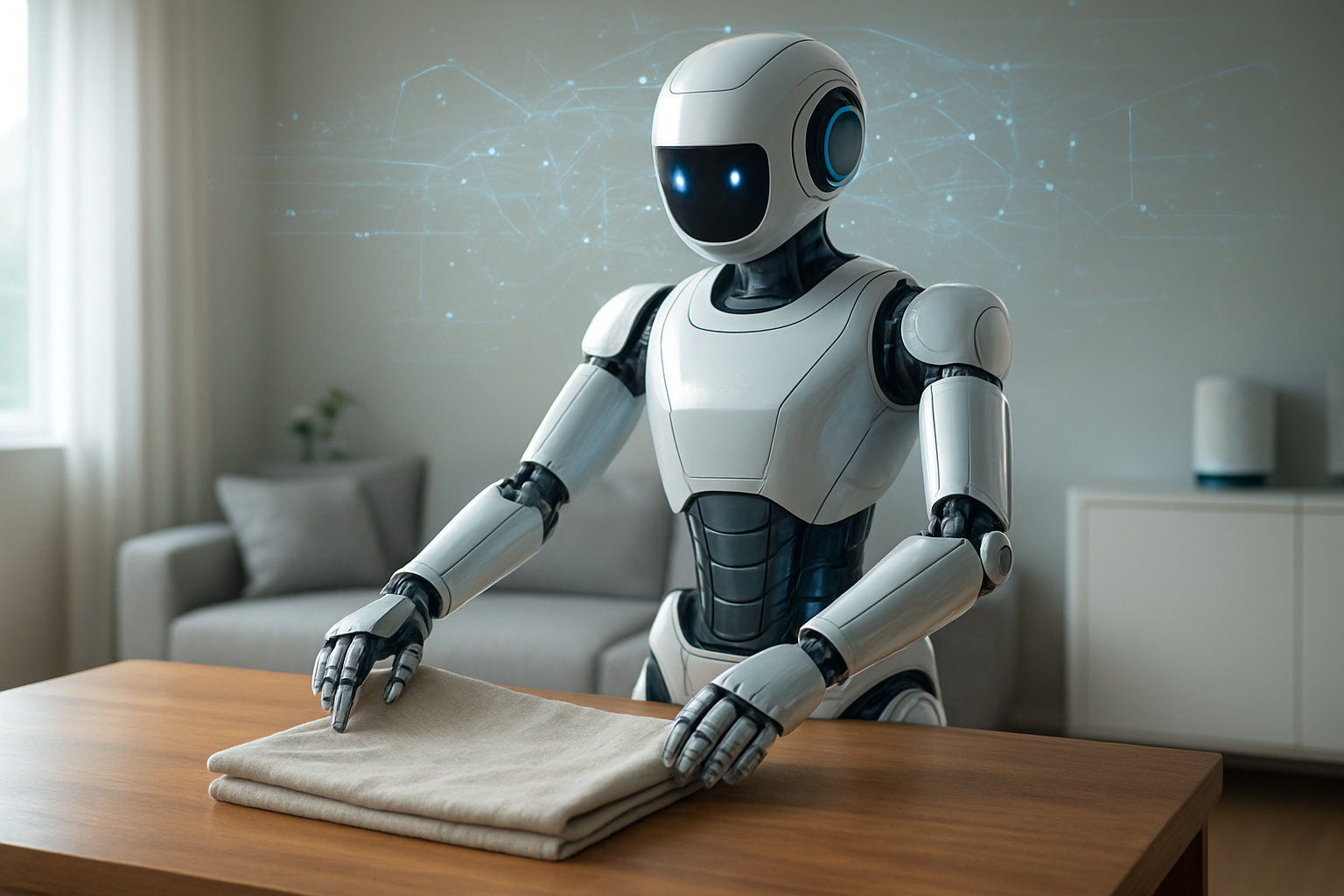
    LAS VEGAS — The dream of a home where laundry folds itself and the dishwasher unloads while you sleep moved one step closer to reality today. At the 2026 Consumer Electronics Show (CES), LG Electronics (KRX: 066570) unveiled its most ambitious project to date: CLOiD, an AI-powered domestic robot designed to serve as the physical manifestation of the company’s "Zero Labor Home" vision. While previous iterations of home robots were often relegated to vacuuming floors or acting as stationary smart speakers, CLOiD represents a leap into "Physical AI," featuring human-like dexterity and the intelligence to navigate the messy, unpredictable environment of a family household.

    The debut of CLOiD marks a significant pivot for the consumer electronics giant, shifting from "smart appliances" to "autonomous agents." LG’s vision is simple yet profound: to transform the home from a place of chores into a sanctuary of relaxation. By integrating advanced robotics with what LG calls "Affectionate Intelligence," CLOiD is intended to understand the context of a household—recognizing when a child has left toys on the floor or when the dryer has finished its cycle—and taking proactive action without needing a single voice command.

    Technical Mastery: From Vision to Action

    CLOiD is a marvel of modern engineering, standing on a stable, wheeled base but featuring a humanoid upper body with two highly articulated arms. Each arm boasts seven degrees of freedom (DOF), mimicking the full range of motion of a human limb. The true breakthrough, however, lies in its hands. Equipped with five independently actuated fingers, CLOiD demonstrated the ability to perform "fine manipulation" tasks that have long eluded domestic robots. During the CES keynote, the robot was seen delicately picking up a wine glass from a dishwasher and placing it in a high cabinet, as well as sorting and folding a basket of mixed laundry—including difficult items like hoodies and fitted sheets.

    Under the hood, CLOiD is powered by the Qualcomm (NASDAQ: QCOM) Robotics RB5 Platform and utilizes Vision-Language-Action (VLA) models. Unlike traditional robots that follow pre-programmed scripts, CLOiD uses these AI models to translate visual data and natural language instructions into complex motor movements in real-time. This is supported by LG’s new proprietary "AXIUM" actuators—high-torque, lightweight robotic joints that allow for smooth, human-like motion. The robot also utilizes a suite of LiDAR sensors and 3D cameras to map homes with centimeter-level precision, ensuring it can navigate around pets and furniture without incident.

    Initial reactions from the AI research community have been cautiously optimistic. Experts praised the integration of VLA models, noting that CLOiD’s ability to understand commands like "clean up the living room" requires a sophisticated level of semantic reasoning. However, many noted that the robot’s pace remains "methodical." In live demos, folding a single towel took nearly 40 seconds—a speed that, while impressive for a machine, still lags behind human efficiency. "We are seeing the 'Netscape moment' for home robotics," said one industry analyst. "It’s not perfect yet, but the foundation for a mass-market product is finally here."

    The Battle for the Living Room: Competitive Implications

    LG’s entrance into the humanoid space puts it on a direct collision course with Tesla (NASDAQ: TSLA) and its Optimus Gen 3 robot. While Tesla has focused on a bipedal (two-legged) design intended for both factory and home use, LG has opted for a wheeled base, prioritizing stability and battery life for the domestic environment. This strategic choice may give LG an edge in the near term, as bipedal balance remains one of the most difficult and power-hungry challenges in robotics.

    The "Zero Labor Home" ecosystem also strengthens LG’s position against Samsung Electronics (KRX: 005930), which has focused more on decentralized AI hubs and smaller companion bots. By providing a robot that can physically interact with any appliance, LG is positioning itself as the primary orchestrator of the future home. This development is also a win for NVIDIA (NASDAQ: NVDA), whose Isaac and Omniverse platforms were used to train CLOiD in "digital twin" environments, allowing the robot to "practice" thousands of hours of laundry folding in a virtual space before ever touching a real garment.

    The market for domestic service robots is projected to reach $17.5 billion by the end of 2026, and LG's move signals a shift away from standalone gadgets toward integrated AI services. Startups like Figure AI—backed by Microsoft (NASDAQ: MSFT) and OpenAI—are also in the race, but LG’s massive existing footprint in the appliance market (washers, dryers, and dishwashers) provides a unique "vertical integration" advantage. CLOiD doesn't just fold laundry; it communicates with the LG ThinQ dryer to know exactly when the load is ready.

    A New Paradigm in Physical AI

    The broader significance of CLOiD lies in the transition from "Generative AI" (text and images) to "Physical AI" (movement and labor). For the past two years, the tech world has been captivated by Large Language Models; CES 2026 is proving that the next frontier is applying that intelligence to the physical world. LG’s "Affectionate Intelligence" represents an attempt to humanize this transition, focusing on empathy and proactive care rather than just mechanical efficiency.

    However, the rise of a dual-armed, camera-equipped robot in the home brings significant concerns regarding privacy and safety. CLOiD requires constant visual monitoring of its environment to function, raising questions about where that data is stored. LG has addressed this by emphasizing "Edge AI," claiming that the majority of visual processing happens locally on the robot’s internal NPU rather than in the cloud. Furthermore, safety protocols are a major talking point; the robot’s AXIUM actuators include "force-feedback" sensors that cause the robot to stop instantly if it detects unexpected resistance, such as a child’s hand.

    Comparisons are already being made to the debut of the first iPhone or the first commercial PC. While CLOiD is currently a high-end luxury concept, it represents a milestone in the "democratization of leisure." Just as the washing machine liberated households from hours of manual scrubbing in the 20th century, CLOiD aims to liberate the 21st-century family from the "invisible labor" of daily tidying.

    The Road Ahead: 2026 and Beyond

    In the near term, LG expects to deploy CLOiD in limited "beta" trials in premium residential complexes in Seoul and Los Angeles. The primary goal is to refine the robot’s speed and its ability to handle "edge cases"—such as identifying stained clothing that needs re-washing or handling delicate silk garments. Experts predict that as VLA models continue to evolve, we will see a rapid increase in the variety of tasks these robots can perform, potentially moving into elder care and basic meal preparation by 2028.

    The long-term challenge remains cost. Current estimates suggest a retail price for a robot with CLOiD’s capabilities could exceed $20,000, making it a toy for the wealthy rather than a tool for the masses. However, LG’s investment in the AXIUM actuator brand suggests they are looking to drive down component costs through mass production, potentially offering "Robot-as-a-Service" (RaaS) subscription models to make the technology more accessible.

    The next few years will likely see a "Cambrian Explosion" of form factors in domestic robotics. While CLOiD is a generalist, we may see specialized versions for gardening, home security, or even dedicated "chef bots." The success of these machines will depend not just on their hardware, but on their ability to gain the trust of the families they serve.

    Conclusion: A Turning Point for Home Automation

    LG’s presentation at CES 2026 will likely be remembered as the moment the "Zero Labor Home" moved from science fiction to a tangible roadmap. CLOiD is more than just a laundry-folding machine; it is a sophisticated AI agent that bridges the gap between digital intelligence and physical utility. By mastering the complex motor skills required for dishwasher unloading and garment folding, LG has set a new bar for what consumers should expect from their home appliances.

    As we move through 2026, the tech industry will be watching closely to see if LG can move CLOiD from the showroom floor to the living room. The significance of this development in AI history cannot be overstated—it is the beginning of the end for manual domestic labor. While there are still hurdles in speed, cost, and privacy to overcome, the vision of a home that "cares for itself" is no longer a distant dream.


    This content is intended for informational purposes only and represents analysis of current AI developments.

    TokenRing AI delivers enterprise-grade solutions for multi-agent AI workflow orchestration, AI-powered development tools, and seamless remote collaboration platforms.
    For more information, visit https://www.tokenring.ai/.
  • The Body Electric: How Dragonwing and Jetson AGX Thor Sparked the Physical AI Revolution

    The Body Electric: How Dragonwing and Jetson AGX Thor Sparked the Physical AI Revolution

    As of January 1, 2026, the artificial intelligence landscape has undergone a profound metamorphosis. The era of "Chatbot AI"—where intelligence was confined to text boxes and cloud-based image generation—has been superseded by the era of Physical AI. This shift represents the transition from digital intelligence to embodied intelligence: AI that can perceive, reason, and interact with the three-dimensional world in real-time. This revolution has been catalyzed by a new generation of "Physical AI" silicon that brings unprecedented compute power to the edge, effectively giving AI a body and a nervous system.

    The cornerstone of this movement is the arrival of ultra-high-performance, low-power chips designed specifically for autonomous machines. Leading the charge are Qualcomm’s (NASDAQ: QCOM) newly rebranded Dragonwing platform and NVIDIA’s (NASDAQ: NVDA) Jetson AGX Thor. These processors have moved the "brain" of the AI from distant data centers directly into the chassis of humanoid robots, autonomous delivery vehicles, and smart automotive cabins. By eliminating the latency of the cloud and providing the raw horsepower necessary for complex sensor fusion, these chips have turned the dream of "Edge AI" into a tangible, physical reality.

    The Silicon Architecture of Embodiment

    Technically, the leap from 2024’s edge processors to the hardware of 2026 is staggering. NVIDIA’s Jetson AGX Thor, which began shipping to developers in late 2025, is built on the Blackwell GPU architecture. It delivers a massive 2,070 FP4 TFLOPS of performance—a nearly 7.5-fold increase over its predecessor, the Jetson Orin. This level of compute is critical for "Project GR00T," NVIDIA’s foundation model for humanoid robots, allowing machines to process multimodal data from cameras, LiDAR, and force sensors simultaneously to navigate complex human environments. Thor also introduces a specialized "Holoscan Sensor Bridge," which slashes the time it takes for data to travel from a robot's "eyes" to its "brain," a necessity for safe real-time interaction.

    In contrast, Qualcomm has carved out a dominant position in industrial and enterprise applications with its Dragonwing IQ-9075 flagship. While NVIDIA focuses on raw TFLOPS for complex humanoids, Qualcomm has optimized for power efficiency and integrated connectivity. The Dragonwing platform features dual Hexagon NPUs capable of 100 INT8 TOPS, designed to run 13-billion parameter models locally while maintaining a thermal profile suitable for fanless industrial drones and Autonomous Mobile Robots (AMRs). Crucially, the IQ-9075 is the first of its kind to integrate UHF RFID, 5G, and Wi-Fi 7 directly into the SoC, allowing robots in smart warehouses to track inventory with centimeter-level precision while maintaining a constant high-speed data link.

    This new hardware differs from previous iterations by prioritizing "Sim-to-Real" capabilities. Previous edge chips were largely reactive, running simple computer vision models. Today’s Physical AI chips are designed to run "World Models"—AI that understands the laws of physics. Industry experts have noted that the ability of these chips to run local, high-fidelity simulations allows robots to "rehearse" a movement in a fraction of a second before executing it in the real world, drastically reducing the risk of accidents in shared human-robot spaces.

    A New Competitive Landscape for the AI Titans

    The emergence of Physical AI has reshaped the strategic priorities of the world’s largest tech companies. For NVIDIA, Jetson AGX Thor is the final piece of CEO Jensen Huang’s "Three-Computer" vision, positioning the company as the end-to-end provider for the robotics industry—from training in the cloud to simulation in the Omniverse and deployment at the edge. This vertical integration has forced competitors to accelerate their own hardware-software stacks. Qualcomm’s pivot to the Dragonwing brand signals a direct challenge to NVIDIA’s industrial dominance, leveraging Qualcomm’s historical strength in mobile power efficiency to capture the massive market for battery-operated edge devices.

    The impact extends deep into the automotive sector. Manufacturers like BYD (OTC: BYDDF) and Volvo (OTC: VLVLY) have already begun integrating DRIVE AGX Thor into their 2026 vehicle lineups. These chips don't just power self-driving features; they transform the automotive cabin into a "Physical AI" environment. With Dragonwing and Thor, cars can now perform real-time "cabin sensing"—detecting a driver’s fatigue level or a passenger’s medical distress—and respond with localized AI agents that don't require an internet connection to function. This has created a secondary market for "AI-first" automotive software, where startups are competing to build the most responsive and intuitive in-car assistants.

    Furthermore, the democratization of this technology is occurring through strategic partnerships. Qualcomm’s 2025 acquisition of Arduino led to the release of the Arduino Uno Q, a "dual-brain" board that pairs a Dragonwing processor with a traditional microcontroller. This move has lowered the barrier to entry for smaller robotics startups and the maker community, allowing them to build sophisticated machines that were previously the sole domain of well-funded labs. As a result, we are seeing a surge in "TinyML" applications, where ultra-low-power sensors act as a "peripheral nervous system," waking up the more powerful "central brain" (Thor or Dragonwing) only when complex reasoning is required.

    The Broader Significance: AI Gets a Sense of Self

    The rise of Physical AI marks a departure from the "Stochastic Parrot" era of AI. When an AI is embodied in a robot powered by a Jetson AGX Thor, it is no longer just predicting the next word in a sentence; it is predicting the next state of the physical world. This has profound implications for AI safety and reliability. Because these machines operate at the edge, they are not subject to the "hallucinations" caused by cloud latency or connectivity drops. The intelligence is local, grounded in the immediate physical context of the machine, which is a prerequisite for deploying AI in high-stakes environments like surgical suites or nuclear decommissioning sites.

    However, this shift also brings new concerns, particularly regarding privacy and security. With machines capable of processing high-resolution video and sensor data locally, the "Edge AI" promise of privacy is put to the test. While data doesn't necessarily leave the device, the sheer amount of information these machines "see" is unprecedented. Regulators are already grappling with how to categorize "Physical AI" entities—are they tools, or are they a new class of autonomous agents? The comparison to previous milestones, like the release of GPT-4, is clear: while LLMs changed how we write and code, Physical AI is changing how we build and move.

    The transition to Physical AI also represents the ultimate realization of TinyML. By moving the most critical inference tasks to the very edge of the network, the industry is reducing its reliance on massive, energy-hungry data centers. This "distributed intelligence" model is seen as a more sustainable path for the future of AI, as it leverages the efficiency of specialized silicon like the Dragonwing series to perform tasks that would otherwise require kilowatts of power in a server farm.

    The Horizon: From Factories to Front Porches

    Looking ahead to the remainder of 2026 and beyond, we expect to see Physical AI move from industrial settings into the domestic sphere. Near-term developments will likely focus on "General Purpose Humanoids" capable of performing unstructured tasks in the home, such as folding laundry or organizing a kitchen. These applications will require even further refinements in "Sim-to-Real" technology, where AI models can generalize from virtual training to the messy, unpredictable reality of a human household.

    The next great challenge for the industry will be the "Battery Barrier." While chips like the Dragonwing IQ-9075 have made great strides in efficiency, the mechanical actuators of robots remain power-hungry. Experts predict that the next breakthrough in Physical AI will not be in the "brain" (the silicon), but in the "muscles"—new types of high-efficiency electric motors and solid-state batteries designed specifically for the robotics form factor. Once the power-to-weight ratio of these machines improves, we may see the first truly ubiquitous personal robots.

    A New Chapter in the History of Intelligence

    The "Edge AI Revolution" of 2025 and 2026 will likely be remembered as the moment AI became a participant in our world rather than just an observer. The release of NVIDIA’s Jetson AGX Thor and Qualcomm’s Dragonwing platform provided the necessary "biological" leap in compute density to make embodied intelligence possible. We have moved beyond the limits of the screen and entered an era where intelligence is woven into the very fabric of our physical environment.

    As we move forward, the key metric for AI success will no longer be "parameters" or "pre-training data," but "physical agency"—the ability of a machine to safely and effectively navigate the complexities of the real world. In the coming months, watch for the first large-scale deployments of Thor-powered humanoids in logistics hubs and the integration of Dragonwing-based "smart city" sensors that can manage traffic and emergency responses in real-time. The revolution is no longer coming; it is already here, and it has a body.


    This content is intended for informational purposes only and represents analysis of current AI developments.

    TokenRing AI delivers enterprise-grade solutions for multi-agent AI workflow orchestration, AI-powered development tools, and seamless remote collaboration platforms.
    For more information, visit https://www.tokenring.ai/.
  • Edge AI Revolution Gains Momentum in Automotive and Robotics Driven by New Low-Power Silicon

    Edge AI Revolution Gains Momentum in Automotive and Robotics Driven by New Low-Power Silicon

    The landscape of artificial intelligence is undergoing a seismic shift as the focus moves from massive data centers to the very "edge" of physical reality. As of late 2025, a new generation of low-power silicon is catalyzing a revolution in the automotive and robotics sectors, transforming machines from pre-programmed automatons into perceptive, adaptive entities. This transition, often referred to as the era of "Physical AI," was punctuated by Qualcomm’s (NASDAQ: QCOM) landmark acquisition of Arduino in October 2025, a move that has effectively bridged the gap between high-end mobile computing and the grassroots developer community.

    This surge in edge intelligence is not merely a technical milestone; it is a strategic pivot for the entire tech industry. By enabling real-time image recognition, voice processing, and complex motion planning directly on-device, companies are eliminating the latency and privacy risks associated with cloud-dependent AI. For the automotive industry, this means safer, more intuitive cabins; for industrial robotics, it marks the arrival of "collaborative" systems that can navigate unstructured environments and labor-constrained markets with unprecedented efficiency.

    The Silicon Powering the Edge: Technical Breakthroughs of 2025

    The technical foundation of this revolution lies in the dramatic improvement of TOPS-per-watt (Tera-Operations Per Second per watt) efficiency. Qualcomm’s new Dragonwing IQ-X Series, built on a 4nm process, has set a new benchmark for industrial processors, delivering up to 45 TOPS of AI performance while maintaining the thermal stability required for extreme environments. This hardware is the backbone of the newly released Arduino Uno Q, a "dual-brain" development board that pairs a Qualcomm Dragonwing QRB2210 with an STM32U575 microcontroller. This architecture allows developers to run Linux-based AI models alongside real-time control loops for less than $50, democratizing access to high-performance edge computing.

    Simultaneously, NVIDIA (NASDAQ: NVDA) has pushed the high-end envelope with its Jetson AGX Thor, based on the Blackwell architecture. Released in August 2025, the Thor module delivers a staggering 2070 TFLOPS of AI compute within a flexible 40W–130W power envelope. Unlike previous generations, Thor is specifically optimized for "Physical AI"—the ability for a robot to understand 3D space and human intent in real-time. This is achieved through dedicated hardware acceleration for transformer models, which are now the standard for both visual perception and natural language interaction in industrial settings.

    Industry experts have noted that these advancements represent a departure from the "general-purpose" NPU (Neural Processing Unit) designs of the early 2020s. Today’s silicon features specialized pipelines for multimodal awareness. For instance, Qualcomm’s Snapdragon Ride Elite platform utilizes a custom Oryon CPU and an upgraded Hexagon NPU to simultaneously process driver monitoring, external environment mapping, and high-fidelity infotainment voice commands without thermal throttling. This level of integration was previously thought to require multiple discrete chips and significantly higher power draw.

    Competitive Landscapes and Strategic Shifts

    The acquisition of Arduino by Qualcomm has sent ripples through the competitive landscape, directly challenging the dominance of ARM (NASDAQ: ARM) and Intel (NASDAQ: INTC) in the prototyping and IoT markets. By integrating its silicon into the Arduino ecosystem, Qualcomm has secured a pipeline of future engineers and startups who will now build their products on Qualcomm-native stacks. This move is a direct defensive and offensive play against NVIDIA’s growing influence in the robotics space through its Isaac and Jetson platforms.

    Other major players are also recalibrating. NXP Semiconductors (NASDAQ: NXPI) recently completed its $307 million acquisition of Kinara to bolster its edge inference capabilities for automotive cabins. Meanwhile, Teradyne (NASDAQ: TER), the parent company of Universal Robots, has moved to consolidate its lead in collaborative robotics (cobots) by releasing the UR AI Accelerator. This kit, which integrates NVIDIA’s Jetson AGX Orin, provides a 100x speed-up in motion planning, allowing UR robots to handle "unstructured" tasks like palletizing mismatched boxes—a task that was a significant hurdle just two years ago.

    The competitive advantage has shifted toward companies that can offer a "full-stack" solution: silicon, optimized software libraries, and a robust developer community. While Intel (NASDAQ: INTC) continues to push its OpenVINO toolkit, the momentum has clearly shifted toward NVIDIA and Qualcomm, who have more aggressively courted the "Physical AI" market. Startups in the space are now finding it easier to secure funding if their hardware is compatible with these dominant edge ecosystems, leading to a consolidation of software standards around ROS 2 and Python-based AI frameworks.

    Broader Significance: Decentralization and the Labor Market

    The shift toward decentralized AI intelligence carries profound implications for global industry and data privacy. By processing data locally, automotive manufacturers can guarantee that sensitive interior video and audio never leave the vehicle, addressing a primary consumer concern. Furthermore, the reliability of edge AI is critical for mission-critical systems; a robot on a high-speed assembly line or an autonomous vehicle on a highway cannot afford the 100ms latency spikes often inherent in cloud-based processing.

    In the industrial sector, the integration of AI by giants like FANUC (OTCMKTS: FANUY) is a direct response to the global labor shortage. By partnering with NVIDIA to bring "Physical AI" to the factory floor, FANUC has enabled its robots to perform autonomous kitting and high-precision assembly on moving lines. These robots no longer require rigid, pre-programmed paths; they "see" the parts and adjust their movements in real-time. This flexibility allows manufacturers to deploy automation in environments that were previously too complex or too costly to automate, effectively bridging the gap in constrained labor markets.

    This era of edge AI is often compared to the mobile revolution of the late 2000s. Just as the smartphone brought internet connectivity to the pocket, low-power AI silicon is bringing "intelligence" to the physical objects around us. However, this milestone is arguably more significant, as it involves the delegation of physical agency to machines. The ability for a robot to safely work alongside a human without a safety cage, or for a car to navigate a complex urban intersection without cloud assistance, represents a fundamental shift in how humanity interacts with technology.

    The Horizon: Humanoids and TinyML

    Looking ahead to 2026 and beyond, the industry is bracing for the mass deployment of humanoid robots. NVIDIA’s Project GR00T and similar initiatives from automotive-adjacent companies are leveraging this new low-power silicon to create general-purpose robots capable of learning from human demonstration. These machines will likely find their first homes in logistics and healthcare, where the ability to navigate human-centric environments is paramount. Near-term developments will likely focus on "TinyML" scaling—bringing even more sophisticated AI models to microcontrollers that consume mere milliwatts of power.

    Challenges remain, particularly regarding the standardization of "AI safety" at the edge. As machines become more autonomous, the industry must develop rigorous frameworks to ensure that edge-based decisions are explainable and fail-safe. Experts predict that the next two years will see a surge in "Edge-to-Cloud" hybrid models, where the edge handles real-time perception and action, while the cloud is used for long-term learning and fleet-wide optimization.

    The consensus among industry analysts is that we are witnessing the "end of the beginning" for AI. The focus is no longer on whether a model can pass a bar exam, but whether it can safely and efficiently operate a 20-ton excavator or a 2,000-pound electric vehicle. As silicon continues to shrink in power consumption and grow in intelligence, the boundary between the digital and physical worlds will continue to blur.

    Summary and Final Thoughts

    The Edge AI revolution of 2025 marks a turning point where intelligence has become a localized, physical utility. Key takeaways include:

    • Hardware as the Catalyst: Qualcomm (NASDAQ: QCOM) and NVIDIA (NASDAQ: NVDA) have redefined the limits of low-power compute, making real-time "Physical AI" a reality.
    • Democratization: The acquisition of Arduino has lowered the barrier to entry, allowing a massive community of developers to build AI-powered systems.
    • Industrial Transformation: Companies like FANUC (OTCMKTS: FANUY) and Universal Robots (NASDAQ: TER) are successfully deploying these technologies to solve real-world labor and efficiency challenges.

    As we move into 2026, the tech industry will be watching the first wave of mass-produced humanoid robots and the continued integration of AI into every facet of the automotive experience. This development's significance in AI history cannot be overstated; it is the moment AI stepped out of the screen and into the world.


    This content is intended for informational purposes only and represents analysis of current AI developments.

    TokenRing AI delivers enterprise-grade solutions for multi-agent AI workflow orchestration, AI-powered development tools, and seamless remote collaboration platforms.
    For more information, visit https://www.tokenring.ai/.
  • Hitachi (TYO: 6501) Soars on Landmark AI Expansion and Strategic Partnerships

    Hitachi (TYO: 6501) Soars on Landmark AI Expansion and Strategic Partnerships

    Tokyo, Japan – October 29, 2025 – Hitachi (TYO: 6501) has witnessed a significant surge in its stock value, with shares jumping 10.3% in Tokyo following a series of ambitious announcements detailing a profound expansion into the artificial intelligence sector. This market enthusiasm reflects strong investor confidence in Hitachi's multi-faceted AI strategy, which includes pivotal partnerships with leading AI firms, substantial infrastructure investments, and a sharpened focus on "Physical AI" solutions. The conglomerate's proactive approach to embedding cutting-edge AI across its diverse business segments signals a strategic pivot designed to leverage AI for operational transformation and new growth avenues.

    The immediate significance of these developments is multifold. Hitachi is not merely adopting AI but positioning itself as a critical enabler of the global AI revolution. By committing to supply energy-efficient infrastructure for data centers, collaborating on advanced AI agents with tech giants, and acquiring specialized AI firms, Hitachi is building a robust ecosystem that spans from foundational power delivery to sophisticated AI application. This strategic foresight addresses key bottlenecks in AI growth—namely, energy and specialized talent—while simultaneously enhancing its core industrial and infrastructure offerings with intelligent capabilities.

    Technical Deep Dive: Hitachi's AI Architecture and Strategic Innovations

    Hitachi's (TYO: 6501) AI expansion is characterized by a sophisticated, layered approach that integrates generative AI, agentic AI, and "Physical AI" within its proprietary Lumada platform. A cornerstone of this strategy is the recently announced expanded strategic alliance with Google Cloud (NASDAQ: GOOGL), which will see Hitachi leverage Gemini Enterprise to develop advanced AI agents. These agents are specifically designed to enhance operational transformation for frontline workers across critical industrial and infrastructure sectors such as energy, railways, and manufacturing. This collaboration is a key step towards realizing Hitachi's Lumada 3.0 vision, which aims to combine Hitachi's deep domain knowledge with AI for practical, real-world applications.

    Further solidifying its technical foundation, Hitachi signed a significant Memorandum of Understanding (MoU) with OpenAI (Private) on October 2, 2025. Under this agreement, Hitachi will provide OpenAI's data centers with essential energy-efficient electric power transmission and distribution equipment, alongside advanced water cooling and air conditioning systems. In return, OpenAI will supply its large language model (LLM) technology, which Hitachi will integrate into its digital services portfolio. This symbiotic relationship ensures Hitachi plays a vital role in the physical infrastructure supporting AI, while also gaining direct access to state-of-the-art LLM capabilities for its Lumada solutions.

    The establishment of a global Hitachi AI Factory, built on NVIDIA's (NASDAQ: NVDA) AI Factory reference architecture, further underscores Hitachi's commitment to robust AI development. This centralized infrastructure, powered by NVIDIA's advanced GPUs—including Blackwell and RTX PRO 6000—is designed to accelerate the development and deployment of "Physical AI" solutions. "Physical AI" is a distinct approach that involves AI models acquiring and interpreting data from physical environments via sensors and cameras, determining actions, and then executing them, deeply integrating with Hitachi's extensive operational technology (OT) expertise. This differs from many existing AI approaches that primarily focus on digital data processing, by emphasizing real-world interaction and control. Initial reactions from the AI research community have highlighted the strategic brilliance of this IT/OT convergence, recognizing Hitachi's unique position to bridge the gap between digital intelligence and physical execution in industrial settings. The acquisition of synvert, a German data and AI services firm, on October 29, 2025, further bolsters Hitachi's capabilities in Agentic AI and Physical AI, accelerating the global expansion of its HMAX business.

    Competitive Landscape and Market Implications

    Hitachi's (TYO: 6501) aggressive AI expansion carries significant competitive implications for both established tech giants and emerging AI startups. Companies like Google Cloud (NASDAQ: GOOGL), OpenAI (Private), Microsoft (NASDAQ: MSFT), and NVIDIA (NASDAQ: NVDA) stand to benefit directly from their partnerships with Hitachi, as these collaborations expand their reach into critical industrial sectors and facilitate the deployment of their foundational AI technologies on a massive scale. For instance, Google Cloud's Gemini Enterprise will see broader adoption in operational settings, while OpenAI's LLMs will be integrated into a wide array of Hitachi's digital services. NVIDIA's GPU technology will power Hitachi's global AI factories, further cementing its dominance in AI hardware.

    Conversely, Hitachi's strategic moves could pose a challenge to competitors that lack a similar depth in both information technology (IT) and operational technology (OT). Companies focused solely on software AI solutions might find it difficult to replicate Hitachi's "Physical AI" capabilities, which leverage decades of expertise in industrial machinery, energy systems, and mobility infrastructure. This unique IT/OT synergy creates a strong competitive moat, potentially disrupting existing products or services that offer less integrated or less physically intelligent solutions for industrial automation and optimization. Hitachi's substantial investment of 300 billion yen (approximately $2.1 billion USD) in generative AI for fiscal year 2024, coupled with plans to train over 50,000 "GenAI Professionals," signals a serious intent to capture market share and establish a leading position in AI-driven industrial transformation.

    Furthermore, Hitachi's focus on providing critical energy infrastructure for AI data centers—highlighted by its MoU with the U.S. Department of Commerce to foster investment in sustainable AI growth and expand manufacturing activities for transformer production—positions it as an indispensable partner in the broader AI ecosystem. This strategic advantage addresses a fundamental bottleneck for the rapidly expanding AI industry: reliable and efficient power. By owning a piece of the foundational infrastructure that enables AI, Hitachi creates a symbiotic relationship where its growth is intertwined with the overall expansion of AI, potentially giving it leverage over competitors reliant on third-party infrastructure providers.

    Broader Significance in the AI Landscape

    Hitachi's (TYO: 6501) comprehensive AI strategy fits squarely within the broader AI landscape's accelerating trend towards practical, industry-specific applications and the convergence of IT and OT. While much of the recent AI hype has focused on large language models and generative AI in consumer and enterprise software, Hitachi's emphasis on "Physical AI" represents a crucial maturation of the field, moving AI from the digital realm into tangible, real-world operational control. This approach resonates with the growing demand for AI solutions that can optimize complex industrial processes, enhance infrastructure resilience, and drive sustainability across critical sectors like energy, mobility, and manufacturing.

    The impacts of this strategy are far-reaching. By integrating advanced AI into its operational technology, Hitachi is poised to unlock unprecedented efficiencies, predictive maintenance capabilities, and autonomous operations in industries that have traditionally been slower to adopt cutting-edge digital transformations. This could lead to significant reductions in energy consumption, improved safety, and enhanced productivity across global supply chains and public utilities. However, potential concerns include the ethical implications of autonomous physical systems, the need for robust cybersecurity to protect critical infrastructure from AI-driven attacks, and the societal impact on human labor in increasingly automated environments.

    Comparing this to previous AI milestones, Hitachi's approach echoes the foundational shifts seen with the advent of industrial robotics and advanced automation, but with a new layer of cognitive intelligence. While past breakthroughs focused on automating repetitive tasks, "Physical AI" aims to bring adaptive, learning intelligence to complex physical systems, allowing for more nuanced decision-making and real-time optimization. This represents a significant step beyond simply digitizing operations; it's about intelligent, adaptive control of the physical world. The substantial investment in generative AI and the training of a vast workforce in GenAI skills also positions Hitachi to leverage the creative and analytical power of LLMs to augment human decision-making and accelerate innovation within its industrial domains.

    Future Developments and Expert Predictions

    Looking ahead, the near-term developments for Hitachi's (TYO: 6501) AI expansion will likely focus on the rapid integration of OpenAI's (Private) LLM technology into its Lumada platform and the deployment of AI agents developed in collaboration with Google Cloud (NASDAQ: GOOGL) across pilot projects in energy, railway, and manufacturing sectors. We can expect to see initial case studies and performance metrics emerging from these deployments, showcasing the tangible benefits of "Physical AI" in optimizing operations, improving efficiency, and enhancing safety. The acquisition of synvert will also accelerate the development of more sophisticated agentic AI capabilities, leading to more autonomous and intelligent systems.

    In the long term, the potential applications and use cases are vast. Hitachi's "Physical AI" could lead to fully autonomous smart factories, self-optimizing energy grids that dynamically balance supply and demand, and predictive maintenance systems for critical infrastructure that anticipate failures with unprecedented accuracy. The integration of generative AI within these systems could enable adaptive design, rapid prototyping of industrial solutions, and even AI-driven co-creation with customers for bespoke industrial applications. Experts predict that Hitachi's unique IT/OT synergy will allow it to carve out a dominant niche in the industrial AI market, transforming how physical assets are managed and operated globally.

    However, several challenges need to be addressed. Scaling these complex AI solutions across diverse industrial environments will require significant customization and robust integration capabilities. Ensuring the reliability, safety, and ethical governance of autonomous "Physical AI" systems will be paramount, demanding rigorous testing and regulatory frameworks. Furthermore, the ongoing global competition for AI talent and the need for continuous innovation in hardware and software will remain critical hurdles. What experts predict will happen next is a continued push towards more sophisticated autonomous systems, with Hitachi leading the charge in demonstrating how AI can profoundly impact the physical world, moving beyond digital processing to tangible operational intelligence.

    Comprehensive Wrap-Up: A New Era for Industrial AI

    Hitachi's (TYO: 6501) recent stock surge and ambitious AI expansion mark a pivotal moment, not just for the Japanese conglomerate but for the broader artificial intelligence landscape. The key takeaways are clear: Hitachi is strategically positioning itself at the nexus of IT and OT, leveraging cutting-edge AI from partners like OpenAI (Private), Google Cloud (NASDAQ: GOOGL), and Microsoft (NASDAQ: MSFT) to transform industrial and infrastructure sectors. Its focus on "Physical AI" and substantial investments in both generative AI capabilities and the foundational energy infrastructure for data centers underscore a holistic and forward-thinking strategy.

    This development's significance in AI history lies in its powerful demonstration of AI's maturation beyond consumer applications and enterprise software into the complex, real-world domain of industrial operations. By bridging the gap between digital intelligence and physical execution, Hitachi is pioneering a new era of intelligent automation and optimization. The company is not just a consumer of AI; it is an architect of the AI-powered future, providing both the brains (AI models) and the brawn (energy infrastructure, operational technology) for the next wave of technological advancement.

    Looking forward, the long-term impact of Hitachi's strategy could reshape global industries, driving unprecedented efficiencies, sustainability, and resilience. What to watch for in the coming weeks and months are the initial results from their AI agent deployments, further details on the integration of OpenAI's LLMs into Lumada, and how Hitachi continues to expand its "Physical AI" offerings globally. The company's commitment to training a massive AI-skilled workforce also signals a long-term play in human capital development, which will be crucial for sustaining its AI leadership.


    This content is intended for informational purposes only and represents analysis of current AI developments.

    TokenRing AI delivers enterprise-grade solutions for multi-agent AI workflow orchestration, AI-powered development tools, and seamless remote collaboration platforms.
    For more information, visit https://www.tokenring.ai/.
  • The Sentient Sphere: Everyday Objects Awakened by AI

    The Sentient Sphere: Everyday Objects Awakened by AI

    The artificial intelligence landscape is undergoing a profound transformation, moving beyond traditional computing interfaces to imbue the physical world with intelligence. Researchers are now actively teaching everyday objects to sense, think, and move, heralding an era where our environment is not merely reactive but proactively intelligent. This groundbreaking development signifies a paradigm shift in human-machine interaction, promising to redefine convenience, safety, and efficiency across all facets of daily life. The immediate significance lies in the democratization of AI, embedding sophisticated capabilities into the mundane, making our surroundings intuitively responsive to our needs.

    This revolution is propelled by the convergence of advanced sensor technologies, cutting-edge AI algorithms, and novel material science. Imagine a coffee mug that subtly shifts to prevent spills, a chair that adjusts its posture to optimize comfort, or a building that intelligently adapts its internal environment based on real-time occupancy and external conditions. These are no longer distant sci-fi fantasies but imminent realities, as AI moves from the digital realm into the tangible objects that populate our homes, workplaces, and cities.

    The Dawn of Unobtrusive Physical AI

    The technical underpinnings of this AI advancement are multifaceted, drawing upon several key disciplines. At its core, the ability of objects to "sense, think, and move" relies on sophisticated integration of sensory inputs, on-device processing, and physical actuation. Objects are being equipped with an array of sensors—cameras, microphones, accelerometers, and temperature sensors—to gather comprehensive data about their environment and internal state. AI, particularly in the form of computer vision and natural language processing, allows these objects to interpret this raw data, enabling them to "perceive" their surroundings with unprecedented accuracy.

    A crucial differentiator from previous approaches is the proliferation of Edge AI (or TinyML). Instead of relying heavily on cloud infrastructure for processing, AI algorithms and models are now deployed directly on local devices. This on-device processing significantly enhances speed, security, and data privacy, allowing for real-time decision-making without constant network reliance. Machine learning and deep learning, especially neural networks, empower these objects to learn from data patterns, make predictions, and adapt their behavior dynamically. Furthermore, the emergence of AI agents and agentic AI enables these models to exhibit autonomy, goal-driven behavior, and adaptability, moving beyond predefined constraints. Carnegie Mellon University's Interactive Structures Lab, for instance, is pioneering the integration of robotics, large language models (LLMs), and computer vision to allow objects like mugs or chairs to subtly move and assist. This involves ceiling-mounted cameras detecting people and objects, transcribing visual signals into text for LLMs to understand the scene, predict user needs, and command objects to assist, representing a significant leap from static smart devices.

    Initial reactions from the AI research community and industry experts have been overwhelmingly positive, with many hailing this as the next frontier in AI. The ability to embed intelligence directly into everyday items promises to unlock a vast array of applications previously limited by the need for dedicated robotic systems. The focus on unobtrusive assistance and seamless integration is particularly lauded, addressing concerns about overly complex or intrusive technology.

    Reshaping the AI Industry Landscape

    This development carries significant implications for AI companies, tech giants, and startups alike. Major players like Google (NASDAQ: GOOGL), Amazon (NASDAQ: AMZN), and Microsoft (NASDAQ: MSFT), with their extensive research in AI, cloud computing, and smart home ecosystems, stand to benefit immensely. Their existing infrastructure and expertise in AI model development, sensor integration, and hardware manufacturing position them favorably to lead in this new wave of intelligent objects. Companies specializing in Edge AI and TinyML, such as Qualcomm (NASDAQ: QCOM) and various startups in the semiconductor space, will also see increased demand for their specialized processors and low-power AI solutions.

    The competitive landscape is poised for significant disruption. Traditional robotics companies may find their market challenged by the integration of robotic capabilities into everyday items, blurring the lines between specialized robots and intelligent consumer products. Startups focusing on novel sensor technologies, smart materials, and AI agent development will find fertile ground for innovation, potentially creating entirely new product categories and services. This shift could lead to a re-evaluation of market positioning, with companies vying to become the foundational platform for this new generation of intelligent objects. The ability to seamlessly integrate AI into diverse physical forms, moving beyond standard form factors, will be a key strategic advantage.

    The Wider Significance: Pervasive and Invisible AI

    This revolution in everyday objects fits squarely into the broader AI landscape's trend towards ubiquitous and contextually aware intelligence. It represents a significant step towards "pervasive and invisible AI," where technology seamlessly enhances our lives without requiring constant explicit commands. The impacts are far-reaching: from enhanced accessibility for individuals with disabilities to optimized resource management in smart cities, and increased safety in homes and workplaces.

    However, this advancement also brings potential concerns. Privacy and data protection are paramount, as intelligent objects will constantly collect and process sensitive information about our environments and behaviors. The potential for bias in AI models embedded in these objects, and the ethical implications of autonomous decision-making by inanimate items, will require careful consideration and robust regulatory frameworks. Comparisons to previous AI milestones, such as the advent of the internet or the rise of smartphones, suggest that this integration of AI into the physical world could be equally transformative, fundamentally altering how humans interact with their environment and each other.

    The Horizon: Anticipating a Truly Intelligent World

    Looking ahead, the near-term will likely see a continued proliferation of Edge AI in consumer devices, with more sophisticated sensing and localized decision-making capabilities. Long-term developments promise a future where AI-enabled everyday objects are not just "smart" but truly intelligent, autonomous, and seamlessly integrated into our physical environment. Expect to see further advancements in soft robotics and smart materials, enabling more flexible, compliant, and integrated physical responses in everyday objects.

    Potential applications on the horizon include highly adaptive smart homes that anticipate user needs, intelligent infrastructure that optimizes energy consumption and traffic flow, and personalized health monitoring systems integrated into clothing or furniture. Challenges that need to be addressed include developing robust security protocols for connected objects, establishing clear ethical guidelines for autonomous physical AI, and ensuring interoperability between diverse intelligent devices. Experts predict that the next decade will witness a profound shift towards "Physical AI" as a foundational model, where AI models continuously collect and analyze sensor data from the physical world to reason, predict, and act, generalizing across countless tasks and use cases.

    A New Era of Sentient Surroundings

    In summary, the AI revolution, where everyday objects are being taught to sense, think, and move, represents a monumental leap in artificial intelligence. This development is characterized by the sophisticated integration of sensors, the power of Edge AI, and the emerging capabilities of agentic AI and smart materials. Its significance lies in its potential to create a truly intelligent and responsive physical environment, offering unprecedented levels of convenience, efficiency, and safety.

    As we move forward, the key takeaways are the shift towards unobtrusive and pervasive AI, the significant competitive implications for the tech industry, and the critical need to address ethical considerations surrounding privacy and autonomy. What to watch for in the coming weeks and months are further breakthroughs in multimodal sensing, the development of more advanced large behavior models for physical systems, and the ongoing dialogue around the societal impacts of an increasingly sentient world.


    This content is intended for informational purposes only and represents analysis of current AI developments.

    TokenRing AI delivers enterprise-grade solutions for multi-agent AI workflow orchestration, AI-powered development tools, and seamless remote collaboration platforms.
    For more information, visit https://www.tokenring.ai/.