Tag: Private Cloud Compute

  • The Privacy-First Powerhouse: Apple’s 3-Billion Parameter ‘Local-First’ AI and the 2026 Siri Transformation

    The Privacy-First Powerhouse: Apple’s 3-Billion Parameter ‘Local-First’ AI and the 2026 Siri Transformation

    As of January 2026, Apple Inc. (NASDAQ: AAPL) has fundamentally redefined the consumer AI landscape by successfully deploying its "local-first" intelligence architecture. While competitors initially raced to build the largest possible cloud models, Apple focused on a specialized, hyper-efficient approach that prioritizes on-device processing and radical data privacy. The cornerstone of this strategy is a sophisticated 3-billion-parameter language model that now runs natively on hundreds of millions of iPhones, iPads, and Macs, providing a level of responsiveness and security that has become the new industry benchmark.

    The culmination of this multi-year roadmap is the scheduled 2026 overhaul of Siri, transitioning the assistant from a voice-activated command tool into a fully autonomous "system orchestrator." By leveraging the unprecedented efficiency of the Apple-designed A19 Pro and M5 silicon, Apple is not just catching up to the generative AI craze—it is pivoting the entire industry toward a model where personal data never leaves the user’s pocket, even when interacting with trillion-parameter cloud brains.

    Technical Precision: The 3B Model and the Private Cloud Moat

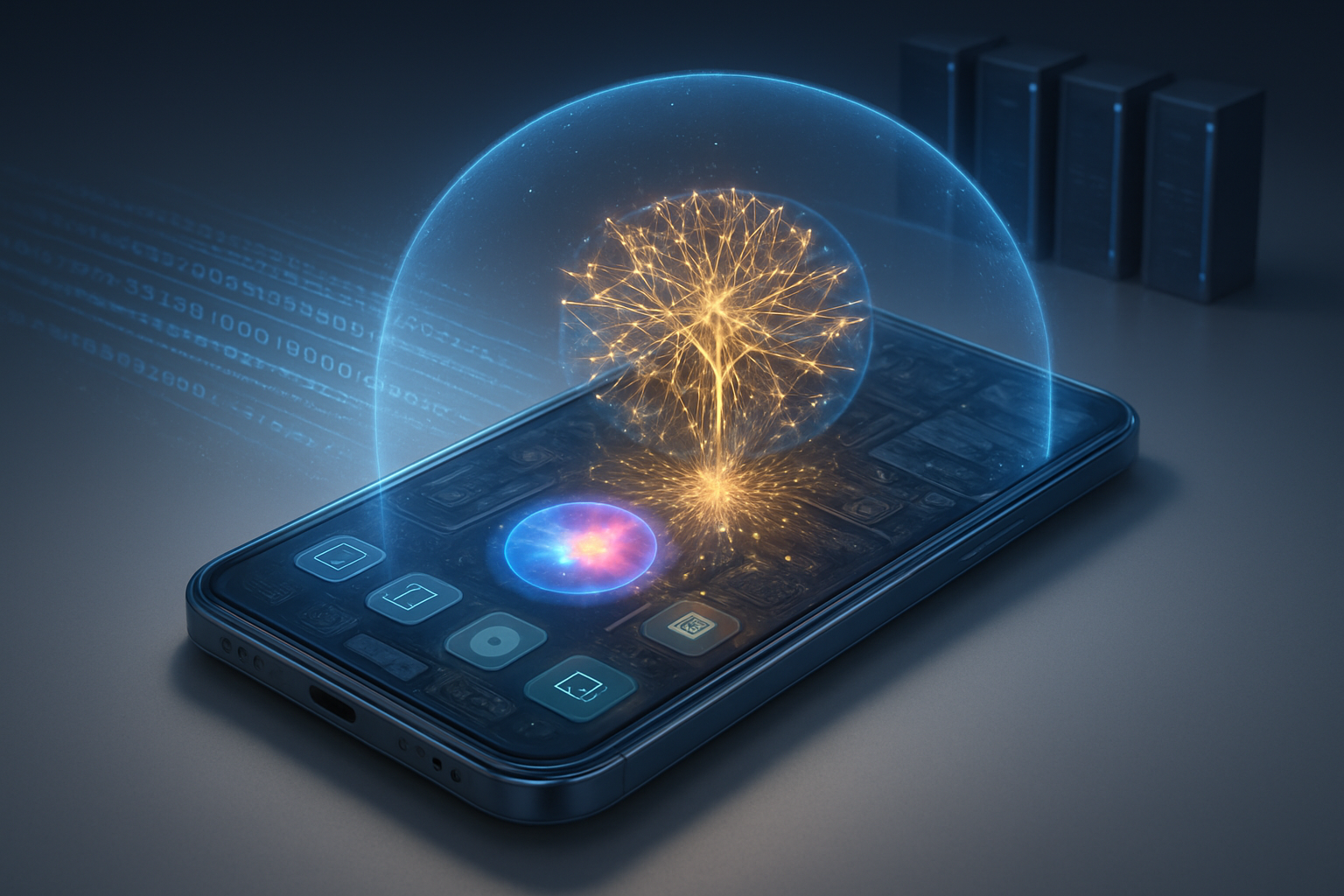
    At the heart of Apple Intelligence sits the AFM-on-device (Apple Foundation Model), a 3-billion-parameter large language model (LLM) designed for extreme efficiency. Unlike general-purpose models that require massive server farms, Apple’s 3B model utilizes mixed 2-bit and 4-bit quantization via Low-Rank Adaptation (LoRA) adapters. This allows the model to reside within the 8GB to 12GB RAM constraints of modern Apple devices while delivering the reasoning capabilities previously seen in much larger models. On the latest iPhone 17 Pro, this model achieves a staggering 30 tokens per second with a latency of less than one millisecond, making interactions feel instantaneous rather than "processed."

    To handle queries that exceed the 3B model's capacity, Apple has pioneered Private Cloud Compute (PCC). Running on custom M5-series silicon in dedicated Apple data centers, PCC is a stateless environment where user data is processed entirely in encrypted memory. In a significant shift for 2026, Apple now hosts third-party model weights—including those from Alphabet Inc. (NASDAQ: GOOGL)—directly on its own PCC hardware. This "intelligence routing" ensures that even when a user taps into Google’s Gemini for complex world knowledge, the raw personal context is never accessible to Google, as the entire operation occurs within Apple’s cryptographically verified secure enclave.

    Initial reactions from the AI research community have been overwhelmingly positive, particularly regarding Apple’s decision to make PCC software images publicly available for security auditing. Experts note that this "verifiable transparency" sets a new standard for cloud AI, moving beyond mere corporate promises to mathematical certainty. By keeping the "Personal Context" index local and only sending anonymized, specific sub-tasks to the cloud, Apple has effectively solved the "privacy vs. performance" paradox that has plagued the first generation of generative AI.

    Strategic Maneuvers: Subscriptions, Partnerships, and the 'Pro' Tier

    The 2026 rollout of Apple Intelligence marks a turning point in the company’s monetization strategy. While base AI features remain free, Apple has introduced an "Apple Intelligence Pro" subscription for $15 per month. This tier unlocks advanced agentic capabilities, such as Siri’s ability to perform complex, multi-step actions across different apps—for example, "Find the flight details from my email and book an Uber for that time." This positions Apple not just as a hardware vendor, but as a dominant service provider in the emerging agentic AI market, potentially disrupting standalone AI assistant startups.

    Competitive implications are significant for other tech giants. By hosting partner models on PCC, Apple has turned potential rivals like Google and OpenAI into high-level utility providers. These companies now compete to be the "preferred engine" inside Apple’s ecosystem, while Apple retains the primary customer relationship and the high-margin subscription revenue. This strategic positioning leverages Apple’s control over the operating system to create a "gatekeeper" effect for AI agents, where third-party apps must integrate with Apple’s App Intent framework to be visible to the new Siri.

    Furthermore, Apple's recent acquisition and integration of creative tools like Pixelmator Pro into its "Apple Creator Studio" demonstrates a clear intent to challenge Adobe Inc. (NASDAQ: ADBE). By embedding AI-driven features like "Super Resolution" upscaling and "Magic Fill" directly into the OS at no additional cost for Pro subscribers, Apple is creating a vertically integrated creative ecosystem that leverages its custom Neural Engine (ANE) hardware more effectively than any cross-platform competitor.

    A Paradigm Shift in the Global AI Landscape

    Apple’s "local-first" approach represents a broader trend toward Edge AI, where the heavy lifting of machine learning moves from massive data centers to the devices in our hands. This shift addresses two of the biggest concerns in the AI era: energy consumption and data sovereignty. By processing the majority of requests locally, Apple significantly reduces the carbon footprint associated with constant cloud pings, a move that aligns with its 2030 carbon-neutral goals and puts pressure on cloud-heavy competitors to justify their environmental impact.

    The significance of the 2026 Siri overhaul cannot be overstated; it marks the transition from "AI as a feature" to "AI as the interface." In previous years, AI was something users went to a specific app to use (like ChatGPT). In the 2026 Apple ecosystem, AI is the translucent layer that sits between the user and every application. This mirrors the revolutionary impact of the original iPhone’s multi-touch interface, replacing menus and search bars with a singular, context-aware conversational thread.

    However, this transition is not without concerns. Critics point to the "walled garden" becoming even more reinforced. As Siri becomes the primary way users interact with their data, the difficulty of switching to Android or a different ecosystem increases exponentially. The "Personal Context" index is a powerful tool for convenience, but it also creates a massive level of vendor lock-in that will likely draw the attention of antitrust regulators in the EU and the US throughout 2026 and 2027.

    The Horizon: From 'Glenwood' to 'Campos'

    Looking ahead to the remainder of 2026, Apple has a two-phased roadmap for its AI evolution. The first phase, codenamed "Glenwood," is currently rolling out with iOS 26.2. It focuses on the "Siri LLM," which eliminates the rigid, intent-based responses of the past in favor of a natural, fluid dialogue system that understands screen content. This allows users to say "Send this to John" while looking at a photo or a document, and the AI correctly identifies both the "this" and the most likely "John."

    The second phase, codenamed "Campos," is expected in late 2026. This is rumored to be a full-scale "Siri Chatbot" built on Apple Foundation Model Version 11. This update aims to provide a sustained, multi-day conversational memory, where the assistant remembers preferences and ongoing projects across weeks of interaction. This move toward long-term memory and autonomous agency is what experts predict will be the next major battleground for AI, moving beyond simple task execution into proactive life management.

    The challenge for Apple moving forward will be maintaining this level of privacy as the AI becomes more deeply integrated into the user's life. As the system begins to anticipate needs—such as suggesting a break when it senses a stressful schedule—the boundary between helpful assistant and invasive observer will blur. Apple’s success will depend on its ability to convince users that its "Privacy-First" branding is more than a marketing slogan, but a technical reality backed by the PCC architecture.

    The New Standard for Intelligent Computing

    As we move further into 2026, it is clear that Apple’s "local-first" gamble has paid off. By refusing to follow the industry trend of sending every keystroke to the cloud, the company has built a unique value proposition centered on trust, speed, and seamless integration. The 3-billion-parameter on-device model has proven that you don't need a trillion parameters to be useful; you just need the right parameters in the right place.

    The 2026 Siri overhaul is the definitive end of the "Siri is behind" narrative. Through a combination of massive hardware advantages in the A19 Pro and a sophisticated "intelligence routing" system that utilizes Private Cloud Compute, Apple has created a platform that is both more private and more capable than its competitors. This development will likely be remembered as the moment when AI moved from being an experimental tool to an invisible, essential part of the modern computing experience.

    In the coming months, keep a close watch on the adoption rates of the Apple Intelligence Pro tier and the first independent security audits of the PCC "Campos" update. These will be the key indicators of whether Apple can maintain its momentum as the undisputed leader in private, edge-based artificial intelligence.


    This content is intended for informational purposes only and represents analysis of current AI developments.

    TokenRing AI delivers enterprise-grade solutions for multi-agent AI workflow orchestration, AI-powered development tools, and seamless remote collaboration platforms.
    For more information, visit https://www.tokenring.ai/.
  • The Privacy-First Powerhouse: Apple’s Strategic Roadmap to Put Generative AI in Two Billion Pockets

    The Privacy-First Powerhouse: Apple’s Strategic Roadmap to Put Generative AI in Two Billion Pockets

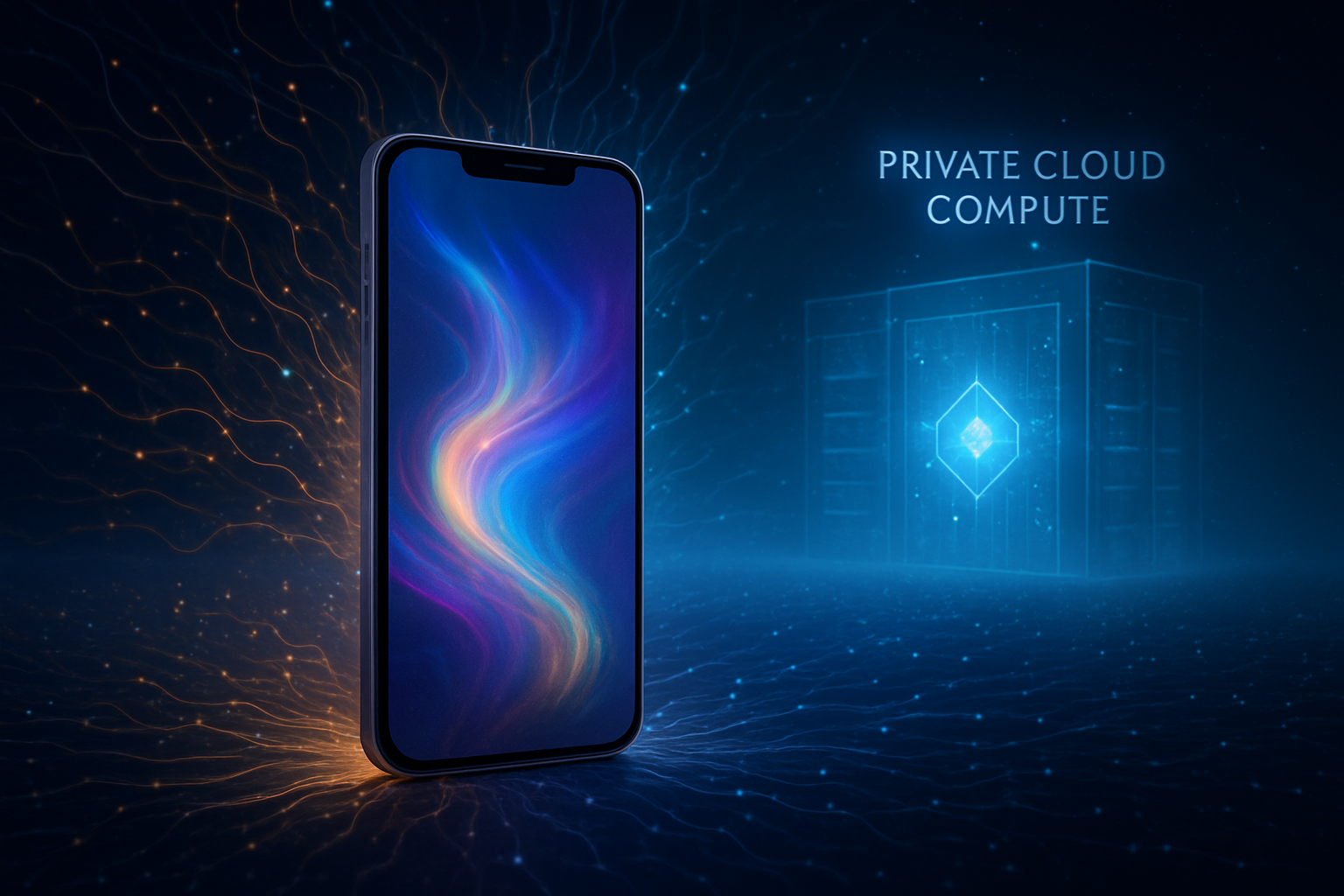
    Just days after the landmark announcement of a multi-year partnership with Alphabet Inc. (NASDAQ: GOOGL), Apple (NASDAQ: AAPL) has solidified its position in the artificial intelligence arms race. On January 12, 2026, the Cupertino giant confirmed that Google’s Gemini 3 will now serve as the foundational engine for Siri’s high-level reasoning, marking a definitive shift in Apple’s roadmap. By combining Google's advanced large language models with Apple’s proprietary "Private Cloud Compute" (PCC) infrastructure, the company is finally executing its plan to bring sophisticated generative AI to its massive global install base of over 2.3 billion active devices.

    This week’s developments represent the culmination of a two-year pivot for Apple. While the company initially positioned itself as a "on-device only" AI player, the reality of 2026 demands a hybrid approach. Apple’s strategy is now clear: use on-device processing for speed and intimacy, use the "Baltra" custom silicon in the cloud for complexity, and lease the "world knowledge" of Gemini to ensure Siri is no longer outmatched by competitors like Microsoft (NASDAQ: MSFT) or OpenAI.

    The Silicon Backbone: Private Cloud Compute and the 'Baltra' Breakthrough

    The technical cornerstone of this roadmap is the evolution of Private Cloud Compute (PCC). Unlike traditional cloud AI that stores user data or logs prompts for training, PCC utilizes a "stateless" environment. Data sent to Apple’s AI data centers is processed in isolated enclaves where it is never stored and remains inaccessible even to Apple’s own engineers. To power this, Apple has transitioned from off-the-shelf server chips to a dedicated AI processor codenamed "Baltra." Developed in collaboration with Broadcom (NASDAQ: AVGO), these 3nm chips are specialized for large language model (LLM) inference, providing the necessary throughput to handle the massive influx of requests from the iPhone 17 and the newly released iPhone 16e.

    This technical architecture differs fundamentally from the approaches taken by Amazon (NASDAQ: AMZN) or Google. While other giants prioritize data collection to improve their models, Apple has built a "privacy-sealed vehicle." By releasing its Virtual Research Environment (VRE) in late 2025, Apple allowed third-party security researchers to cryptographically verify its privacy claims. This move has largely silenced critics in the AI research community who previously argued that "cloud AI" and "privacy" were mutually exclusive terms. Experts now view Apple’s hybrid model—where the phone decides whether a task is "personal" (processed on-device) or "complex" (sent to PCC)—as the new gold standard for consumer AI safety.

    A New Era of Competition: The Apple-Google Paradox

    The integration of Gemini 3 into the Apple ecosystem has sent shockwaves through the tech industry. For Alphabet, the deal is a massive victory, reportedly worth over $1 billion annually, securing its place as the primary search and intelligence provider for the world’s most lucrative user base. However, for Samsung (KRX: 005930) and other Android manufacturers, the move erodes one of their key advantages: the perceived "intelligence gap" between Siri and the Google Assistant. By adopting Gemini, Apple has effectively commoditized the underlying model while focusing its competitive energy on the user experience and privacy.

    This strategic positioning places significant pressure on NVIDIA (NASDAQ: NVDA) and Microsoft. As Apple increasingly moves toward its own "Baltra" silicon for its cloud needs, its reliance on generic AI server farms diminishes. Furthermore, startups in the AI agent space now face a formidable "incumbent moats" problem. With Siri 2.0 capable of "on-screen awareness"—meaning it can see what is in your apps and take actions across them—the need for third-party AI assistants has plummeted. Apple is not just selling a phone anymore; it is selling a private, proactive agent that lives across a multi-device ecosystem.

    Normalizing the 'Intelligence' Brand: The Social and Regulatory Shift

    Beyond the technical and market implications, Apple’s roadmap is a masterclass in AI normalization. By branding its features as "Apple Intelligence" rather than "Generative AI," the company has successfully distanced itself from the "hallucination" and "deepfake" controversies that plagued 2024 and 2025. The phased rollout, which saw expansion into the European Union and Asia in mid-2025 following intense negotiations over the Digital Markets Act (DMA), has proven that Apple can navigate complex regulatory landscapes without compromising its core privacy architecture.

    The wider significance lies in the sheer scale of the deployment. By targeting 2 billion users, Apple is moving AI from a niche tool for tech enthusiasts into a fundamental utility for the average consumer. Concerns remain, however, regarding the "hardware gate." Because Apple Intelligence requires a minimum of 8GB to 12GB of RAM and high-performance Neural Engines, hundreds of millions of users with older iPhones are being pushed into a massive "super-cycle" of upgrades. This has raised questions about electronic waste and the digital divide, even as Apple touts the environmental efficiency of its new 3nm silicon.

    The Road to iOS 27 and Agentic Autonomy

    Looking ahead to the remainder of 2026, the focus will shift to "Conversational Memory" and the launch of iOS 27. Internal leaks suggest that Apple is working on a feature that allows Siri to maintain context over days or even weeks, potentially acting as a life-coach or long-term personal assistant. This "agentic AI" will be able to perform complex, multi-step tasks such as "reorganize my travel itinerary because my flight was canceled and notify my hotel," all without user intervention.

    The long-term roadmap also points toward the integration of Apple Intelligence into the rumored "Apple Glasses," expected to be teased at WWDC 2026 this June. With the foundation of Gemini for world knowledge and PCC for private processing, wearable AI represents the next frontier for the company. Challenges persist, particularly in maintaining low latency and managing the thermal demands of such powerful models on wearable hardware, but industry analysts predict that Apple’s vertical integration of software, silicon, and cloud services gives them an insurmountable lead in this category.

    Conclusion: The New Standard for the AI Era

    Apple’s January 2026 roadmap updates mark a definitive turning point in the history of personal computing. By successfully merging the raw power of Google’s Gemini with the uncompromising security of Private Cloud Compute, Apple has redefined what consumers should expect from their devices. The company has moved beyond being a hardware manufacturer to becoming a curator of "private intelligence," effectively bridging the gap between cutting-edge AI research and mass-market utility.

    As we move into the spring of 2026, the tech world will be watching the public rollout of Siri 2.0 with bated breath. The success of this launch will determine if Apple can maintain its premium status in an era where software intelligence is the new currency. For now, one thing is certain: the goal of putting generative AI in the pockets of two billion people is no longer a vision—it is an operational reality.


    This content is intended for informational purposes only and represents analysis of current AI developments.

    TokenRing AI delivers enterprise-grade solutions for multi-agent AI workflow orchestration, AI-powered development tools, and seamless remote collaboration platforms.
    For more information, visit https://www.tokenring.ai/.
  • The Intelligence Revolution: How Apple’s 2026 Ecosystem is Redefining the ‘AI Supercycle’

    The Intelligence Revolution: How Apple’s 2026 Ecosystem is Redefining the ‘AI Supercycle’

    As of January 1, 2026, the technology landscape has been fundamentally reshaped by the full-scale maturation of Apple Intelligence. What began as a series of tentative beta features in late 2024 has evolved into a seamless, multi-modal operating system experience that has triggered the long-anticipated "AI Supercycle." With the recent release of the iPhone 17 Pro and the continued rollout of advanced features in the iOS 19.x cycle, Apple Inc. (NASDAQ: AAPL) has successfully transitioned from a hardware-centric giant into the world’s leading provider of consumer-grade, privacy-first artificial intelligence.

    The immediate significance of this development cannot be overstated. By integrating generative AI directly into the core of iOS, macOS, and iPadOS, Apple has moved beyond the "chatbot" era and into the "agentic" era. The current ecosystem allows for a level of cross-app orchestration and personal context awareness that was considered experimental just eighteen months ago. This integration has not only revitalized iPhone sales but has also set a new industry standard for how artificial intelligence should interact with sensitive user data.

    Technical Foundations: From iOS 18.2 to the A19 Era

    The technical journey to this point was anchored by the pivotal rollout of iOS 18.2, which introduced the first wave of "creative" AI tools such as Genmoji, Image Playground, and the dedicated Visual Intelligence interface. By 2026, these tools have matured significantly. Genmoji and Image Playground have moved past their initial "cartoonish" phase, now utilizing more sophisticated diffusion models that can generate high-fidelity illustrations and sketches while maintaining strict guardrails against photorealistic deepfakes. Visual Intelligence, triggered via the dedicated Camera Control on the iPhone 16 and 17 series, has evolved into a comprehensive "Screen-Aware" system. Users can now identify objects, translate live text, and even pull data from third-party apps into their calendars with a single press.

    Underpinning these features is the massive hardware leap found in the iPhone 17 series. To support the increasingly complex on-device Large Language Models (LLMs), Apple standardized 12GB of RAM across its Pro lineup, a necessary upgrade from the 8GB floor seen in the iPhone 16. The A19 chip features a redesigned Neural Engine with dedicated "Neural Accelerators" in every core, providing a 40% increase in AI throughput. This hardware allows for "Writing Tools" to function in a new "Compose" mode, which can draft long-form documents in a user’s specific voice by locally analyzing past communications—all without the data ever leaving the device.

    For tasks too complex for on-device processing, Apple’s Private Cloud Compute (PCC) has become the gold standard for secure AI. Unlike traditional cloud AI, which often processes data in a readable state, PCC uses custom Apple silicon in the data center to ensure that user data is never stored or accessible, even to Apple itself. This "Stateless AI" architecture has largely silenced critics who argued that generative AI was inherently incompatible with user privacy.

    Market Dynamics and the Competitive Landscape

    The success of Apple Intelligence has sent ripples through the entire tech sector. Apple (NASDAQ: AAPL) has seen a significant surge in its services revenue and hardware upgrades, as the "AI Supercycle" finally took hold in late 2025. This has placed immense pressure on competitors like Samsung (KRX: 005930) and Alphabet Inc. (NASDAQ: GOOGL). While Google’s Pixel 10 and Gemini Live offer superior "world knowledge" and proactive suggestions, Apple has maintained its lead in the premium market by focusing on "Invisible AI"—features that work quietly in the background to simplify existing workflows rather than requiring the user to interact with a standalone assistant.

    OpenAI has also emerged as a primary beneficiary of this rollout. The deep integration of ChatGPT (now utilizing the GPT-5 architecture as of late 2025) as Siri’s primary "World Knowledge" fallback has solidified OpenAI’s position in the consumer market. However, 2026 has also seen Apple begin to diversify its partnerships. Under pressure from global regulators, particularly in the European Union, Apple has started integrating Gemini and Anthropic’s Claude as optional "Intelligence Partners," allowing users to choose their preferred external model for complex reasoning.

    This shift has disrupted the traditional app economy. With Siri now capable of performing multi-step actions across apps—such as "Find the receipt from yesterday, crop it, and email it to my accountant"—third-party developers have been forced to adopt the "App Intents" framework or risk becoming obsolete. Startups that once focused on simple AI wrappers are struggling to compete with the system-level utility now baked directly into the iPhone and Mac.

    Privacy, Utility, and the Global AI Landscape

    The wider significance of Apple’s AI strategy lies in its "privacy-first" philosophy. While Microsoft (NASDAQ: MSFT) and Google have leaned heavily into cloud-based Copilots, Apple has proven that a significant portion of generative AI utility can be delivered on-device or through verifiable private clouds. This has created a bifurcated AI landscape: one side focuses on raw generative power and data harvesting, while the other—led by Apple—focuses on "Personal Intelligence" that respects the user’s digital boundaries.

    However, this approach has not been without its challenges. The rollout of Apple Intelligence in regions like China and the EU has been hampered by local data residency and AI safety laws. In 2026, Apple is still navigating complex negotiations with Chinese providers like Baidu and Alibaba to bring a localized version of its AI features to the world's largest smartphone market. Furthermore, the "AI Supercycle" has raised environmental concerns, as the increased compute requirements of LLMs—even on-device—demand more power and more frequent hardware turnover.

    Comparisons are already being made to the original iPhone launch in 2007 or the transition to the App Store in 2008. Industry experts suggest that we are witnessing the birth of the "Intelligent OS," where the interface between human and machine is no longer a series of icons and taps, but a continuous, context-aware conversation.

    The Horizon: iOS 20 and the Future of Agents

    Looking forward, the industry is already buzzing with rumors regarding iOS 20. Analysts predict that Apple will move toward "Full Agency," where Siri can proactively manage a user’s digital life—booking travel, managing finances, and coordinating schedules—with minimal human intervention. The integration of Apple Intelligence into the rumored "Vision Pro 2" and future lightweight AR glasses is expected to be the next major frontier, moving AI from the screen into the user’s physical environment.

    The primary challenge moving forward will be the "hallucination" problem in personal context. While GPT-5 has significantly reduced errors in general knowledge, the stakes are much higher when an AI is managing a user’s personal calendar or financial data. Apple is expected to invest heavily in "Formal Verification" for AI actions, ensuring that the assistant never takes an irreversible step (like sending a payment) without explicit, multi-factor confirmation.

    A New Era of Personal Computing

    The integration of Apple Intelligence into the iPhone and Mac ecosystem marks a definitive turning point in the history of technology. By the start of 2026, the "AI Supercycle" has moved from a marketing buzzword to a tangible reality, driven by a combination of high-performance A19 silicon, 12GB RAM standards, and the unprecedented security of Private Cloud Compute.

    The key takeaway for 2026 is that AI is no longer a destination or a specific app; it is the fabric of the operating system itself. Apple has successfully navigated the transition by prioritizing utility and privacy over "flashy" generative demos. In the coming months, the focus will shift to how Apple expands this intelligence into its broader hardware lineup and how it manages the complex regulatory landscape of a world that is now permanently augmented by AI.


    This content is intended for informational purposes only and represents analysis of current AI developments.

    TokenRing AI delivers enterprise-grade solutions for multi-agent AI workflow orchestration, AI-powered development tools, and seamless remote collaboration platforms.
    For more information, visit https://www.tokenring.ai/.
  • Apple’s Global AI Conquest: The Great Wall of Intelligence and the Alibaba Pivot

    Apple’s Global AI Conquest: The Great Wall of Intelligence and the Alibaba Pivot

    As 2025 draws to a close, Apple Inc. (NASDAQ: AAPL) has successfully transitioned from a perceived laggard in the generative AI race to a dominant "AI Orchestrator." The global rollout of Apple Intelligence, culminating in a landmark partnership with Alibaba Group Holding Ltd (NYSE: BABA) for the Chinese market, marks a pivotal moment in the history of consumer technology. By deeply embedding artificial intelligence into the core of iOS, Apple has effectively moved AI from a standalone novelty into a seamless, proactive layer of daily computing for over a billion users worldwide.

    The significance of this rollout cannot be overstated. While competitors rushed to launch cloud-heavy chatbots, Apple spent the last eighteen months perfecting a "Privacy-First" hybrid model that balances on-device processing with its revolutionary Private Cloud Compute (PCC). This strategy has not only redefined user expectations for digital privacy but has also allowed Apple to navigate the complex geopolitical landscape of China, where it has successfully integrated localized AI models to meet strict regulatory requirements while maintaining the cohesive user experience that defines its brand.

    The Technical Architecture of Siri 2.0 and the "Digital Border"

    The 2025 iteration of Apple Intelligence, showcased in the latest releases of iOS, represents a fundamental shift in how humans interact with machines. At the heart of this advancement is "Siri 2.0," an agentic AI system that possesses full on-screen awareness and cross-app action capabilities. Unlike previous iterations that relied on simple voice-to-text triggers, the new Siri can understand the context of what a user is looking at—whether it's an email, a photo, or a complex spreadsheet—and perform multi-step tasks across different applications. For instance, a user can now command Siri to "take the address from this email and add it to my Friday calendar event with a fifteen-minute buffer," a task that requires semantic understanding of both the content and the user's personal schedule.

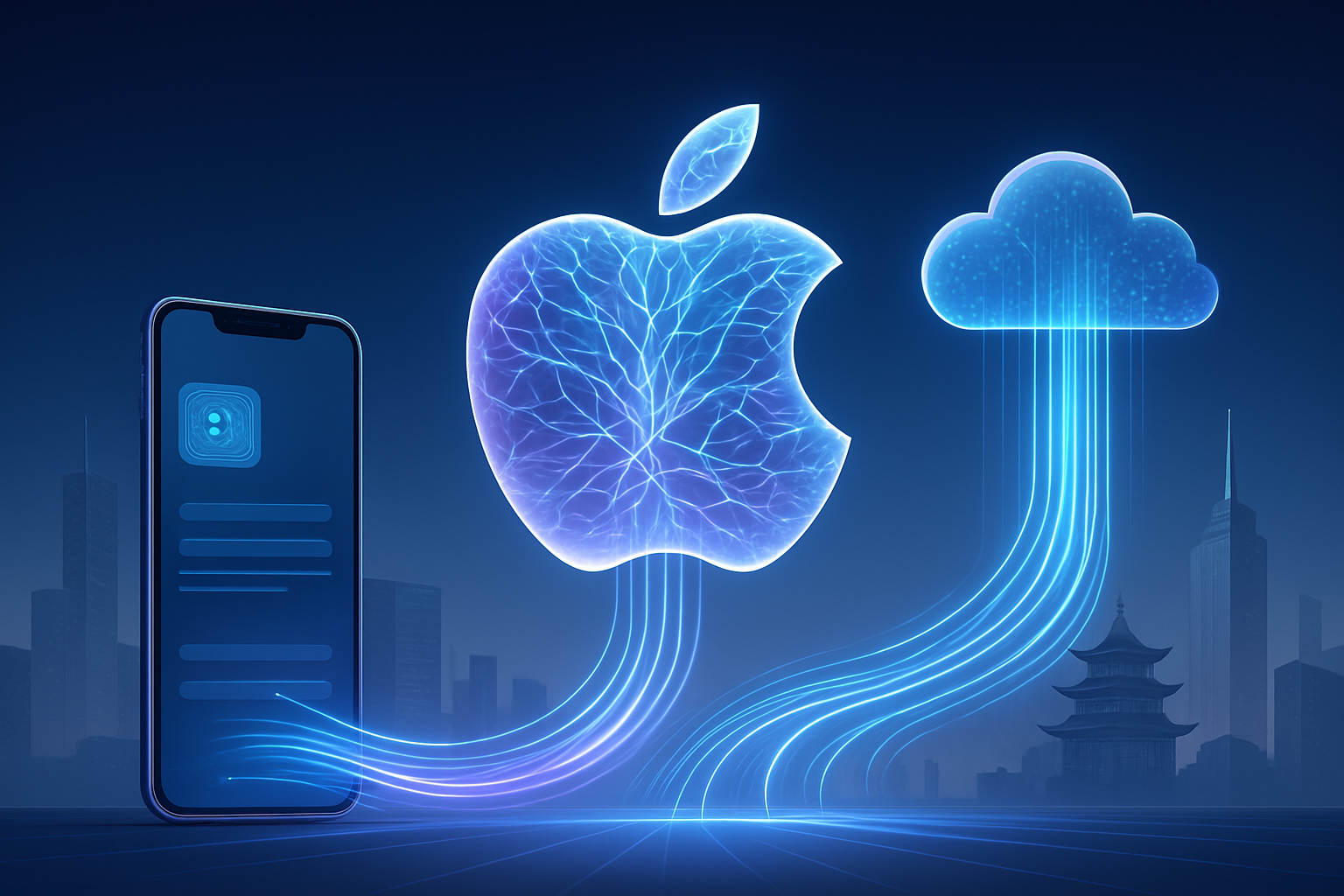
    To bring these features to the Chinese market, Apple orchestrated a sophisticated technical "digital border." Because global partners like OpenAI are restricted in China, Apple collaborated with Alibaba to integrate its Tongyi Qianwen (Qwen) large language models into the iOS ecosystem. This partnership involves a localized version of Apple Intelligence where Alibaba provides the "intelligence layer" for general tasks, while Baidu (NASDAQ: BIDU) handles specialized functions like Visual Intelligence and localized search. This system underwent a rigorous "2,000-question test" by the Cyberspace Administration of China (CAC), requiring the AI to successfully navigate sensitive political and social queries to gain commercial approval.

    Initial reactions from the AI research community have been overwhelmingly positive, particularly regarding Apple’s Private Cloud Compute (PCC). By late 2025, Apple began publishing public software images of every PCC production build, allowing independent security researchers to verify that user data is never stored or accessible to the company. This "verifiable transparency" has set a new industry benchmark, forcing rivals like Alphabet Inc. (NASDAQ: GOOGL) and Samsung Electronics Co., Ltd. (OTC: SSNLF) to rethink their own cloud-based AI architectures to compete with Apple's privacy-centric model.

    Market Positioning and the "Sherlocking" of AI Startups

    The global rollout has fundamentally altered the competitive landscape of the tech industry. Apple has positioned itself as the "AI Orchestrator," a gatekeeper that allows users to "plug in" their preferred third-party models—such as ChatGPT or Google Gemini—while keeping the core user data within Apple's secure environment. This strategy has commoditized the underlying LLMs, preventing any single AI lab from owning the user relationship. While OpenAI has benefited from massive distribution through Apple's ecosystem, it now finds itself in a position where its "intelligence" is just one of many options available to the iOS user.

    The impact on the broader startup ecosystem has been more disruptive. Many specialized AI applications that focused on singular tasks like grammar correction, basic photo editing, or automated scheduling have been "Sherlocked"—a term used when Apple integrates a startup's core functionality directly into the operating system. With system-wide "Writing Tools" and "Image Playground" now native to iOS, many independent AI developers are being forced to pivot toward building deep integrations with Apple Intelligence rather than trying to compete as standalone platforms.

    In the Chinese market, the Alibaba partnership has been a masterstroke. After facing declining sales in early 2025 due to "patriotic buying" of domestic brands like Huawei, Apple saw a 37% year-over-year surge in iPhone sales in late 2025. By offering a fully compliant, localized AI experience that feels identical to the global version, Apple has recaptured the affluent demographic in China that values both high-end hardware and seamless software integration.

    The Broader Significance: Privacy as a Product

    Apple's AI strategy represents a significant milestone in the broader AI landscape, signaling a shift away from "data-at-any-cost" toward "privacy-by-design." For years, the tech industry operated under the assumption that powerful AI required a trade-off in personal privacy. Apple has challenged this narrative by proving that complex, agentic AI can function on-device or within a verifiable cloud environment. This move fits into a larger trend of consumer pushback against data harvesting and represents a major victory for digital rights advocates.

    However, the localized rollout in China has also raised concerns about the fragmentation of the internet. The "digital border" Apple has created ensures that an iPhone in Shanghai operates with a fundamentally different "truth" than an iPhone in San Francisco, as the Alibaba-powered models are tuned to comply with local censorship laws. This highlights a potential future where AI is not a global, unifying technology, but a localized one that reflects the political and social values of the region in which it resides.

    Comparatively, this rollout is being viewed as the "iPhone moment" for generative AI. Just as the original iPhone moved the internet from the desktop to the pocket, Apple Intelligence has moved the power of large language models from the data center to the palm of the hand. It marks the transition from "chatting with an AI" to "living with an AI" that manages one's digital life autonomously.

    Future Developments and the A19 Era

    Looking ahead to 2026, experts predict that Apple will further lean into hardware-level AI optimization. The recently released iPhone 17 series, powered by the A19 chip, features a significantly enhanced Neural Engine specifically designed for the "Siri 2.0" agentic workflows. Near-term developments are expected to include deeper integration with the Apple Vision Pro, where "Visual Intelligence" will allow the headset to understand and interact with the user's physical surroundings in real-time, providing an augmented reality experience that is contextually aware.

    The next major challenge for Apple will be the expansion of "Actionable AI." While Siri can now perform tasks across apps, the next frontier is "Agentic Autonomy," where the AI can proactively manage tasks without a direct prompt—such as automatically rescheduling a meeting when it detects a flight delay or proactively suggesting a gift for a friend's upcoming birthday based on past conversations. These developments will require even more sophisticated on-device reasoning and further refinements to the Private Cloud Compute infrastructure.

    A New Chapter in AI History

    The global rollout of Apple Intelligence and the successful navigation of the Chinese market through the Alibaba partnership mark the beginning of a new era for Apple. By prioritizing privacy and deep OS integration, Apple has not only secured its position in the AI age but has also set the standard for how AI should be delivered to the masses. The company’s climb to a $4 trillion market capitalization in late 2025 is a testament to the success of this "patience and privacy" strategy.

    Key takeaways from this development include the successful localization of AI in restricted markets, the emergence of the "AI Orchestrator" model, and the validation of verifiable privacy as a core product feature. In the coming months, the industry will be watching closely to see how Google and Samsung respond to Apple's "Siri 2.0" and whether the Alibaba-powered Apple Intelligence in China can maintain its momentum against domestic rivals. For now, Apple has once again proven that while it may not always be the first to a new technology, its ability to refine and integrate that technology into the lives of millions is unparalleled.


    This content is intended for informational purposes only and represents analysis of current AI developments.

    TokenRing AI delivers enterprise-grade solutions for multi-agent AI workflow orchestration, AI-powered development tools, and seamless remote collaboration platforms.
    For more information, visit https://www.tokenring.ai/.