Tag: Retail AI

  • AI Takes the Reins: How Smart Tools Are Revolutionizing Holiday Savings for Consumers

    AI Takes the Reins: How Smart Tools Are Revolutionizing Holiday Savings for Consumers

    As the 2025 holiday shopping season kicks into full gear, artificial intelligence (AI) is emerging as an indispensable ally for consumers navigating the often-stressful quest for the best deals and maximum savings. With a significant portion of shoppers, particularly Gen Z, planning to leverage AI tools, this year marks a pivotal shift where intelligent algorithms are becoming the central engine of the shopping experience, moving far beyond mere product discovery to actively optimize spending and unearth unparalleled value. This widespread adoption underscores a growing consumer reliance on AI to stretch budgets and find the perfect gifts without breaking the bank.

    The Technical Edge: AI's Arsenal for Smart Shopping

    The array of AI tools at consumers' fingertips this holiday season is both sophisticated and diverse, offering a powerful suite of functionalities that dramatically alter traditional shopping methods. At the forefront are personalized recommendation engines. These advanced AI algorithms meticulously analyze a shopper's past purchases, browsing history, wish lists, and even seasonal preferences to suggest highly relevant products and gift ideas. Companies like Amazon (NASDAQ: AMZN), with its AI assistant Rufus, exemplify this by tailoring experiences based on individual shopping activity, ensuring that money is spent on genuinely desired goods rather than impulsive buys. This personalized approach significantly reduces decision fatigue and improves the efficiency of gift-finding.

    Beyond recommendations, AI-powered price comparison and deal aggregators have become exceptionally adept at scouring the vast digital marketplace. Platforms such as Klarna AI and PayPal (NASDAQ: PYPL) Honey, which is increasingly integrating into AI conversational interfaces, can compare prices across countless retailers in real-time, track price fluctuations over time, and even predict optimal buying windows for specific items. These tools go a step further by identifying obscure deals and automatically applying available coupons or promo codes at checkout, guaranteeing that shoppers capitalize on every possible discount. Microsoft (NASDAQ: MSFT) Copilot also offers robust features for price comparison and deal discovery, providing a seamless experience within existing digital ecosystems.

    Furthermore, smart shopping assistants and generative AI chatbots like ChatGPT, Google's (NASDAQ: GOOGL) Gemini, and Microsoft Copilot are transforming into highly capable personal shopping concierges. These tools can answer detailed product questions, summarize extensive customer reviews, generate tailored gift ideas based on specific criteria (e.g., "eco-friendly gifts for a gardener under $75"), and facilitate side-by-side comparisons of product features. Their conversational interfaces make complex research accessible, and some are even evolving to facilitate direct purchases, aiming to become a 'one-stop-shop' for both discovery and transaction. An emerging and particularly powerful application for 2025 is agentic AI, where these intelligent agents can manage entire shopping tasks, from tracking prices and comparing models to autonomously executing a purchase when the best deal materializes, freeing consumers from constant vigilance. Lastly, visual search and image recognition tools, such such as those integrated into Klarna AI, allow users to upload photos or screenshots of desired items to instantly locate identical or similar products across various retailers, streamlining the price comparison process for visually discovered goods.

    Corporate Playbook: How AI Shapes the Retail Landscape

    The pervasive integration of AI into holiday shopping has profound implications for AI companies, tech giants, and innovative startups alike. Nearly all major U.S. retailers (a staggering 97%) are strategically deploying AI to enhance various aspects of the shopping experience this holiday season. While much of this AI operates behind the scenes—improving customer service, optimizing audience targeting, and streamlining inventory management—it directly benefits consumers through better pricing, improved product availability, and more relevant offers.

    Tech behemoths like Amazon (NASDAQ: AMZN), Microsoft (NASDAQ: MSFT), Google (NASDAQ: GOOGL), and PayPal (NASDAQ: PYPL) are at the forefront, leveraging their vast resources and data to develop sophisticated AI-powered shopping tools. Amazon's Rufus, Microsoft Copilot, Google Gemini, and PayPal Honey are prime examples of how these companies are embedding AI directly into consumer-facing platforms, aiming to capture a larger share of the holiday spending by offering unparalleled convenience and savings. Startups focusing on niche AI applications, such as advanced coupon aggregators or hyper-personalized gift recommendation engines, also stand to benefit by either being acquired by larger players or carving out their own market share through specialized, highly effective solutions. The competitive landscape is intensifying, with companies vying to offer the most intuitive, comprehensive, and money-saving AI tools. This shift also represents a significant disruption to traditional search engine reliance for product discovery; a late 2024 survey indicated that 58% of global consumers now prefer generative AI over traditional search for product recommendations, signaling a major paradigm shift in how consumers initiate their shopping journeys.

    Broader Implications: AI's Expanding Footprint in Commerce

    The widespread embrace of AI in holiday shopping is a clear indicator of its rapidly expanding footprint across the broader AI landscape and consumer commerce. This trend highlights a growing trust and reliance on intelligent systems to navigate complex decisions, especially in economically sensitive periods. The impact on consumer behavior is substantial: data from 2024 revealed that AI-powered recommendations influenced 19% of purchases, a figure expected to rise significantly in 2025. This year, between 39% and 75% of consumers are planning to actively use AI for tasks like deal-finding and price comparison, driven by a collective desire to spend smarter, with 74% anticipating spending the same or less than last year and many requiring at least a 15% discount to make a purchase.

    The growth in traffic from generative AI tools to U.S. retail sites, which saw an "incredible 1,300%" increase during the 2024 holiday season and continued to surge into 2025, underscores AI's escalating influence on shopping journeys. This isn't just about saving money; it's also about convenience and personalization. Consumers are increasingly looking to AI to make holiday shopping less stressful and more enjoyable, with 50% of global consumers anticipating these benefits from AI agents. While the advantages are clear, potential concerns around data privacy and security remain. As AI tools collect more personal shopping data to offer tailored recommendations and deals, ensuring the ethical handling and protection of this information will be paramount. This current wave of AI integration can be compared to the advent of e-commerce itself, representing a foundational shift in how transactions occur and how value is perceived and delivered to the consumer.

    The Horizon: What's Next for AI in Retail

    Looking ahead, the evolution of AI in consumer savings and retail is poised for even more transformative developments. The concept of agentic checkout, where AI agents autonomously manage and execute shopping tasks from start to finish, is expected to become more prevalent. These agents could monitor desired products, wait for optimal price drops, and complete purchases without direct user intervention, offering unparalleled convenience. We can anticipate the continued sophistication of personalized shopping assistants, moving beyond recommendations to proactive planning, managing gift lists across multiple recipients, and even coordinating deliveries.

    However, challenges remain. Building and maintaining consumer trust in these autonomous systems, especially concerning sensitive financial transactions and personal data, will be crucial. Ensuring transparency in how AI makes decisions and provides recommendations will also be vital to widespread adoption. Experts predict that the lines between traditional shopping, online retail, and AI-driven commerce will continue to blur, leading to a hyper-personalized and hyper-efficient shopping ecosystem. The integration of AI with augmented reality (AR) and virtual reality (VR) could also offer immersive shopping experiences that allow consumers to "try on" or visualize products before purchase, further optimizing spending by reducing returns and buyer's remorse. The next few years will likely see AI becoming an even more embedded and indispensable part of the entire consumer purchasing lifecycle.

    Wrapping Up: AI's Enduring Impact on Holiday Spending

    In summary, the 2025 holiday shopping season marks a significant milestone in the integration of artificial intelligence into daily consumer life, particularly as a powerful tool for saving money and finding deals. From personalized recommendation engines and sophisticated price comparison tools to intelligent shopping assistants and the nascent rise of agentic AI, these technologies are fundamentally reshaping how consumers approach their holiday spending. The key takeaways are clear: AI is empowering shoppers with unprecedented control over their budgets, offering convenience, personalization, and efficiency that traditional methods simply cannot match.

    This development is not just a seasonal trend; it represents a critical juncture in AI history, underscoring its practical utility beyond enterprise applications to directly benefit individual consumers. The widespread adoption by both retailers and shoppers signals a permanent shift in the retail landscape, where AI is no longer a novelty but a core component of the purchasing journey. In the coming weeks and months, we should watch for continued advancements in agentic AI capabilities, further integration of AI into existing financial and shopping platforms, and ongoing discussions around data privacy and ethical AI use. As consumers become more adept at leveraging these smart tools, AI will continue to solidify its position as an essential guide through the complexities of modern commerce, making every holiday season smarter and more budget-friendly.


    This content is intended for informational purposes only and represents analysis of current AI developments.

    TokenRing AI delivers enterprise-grade solutions for multi-agent AI workflow orchestration, AI-powered development tools, and seamless remote collaboration platforms.
    For more information, visit https://www.tokenring.ai/.

  • Walmart and OpenAI Forge Groundbreaking Alliance for AI-Driven Shopping via ChatGPT

    Walmart and OpenAI Forge Groundbreaking Alliance for AI-Driven Shopping via ChatGPT

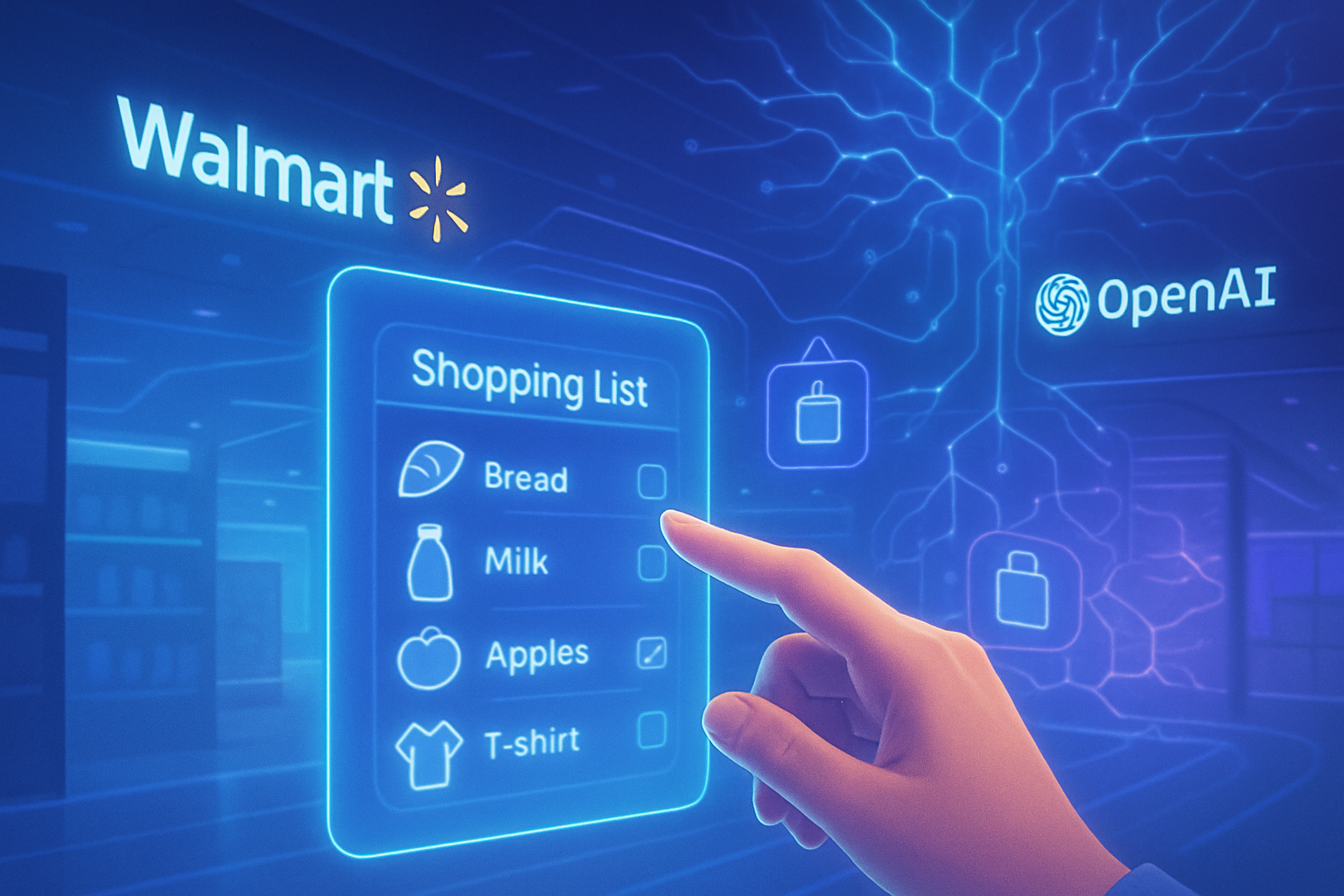
    In a landmark announcement that sent ripples across the retail and technology sectors yesterday, October 14, 2025, retail behemoth Walmart (NYSE: WMT) officially unveiled a strategic partnership with artificial intelligence pioneer OpenAI. This collaboration is set to revolutionize the online shopping experience by integrating advanced AI capabilities directly into ChatGPT, allowing customers to engage in "agentic commerce" through conversational interfaces. The move signals a significant leap in how consumers will interact with e-commerce platforms, promising a future where shopping is not just personalized but proactively intelligent.

    This unprecedented alliance aims to transform the transactional nature of online retail into a seamless, intuitive, and highly personalized dialogue. By leveraging OpenAI's cutting-edge language models and newly introduced "Instant Checkout" feature, Walmart is positioning itself at the forefront of AI-powered commerce, redefining convenience and efficiency for its vast customer base and loyalty members across Walmart and Sam's Club. The immediate significance lies in the potential for mass adoption of truly conversational shopping, moving beyond the traditional search bar and into a dynamic, AI-guided purchasing journey.

    The Dawn of Agentic Commerce: A Technical Deep Dive into Conversational Retail

    The core of the Walmart-OpenAI partnership lies in its innovative approach to AI-driven shopping, fundamentally shifting from reactive search to proactive, "agentic commerce." At its heart, customers will be able to "Chat and Buy" directly within ChatGPT using natural language, either through text or voice commands. This goes far beyond simple product searches; the system is designed to understand complex requests and anticipate user needs. For instance, a user planning a "Taco Tuesday" dinner can simply ask ChatGPT to find all necessary ingredients, and the AI will curate a comprehensive grocery list, ready for purchase.

    Technically, this experience is powered by OpenAI's recently launched "Instant Checkout" feature, which enables direct purchases within the ChatGPT interface. This feature, initially rolled out for Etsy sellers and slated for Shopify (NYSE: SHOP) merchants, facilitates a frictionless transaction process, eliminating the need for users to navigate to external websites or applications. The underlying mechanism, dubbed "Agentic Commerce Protocol," was co-developed by OpenAI and Stripe (NYSE: STRIP), ensuring secure and efficient payment processing. Initially, the Instant Checkout system will support single-item purchases, with ambitious plans to expand to multi-item carts and additional geographical regions, signifying a phased but rapid deployment strategy.

    This approach dramatically differs from previous e-commerce models, which predominantly relied on keyword searches, curated product listings, and manual navigation. While some retailers have experimented with AI chatbots, their functionalities have largely been limited to customer service or basic product recommendations. The Walmart-OpenAI integration, however, introduces a truly multi-media, personalized, and contextual shopping experience. It's an AI that learns, plans, and predicts, effectively acting as a personal shopping assistant that evolves with the consumer's habits and preferences. Initial reactions from the AI research community and industry experts highlight this as a pivotal moment, demonstrating the practical application of large language models (LLMs) in transforming real-world consumer interactions at an unprecedented scale.

    Reshaping the Retail Landscape: Implications for AI Companies and Tech Giants

    This groundbreaking partnership between Walmart (NYSE: WMT) and OpenAI sends a clear signal to the entire tech and retail industry: AI is no longer just a backend optimization tool but a front-facing, revenue-generating engine. Walmart stands to benefit immensely, solidifying its position as an innovator in digital retail and potentially capturing a significant share of the burgeoning conversational commerce market. By being an early mover in integrating advanced LLMs into its core shopping experience, Walmart gains a strategic advantage over competitors, particularly Amazon (NASDAQ: AMZN), which has traditionally dominated online retail. While Amazon has its own AI capabilities (like Alexa), the direct, conversational "Chat and Buy" integration within a widely adopted platform like ChatGPT represents a novel and potentially more fluid user experience.

    For OpenAI, this collaboration is a massive validation of its generative AI capabilities and its strategic push into "agentic commerce." The partnership with a retail giant like Walmart demonstrates the commercial viability and scalability of its Instant Checkout and Agentic Commerce Protocol. This move positions OpenAI not just as a developer of foundational AI models but as a critical enabler of next-generation digital marketplaces. Other AI labs and tech companies will undoubtedly feel the pressure to innovate in similar conversational commerce spaces. Companies like Google (NASDAQ: GOOGL), Meta (NASDAQ: META), and Apple (NASDAQ: AAPL), all with significant AI investments and consumer-facing platforms, will likely accelerate their efforts to integrate sophisticated shopping functionalities into their own AI assistants and ecosystems to avoid being left behind.

    The potential disruption to existing products and services is substantial. Traditional e-commerce interfaces, comparison shopping sites, and even some niche shopping apps could face significant challenges as consumers gravitate towards the ease and intelligence of AI-driven conversational shopping. Market positioning will increasingly depend on the seamless integration of AI into the customer journey, with companies that can offer personalized, predictive, and frictionless experiences gaining a significant competitive edge. This partnership underscores a strategic shift where AI companies are becoming direct partners in consumer transactions, rather than just providing underlying technology, thereby reshaping the competitive dynamics across both the AI and retail sectors.

    The Broader AI Landscape: A Paradigm Shift in Consumer Interaction

    The Walmart-OpenAI partnership represents more than just a new feature; it signifies a profound shift in the broader AI landscape, particularly in how artificial intelligence is expected to interact with and serve consumers. This move towards "agentic commerce" aligns perfectly with the overarching trend of AI becoming more proactive and less reactive. Instead of merely responding to explicit commands, AI is now being designed to anticipate needs, plan complex tasks (like meal planning), and execute multi-step processes (like shopping and checkout) autonomously. This is a significant evolution from earlier AI applications, which were often siloed or offered limited interactive capabilities.

    The impacts are far-reaching. For consumers, it promises unparalleled convenience and personalization, potentially reducing decision fatigue and saving time. Imagine an AI that not only knows your dietary preferences but also your typical shopping list, prompting you to restock essentials before you even realize you're running low. However, this level of integration also raises potential concerns, particularly around data privacy and security. The linking of personal shopping habits and financial information to an AI platform necessitates robust safeguards and transparent data handling policies. There's also the question of algorithmic bias in product recommendations and the potential for over-reliance on AI for purchasing decisions, which could impact consumer autonomy.

    Comparing this to previous AI milestones, the Walmart-OpenAI collaboration stands out as a major step in the commercialization and mainstream adoption of advanced generative AI. While the introduction of voice assistants like Alexa and Google Assistant marked an initial foray into conversational AI, their shopping capabilities remained relatively rudimentary. This new partnership, leveraging the sophisticated understanding and generation capabilities of ChatGPT, pushes the boundaries into truly intelligent and transactional conversations. It echoes the transformative impact of early e-commerce platforms but with an added layer of AI-driven intelligence that fundamentally alters the user experience, moving from browsing to a guided, predictive interaction.

    Future Horizons: What's Next for AI-Driven Retail

    Looking ahead, the Walmart-OpenAI partnership is merely the beginning of a transformative era for AI-driven retail. In the near-term, we can expect the gradual rollout of the "Chat and Buy" feature to Walmart (NYSE: WMT) and Sam's Club customers across the US, initially focusing on single-item purchases. The expansion to multi-item carts and more complex shopping scenarios, such as subscription management and personalized recommendations based on evolving lifestyle needs, is a highly anticipated next step. Beyond basic transactions, the "Agentic Commerce Protocol" could evolve to integrate with smart home devices, automatically reordering groceries when stock is low, or suggesting recipes based on available ingredients and dietary goals.

    Long-term developments are poised to see AI becoming an indispensable personal shopping agent that understands not just what you want to buy, but why, when, and how you prefer to shop. This could lead to a hyper-personalized retail experience where AI anticipates needs even before they manifest, offering curated selections, exclusive deals, and proactive problem-solving. Potential applications extend beyond groceries to fashion, electronics, and even services, with AI assisting in booking appointments or managing subscriptions based on user preferences and schedules.

    However, several challenges need to be addressed for this vision to fully materialize. Ensuring the ethical use of AI, particularly concerning data privacy and algorithmic transparency, will be paramount. Developing robust security measures to protect sensitive customer data and financial information is crucial. Furthermore, refining the AI's understanding of nuanced human language and intent, especially in complex or ambiguous shopping scenarios, will require continuous development. Experts predict that the success of this model will spur other major retailers and tech companies to invest heavily in similar "agentic" AI solutions, leading to a highly competitive landscape where the most intelligent and trustworthy AI assistants will gain consumer loyalty. The evolution of the "Instant Checkout" feature to support a wider array of merchants and product categories will also be a key indicator of its broader market impact.

    The AI Retail Revolution: A Concluding Assessment

    The recent announcement of the partnership between Walmart (NYSE: WMT) and OpenAI to launch AI-driven shopping through ChatGPT marks a pivotal moment in the history of both artificial intelligence and retail. The key takeaway is the shift towards "agentic commerce," where AI moves beyond simple chatbots to become a proactive, intelligent assistant capable of understanding complex needs, planning purchases, and executing transactions directly within a conversational interface. This integration of OpenAI's advanced language models and "Instant Checkout" feature into Walmart's vast retail ecosystem is set to redefine consumer expectations for convenience, personalization, and efficiency in online shopping.

    This development holds immense significance in AI history, illustrating the maturation of large language models from experimental tools to commercially viable engines driving fundamental changes in consumer behavior. It underscores the accelerating trend of AI becoming deeply embedded in our daily lives, transforming mundane tasks into seamless, intelligent interactions. While offering unprecedented convenience, it also brings to the forefront critical discussions around data privacy, algorithmic ethics, and the evolving relationship between humans and AI in commercial contexts.

    In the long term, this partnership is likely to be remembered as a catalyst that spurred a new wave of innovation in conversational commerce. It sets a new benchmark for how retailers and technology companies will collaborate to leverage AI for enhanced customer experiences. What to watch for in the coming weeks and months includes the initial rollout and customer adoption rates of the "Chat and Buy" feature, the expansion of "Instant Checkout" to multi-item carts and other merchants, and how competitors will respond to this bold strategic move. The AI retail revolution has truly begun, and its trajectory will be shaped by how effectively these intelligent systems can deliver on their promise while navigating the inherent challenges of advanced AI integration.


    This content is intended for informational purposes only and represents analysis of current AI developments.

    TokenRing AI delivers enterprise-grade solutions for multi-agent AI workflow orchestration, AI-powered development tools, and seamless remote collaboration platforms.
    For more information, visit https://www.tokenring.ai/.