Tag: Rubin GPU

  • The Blackwell Reign: NVIDIA’s AI Hegemony Faces the 2026 Energy Wall as Rubin Beckons

    The Blackwell Reign: NVIDIA’s AI Hegemony Faces the 2026 Energy Wall as Rubin Beckons

    As of January 9, 2026, the artificial intelligence landscape is defined by a singular, monolithic force: the NVIDIA Blackwell architecture. What began as a high-stakes gamble on liquid-cooled, rack-scale computing has matured into the undisputed backbone of the global AI economy. From the massive "AI Factories" of Microsoft (NASDAQ: MSFT) to the sovereign clouds of the Middle East, Blackwell GPUs—specifically the GB200 NVL72—are currently processing the vast majority of the world’s frontier model training and high-stakes inference.

    However, even as NVIDIA (NASDAQ: NVDA) enjoys record-breaking quarterly revenues exceeding $50 billion, the industry is already looking toward the horizon. The transition to the next-generation Rubin platform, scheduled for late 2026, is no longer just a performance upgrade; it is a strategic necessity. As the industry hits the "Energy Wall"—a physical limit where power grid capacity, not silicon availability, dictates growth—the shift from Blackwell to Rubin represents a pivot from raw compute power to extreme energy efficiency and the support of "Agentic AI" workloads.

    The Blackwell Standard: Engineering the Trillion-Parameter Era

    The current dominance of the Blackwell architecture is rooted in its departure from traditional chip design. Unlike its predecessor, the Hopper H100, Blackwell was designed as a system-level solution. The flagship GB200 NVL72, which connects 72 Blackwell GPUs into a single logical unit via NVLink 5, delivers a staggering 1.44 ExaFLOPS of FP4 inference performance. This 7.5x increase in low-precision compute over the Hopper generation has allowed labs like OpenAI and Anthropic to push beyond the 10-trillion parameter mark, making real-time reasoning models a commercial reality.

    Technically, Blackwell’s success is attributed to its adoption of the NVFP4 (4-bit floating point) precision format, which effectively doubles the throughput of previous 8-bit standards without sacrificing the accuracy required for complex LLMs. The recent introduction of "Blackwell Ultra" (B300) in late 2025 served as a mid-cycle "bridge," increasing HBM3e memory capacity to 288GB and further refining the power delivery systems. Industry experts have praised the architecture's resilience; despite early production hiccups in 2025 regarding TSMC (NYSE: TSM) CoWoS packaging, NVIDIA successfully scaled production to over 100,000 wafers per month by the start of 2026, effectively ending the "GPU shortage" era.

    The Competitive Gauntlet: AMD and Custom Silicon

    While NVIDIA maintains a market share north of 90%, the 2026 landscape is far from a monopoly. Advanced Micro Devices (NASDAQ: AMD) has emerged as a formidable challenger with its Instinct MI400 series. By prioritizing memory bandwidth and capacity—offering up to 432GB of HBM4 on its MI455X chips—AMD has carved out a significant niche among hyperscalers like Meta (NASDAQ: META) and Microsoft who are desperate to diversify their supply chains. AMD’s CDNA 5 architecture now rivals Blackwell in raw FP4 performance, though NVIDIA’s CUDA software ecosystem remains a formidable "moat" that keeps most developers tethered to the green team.

    Simultaneously, the "Big Three" cloud providers have reached a point of performance parity for internal workloads. Amazon (NASDAQ: AMZN) recently announced that its Trainium 3 clusters now power the majority of Anthropic’s internal research, claiming a 50% lower total cost of ownership (TCO) compared to Blackwell. Google (NASDAQ: GOOGL) continues to lead in inference efficiency with its TPU v6 "Trillium," while Microsoft’s Maia 200 has become the primary engine for OpenAI’s specialized "Microscaling" formats. This rise of custom silicon has forced NVIDIA to accelerate its roadmap, shifting from a two-year to a one-year release cycle to maintain its lead.

    The Energy Wall and the Rise of Agentic AI

    The most significant shift in early 2026 is not in what the chips can do, but in what the environment can sustain. The "Energy Wall" has become the primary bottleneck for AI expansion. With Blackwell racks drawing over 120 kW each, many data center operators are facing 5-to-10-year wait times for new grid connections. Gartner predicts that by 2027, 40% of existing AI data centers will be operationally constrained by power availability. This has fundamentally changed the design philosophy of upcoming hardware, moving the focus from FLOPS to "performance-per-watt."

    Furthermore, the nature of AI workloads is evolving. The industry has moved past "stateless" chatbots toward "Agentic AI"—autonomous systems that perform multi-step reasoning over long durations. These workloads require massive "context windows" and high-speed memory to store the "KV Cache" (the model's short-term memory). To address this, hardware in 2026 is increasingly judged by its "context throughput." NVIDIA’s response has been the development of Inference Context Memory Storage (ICMS), which allows agents to share and reuse massive context histories across a cluster, reducing the need for redundant, power-hungry re-computations.

    The Rubin Revolution: What Lies Ahead in Late 2026

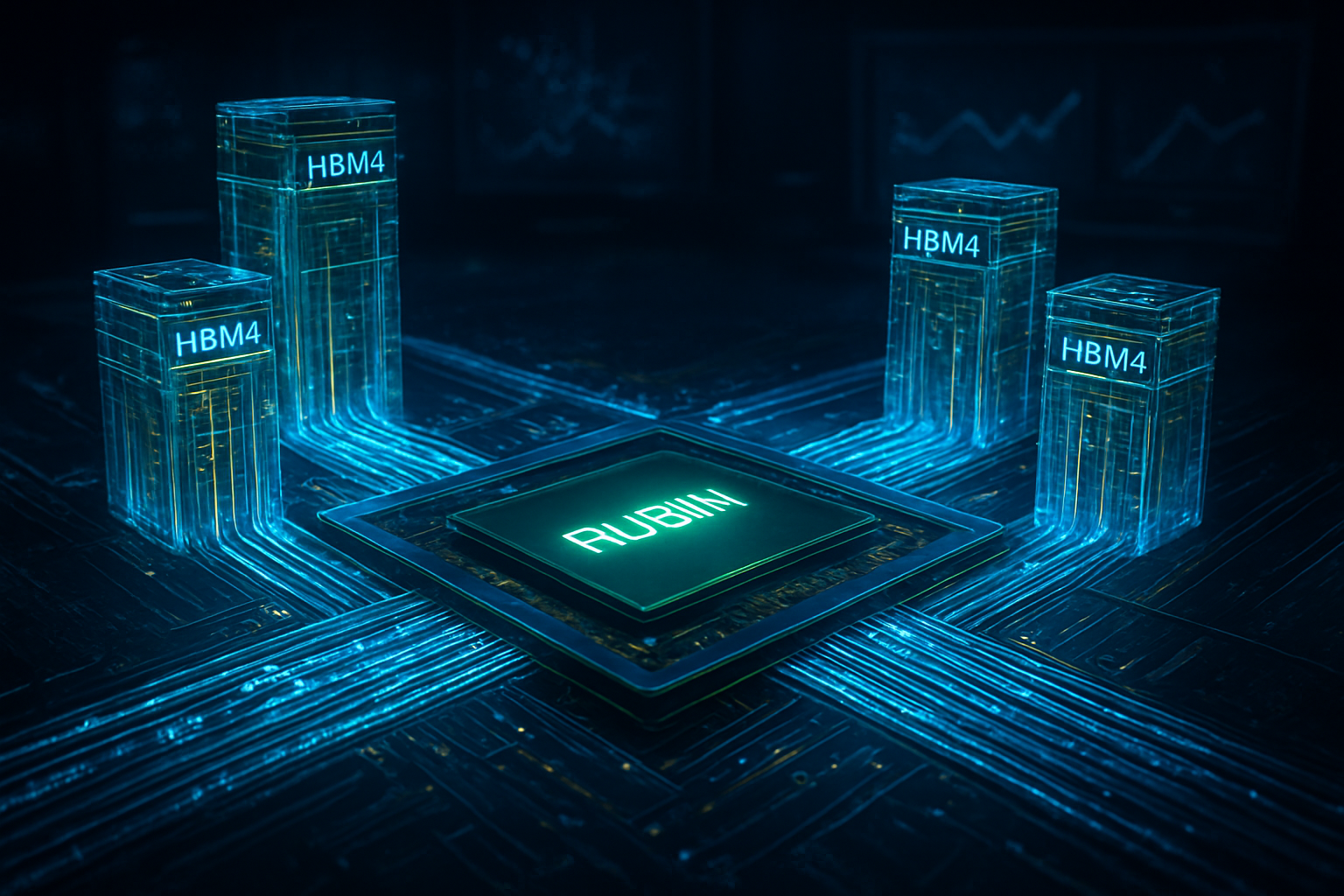
    Expected to ship in volume in the second half of 2026, the NVIDIA Rubin (R100) platform is designed specifically to dismantle the Energy Wall. Built on TSMC’s enhanced 3nm process, the Rubin GPU will be the first to widely adopt HBM4 memory, offering a staggering 22 TB/s of bandwidth. But the real star of the Rubin era is the Vera CPU. Replacing the Grace CPU, Vera features 88 custom "Olympus" ARM cores and utilizes NVLink-C2C to create a unified memory pool between the CPU and GPU.

    NVIDIA claims that the Rubin platform will deliver a 10x reduction in the cost-per-token for inference and an 8x improvement in performance-per-watt for large-scale Mixture-of-Experts (MoE) models. Perhaps most impressively, Jensen Huang has teased a "thermal breakthrough" for Rubin, suggesting that these systems can be cooled with 45°C (113°F) water. This would allow data centers to eliminate power-hungry chillers entirely, using simple heat exchangers to reject heat into the environment—a critical innovation for a world where every kilowatt counts.

    A New Chapter in AI Infrastructure

    As we move through 2026, the NVIDIA Blackwell architecture remains the gold standard for the current generation of AI, but its successor is already casting a long shadow. The transition from Blackwell to Rubin marks the end of the "brute force" era of AI scaling and the beginning of the "efficiency" era. NVIDIA’s ability to pivot from selling individual chips to selling entire "AI Factories" has allowed it to maintain its grip on the industry, even as competitors and custom silicon close the gap.

    In the coming months, the focus will shift toward the first customer samplings of the Rubin R100 and the Vera CPU. For investors and tech leaders, the metrics to watch are no longer just TeraFLOPS, but rather the cost-per-token and the ability of these systems to operate within the tightening constraints of the global power grid. Blackwell has built the foundation of the AI age; Rubin will determine whether that foundation can scale into a sustainable future.


    This content is intended for informational purposes only and represents analysis of current AI developments.

    TokenRing AI delivers enterprise-grade solutions for multi-agent AI workflow orchestration, AI-powered development tools, and seamless remote collaboration platforms.
    For more information, visit https://www.tokenring.ai/.
  • The HBM4 Race Heats Up: Samsung and SK Hynix Deliver Paid Samples for NVIDIA’s Rubin GPUs

    The HBM4 Race Heats Up: Samsung and SK Hynix Deliver Paid Samples for NVIDIA’s Rubin GPUs

    The global race for semiconductor supremacy has reached a fever pitch as the calendar turns to 2026. In a move that signals the imminent arrival of the next generation of artificial intelligence, both Samsung Electronics (KRX: 005930) and SK Hynix (KRX: 000660) have officially transitioned from prototyping to the delivery of paid final samples of 6th-generation High Bandwidth Memory (HBM4) to NVIDIA (NASDAQ: NVDA). These samples are currently undergoing final quality verification for integration into NVIDIA’s highly anticipated 'Rubin' R100 GPUs, marking the start of a new era in AI hardware capability.

    The delivery of paid samples is a critical milestone, indicating that the technology has matured beyond experimental stages and is meeting the rigorous performance and reliability standards required for mass-market data center deployment. As NVIDIA prepares to roll out the Rubin architecture in early 2026, the battle between the world’s leading memory makers is no longer just about who can produce the fastest chips, but who can manufacture them at the unprecedented scale required by the "AI arms race."

    Technical Breakthroughs: Doubling the Data Highway

    The transition from HBM3e to HBM4 represents the most significant architectural shift in the history of high-bandwidth memory. While previous generations focused on incremental speed increases, HBM4 fundamentally redesigns the interface between the memory and the processor. The most striking change is the doubling of the data bus width from 1,024-bit to a massive 2,048-bit interface. This "wider road" allows for a staggering increase in data throughput without the thermal and power penalties associated with simply increasing clock speeds.

    NVIDIA’s Rubin R100 GPU, the primary beneficiary of this advancement, is expected to be a powerhouse of efficiency and performance. Built on TSMC (NYSE: TSM)’s advanced N3P (3nm) process, the Rubin architecture utilizes a chiplet-based design that incorporates eight HBM4 stacks. This configuration provides a total of 288GB of VRAM and a peak bandwidth of 13 TB/s—a 60% increase over the current Blackwell B100. Furthermore, HBM4 introduces 16-layer stacking (16-Hi), allowing for higher density and capacity per stack, which is essential for the trillion-parameter models that are becoming the industry standard.

    The industry has also seen a shift in how these chips are built. SK Hynix has formed a "One-Team" alliance with TSMC to manufacture the HBM4 logic base die using TSMC’s logic processes, rather than traditional memory processes. This allows for tighter integration and lower latency. Conversely, Samsung is touting its "turnkey" advantage, using its own 4nm foundry to produce the base die, memory cells, and advanced packaging in-house. Initial reactions from the research community suggest that this diversification of manufacturing approaches is critical for stabilizing the global supply chain as demand continues to outstrip supply.

    Shifting the Competitive Landscape

    The HBM4 rollout is poised to reshape the hierarchy of the semiconductor industry. For Samsung, this is a "redemption arc" moment. After trailing SK Hynix during the HBM3e cycle, Samsung is planning a massive 50% surge in HBM production capacity by 2026, aiming for a monthly output of 250,000 wafers. By leveraging its vertically integrated structure, Samsung hopes to recapture its position as the world’s leading memory supplier and secure a larger share of NVIDIA’s lucrative contracts.

    SK Hynix, however, is not yielding its lead easily. As the incumbent preferred supplier for NVIDIA, SK Hynix has already established a mass production system at its M16 and M15X fabs, with full-scale manufacturing slated to begin in February 2026. The company’s deep technical partnership with NVIDIA and TSMC gives it a strategic advantage in optimizing memory for the Rubin architecture. Meanwhile, Micron Technology (NASDAQ: MU) remains a formidable third player, focusing on high-efficiency HBM4 designs that target the growing market for edge AI and specialized accelerators.

    For NVIDIA, the availability of HBM4 from multiple reliable sources is a strategic win. It reduces reliance on a single supplier and provides the necessary components to maintain its yearly release cycle. The competition between Samsung and SK Hynix also exerts downward pressure on costs and accelerates the pace of innovation, ensuring that NVIDIA remains the undisputed leader in AI training and inference hardware.

    Breaking the "Memory Wall" and the Future of AI

    The broader significance of the HBM4 transition lies in its ability to address the "Memory Wall"—the growing bottleneck where processor performance outpaces the ability of memory to feed it data. As AI models move toward 10-trillion and 100-trillion parameters, the sheer volume of data that must be moved between the GPU and memory becomes the primary limiting factor in performance. HBM4’s 13 TB/s bandwidth is not just a luxury; it is a necessity for the next generation of multimodal AI that can process video, voice, and text simultaneously in real-time.

    Energy efficiency is another critical factor. Data centers are increasingly constrained by power availability and cooling requirements. By doubling the interface width, HBM4 can achieve higher throughput at lower clock speeds, reducing the energy cost per bit by approximately 40%. This efficiency gain is vital for the sustainability of gigawatt-scale AI clusters and helps cloud providers manage the soaring operational costs of AI infrastructure.

    This milestone mirrors previous breakthroughs like the transition to DDR memory or the introduction of the first HBM chips, but the stakes are significantly higher. The ability to supply HBM4 has become a matter of national economic security for South Korea and a cornerstone of the global AI economy. As the industry moves toward 2026, the successful integration of HBM4 into the Rubin platform will likely be remembered as the moment when AI hardware finally caught up to the ambitions of AI software.

    The Road Ahead: Customization and HBM4e

    Looking toward the near future, the HBM4 era will be defined by customization. Unlike previous generations that were "off-the-shelf" components, HBM4 allows for the integration of custom logic dies. This means that AI companies can potentially request specific features to be baked directly into the memory stack, such as specialized encryption or data compression, further blurring the lines between memory and processing.

    Experts predict that once the initial Rubin rollout is complete, the focus will quickly shift to HBM4e (Extended), which is expected to appear around late 2026 or early 2027. This iteration will likely push stacking to 20 or 24 layers, providing even greater density for the massive "sovereign AI" projects being undertaken by nations around the world. The primary challenge remains yield rates; as the complexity of 16-layer stacks and hybrid bonding increases, maintaining high production yields will be the ultimate test for Samsung and SK Hynix.

    A New Benchmark for AI Infrastructure

    The delivery of paid HBM4 samples to NVIDIA marks a definitive turning point in the AI hardware narrative. It signals that the industry is ready to support the next leap in artificial intelligence, providing the raw data-handling power required for the world’s most complex neural networks. The fierce competition between Samsung and SK Hynix has accelerated this timeline, ensuring that the Rubin architecture will launch with the most advanced memory technology ever created.

    As we move into 2026, the key metrics to watch will be the yield rates of these 16-layer stacks and the performance benchmarks of the first Rubin-powered clusters. This development is more than just a technical upgrade; it is the foundation upon which the next generation of AI breakthroughs—from autonomous scientific discovery to truly conversational agents—will be built. The HBM4 race has only just begun, and the implications for the global tech landscape will be felt for years to come.


    This content is intended for informational purposes only and represents analysis of current AI developments.

    TokenRing AI delivers enterprise-grade solutions for multi-agent AI workflow orchestration, AI-powered development tools, and seamless remote collaboration platforms.
    For more information, visit https://www.tokenring.ai/.

  • Beyond Blackwell: Nvidia Solidifies AI Dominance with ‘Rubin’ Reveal and Massive $3.2 Billion Infrastructure Surge

    Beyond Blackwell: Nvidia Solidifies AI Dominance with ‘Rubin’ Reveal and Massive $3.2 Billion Infrastructure Surge

    As of late December 2025, the artificial intelligence landscape continues to be defined by a single name: NVIDIA (NASDAQ: NVDA). With the Blackwell architecture now in full-scale volume production and powering the world’s most advanced data centers, the company has officially pulled back the curtain on its next act—the "Rubin" GPU platform. This transition marks the successful execution of CEO Jensen Huang’s ambitious shift to an annual product cadence, effectively widening the gap between the Silicon Valley giant and its closest competitors.

    The announcement comes alongside a massive $3.2 billion capital expenditure expansion, a strategic move designed to fortify Nvidia’s internal R&D capabilities and secure its supply chain against global volatility. By December 2025, Nvidia has not only maintained its grip on the AI accelerator market but has arguably transformed into a full-stack infrastructure provider, selling entire rack-scale supercomputers rather than just individual chips. This evolution has pushed the company’s data center revenue to record-breaking heights, leaving the industry to wonder if any rival can truly challenge its 90% market share.

    The Blackwell Peak and the Rise of Rubin

    The Blackwell architecture, specifically the Blackwell Ultra (B300 series), has reached its manufacturing zenith this month. After overcoming early packaging bottlenecks related to TSMC’s CoWoS-L technology, Nvidia is now shipping units at a record pace from facilities in both Taiwan and the United States. The flagship GB300 NVL72 systems—liquid-cooled racks that act as a single, massive GPU—are now the primary workhorses for the latest generation of frontier models. These systems have moved from experimental phases into global production for hyperscalers like Microsoft (NASDAQ: MSFT) and Amazon (NASDAQ: AMZN), providing the compute backbone for "agentic AI" systems that can reason and execute complex tasks autonomously.

    However, the spotlight is already shifting to the newly detailed "Rubin" architecture, scheduled for initial availability in the second half of 2026. Named after astronomer Vera Rubin, the platform introduces the Rubin GPU and the new Vera CPU, which features 88 custom Arm cores. Technically, Rubin represents a quantum leap over Blackwell; it is the first Nvidia platform to utilize 6th-generation High-Bandwidth Memory (HBM4). This allows for a staggering memory bandwidth of up to 20.5 TB/s, a nearly three-fold increase over early Blackwell iterations.

    A standout feature of the Rubin lineup is the Rubin CPX, a specialized variant designed specifically for "massive-context" inference. As Large Language Models (LLMs) move toward processing millions of tokens in a single prompt, the CPX variant addresses the prefill stage of compute, allowing for near-instantaneous retrieval and analysis of entire libraries of data. Industry experts note that while Blackwell optimized for raw training power, Rubin is being engineered for the era of "reasoning-at-scale," where the cost and speed of inference are the primary constraints for AI deployment.

    A Market in Nvidia’s Shadow

    Nvidia’s dominance in the AI data center market remains nearly absolute, with the company controlling between 85% and 90% of the accelerator space as of Q4 2025. This year, the Data Center segment alone generated over $115 billion in revenue, reflecting the desperate hunger for AI silicon across every sector of the economy. While AMD (NASDAQ: AMD) has successfully carved out a 12% market share with its MI350 series—positioning itself as the primary alternative for cost-conscious buyers—Intel (NASDAQ: INTC) has struggled to keep pace, with its Gaudi line seeing diminishing returns in the face of Nvidia’s aggressive release cycle.

    The strategic advantage for Nvidia lies not just in its hardware, but in its software moat and "rack-scale" sales model. By selling the NVLink-connected racks (like the NVL144), Nvidia has made it increasingly difficult for customers to swap out individual components for a competitor’s chip. This "locked-in" ecosystem has forced even the largest tech giants to remain dependent on Nvidia, even as they develop their own internal silicon like Google’s (NASDAQ: GOOGL) TPUs or Amazon’s Trainium. For these companies, the time-to-market advantage provided by Nvidia’s mature CUDA software stack outweighs the potential savings of using in-house chips.

    Startups and smaller AI labs are also finding themselves increasingly tied to Nvidia’s roadmap. The launch of the RTX PRO 5000 Blackwell GPU for workstations this month has brought enterprise-grade AI development to the desktop, allowing developers to prototype agentic workflows locally before scaling them to the cloud. This end-to-end integration—from the desktop to the world’s largest supercomputers—has created a flywheel effect that competitors are finding nearly impossible to disrupt.

    The $3.2 Billion Infrastructure Gamble

    Nvidia’s $3.2 billion capex expansion in 2025 signals a shift from a purely fabless model toward a more infrastructure-heavy strategy. A significant portion of this investment was directed toward internal AI supercomputing clusters, such as the "Eos" and "Stargate" initiatives, which Nvidia uses to train its own proprietary models and optimize its hardware-software integration. By becoming its own largest customer, Nvidia can stress-test new architectures like Rubin months before they reach the public market.

    Furthermore, the expansion includes a massive real-estate play. Nvidia spent nearly $840 million acquiring and developing facilities near its Santa Clara headquarters and opened a 1.1 million square foot supercomputing hub in North Texas. This physical expansion is paired with a move toward supply chain resilience, including localized production in the U.S. to mitigate geopolitical risks in the Taiwan Strait. This proactive stance on sovereign AI—where nations seek to build their own domestic compute capacity—has opened new revenue streams from governments in the Middle East and Europe, further diversifying Nvidia’s income beyond the traditional tech sector.

    Comparatively, this era of AI development mirrors the early days of the internet’s build-out, but at a vastly accelerated pace. While previous milestones were defined by the transition from CPU to GPU, the current shift is defined by the transition from "chips" to "data centers as a unit of compute." Concerns remain regarding the astronomical power requirements of these new systems, with a single Vera Rubin rack expected to consume significantly more energy than its predecessors, prompting a parallel boom in liquid cooling and energy infrastructure.

    The Road to 2026: What’s Next for Rubin?

    Looking ahead, the primary challenge for Nvidia will be maintaining its annual release cadence without sacrificing yield or reliability. The transition to 3nm process nodes for Rubin and the integration of HBM4 memory represent significant engineering hurdles. However, early samples are already reportedly in the hands of key partners, and analysts predict that the demand for Rubin will exceed even the record-breaking levels seen for Blackwell.

    In the near term, we can expect a flurry of software updates to the CUDA platform to prepare for Rubin’s massive-context capabilities. The industry will also be watching for the first "Sovereign AI" clouds powered by Blackwell Ultra to go live in early 2026, providing a blueprint for how nations will manage their own data and compute resources. As AI models move toward "World Models" that understand physical laws and complex spatial reasoning, the sheer bandwidth of the Rubin platform will be the critical enabler.

    Final Thoughts: A New Era of Compute

    Nvidia’s performance in 2025 has cemented its role as the indispensable architect of the AI era. The successful ramp-up of Blackwell and the visionary roadmap for Rubin demonstrate a company that is not content to lead the market, but is actively seeking to redefine it. By investing $3.2 billion into its own infrastructure, Nvidia is betting that the demand for intelligence is effectively infinite, and that the only limit to AI progress is the availability of compute.

    As we move into 2026, the tech industry will be watching the first production benchmarks of the Rubin platform and the continued expansion of Nvidia’s rack-scale dominance. For now, the company stands alone at the summit of the semiconductor world, having turned the challenge of the AI revolution into a trillion-dollar opportunity.


    This content is intended for informational purposes only and represents analysis of current AI developments.

    TokenRing AI delivers enterprise-grade solutions for multi-agent AI workflow orchestration, AI-powered development tools, and seamless remote collaboration platforms.
    For more information, visit https://www.tokenring.ai/.