Tag: Ryzen AI

  • AMD Unleashes Zen 5 for the Edge: New Ryzen AI P100 and X100 Series to Power Next-Gen Robotics and Automotive Cockpits

    AMD Unleashes Zen 5 for the Edge: New Ryzen AI P100 and X100 Series to Power Next-Gen Robotics and Automotive Cockpits

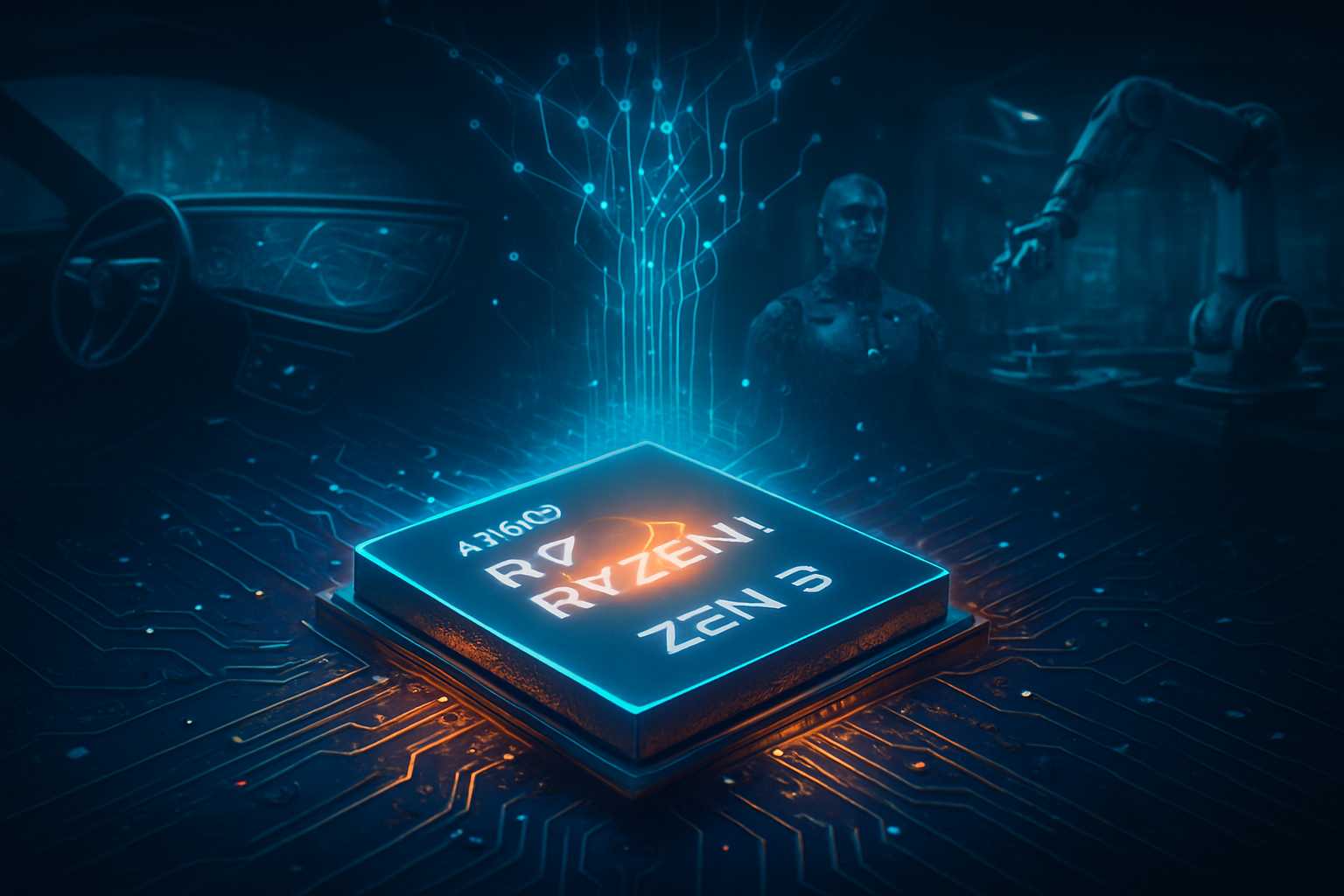
    LAS VEGAS — At the 2026 Consumer Electronics Show (CES), Advanced Micro Devices (NASDAQ: AMD) officially signaled its intent to dominate the rapidly expanding edge AI market. The company announced the launch of the Ryzen AI Embedded P100 and X100 series, a groundbreaking family of processors designed to bring high-performance "Physical AI" to the industrial and automotive sectors. By integrating the latest Zen 5 CPU architecture with a dedicated XDNA 2 Neural Processing Unit (NPU), AMD is positioning itself as the primary architect for the intelligent machines of the future, from humanoid robots to fully digital vehicle cockpits.

    The announcement marks a pivotal shift in the embedded computing landscape. Historically, high-level AI inference was relegated to power-hungry discrete GPUs or remote cloud servers. With the P100 and X100 series, AMD (NASDAQ: AMD) delivers up to 50 TOPS (Trillions of Operations Per Second) of dedicated AI performance in a power-efficient, single-chip solution. This development is expected to accelerate the deployment of autonomous systems that require immediate, low-latency decision-making without the privacy risks or connectivity dependencies of the cloud.

    Technical Prowess: Zen 5 and the 50 TOPS Threshold

    The Ryzen AI Embedded P100 and X100 series are built on a cutting-edge 4nm process, utilizing a hybrid architecture of "Zen 5" high-performance cores and "Zen 5c" efficiency cores. This combination allows the processors to handle complex multi-threaded workloads—such as running a vehicle's infotainment system while simultaneously monitoring driver fatigue—with a 2.2X performance-per-watt improvement over the previous Ryzen Embedded 8000 generation. The flagship X100 series scales up to 16 cores, providing the raw computational horsepower needed for the most demanding "Physical AI" applications.

    The true centerpiece of this new silicon is the XDNA 2 NPU. Delivering a massive 3x jump in AI throughput compared to its predecessor, the XDNA 2 architecture is optimized for vision transformers and compact Large Language Models (LLMs). For the first time, embedded developers can run sophisticated generative AI models locally on the device. Complementing the AI engine is the RDNA 3.5 graphics architecture, which supports up to four simultaneous 4K displays. This makes the P100 series a formidable choice for automotive digital cockpits, where high-fidelity 3D maps and augmented reality overlays must be rendered in real-time with zero lag.

    Initial reactions from the industrial research community have been overwhelmingly positive. Experts note that the inclusion of Time-Sensitive Networking (TSN) and ECC memory support makes these chips uniquely suited for "deterministic" AI—where timing is critical. Unlike consumer-grade chips, the P100/X100 series are AEC-Q100 qualified, meaning they can operate in the extreme temperature ranges (-40°C to +105°C) required for automotive and heavy industrial environments.

    Shifting the Competitive Landscape: AMD vs. NVIDIA and Intel

    This move places AMD in direct competition with NVIDIA (NASDAQ: NVDA) and its dominant Jetson platform. While NVIDIA has long held the lead in edge AI through its CUDA ecosystem, AMD is countering with an "open-source first" strategy. By leveraging the ROCm 7 software stack and the unified Ryzen AI software flow, AMD allows developers to port AI models seamlessly from EPYC-powered cloud servers to Ryzen-powered edge devices. This interoperability could disrupt the market for startups and OEMs who are wary of the "vendor lock-in" associated with proprietary AI platforms.

    Intel (NASDAQ: INTC) also finds itself in a tightening race. While Intel’s Core Ultra "Panther Lake" embedded chips offer competitive AI features, AMD’s integration of the XDNA 2 NPU currently leads in raw TOPS-per-watt for the embedded sector. Market analysts suggest that AMD’s aggressive 10-year production lifecycle guarantee for the P100/X100 series will be a major selling point for industrial giants like Siemens and Bosch, who require long-term hardware stability for factory automation lines that may remain in service for over a decade.

    For the automotive sector, the P100 series targets the "multi-domain" architecture trend. Rather than having separate chips for the dashboard, navigation, and driver assistance, car manufacturers can now consolidate these functions into a single AMD-powered module. This consolidation reduces vehicle weight, lowers power consumption, and simplifies the complex software supply chain for next-generation electric vehicles (EVs).

    The Rise of Physical AI and the Local Processing Revolution

    The launch of the X100 series specifically targets the nascent field of humanoid robotics. As companies like Tesla (NASDAQ: TSLA) and Figure AI race to bring general-purpose robots to factory floors, the need for "on-robot" intelligence has become paramount. A humanoid robot must process vast amounts of visual and tactile data in milliseconds to navigate a dynamic environment. By providing 50 TOPS of local NPU performance, AMD enables these machines to interpret natural language commands and recognize objects without sending data to a central server, ensuring both speed and data privacy.

    This transition from cloud-centric AI to "Edge AI" is a defining trend of 2026. As AI models become more efficient through techniques like quantization, the hardware's ability to execute these models locally becomes the primary bottleneck. AMD’s expansion reflects a broader industry realization: for AI to be truly ubiquitous, it must be invisible, reliable, and decoupled from the internet. This "Local AI" movement addresses growing societal concerns regarding data harvesting and the vulnerability of critical infrastructure to network outages.

    Furthermore, the environmental impact of this shift cannot be understated. By moving inference from massive, water-cooled data centers to efficient edge chips, the carbon footprint of AI operations is significantly reduced. AMD’s focus on the Zen 5c efficiency cores demonstrates a commitment to sustainable computing that resonates with ESG-conscious corporate buyers in the industrial sector.

    Looking Ahead: The Future of Autonomous Systems

    In the near term, expect to see the first wave of P100-powered vehicles and industrial controllers hit the market by mid-2026. Early adopters are likely to be in the high-end EV space and advanced logistics warehouses. However, the long-term potential lies in the democratization of sophisticated robotics. As the cost of high-performance AI silicon drops, we may see the X100 series powering everything from autonomous delivery drones to robotic surgical assistants.

    Challenges remain, particularly in the software ecosystem. While ROCm 7 is a significant step forward, NVIDIA still holds a massive lead in developer mindshare. AMD will need to continue its aggressive outreach to the AI research community to ensure that the latest models are optimized for XDNA 2 out of the box. Additionally, as AI becomes more integrated into physical safety systems, regulatory scrutiny over "deterministic AI" performance will likely increase, requiring AMD to work closely with safety certification bodies.

    A New Chapter for Embedded AI

    The introduction of the Ryzen AI Embedded P100 and X100 series is more than just a hardware refresh; it is a declaration of AMD's (NASDAQ: AMD) vision for the next decade of computing. By bringing the power of Zen 5 and XDNA 2 to the edge, AMD is providing the foundational "brains" for a new generation of autonomous, intelligent, and efficient machines.

    The significance of this development in AI history lies in its focus on "Physical AI"—the bridge between digital intelligence and the material world. As we move through 2026, the success of these chips will be measured not just by benchmarks, but by the autonomy of the robots they power and the safety of the vehicles they control. Investors and tech enthusiasts should keep a close eye on AMD’s upcoming partnership announcements with major automotive and robotics firms in the coming months, as these will signal the true scale of AMD's edge AI ambitions.


    This content is intended for informational purposes only and represents analysis of current AI developments.

    TokenRing AI delivers enterprise-grade solutions for multi-agent AI workflow orchestration, AI-powered development tools, and seamless remote collaboration platforms.
    For more information, visit https://www.tokenring.ai/.
  • AMD Shakes Up CES 2026 with Ryzen AI 400 and Ryzen AI Max: The New Frontier of 60 TOPS Edge Computing

    AMD Shakes Up CES 2026 with Ryzen AI 400 and Ryzen AI Max: The New Frontier of 60 TOPS Edge Computing

    In a definitive bid to capture the rapidly evolving "AI PC" market, Advanced Micro Devices (NASDAQ: AMD) took center stage at CES 2026 to unveil its next-generation silicon: the Ryzen AI 400 series and the powerhouse Ryzen AI Max processors. These announcements represent a pivotal shift in AMD’s strategy, moving beyond mere incremental CPU upgrades to deliver specialized silicon designed to handle the massive computational demands of local Large Language Models (LLMs) and autonomous "Physical AI" systems.

    The significance of these launches cannot be overstated. As the industry moves away from a total reliance on cloud-based AI, the Ryzen AI 400 and Ryzen AI Max are positioned as the primary engines for the next generation of "Copilot+" experiences. By integrating high-performance Zen 5 cores with a significantly beefed-up Neural Processing Unit (NPU), AMD is not just competing with traditional rival Intel; it is directly challenging NVIDIA (NASDAQ: NVDA) for dominance in the edge AI and workstation sectors.

    Technical Prowess: Zen 5 and the 60 TOPS Milestone

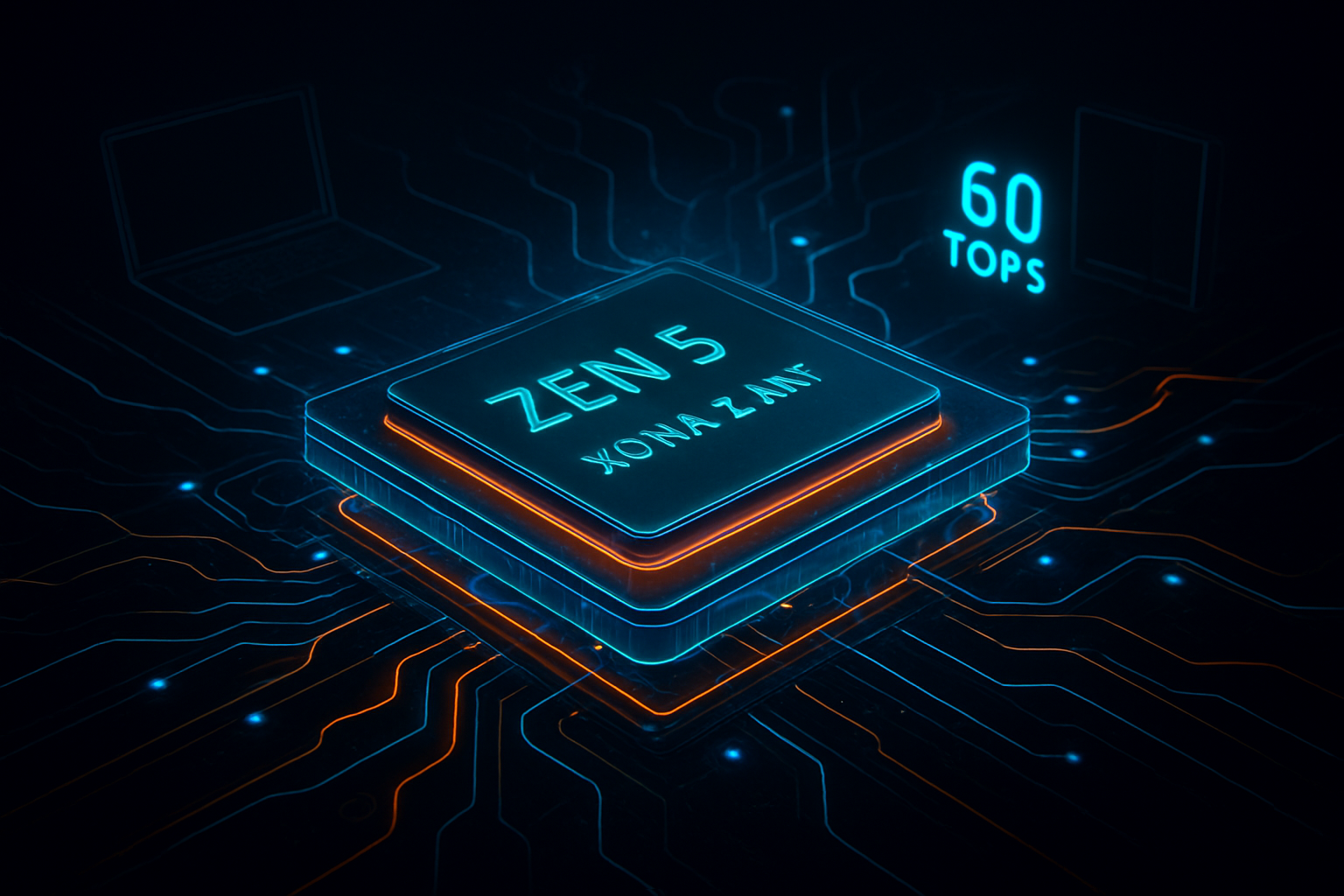
    The star of the show, the Ryzen AI 400 series (codenamed "Gorgon Point"), is built on a refined 4nm process and utilizes the Zen 5 microarchitecture. The flagship of this lineup, the Ryzen AI 9 HX 475, introduces the second-generation XDNA 2 NPU, which has been clocked to deliver a staggering 60 TOPS (Trillions of Operations Per Second). This marks a 20% increase over the previous generation and comfortably surpasses the 40-50 TOPS threshold required for the latest Microsoft Copilot+ features. This performance boost is achieved through a mix of high-performance Zen 5 cores and efficiency-focused Zen 5c cores, allowing thin-and-light laptops to maintain long battery life while processing complex AI tasks locally.

    For the professional and enthusiast market, the Ryzen AI Max series (codenamed "Strix Halo") pushes the boundaries of what integrated silicon can achieve. These chips, such as the Ryzen AI Max+ 392, feature up to 12 Zen 5 cores paired with a massive 40-core RDNA 3.5 integrated GPU. While the NPU in the Max series holds steady at 50 TOPS, its true power lies in its graphics-based AI compute—capable of up to 60 TFLOPS—and support for up to 128GB of LPDDR5X unified memory. This unified memory architecture is a direct response to the needs of AI developers, enabling the local execution of LLMs with up to 200 billion parameters, a feat previously impossible without high-end discrete graphics cards.

    This technical leap differs from previous approaches by focusing heavily on "balanced throughput." Rather than just chasing raw CPU clock speeds, AMD has optimized the interconnects between the Zen 5 cores, the RDNA 3.5 GPU, and the XDNA 2 NPU. Early reactions from industry experts suggest that AMD has successfully addressed the "memory bottleneck" that has plagued mobile AI performance. Analysts at the event noted that the ability to run massive models locally on a laptop-sized chip significantly reduces latency and enhances privacy, making these processors highly attractive for enterprise and creative workflows.

    Disrupting the Status Quo: A Direct Challenge to NVIDIA and Intel

    The introduction of the Ryzen AI Max series is a strategic shot across the bow for NVIDIA's workstation dominance. AMD explicitly positioned its new "Ryzen AI Halo" developer platforms as rivals to NVIDIA’s DGX Spark mini-workstations. By offering superior "tokens-per-second-per-dollar" for local LLM inference, AMD is targeting the growing demographic of AI researchers and developers who require powerful local hardware but may be priced out of NVIDIA’s high-end discrete GPU ecosystem. This competitive pressure could force a pricing realignment in the professional workstation market.

    Furthermore, AMD’s push into the edge and industrial sectors with the Ryzen AI Embedded P100 and X100 series directly challenges the NVIDIA Jetson lineup. These chips are designed for automotive digital cockpits and humanoid robotics, featuring industrial-grade temperature tolerances and a unified software stack. For tech giants like Tesla or robotics startups, the availability of a high-performance, X86-compatible alternative to ARM-based NVIDIA solutions provides more flexibility in software development and deployment.

    Major PC manufacturers, including Dell, HP, and Lenovo, have already announced dozens of designs based on the Ryzen AI 400 series. These companies stand to benefit from a renewed consumer interest in AI-capable hardware, potentially sparking a massive upgrade cycle. Meanwhile, Intel (NASDAQ: INTC) finds itself in a defensive position; while its "Panther Lake" chips offer competitive NPU performance, AMD’s lead in integrated graphics and unified memory for the workstation segment gives it a strategic advantage in the high-margin "Prosumer" market.

    The Broader AI Landscape: From Cloud to Edge

    AMD’s CES 2026 announcements reflect a broader trend in the AI landscape: the decentralization of intelligence. For the past several years, the "AI boom" has been characterized by massive data centers and cloud-based API calls. However, concerns over data privacy, latency, and the sheer cost of cloud compute have driven a demand for local execution. By delivering 60 TOPS in a thin-and-light form factor, AMD is making "Personal AI" a reality, where sensitive data never has to leave the user's device.

    This shift has profound implications for software development. With the release of ROCm 7.2, AMD is finally bringing its professional-grade AI software stack to the consumer and edge levels. This move aims to erode NVIDIA’s "CUDA moat" by providing an open-source, cross-platform alternative that works seamlessly across Windows and Linux. If AMD can successfully convince developers to optimize for ROCm at the edge, it could fundamentally change the power dynamics of the AI software ecosystem, which has been dominated by NVIDIA for over a decade.

    However, this transition is not without its challenges. The industry still lacks a unified standard for AI performance measurement, and "TOPS" can often be a misleading metric if the software cannot efficiently utilize the hardware. Comparisons to previous milestones, such as the transition to multi-core processing in the mid-2000s, suggest that we are currently in a "Wild West" phase of AI hardware, where architectural innovation is outpacing software standardization.

    The Horizon: What Lies Ahead for Ryzen AI

    Looking forward, the near-term focus for AMD will be the successful rollout of the Ryzen AI 400 series in Q1 2026. The real test will be the performance of these chips in real-world "Physical AI" applications. We expect to see a surge in specialized laptops and mini-PCs designed specifically for local AI training and "fine-tuning," where users can take a base model and customize it with their own data without needing a server farm.

    In the long term, the Ryzen AI Max series could pave the way for a new category of "AI-First" devices. Experts predict that by 2027, the distinction between a "laptop" and an "AI workstation" will blur, as unified memory architectures become the standard. The potential for these chips to power sophisticated humanoid robotics and autonomous vehicles is also on the horizon, provided AMD can maintain its momentum in the embedded space. The next major hurdle will be the integration of even more advanced "Agentic AI" capabilities directly into the silicon, allowing the NPU to proactively manage complex workflows without user intervention.

    Final Reflections on AMD’s AI Evolution

    AMD’s performance at CES 2026 marks a significant milestone in the company’s history. By successfully integrating Zen 5, RDNA 3.5, and XDNA 2 into a cohesive and powerful package, they have transitioned from a "CPU company" to a "Total AI Silicon company." The Ryzen AI 400 and Ryzen AI Max series are not just products; they are a statement of intent that AMD is ready to lead the charge into the era of pervasive, local artificial intelligence.

    The significance of this development in AI history lies in the democratization of high-performance compute. By bringing 60 TOPS and massive unified memory to the consumer and professional edge, AMD is lowering the barrier to entry for AI innovation. In the coming weeks and months, the tech world will be watching closely as the first Ryzen AI 400 systems hit the shelves and developers begin to push the limits of ROCm 7.2. The battle for the edge has officially begun, and AMD has just claimed a formidable piece of the high ground.


    This content is intended for informational purposes only and represents analysis of current AI developments.

    TokenRing AI delivers enterprise-grade solutions for multi-agent AI workflow orchestration, AI-powered development tools, and seamless remote collaboration platforms.
    For more information, visit https://www.tokenring.ai/.