
Tag: Samsung Electronics

  • AI Ignites Memory Supercycle: DRAM and NAND Demand Skyrockets, Reshaping Tech Landscape

    AI Ignites Memory Supercycle: DRAM and NAND Demand Skyrockets, Reshaping Tech Landscape

    The global memory chip market is currently experiencing an unprecedented surge in demand, primarily fueled by the insatiable requirements of Artificial Intelligence (AI). This dramatic upturn, particularly for Dynamic Random-Access Memory (DRAM) and NAND flash, is not merely a cyclical rebound but is being hailed by analysts as the "first semiconductor supercycle in seven years," fundamentally transforming the tech industry as we approach late 2025. This immediate significance translates into rapidly escalating prices, persistent supply shortages, and a strategic pivot by leading manufacturers to prioritize high-value AI-centric memory.

    Inventory levels for DRAM have plummeted to a record low of 3.3 weeks by the end of the third quarter of 2025, echoing the scarcity last seen during the 2018 supercycle. This intense demand has led to significant price increases, with conventional DRAM contract prices projected to rise by 8% to 13% quarter-on-quarter in Q4 2025, and High-Bandwidth Memory (HBM) seeing even steeper jumps of 13% to 18%. NAND Flash contract prices are also expected to climb by 5% to 10% in the same period. This upward momentum is anticipated to continue well into 2026, with some experts predicting sustained appreciation into mid-2025 and beyond as AI workloads continue to scale exponentially.

    The Technical Underpinnings of AI's Memory Hunger

    The overwhelming force driving this memory market boom is the computational intensity of Artificial Intelligence, especially the demands emanating from AI servers and sophisticated data centers. Modern AI applications, particularly large language models (LLMs) and complex machine learning algorithms, necessitate immense processing power coupled with exceptionally rapid data transfer capabilities between GPUs and memory. This is where High-Bandwidth Memory (HBM) becomes critical, offering unparalleled low latency and high bandwidth, making it the "ideal choice" for these demanding AI workloads. Demand for HBM is projected to double in 2025, building on an almost 200% growth observed in 2024. This surge in HBM production has a cascading effect, diverting manufacturing capacity from conventional DRAM and exacerbating overall supply tightness.

    AI servers, the backbone of modern AI infrastructure, demand significantly more memory than their standard counterparts—requiring roughly three times the NAND and eight times the DRAM. Hyperscale cloud service providers (CSPs) are aggressively procuring vast quantities of memory to build out their AI infrastructure. For instance, OpenAI's ambitious "Stargate" project has reportedly secured commitments for up to 900,000 DRAM wafers per month from major manufacturers, a staggering figure equivalent to nearly 40% of the global DRAM output. Beyond DRAM, AI workloads also require high-capacity storage. Quad-Level Cell (QLC) NAND SSDs are gaining significant traction due to their cost-effectiveness and high-density storage, increasingly replacing traditional HDDs in data centers for AI and high-performance computing (HPC) applications. Data center NAND demand is expected to grow by over 30% in 2025, with AI applications projected to account for one in five NAND bits by 2026, contributing up to 34% of the total market value. This is a fundamental shift from previous cycles, where demand was more evenly distributed across consumer electronics and enterprise IT, highlighting AI's unique and voracious appetite for specialized, high-performance memory.

    Corporate Impact: Beneficiaries, Battles, and Strategic Shifts

    The surging demand and constrained supply environment are creating a challenging yet immensely lucrative landscape across the tech industry, with memory manufacturers standing as the primary beneficiaries. Companies like Samsung Electronics (005930.KS) and SK Hynix (000660.KS) are at the forefront, experiencing a robust financial rebound. For the September quarter (Q3 2025), Samsung's semiconductor division reported an operating profit surge of 80% quarter-on-quarter, reaching $5.8 billion, significantly exceeding analyst forecasts. Its memory business achieved "new all-time high for quarterly sales," driven by strong performance in HBM3E and server SSDs.

    This boom has intensified competition, particularly in the critical HBM segment. While SK Hynix (000660.KS) currently holds a larger share of the HBM market, Samsung Electronics (005930.KS) is aggressively investing to reclaim market leadership. Samsung plans to invest $33 billion in 2025 to expand and upgrade its chip production capacity, including a $3 billion investment in its Pyeongtaek facility (P4) to boost HBM4 and 1c DRAM output. The company has accelerated shipments of fifth-generation HBM (HBM3E) to "all customers," including Nvidia (NVDA.US), and is actively developing HBM4 for mass production in 2026, customizing it for platforms like Microsoft (MSFT.US) and Meta (META.US). They have already secured clients for next year's expanded HBM production, including significant orders from AMD (AMD.US) and are in the final stages of qualification with Nvidia for HBM3E and HBM4 chips. The rising cost of memory chips is also impacting downstream industries, with companies like Xiaomi warning that higher memory costs are being passed on to the prices of new smartphones and other consumer devices, potentially disrupting existing product pricing structures across the board.

    Wider Significance: A New Era for AI Hardware

    This memory supercycle signifies a critical juncture in the broader AI landscape, underscoring that the advancement of AI is not solely dependent on software and algorithms but is fundamentally bottlenecked by hardware capabilities. The sheer scale of data and computational power required by modern AI models is now directly translating into a physical demand for specialized memory, highlighting the symbiotic relationship between AI software innovation and semiconductor manufacturing prowess. This trend suggests that memory will be a foundational component in the continued scaling of AI, with its availability and cost directly influencing the pace of AI development and deployment.

    The impacts are far-reaching: sustained shortages and higher prices for both businesses and consumers, but also an accelerated pace of innovation in memory technologies, particularly HBM. Potential concerns include the stability of the global supply chain under such immense pressure, the potential for market speculation, and the accessibility of advanced AI resources if memory becomes too expensive or scarce, potentially widening the gap between well-funded tech giants and smaller startups. This period draws comparisons to previous silicon booms, but it is uniquely tied to the unprecedented computational demands of modern AI models, marking it as a "structural market shift" rather than a mere cyclical fluctuation. It's a new kind of hardware-driven boom, one that underpins the very foundation of the AI revolution.

    The Horizon: Future Developments and Challenges

    Looking ahead, the upward price momentum for memory chips is expected to extend well into 2026, with Samsung Electronics (005930.KS) projecting that customer demand for memory chips in 2026 will exceed its supply, even with planned investments and capacity expansion. This bullish outlook indicates that the current market conditions are likely to persist for the foreseeable future. Manufacturers will continue to pour substantial investments into advanced memory technologies, with Samsung planning mass production of HBM4 in 2026 and its next-generation V9 NAND, expected for 2026, reportedly "nearly sold out" with cloud customers pre-booking capacity. The company also has plans for a P5 facility for further expansion beyond 2027.

    Potential applications and use cases on the horizon include the further proliferation of AI PCs, projected to constitute 43% of PC shipments by 2025, and AI smartphones, which are doubling their LPDDR5X memory capacity. More sophisticated AI models across various industries will undoubtedly require even greater and more specialized memory solutions. However, significant challenges remain. Sustaining the supply of advanced memory to meet the exponential growth of AI will be a continuous battle, requiring massive capital expenditure and disciplined production strategies. Managing the increasing manufacturing complexity for cutting-edge memory like HBM, which involves intricate stacking and packaging technologies, will also be crucial. Experts predict sustained shortages well into 2026, potentially for several years, with some even suggesting the NAND shortage could last a "staggering 10 years." Profit margins for DRAM and NAND are expected to reach records in 2026, underscoring the long-term strategic importance of this sector.

    Comprehensive Wrap-Up: A Defining Moment for AI and Semiconductors

    The current surge in demand for DRAM and NAND memory chips, unequivocally driven by the ascent of Artificial Intelligence, represents a defining moment for both the AI and semiconductor industries. It is not merely a market upswing but an "unprecedented supercycle" that is fundamentally reshaping supply chains, pricing structures, and strategic priorities for leading manufacturers worldwide. The insatiable hunger of AI for high-bandwidth, high-capacity memory has propelled companies like Samsung Electronics (005930.KS) into a period of robust financial rebound and aggressive investment, with their semiconductor division achieving record sales and profits.

    This development underscores that while AI's advancements often capture headlines for their algorithmic brilliance, the underlying hardware infrastructure—particularly memory—is becoming an increasingly critical bottleneck and enabler. The physical limitations and capabilities of memory chips will dictate the pace and scale of future AI innovations. This era is characterized by rapidly escalating prices, disciplined supply strategies by manufacturers, and a strategic pivot towards high-value AI-centric memory solutions like HBM. The long-term impact will likely see continued innovation in memory architecture, closer collaboration between AI developers and chip manufacturers, and potentially a recalibration of how AI development costs are factored. In the coming weeks and months, industry watchers will be keenly observing further earnings reports from memory giants, updates on their capacity expansion plans, the evolution of HBM roadmaps, and the ripple effects on pricing for consumer devices and enterprise AI solutions.


    This content is intended for informational purposes only and represents analysis of current AI developments.

    TokenRing AI delivers enterprise-grade solutions for multi-agent AI workflow orchestration, AI-powered development tools, and seamless remote collaboration platforms.
    For more information, visit https://www.tokenring.ai/.
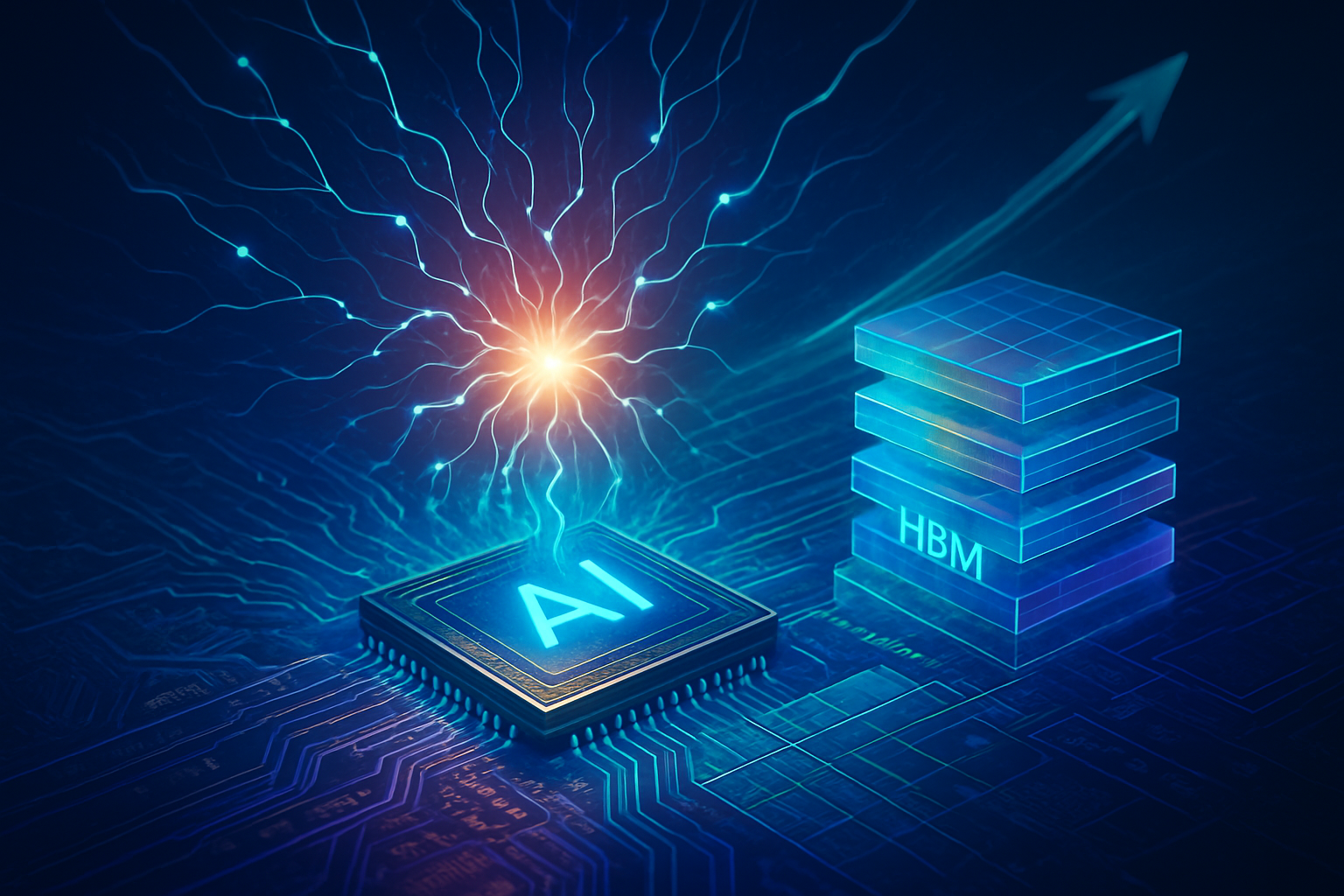
  • The Silicon Gold Rush: AI Supercharges Semiconductor Industry, Igniting a Fierce Talent War and HBM Frenzy

    The Silicon Gold Rush: AI Supercharges Semiconductor Industry, Igniting a Fierce Talent War and HBM Frenzy

    The global semiconductor industry is in the throes of an unprecedented "AI-driven supercycle," a transformative era fundamentally reshaped by the explosive growth of artificial intelligence. As of October 2025, this isn't merely a cyclical upturn but a structural shift, propelling the market towards a projected $1 trillion valuation by 2030, with AI chips alone expected to generate over $150 billion in sales this year. At the heart of this revolution is the surging demand for specialized AI semiconductor solutions, most notably High Bandwidth Memory (HBM), and a fierce global competition for top-tier engineering talent in design and R&D.

    This supercycle is characterized by an insatiable need for computational power to fuel generative AI, large language models, and the expansion of hyperscale data centers. Memory giants like SK Hynix (KRX: 000660) and Samsung Electronics (KRX: 005930) are at the forefront, aggressively expanding their hiring and investing billions to dominate the HBM market, which is projected to nearly double in revenue in 2025 to approximately $34 billion. Their strategic moves underscore a broader industry scramble to meet the relentless demands of an AI-first world, from advanced chip design to innovative packaging technologies.

    The Technical Backbone of the AI Revolution: HBM and Advanced Silicon

    The core of the AI supercycle's technical demands lies in overcoming the "memory wall" bottleneck, where traditional memory architectures struggle to keep pace with the exponential processing power of modern AI accelerators. High Bandwidth Memory (HBM) is the critical enabler, designed specifically for parallel processing in High-Performance Computing (HPC) and AI workloads. Its stacked die architecture and wide interface allow it to handle multiple memory requests simultaneously, delivering significantly higher bandwidth than conventional DRAM—a crucial advantage for GPUs and other AI accelerators that process massive datasets.

    The industry is rapidly advancing through HBM generations. While HBM3 and HBM3E are widely adopted, the market is eagerly anticipating the launch of HBM4 in late 2025, promising even higher capacity and a significant improvement in power efficiency, potentially offering 10Gbps speeds and a 40% boost over HBM3. Looking further ahead, HBM4E is targeted for 2027. To facilitate these advancements, JEDEC has confirmed a relaxation to 775 µm stack height to accommodate higher stack configurations, such as 12-hi. These continuous innovations ensure that memory bandwidth keeps pace with the ever-increasing computational requirements of AI models.

    Beyond HBM, the demand for a spectrum of AI-optimized semiconductor solutions is skyrocketing. Graphics Processing Units (GPUs) and Application-Specific Integrated Circuits (ASICs) remain indispensable, with the AI accelerator market projected to grow from $20.95 billion in 2025 to $53.23 billion in 2029. Companies like Nvidia (NASDAQ: NVDA), with its A100, H100, and new Blackwell architecture GPUs, continue to lead, but specialized Neural Processing Units (NPUs) are also gaining traction, becoming standard components in next-generation smartphones, laptops, and IoT devices for efficient on-device AI processing.

    Crucially, advanced packaging techniques are transforming chip architecture, enabling the integration of these complex components into compact, high-performance systems. Technologies like 2.5D and 3D integration/stacking, exemplified by TSMC’s (NYSE: TSM) Chip-on-Wafer-on-Substrate (CoWoS) and Intel’s (NASDAQ: INTC) Embedded Multi-die Interconnect Bridge (EMIB), are essential for connecting HBM stacks with logic dies, minimizing latency and maximizing data transfer rates. These innovations are not just incremental improvements; they represent a fundamental shift in how chips are designed and manufactured to meet the rigorous demands of AI.

    Reshaping the AI Ecosystem: Winners, Losers, and Strategic Advantages

    The AI-driven semiconductor supercycle is profoundly reshaping the competitive landscape across the technology sector, creating clear beneficiaries and intense strategic pressures. Chip designers and manufacturers specializing in AI-optimized silicon, particularly those with strong HBM capabilities, stand to gain immensely. Nvidia, already a dominant force, continues to solidify its market leadership with its high-performance GPUs, essential for AI training and inference. Other major players like AMD (NASDAQ: AMD) and Intel are also heavily investing to capture a larger share of this burgeoning market.

    The direct beneficiaries extend to hyperscale data center operators and cloud computing giants such as Amazon (NASDAQ: AMZN) Web Services, Microsoft (NASDAQ: MSFT) Azure, and Google (NASDAQ: GOOGL) Cloud. Their massive AI infrastructure build-outs are the primary drivers of demand for advanced GPUs, HBM, and custom AI ASICs. These companies are increasingly exploring custom silicon development to optimize their AI workloads, further intensifying the demand for specialized design and manufacturing expertise.

    For memory manufacturers, the supercycle presents an unparalleled opportunity, but also fierce competition. SK Hynix, currently holding a commanding lead in the HBM market, is aggressively expanding its capacity and pushing the boundaries of HBM technology. Samsung Electronics, while playing catch-up in HBM market share, is leveraging its comprehensive semiconductor portfolio—including foundry services, DRAM, and NAND—to offer a full-stack AI solution. Its aggressive investment in HBM4 development and efforts to secure Nvidia certification highlight its determination to regain market dominance, as evidenced by its recent agreements to supply HBM semiconductors for OpenAI's 'Stargate Project', a partnership also secured by SK Hynix.

    Startups and smaller AI companies, while benefiting from the availability of more powerful and efficient AI hardware, face challenges in securing allocation of these in-demand chips and competing for top talent. However, the supercycle also fosters innovation in niche areas, such as edge AI accelerators and specialized AI software, creating new opportunities for disruption. The strategic advantage now lies not just in developing cutting-edge AI algorithms, but in securing the underlying hardware infrastructure that makes those algorithms possible, leading to significant market positioning shifts and a re-evaluation of supply chain resilience.

    A New Industrial Revolution: Broader Implications and Societal Shifts

    This AI-driven supercycle in semiconductors is more than just a market boom; it signifies a new industrial revolution, fundamentally altering the broader technological landscape and societal fabric. It underscores the critical role of hardware in the age of AI, moving beyond software-centric narratives to highlight the foundational importance of advanced silicon. The "infrastructure arms race" for specialized chips is a testament to this, as nations and corporations vie for technological supremacy in an AI-powered future.

    The impacts are far-reaching. Economically, it's driving unprecedented investment in R&D, manufacturing facilities, and advanced materials. Geopolitically, the concentration of advanced semiconductor manufacturing in a few regions creates strategic vulnerabilities and intensifies competition for supply chain control. The reliance on a handful of companies for cutting-edge AI chips could lead to concerns about market concentration and potential bottlenecks, similar to past energy crises but with data as the new oil.

    Comparisons to previous AI milestones, such as the rise of deep learning or the advent of the internet, fall short in capturing the sheer scale of this transformation. This supercycle is not merely enabling new applications; it's redefining the very capabilities of AI, pushing the boundaries of what machines can learn, create, and achieve. However, it also raises potential concerns, including the massive energy consumption of AI training and inference, the ethical implications of increasingly powerful AI systems, and the widening digital divide for those without access to this advanced infrastructure.

    A critical concern is the intensifying global talent shortage. Projections indicate a need for over one million additional skilled professionals globally by 2030, with a significant deficit in AI and machine learning chip design engineers, analog and digital design specialists, and design verification experts. This talent crunch threatens to impede growth, pushing companies to adopt skills-based hiring and invest heavily in upskilling initiatives. The societal implications of this talent gap, and the efforts to address it, will be a defining feature of the coming decade.

    The Road Ahead: Anticipating Future Developments

    The trajectory of the AI-driven semiconductor supercycle points towards continuous, rapid innovation. In the near term, the industry will focus on the widespread adoption of HBM4, with its enhanced capacity and power efficiency, and the subsequent development of HBM4E by 2027. We can expect further advancements in packaging technologies, such as Chip-on-Wafer-on-Substrate (CoWoS) and hybrid bonding, which will become even more critical for integrating increasingly complex multi-die systems and achieving higher performance densities.

    Looking further out, the development of novel computing architectures beyond traditional Von Neumann designs, such as neuromorphic computing and in-memory computing, holds immense promise for even more energy-efficient and powerful AI processing. Research into new materials and quantum computing could also play a significant role in the long-term evolution of AI semiconductors. Furthermore, the integration of AI itself into the chip design process, leveraging generative AI to automate complex design tasks and optimize performance, will accelerate development cycles and push the boundaries of what's possible.

    The applications of these advancements are vast and diverse. Beyond hyperscale data centers, we will see a proliferation of powerful AI at the edge, enabling truly intelligent autonomous vehicles, advanced robotics, smart cities, and personalized healthcare devices. Challenges remain, including the need for sustainable manufacturing practices to mitigate the environmental impact of increased production, addressing the persistent talent gap through education and workforce development, and navigating the complex geopolitical landscape of semiconductor supply chains. Experts predict that the convergence of these hardware advancements with software innovation will unlock unprecedented AI capabilities, leading to a future where AI permeates nearly every aspect of human life.

    Concluding Thoughts: A Defining Moment in AI History

    The AI-driven supercycle in the semiconductor industry is a defining moment in the history of artificial intelligence, marking a fundamental shift in technological capabilities and economic power. The relentless demand for High Bandwidth Memory and other advanced AI semiconductor solutions is not a fleeting trend but a structural transformation, driven by the foundational requirements of modern AI. Companies like SK Hynix and Samsung Electronics, through their aggressive investments in R&D and talent, are not just competing for market share; they are laying the silicon foundation for the AI-powered future.

    The key takeaways from this supercycle are clear: hardware is paramount in the age of AI, HBM is an indispensable component, and the global competition for talent and technological leadership is intensifying. This development's significance in AI history rivals that of the internet's emergence, promising to unlock new frontiers in intelligence, automation, and human-computer interaction. The long-term impact will be a world profoundly reshaped by ubiquitous, powerful, and efficient AI, with implications for every industry and aspect of daily life.

    In the coming weeks and months, watch for continued announcements regarding HBM production capacity expansions, new partnerships between chip manufacturers and AI developers, and further details on next-generation HBM and AI accelerator architectures. The talent war will also intensify, with companies rolling out innovative strategies to attract and retain the engineers crucial to this new era. This is not just a technological race; it's a race to build the infrastructure of the future.

    This content is intended for informational purposes only and represents analysis of current AI developments.

    TokenRing AI delivers enterprise-grade solutions for multi-agent AI workflow orchestration, AI-powered development tools, and seamless remote collaboration platforms.
    For more information, visit https://www.tokenring.ai/.