Tag: SiC

  • Wolfspeed’s Pivotal Earnings: A Bellwether for AI’s Power-Hungry Future

    Wolfspeed’s Pivotal Earnings: A Bellwether for AI’s Power-Hungry Future

    As the artificial intelligence industry continues its relentless expansion, demanding ever more powerful and energy-efficient hardware, all eyes are turning to Wolfspeed (NYSE: WOLF), a critical enabler of next-generation power electronics. The company is set to release its fiscal first-quarter 2026 earnings report on Wednesday, October 29, 2025, an event widely anticipated to offer significant insights into the health of the wide-bandgap semiconductor market and its implications for the broader AI ecosystem. This report comes at a crucial juncture for Wolfspeed, following a recent financial restructuring and amidst a cautious market sentiment, making its upcoming disclosures pivotal for investors and AI innovators alike.

    Wolfspeed's performance is more than just a company-specific metric; it serves as a barometer for the underlying infrastructure powering the AI revolution. Its specialized silicon carbide (SiC) and gallium nitride (GaN) technologies are foundational to advanced power management solutions, directly impacting the efficiency and scalability of data centers, electric vehicles (EVs), and renewable energy systems—all pillars supporting AI's growth. The upcoming report will not only detail Wolfspeed's financial standing but will also provide a glimpse into the demand trends for high-performance power semiconductors, revealing the pace at which AI's insatiable energy appetite is being addressed by cutting-edge hardware.

    Wolfspeed's Wide-Bandgap Edge: Powering AI's Efficiency Imperative

    Wolfspeed stands at the forefront of wide-bandgap (WBG) semiconductor technology, specializing in silicon carbide (SiC) and gallium nitride (GaN) materials and devices. These materials are not merely incremental improvements over traditional silicon; they represent a fundamental shift, offering superior properties such as higher thermal conductivity, greater breakdown voltages, and significantly faster switching speeds. For the AI sector, these technical advantages translate directly into reduced power losses and lower thermal loads, critical factors in managing the escalating energy demands of AI chipsets and data centers. For instance, Wolfspeed's Gen 4 SiC technology, introduced in early 2025, boasts the ability to slash thermal loads in AI data centers by a remarkable 40% compared to silicon-based systems, drastically cutting cooling costs which can comprise up to 40% of data center operational expenses.

    Despite its technological leadership and strategic importance, Wolfspeed has faced recent challenges. Its Q4 fiscal year 2025 results revealed a decline in revenue, negative GAAP gross margins, and a GAAP loss per share, attributed partly to sluggish demand in the EV and renewable energy markets. However, the company recently completed a Chapter 11 financial restructuring in September 2025, which significantly reduced its total debt by 70% and annual cash interest expense by 60%, positioning it on a stronger financial footing. Management has provided a cautious outlook for fiscal year 2026, anticipating lower revenue than consensus estimates and continued net losses in the short term. Nevertheless, with new leadership at the helm, Wolfspeed is aggressively focusing on scaling its 200mm SiC wafer production and forging strategic partnerships to leverage its robust technological foundation.

    The differentiation of Wolfspeed's technology lies in its ability to enable power density and efficiency that silicon simply cannot match. SiC's superior thermal conductivity allows for more compact and efficient server power supplies, crucial for meeting stringent efficiency standards like 80+ Titanium in data centers. GaN's high-frequency capabilities are equally vital for AI workloads that demand minimal energy waste and heat generation. While the recent financial performance reflects broader market headwinds, Wolfspeed's core innovation remains indispensable for the future of high-performance, energy-efficient AI infrastructure.

    Competitive Currents: How Wolfspeed's Report Shapes the AI Hardware Landscape

    Wolfspeed's upcoming earnings report carries substantial weight for a wide array of AI companies, tech giants, and burgeoning startups. Companies heavily invested in AI infrastructure, such as hyperscale cloud providers (e.g., Amazon (NASDAQ: AMZN), Google (NASDAQ: GOOGL), Microsoft (NASDAQ: MSFT)) and specialized AI hardware manufacturers, rely on efficient power solutions to manage the colossal energy consumption of their data centers. A strong performance or a clear strategic roadmap from Wolfspeed could signal stability and availability in the supply of critical SiC components, reassuring these companies about their ability to scale AI operations efficiently. Conversely, any indications of prolonged market softness or production delays could force a re-evaluation of supply chain strategies and potentially slow down the deployment of next-generation AI hardware.

    The competitive implications are also significant. Wolfspeed is a market leader in SiC, holding over 30% of the global EV semiconductor supply chain, and its technology is increasingly vital for power modules in high-voltage EV architectures. As autonomous vehicles become a key application for AI, the reliability and efficiency of power electronics supplied by companies like Wolfspeed directly impact the performance and range of these sophisticated machines. Any shifts in Wolfspeed's market positioning, whether due to increased competition from other WBG players or internal execution, will ripple through the automotive and industrial AI sectors. Startups developing novel AI-powered devices, from advanced robotics to edge AI applications, also benefit from the continued innovation and availability of high-efficiency power components that enable smaller form factors and extended battery life.

    Potential disruption to existing products or services could arise if Wolfspeed's technological advancements or production capabilities outpace competitors. For instance, if Wolfspeed successfully scales its 200mm SiC wafer production faster and more cost-effectively, it could set a new industry benchmark, putting pressure on competitors to accelerate their own WBG initiatives. This could lead to a broader adoption of SiC across more applications, potentially disrupting traditional silicon-based power solutions in areas where energy efficiency and power density are paramount. Market positioning and strategic advantages will increasingly hinge on access to and mastery of these advanced materials, making Wolfspeed's trajectory a key indicator for the direction of AI-enabling hardware.

    Broader Significance: Wolfspeed's Role in AI's Sustainable Future

    Wolfspeed's earnings report transcends mere financial figures; it is a critical data point within the broader AI landscape, reflecting key trends in energy efficiency, supply chain resilience, and the drive towards sustainable computing. The escalating power demands of AI models and infrastructure are well-documented, making the adoption of highly efficient power semiconductors like SiC and GaN not just an economic choice but an environmental imperative. Wolfspeed's performance will offer insights into how quickly industries are transitioning to these advanced materials to curb energy consumption and reduce the carbon footprint of AI.

    The impacts of Wolfspeed's operations extend to global supply chains, particularly as nations prioritize domestic semiconductor manufacturing. As a major producer of SiC, Wolfspeed's production ramp-up, especially at its 200mm SiC wafer facility, is crucial for diversifying and securing the supply of these strategic materials. Any challenges or successes in their manufacturing scale-up will highlight the complexities and investments required to meet the accelerating demand for advanced semiconductors globally. Concerns about market saturation in specific segments, like the cautious outlook for EV demand, could also signal broader economic headwinds that might affect AI investments in related hardware.

    Comparing Wolfspeed's current situation to previous AI milestones, its role is akin to that of foundational chip manufacturers during earlier computing revolutions. Just as Intel (NASDAQ: INTC) provided the processors for the PC era, and NVIDIA (NASDAQ: NVDA) became synonymous with AI accelerators, Wolfspeed is enabling the power infrastructure that underpins these advancements. Its wide-bandgap technologies are pivotal for managing the energy requirements of large language models (LLMs), high-performance computing (HPC), and the burgeoning field of edge AI. The report will help assess the pace at which these essential power components are being integrated into the AI value chain, serving as a bellwether for the industry's commitment to sustainable and scalable growth.

    The Road Ahead: Wolfspeed's Strategic Pivots and AI's Power Evolution

    Looking ahead, Wolfspeed's strategic focus on scaling its 200mm SiC wafer production is a critical near-term development. This expansion is vital for meeting the anticipated long-term demand for high-performance power devices, especially as AI continues to proliferate across industries. Experts predict that successful execution of this ramp-up will solidify Wolfspeed's market leadership and enable broader adoption of SiC in new applications. Potential applications on the horizon include more efficient power delivery systems for next-generation AI accelerators, compact power solutions for advanced robotics, and enhanced energy storage systems for AI-driven smart grids.

    However, challenges remain. The company's cautious outlook regarding short-term revenue and continued net losses suggests that market headwinds, particularly in the EV and renewable energy sectors, are still a factor. Addressing these demand fluctuations while simultaneously investing heavily in manufacturing expansion will require careful financial management and strategic agility. Furthermore, increased competition in the WBG space from both established players and emerging entrants could put pressure on pricing and market share. Experts predict that Wolfspeed's ability to innovate, secure long-term supply agreements with key partners, and effectively manage its production costs will be paramount for its sustained success.

    What experts predict will happen next is a continued push for higher efficiency and greater power density in AI hardware, making Wolfspeed's technologies even more indispensable. The company's renewed financial stability post-restructuring, coupled with its new leadership, provides a foundation for aggressive pursuit of these market opportunities. The industry will be watching for signs of increased order bookings, improved gross margins, and clearer guidance on the utilization rates of its new manufacturing facilities as indicators of its recovery and future trajectory in powering the AI revolution.

    Comprehensive Wrap-up: A Critical Juncture for AI's Power Backbone

    Wolfspeed's upcoming earnings report is more than just a quarterly financial update; it is a significant event for the entire AI industry. The key takeaways will revolve around the demand trends for wide-bandgap semiconductors, Wolfspeed's operational efficiency in scaling its SiC production, and its financial health following restructuring. Its performance will offer a critical assessment of the pace at which the AI sector is adopting advanced power management solutions to address its growing energy consumption and thermal challenges.

    In the annals of AI history, this period marks a crucial transition towards more sustainable and efficient hardware infrastructure. Wolfspeed, as a leader in SiC and GaN, is at the heart of this transition. Its success or struggle will underscore the broader industry's capacity to innovate at the foundational hardware level to meet the demands of increasingly complex AI models and widespread deployment. The long-term impact of this development lies in its potential to accelerate the adoption of energy-efficient AI systems, thereby mitigating environmental concerns and enabling new frontiers in AI applications that were previously constrained by power limitations.

    In the coming weeks and months, all eyes will be on Wolfspeed's ability to convert its technological leadership into profitable growth. Investors and industry observers will be watching for signs of improved market demand, successful ramp-up of 200mm SiC production, and strategic partnerships that solidify its position. The October 29th earnings call will undoubtedly provide critical clarity on these fronts, offering a fresh perspective on the trajectory of a company whose technology is quietly powering the future of artificial intelligence.


    This content is intended for informational purposes only and represents analysis of current AI developments.

    TokenRing AI delivers enterprise-grade solutions for multi-agent AI workflow orchestration, AI-powered development tools, and seamless remote collaboration platforms.
    For more information, visit https://www.tokenring.ai/.

  • Revolutionizing the Chip: Gold Deplating and Wide Bandgap Semiconductors Power AI’s Future

    Revolutionizing the Chip: Gold Deplating and Wide Bandgap Semiconductors Power AI’s Future

    October 20, 2025, marks a pivotal moment in semiconductor manufacturing, where a confluence of groundbreaking new tools and refined processes is propelling chip performance and efficiency to unprecedented levels. At the forefront of this revolution is the accelerated adoption of wide bandgap (WBG) compound semiconductors like Gallium Nitride (GaN) and Silicon Carbide (SiC). These materials are not merely incremental upgrades; they offer superior operating temperatures, higher breakdown voltages, and significantly faster switching speeds—up to ten times quicker than traditional silicon. This leap is critical for meeting the escalating demands of artificial intelligence (AI), high-performance computing (HPC), and electric vehicles (EVs), enabling vastly improved thermal management and drastically lower energy losses. Complementing these material innovations are sophisticated manufacturing techniques, including advanced lithography with High-NA EUV systems and revolutionary packaging solutions like die-to-wafer hybrid bonding and chiplet architectures, which integrate diverse functionalities into single, dense modules.

    Among the critical processes enabling these high-performance chips is the refinement of gold deplating, particularly relevant for the intricate fabrication of wide bandgap compound semiconductors. Gold remains an indispensable material in semiconductor devices due to its exceptional electrical conductivity, resistance to corrosion, and thermal properties, essential for contacts, vias, connectors, and bond pads. Electrolytic gold deplating has emerged as a cost-effective and precise method for "feature isolation"—the removal of the original gold seed layer after electrodeposition. This process offers significant advantages over traditional dry etch methods by producing a smoother gold surface with minimal critical dimension (CD) loss. Furthermore, innovations in gold etchant solutions, such as MacDermid Alpha's non-cyanide MICROFAB AU100 CT DEPLATE, provide precise and uniform gold seed etching on various barriers, optimizing cost efficiency and performance in compound semiconductor fabrication. These advancements in gold processing are crucial for ensuring the reliability and performance of next-generation WBG devices, directly contributing to the development of more powerful and energy-efficient electronic systems.

    The Technical Edge: Precision in a Nanometer World

    The technical advancements in semiconductor manufacturing, particularly concerning WBG compound semiconductors like GaN and SiC, are significantly enhancing efficiency and performance, driven by the insatiable demand for advanced AI and 5G technologies. A key development is the emergence of advanced gold deplating techniques, which offer superior alternatives to traditional methods for critical feature isolation in chip fabrication. These innovations are being met with strong positive reactions from both the AI research community and industry experts, who see them as foundational for the next generation of computing.

    Gold deplating is a process for precisely removing gold from specific areas of a semiconductor wafer, crucial for creating distinct electrical pathways and bond pads. Traditionally, this feature isolation was often performed using expensive dry etch processes in vacuum chambers, which could lead to roughened surfaces and less precise feature definition. In contrast, new electrolytic gold deplating tools, such as the ACM Research (NASDAQ: ACMR) Ultra ECDP and ClassOne Technology's Solstice platform with its proprietary Gen4 ECD reactor, utilize wet processing to achieve extremely uniform removal, minimal critical dimension (CD) loss, and exceptionally smooth gold surfaces. These systems are compatible with various wafer sizes (e.g., 75-200mm, configurable for non-standard sizes up to 200mm) and materials including Silicon, GaAs, GaN on Si, GaN on Sapphire, and Sapphire, supporting applications like microLED bond pads, VCSEL p- and n-contact plating, and gold bumps. The Ultra ECDP specifically targets electrochemical wafer-level gold etching outside the pattern area, ensuring improved uniformity, smaller undercuts, and enhanced gold line appearance. These advancements represent a shift towards more cost-effective and precise manufacturing, as gold is a vital material for its high conductivity, corrosion resistance, and malleability in WBG devices.

    The AI research community and industry experts have largely welcomed these advancements with enthusiasm, recognizing their pivotal role in enabling more powerful and efficient AI systems. Improved semiconductor manufacturing processes, including precise gold deplating, directly facilitate the creation of larger and more capable AI models by allowing for higher transistor density and faster memory access through advanced packaging. This creates a "virtuous cycle," where AI demands more powerful chips, and advanced manufacturing processes, sometimes even aided by AI, deliver them. Companies like Taiwan Semiconductor Manufacturing Company (TSMC) (NYSE: TSM), Intel (NASDAQ: INTC), and Samsung Electronics (KRX: 005930) are at the forefront of adopting these AI-driven innovations for yield optimization, predictive maintenance, and process control. Furthermore, the adoption of gold deplating in WBG compound semiconductors is critical for applications in electric vehicles, 5G/6G communication, RF, and various AI applications, which require superior performance in high-power, high-frequency, and high-temperature environments. The shift away from cyanide-based gold processes towards more environmentally conscious techniques also addresses growing sustainability concerns within the industry.

    Industry Shifts: Who Benefits from the Golden Age of Chips

    The latest advancements in semiconductor manufacturing, particularly focusing on new tools and processes like gold deplating for wide bandgap (WBG) compound semiconductors, are poised to significantly impact AI companies, tech giants, and startups. Gold is a crucial component in advanced semiconductor packaging due to its superior conductivity and corrosion resistance, and its demand is increasing with the rise of AI and premium smartphones. Processes like gold deplating, or electrochemical etching, are essential for precision in manufacturing, enhancing uniformity, minimizing undercuts, and improving the appearance of gold lines in advanced devices. These improvements are critical for wide bandgap semiconductors such as Silicon Carbide (SiC) and Gallium Nitride (GaN), which are vital for high-performance computing, electric vehicles, 5G/6G communication, and AI applications. Companies that successfully implement these AI-driven innovations stand to gain significant strategic advantages, influencing market positioning and potentially disrupting existing product and service offerings.

    AI companies and tech giants, constantly pushing the boundaries of computational power, stand to benefit immensely from these advancements. More efficient manufacturing processes for WBG semiconductors mean faster production of powerful and accessible AI accelerators, GPUs, and specialized processors. This allows companies like NVIDIA (NASDAQ: NVDA), Advanced Micro Devices (NASDAQ: AMD), and Qualcomm (NASDAQ: QCOM) to bring their innovative AI hardware to market more quickly and at a lower cost, fueling the development of even more sophisticated AI models and autonomous systems. Furthermore, AI itself is being integrated into semiconductor manufacturing to optimize design, streamline production, automate defect detection, and refine supply chain management, leading to higher efficiency, reduced costs, and accelerated innovation. Companies like Taiwan Semiconductor Manufacturing Company (TSMC) (NYSE: TSM), Intel (NASDAQ: INTC), and Samsung Electronics (KRX: 005930) are key players in this manufacturing evolution, leveraging AI to enhance their processes and meet the surging demand for AI chips.

    The competitive implications are substantial. Major AI labs and tech companies that can secure access to or develop these advanced manufacturing capabilities will gain a significant edge. The ability to produce more powerful and reliable WBG semiconductors more efficiently can lead to increased market share and strategic advantages. For instance, ACM Research (NASDAQ: ACMR), with its newly launched Ultra ECDP Electrochemical Deplating tool, is positioned as a key innovator in addressing challenges in the growing compound semiconductor market. Technic Inc. and MacDermid are also significant players in supplying high-performance gold plating solutions. Startups, while facing higher barriers to entry due to the capital-intensive nature of advanced semiconductor manufacturing, can still thrive by focusing on specialized niches or developing innovative AI applications that leverage these new, powerful chips. The potential disruption to existing products and services is evident: as WBG semiconductors become more widespread and cost-effective, they will enable entirely new categories of high-performance, energy-efficient AI products and services, potentially rendering older, less efficient silicon-based solutions obsolete in certain applications. This creates a virtuous cycle where advanced manufacturing fuels AI development, which in turn demands even more sophisticated chips.

    Broader Implications: Fueling AI's Exponential Growth

    The latest advancements in semiconductor manufacturing, particularly those focusing on new tools and processes like gold deplating for wide bandgap (WBG) compound semiconductors, are fundamentally reshaping the technological landscape as of October 2025. The insatiable demand for processing power, largely driven by the exponential growth of Artificial Intelligence (AI), is creating a symbiotic relationship where AI both consumes and enables the next generation of chip fabrication. Leading foundries like TSMC (NYSE: TSM) are spearheading massive expansion efforts to meet the escalating needs of AI, with 3nm and emerging 2nm process nodes at the forefront of current manufacturing capabilities. High-NA EUV lithography, capable of patterning features 1.7 times smaller and nearly tripling density, is becoming indispensable for these advanced nodes. Additionally, advancements in 3D stacking and hybrid bonding are allowing for greater integration and performance in smaller footprints. WBG semiconductors, such as GaN and SiC, are proving crucial for high-efficiency power converters, offering superior properties like higher operating temperatures, breakdown voltages, and significantly faster switching speeds—up to ten times quicker than silicon, translating to lower energy losses and improved thermal management for power-hungry AI data centers and electric vehicles.

    Gold deplating, a less conventional but significant process, plays a role in achieving precise feature isolation in semiconductor devices. While dry etch methods are available, electrolytic gold deplating offers a lower-cost alternative with minimal critical dimension (CD) loss and a smoother gold surface, integrating seamlessly with advanced plating tools. This technique is particularly valuable in applications requiring high reliability and performance, such as connectors and switches, where gold's excellent electrical conductivity, corrosion resistance, and thermal conductivity are essential. Gold plating also supports advancements in high-frequency operations and enhanced durability by protecting sensitive components from environmental factors. The ability to precisely control gold deposition and removal through deplating could optimize these connections, especially critical for the enhanced performance characteristics of WBG devices, where gold has historically been used for low inductance electrical connections and to handle high current densities in high-power circuits.

    The significance of these manufacturing advancements for the broader AI landscape is profound. The ability to produce faster, smaller, and more energy-efficient chips is directly fueling AI's exponential growth across diverse fields, including generative AI, edge computing, autonomous systems, and high-performance computing. AI models are becoming more complex and data-hungry, demanding ever-increasing computational power, and advanced semiconductor manufacturing creates a virtuous cycle where more powerful chips enable even more sophisticated AI. This has led to a projected AI chip market exceeding $150 billion in 2025. Compared to previous AI milestones, the current era is marked by AI enabling its own acceleration through more efficient hardware production. While past breakthroughs focused on algorithms and data, the current period emphasizes the crucial role of hardware in running increasingly complex AI models. The impact is far-reaching, enabling more realistic simulations, accelerating drug discovery, and advancing climate modeling. Potential concerns include the increasing cost of developing and manufacturing at advanced nodes, a persistent talent gap in semiconductor manufacturing, and geopolitical tensions that could disrupt supply chains. There are also environmental considerations, as chip manufacturing is highly energy and water intensive, and involves hazardous chemicals, though efforts are being made towards more sustainable practices, including recycling and renewable energy integration.

    The Road Ahead: What's Next for Chip Innovation

    Future developments in advanced semiconductor manufacturing are characterized by a relentless pursuit of higher performance, increased efficiency, and greater integration, particularly driven by the burgeoning demands of artificial intelligence (AI), high-performance computing (HPC), and electric vehicles (EVs). A significant trend is the move towards wide bandgap (WBG) compound semiconductors like Silicon Carbide (SiC) and Gallium Nitride (GaN), which offer superior thermal conductivity, breakdown voltage, and energy efficiency compared to traditional silicon. These materials are revolutionizing power electronics for EVs, renewable energy systems, and 5G/6G infrastructure. To meet these demands, new tools and processes are emerging, such as advanced packaging techniques, including 2.5D and 3D integration, which enable the combination of diverse chiplets into a single, high-density module, thus extending the "More than Moore" era. Furthermore, AI-driven manufacturing processes are becoming crucial for optimizing chip design and production, improving efficiency, and reducing errors in increasingly complex fabrication environments.

    A notable recent development in this landscape is the introduction of specialized tools for gold deplating, particularly for wide bandgap compound semiconductors. As of September 2025, ACM Research (NASDAQ: ACMR) launched its Ultra ECDP (Electrochemical Deplating) tool, specifically designed for wafer-level gold etching in the manufacturing of wide bandgap compound semiconductors like SiC and Gallium Arsenide (GaAs). This tool enhances electrochemical gold etching by improving uniformity, minimizing undercut, and refining the appearance of gold lines, addressing critical challenges associated with gold's use in these advanced devices. Gold is an advantageous material for these devices due to its high conductivity, corrosion resistance, and malleability, despite presenting etching and plating challenges. The Ultra ECDP tool supports processes like gold bump removal and thin film gold etching, integrating advanced features such as cleaning chambers and multi-anode technology for precise control and high surface finish. This innovation is vital for developing high-performance, energy-efficient chips that are essential for next-generation applications.

    Looking ahead, near-term developments (late 2025 into 2026) are expected to see widespread adoption of 2nm and 1.4nm process nodes, driven by Gate-All-Around (GAA) transistors and High-NA EUV lithography, yielding incredibly powerful AI accelerators and CPUs. Advanced packaging will become standard for high-performance chips, integrating diverse functionalities into single modules. Long-term, the semiconductor market is projected to reach a $1 trillion valuation by 2030, fueled by demand from high-performance computing, memory, and AI-driven technologies. Potential applications on the horizon include the accelerated commercialization of neuromorphic chips for embedded AI in IoT devices, smart sensors, and advanced robotics, benefiting from their low power consumption. Challenges that need addressing include the inherent complexity of designing and integrating diverse components in heterogeneous integration, the lack of industry-wide standardization, effective thermal management, and ensuring material compatibility. Additionally, the industry faces persistent talent gaps, supply chain vulnerabilities exacerbated by geopolitical tensions, and the critical need for sustainable manufacturing practices, including efficient gold recovery and recycling from waste. Experts predict continued growth, with a strong emphasis on innovations in materials, advanced packaging, and AI-driven manufacturing to overcome these hurdles and enable the next wave of technological breakthroughs.

    A New Era for AI Hardware: The Golden Standard

    The semiconductor manufacturing landscape is undergoing a rapid transformation driven by an insatiable demand for more powerful, efficient, and specialized chips, particularly for artificial intelligence (AI) applications. As of October 2025, several cutting-edge tools and processes are defining this new era. Extreme Ultraviolet (EUV) lithography continues to advance, enabling the creation of features as small as 7nm and below with fewer steps, boosting resolution and efficiency in wafer fabrication. Beyond traditional scaling, the industry is seeing a significant shift towards "more than Moore" approaches, emphasizing advanced packaging technologies like CoWoS, SoIC, hybrid bonding, and 3D stacking to integrate multiple components into compact, high-performance systems. Innovations such as Gate-All-Around (GAA) transistor designs are entering production, with TSMC (NYSE: TSM) and Intel (NASDAQ: INTC) slated to scale these in 2025, alongside backside power delivery networks that promise reduced heat and enhanced performance. AI itself is becoming an indispensable tool within manufacturing, optimizing quality control, defect detection, process optimization, and even chip design through AI-driven platforms that significantly reduce development cycles and improve wafer yields.

    A particularly noteworthy advancement for wide bandgap compound semiconductors, critical for electric vehicles, 5G/6G communication, RF, and AI applications, is the emergence of advanced gold deplating processes. In September 2025, ACM Research (NASDAQ: ACMR) launched its Ultra ECDP Electrochemical Deplating tool, specifically engineered for electrochemical wafer-level gold (Au) etching in the manufacturing of these specialized semiconductors. Gold, prized for its high conductivity, corrosion resistance, and malleability, presents unique etching and plating challenges. The Ultra ECDP tool tackles these by offering improved uniformity, smaller undercuts, enhanced gold line appearance, and specialized processes for Au bump removal, thin film Au etching, and deep-hole Au deplating. This precision technology is crucial for optimizing devices built on substrates like silicon carbide (SiC) and gallium arsenide (GaAs), ensuring superior electrical conductivity and reliability in increasingly miniaturized and high-performance components. The integration of such precise deplating techniques underscores the industry's commitment to overcoming material-specific challenges to unlock the full potential of advanced materials.

    The significance of these developments in AI history is profound, marking a defining moment where hardware innovation directly dictates the pace and scale of AI progress. These advancements are the fundamental enablers for the ever-increasing computational demands of large language models, advanced computer vision, and sophisticated reinforcement learning, propelling AI into truly ubiquitous applications from hyper-personalized edge devices to entirely new autonomous systems. The long-term impact points towards a global semiconductor market projected to exceed $1 trillion by 2030, potentially reaching $2 trillion by 2040, driven by this symbiotic relationship between AI and semiconductor technology. Key takeaways include the relentless push for miniaturization to sub-2nm nodes, the indispensable role of advanced packaging, and the critical need for energy-efficient designs as power consumption becomes a growing concern. In the coming weeks and months, industry observers should watch for the continued ramp-up of next-generation AI chip production, such as Nvidia's (NASDAQ: NVDA) Blackwell wafers in the US, the further progress of Intel's (NASDAQ: INTC) 18A process, and TSMC's (NYSE: TSM) accelerated capacity expansions driven by strong AI demand. Additionally, developments from emerging players in advanced lithography and the broader adoption of chiplet architectures, especially in demanding sectors like automotive, will be crucial indicators of the industry's trajectory.


    This content is intended for informational purposes only and represents analysis of current AI developments.

    TokenRing AI delivers enterprise-grade solutions for multi-agent AI workflow orchestration, AI-powered development tools, and seamless remote collaboration platforms.
    For more information, visit https://www.tokenring.ai/.
  • Navitas Semiconductor Surges as GaN and SiC Power Nvidia’s AI Revolution

    Navitas Semiconductor Surges as GaN and SiC Power Nvidia’s AI Revolution

    Navitas Semiconductor (NASDAQ: NVTS) has experienced an extraordinary market surge in late 2024 and throughout 2025, driven by its pivotal role in powering the next generation of artificial intelligence. The company's innovative Gallium Nitride (GaN) and Silicon Carbide (SiC) power semiconductors are now at the heart of Nvidia's (NASDAQ: NVDA) ambitious "AI factory" computing platforms, promising to redefine efficiency and performance in the rapidly expanding AI data center landscape. This strategic partnership and technological breakthrough signify a critical inflection point, enabling the unprecedented power demands of advanced AI workloads.

    The market has reacted with enthusiasm, with Navitas shares skyrocketing over 180% year-to-date by mid-October 2025, largely fueled by the May 2025 announcement of its deep collaboration with Nvidia. This alliance is not merely a commercial agreement but a technical imperative, addressing the fundamental challenge of delivering immense, clean power to AI accelerators. As AI models grow in complexity and computational hunger, traditional power delivery systems are proving inadequate. Navitas's wide bandgap (WBG) solutions offer a path forward, making the deployment of multi-megawatt AI racks not just feasible, but also significantly more efficient and sustainable.

    The Technical Backbone of AI: GaN and SiC Unleashed

    At the core of Navitas's ascendancy is its leadership in GaNFast™ and GeneSiC™ technologies, which represent a paradigm shift from conventional silicon-based power semiconductors. The collaboration with Nvidia centers on developing and supporting an innovative 800 VDC power architecture for AI data centers, a crucial departure from the inefficient 54V systems that can no longer meet the multi-megawatt rack densities demanded by modern AI. This higher voltage system drastically reduces power losses and copper usage, streamlining power conversion from the utility grid to the IT racks.

    Navitas's technical contributions are multifaceted. The company has unveiled new 100V GaN FETs specifically optimized for the lower-voltage DC-DC stages on GPU power boards. These compact, high-speed transistors are vital for managing the ultra-high power density and thermal challenges posed by individual AI chips, which can consume over 1000W. Furthermore, Navitas's 650V GaN portfolio, including advanced GaNSafe™ power ICs, integrates robust control, drive, sensing, and protection features, ensuring reliability with ultra-fast short-circuit protection and enhanced ESD resilience. Complementing these are Navitas's SiC MOSFETs, ranging from 650V to 6,500V, which support various power conversion stages across the broader data center infrastructure. These WBG semiconductors outperform silicon by enabling faster switching speeds, higher power density, and significantly reduced energy losses—up to 30% reduction in energy loss and a tripling of power density, leading to 98% efficiency in AI data center power supplies. This translates into the potential for 100 times more server rack power capacity by 2030 for hyperscalers.

    This approach differs profoundly from previous generations, where silicon's inherent limitations in switching speed and thermal management constrained power delivery. The monolithic integration design of Navitas's GaN chips further reduces component count, board space, and system design complexity, resulting in smaller, lighter, and more energy-efficient power supplies. The initial reaction from the AI research community and industry experts has been overwhelmingly positive, recognizing this partnership as a critical enabler for the continued exponential growth of AI computing, solving a fundamental power bottleneck that threatened to slow progress.

    Reshaping the AI Industry Landscape

    Navitas's partnership with Nvidia carries profound implications for AI companies, tech giants, and startups alike. Nvidia, as a leading provider of AI GPUs, stands to benefit immensely from more efficient and denser power solutions, allowing it to push the boundaries of AI chip performance and data center scale. Hyperscalers and data center operators, the backbone of AI infrastructure, will also be major beneficiaries, as Navitas's technology promises lower operational costs, reduced cooling requirements, and a significantly lower total cost of ownership (TCO) for their vast AI deployments.

    The competitive landscape is poised for disruption. Navitas is strategically positioning itself as a foundational enabler of the AI revolution, moving beyond its initial mobile and consumer markets into high-growth segments like data centers, electric vehicles (EVs), solar, and energy storage. This "pure-play" wide bandgap strategy gives it a distinct advantage over diversified semiconductor companies that may be slower to innovate in this specialized area. By solving critical power problems, Navitas helps accelerate AI model training times by allowing more GPUs to be integrated into a smaller footprint, thereby enabling the development of even larger and more capable AI models.

    While Navitas's surge signifies strong market confidence, the company remains a high-beta stock, subject to volatility. Despite its rapid growth and numerous design wins (over 430 in 2024 with potential associated revenue of $450 million), Navitas was still unprofitable in Q2 2025. This highlights the inherent challenges of scaling innovative technology, including the need for potential future capital raises to sustain its aggressive expansion and commercialization timeline. Nevertheless, the strategic advantage gained through its Nvidia partnership and its unique technological offerings firmly establish Navitas as a key player in the AI hardware ecosystem.

    Broader Significance and the AI Energy Equation

    The collaboration between Navitas and Nvidia extends beyond mere technical specifications; it addresses a critical challenge in the broader AI landscape: energy consumption. The immense computational power required by AI models translates directly into staggering energy demands, making efficiency paramount for both economic viability and environmental sustainability. Navitas's GaN and SiC solutions, by cutting energy losses by 30% and tripling power density, significantly mitigate the carbon footprint of AI data centers, contributing to a greener technological future.

    This development fits perfectly into the overarching trend of "more compute per watt." As AI capabilities expand, the industry is increasingly focused on maximizing performance while minimizing energy draw. Navitas's technology is a key piece of this puzzle, enabling the next wave of AI innovation without escalating energy costs and environmental impact to unsustainable levels. Comparisons to previous AI milestones, such as the initial breakthroughs in GPU acceleration or the development of specialized AI chips, highlight that advancements in power delivery are just as crucial as improvements in processing power. Without efficient power, even the most powerful chips remain bottlenecked.

    Potential concerns, beyond the company's financial profitability and stock volatility, include geopolitical risks, particularly given Navitas's production facilities in China. While perceived easing of U.S.-China trade relations in October 2025 offered some relief to chip firms, the global supply chain remains a sensitive area. However, the fundamental drive for more efficient and powerful AI infrastructure, regardless of geopolitical currents, ensures a strong demand for Navitas's core technology. The company's strategic focus on a pure-play wide bandgap strategy allows it to scale and innovate with speed and specialization, making it a critical player in the ongoing AI revolution.

    The Road Ahead: Powering the AI Future

    Looking ahead, the partnership between Navitas and Nvidia is expected to deepen, with continuous innovation in power architectures and wide bandgap device integration. Near-term developments will likely focus on the widespread deployment of the 800 VDC architecture in new AI data centers and the further optimization of GaN and SiC devices for even higher power densities and efficiencies. The expansion of Navitas's manufacturing capabilities, particularly its partnership with Powerchip Semiconductor Manufacturing Corp (PSMC) for 200mm GaN-on-Si transistors, signals a commitment to scalable, high-volume production to meet anticipated demand.

    Potential applications and use cases on the horizon extend beyond AI data centers to other power-intensive sectors. Navitas's technology is equally transformative for electric vehicles (EVs), solar inverters, and energy storage systems, all of which benefit immensely from improved power conversion efficiency and reduced size/weight. As these markets continue their rapid growth, Navitas's diversified portfolio positions it for sustained long-term success. Experts predict that wide bandgap semiconductors, particularly GaN and SiC, will become the standard for high-power, high-efficiency applications, with the market projected to reach $26 billion by 2030.

    Challenges that need to be addressed include the continued need for capital to fund growth and the ongoing education of the market regarding the benefits of GaN and SiC over traditional silicon. While the Nvidia partnership provides strong validation, widespread adoption across all potential industries requires sustained effort. However, the inherent advantages of Navitas's technology in an increasingly power-hungry world suggest a bright future. Experts anticipate that the innovations in power delivery will enable entirely new classes of AI hardware, from more powerful edge AI devices to even more massive cloud-based AI supercomputers, pushing the boundaries of what AI can achieve.

    A New Era of Efficient AI

    Navitas Semiconductor's recent surge and its strategic partnership with Nvidia mark a pivotal moment in the history of artificial intelligence. The key takeaway is clear: the future of AI is inextricably linked to advancements in power efficiency and density. By championing Gallium Nitride and Silicon Carbide technologies, Navitas is not just supplying components; it is providing the fundamental power infrastructure that will enable the next generation of AI breakthroughs. This collaboration validates the critical role of WBG semiconductors in overcoming the power bottlenecks that could otherwise impede AI's exponential growth.

    The significance of this development in AI history cannot be overstated. Just as advancements in GPU architecture revolutionized parallel processing for AI, Navitas's innovations in power delivery are now setting new standards for how that immense computational power is efficiently harnessed. This partnership underscores a broader industry trend towards holistic system design, where every component, from the core processor to the power supply, is optimized for maximum performance and sustainability.

    In the coming weeks and months, industry observers should watch for further announcements regarding the deployment of Nvidia's 800 VDC AI factory architecture, additional design wins for Navitas in the data center and EV markets, and the continued financial performance of Navitas as it scales its operations. The energy efficiency gains offered by GaN and SiC are not just technical improvements; they are foundational elements for a more sustainable and capable AI-powered future.


    This content is intended for informational purposes only and represents analysis of current AI developments.

    TokenRing AI delivers enterprise-grade solutions for multi-agent AI workflow orchestration, AI-powered development tools, and seamless remote collaboration platforms.
    For more information, visit https://www.tokenring.ai/.

  • Powering the Future of AI: GigaDevice and Navitas Forge a New Era in High-Efficiency Power Management

    Powering the Future of AI: GigaDevice and Navitas Forge a New Era in High-Efficiency Power Management

    Shanghai, China – October 15, 2025 – In a landmark collaboration poised to redefine the energy landscape for artificial intelligence, the GigaDevice and Navitas Digital Power Joint Lab, officially launched on April 9, 2025, is rapidly advancing high-efficiency power management solutions. This strategic partnership is critical for addressing the insatiable power demands of AI and other advanced computing, signaling a pivotal shift towards sustainable and more powerful computational infrastructure. By integrating cutting-edge Gallium Nitride (GaN) and Silicon Carbide (SiC) technologies with advanced microcontrollers, the joint lab is setting new benchmarks for efficiency and power density, directly enabling the next generation of AI hardware.

    The immediate significance of this joint venture lies in its direct attack on the mounting energy consumption of AI. As AI models grow in complexity and scale, the need for efficient power delivery becomes paramount. The GigaDevice and Navitas collaboration offers a pathway to mitigate the environmental impact and operational costs associated with AI's immense energy footprint, ensuring that the rapid progress in AI is matched by equally innovative strides in power sustainability.

    Technical Prowess: Unpacking the Innovations Driving AI Efficiency

    The GigaDevice and Navitas Digital Power Joint Lab is a convergence of specialized expertise. Navitas Semiconductor (NASDAQ: NVTS), a leader in GaN and SiC power integrated circuits, brings its high-frequency, high-speed, and highly integrated GaNFast™ and GeneSiC™ technologies. These wide-bandgap (WBG) materials dramatically outperform traditional silicon, allowing power devices to switch up to 100 times faster, boost energy efficiency by up to 40%, and operate at higher temperatures while remaining significantly smaller. Complementing this, GigaDevice Semiconductor Inc. (SSE: 603986) contributes its robust GD32 series microcontrollers (MCUs), providing the intelligent control backbone necessary to harness the full potential of these advanced power semiconductors.

    The lab's primary goals are to accelerate innovation in next-generation digital power systems, deliver comprehensive system-level reference designs, and provide application-specific solutions for rapidly expanding markets. This integrated approach tackles inherent design complexities like electromagnetic interference (EMI) reduction, thermal management, and robust protection algorithms, moving away from siloed development processes. This differs significantly from previous approaches that often treated power management as a secondary consideration, relying on less efficient silicon-based components.

    Initial reactions from the AI research community and industry experts highlight the critical timing of this collaboration. Before its official launch, the lab already achieved important technological milestones, including 4.5kW and 12kW server power supply solutions specifically targeting AI servers and hyperscale data centers. The 12kW model, for instance, developed with GigaDevice's GD32G553 MCU and Navitas GaNSafe™ ICs and Gen-3 Fast SiC MOSFETs, surpasses the 80 PLUS® "Ruby" efficiency benchmark, achieving up to an impressive 97.8% peak efficiency. These achievements demonstrate a tangible leap in delivering high-density, high-efficiency power designs essential for the future of AI.

    Reshaping the AI Industry: Competitive Implications and Market Dynamics

    The innovations from the GigaDevice and Navitas Digital Power Joint Lab carry profound implications for AI companies, tech giants, and startups alike. Companies like Nvidia Corporation (NASDAQ: NVDA), Google (NASDAQ: GOOGL), Amazon.com, Inc. (NASDAQ: AMZN), and Microsoft Corporation (NASDAQ: MSFT), particularly those operating vast AI server farms and cloud infrastructure, stand to benefit immensely. Navitas is already collaborating with Nvidia on 800V DC power architecture for next-generation AI factories, underscoring the direct impact on managing multi-megawatt power requirements and reducing operational costs, especially cooling. Cloud service providers can achieve significant energy savings, making large-scale AI deployments more economically viable.

    The competitive landscape will undoubtedly shift. Early adopters of these high-efficiency power management solutions will gain a significant strategic advantage, translating to lower operational costs, increased computational density within existing footprints, and the ability to deploy more compact and powerful AI-enabled devices. Conversely, tech companies and AI labs that continue to rely on less efficient silicon-based power management architectures will face increasing pressure, risking higher operational costs and competitive disadvantages.

    This development also poses potential disruption to existing products and services. Traditional silicon-based power supplies for AI servers and data centers are at risk of obsolescence, as the efficiency and power density gains offered by GaN and SiC become industry standards. Furthermore, the ability to achieve higher power density and reduce cooling requirements could lead to a fundamental rethinking of data center layouts and thermal management strategies, potentially disrupting established vendors in these areas. For GigaDevice and Navitas, the joint lab strengthens their market positioning, establishing them as key enablers for the future of AI infrastructure. Their focus on system-level reference designs will significantly reduce time-to-market for manufacturers, making it easier to integrate advanced GaN and SiC technologies.

    Broader Significance: AI's Sustainable Future

    The establishment of the GigaDevice-Navitas Digital Power Joint Lab and its innovations are deeply embedded within the broader AI landscape and current trends. It directly addresses what many consider AI's looming "energy crisis." The computational demands of modern AI, particularly large language models and generative AI, require astronomical amounts of energy. Data centers, the backbone of AI, are projected to see their electricity consumption surge, potentially tripling by 2028. This collaboration is a critical response, providing hardware-level solutions for high-efficiency power management, a cornerstone of the burgeoning "Green AI" movement.

    The broader impacts are far-reaching. Environmentally, these solutions contribute significantly to reducing the carbon footprint, greenhouse gas emissions, and even water consumption associated with cooling power-intensive AI data centers. Economically, enhanced efficiency translates directly into lower operational costs, making AI deployment more accessible and affordable. Technologically, this partnership accelerates the commercialization and widespread adoption of GaN and SiC, fostering further innovation in system design and integration. Beyond AI, the developed technologies are crucial for electric vehicles (EVs), solar energy platforms, and energy storage systems (ESS), underscoring the pervasive need for high-efficiency power management in a world increasingly driven by electrification.

    However, potential concerns exist. Despite efficiency gains, the sheer growth and increasing complexity of AI models mean that the absolute energy demand of AI is still soaring, potentially outpacing efficiency improvements. There are also concerns regarding resource depletion, e-waste from advanced chip manufacturing, and the high development costs associated with specialized hardware. Nevertheless, this development marks a significant departure from previous AI milestones. While earlier breakthroughs focused on algorithmic advancements and raw computational power (from CPUs to GPUs), the GigaDevice-Navitas collaboration signifies a critical shift towards sustainable and energy-efficient computation as a primary driver for scaling AI, mitigating the risk of an "energy winter" for the technology.

    The Road Ahead: Future Developments and Expert Predictions

    Looking ahead, the GigaDevice and Navitas Digital Power Joint Lab is expected to deliver a continuous stream of innovations. In the near-term, expect a rapid rollout of comprehensive reference designs and application-specific solutions, including optimized power modules and control boards specifically tailored for AI server power supplies and EV charging infrastructure. These blueprints will significantly shorten development cycles for manufacturers, accelerating the commercialization of GaN and SiC technologies in higher-power markets.

    Long-term developments envision a new level of integration, performance, and high-power-density digital power solutions. This collaboration is set to accelerate the broader adoption of GaN and SiC, driving further innovation in related fields such as advanced sensing, protection, and communication within power systems. Potential applications extend across AI data centers, electric vehicles, solar power, energy storage, industrial automation, edge AI devices, and advanced robotics. Navitas's GaN ICs are already powering AI notebooks from companies like Dell Technologies Inc. (NYSE: DELL), indicating the breadth of potential use cases.

    Challenges remain, primarily in simplifying the inherent complexities of GaN and SiC design, optimizing control systems to fully leverage their fast-switching characteristics, and further reducing integration complexity and cost for end customers. Experts predict that deep collaborations between power semiconductor specialists and microcontroller providers, like GigaDevice and Navitas, will become increasingly common. The synergy between high-speed power switching and intelligent digital control is deemed essential for unlocking the full potential of wide-bandgap technologies. Navitas is strategically positioned to capitalize on the growing AI data center power semiconductor market, which is projected to reach $2.6 billion annually by 2030, with experts asserting that only silicon carbide and gallium nitride technologies can break through the "power wall" threatening large-scale AI deployment.

    A Sustainable Horizon for AI: Wrap-Up and What to Watch

    The GigaDevice and Navitas Digital Power Joint Lab represents a monumental step forward in addressing one of AI's most pressing challenges: sustainable power. The key takeaways from this collaboration are the delivery of integrated, high-efficiency AI server power supplies (like the 12kW unit with 97.8% peak efficiency), significant advancements in power density and form factor reduction, the provision of critical reference designs to accelerate development, and the integration of advanced control techniques like Navitas's IntelliWeave. Strategic partnerships, notably with Nvidia, further solidify the impact on next-generation AI infrastructure.

    This development's significance in AI history cannot be overstated. It marks a crucial pivot towards enabling next-generation AI hardware through a focus on energy efficiency and sustainability, setting new benchmarks for power management. The long-term impact promises sustainable AI growth, acting as an innovation catalyst across the AI hardware ecosystem, and providing a significant competitive edge for companies that embrace these advanced solutions.

    As of October 15, 2025, several key developments are on the horizon. Watch for a rapid rollout of comprehensive reference designs and application-specific solutions from the joint lab, particularly for AI server power supplies. Investors and industry watchers will also be keenly observing Navitas Semiconductor (NASDAQ: NVTS)'s Q3 2025 financial results, scheduled for November 3, 2025, for further insights into their AI initiatives. Furthermore, Navitas anticipates initial device qualification for its 200mm GaN-on-silicon production at Powerchip Semiconductor Manufacturing Corporation (PSMC) in Q4 2025, a move expected to enhance performance, efficiency, and cost for AI data centers. Continued announcements regarding the collaboration between Navitas and Nvidia on 800V HVDC architectures, especially for platforms like NVIDIA Rubin Ultra, will also be critical indicators of progress. The GigaDevice-Navitas Joint Lab is not just innovating; it's building the sustainable power backbone for the AI-driven future.


    This content is intended for informational purposes only and represents analysis of current AI developments.

    TokenRing AI delivers enterprise-grade solutions for multi-agent AI workflow orchestration, AI-powered development tools, and seamless remote collaboration platforms.
    For more information, visit https://www.tokenring.ai/.

  • Navitas Unleashes GaN and SiC Power for Nvidia’s 800V AI Architecture, Revolutionizing Data Center Efficiency

    Navitas Unleashes GaN and SiC Power for Nvidia’s 800V AI Architecture, Revolutionizing Data Center Efficiency

    Sunnyvale, CA – October 14, 2025 – In a pivotal moment for the future of artificial intelligence infrastructure, Navitas Semiconductor (NASDAQ: NVTS) has announced a groundbreaking suite of power semiconductors specifically engineered to power Nvidia's (NASDAQ: NVDA) ambitious 800 VDC "AI factory" architecture. Unveiled yesterday, October 13, 2025, these advanced Gallium Nitride (GaN) and Silicon Carbide (SiC) devices are poised to deliver unprecedented energy efficiency and performance crucial for the escalating demands of next-generation AI workloads and hyperscale data centers. This development marks a significant leap in power delivery, addressing one of the most pressing challenges in scaling AI—the immense power consumption and thermal management.

    The immediate significance of Navitas's new product line cannot be overstated. By enabling Nvidia's innovative 800 VDC power distribution system, these power chips are set to dramatically reduce energy losses, improve overall system efficiency by up to 5% end-to-end, and enhance power density within AI data centers. This architectural shift is not merely an incremental upgrade; it represents a fundamental re-imagining of how power is delivered to AI accelerators, promising to unlock new levels of computational capability while simultaneously mitigating the environmental and operational costs associated with massive AI deployments. As AI models grow exponentially in complexity and size, efficient power management becomes a cornerstone for sustainable and scalable innovation.

    Technical Prowess: Powering the AI Revolution with GaN and SiC

    Navitas Semiconductor's new product portfolio is a testament to the power of wide-bandgap materials in high-performance computing. The core of this innovation lies in two distinct categories of power devices tailored for different stages of Nvidia's 800 VDC power architecture:

    Firstly, 100V GaN FETs (Gallium Nitride Field-Effect Transistors) are specifically optimized for the critical lower-voltage DC-DC stages found directly on GPU power boards. In these highly localized environments, individual AI chips can draw over 1000W of power, demanding power conversion solutions that offer ultra-high density and exceptional thermal management. Navitas's GaN FETs excel here due to their superior switching speeds and lower on-resistance compared to traditional silicon-based MOSFETs, minimizing energy loss right at the point of consumption. This allows for more compact power delivery modules, enabling higher computational density within each AI server rack.

    Secondly, for the initial high-power conversion stages that handle the immense power flow from the utility grid to the 800V DC backbone of the AI data center, Navitas is deploying a combination of 650V GaN devices and high-voltage SiC (Silicon Carbide) devices. These components are instrumental in rectifying and stepping down the incoming AC power to the 800V DC rail with minimal losses. The higher voltage handling capabilities of SiC, coupled with the high-frequency switching and efficiency of GaN, allow for significantly more efficient power conversion across the entire data center infrastructure. This multi-material approach ensures optimal performance and efficiency at every stage of power delivery.

    This approach fundamentally differs from previous generations of AI data center power delivery, which typically relied on lower voltage (e.g., 54V) DC systems or multiple AC/DC and DC/DC conversion stages. The 800 VDC architecture, facilitated by Navitas's wide-bandgap components, streamlines power conversion by reducing the number of conversion steps, thereby maximizing energy efficiency, reducing resistive losses in cabling (which are proportional to the square of the current), and enhancing overall system reliability. For example, solutions leveraging these devices have achieved power supply units (PSUs) with up to 98% efficiency, with a 4.5 kW AI GPU power supply solution demonstrating an impressive power density of 137 W/in³. Initial reactions from the AI research community and industry experts have been overwhelmingly positive, highlighting the critical need for such advancements to sustain the rapid growth of AI and acknowledging Navitas's role in enabling this crucial infrastructure.

    Market Dynamics: Reshaping the AI Hardware Landscape

    The introduction of Navitas Semiconductor's advanced power solutions for Nvidia's 800 VDC AI architecture is set to profoundly impact various players across the AI and tech industries. Nvidia (NASDAQ: NVDA) stands to be a primary beneficiary, as these power semiconductors are integral to the success and widespread adoption of its next-generation AI infrastructure. By offering a more energy-efficient and high-performance power delivery system, Nvidia can further solidify its dominance in the AI accelerator market, making its "AI factories" more attractive to hyperscalers, cloud providers, and enterprises building massive AI models. The ability to manage power effectively is a key differentiator in a market where computational power and operational costs are paramount.

    Beyond Nvidia, other companies involved in the AI supply chain, particularly those manufacturing power supplies, server racks, and data center infrastructure, stand to benefit. Original Design Manufacturers (ODMs) and Original Equipment Manufacturers (OEMs) that integrate these power solutions into their server designs will gain a competitive edge by offering more efficient and dense AI computing platforms. This development could also spur innovation among cooling solution providers, as higher power densities necessitate more sophisticated thermal management. Conversely, companies heavily invested in traditional silicon-based power management solutions might face increased pressure to adapt or risk falling behind, as the efficiency gains offered by GaN and SiC become industry standards for AI.

    The competitive implications for major AI labs and tech companies are significant. As AI models become larger and more complex, the underlying infrastructure's efficiency directly translates to faster training times, lower operational costs, and greater scalability. Companies like Google (NASDAQ: GOOGL), Microsoft (NASDAQ: MSFT), Amazon (NASDAQ: AMZN), and Meta (NASDAQ: META), all of whom operate vast AI data centers, will likely prioritize adopting systems that leverage such advanced power delivery. This could disrupt existing product roadmaps for internal AI hardware development if their current power solutions cannot match the efficiency and density offered by Nvidia's 800V architecture enabled by Navitas. The strategic advantage lies with those who can deploy and scale AI infrastructure most efficiently, making power semiconductor innovation a critical battleground in the AI arms race.

    Broader Significance: A Cornerstone for Sustainable AI Growth

    Navitas's advancements in power semiconductors for Nvidia's 800V AI architecture fit perfectly into the broader AI landscape and current trends emphasizing sustainability and efficiency. As AI adoption accelerates globally, the energy footprint of AI data centers has become a significant concern. This development directly addresses that concern by offering a path to significantly reduce power consumption and associated carbon emissions. It aligns with the industry's push towards "green AI" and more environmentally responsible computing, a trend that is gaining increasing importance among investors, regulators, and the public.

    The impact extends beyond just energy savings. The ability to achieve higher power density means that more computational power can be packed into a smaller physical footprint, leading to more efficient use of real estate within data centers. This is crucial for "AI factories" that require multi-megawatt rack densities. Furthermore, simplified power conversion stages can enhance system reliability by reducing the number of components and potential points of failure, which is vital for continuous operation of mission-critical AI applications. Potential concerns, however, might include the initial cost of migrating to new 800V infrastructure and the supply chain readiness for wide-bandgap materials, although these are typically outweighed by the long-term operational benefits.

    Comparing this to previous AI milestones, this development can be seen as foundational, akin to breakthroughs in processor architecture or high-bandwidth memory. While not a direct AI algorithm innovation, it is an enabling technology that removes a significant bottleneck for AI's continued scaling. Just as faster GPUs or more efficient memory allowed for larger models, more efficient power delivery allows for more powerful and denser AI systems to operate sustainably. It represents a critical step in building the physical infrastructure necessary for the next generation of AI, from advanced generative models to real-time autonomous systems, ensuring that the industry can continue its rapid expansion without hitting power or thermal ceilings.

    The Road Ahead: Future Developments and Predictions

    The immediate future will likely see a rapid adoption of Navitas's GaN and SiC solutions within Nvidia's ecosystem, as AI data centers begin to deploy the 800V architecture. We can expect to see more detailed performance benchmarks and case studies emerging from early adopters, showcasing the real-world efficiency gains and operational benefits. In the near term, the focus will be on optimizing these power delivery systems further, potentially integrating more intelligent power management features and even higher power densities as wide-bandgap material technology continues to mature. The push for even higher voltages and more streamlined power conversion stages will persist.

    Looking further ahead, the potential applications and use cases are vast. Beyond hyperscale AI data centers, this technology could trickle down to enterprise AI deployments, edge AI computing, and even other high-power applications requiring extreme efficiency and density, such as electric vehicle charging infrastructure and industrial power systems. The principles of high-voltage DC distribution and wide-bandgap power conversion are universally applicable wherever significant power is consumed and efficiency is paramount. Experts predict that the move to 800V and beyond, facilitated by technologies like Navitas's, will become the industry standard for high-performance computing within the next five years, rendering older, less efficient power architectures obsolete.

    However, challenges remain. The scaling of wide-bandgap material production to meet potentially massive demand will be critical. Furthermore, ensuring interoperability and standardization across different vendors within the 800V ecosystem will be important for widespread adoption. As power densities increase, advanced cooling technologies, including liquid cooling, will become even more essential, creating a co-dependent innovation cycle. Experts also anticipate a continued convergence of power management and digital control, leading to "smarter" power delivery units that can dynamically optimize efficiency based on workload demands. The race for ultimate AI efficiency is far from over, and power semiconductors are at its heart.

    A New Era of AI Efficiency: Powering the Future

    In summary, Navitas Semiconductor's introduction of specialized GaN and SiC power devices for Nvidia's 800 VDC AI architecture marks a monumental step forward in the quest for more energy-efficient and high-performance artificial intelligence. The key takeaways are the significant improvements in power conversion efficiency (up to 98% for PSUs), the enhanced power density, and the fundamental shift towards a more streamlined, high-voltage DC distribution system in AI data centers. This innovation is not just about incremental gains; it's about laying the groundwork for the sustainable scalability of AI, addressing the critical bottleneck of power consumption that has loomed over the industry.

    This development's significance in AI history is profound, positioning it as an enabling technology that will underpin the next wave of AI breakthroughs. Without such advancements in power delivery, the exponential growth of AI models and the deployment of massive "AI factories" would be severely constrained by energy costs and thermal limits. Navitas, in collaboration with Nvidia, has effectively raised the ceiling for what is possible in AI computing infrastructure.

    In the coming weeks and months, industry watchers should keenly observe the adoption rates of Nvidia's 800V architecture and Navitas's integrated solutions. We should also watch for competitive responses from other power semiconductor manufacturers and infrastructure providers, as the race for AI efficiency intensifies. The long-term impact will be a greener, more powerful, and more scalable AI ecosystem, accelerating the development and deployment of advanced AI across every sector.


    This content is intended for informational purposes only and represents analysis of current AI developments.

    TokenRing AI delivers enterprise-grade solutions for multi-agent AI workflow orchestration, AI-powered development tools, and seamless remote collaboration platforms.
    For more information, visit https://www.tokenring.ai/.
  • Navitas Semiconductor Soars on Nvidia Boost: Powering the AI Revolution with GaN and SiC

    Navitas Semiconductor Soars on Nvidia Boost: Powering the AI Revolution with GaN and SiC

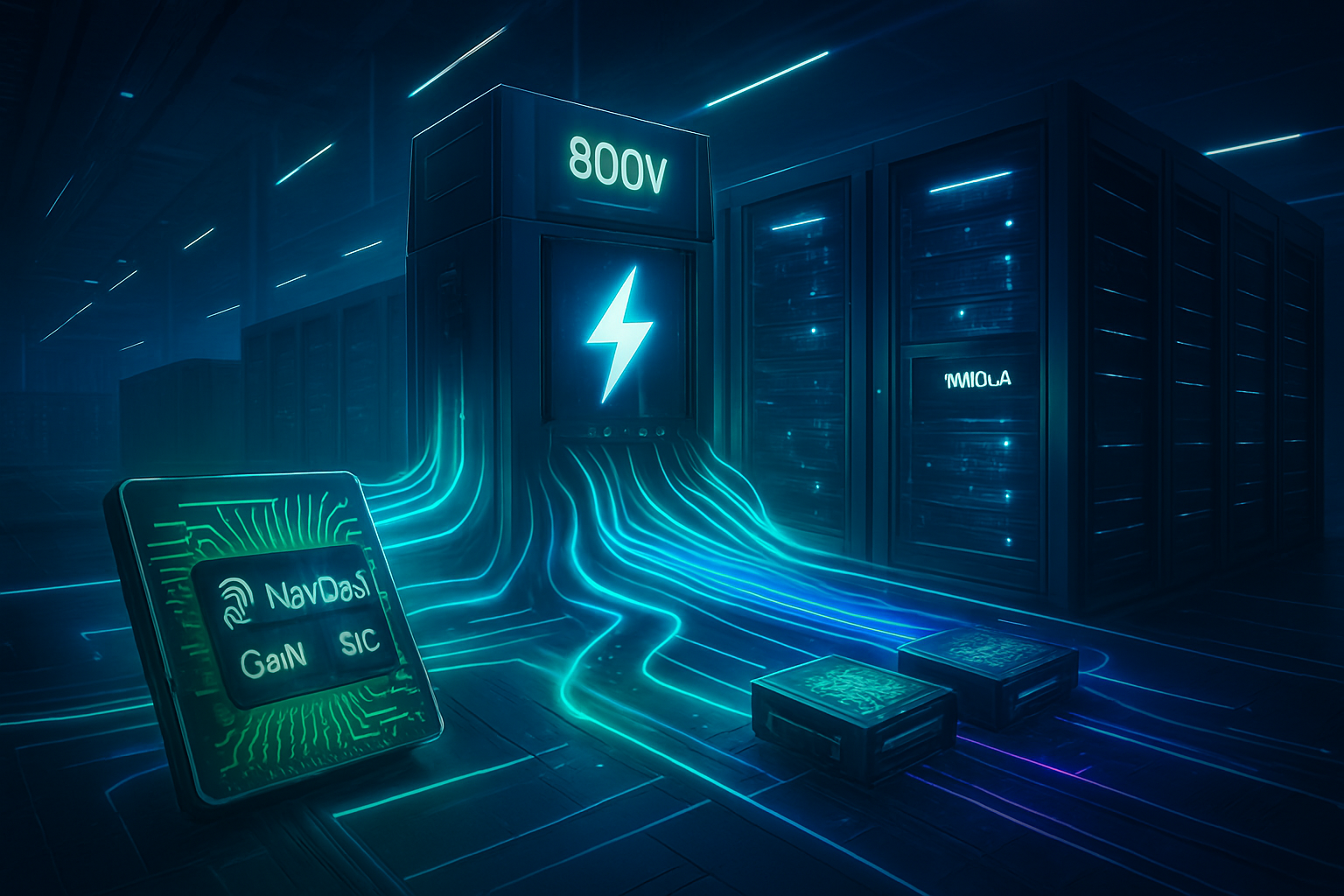
    Navitas Semiconductor (NASDAQ: NVTS) has experienced a dramatic surge in its stock value, climbing as much as 27% in a single day and approximately 179% year-to-date, following a pivotal announcement on October 13, 2025. This significant boost is directly attributed to its strategic collaboration with Nvidia (NASDAQ: NVDA), positioning Navitas as a crucial enabler for Nvidia's next-generation "AI factory" computing platforms. The partnership centers on a revolutionary 800-volt (800V) DC power architecture, designed to address the unprecedented power demands of advanced AI workloads and multi-megawatt rack densities required by modern AI data centers.

    The immediate significance of this development lies in Navitas Semiconductor's role in providing advanced Gallium Nitride (GaN) and Silicon Carbide (SiC) power chips specifically engineered for this high-voltage architecture. This validates Navitas's wide-bandgap (WBG) technology for high-performance, high-growth markets like AI data centers, marking a strategic expansion beyond its traditional focus on consumer fast chargers. The market has reacted strongly, betting on Navitas's future as a key supplier in the rapidly expanding AI infrastructure market, which is grappling with the critical need for power efficiency.

    The Technical Backbone: GaN and SiC Fueling AI's Power Needs

    Navitas Semiconductor is at the forefront of powering artificial intelligence infrastructure with its advanced GaN and SiC technologies, which offer significant improvements in power efficiency, density, and performance compared to traditional silicon-based semiconductors. These wide-bandgap materials are crucial for meeting the escalating power demands of next-generation AI data centers and Nvidia's AI factory computing platforms.

    Navitas's GaNFast™ power ICs integrate GaN power, drive, control, sensing, and protection onto a single chip. This monolithic integration minimizes delays and eliminates parasitic inductances, allowing GaN devices to switch up to 100 times faster than silicon. This results in significantly higher operating frequencies, reduced switching losses, and smaller passive components, leading to more compact and lighter power supplies. GaN devices exhibit lower on-state resistance and no reverse recovery losses, contributing to power conversion efficiencies often exceeding 95% and even up to 97%. For high-voltage, high-power applications, Navitas leverages its GeneSiC™ technology, acquired through GeneSiC. SiC boasts a bandgap nearly three times that of silicon, enabling operation at significantly higher voltages and temperatures (up to 250-300°C junction temperature) with superior thermal conductivity and robustness. SiC is particularly well-suited for high-current, high-voltage applications like power factor correction (PFC) stages in AI server power supplies, where it can achieve efficiencies over 98%.

    The fundamental difference from traditional silicon lies in the material properties of Gallium Nitride (GaN) and Silicon Carbide (SiC) as wide-bandgap semiconductors compared to traditional silicon (Si). GaN and SiC, with their wider bandgaps, can withstand higher electric fields and operate at higher temperatures and switching frequencies with dramatically lower losses. Silicon, with its narrower bandgap, is limited in these areas, resulting in larger, less efficient, and hotter power conversion systems. Navitas's new 100V GaN FETs are optimized for the lower-voltage DC-DC stages directly on GPU power boards, where individual AI chips can consume over 1000W, demanding ultra-high density and efficient thermal management. Meanwhile, 650V GaN and high-voltage SiC devices handle the initial high-power conversion stages, from the utility grid to the 800V DC backbone.

    Initial reactions from the AI research community and industry experts are overwhelmingly positive, emphasizing the critical importance of wide-bandgap semiconductors. Experts consistently highlight that power delivery has become a significant bottleneck for AI's growth, with AI workloads consuming substantially more power than traditional computing. The shift to 800 VDC architectures, enabled by GaN and SiC, is seen as crucial for scaling complex AI models, especially large language models (LLMs) and generative AI. This technological imperative underscores that advanced materials beyond silicon are not just an option but a necessity for meeting the power and thermal challenges of modern AI infrastructure.

    Reshaping the AI Landscape: Corporate Impacts and Competitive Edge

    Navitas Semiconductor's advancements in GaN and SiC power efficiency are profoundly impacting the artificial intelligence industry, particularly through its collaboration with Nvidia (NASDAQ: NVDA). These wide-bandgap semiconductors are enabling a fundamental architectural shift in AI infrastructure, moving towards higher voltage and significantly more efficient power delivery, which has wide-ranging implications for AI companies, tech giants, and startups.

    Nvidia (NASDAQ: NVDA) and other AI hardware innovators are the primary beneficiaries. As the driver of the 800 VDC architecture, Nvidia directly benefits from Navitas's GaN and SiC advancements, which are critical for powering its next-generation AI computing platforms like the NVIDIA Rubin Ultra, ensuring GPUs can operate at unprecedented power levels with optimal efficiency. Hyperscale cloud providers and tech giants such as Alphabet (NASDAQ: GOOGL), Microsoft (NASDAQ: MSFT), Amazon (NASDAQ: AMZN), and Meta Platforms (NASDAQ: META) also stand to gain significantly. The efficiency gains, reduced cooling costs, and higher power density offered by GaN/SiC-enabled infrastructure will directly impact their operational expenditures and allow them to scale their AI compute capacity more effectively. For Navitas Semiconductor (NASDAQ: NVTS), the partnership with Nvidia provides substantial validation for its technology and strengthens its market position as a critical supplier in the high-growth AI data center sector, strategically shifting its focus from lower-margin consumer products to high-performance AI solutions.

    The adoption of GaN and SiC in AI infrastructure creates both opportunities and challenges for major players. Nvidia's active collaboration with Navitas further solidifies its dominance in AI hardware, as the ability to efficiently power its high-performance GPUs (which can consume over 1000W each) is crucial for maintaining its competitive edge. This puts pressure on competitors like Advanced Micro Devices (NASDAQ: AMD) and Intel (NASDAQ: INTC) to integrate similar advanced power management solutions. Companies like Navitas and Infineon (OTCQX: IFNNY), which also develops GaN/SiC solutions for AI data centers, are becoming increasingly important, shifting the competitive landscape in power electronics for AI. The transition to an 800 VDC architecture fundamentally disrupts the market for traditional 54V power systems, making them less suitable for the multi-megawatt demands of modern AI factories and accelerating the shift towards advanced thermal management solutions like liquid cooling.

    Navitas Semiconductor (NASDAQ: NVTS) is strategically positioning itself as a leader in power semiconductor solutions for AI data centers. Its first-mover advantage and deep collaboration with Nvidia (NASDAQ: NVDA) provide a strong strategic advantage, validating its technology and securing its place as a key enabler for next-generation AI infrastructure. This partnership is seen as a "proof of concept" for scaling GaN and SiC solutions across the broader AI market. Navitas's GaNFast™ and GeneSiC™ technologies offer superior efficiency, power density, and thermal performance—critical differentiators in the power-hungry AI market. By pivoting its focus to high-performance, high-growth sectors like AI data centers, Navitas is targeting a rapidly expanding and lucrative market segment, with its "Grid to GPU" strategy offering comprehensive power delivery solutions.

    The Broader AI Canvas: Environmental, Economic, and Historical Significance

    Navitas Semiconductor's advancements in Gallium Nitride (GaN) and Silicon Carbide (SiC) technologies, particularly in collaboration with Nvidia (NASDAQ: NVDA), represent a pivotal development for AI power efficiency, addressing the escalating energy demands of modern artificial intelligence. This progress is not merely an incremental improvement but a fundamental shift enabling the continued scaling and sustainability of AI infrastructure.

    The rapid expansion of AI, especially large language models (LLMs) and other complex neural networks, has led to an unprecedented surge in computational power requirements and, consequently, energy consumption. High-performance AI processors, such as Nvidia's H100, already demand 700W, with next-generation chips like the Blackwell B100 and B200 projected to exceed 1,000W. Traditional data center power architectures, typically operating at 54V, are proving inadequate for the multi-megawatt rack densities needed by "AI factories." Nvidia is spearheading a transition to an 800 VDC power architecture for these AI factories, which aims to support 1 MW server racks and beyond. Navitas's GaN and SiC power semiconductors are purpose-built to enable this 800 VDC architecture, offering breakthrough efficiency, power density, and performance from the utility grid to the GPU.

    The widespread adoption of GaN and SiC in AI infrastructure offers substantial environmental and economic benefits. Improved energy efficiency directly translates to reduced electricity consumption in data centers, which are projected to account for a significant and growing portion of global electricity use, potentially doubling by 2030. This reduction in energy demand lowers the carbon footprint associated with AI operations, with Navitas estimating its GaN technology alone could reduce over 33 gigatons of carbon dioxide by 2050. Economically, enhanced efficiency leads to significant cost savings for data center operators through lower electricity bills and reduced operational expenditures. The increased power density allowed by GaN and SiC means more computing power can be housed in the same physical space, maximizing real estate utilization and potentially generating more revenue per data center. The shift to 800 VDC also reduces copper usage by up to 45%, simplifying power trains and cutting material costs.

    Despite the significant advantages, challenges exist regarding the widespread adoption of GaN and SiC technologies. The manufacturing processes for GaN and SiC are more complex than those for traditional silicon, requiring specialized equipment and epitaxial growth techniques, which can lead to limited availability and higher costs. However, the industry is actively addressing these issues through advancements in bulk production, epitaxial growth, and the transition to larger wafer sizes. Navitas has established a strategic partnership with Powerchip for scalable, high-volume GaN-on-Si manufacturing to mitigate some of these concerns. While GaN and SiC semiconductors are generally more expensive to produce than silicon-based devices, continuous improvements in manufacturing processes, increased production volumes, and competition are steadily reducing costs.

    Navitas's GaN and SiC advancements, particularly in the context of Nvidia's 800 VDC architecture, represent a crucial foundational enabler rather than an algorithmic or computational breakthrough in AI itself. Historically, AI milestones have often focused on advances in algorithms or processing power. However, the "insatiable power demands" of modern AI have created a looming energy crisis that threatens to impede further advancement. This focus on power efficiency can be seen as a maturation of the AI industry, moving beyond a singular pursuit of computational power to embrace responsible and sustainable advancement. The collaboration between Navitas (NASDAQ: NVTS) and Nvidia (NASDAQ: NVDA) is a critical step in addressing the physical and economic limits that could otherwise hinder the continuous scaling of AI computational power, making possible the next generation of AI innovation.

    The Road Ahead: Future Developments and Expert Outlook

    Navitas Semiconductor (NASDAQ: NVTS), through its strategic partnership with Nvidia (NASDAQ: NVDA) and continuous innovation in GaN and SiC technologies, is playing a pivotal role in enabling the high-efficiency and high-density power solutions essential for the future of AI infrastructure. This involves a fundamental shift to 800 VDC architectures, the development of specialized power devices, and a commitment to scalable manufacturing.

    In the near term, a significant development is the industry-wide shift towards an 800 VDC power architecture, championed by Nvidia for its "AI factories." Navitas is actively supporting this transition with purpose-built GaN and SiC devices, which are expected to deliver up to 5% end-to-end efficiency improvements. Navitas has already unveiled new 100V GaN FETs optimized for lower-voltage DC-DC stages on GPU power boards, and 650V GaN as well as high-voltage SiC devices designed for Nvidia's 800 VDC AI factory architecture. These products aim for breakthrough efficiency, power density, and performance, with solutions demonstrating a 4.5 kW AI GPU power supply achieving a power density of 137 W/in³ and PSUs delivering up to 98% efficiency. To support high-volume demand, Navitas has established a strategic partnership with Powerchip for 200 mm GaN-on-Si wafer fabrication.

    Longer term, GaN and SiC are seen as foundational enablers for the continuous scaling of AI computational power, as traditional silicon technologies reach their inherent physical limits. The integration of GaN with SiC into hybrid solutions is anticipated to further optimize cost and performance across various power stages within AI data centers. Advanced packaging technologies, including 2.5D and 3D-IC stacking, will become standard to overcome bandwidth limitations and reduce energy consumption. Experts predict that AI itself will play an increasingly critical role in the semiconductor industry, automating design processes, optimizing manufacturing, and accelerating the discovery of new materials. Wide-bandbandgap semiconductors like GaN and SiC are projected to gradually displace silicon in mass-market power electronics from the mid-2030s, becoming indispensable for applications ranging from data centers to electric vehicles.

    The rapid growth of AI presents several challenges that Navitas's technologies aim to address. The soaring energy consumption of AI, with high-performance GPUs like Nvidia's upcoming B200 and GB200 consuming 1000W and 2700W respectively, exacerbates power demands. This necessitates superior thermal management solutions, which increased power conversion efficiency directly reduces. While GaN devices are approaching cost parity with traditional silicon, continuous efforts are needed to address cost and scalability, including further development in 300 mm GaN wafer fabrication. Experts predict a profound transformation driven by the convergence of AI and advanced materials, with GaN and SiC becoming indispensable for power electronics in high-growth areas. The industry is undergoing a fundamental architectural redesign, moving towards 400-800 V DC power distribution and standardizing on GaN- and SiC-enabled Power Supply Units (PSUs) to meet escalating power demands.

    A New Era for AI Power: The Path Forward

    Navitas Semiconductor's (NASDAQ: NVTS) recent stock surge, directly linked to its pivotal role in powering Nvidia's (NASDAQ: NVDA) next-generation AI data centers, underscores a fundamental shift in the landscape of artificial intelligence. The key takeaway is that the continued exponential growth of AI is critically dependent on breakthroughs in power efficiency, which wide-bandgap semiconductors like Gallium Nitride (GaN) and Silicon Carbide (SiC) are uniquely positioned to deliver. Navitas's collaboration with Nvidia on an 800V DC power architecture for "AI factories" is not merely an incremental improvement but a foundational enabler for the future of high-performance, sustainable AI.

    This development holds immense significance in AI history, marking a maturation of the industry where the focus extends beyond raw computational power to encompass the crucial aspect of energy sustainability. As AI workloads, particularly large language models, consume unprecedented amounts of electricity, the ability to efficiently deliver and manage power becomes the new frontier. Navitas's technology directly addresses this looming energy crisis, ensuring that the physical and economic constraints of powering increasingly powerful AI processors do not impede the industry's relentless pace of innovation. It enables the construction of multi-megawatt AI factories that would be unfeasible with traditional power systems, thereby unlocking new levels of performance and significantly contributing to mitigating the escalating environmental concerns associated with AI's expansion.

    The long-term impact is profound. We can expect a comprehensive overhaul of data center design, leading to substantial reductions in operational costs for AI infrastructure providers due to improved energy efficiency and decreased cooling needs. Navitas's solutions are crucial for the viability of future AI hardware, ensuring reliable and efficient power delivery to advanced accelerators like Nvidia's Rubin Ultra platform. On a societal level, widespread adoption of these power-efficient technologies will play a critical role in managing the carbon footprint of the burgeoning AI industry, making AI growth more sustainable. Navitas is now strategically positioned as a critical enabler in the rapidly expanding and lucrative AI data center market, fundamentally reshaping its investment narrative and growth trajectory.

    In the coming weeks and months, investors and industry observers should closely monitor Navitas's financial performance, particularly its Q3 2025 results, to assess how quickly its technological leadership translates into revenue growth. Key indicators will also include updates on the commercial deployment timelines and scaling of Nvidia's 800V HVDC systems, with widespread adoption anticipated around 2027. Further partnerships or design wins for Navitas with other hyperscalers or major AI players would signal continued momentum. Additionally, any new announcements from Nvidia regarding its "AI factory" vision and future platforms will provide insights into the pace and scale of adoption for Navitas's power solutions, reinforcing the critical role of GaN and SiC in the unfolding AI revolution.


    This content is intended for informational purposes only and represents analysis of current AI developments.

    TokenRing AI delivers enterprise-grade solutions for multi-agent AI workflow orchestration, AI-powered development tools, and seamless remote collaboration platforms.
    For more information, visit https://www.tokenring.ai/.

  • Navitas Semiconductor Unveils 800V Power Solutions, Propelling NVIDIA’s Next-Gen AI Data Centers

    Navitas Semiconductor Unveils 800V Power Solutions, Propelling NVIDIA’s Next-Gen AI Data Centers

    Navitas Semiconductor (NASDAQ: NVTS) today, October 13, 2025, announced a pivotal advancement in its power chip technology, unveiling new gallium nitride (GaN) and silicon carbide (SiC) devices specifically engineered to support NVIDIA's (NASDAQ: NVDA) groundbreaking 800 VDC power architecture. This development is critical for enabling the next generation of AI computing platforms and "AI factories," which face unprecedented power demands. The immediate significance lies in facilitating a fundamental architectural shift within data centers, moving away from traditional 54V systems to meet the multi-megawatt rack densities required by cutting-edge AI workloads, promising enhanced efficiency, scalability, and reduced infrastructure costs for the rapidly expanding AI sector.

    This strategic move by Navitas is set to redefine power delivery for high-performance AI, ensuring that the physical and economic constraints of powering increasingly powerful AI processors do not impede the industry's relentless pace of innovation. By addressing the core challenge of efficient energy distribution, Navitas's solutions are poised to unlock new levels of performance and sustainability for AI infrastructure globally.

    Technical Prowess: Powering the AI Revolution with GaN and SiC

    Navitas's latest portfolio introduces a suite of high-performance power devices tailored for NVIDIA's demanding AI infrastructure. Key among these are the new 100 V GaN FETs, meticulously optimized for the lower-voltage DC-DC stages found on GPU power boards. These GaN-on-Si field-effect transistors are fabricated using a 200 mm process through a strategic partnership with Power Chip, ensuring scalable, high-volume manufacturing. Designed with advanced dual-sided cooled packages, these FETs directly tackle the critical needs for ultra-high power density and superior thermal management in next-generation AI compute platforms, where individual AI chips can consume upwards of 1000W.

    Complementing the 100 V GaN FETs, Navitas has also enhanced its 650 V GaN portfolio with new high-power GaN FETs and advanced GaNSafe™ power ICs. The GaNSafe™ devices integrate crucial control, drive, sensing, and built-in protection features, offering enhanced robustness and reliability vital for demanding AI infrastructure. These components boast ultra-fast short-circuit protection with a 350 ns response time, 2 kV ESD protection, and programmable slew-rate control, ensuring stable and secure operation in high-stress environments. Furthermore, Navitas continues to leverage its High-Voltage GeneSiC™ SiC MOSFET lineup, providing silicon carbide MOSFETs ranging from 650 V to 6,500 V, which support various stages of power conversion across the broader data center infrastructure.

    This technological leap fundamentally differs from previous approaches by enabling NVIDIA's recently announced 800 VDC power architecture. Unlike traditional 54V in-rack power distribution systems, the 800 VDC architecture allows for direct conversion from 13.8 kVAC utility power to 800 VDC at the data center perimeter. This eliminates multiple conventional AC/DC and DC/DC conversion stages, drastically maximizing energy efficiency and reducing resistive losses. Navitas's solutions are capable of achieving PFC peak efficiencies of up to 99.3%, a significant improvement that directly translates to lower operational costs and a smaller carbon footprint. The shift also reduces copper wire thickness by up to 45% due to lower current, leading to material cost savings and reduced weight.

    Initial reactions from the AI research community and industry experts underscore the critical importance of these advancements. While specific, in-depth reactions to this very recent announcement are still emerging, the consensus emphasizes the pivotal role of wide-bandbandgap (WBG) semiconductors like GaN and SiC in addressing the escalating power and thermal challenges of AI data centers. Experts consistently highlight that power delivery has become a significant bottleneck for AI's growth, with AI workloads consuming substantially more power than traditional computing. The industry widely recognizes NVIDIA's strategic shift to 800 VDC as a necessary architectural evolution, with other partners like ABB (SWX: ABBN) and Infineon (FWB: IFX) also announcing support, reinforcing the widespread need for higher voltage systems to enhance efficiency, scalability, and reliability.

    Strategic Implications: Reshaping the AI Industry Landscape

    Navitas Semiconductor's integral role in powering NVIDIA's 800 VDC AI platforms is set to profoundly impact various players across the AI industry. Hyperscale cloud providers and AI factory operators, including tech giants like Alphabet (NASDAQ: GOOGL), Amazon (NASDAQ: AMZN), Meta Platforms (NASDAQ: META), Microsoft (NASDAQ: MSFT), and Oracle Cloud Infrastructure (NYSE: ORCL), alongside specialized AI infrastructure providers such as CoreWeave, Lambda, Nebius, and Together AI, stand as primary beneficiaries. The enhanced power efficiency, increased power density, and improved thermal performance offered by Navitas's chips will lead to substantial reductions in operational costs—energy, cooling, and maintenance—for these companies. This translates directly to a lower total cost of ownership (TCO) for AI infrastructure, enabling them to scale their AI operations more economically and sustainably.

    AI model developers and researchers will benefit indirectly from the more robust and efficient infrastructure. The ability to deploy higher power density racks means more GPUs can be integrated into a smaller footprint, significantly accelerating training times and enabling the development of even larger and more capable AI models. This foundational improvement is crucial for fueling continued innovation in areas such as generative AI, large language models, and advanced scientific simulations, pushing the boundaries of what AI can achieve.

    For AI hardware manufacturers and data center infrastructure providers, such as HPE (NYSE: HPE), Vertiv (NYSE: VRT), and Foxconn (TPE: 2317), the shift to the 800 VDC architecture necessitates adaptation. Companies that swiftly integrate these new power management solutions, leveraging the superior characteristics of GaN and SiC, will gain a significant competitive advantage. Vertiv, for instance, has already unveiled its 800 VDC MGX reference architecture, demonstrating proactive engagement with this evolving standard. This transition also presents opportunities for startups specializing in cooling, power distribution, and modular data center solutions to innovate within the new architectural paradigm.

    Navitas Semiconductor's collaboration with NVIDIA significantly bolsters its market positioning. As a pure-play wide-bandgap power semiconductor company, Navitas has validated its technology for high-performance, high-growth markets like AI data centers, strategically expanding beyond its traditional strength in consumer fast chargers. This partnership positions Navitas as a critical enabler of this architectural shift, particularly with its specialized 100V GaN FET portfolio and high-voltage SiC MOSFETs. While the power semiconductor market remains highly competitive, with major players like Infineon, STMicroelectronics (NYSE: STM), Texas Instruments (NASDAQ: TXN), and OnSemi (NASDAQ: ON) also developing GaN and SiC solutions, Navitas's specific focus and early engagement with NVIDIA provide a strong foothold. The overall wide-bandgap semiconductor market is projected for substantial growth, ensuring intense competition and continuous innovation.

    Wider Significance: A Foundational Shift for Sustainable AI

    This development by Navitas Semiconductor, enabling NVIDIA's 800 VDC AI platforms, represents more than just a component upgrade; it signifies a fundamental architectural transformation within the broader AI landscape. It directly addresses the most pressing challenge facing the exponential growth of AI: scalable and efficient power delivery. As AI workloads continue to surge, demanding multi-megawatt rack densities that traditional 54V systems cannot accommodate, the 800 VDC architecture becomes an indispensable enabler for the "AI factories" of the future. This move aligns perfectly with the industry trend towards higher power density, greater energy efficiency, and simplified power distribution to support the insatiable demands of AI processors that can exceed 1,000W per chip.

    The impacts on the industry are profound, leading to a complete overhaul of data center design. This shift will result in significant reductions in operational costs for AI infrastructure providers due to improved energy efficiency (up to 5% end-to-end) and reduced cooling requirements. It is also crucial for enabling the next generation of AI hardware, such as NVIDIA's Rubin Ultra platform, by ensuring that these powerful accelerators receive the necessary, reliable power. On a societal level, this advancement contributes significantly to addressing the escalating energy consumption and environmental concerns associated with AI. By making AI infrastructure more sustainable, it helps mitigate the carbon footprint of AI, which is projected to consume a substantial portion of global electricity in the coming years.

    However, this transformative shift is not without its concerns. Implementing 800 VDC systems introduces new complexities related to electrical safety, insulation, and fault management within data centers. There's also the challenge of potential supply chain dependence on specialized GaN and SiC power semiconductors, though Navitas's partnership with Power Chip for 200mm GaN-on-Si production aims to mitigate this. Thermal management remains a critical issue despite improved electrical efficiency, necessitating advanced liquid cooling solutions for ultra-high power density racks. Furthermore, while efficiency gains are crucial, there is a risk of a "rebound effect" (Jevon's paradox), where increased efficiency might lead to even greater overall energy consumption due to expanded AI deployment and usage, placing unprecedented demands on energy grids.

    In terms of historical context, this development is comparable to the pivotal transition from CPUs to GPUs for AI, which provided orders of magnitude improvements in computational power. While not an algorithmic breakthrough itself, Navitas's power chips are a foundational infrastructure enabler, akin to the early shifts to higher voltage (e.g., 12V to 48V) in data centers, but on a far grander scale. It also echoes the continuous development of specialized AI accelerators and the increasing necessity of advanced cooling solutions. Essentially, this power management innovation is a critical prerequisite, allowing the AI industry to overcome physical limitations and continue its rapid advancement and societal impact.

    The Road Ahead: Future Developments in AI Power Management

    In the near term, the focus will be on the widespread adoption and refinement of the 800 VDC architecture, leveraging Navitas's advanced GaN and SiC power devices. Navitas is actively progressing its "AI Power Roadmap," which aims to rapidly increase server power platforms from 3kW to 12kW and beyond. The company has already demonstrated an 8.5kW AI data center PSU powered by GaN and SiC, achieving 98% efficiency and complying with Open Compute Project (OCP) and Open Rack v3 (ORv3) specifications. Expect continued innovation in integrated GaNSafe™ power ICs, offering further advancements in control, drive, sensing, and protection, crucial for the robustness of future AI factories.

    Looking further ahead, the potential applications and use cases for these high-efficiency power solutions extend beyond just hyperscale AI data centers. While "AI factories" remain the primary target, the underlying wide bandgap technologies are also highly relevant for industrial platforms, advanced energy storage systems, and grid-tied inverter projects, where efficiency and power density are paramount. The ability to deliver megawatt-scale power with significantly more compact and reliable solutions will facilitate the expansion of AI into new frontiers, including more powerful edge AI deployments where space and power constraints are even more critical.

    However, several challenges need continuous attention. The exponentially growing power demands of AI will remain the most significant hurdle; even with 800 VDC, the sheer scale of anticipated AI factories will place immense strain on energy grids. The "readiness gap" in existing data center ecosystems, many of which cannot yet support the power demands of the latest NVIDIA GPUs, requires substantial investment and upgrades. Furthermore, ensuring robust and efficient thermal management for increasingly dense AI racks will necessitate ongoing innovation in liquid cooling technologies, such as direct-to-chip and immersion cooling, which can reduce cooling energy requirements by up to 95%.

    Experts predict a dramatic surge in data center power consumption, with Goldman Sachs Research forecasting a 50% increase by 2027 and up to 165% by the end of the decade compared to 2023. This necessitates a "power-first" approach to data center site selection, prioritizing access to substantial power capacity. The integration of renewable energy sources, on-site generation, and advanced battery storage will become increasingly critical to meet these demands sustainably. The evolution of data center design will continue towards higher power densities, with racks reaching up to 30 kW by 2027 and even 120 kW for specific AI training models, fundamentally reshaping the physical and operational landscape of AI infrastructure.

    A New Era for AI Power: Concluding Thoughts

    Navitas Semiconductor's announcement on October 13, 2025, regarding its new GaN and SiC power chips for NVIDIA's 800 VDC AI platforms marks a monumental leap forward in addressing the insatiable power demands of artificial intelligence. The key takeaway is the enablement of a fundamental architectural shift in data center power delivery, moving from the limitations of 54V systems to a more efficient, scalable, and reliable 800 VDC infrastructure. This transition, powered by Navitas's advanced wide bandgap semiconductors, promises up to 5% end-to-end efficiency improvements, significant reductions in copper usage, and simplified power trains, directly supporting NVIDIA's vision of multi-megawatt "AI factories."

    This development's significance in AI history cannot be overstated. While not an AI algorithmic breakthrough, it is a critical foundational enabler that allows the continuous scaling of AI computational power. Without such innovations in power management, the physical and economic limits of data center construction would severely impede the advancement of AI. It represents a necessary evolution, akin to past shifts in computing architecture, but driven by the unprecedented energy requirements of modern AI. This move is crucial for the sustained growth of AI, from large language models to complex scientific simulations, and for realizing the full potential of AI's societal impact.

    The long-term impact will be profound, shaping the future of AI infrastructure to be more efficient, sustainable, and scalable. It will reduce operational costs for AI operators, contribute to environmental responsibility by lowering AI's carbon footprint, and spur further innovation in power electronics across various industries. The shift to 800 VDC is not merely an upgrade; it's a paradigm shift that redefines how AI is powered, deployed, and scaled globally.

    In the coming weeks and months, the industry should closely watch for the implementation of this 800 VDC architecture in new AI factories and data centers, with particular attention to initial performance benchmarks and efficiency gains. Further announcements from Navitas regarding product expansions and collaborations within the rapidly growing 800 VDC ecosystem will be critical. The broader adoption of new industry standards for high-voltage DC power delivery, championed by organizations like the Open Compute Project, will also be a key indicator of this architectural shift's momentum. The evolution of AI hinges on these foundational power innovations, making Navitas's role in this transformation one to watch closely.


    This content is intended for informational purposes only and represents analysis of current AI developments.

    TokenRing AI delivers enterprise-grade solutions for multi-agent AI workflow orchestration, AI-powered development tools, and seamless remote collaboration platforms.
    For more information, visit https://www.tokenring.ai/.

  • The Quiet Revolution: Discrete Semiconductors Poised for Explosive Growth as Tech Demands Soar

    The Quiet Revolution: Discrete Semiconductors Poised for Explosive Growth as Tech Demands Soar

    The often-overlooked yet fundamentally critical discrete semiconductors market is on the cusp of an unprecedented boom, with projections indicating a substantial multi-billion dollar expansion in the coming years. As of late 2025, industry analyses reveal a market poised for robust growth, driven by a confluence of global electrification trends, the relentless march of consumer electronics, and an escalating demand for energy efficiency across all sectors. These essential building blocks of modern electronics, responsible for controlling voltage, current, and power flow, are becoming increasingly vital as industries push the boundaries of performance and sustainability.

    This projected surge, with market valuations estimated to reach between USD 32.74 billion and USD 48.06 billion in 2025 and potentially soaring past USD 90 billion by the early 2030s, underscores the immediate significance of discrete components. From powering the rapidly expanding electric vehicle (EV) market and enabling the vast network of Internet of Things (IoT) devices to optimizing renewable energy systems and bolstering telecommunications infrastructure, discrete semiconductors are proving indispensable. Their evolution, particularly with the advent of advanced materials, is not just supporting but actively propelling the next wave of technological innovation.

    The Engineering Backbone: Unpacking the Technical Drivers of Discrete Semiconductor Growth

    The burgeoning discrete semiconductors market is not merely a product of increased demand but a testament to significant technical advancements and evolving application requirements. At the heart of this growth are innovations that enhance performance, efficiency, and reliability, differentiating modern discrete components from their predecessors.

    A key technical differentiator lies in the widespread adoption and continuous improvement of wide-bandgap (WBG) materials, specifically Silicon Carbide (SiC) and Gallium Nitride (GaN). Unlike traditional silicon-based semiconductors, SiC and GaN offer superior properties such as higher breakdown voltage, faster switching speeds, lower on-resistance, and better thermal conductivity. These characteristics translate directly into more compact, more efficient, and more robust power electronics. For instance, in electric vehicles, SiC MOSFETs enable more efficient power conversion in inverters, extending battery range and reducing charging times. GaN HEMTs (High Electron Mobility Transistors) are revolutionizing power adapters and RF applications due to their high-frequency capabilities and reduced energy losses. This contrasts sharply with older silicon devices, which often required larger heat sinks and operated with greater energy dissipation, limiting their application in power-dense environments.

    The technical specifications of these advanced discretes are impressive. SiC devices can handle voltages exceeding 1200V and operate at temperatures up to 200°C, making them ideal for high-power industrial and automotive applications. GaN devices, while typically used at lower voltages (up to 650V), offer significantly faster switching frequencies, often in the MHz range, which is critical for compact power supplies and 5G telecommunications. These capabilities are crucial for managing the increasingly complex and demanding power requirements of modern electronics, from sophisticated automotive powertrains to intricate data center power distribution units. The AI research community, though not directly focused on discrete semiconductors, indirectly benefits from these advancements as efficient power delivery is crucial for high-performance computing and AI accelerators, where power consumption and thermal management are significant challenges.

    Initial reactions from the semiconductor industry and engineering community have been overwhelmingly positive, with significant investment flowing into WBG material research and manufacturing. Companies are actively retooling fabs and developing new product lines to capitalize on these materials' advantages. The shift represents a fundamental evolution in power electronics design, enabling engineers to create systems that were previously impractical due to limitations of silicon technology. This technical leap is not just incremental; it’s a paradigm shift that allows for higher power densities, reduced system size and weight, and substantial improvements in overall energy efficiency, directly addressing global mandates for sustainability and performance.

    Corporate Maneuvers: How the Discrete Semiconductor Boom Reshapes the Industry Landscape

    The projected surge in the discrete semiconductors market is creating significant opportunities and competitive shifts among established tech giants and specialized semiconductor firms alike. Companies with strong positions in power management, automotive, and industrial sectors are particularly well-poised to capitalize on this growth.

    Among the major beneficiaries are companies like Infineon Technologies AG (FWB: IFX, OTCQX: IFNNY), a global leader in power semiconductors and automotive electronics. Infineon's extensive portfolio of MOSFETs, IGBTs, and increasingly, SiC and GaN power devices, places it at the forefront of the electrification trend. Its deep ties with automotive manufacturers and industrial clients ensure a steady demand for its high-performance discretes. Similarly, STMicroelectronics N.V. (NYSE: STM), with its strong presence in automotive, industrial, and consumer markets, is a key player, particularly with its investments in SiC manufacturing. These companies stand to benefit from the increasing content of discrete semiconductors per vehicle (especially EVs) and per industrial application.

    The competitive landscape is also seeing intensified efforts from other significant players. ON Semiconductor Corporation (NASDAQ: ON), now branded as onsemi, has strategically pivoted towards intelligent power and sensing technologies, with a strong emphasis on SiC solutions for automotive and industrial applications. NXP Semiconductors N.V. (NASDAQ: NXPI) also holds a strong position in automotive and IoT, leveraging its discrete components for various embedded applications. Japanese giants like Renesas Electronics Corporation (TSE: 6723) and Mitsubishi Electric Corporation (TSE: 6503) are also formidable competitors, particularly in IGBTs for industrial motor control and power modules. The increasing demand for specialized, high-performance discretes is driving these companies to invest heavily in R&D and manufacturing capacity, leading to potential disruption for those slower to adopt WBG technologies.

    For startups and smaller specialized firms, the boom presents opportunities in niche segments, particularly around advanced packaging, testing, or specific application-focused SiC/GaN solutions. However, the high capital expenditure required for semiconductor fabrication (fabs) means that significant market share gains often remain with the larger, more established players who can afford the necessary investments in capacity and R&D. Market positioning is increasingly defined by technological leadership in WBG materials and the ability to scale production efficiently. Companies that can offer integrated solutions, combining discretes with microcontrollers or sensors, will also gain a strategic advantage by simplifying design for their customers and offering more comprehensive solutions.

    A Broader Lens: Discrete Semiconductors and the Global Tech Tapestry

    The projected boom in discrete semiconductors is far more than an isolated market trend; it is a foundational pillar supporting several overarching global technological and societal shifts. This growth seamlessly integrates into the broader AI landscape and other macro trends, underscoring its pivotal role in shaping the future.

    One of the most significant impacts is on the global push for sustainability and energy efficiency. As the world grapples with climate change, the demand for renewable energy systems (solar, wind), smart grids, and energy-efficient industrial machinery is skyrocketing. Discrete semiconductors, especially those made from SiC and GaN, are crucial enablers in these systems, facilitating more efficient power conversion, reducing energy losses, and enabling smarter energy management. This directly contributes to reducing carbon footprints and achieving global climate goals. The electrification of transportation, particularly the rise of electric vehicles, is another massive driver. EVs rely heavily on high-performance power discretes for their inverters, onboard chargers, and DC-DC converters, making the discrete market boom intrinsically linked to the automotive industry's green transformation.

    Beyond sustainability, the discrete semiconductor market's expansion is critical for the continued growth of the Internet of Things (IoT) and edge computing. Millions of connected devices, from smart home appliances to industrial sensors, require efficient and compact power management solutions, often provided by discrete components. As AI capabilities increasingly migrate to the edge, processing data closer to the source, the demand for power-efficient and robust discrete semiconductors in these edge devices will only intensify. This enables real-time data processing and decision-making, which is vital for autonomous systems and smart infrastructure.

    Potential concerns, however, include supply chain vulnerabilities and the environmental impact of increased manufacturing. The highly globalized semiconductor supply chain has shown its fragility in recent years, and a surge in demand could put pressure on raw material sourcing and manufacturing capacity. Additionally, while the end products are more energy-efficient, the manufacturing process for advanced semiconductors can be energy-intensive and generate waste, prompting calls for more sustainable production methods. Comparisons to previous semiconductor cycles highlight the cyclical nature of the industry, but the current drivers—electrification, AI, and IoT—represent long-term structural shifts rather than transient fads, suggesting a more sustained growth trajectory for discretes. This boom is not just about faster chips; it's about powering the fundamental infrastructure of a more connected, electric, and intelligent world.

    The Road Ahead: Anticipating Future Developments in Discrete Semiconductors

    The trajectory of the discrete semiconductors market points towards a future characterized by continuous innovation, deeper integration into advanced systems, and an even greater emphasis on performance and efficiency. Experts predict several key developments in the near and long term.

    In the near term, the industry will likely see further advancements in wide-bandgap (WBG) materials, particularly in scaling up SiC and GaN production, improving manufacturing yields, and reducing costs. This will make these high-performance discretes more accessible for a broader range of applications, including mainstream consumer electronics. We can also expect to see the development of hybrid power modules that integrate different types of discrete components (e.g., SiC MOSFETs with silicon IGBTs) to optimize performance for specific applications. Furthermore, there will be a strong focus on advanced packaging technologies to enable higher power densities, better thermal management, and smaller form factors, crucial for miniaturization trends in IoT and portable devices.

    Looking further ahead, the potential applications and use cases are vast. Beyond current trends, discrete semiconductors will be pivotal in emerging fields such such as quantum computing (for power delivery and control systems), advanced robotics, and next-generation aerospace and defense systems. The continuous drive for higher power efficiency will also fuel research into novel materials beyond SiC and GaN, exploring even wider bandgap materials or new device structures that can push the boundaries of voltage, current, and temperature handling. Challenges that need to be addressed include overcoming the current limitations in WBG material substrate availability, standardizing testing and reliability protocols for these new technologies, and developing a skilled workforce capable of designing and manufacturing these advanced components.

    Experts predict that the discrete semiconductor market will become even more specialized, with companies focusing on specific application segments (e.g., automotive power, RF communications, industrial motor control) to gain a competitive edge. The emphasis will shift from simply supplying components to providing integrated power solutions that include intelligent control and sensing capabilities. The relentless pursuit of energy efficiency and the electrification of everything will ensure that discrete semiconductors remain at the forefront of technological innovation for decades to come.

    Conclusion: Powering the Future, One Discrete Component at a Time

    The projected boom in the discrete semiconductors market signifies a quiet but profound revolution underpinning the technological advancements of our era. From the burgeoning electric vehicle industry and the pervasive Internet of Things to the global imperative for energy efficiency and the expansion of 5G networks, these often-unseen components are the unsung heroes, enabling the functionality and performance of modern electronics. The shift towards wide-bandgap materials like SiC and GaN represents a critical inflection point, offering unprecedented efficiency, speed, and reliability that silicon alone could not deliver.

    This development is not merely an incremental step but a foundational shift with significant implications for major players like Infineon Technologies (FWB: IFX, OTCQX: IFNNY), STMicroelectronics (NYSE: STM), and onsemi (NASDAQ: ON), who are strategically positioned to lead this transformation. Their investments in advanced materials and manufacturing capacity will dictate the pace of innovation and market penetration. The wider significance of this boom extends to global sustainability goals, the proliferation of smart technologies, and the very infrastructure of our increasingly connected world.

    As we look to the coming weeks and months, it will be crucial to watch for continued advancements in WBG material production, further consolidation or strategic partnerships within the industry, and the emergence of new applications that leverage the enhanced capabilities of these discretes. The challenges of supply chain resilience and sustainable manufacturing will also remain key areas of focus. Ultimately, the discrete semiconductor market is not just experiencing a temporary surge; it is undergoing a fundamental re-evaluation of its critical role, solidifying its position as an indispensable engine for the future of technology.

    This content is intended for informational purposes only and represents analysis of current AI developments.

    TokenRing AI delivers enterprise-grade solutions for multi-agent AI workflow orchestration, AI-powered development tools, and seamless remote collaboration platforms.
    For more information, visit https://www.tokenring.ai/.

  • Beyond Silicon: A New Frontier of Materials and Architectures Reshaping the Future of Tech

    Beyond Silicon: A New Frontier of Materials and Architectures Reshaping the Future of Tech

    The semiconductor industry is on the cusp of a revolutionary transformation, moving beyond the long-standing dominance of silicon to unlock unprecedented capabilities in computing. This shift is driven by the escalating demands of artificial intelligence (AI), 5G/6G communications, electric vehicles (EVs), and quantum computing, all of which are pushing silicon to its inherent physical limits in miniaturization, power consumption, and thermal management. Emerging semiconductor technologies, focusing on novel materials and advanced architectures, are poised to redefine chip design and manufacturing, ushering in an era of hyper-efficient, powerful, and specialized computing previously unattainable.

    Innovations poised to reshape the tech industry in the near future include wide-bandgap (WBG) materials like Gallium Nitride (GaN) and Silicon Carbide (SiC), which offer superior electrical efficiency, higher electron mobility, and better heat resistance for high-power applications, critical for EVs, 5G infrastructure, and data centers. Complementing these are two-dimensional (2D) materials such as graphene and Molybdenum Disulfide (MoS2), providing pathways to extreme miniaturization, enhanced electrostatic control, and even flexible electronics due to their atomic thinness. Beyond current FinFET transistor designs, new architectures like Gate-All-Around FETs (GAA-FETs, including nanosheets and nanoribbons) and Complementary FETs (CFETs) are becoming critical, enabling superior channel control and denser, more energy-efficient chips required for next-generation logic at 2nm nodes and beyond. Furthermore, advanced packaging techniques like chiplets and 3D stacking, along with the integration of silicon photonics for faster data transmission, are becoming essential to overcome bandwidth limitations and reduce energy consumption in high-performance computing and AI workloads. These advancements are not merely incremental improvements; they represent a fundamental re-evaluation of foundational materials and structures, enabling entirely new classes of AI applications, neuromorphic computing, and specialized processing that will power the next wave of technological innovation.

    The Technical Core: Unpacking the Next-Gen Semiconductor Innovations

    The semiconductor industry is undergoing a profound transformation driven by the escalating demands for higher performance, greater energy efficiency, and miniaturization beyond the limits of traditional silicon-based architectures. Emerging semiconductor technologies, encompassing novel materials, advanced transistor designs, and innovative packaging techniques, are poised to reshape the tech industry, particularly in the realm of artificial intelligence (AI).

    Wide-Bandgap Materials: Gallium Nitride (GaN) and Silicon Carbide (SiC)

    Gallium Nitride (GaN) and Silicon Carbide (SiC) are wide-bandgap (WBG) semiconductors that offer significant advantages over conventional silicon, especially in power electronics and high-frequency applications. Silicon has a bandgap of approximately 1.1 eV, while SiC boasts about 3.3 eV and GaN an even wider 3.4 eV. This larger energy difference allows WBG materials to sustain much higher electric fields before breakdown, handling nearly ten times higher voltages and operating at significantly higher temperatures (typically up to 200°C vs. silicon's 150°C). This improved thermal performance leads to better heat dissipation and allows for simpler, smaller, and lighter packaging. Both GaN and SiC exhibit higher electron mobility and saturation velocity, enabling switching frequencies up to 10 times higher than silicon, resulting in lower conduction and switching losses and efficiency improvements of up to 70%.

    While both offer significant improvements, GaN and SiC serve different power applications. SiC devices typically withstand higher voltages (1200V and above) and higher current-carrying capabilities, making them ideal for high-power applications such as automotive and locomotive traction inverters, large solar farms, and three-phase grid converters. GaN excels in high-frequency applications and lower power levels (up to a few kilowatts), offering superior switching speeds and lower losses, suitable for DC-DC converters and voltage regulators in consumer electronics and advanced computing.

    2D Materials: Graphene and Molybdenum Disulfide (MoS₂)

    Two-dimensional (2D) materials, only a few atoms thick, present unique properties for next-generation electronics. Graphene, a semimetal with a zero-electron bandgap, exhibits exceptional electrical and thermal conductivity, mechanical strength, flexibility, and optical transparency. Its high conductivity makes it promising for transparent conductive oxides and interconnects. However, its zero bandgap restricts its direct application in optoelectronics and field-effect transistors where a clear on/off switching characteristic is required.

    Molybdenum Disulfide (MoS₂), a transition metal dichalcogenide (TMDC), has a direct bandgap of 1.8 eV in its monolayer form. Unlike graphene, MoS₂'s natural bandgap makes it highly suitable for applications requiring efficient light absorption and emission, such as photodetectors, LEDs, and solar cells. MoS₂ monolayers have shown strong performance in 5nm electronic devices, including 2D MoS₂-based field-effect transistors and highly efficient photodetectors. Integrating MoS₂ and graphene creates hybrid systems that leverage the strengths of both, for instance, in high-efficiency solar cells or as ohmic contacts for MoS₂ transistors.

    Advanced Architectures: Gate-All-Around FETs (GAA-FETs) and Complementary FETs (CFETs)

    As traditional planar transistors reached their scaling limits, FinFETs emerged as 3D structures. FinFETs utilize a fin-shaped channel surrounded by the gate on three sides, offering improved electrostatic control and reduced leakage. However, at 3nm and below, FinFETs face challenges due to increasing variability and limitations in scaling metal pitch.

    Gate-All-Around FETs (GAA-FETs) overcome these limitations by having the gate fully enclose the entire channel on all four sides, providing superior electrostatic control and significantly reducing leakage and short-channel effects. GAA-FETs, typically constructed using stacked nanosheets, allow for a vertical form factor and continuous variation of channel width, offering greater design flexibility and improved drive current. They are emerging at 3nm and are expected to be dominant at 2nm and below.

    Complementary FETs (CFETs) are a potential future evolution beyond GAA-FETs, expected beyond 2030. CFETs dramatically reduce the footprint area by vertically stacking n-type MOSFET (nMOS) and p-type MOSFET (pMOS) transistors, allowing for much higher transistor density and promising significant improvements in power, performance, and area (PPA).

    Advanced Packaging: Chiplets, 3D Stacking, and Silicon Photonics

    Advanced packaging techniques are critical for continuing performance scaling as Moore's Law slows down, enabling heterogeneous integration and specialized functionalities, especially for AI workloads.

    Chiplets are small, specialized dies manufactured using optimal process nodes for their specific function. Multiple chiplets are assembled into a multi-chiplet module (MCM) or System-in-Package (SiP). This modular approach significantly improves manufacturing yields, allows for heterogeneous integration, and can lead to 30-40% lower energy consumption. It also optimizes cost by using cutting-edge nodes only where necessary.

    3D stacking involves vertically integrating multiple semiconductor dies or wafers using Through-Silicon Vias (TSVs) for vertical electrical connections. This dramatically shortens interconnect distances. 2.5D packaging places components side-by-side on an interposer, increasing bandwidth and reducing latency. True 3D packaging stacks active dies vertically using hybrid bonding, achieving even greater integration density, higher I/O density, reduced signal propagation delays, and significantly lower latency. These solutions can reduce system size by up to 70% and improve overall computing performance by up to 10 times.

    Silicon photonics integrates optical and electronic components on a single silicon chip, using light (photons) instead of electrons for data transmission. This enables extremely high bandwidth and low power consumption. In AI, silicon photonics, particularly through Co-Packaged Optics (CPO), is replacing copper interconnects to reduce power and latency in multi-rack AI clusters and data centers, addressing bandwidth bottlenecks for high-performance AI systems.

    Initial Reactions from the AI Research Community and Industry Experts

    The AI research community and industry experts have shown overwhelmingly positive reactions to these emerging semiconductor technologies. They are recognized as critical for fueling the next wave of AI innovation, especially given AI's increasing demand for computational power, vast memory bandwidth, and ultra-low latency. Experts acknowledge that traditional silicon scaling (Moore's Law) is reaching its physical limits, making advanced packaging techniques like 3D stacking and chiplets crucial solutions. These innovations are expected to profoundly impact various sectors, including autonomous vehicles, IoT, 5G/6G networks, cloud computing, and advanced robotics. Furthermore, AI itself is not only a consumer but also a catalyst for innovation in semiconductor design and manufacturing, with AI algorithms accelerating material discovery, speeding up design cycles, and optimizing power efficiency.

    Corporate Battlegrounds: How Emerging Semiconductors Reshape the Tech Industry

    The rapid evolution of Artificial Intelligence (AI) is heavily reliant on breakthroughs in semiconductor technology. Emerging technologies like wide-bandgap materials, 2D materials, Gate-All-Around FETs (GAA-FETs), Complementary FETs (CFETs), chiplets, 3D stacking, and silicon photonics are reshaping the landscape for AI companies, tech giants, and startups by offering enhanced performance, power efficiency, and new capabilities.

    Wide-Bandgap Materials: Powering the AI Infrastructure

    WBG materials (GaN, SiC) are crucial for power management in energy-intensive AI data centers, allowing for more efficient power delivery to AI accelerators and reducing operational costs. Companies like Nvidia (NASDAQ: NVDA) are already partnering to deploy GaN in 800V HVDC architectures for their next-generation AI processors. Tech giants like Google (NASDAQ: GOOGL), Meta (NASDAQ: META), and AMD (NASDAQ: AMD) will be major consumers for their custom silicon. Navitas Semiconductor (NASDAQ: NVTS) is a key beneficiary, validated as a critical supplier for AI infrastructure through its partnership with Nvidia. Other players like Wolfspeed (NYSE: WOLF), Infineon Technologies (FWB: IFX) (which acquired GaN Systems), ON Semiconductor (NASDAQ: ON), and STMicroelectronics (NYSE: STM) are solidifying their positions. Companies embracing WBG materials will have more energy-efficient and powerful AI systems, displacing silicon in power electronics and RF applications.

    2D Materials: Miniaturization and Novel Architectures

    2D materials (graphene, MoS2) promise extreme miniaturization, enabling ultra-low-power, high-density computing and in-sensor memory for AI. Major foundries like TSMC (NYSE: TSM) and Intel (NASDAQ: INTC) are heavily investing in their research and integration. Startups like Graphenea and Haydale Graphene Industries specialize in producing these nanomaterials. Companies successfully integrating 2D materials for ultra-fast, energy-efficient transistors will gain significant market advantages, although these are a long-term solution to scaling limits.

    Advanced Transistor Architectures: The Core of Future Chips

    GAA-FETs and CFETs are critical for continuing miniaturization and enhancing the performance and power efficiency of AI processors. Foundries like TSMC, Samsung (KRX: 005930), and Intel are at the forefront of developing and implementing these, making their ability to master these nodes a key competitive differentiator. Tech giants designing custom AI chips will leverage these advanced nodes. Startups may face high entry barriers due to R&D costs, but advanced EDA tools from companies like Siemens (FWB: SIE) and Synopsys (NASDAQ: SNPS) will be crucial. Foundries that successfully implement these earliest will attract top AI chip designers.

    Chiplets: Modular Innovation for AI

    Chiplets enable the creation of highly customized, powerful, and energy-efficient AI accelerators by integrating diverse, purpose-built processing units. This modular approach optimizes cost and improves energy efficiency. Tech giants like Google, Amazon (NASDAQ: AMZN), and Microsoft (NASDAQ: MSFT) are heavily reliant on chiplets for their custom AI chips. AMD has been a pioneer, and Intel is heavily invested with its IDM 2.0 strategy. Broadcom (NASDAQ: AVGO) is also developing 3.5D packaging. Chiplets significantly lower the barrier to entry for specialized AI hardware development for startups. This technology fosters an "infrastructure arms race," challenging existing monopolies like Nvidia's dominance.

    3D Stacking: Overcoming the Memory Wall

    3D stacking vertically integrates multiple layers of chips to enhance performance, reduce power, and increase storage capacity. This, especially with High Bandwidth Memory (HBM), is critical for AI accelerators, dramatically increasing bandwidth between processing units and memory. AMD (Instinct MI300 series), Intel (Foveros), Nvidia, Samsung, Micron (NASDAQ: MU), and SK Hynix (KRX: 000660) are heavily investing in this. Foundries like TSMC, Intel, and Samsung are making massive investments in advanced packaging, with TSMC dominating. Companies like Micron are becoming key memory suppliers for AI workloads. This is a foundational enabler for sustaining AI innovation beyond Moore's Law.

    Silicon Photonics: Ultra-Fast, Low-Power Interconnects

    Silicon photonics uses light for data transmission, enabling high-speed, low-power communication. This directly addresses the "bandwidth wall" for real-time AI processing and large language models. Tech giants like Google, Amazon, and Microsoft, invested in cloud AI services, benefit immensely for their data center interconnects. Startups focusing on optical I/O chiplets, like Ayar Labs, are emerging as leaders. Silicon photonics is positioned to solve the "twin crises" of power consumption and bandwidth limitations in AI, transforming the switching layer in AI networks.

    Overall Competitive Implications and Disruption

    The competitive landscape is being reshaped by an "infrastructure arms race" driven by advanced packaging and chiplet integration, challenging existing monopolies. Tech giants are increasingly designing their own custom AI chips, directly challenging general-purpose GPU providers. A severe talent shortage in semiconductor design and manufacturing is exacerbating competition for specialized talent. The industry is shifting from monolithic to modular chip designs, and the energy efficiency imperative is pushing existing inefficient products towards obsolescence. Foundries (TSMC, Intel Foundry Services, Samsung Foundry) and companies providing EDA tools (Arm (NASDAQ: ARM) for architectures, Siemens, Synopsys, Cadence (NASDAQ: CDNS)) are crucial. Memory innovators like Micron and SK Hynix are critical, and strategic partnerships are vital for accelerating adoption.

    The Broader Canvas: AI's Symbiotic Dance with Advanced Semiconductors

    Emerging semiconductor technologies are fundamentally reshaping the landscape of artificial intelligence, enabling unprecedented computational power, efficiency, and new application possibilities. These advancements are critical for overcoming the physical and economic limitations of traditional silicon-based architectures and fueling the current "AI Supercycle."

    Fitting into the Broader AI Landscape

    The relationship between AI and semiconductors is deeply symbiotic. AI's explosive growth, especially in generative AI and large language models (LLMs), is the primary catalyst driving unprecedented demand for smaller, faster, and more energy-efficient semiconductors. These emerging technologies are the engine powering the next generation of AI, enabling capabilities that would be impossible with traditional silicon. They fit into several key AI trends:

    • Beyond Moore's Law: As traditional transistor scaling slows, these technologies, particularly chiplets and 3D stacking, provide alternative pathways to continued performance gains.

    • Heterogeneous Computing: Combining different processor types with specialized memory and interconnects is crucial for optimizing diverse AI workloads, and emerging semiconductors enable this more effectively.

    • Energy Efficiency: The immense power consumption of AI necessitates hardware innovations that significantly improve energy efficiency, directly addressed by wide-bandbandgap materials and silicon photonics.

    • Memory Wall Breakthroughs: AI workloads are increasingly memory-bound. 3D stacking with HBM is directly addressing the "memory wall" by providing massive bandwidth, critical for LLMs.

    • Edge AI: The demand for real-time AI processing on devices with minimal power consumption drives the need for optimized chips using these advanced materials and packaging techniques.

    • AI for Semiconductors (AI4EDA): AI is not just a consumer but also a powerful tool in the design, manufacturing, and optimization of semiconductors themselves, creating a powerful feedback loop.

    Impacts and Potential Concerns

    Positive Impacts: These innovations deliver unprecedented performance, significantly faster processing, higher data throughput, and lower latency, directly translating to more powerful and capable AI models. They bring enhanced energy efficiency, greater customization and flexibility through chiplets, and miniaturization for widespread AI deployment. They also open new AI frontiers like neuromorphic computing and quantum AI, driving economic growth.

    Potential Concerns: The exorbitant costs of innovation, requiring billions in R&D and state-of-the-art fabrication facilities, create high barriers to entry. Physical and engineering challenges, such as heat dissipation and managing complexity at nanometer scales, remain difficult. Supply chain vulnerability, due to extreme concentration of advanced manufacturing, creates geopolitical risks. Data scarcity for AI in manufacturing, and integration/compatibility issues with new hardware architectures, also pose hurdles. Despite efficiency gains, the sheer scale of AI models means overall electricity consumption for AI is projected to rise dramatically, posing a significant sustainability challenge. Ethical concerns about workforce disruption, privacy, bias, and misuse of AI also become more pressing.

    Comparison to Previous AI Milestones

    The current advancements are ushering in an "AI Supercycle" comparable to previous transformative periods. Unlike past milestones often driven by software on existing hardware, this era is defined by deep co-design between AI algorithms and specialized hardware, representing a more profound shift. The relationship is deeply symbiotic, with AI driving hardware innovation and vice versa. These technologies are directly tackling fundamental physical and architectural bottlenecks (Moore's Law limits, memory wall, power consumption) that previous generations faced. The trend is towards highly specialized AI accelerators, often enabled by chiplets and 3D stacking, leading to unprecedented efficiency. The scale of modern AI is vastly greater, necessitating these innovations. A distinct difference is the emergence of AI being used to accelerate semiconductor development and manufacturing itself.

    The Horizon: Charting the Future of Semiconductor Innovation

    Emerging semiconductor technologies are rapidly advancing to meet the escalating demand for more powerful, energy-efficient, and compact electronic devices. These innovations are critical for driving progress in fields like artificial intelligence (AI), automotive, 5G/6G communication, and high-performance computing (HPC).

    Wide-Bandgap Materials (SiC and GaN)

    Near-Term (1-5 years): Continued optimization of manufacturing processes for SiC and GaN, increasing wafer sizes (e.g., to 200mm SiC wafers), and reducing production costs will enable broader adoption. SiC is expected to gain significant market share in EVs, power electronics, and renewable energy.
    Long-Term (Beyond 5 years): WBG semiconductors, including SiC and GaN, will largely replace traditional silicon in power electronics. Further integration with advanced packaging will maximize performance. Diamond (Dia) is emerging as a future ultrawide bandgap semiconductor.
    Applications: EVs (inverters, motor drives, fast charging), 5G/6G infrastructure, renewable energy systems, data centers, industrial power conversion, aerospace, and consumer electronics (fast chargers).
    Challenges: High production costs, material quality and reliability, lack of standardized norms, and limited production capabilities.
    Expert Predictions: SiC will become indispensable for electrification. The WBG technology market is expected to boom, projected to reach around $24.5 billion by 2034.

    2D Materials

    Near-Term (1-5 years): Continued R&D, with early adopters implementing them in niche applications. Hybrid approaches with silicon or WBG semiconductors might be initial commercialization pathways. Graphene is already used in thermal management.
    Long-Term (Beyond 5 years): 2D materials are expected to become standard components in high-performance and next-generation devices, enabling ultra-dense, energy-efficient transistors at atomic scales and monolithic 3D integration. They are crucial for logic applications.
    Applications: Ultra-fast, energy-efficient chips (graphene as optical-electronic translator), advanced transistors (MoS2, InSe), flexible and wearable electronics, high-performance sensors, neuromorphic computing, thermal management, and quantum photonics.
    Challenges: Scalability of high-quality production, compatible fabrication techniques, material stability (degradation by moisture/oxygen), cost, and integration with silicon.
    Expert Predictions: Crucial for future IT, enabling breakthroughs in device performance. The global 2D materials market is projected to reach $4,000 million by 2031, growing at a CAGR of 25.3%.

    Gate-All-Around FETs (GAA-FETs) and Complementary FETs (CFETs)

    Near-Term (1-5 years): GAA-FETs are critical for shrinking transistors beyond 3nm and 2nm nodes, offering superior electrostatic control and reduced leakage. The industry is transitioning to GAA-FETs.
    Long-Term (Beyond 5 years): Exploration of innovative designs like U-shaped FETs and CFETs as successors. CFETs are expected to offer even greater density and efficiency by vertically stacking n-type and p-type GAA-FETs. Research into alternative materials for channels is also on the horizon.
    Applications: HPC, AI processors, low-power logic systems, mobile devices, and IoT.
    Challenges: Fabrication complexities, heat dissipation, leakage currents, material compatibility, and scalability issues.
    Expert Predictions: GAA-FETs are pivotal for future semiconductor technologies, particularly for low-power logic systems, HPC, and AI domains.

    Chiplets

    Near-Term (1-5 years): Broader adoption beyond high-end CPUs and GPUs. The Universal Chiplet Interconnect Express (UCIe) standard is expected to mature, fostering a robust ecosystem. Advanced packaging (2.5D, 3D hybrid bonding) will become standard for HPC and AI, alongside intensified adoption of HBM4.
    Long-Term (Beyond 5 years): Fully modular semiconductor designs with custom chiplets optimized for specific AI workloads will dominate. Transition from 2.5D to more prevalent 3D heterogeneous computing. Co-packaged optics (CPO) are expected to replace traditional copper interconnects.
    Applications: HPC and AI hardware (specialized accelerators, breaking memory wall), CPUs and GPUs, data centers, autonomous vehicles, networking, edge computing, and smartphones.
    Challenges: Standardization (UCIe addressing this), complex thermal management, robust testing methodologies for multi-vendor ecosystems, design complexity, packaging/interconnect technology, and supply chain coordination.
    Expert Predictions: Chiplets will be found in almost all high-performance computing systems, becoming ubiquitous in AI hardware. The global chiplet market is projected to reach hundreds of billions of dollars.

    3D Stacking

    Near-Term (1-5 years): Rapid growth driven by demand for enhanced performance. TSMC (NYSE: TSM), Samsung, and Intel are leading this trend. Quick move towards glass substrates to replace current 2.5D and 3D packaging between 2026 and 2030.
    Long-Term (Beyond 5 years): Increasingly prevalent for heterogeneous computing, integrating different functional layers directly on a single chip. Further miniaturization and integration with quantum computing and photonics. More cost-effective solutions.
    Applications: HPC and AI (higher memory density, high-performance memory, quantum-optimized logic), mobile devices and wearables, data centers, consumer electronics, and automotive.
    Challenges: High manufacturing complexity, thermal management, yield challenges, high cost, interconnect technology, and supply chain.
    Expert Predictions: Rapid growth in the 3D stacking market, with projections ranging from reaching USD 9.48 billion by 2033 to USD 3.1 billion by 2028.

    Silicon Photonics

    Near-Term (1-5 years): Robust growth driven by AI and datacom transceiver demand. Arrival of 3.2Tbps transceivers by 2026. Innovation will involve monolithic integration using quantum dot lasers.
    Long-Term (Beyond 5 years): Pivotal role in next-generation computing, with applications in high-bandwidth chip-to-chip interconnects, advanced packaging, and co-packaged optics (CPO) replacing copper. Programmable photonics and photonic quantum computers.
    Applications: AI data centers, telecommunications, optical interconnects, quantum computing, LiDAR systems, healthcare sensors, photonic engines, and data storage.
    Challenges: Material limitations (achieving optical gain/lasing in silicon), integration complexity (high-powered lasers), cost management, thermal effects, lack of global standards, and production lead times.
    Expert Predictions: Market projected to grow significantly (44-45% CAGR between 2022-2028/2029). AI is a major driver. Key players will emerge, and China is making strides towards global leadership.

    The AI Supercycle: A Comprehensive Wrap-Up of Semiconductor's New Era

    Emerging semiconductor technologies are rapidly reshaping the landscape of modern computing and artificial intelligence, driving unprecedented innovation and projected market growth to a trillion dollars by the end of the decade. This transformation is marked by advancements across materials, architectures, packaging, and specialized processing units, all converging to meet the escalating demands for faster, more efficient, and intelligent systems.

    Key Takeaways

    The core of this revolution lies in several synergistic advancements: advanced transistor architectures like GAA-FETs and the upcoming CFETs, pushing density and efficiency beyond FinFETs; new materials such as Gallium Nitride (GaN) and Silicon Carbide (SiC), which offer superior power efficiency and thermal performance for demanding applications; and advanced packaging technologies including 2.5D/3D stacking and chiplets, enabling heterogeneous integration and overcoming traditional scaling limits by creating modular, highly customized systems. Crucially, specialized AI hardware—from advanced GPUs to neuromorphic chips—is being developed with these technologies to handle complex AI workloads. Furthermore, quantum computing, though nascent, leverages semiconductor breakthroughs to explore entirely new computational paradigms. The Universal Chiplet Interconnect Express (UCIe) standard is rapidly maturing to foster interoperability in the chiplet ecosystem, and High Bandwidth Memory (HBM) is becoming the "scarce currency of AI," with HBM4 pushing the boundaries of data transfer speeds.

    Significance in AI History

    Semiconductors have always been the bedrock of technological progress. In the context of AI, these emerging technologies mark a pivotal moment, driving an "AI Supercycle." They are not just enabling incremental gains but are fundamentally accelerating AI capabilities, pushing beyond the limits of Moore's Law through innovative architectural and packaging solutions. This era is characterized by a deep hardware-software symbiosis, where AI's immense computational demands directly fuel semiconductor innovation, and in turn, these hardware advancements unlock new AI models and applications. This also facilitates the democratization of AI, allowing complex models to run on smaller, more accessible edge devices. The intertwining evolution is so profound that AI is now being used to optimize semiconductor design and manufacturing itself.

    Long-Term Impact

    The long-term impact of these emerging semiconductor technologies will be transformative, leading to ubiquitous AI seamlessly integrated into every facet of life, from smart cities to personalized healthcare. A strong focus on energy efficiency and sustainability will intensify, driven by materials like GaN and SiC and eco-friendly production methods. Geopolitical factors will continue to reshape global supply chains, fostering more resilient and regionally focused manufacturing. New frontiers in computing, particularly quantum AI, promise to tackle currently intractable problems. Finally, enhanced customization and functionality through advanced packaging will broaden the scope of electronic devices across various industrial applications. The transition to glass substrates for advanced packaging between 2026 and 2030 is also a significant long-term shift to watch.

    What to Watch For in the Coming Weeks and Months

    The semiconductor landscape remains highly dynamic. Key areas to monitor include:

    • Manufacturing Process Node Updates: Keep a close eye on progress in the 2nm race and Angstrom-class (1.6nm, 1.8nm) technologies from leading foundries like TSMC (NYSE: TSM) and Intel (NASDAQ: INTC), focusing on their High Volume Manufacturing (HVM) timelines and architectural innovations like backside power delivery.
    • Advanced Packaging Capacity Expansion: Observe the aggressive expansion of advanced packaging solutions, such as TSMC's CoWoS and other 3D IC technologies, which are crucial for next-generation AI accelerators.
    • HBM Developments: High Bandwidth Memory remains critical. Watch for updates on new HBM generations (e.g., HBM4), customization efforts, and its increasing share of the DRAM market, with revenue projected to double in 2025.
    • AI PC and GenAI Smartphone Rollouts: The proliferation of AI-capable PCs and GenAI smartphones, driven by initiatives like Microsoft's (NASDAQ: MSFT) Copilot+ baseline, represents a substantial market shift for edge AI processors.
    • Government Incentives and Supply Chain Shifts: Monitor the impact of government incentives like the US CHIPS and Science Act, as investments in domestic manufacturing are expected to become more evident from 2025, reshaping global supply chains.
    • Neuromorphic Computing Progress: Look for breakthroughs and increased investment in neuromorphic chips that mimic brain-like functions, promising more energy-efficient and adaptive AI at the edge.

    The industry's ability to navigate the complexities of miniaturization, thermal management, power consumption, and geopolitical influences will determine the pace and direction of future innovations.


    This content is intended for informational purposes only and represents analysis of current AI developments.

    TokenRing AI delivers enterprise-grade solutions for multi-agent AI workflow orchestration, AI-powered development tools, and seamless remote collaboration platforms. For more information, visit https://www.tokenring.ai/.

  • Beyond Silicon: Exploring New Materials for Next-Generation Semiconductors

    Beyond Silicon: Exploring New Materials for Next-Generation Semiconductors

    The semiconductor industry stands at the precipice of a monumental shift, driven by the relentless pursuit of faster, more energy-efficient, and smaller electronic devices. For decades, silicon has been the undisputed king, powering everything from our smartphones to supercomputers. However, as the demands of artificial intelligence (AI), 5G/6G communications, electric vehicles (EVs), and quantum computing escalate, silicon is rapidly approaching its inherent physical and functional limits. This looming barrier has ignited an urgent and extensive global effort into researching and developing new materials and transistor technologies, promising to redefine chip design and manufacturing for the next era of technological advancement.

    This fundamental re-evaluation of foundational materials is not merely an incremental upgrade but a pivotal paradigm shift. The immediate significance lies in overcoming silicon's constraints in miniaturization, power consumption, and thermal management. Novel materials like Gallium Nitride (GaN), Silicon Carbide (SiC), and various two-dimensional (2D) materials are emerging as frontrunners, each offering unique properties that could unlock unprecedented levels of performance and efficiency. This transition is critical for sustaining the exponential growth of computing power and enabling the complex, data-intensive applications that define modern AI and advanced technologies.

    The Physical Frontier: Pushing Beyond Silicon's Limits

    Silicon's dominance in the semiconductor industry has been remarkable, but its intrinsic properties now present significant hurdles. As transistors shrink to sub-5-nanometer regimes, quantum effects become pronounced, heat dissipation becomes a critical issue, and power consumption spirals upwards. Silicon's relatively narrow bandgap (1.1 eV) and lower breakdown field (0.3 MV/cm) restrict its efficacy in high-voltage and high-power applications, while its electron mobility limits switching speeds. The brittleness and thickness required for silicon wafers also present challenges for certain advanced manufacturing processes and flexible electronics.

    Leading the charge against these limitations are wide-bandgap (WBG) semiconductors such as Gallium Nitride (GaN) and Silicon Carbide (SiC), alongside the revolutionary potential of two-dimensional (2D) materials. GaN, with a bandgap of 3.4 eV and a breakdown field strength ten times higher than silicon, offers significantly faster switching speeds—up to 10-100 times faster than traditional silicon MOSFETs—and lower on-resistance. This translates directly to reduced conduction and switching losses, leading to vastly improved energy efficiency and the ability to handle higher voltages and power densities without performance degradation. GaN's superior thermal conductivity also allows devices to operate more efficiently at higher temperatures, simplifying cooling systems and enabling smaller, lighter form factors. Initial reactions from the power electronics community have been overwhelmingly positive, with GaN already making significant inroads into fast chargers, 5G base stations, and EV power systems.

    Similarly, Silicon Carbide (SiC) is transforming power electronics, particularly in high-voltage, high-temperature environments. Boasting a bandgap of 3.2-3.3 eV and a breakdown field strength up to 10 times that of silicon, SiC devices can operate efficiently at much higher voltages (up to 10 kV) and temperatures (exceeding 200°C). This allows for up to 50% less heat loss than silicon, crucial for extending battery life in EVs and improving efficiency in renewable energy inverters. SiC's thermal conductivity is approximately three times higher than silicon, ensuring robust performance in harsh conditions. Industry experts view SiC as indispensable for the electrification of transportation and industrial power conversion, praising its durability and reliability.

    Beyond these WBG materials, 2D materials like graphene, Molybdenum Disulfide (MoS2), and Indium Selenide (InSe) represent a potential long-term solution to the ultimate scaling limits. Being only a few atomic layers thick, these materials enable extreme miniaturization and enhanced electrostatic control, crucial for overcoming short-channel effects that plague highly scaled silicon transistors. While graphene offers exceptional electron mobility, materials like MoS2 and InSe possess natural bandgaps suitable for semiconductor applications. Researchers have demonstrated 2D indium selenide transistors with electron mobility up to 287 cm²/V·s, potentially outperforming silicon's projected performance for 2037. The atomic thinness and flexibility of these materials also open doors for novel device architectures, flexible electronics, and neuromorphic computing, capabilities largely unattainable with silicon. The AI research community is particularly excited about 2D materials' potential for ultra-low-power, high-density computing, and in-sensor memory.

    Corporate Giants and Nimble Startups: Navigating the New Material Frontier

    The shift beyond silicon is not just a technical challenge but a profound business opportunity, creating a new competitive landscape for major tech companies, AI labs, and specialized startups. Companies that successfully integrate and innovate with these new materials stand to gain significant market advantages, while those clinging to silicon-only strategies risk disruption.

    In the realm of power electronics, the benefits of GaN and SiC are already being realized, with several key players emerging. Wolfspeed (NYSE: WOLF), a dominant force in SiC wafers and devices, is crucial for the burgeoning electric vehicle (EV) and renewable energy sectors. Infineon Technologies AG (ETR: IFX), a global leader in semiconductor solutions, has made substantial investments in both GaN and SiC, notably strengthening its position with the acquisition of GaN Systems. ON Semiconductor (NASDAQ: ON) is another prominent SiC producer, actively expanding its capabilities and securing major supply agreements for EV chargers and drive technologies. STMicroelectronics (NYSE: STM) is also a leading manufacturer of highly efficient SiC devices for automotive and industrial applications. Companies like Qorvo, Inc. (NASDAQ: QRVO) are leveraging GaN for advanced RF solutions in 5G infrastructure, while Navitas Semiconductor (NASDAQ: NVTS) is a pure-play GaN power IC company expanding into SiC. These firms are not just selling components; they are enabling the next generation of power-efficient systems, directly benefiting from the demand for smaller, faster, and more efficient power conversion.

    For AI hardware and advanced computing, the implications are even more transformative. Major foundries like TSMC (NYSE: TSM) and Intel (NASDAQ: INTC) are heavily investing in the research and integration of 2D materials, signaling a critical transition from laboratory to industrial-scale applications. Intel is also exploring 300mm GaN wafers, indicating a broader embrace of WBG materials for high-performance computing. Specialized firms like Graphenea and Haydale Graphene Industries plc (LON: HAYD) are at the forefront of producing and functionalizing graphene and other 2D nanomaterials for advanced electronics. Tech giants such such as Google (NASDAQ: GOOGL), NVIDIA (NASDAQ: NVDA), Meta (NASDAQ: META), and AMD (NASDAQ: AMD) are increasingly designing their own custom silicon, often leveraging AI for design optimization. These companies will be major consumers of advanced components made from emerging materials, seeking enhanced performance and energy efficiency for their demanding AI workloads. Startups like Cerebras, with its wafer-scale chips for AI, and Axelera AI, focusing on AI inference chiplets, are pushing the boundaries of integration and parallelism, demonstrating the potential for disruptive innovation.

    The competitive landscape is shifting into a "More than Moore" era, where performance gains are increasingly derived from materials innovation and advanced packaging rather than just transistor scaling. This drives a strategic battleground where energy efficiency becomes a paramount competitive edge, especially for the enormous energy footprint of AI hardware and data centers. Companies offering comprehensive solutions across both GaN and SiC, coupled with significant investments in R&D and manufacturing, are poised to gain a competitive advantage. The ability to design custom, energy-efficient chips tailored for specific AI workloads—a trend seen with Google's TPUs—further underscores the strategic importance of these material advancements and the underlying supply chain.

    A New Dawn for AI: Broader Significance and Societal Impact

    The transition to new semiconductor materials extends far beyond mere technical specifications; it represents a profound shift in the broader AI landscape and global technological trends. This evolution is not just about making existing devices better, but about enabling entirely new classes of AI applications and computing paradigms that were previously unattainable with silicon. The development of GaN, SiC, and 2D materials is a critical enabler for the next wave of AI innovation, promising to address some of the most pressing challenges facing the industry today.

    One of the most significant impacts is the potential to dramatically improve the energy efficiency of AI systems. The massive computational demands of training and running large AI models, such as those used in generative AI and large language models (LLMs), consume vast amounts of energy, contributing to significant operational costs and environmental concerns. GaN and SiC, with their superior efficiency in power conversion, can substantially reduce the energy footprint of data centers and AI accelerators. This aligns with a growing global focus on sustainability and could allow for more powerful AI models to be deployed with a reduced environmental impact. Furthermore, the ability of these materials to operate at higher temperatures and power densities facilitates greater computational throughput within smaller physical footprints, allowing for denser AI hardware and more localized, edge AI deployments.

    The advent of 2D materials, in particular, holds the promise of fundamentally reshaping computing architectures. Their atomic thinness and unique electrical properties are ideal for developing novel concepts like in-memory computing and neuromorphic computing. In-memory computing, where data processing occurs directly within memory units, can overcome the "Von Neumann bottleneck"—the traditional separation of processing and memory that limits the speed and efficiency of conventional silicon architectures. Neuromorphic chips, designed to mimic the human brain's structure and function, could lead to ultra-low-power, highly parallel AI systems capable of learning and adapting more efficiently. These advancements could unlock breakthroughs in real-time AI processing for autonomous systems, advanced robotics, and highly complex data analysis, moving AI closer to true cognitive capabilities.

    While the benefits are immense, potential concerns include the significant investment required for scaling up manufacturing processes for these new materials, the complexity of integrating diverse material systems, and ensuring the long-term reliability and cost-effectiveness compared to established silicon infrastructure. The learning curve for designing and fabricating devices with these novel materials is steep, and a robust supply chain needs to be established. However, the potential for overcoming silicon's fundamental limits and enabling a new era of AI-driven innovation positions this development as a milestone comparable to the invention of the transistor itself or the early breakthroughs in microprocessor design. It is a testament to the industry's continuous drive to push the boundaries of what's possible, ensuring AI continues its rapid evolution.

    The Horizon: Anticipating Future Developments and Applications

    The journey beyond silicon is just beginning, with a vibrant future unfolding for new materials and transistor technologies. In the near term, we can expect continued refinement and broader adoption of GaN and SiC in high-growth areas, while 2D materials move closer to commercial viability for specialized applications.

    For GaN and SiC, the focus will be on further optimizing manufacturing processes, increasing wafer sizes (e.g., transitioning to 200mm SiC wafers), and reducing production costs to make them more accessible for a wider range of applications. Experts predict a rapid expansion of SiC in electric vehicle powertrains and charging infrastructure, with GaN gaining significant traction in consumer electronics (fast chargers), 5G telecommunications, and high-efficiency data center power supplies. We will likely see more integrated solutions combining these materials with advanced packaging techniques to maximize performance and minimize footprint. The development of more robust and reliable packaging for GaN and SiC devices will also be critical for their widespread adoption in harsh environments.

    Looking further ahead, 2D materials hold the key to truly revolutionary advancements. Expected long-term developments include the creation of ultra-dense, energy-efficient transistors operating at atomic scales, potentially enabling monolithic 3D integration where different functional layers are stacked directly on a single chip. This could drastically reduce latency and power consumption for AI computing, extending Moore's Law in new dimensions. Potential applications on the horizon include highly flexible and transparent electronics, advanced quantum computing components, and sophisticated neuromorphic systems that more closely mimic biological brains. Imagine AI accelerators embedded directly into flexible sensors or wearable devices, performing complex inferences with minimal power draw.

    However, significant challenges remain. Scaling up the production of high-quality 2D material wafers, ensuring consistent material properties across large areas, and developing compatible fabrication techniques are major hurdles. Integration with existing silicon-based infrastructure and the development of new design tools tailored for these novel materials will also be crucial. Experts predict that hybrid approaches, where 2D materials are integrated with silicon or WBG semiconductors, might be the initial pathway to commercialization, leveraging the strengths of each material. The coming years will see intense research into defect control, interface engineering, and novel device architectures to fully unlock the potential of these atomic-scale wonders.

    Concluding Thoughts: A Pivotal Moment for AI and Computing

    The exploration of materials and transistor technologies beyond traditional silicon marks a pivotal moment in the history of computing and artificial intelligence. The limitations of silicon, once the bedrock of the digital age, are now driving an unprecedented wave of innovation in materials science, promising to unlock new capabilities essential for the next generation of AI. The key takeaways from this evolving landscape are clear: GaN and SiC are already transforming power electronics, enabling more efficient and compact solutions for EVs, 5G, and data centers, directly impacting the operational efficiency of AI infrastructure. Meanwhile, 2D materials represent the ultimate frontier, offering pathways to ultra-miniaturized, energy-efficient, and fundamentally new computing architectures that could redefine AI hardware entirely.

    This development's significance in AI history cannot be overstated. It is not just about incremental improvements but about laying the groundwork for AI systems that are orders of magnitude more powerful, energy-efficient, and capable of operating in diverse, previously inaccessible environments. The move beyond silicon addresses the critical challenges of power consumption and thermal management, which are becoming increasingly acute as AI models grow in complexity and scale. It also opens doors to novel computing paradigms like in-memory and neuromorphic computing, which could accelerate AI's progression towards more human-like intelligence and real-time decision-making.

    In the coming weeks and months, watch for continued announcements regarding manufacturing advancements in GaN and SiC, particularly in terms of cost reduction and increased wafer sizes. Keep an eye on research breakthroughs in 2D materials, especially those demonstrating stable, high-performance transistors and successful integration with existing semiconductor platforms. The strategic partnerships, acquisitions, and investments by major tech companies and specialized startups in these advanced materials will be key indicators of market momentum. The future of AI is intrinsically linked to the materials it runs on, and the journey beyond silicon is set to power an extraordinary new chapter in technological innovation.

    This content is intended for informational purposes only and represents analysis of current AI developments.

    TokenRing AI delivers enterprise-grade solutions for multi-agent AI workflow orchestration, AI-powered development tools, and seamless remote collaboration platforms.
    For more information, visit https://www.tokenring.ai/.