Tag: Siri 2026

  • Apple’s Intelligence Web: Inside the Multi-Billion Dollar Global Alliances with Alibaba and Google

    Apple’s Intelligence Web: Inside the Multi-Billion Dollar Global Alliances with Alibaba and Google

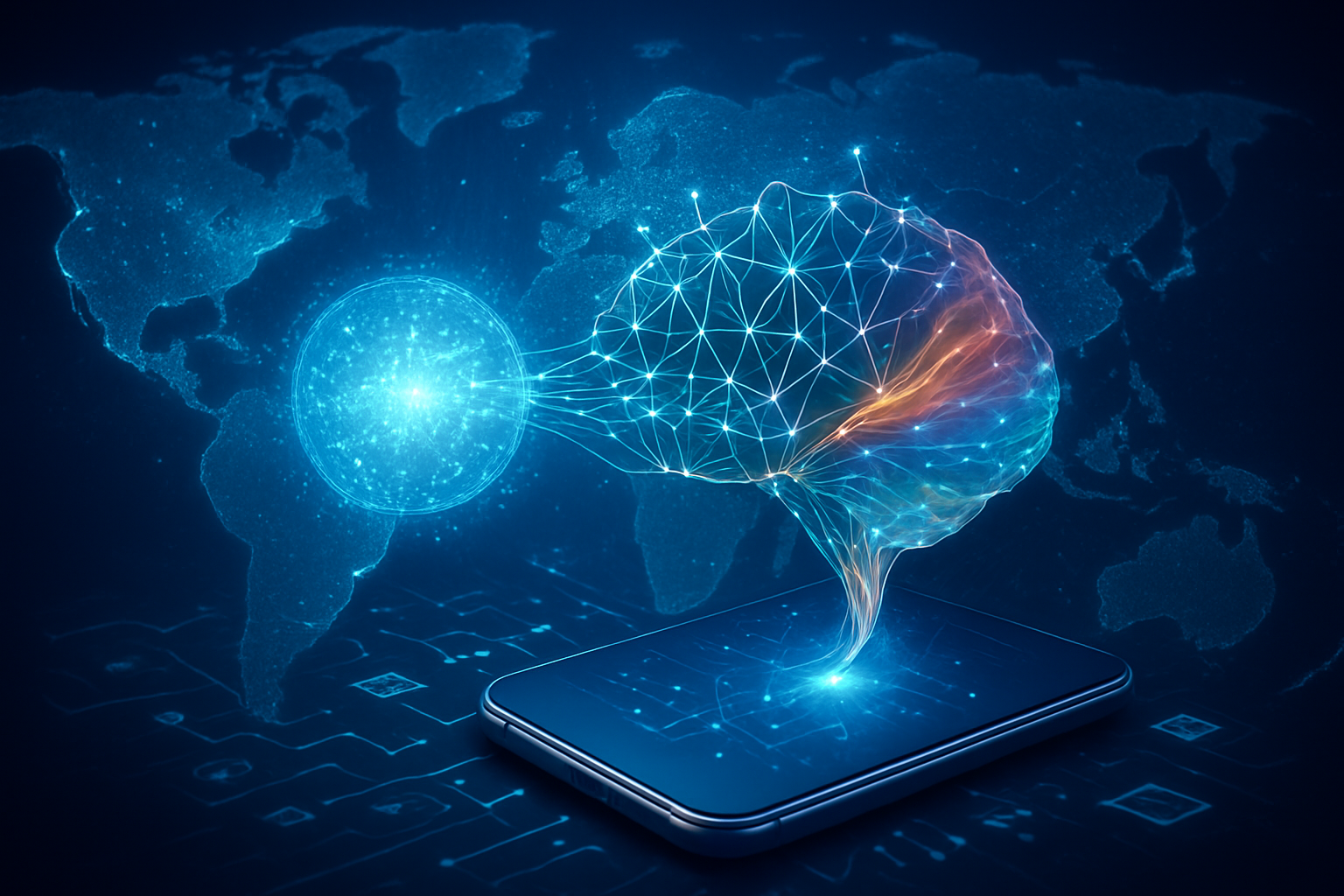
    As of February 5, 2026, the landscape of consumer artificial intelligence has undergone a fundamental transformation, driven by Apple Inc.’s (NASDAQ: AAPL) strategic pivot toward a "multi-vendor" intelligence model. Rather than relying solely on its internal research, Apple has spent the last year weaving together a complex tapestry of global partnerships to power "Apple Intelligence." This strategy reached its zenith in early 2026 with the formalization of deep-level integrations with Alibaba Group (NYSE: BABA) in China and Alphabet Inc.’s Google (NASDAQ: GOOGL) globally, marking a definitive end to the era of the monolithic AI stack.

    This modular approach allows Apple to maintain its signature user experience while navigating the disparate regulatory and technical requirements of a fractured global market. By outsourcing the heavy lifting of "world knowledge" and "complex reasoning" to proven giants like Google and Alibaba, Apple has effectively positioned itself as the world’s most powerful AI curator, rather than just another developer in the crowded Large Language Model (LLM) race.

    The Technical Architecture: Qwen3 and the Gemini Bridge

    The core of Apple’s localized strategy in China revolves around a deep technical integration with Alibaba’s Tongyi Qianwen (Qwen) series. Specifically, the latest Qwen3 model has been re-engineered to run natively on Apple’s MLX architecture, allowing it to leverage the specialized Neural Engine inside the A19 and M5 chips. This on-device integration handles high-speed, privacy-sensitive tasks like text summarization and real-time translation without ever leaving the local hardware. However, for more complex generative tasks, Apple has established a localized "Private Cloud Compute" (PCC) infrastructure in mainland China, hosted on Alibaba Cloud. This setup satisfies strict domestic data sovereignty laws while attempting to mirror the security protocols Apple uses elsewhere.

    Globally, the technical integration of Google’s Gemini serves a different purpose: it acts as a "reasoning bridge" for the next generation of Siri. Research into Apple’s internal performance metrics in late 2025 revealed that its proprietary Apple Foundation Models (AFM) still struggled with multi-step, logic-heavy queries. To solve this, Apple has integrated Gemini 1.5 Pro as the primary backend for "Advanced Siri" requests. In this configuration, Gemini acts as a "teacher" model, providing high-level reasoning that Siri then translates into specific on-device actions. This partnership is estimated to cost Apple roughly $1 billion annually, a figure that rivals the historic search-default agreement between the two tech titans.

    This multi-tiered system differs significantly from the approaches of competitors. While Microsoft (NASDAQ: MSFT) remains deeply vertically integrated with OpenAI, Apple’s 2026 architecture is a four-layer stack: on-device AFM for basic tasks, Apple’s own PCC for privacy-first cloud processing, Google Gemini for complex reasoning, and OpenAI’s ChatGPT for broad "world knowledge" or creative generation. This "orchestration layer" is invisible to the user, who simply sees a more capable, context-aware interface.

    Market Dynamics: The Rise of the AI Curator

    The primary beneficiary of this strategy is undoubtedly Apple itself, which has managed to mitigate the risk of falling behind in the AI "arms race" by leveraging the R&D budgets of its rivals. By becoming a "platform of platforms," Apple maintains its high hardware margins while avoiding the massive capital expenditures required to train frontier-level 1-trillion-parameter models. This has forced a shift in the competitive landscape; Samsung (KRX: 005930), which initially held a lead in mobile AI through early Gemini integration, now faces an Apple ecosystem that offers a more refined, multi-model experience.

    For Google, the partnership is a strategic masterstroke. Despite the $1 billion price tag Apple pays for the service, the deal cements Google’s position as the foundational infrastructure of the mobile web, even as traditional search behavior begins to shift toward conversational AI. Similarly, for Alibaba, the deal provides a massive, high-value user base for its Qwen models, providing the scale necessary to compete with Baidu (NASDAQ: BIDU), which had previously been rumored to be Apple's primary partner in the region.

    However, this strategy is not without disruption. Smaller AI startups are finding it increasingly difficult to break into the iOS ecosystem as Apple consolidates its "preferred provider" list. The market is witnessing a "winner-takes-most" scenario where only the most well-funded and regulator-approved models—like those from Google, Alibaba, and OpenAI—can afford the integration costs and security audits required by Apple’s stringent Private Cloud Compute standards.

    Global Significance: Sovereignty vs. Silicon Valley

    The broader significance of Apple’s strategy lies in its navigation of the "AI Iron Curtain." By choosing Alibaba in China and Google in the West, Apple has acknowledged that a single, global AI model is a geopolitical impossibility. This marks a departure from previous tech milestones; while the iPhone hardware was largely standardized globally, its "intelligence" is now regionally bifurcated.

    This development has raised significant concerns regarding privacy and censorship. In China, Alibaba’s models must include a real-time filtering layer to comply with mandates from the Cyberspace Administration of China (CAC). This means that for the first time, an iPhone’s core intelligence will behave differently depending on the user's geographic location, filtering content in one region that would be accessible in another. This divergence challenges Apple’s long-standing marketing narrative of a "universal" and "privacy-first" experience.

    Furthermore, the deal highlights the increasing importance of "Private Cloud Compute." As the industry moves away from 100% on-device processing due to the sheer size of modern LLMs, the battleground has shifted to the security of the cloud. Apple is betting that its ability to audit and verify the silicon and software of its partners' servers will be enough to convince skeptical consumers that their data remains safe, even when being processed by a third-party "brain" like Gemini.

    The Horizon: From Siri to "Personalized Agents"

    Looking ahead toward the end of 2026 and into 2027, experts predict that Apple will use these partnerships as a stopgap while it develops its next-generation internal architecture, codenamed Ferret-3. This upcoming model is expected to bridge the gap between Apple’s on-device efficiency and Google’s cloud-based reasoning, potentially allowing Apple to reduce its reliance on external providers over time.

    In the near term, we expect to see the rollout of "Personalized Siri" in iOS 19.4. This feature will use the Gemini-powered reasoning engine to look across a user’s entire app library—emails, calendars, messages, and third-party apps—to perform complex cross-app tasks, such as "Find the hotel reservation from my email and book an Uber for 15 minutes before check-in." Such use cases were once the stuff of science fiction but are becoming the baseline for the smartphone experience in 2026.

    The primary challenge remains regulatory. As the European Union and the United States continue to scrutinize "Big Tech" alliances, the Apple-Google and Apple-Alibaba deals will likely face intense antitrust reviews. Regulators are increasingly wary of "gatekeeper" partnerships that could stifle competition from independent AI developers.

    A New Chapter in AI History

    Apple’s global partnership strategy represents a watershed moment in the history of artificial intelligence. It signals the end of the "model-centric" era and the beginning of the "integration-centric" era. By successfully stitching together the best-in-class technologies from Alibaba and Google, Apple has demonstrated that the value of AI in the consumer market lies not in the raw power of the model, but in the seamlessness and security of the integration.

    The key takeaway is that Apple has managed to protect its moat by becoming the essential intermediary. While Google and Alibaba provide the "neurons," Apple provides the "nervous system"—the interface, the hardware, and the trusted security layer that makes AI usable for the average consumer.

    In the coming months, the industry will be watching the performance of the "Advanced Siri" rollout and the user reception of localized AI in China. If Apple can maintain its high privacy standards while delivering the capabilities of Gemini and Qwen, it will have written the playbook for how a global tech giant survives—and thrives—in the age of generative AI.


    This content is intended for informational purposes only and represents analysis of current AI developments.

    TokenRing AI delivers enterprise-grade solutions for multi-agent AI workflow orchestration, AI-powered development tools, and seamless remote collaboration platforms.
    For more information, visit https://www.tokenring.ai/.
  • The Privacy-First Powerhouse: Apple’s 3-Billion Parameter ‘Local-First’ AI and the 2026 Siri Transformation

    The Privacy-First Powerhouse: Apple’s 3-Billion Parameter ‘Local-First’ AI and the 2026 Siri Transformation

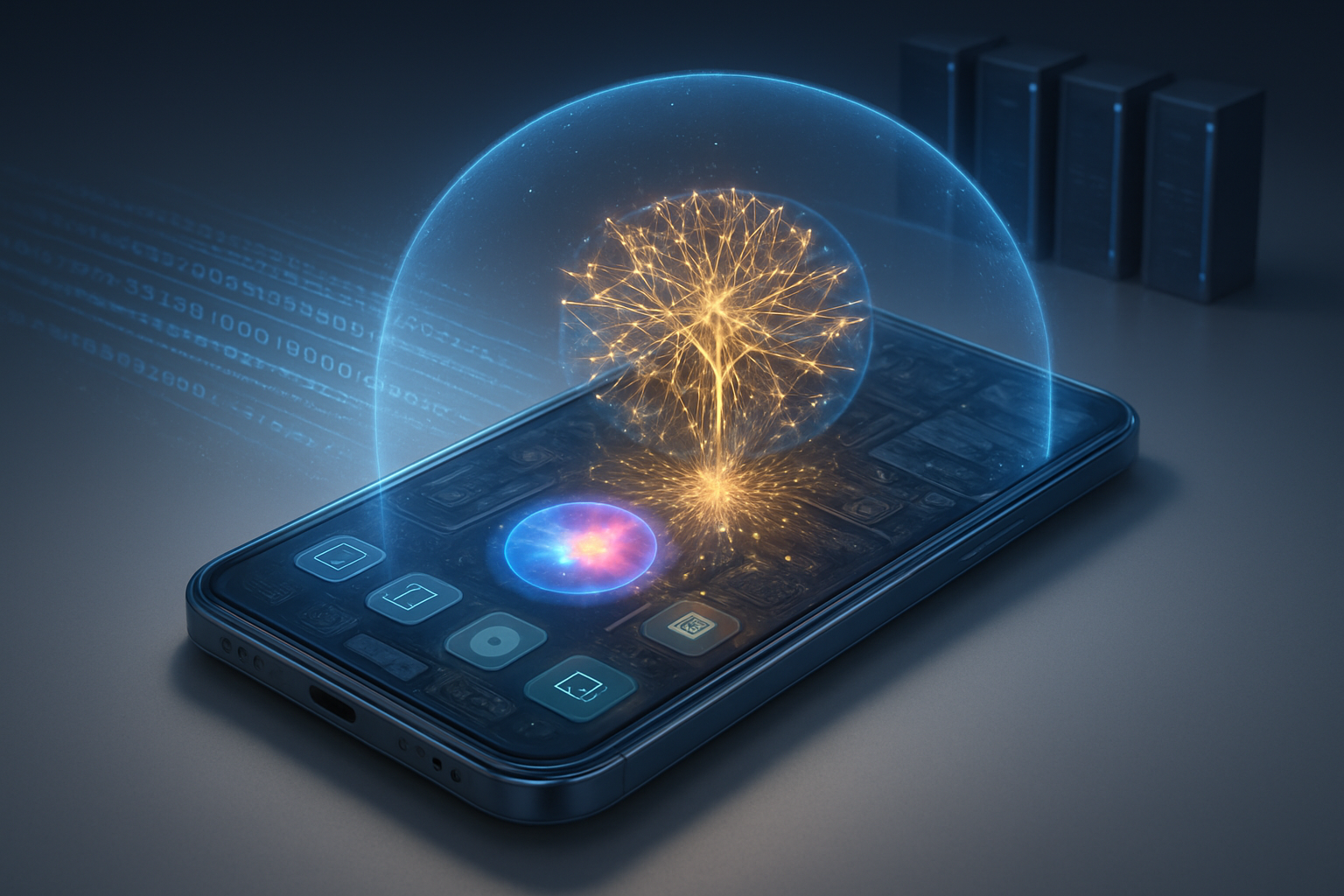
    As of January 2026, Apple Inc. (NASDAQ: AAPL) has fundamentally redefined the consumer AI landscape by successfully deploying its "local-first" intelligence architecture. While competitors initially raced to build the largest possible cloud models, Apple focused on a specialized, hyper-efficient approach that prioritizes on-device processing and radical data privacy. The cornerstone of this strategy is a sophisticated 3-billion-parameter language model that now runs natively on hundreds of millions of iPhones, iPads, and Macs, providing a level of responsiveness and security that has become the new industry benchmark.

    The culmination of this multi-year roadmap is the scheduled 2026 overhaul of Siri, transitioning the assistant from a voice-activated command tool into a fully autonomous "system orchestrator." By leveraging the unprecedented efficiency of the Apple-designed A19 Pro and M5 silicon, Apple is not just catching up to the generative AI craze—it is pivoting the entire industry toward a model where personal data never leaves the user’s pocket, even when interacting with trillion-parameter cloud brains.

    Technical Precision: The 3B Model and the Private Cloud Moat

    At the heart of Apple Intelligence sits the AFM-on-device (Apple Foundation Model), a 3-billion-parameter large language model (LLM) designed for extreme efficiency. Unlike general-purpose models that require massive server farms, Apple’s 3B model utilizes mixed 2-bit and 4-bit quantization via Low-Rank Adaptation (LoRA) adapters. This allows the model to reside within the 8GB to 12GB RAM constraints of modern Apple devices while delivering the reasoning capabilities previously seen in much larger models. On the latest iPhone 17 Pro, this model achieves a staggering 30 tokens per second with a latency of less than one millisecond, making interactions feel instantaneous rather than "processed."

    To handle queries that exceed the 3B model's capacity, Apple has pioneered Private Cloud Compute (PCC). Running on custom M5-series silicon in dedicated Apple data centers, PCC is a stateless environment where user data is processed entirely in encrypted memory. In a significant shift for 2026, Apple now hosts third-party model weights—including those from Alphabet Inc. (NASDAQ: GOOGL)—directly on its own PCC hardware. This "intelligence routing" ensures that even when a user taps into Google’s Gemini for complex world knowledge, the raw personal context is never accessible to Google, as the entire operation occurs within Apple’s cryptographically verified secure enclave.

    Initial reactions from the AI research community have been overwhelmingly positive, particularly regarding Apple’s decision to make PCC software images publicly available for security auditing. Experts note that this "verifiable transparency" sets a new standard for cloud AI, moving beyond mere corporate promises to mathematical certainty. By keeping the "Personal Context" index local and only sending anonymized, specific sub-tasks to the cloud, Apple has effectively solved the "privacy vs. performance" paradox that has plagued the first generation of generative AI.

    Strategic Maneuvers: Subscriptions, Partnerships, and the 'Pro' Tier

    The 2026 rollout of Apple Intelligence marks a turning point in the company’s monetization strategy. While base AI features remain free, Apple has introduced an "Apple Intelligence Pro" subscription for $15 per month. This tier unlocks advanced agentic capabilities, such as Siri’s ability to perform complex, multi-step actions across different apps—for example, "Find the flight details from my email and book an Uber for that time." This positions Apple not just as a hardware vendor, but as a dominant service provider in the emerging agentic AI market, potentially disrupting standalone AI assistant startups.

    Competitive implications are significant for other tech giants. By hosting partner models on PCC, Apple has turned potential rivals like Google and OpenAI into high-level utility providers. These companies now compete to be the "preferred engine" inside Apple’s ecosystem, while Apple retains the primary customer relationship and the high-margin subscription revenue. This strategic positioning leverages Apple’s control over the operating system to create a "gatekeeper" effect for AI agents, where third-party apps must integrate with Apple’s App Intent framework to be visible to the new Siri.

    Furthermore, Apple's recent acquisition and integration of creative tools like Pixelmator Pro into its "Apple Creator Studio" demonstrates a clear intent to challenge Adobe Inc. (NASDAQ: ADBE). By embedding AI-driven features like "Super Resolution" upscaling and "Magic Fill" directly into the OS at no additional cost for Pro subscribers, Apple is creating a vertically integrated creative ecosystem that leverages its custom Neural Engine (ANE) hardware more effectively than any cross-platform competitor.

    A Paradigm Shift in the Global AI Landscape

    Apple’s "local-first" approach represents a broader trend toward Edge AI, where the heavy lifting of machine learning moves from massive data centers to the devices in our hands. This shift addresses two of the biggest concerns in the AI era: energy consumption and data sovereignty. By processing the majority of requests locally, Apple significantly reduces the carbon footprint associated with constant cloud pings, a move that aligns with its 2030 carbon-neutral goals and puts pressure on cloud-heavy competitors to justify their environmental impact.

    The significance of the 2026 Siri overhaul cannot be overstated; it marks the transition from "AI as a feature" to "AI as the interface." In previous years, AI was something users went to a specific app to use (like ChatGPT). In the 2026 Apple ecosystem, AI is the translucent layer that sits between the user and every application. This mirrors the revolutionary impact of the original iPhone’s multi-touch interface, replacing menus and search bars with a singular, context-aware conversational thread.

    However, this transition is not without concerns. Critics point to the "walled garden" becoming even more reinforced. As Siri becomes the primary way users interact with their data, the difficulty of switching to Android or a different ecosystem increases exponentially. The "Personal Context" index is a powerful tool for convenience, but it also creates a massive level of vendor lock-in that will likely draw the attention of antitrust regulators in the EU and the US throughout 2026 and 2027.

    The Horizon: From 'Glenwood' to 'Campos'

    Looking ahead to the remainder of 2026, Apple has a two-phased roadmap for its AI evolution. The first phase, codenamed "Glenwood," is currently rolling out with iOS 26.2. It focuses on the "Siri LLM," which eliminates the rigid, intent-based responses of the past in favor of a natural, fluid dialogue system that understands screen content. This allows users to say "Send this to John" while looking at a photo or a document, and the AI correctly identifies both the "this" and the most likely "John."

    The second phase, codenamed "Campos," is expected in late 2026. This is rumored to be a full-scale "Siri Chatbot" built on Apple Foundation Model Version 11. This update aims to provide a sustained, multi-day conversational memory, where the assistant remembers preferences and ongoing projects across weeks of interaction. This move toward long-term memory and autonomous agency is what experts predict will be the next major battleground for AI, moving beyond simple task execution into proactive life management.

    The challenge for Apple moving forward will be maintaining this level of privacy as the AI becomes more deeply integrated into the user's life. As the system begins to anticipate needs—such as suggesting a break when it senses a stressful schedule—the boundary between helpful assistant and invasive observer will blur. Apple’s success will depend on its ability to convince users that its "Privacy-First" branding is more than a marketing slogan, but a technical reality backed by the PCC architecture.

    The New Standard for Intelligent Computing

    As we move further into 2026, it is clear that Apple’s "local-first" gamble has paid off. By refusing to follow the industry trend of sending every keystroke to the cloud, the company has built a unique value proposition centered on trust, speed, and seamless integration. The 3-billion-parameter on-device model has proven that you don't need a trillion parameters to be useful; you just need the right parameters in the right place.

    The 2026 Siri overhaul is the definitive end of the "Siri is behind" narrative. Through a combination of massive hardware advantages in the A19 Pro and a sophisticated "intelligence routing" system that utilizes Private Cloud Compute, Apple has created a platform that is both more private and more capable than its competitors. This development will likely be remembered as the moment when AI moved from being an experimental tool to an invisible, essential part of the modern computing experience.

    In the coming months, keep a close watch on the adoption rates of the Apple Intelligence Pro tier and the first independent security audits of the PCC "Campos" update. These will be the key indicators of whether Apple can maintain its momentum as the undisputed leader in private, edge-based artificial intelligence.


    This content is intended for informational purposes only and represents analysis of current AI developments.

    TokenRing AI delivers enterprise-grade solutions for multi-agent AI workflow orchestration, AI-powered development tools, and seamless remote collaboration platforms.
    For more information, visit https://www.tokenring.ai/.