Tag: Smart Buildings

  • AI Reshapes Construction: A Look at 2025’s Transformative Trends

    AI Reshapes Construction: A Look at 2025’s Transformative Trends

    As of December 17, 2025, Artificial Intelligence (AI) has firmly cemented its position as an indispensable force within the construction technology sector, ushering in an era of unprecedented efficiency, safety, and innovation. What was once a futuristic concept has evolved into a practical reality, with AI-powered solutions now integrated across every stage of the project lifecycle. The industry is experiencing a profound paradigm shift, moving decisively towards smarter, safer, and more sustainable building practices, propelled by significant technological breakthroughs, widespread adoption, and escalating investments. The global AI in construction market is on a steep upward trajectory, projected to reach an estimated $4.86 billion this year, underscoring its pivotal role in modern construction.

    This year has seen AI not just augment, but fundamentally redefine traditional construction methodologies. From the initial blueprint to the final operational phase of a building, intelligent systems are optimizing every step, delivering tangible benefits that range from predictive risk mitigation to automated design generation. The implications are vast, promising to alleviate long-standing challenges such as labor shortages, project delays, and cost overruns, while simultaneously elevating safety standards and fostering a more sustainable built environment.

    Technical Foundations: The AI Engines Driving Construction Forward

    The technical advancements in AI for construction in 2025 are both diverse and deeply impactful, representing a significant departure from previous, more rudimentary approaches. At the forefront are AI and Machine Learning (ML) algorithms that have revolutionized project management. These sophisticated tools leverage vast datasets to predict potential delays, optimize costs through intricate data analysis, and enhance safety protocols with remarkable precision. Predictive analytics, in particular, has become a cornerstone, enabling managers to forecast and mitigate risks proactively, thereby improving project profitability and reducing unforeseen complications.

    Generative AI stands as another transformative force, particularly in the design and planning phases. This cutting-edge technology employs algorithms to rapidly create a multitude of design options based on specified parameters, allowing architects and engineers to explore a far wider range of possibilities with unprecedented speed. This not only streamlines creative processes but also optimizes functionality, aesthetics, and sustainability, while significantly reducing human error. AI-powered generative design tools are now routinely optimizing architectural, structural, and subsystem designs, directly contributing to reduced material waste and enhanced buildability. This contrasts sharply with traditional manual design processes, which were often iterative, time-consuming, and limited in scope.

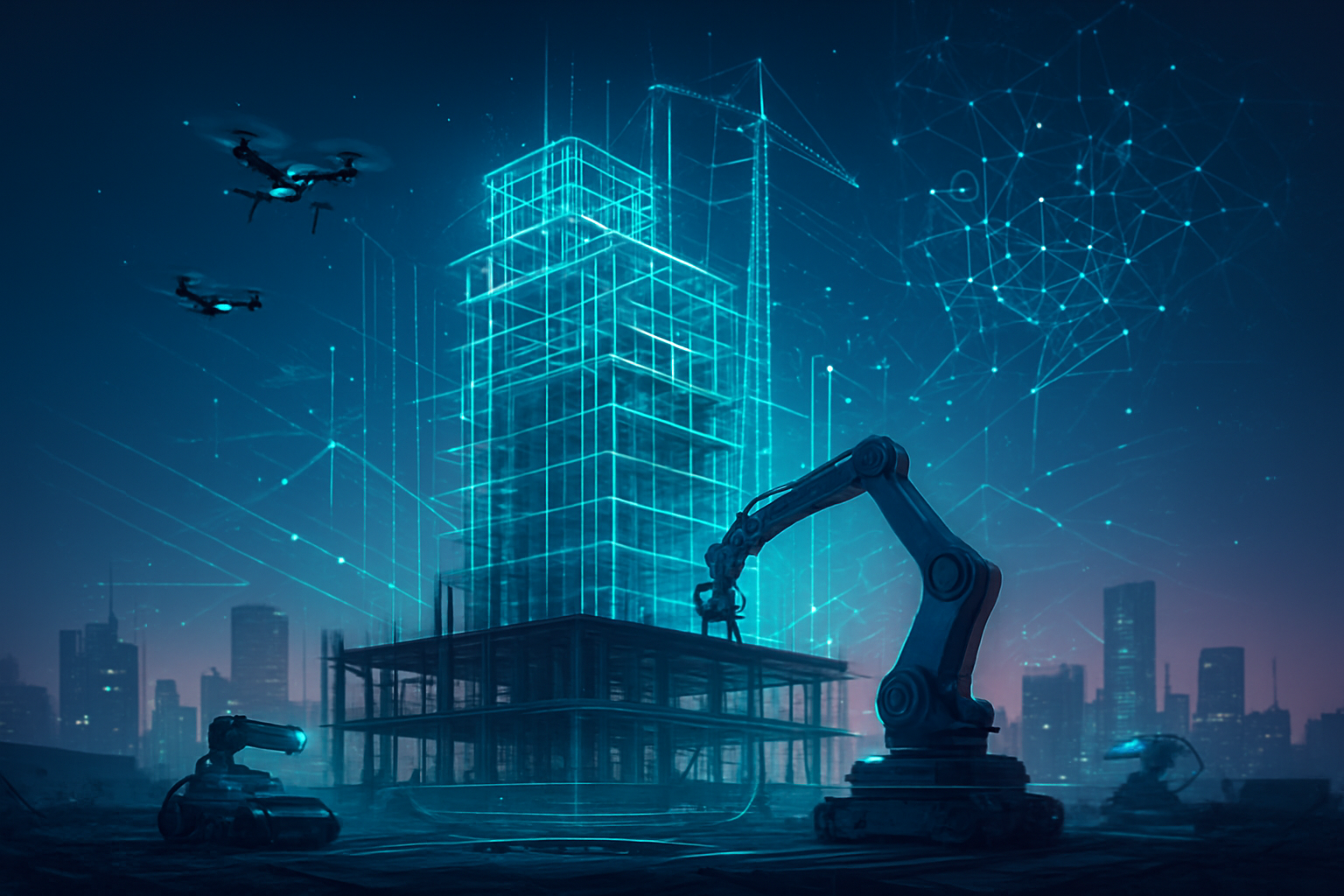
    Robotics and automation, intrinsically linked with AI, have become integral to construction sites. Autonomous machines are increasingly performing repetitive and dangerous tasks such as bricklaying, welding, and 3D printing. This leads to faster construction times, reduced labor costs, and improved quality through precise execution. Furthermore, AI-powered computer vision and sensor systems are redefining site safety. These systems continuously monitor job sites for hazards, detect non-compliance with safety measures (e.g., improper helmet use), and alert teams in real time, dramatically reducing accidents. This proactive, real-time monitoring represents a significant leap from reactive safety inspections. Finally, AI is revolutionizing Building Information Modeling (BIM) by integrating predictive analytics, performance monitoring, and advanced building virtualization, enhancing data-driven decision-making and enabling rapid design standardization and validation.

    Corporate Landscape: Beneficiaries and Disruptors

    The rapid integration of AI into construction has created a dynamic competitive landscape, with established tech giants, specialized AI firms, and innovative startups vying for market leadership. Companies that have successfully embraced and developed AI-powered solutions stand to benefit immensely. For instance, Mastt is gaining traction with its AI-powered cost tracking, risk control, and dashboard solutions tailored for capital project owners. Similarly, Togal.AI is making waves with its AI-driven takeoff and estimating directly from blueprints, significantly accelerating bid processes and improving accuracy for contractors.

    ALICE Technologies is a prime example of a company leveraging generative AI for complex construction scheduling and planning, allowing for sophisticated scenario modeling and optimization that was previously unimaginable. In the legal and contractual realm, Document Crunch utilizes AI for contract risk analysis and automated clause detection, streamlining workflows for legal and contract teams. Major construction players are also internalizing AI capabilities; Obayashi Corporation launched AiCorb, a generative design tool that instantly creates façade options and auto-generates 3D BIM models from simple sketches. Bouygues Construction is leveraging AI for design engineering to reduce material waste—reportedly cutting 140 tonnes of steel on a metro project—and using AI-driven schedule simulations to improve project speed and reduce delivery risk.

    The competitive implications are clear: companies that fail to adopt AI risk falling behind in efficiency, cost-effectiveness, and safety. AI platforms like Slate Technologies, which deliver up to 15% productivity improvements and a 60% reduction in rework, are becoming indispensable, potentially saving major contractors over $18 million per project. Slate's recent partnership with CMC Project Solutions in December 2025 further underscores the strategic importance of expanding access to advanced project intelligence. Furthermore, HKT is integrating 5G, AI, and IoT to deliver advanced solutions like the Smart Site Safety System (4S), particularly in Hong Kong, showcasing the convergence of multiple cutting-edge technologies. The startup ecosystem is vibrant, with companies like Konstruksi.AI, Renalto, Wenti Labs, BLDX, and Volve demonstrating the breadth of innovation and potential disruption across various construction sub-sectors.

    Broader Significance: A New Era for the Built Environment

    The pervasive integration of AI into construction signifies a monumental shift in the broader AI landscape, demonstrating the technology's maturity and its capacity to revolutionize traditionally conservative industries. This development is not merely incremental; it represents a fundamental transition from reactive problem-solving to proactive risk mitigation and predictive management across all phases of construction. The ability to anticipate material shortages, schedule conflicts, and equipment breakdowns with greater accuracy fundamentally transforms project delivery.

    One of the most significant impacts of AI in construction is its crucial role in addressing the severe global labor shortage facing the industry. By automating repetitive tasks and enhancing overall efficiency, AI allows the existing workforce to focus on higher-value activities, effectively augmenting human capabilities rather than simply replacing them. This strategic application of AI is vital for maintaining productivity and growth in a challenging labor market. The tangible benefits are compelling: AI-powered systems are consistently demonstrating productivity improvements of up to 15% and a remarkable 60% reduction in rework, translating into substantial cost savings and improved project profitability.

    Beyond economics, AI is setting new benchmarks for jobsite safety. AI-based safety monitoring, exemplified by KOLON Benit's AI Vision Intelligence system deployed on KOLON GLOBAL's construction sites, is becoming standard practice, fostering a more mindful and secure culture among workers. The continuous, intelligent oversight provided by AI significantly reduces the risk of accidents and ensures compliance with safety protocols. This data-driven approach to decision-making is now central to planning, resource allocation, and on-site execution, marking a profound change from intuition-based or experience-dependent methods. The increased investment in construction-focused AI solutions further underscores the industry's recognition of AI as a critical driver for future success and sustainability.

    The Horizon: Future Developments and Uncharted Territory

    Looking ahead, the trajectory of AI in construction promises even more transformative developments. Near-term expectations include the widespread adoption of pervasive predictive analytics, which will become a default capability for all major construction projects, enabling unprecedented foresight and control. Generative design tools are anticipated to scale further, moving beyond initial design concepts to fully automated creation of detailed 3D BIM models directly from high-level specifications, drastically accelerating the pre-construction phase.

    On the long-term horizon, we can expect the deeper integration of autonomous equipment. Autonomous excavators, cranes, and other construction robots will not only handle digging and material tasks but will increasingly coordinate complex operations with minimal human oversight, leading to highly efficient and safe automated construction sites. The vision of fully integrated IoT-enabled smart buildings, where sensors and AI continuously monitor and adjust systems for optimal energy consumption, security, and occupant comfort, is rapidly becoming a reality. These buildings will be self-optimizing ecosystems, responding dynamically to environmental conditions and user needs.

    However, challenges remain. The interoperability of diverse AI systems from different vendors, the need for robust cybersecurity measures to protect sensitive project data, and the upskilling of the construction workforce to effectively manage and interact with AI tools are critical areas that need to be addressed. Experts predict a future where AI acts as a universal co-pilot for construction professionals, providing intelligent assistance at every level, from strategic planning to on-site execution. The development of more intuitive conversational AI interfaces will further streamline data interactions, allowing project managers and field workers to access critical information and insights through natural language commands, enhancing decision-making and collaboration.

    Concluding Thoughts: AI's Enduring Legacy in Construction

    In summary, December 2025 marks a pivotal moment where AI has matured into an indispensable, transformative force within the construction technology sector. The key takeaways from this year include the widespread adoption of predictive analytics, the revolutionary impact of generative AI on design, the increasing prevalence of robotics and automation, and the profound improvements in site safety and efficiency. These advancements collectively represent a shift from reactive to proactive project management, addressing critical industry challenges such as labor shortages and cost overruns.

    The significance of these developments in the history of AI is profound. They demonstrate AI's ability to move beyond niche applications and deliver tangible, large-scale benefits in a traditionally conservative, capital-intensive industry. This year's breakthroughs are not merely incremental improvements but foundational changes that are redefining how structures are designed, built, and managed. The long-term impact will be a safer, more sustainable, and significantly more efficient construction industry, capable of delivering complex projects with unprecedented precision and speed.

    As we move into the coming weeks and months, the industry should watch for continued advancements in autonomous construction equipment, further integration of AI with BIM platforms, and the emergence of even more sophisticated generative AI tools. The focus will also be on developing comprehensive training programs to equip the workforce with the necessary skills to leverage these powerful new technologies effectively. The future of construction is inextricably linked with AI, promising an era of intelligent building that will reshape our urban landscapes and infrastructure for generations to come.


    This content is intended for informational purposes only and represents analysis of current AI developments.

    TokenRing AI delivers enterprise-grade solutions for multi-agent AI workflow orchestration, AI-powered development tools, and seamless remote collaboration platforms.
    For more information, visit https://www.tokenring.ai/.

  • AI Revolutionizes Real Estate: Agents Embrace Smart Tech for Unprecedented Market Impact

    AI Revolutionizes Real Estate: Agents Embrace Smart Tech for Unprecedented Market Impact

    The real estate industry, traditionally known for its reliance on human expertise and established practices, is undergoing a profound and rapid transformation driven by the pervasive integration of Artificial Intelligence (AI). This technological shift is fundamentally reshaping how real estate agents operate, enhancing efficiency, improving customer experiences, and providing a significant competitive edge in a market increasingly demanding speed and data-driven insights. From automated lead generation to predictive market analysis and personalized property recommendations, AI is no longer a futuristic concept but a present reality that is redefining the operational landscape and market dynamics of real estate.

    This seismic shift is evident in the accelerating adoption rates and substantial investment in AI within the PropTech sector. With an estimated 75% of leading U.S. brokerages having already integrated AI technologies into their operations, and a global AI in real estate market projected to surge from $2.9 billion in 2024 to $41.5 billion by 2033, the immediate significance is clear: AI is becoming an indispensable tool for staying competitive, driving efficiency, and delivering superior client services in the modern real estate arena.

    The Technical Underpinnings: How AI is Reshaping Real Estate Operations

    The integration of AI in real estate is powered by sophisticated technical specifications and advanced algorithms that move far beyond traditional data handling. At its core, AI in this sector leverages massive and diverse datasets, including historical sales records, detailed property characteristics, location-specific data, market trends, economic indicators, and even unstructured data like property images, video tours, listing descriptions, and social media sentiment. To manage these "massive volumes of structured and unstructured information," companies are adopting centralized data lakes and robust computational platforms, often relying on cloud migration to reduce hosting costs and enable real-time analytics.

    The algorithms predominantly employed include Machine Learning (ML), Deep Learning (DL), and Natural Language Processing (NLP). ML algorithms, such as regression analysis, time series forecasting, and ensemble learning (e.g., Random Forest, XGBoost), are used for highly accurate property valuation, predictive analytics for market trends, lead prioritization, and automated property management tasks. Deep Learning, a subset of ML, utilizes multi-layered neural networks to process vast amounts of data, excelling in complex pattern recognition for property valuation, image recognition (e.g., analyzing property features from photos), and predictive maintenance by analyzing IoT sensor data. Natural Language Processing enables computers to understand and generate human language, powering smarter property searches, 24/7 chatbots and virtual assistants, automated document extraction from contracts, and sentiment analysis from online reviews.

    These AI advancements fundamentally differ from traditional real estate methods. Where manual market research and property appraisals were time-consuming and subjective, AI provides rapid, objective, and highly accurate valuations by analyzing thousands of data points simultaneously. This shifts the industry from reactive to proactive, offering forward-looking insights into future market trends. For instance, Zillow's (NASDAQ: ZG) "Zestimate" system, leveraging AI, has significantly improved accuracy, reducing its error rate for off-market homes to less than 1.9% by 2023. This scalability and ability to process complex, diverse datasets far surpass the capabilities of traditional human-led processes, leading to estimated operational cost reductions of 10–15% in property management.

    Initial reactions from the AI research community and industry experts have evolved from skepticism to rapid adoption. By late 2025, an unprecedented 88% of investors, owners, and landlords, and 92% of occupiers, were running AI pilots, with 60% of companies already piloting AI use cases by 2024. While the benefits of increased efficiency, accuracy, and customer service are widely recognized, challenges remain, including fragmented data quality, a significant expertise gap among professionals, difficulties integrating with legacy systems, and critical ethical concerns around bias and data privacy. Despite these hurdles, the consensus is that AI is "essential for staying competitive" and will continue to enhance human judgment rather than fully replace it.

    Reshaping the Corporate Landscape: Who Benefits and Who Faces Disruption

    The integration of AI into real estate is creating a dynamic competitive landscape, benefiting specialized AI companies, tech giants, and innovative startups, while simultaneously disrupting traditional services and market positions.

    Pure-play AI solution providers stand to gain significantly. Companies like Synodus and Haptik offer AI-driven predictive analytics and property valuation tools, while others such as DataToBiz, Yalantis, and AscendixTech provide crucial AI consulting, development, and integration services to real estate businesses. Their deep technical expertise allows them to craft highly specialized algorithms tailored to the industry's unique needs.

    Tech giants and established real estate platforms are leveraging their vast data resources, extensive customer bases, and substantial R&D budgets. Zillow's (NASDAQ: ZG) is a prime example, using AI for its "Zestimate" algorithm and personalized recommendations. Redfin (NASDAQ: RDFN) employs AI to recommend properties, and Opendoor (NASDAQ: OPEN) utilizes AI to streamline home transactions with instant offers. Compass (NYSE: COMP) integrates AI into an "operating system" for its agents, offering real-time data analysis. CoreLogic, a major data provider, uses AI in its OneHome platform. Underlying these are tech giants like Google (NASDAQ: GOOGL), Amazon (NASDAQ: AMZN), and Microsoft (NASDAQ: MSFT), whose cloud and AI infrastructure (e.g., Google's Vertex AI) serve as foundational enablers for many real estate AI solutions. Their platform dominance and data advantage create significant barriers to entry for new competitors.

    PropTech startups are agile disruptors, quickly identifying niche pain points and addressing them with AI. Entera provides AI-driven solutions for real estate investment, while Hyro.ai enhances customer service with conversational AI. Likely.AI specializes in predictive analytics for market shifts, and Ylopo is an AI-based digital marketing platform. Startups like Ridley are even challenging traditional brokerage models by automating services and significantly reducing commissions, potentially making high commissions a "relic of the past." This innovative surge attracts substantial venture capital, fostering a vibrant ecosystem of specialized AI applications.

    The competitive implications are profound. Tech giants with foundational AI models are becoming essential enablers, while companies with vast, high-quality real estate data strengthen their market dominance. The intense demand for AI talent creates a talent war, often favoring larger firms. AI is disrupting traditional appraisal methods, property search, administrative tasks, and customer service. It offers predictive analytics for investment and risk assessment that far surpass traditional methods. However, the "human touch" in complex negotiations and nuanced client understanding remains an area where human real estate professionals retain an edge. Companies integrating AI are establishing strategic advantages through efficiency, data-driven decision-making, personalized customer experiences, speed, and innovation, positioning AI as a core infrastructure rather than an optional tool.

    A Wider Lens: AI in Real Estate's Broader Significance

    AI's integration into the real estate sector is not an isolated phenomenon but a crucial development within the broader AI landscape, reflecting global trends of accelerating AI investment and technological maturity. This move signifies real estate's transition from a technology laggard to a proactive adopter, especially of Generative AI (GenAI), which is seen as a key transformative force. Private investment in AI in the US alone hit US$109 billion in 2024, doubling from 2023, underscoring the widespread confidence in AI's potential across industries.

    The societal and economic impacts are substantial. Economically, AI is projected to generate $34 billion in efficiency gains for the real estate industry by 2030, with McKinsey estimating GenAI alone could add $110 billion to $180 billion in value. The global AI in real estate market, valued at $303 billion in 2025, is projected to reach nearly $1 trillion by 2029. This growth is driven by cost savings from automation (e.g., 10-15% reduction in operational costs from predictive maintenance), enhanced valuation accuracy, new revenue streams, and improved customer experiences. Societally, AI can boost sustainability by optimizing building operations and potentially facilitate fairer deals through objective, data-driven decisions, reducing human bias in valuations and lending.

    However, significant concerns loom large. Ethical issues, particularly algorithmic bias, are paramount. AI systems trained on historical data reflecting societal inequalities can perpetuate or even amplify discrimination in property valuations, tenant screening, or mortgage lending. The "black box" nature of some AI algorithms raises transparency and accountability issues. Data privacy and security are also critical, given the vast amounts of sensitive personal and property data processed by AI. The specter of job displacement is another major concern, with experts like Robert Kiyosaki and the CEO of Anthropic warning of a "structural crisis" where AI accelerates job losses, potentially impacting hundreds of millions of jobs globally in the coming years, particularly in white-collar and entry-level roles.

    Comparing this to previous AI milestones, the current wave, driven by large language models (LLMs) and deep learning, moves beyond earlier rule-based systems and narrow AI applications. It enables AI to handle more complex, creative, and interpretive tasks, pushing towards Artificial General Intelligence (AGI) capabilities in specialized domains. The real estate industry is now at a "pivotal juncture," where AI is not just an enhancement but an essential tool for competitive advantage. The rapid adoption rates (90.1% of companies expect AI to support human experts within five years, per JLL's 2025 survey) underscore this shift, even as challenges in data quality, expertise gaps, and ethical implementation remain central to the ongoing discourse.

    The Horizon: Charting Future Developments in Real Estate AI

    The future of AI in real estate, particularly from 2025 onwards, promises an accelerated pace of innovation, marked by increasingly sophisticated applications and deeper integration across the entire property lifecycle.

    In the near-term (2025-2030), we can expect AI to further refine operational efficiency and customer interactions. Hyper-personalized property search and recommendations, moving beyond basic filters to analyze user behavior and implicit preferences, will become standard. Voice-activated AI assistants will facilitate conversational searches. Advanced Automated Valuation Models (AVMs) will achieve even greater accuracy, potentially 15-20% more reliable than traditional methods, by processing vast datasets including real-time market sentiment. Enhanced customer experience will be driven by 24/7 chatbots and virtual assistants, handling inquiries, scheduling, and lead generation. Immersive virtual and augmented reality (VR/AR) tours, powered by AI, will become commonplace, allowing prospective buyers to virtually stage and modify properties. AI will also play a crucial role in automated property management, handling routine maintenance and tenant communications, and contributing to sustainable real estate development by optimizing energy usage and material selection.

    Looking further ahead (beyond 2030), AI's role will become even more transformative. We anticipate hyper-sophisticated analytics providing unprecedented insights into market trends. The integration of quantum computing by 2030 could revolutionize complex data processing, enabling real-time market simulations and highly accurate forecasting. Advanced biometric systems will enhance property security and operational efficiency. The confluence of AI and the Internet of Things (IoT) will give rise to truly "smart cities," optimizing urban infrastructure and creating "real intelligent buildings" with experience-driven designs. Furthermore, the combination of AI with blockchain technology will streamline transactions through smart contracts, ensuring greater transparency and security in real estate deals.

    Key potential applications on the horizon include AI-driven investment and portfolio analysis for faster, more precise decisions, AI assistance in construction and design (projected to reach $7.21 billion by 2029), enhanced fraud detection and compliance automation, and sophisticated tenant behavior and sentiment analytics. AI will also automate aspects of due diligence, rapidly analyzing property conditions, demographics, and legal documents.

    However, several challenges must be addressed. Data quality and integration remain paramount, as AI's effectiveness hinges on complete, consistent, and standardized data. Resistance to change among real estate professionals, coupled with fears of job displacement, necessitates education and clear demonstrations of AI's benefits. Ethical considerations, particularly algorithmic bias, and paramount concerns about data privacy and security, require robust frameworks, bias detection tools, and transparent data handling. High implementation costs, a limited talent pool, and the need for new skills (data literacy, AI proficiency) are also significant hurdles. Experts, including Morgan Stanley Research, predict $34 billion in efficiency gains by 2030, with some sectors like brokerages seeing a 34% increase in operating cash flow. While AI will enhance human expertise, the debate around job displacement and the need for reskilling will intensify, underscoring the need for a balanced approach that integrates human judgment with AI capabilities.

    The AI Imperative: A New Era for Real Estate

    The integration of Artificial Intelligence into the real estate sector marks a pivotal moment, fundamentally reshaping an industry once characterized by its traditional methodologies. This technological evolution is not merely an upgrade but a redefinition of how properties are valued, managed, bought, and sold, ushering in an era of unprecedented efficiency, data-driven precision, and hyper-personalized customer experiences.

    Key takeaways from this transformation include the dramatic increase in operational efficiency and cost savings through AI-powered automation, the unparalleled accuracy and predictive power offered by AI in market analysis and property valuation, and the revolution in customer engagement through intelligent assistants and personalized recommendations. AI is also poised to transform property management and design, fostering sustainable development and creating new demands for specialized real estate assets like data centers. This shift signifies a maturation of AI, demonstrating its widespread applicability and its ability to transform the "art" of real estate into a data-driven science.

    In the broader context of AI history, real estate's proactive embrace of this technology, particularly generative AI, marks a significant milestone. It highlights AI's growing capability to move beyond narrow, analytical tasks into creative and interpretive domains, enhancing human decision-making rather than solely replacing it. The long-term impact will be profound, leading to an evolution of space demand, new investment and revenue models, and the widespread adoption of smart, sustainable buildings. However, this journey is not without its complexities, demanding careful navigation of ethical considerations, potential job displacement, and the critical need for robust data governance and transparency.

    In the coming weeks and months, the real estate industry should watch for an acceleration of AI investments, leading to the development and scaling of more sophisticated solutions, especially those leveraging generative AI for client communication, marketing content, and property design. A critical focus will be placed on improving data quality and integration across disparate systems, as this forms the bedrock of effective AI implementation. The unique impacts of AI on specific real estate sub-sectors, such as lodging, resorts, and brokerages, will become clearer, along with the surging demand for data center infrastructure. Furthermore, attention must be paid to workforce adaptation, with an increased emphasis on AI literacy and the acquisition of specialized talent. Finally, the development of regulatory and ethical frameworks will be crucial in guiding responsible AI adoption, particularly concerning data privacy, algorithmic bias, and fair housing practices, ensuring that AI's transformative power benefits all stakeholders in a transparent and equitable manner.


    This content is intended for informational purposes only and represents analysis of current AI developments.

    TokenRing AI delivers enterprise-grade solutions for multi-agent AI workflow orchestration, AI-powered development tools, and seamless remote collaboration platforms.
    For more information, visit https://www.tokenring.ai/.