Tag: Smart Factory

  • STMicroelectronics Unveils Game-Changing Motion Sensor, Propelling Industrial Automation into a New Era

    STMicroelectronics Unveils Game-Changing Motion Sensor, Propelling Industrial Automation into a New Era

    In a significant stride for industrial automation and smart factory initiatives, STMicroelectronics (NYSE: STM) today, November 6, 2025, announced the launch of its groundbreaking ISM6HG256X dual-range motion sensor. This innovative three-in-one MEMS inertial sensor, integrating advanced edge AI capabilities, is poised to redefine data acquisition and processing in demanding industrial environments, promising unprecedented levels of efficiency, safety, and intelligence. The announcement marks a pivotal moment in the ongoing evolution of Industry 4.0 and the emerging Industry 5.0 paradigm, where intelligent sensors are the bedrock of autonomous and adaptive industrial processes.

    The introduction of the ISM6HG256X comes on the heels of other strategic advancements by STMicroelectronics, including the definitive agreement in July 2025 to acquire NXP's MEMS sensors business for $950 million, a move expected to significantly bolster ST's capabilities in high-performance sensors. Coupled with the recent launch of a new family of 5MP CMOS image sensors (VD1943, VB1943, VD5943, and VB5943) in October 2025, STMicroelectronics is cementing its position at the forefront of the smart sensor revolution. These developments collectively underscore a clear industry trend towards highly integrated, intelligent, and robust sensing solutions that process data at the edge, reducing latency and reliance on cloud infrastructure.

    Technical Prowess: Consolidating Intelligence at the Edge

    The ISM6HG256X stands out with its ability to simultaneously sense dual-range acceleration – a sensitive ±16g for detecting subtle motions and a robust ±256g for capturing extreme impacts – alongside an integrated high-performance gyroscope. This unique combination in a compact 2.5mm x 3mm package eliminates the need for multiple discrete sensors, drastically simplifying system design, reducing the bill-of-materials, and lowering overall power consumption. Its embedded Machine Learning Core (MLC) and Finite State Machine (FSM) are central to its "edge AI" capabilities, enabling real-time event detection and context-adaptive sensing directly within the sensor. This on-chip processing capability significantly reduces the data bandwidth required for transmission and offloads computational burden from main processors, leading to enhanced power efficiency and faster decision-making.

    This approach represents a significant departure from previous generations of industrial sensors, which typically required external microcontrollers or cloud-based processing for complex data analysis. By embedding intelligence at the sensor level, STMicroelectronics' new offerings, including other MLC-integrated IMUs like the ISM330DHCX and LSM6DSOX, facilitate a shift from reactive to proactive industrial operations. The 5MP CMOS image sensors further complement this intelligence, offering unique hybrid global and rolling shutter modes, advanced 3D stacking, and on-chip HDR for high-speed, high-detail machine vision, crucial for precision robotics and quality control in automated manufacturing. Initial reactions from the AI research community and industry experts describe the ISM6HG256X as "game-changing," "setting a new benchmark" for its integration and efficiency, and providing "more than 50% current reduction" compared to some competitors.

    Competitive Landscape and Market Implications

    STMicroelectronics (NYSE: STM) is poised to significantly benefit from these advancements, solidifying its market leadership in MEMS sensors for industrial applications. The ISM6HG256X and the broader portfolio of intelligent sensors offer a compelling value proposition, enabling customers to develop more compact, power-efficient, and intelligent industrial IoT devices. The strategic acquisition of NXP's MEMS sensors business is particularly impactful, broadening ST's intellectual property and product offerings, especially in high-performance safety-critical sensors, which have direct applicability in industrial vehicles and heavy machinery. This move strengthens ST's competitive edge against major players like Bosch Sensortec and Texas Instruments (NASDAQ: TXN), both of whom are also heavily investing in AI-integrated smart sensor platforms.

    The competitive implications for major AI labs and tech companies are substantial. As sensors become more intelligent and capable of local data processing, the demand for cloud-based AI inference might shift, although cloud platforms will remain crucial for large-scale data aggregation, model training, and complex analytics. This development could disrupt existing product lines that rely on less integrated, less intelligent sensor architectures, forcing competitors to accelerate their own edge AI sensor development. For startups, these highly integrated components could lower the barrier to entry for developing sophisticated industrial IoT solutions, as they can leverage advanced sensing and processing capabilities without extensive in-house hardware design. STMicroelectronics' commitment to a 10-year longevity for many of its industrial sensors also provides a strategic advantage, offering long-term supply assurance critical for industrial customers.

    Wider Significance: Fueling the Smart Factory Revolution

    These advancements by STMicroelectronics fit perfectly into the broader AI landscape and the accelerating trend towards pervasive intelligence, particularly at the edge. The smart sensor market, projected to grow from USD 49.6 billion in 2025 to USD 187.2 billion by 2032, underscores the critical role these components play in the digital transformation of industries. By embedding Machine Learning Cores and Intelligent Sensor Processing Units, STMicroelectronics is not just providing data; it's enabling real-time, context-aware insights that are fundamental to Industry 4.0's vision of connected, self-optimizing factories and Industry 5.0's focus on human-centric, sustainable, and resilient industrial processes.

    The impacts are far-reaching. Enhanced efficiency translates to reduced operational costs and increased productivity through optimized resource utilization and automated processes. Predictive maintenance, powered by real-time anomaly detection and vibration analysis (e.g., using sensors like the IIS3DWB), dramatically reduces unplanned downtime and extends equipment lifespan. Safety is significantly improved through applications like worker safety wearables and black box event recording in industrial vehicles, where the ISM6HG256X can capture both subtle and severe impacts. Potential concerns, however, include the complexity of integrating these advanced sensors into legacy systems and ensuring robust cybersecurity for edge AI deployments. Nonetheless, these developments represent a significant leap compared to previous AI milestones, moving beyond mere data collection to intelligent, localized decision-making, which is crucial for truly autonomous industrial systems.

    Future Developments and Expert Predictions

    Looking ahead, the trajectory for advanced motion sensors in industrial automation is one of increasing integration, higher intelligence, and greater autonomy. Expected near-term developments include further miniaturization of these multi-sensor, edge-AI-enabled packages, allowing for their deployment in an even wider array of industrial assets, from tiny robotic components to large-scale machinery. Long-term, we can anticipate more sophisticated on-chip AI models capable of learning and adapting to specific industrial environments and tasks, potentially leading to fully self-calibrating and self-optimizing sensor networks.

    Potential applications on the horizon are vast, encompassing adaptive robotics that can dynamically adjust to changing conditions, advanced asset tracking with granular contextual awareness, and comprehensive digital twins that mirror real-world industrial processes with unprecedented fidelity. Challenges that need to be addressed include the standardization of edge AI frameworks, ensuring interoperability between different sensor ecosystems, and developing robust security protocols to protect sensitive industrial data processed at the edge. Experts predict that the next wave of industrial automation will be characterized by a seamless fusion of physical and digital worlds, driven by these intelligent sensors, leading to more resilient supply chains and hyper-personalized manufacturing. The focus will increasingly shift towards collaborative robotics and human-robot interaction, where precise and intelligent motion sensing will be paramount for safety and efficiency.

    A New Benchmark in Industrial Intelligence

    In summary, STMicroelectronics' recent advancements, particularly the launch of the ISM6HG256X and the acquisition of NXP's MEMS business, represent a significant inflection point in industrial automation. By embedding sophisticated edge AI capabilities into compact, multi-functional motion sensors, the company is delivering on the promise of the smart factory: enhanced efficiency, proactive predictive maintenance, heightened safety, and overall greater intelligence across industrial environments. These developments not only strengthen STMicroelectronics' market position but also accelerate the broader industry's transition towards more autonomous and adaptive manufacturing processes.

    The significance of these intelligent sensors in AI history cannot be overstated; they are the eyes and ears of the industrial AI revolution, enabling real-time insights and localized decision-making that were previously unattainable. As we move forward, the long-term impact will be seen in more sustainable, resilient, and human-centric industrial operations. In the coming weeks and months, the industry will be watching for the widespread adoption of these new sensor technologies, the emergence of innovative applications, and how competitors respond to STMicroelectronics' bold steps in pushing the boundaries of industrial intelligence.


    This content is intended for informational purposes only and represents analysis of current AI developments.

    TokenRing AI delivers enterprise-grade solutions for multi-agent AI workflow orchestration, AI-powered development tools, and seamless remote collaboration platforms.
    For more information, visit https://www.tokenring.ai/.

  • STMicroelectronics Unveils Game-Changing Dual-Range Motion Sensor with Edge AI for Industrial IoT

    STMicroelectronics Unveils Game-Changing Dual-Range Motion Sensor with Edge AI for Industrial IoT

    Geneva, Switzerland – November 6, 2025 – In a significant leap forward for industrial automation and the Internet of Things (IoT), STMicroelectronics (NYSE: STM) today announced the launch of its ISM6HG256X, a groundbreaking dual-range motion sensor designed to revolutionize data acquisition and processing in demanding industrial environments. This compact, three-in-one MEMS inertial sensor integrates advanced edge AI capabilities, promising to simplify system designs, reduce costs, and deliver real-time insights for a myriad of industrial applications.

    The ISM6HG256X marks a pivotal moment in the evolution of smart sensors, addressing the growing need for robust, intelligent, and power-efficient solutions in smart factories, asset tracking, and worker safety. By combining unprecedented sensing capabilities with on-board artificial intelligence, STMicroelectronics is empowering industries to move closer to fully autonomous and predictive operational models, setting a new benchmark for performance and integration in the industrial IoT landscape.

    Technical Prowess: A New Era of Integrated Sensing and Edge AI

    At the heart of the ISM6HG256X's innovation is its unique dual-range acceleration sensing, allowing for simultaneous detection of both subtle low-g (±16g) and extreme high-g (±256g) accelerations. This eliminates the traditional requirement for multiple sensors to cover different acceleration thresholds, drastically simplifying system design, reducing bill-of-materials, and lowering power consumption. Complementing this, the sensor integrates a high-performance, stable precision gyroscope within the same compact 2.5mm x 3mm package, offering a comprehensive motion tracking solution.

    Beyond its impressive hardware, the ISM6HG256X stands out with its embedded edge AI capabilities, powered by STMicroelectronics' advanced in-sensor processing. This includes a Machine Learning Core (MLC), Finite State Machine (FSM), Adaptive Self-Configuration (ASC), and Sensor Fusion Low Power (SFLP). These features enable the sensor to perform real-time event classification and 3D orientation tracking directly at the edge, consuming ultra-low power. This contrasts sharply with previous approaches that often required external microcontrollers or cloud processing for complex data analysis, introducing latency and increasing energy demands.

    The robust design of the ISM6HG256X, rated for an ambient temperature range of -40°C to 105°C, ensures its reliability in harsh industrial settings. Its real-time event detection and context-adaptive sensing capabilities are crucial for applications requiring long-lasting asset tracking nodes and continuous industrial equipment monitoring, moving beyond the capabilities of earlier sensors like the ISM330IS/ISM330ISN or even the LSM6DSV320X, which, while advanced, did not offer the same dual-range acceleration with integrated edge AI in such a compact form factor for industrial applications. Initial reactions from early evaluators highlight the sensor's potential to significantly accelerate the deployment of intelligent industrial IoT solutions.

    Redefining Competition and Strategic Advantages in the AI Landscape

    The introduction of the ISM6HG256X positions STMicroelectronics (NYSE: STM) as a formidable leader in the industrial IoT sensor market, creating significant competitive implications across the tech industry. Companies specializing in industrial automation, robotics, predictive maintenance, and smart factory solutions stand to benefit immensely. Manufacturers of industrial machinery, for instance, can now integrate more sophisticated condition monitoring directly into their products with fewer components, leading to more reliable and efficient operations.

    This development could disrupt existing product lines from other sensor manufacturers that rely on discrete accelerometers and gyroscopes, or those offering less integrated edge processing. STMicroelectronics' ability to combine dual-range sensing with powerful on-chip AI in a single, robust package offers a compelling value proposition that could shift market share. Companies like Analog Devices (NASDAQ: ADI) and Bosch Sensortec, while strong players in the sensor market, will likely need to accelerate their own integration and edge AI initiatives to remain competitive in this rapidly evolving segment.

    The strategic advantage for STMicroelectronics lies in its deep expertise in MEMS technology combined with its growing prowess in embedded AI. This allows the company to offer a holistic solution that not only collects high-quality data but also processes it intelligently at the source. This market positioning enables customers to develop more agile, power-efficient, and cost-effective industrial IoT deployments, potentially accelerating the adoption of Industry 4.0 paradigms across various sectors. Startups focusing on AI-driven analytics for industrial applications will also find it easier to integrate advanced data sources, lowering their barrier to entry for sophisticated solutions.

    Broadening Horizons: The Wider Significance for AI and IoT

    The ISM6HG256X is more than just a new sensor; it represents a significant milestone in the broader AI and IoT landscape, embodying the accelerating trend towards distributed intelligence and edge computing. Its ability to perform complex AI algorithms directly on the sensor aligns perfectly with the vision of pervasive AI, where intelligence is embedded into every device, reducing reliance on centralized cloud infrastructure. This development is crucial for applications where latency is critical, such as real-time control in robotics or immediate anomaly detection in critical infrastructure.

    The impacts are far-reaching. For industrial operations, it promises enhanced efficiency through proactive maintenance, improved worker safety through immediate hazard detection, and deeper insights into machine performance and asset utilization. By moving processing to the edge, it also addresses potential concerns regarding data privacy and security, as sensitive raw data can be processed and filtered locally before being transmitted, reducing the amount of data sent to the cloud. This aligns with a growing industry push for more secure and privacy-centric IoT solutions.

    Comparing this to previous AI milestones, the ISM6HG256X builds upon the foundation laid by earlier smart sensors that offered basic anomaly detection or sensor fusion. However, its integrated dual-range capability combined with a versatile AI core marks a qualitative leap, enabling more sophisticated and adaptive intelligence directly at the point of data collection. It underscores the industry's progression from simply collecting data to intelligently understanding and reacting to it in real-time, pushing the boundaries of what's possible in autonomous industrial systems.

    The Road Ahead: Future Developments and Expert Predictions

    Looking ahead, the launch of the ISM6HG256X sets the stage for a new wave of innovation in industrial IoT. In the near term, we can expect to see rapid adoption of this sensor in high-growth areas such as predictive maintenance for industrial machinery, advanced robotics for manufacturing, and sophisticated asset tracking systems that require detailed motion and impact analysis. The ease of integration and the power of on-board AI will likely drive the development of more compact, self-contained, and long-lasting industrial IoT nodes.

    Longer term, this development points towards an era of even more intelligent and autonomous systems. Future iterations of such sensors are likely to integrate more diverse sensing modalities (e.g., environmental, acoustic) with even more powerful and energy-efficient AI cores, capable of running more complex machine learning models directly at the edge. Potential applications on the horizon include fully self-optimizing factory floors, highly adaptive robotic co-workers, and ubiquitous smart infrastructure that can dynamically respond to changing conditions without human intervention.

    However, challenges remain. The industry will need to address standardization for edge AI models and data interpretation to ensure interoperability across different platforms. Furthermore, enhancing the ease of programming and deploying custom AI models onto such embedded cores will be crucial for broader adoption. Experts predict a continued convergence of hardware and software, with sensor manufacturers increasingly offering comprehensive development ecosystems to simplify the creation of intelligent edge solutions, pushing the boundaries of what dedicated low-power silicon can achieve in terms of AI inference.

    A New Benchmark for Industrial Intelligence

    The launch of STMicroelectronics' ISM6HG256X is a landmark event in the evolution of industrial IoT and edge AI. Its key takeaways include the significant advancement in integrated sensing through dual-range acceleration and gyroscope capabilities, coupled with robust on-chip AI for real-time, ultra-low-power processing. This development is set to simplify industrial system designs, reduce costs, and accelerate the deployment of intelligent solutions across smart factories, asset tracking, and worker safety applications.

    This sensor's significance in AI history lies in its powerful demonstration of how sophisticated artificial intelligence can be effectively miniaturized and embedded directly at the data source, moving beyond mere data collection to intelligent, real-time decision-making at the edge. It underscores a fundamental shift towards more distributed, autonomous, and efficient industrial ecosystems.

    In the coming weeks and months, industry watchers will be keenly observing the market's reception of the ISM6HG256X and how it influences competitive strategies among other sensor manufacturers and industrial solution providers. Its impact is poised to ripple across the entire industrial IoT landscape, driving innovation and bringing the promise of Industry 4.0 closer to reality.


    This content is intended for informational purposes only and represents analysis of current AI developments.

    TokenRing AI delivers enterprise-grade solutions for multi-agent AI workflow orchestration, AI-powered development tools, and seamless remote collaboration platforms.
    For more information, visit https://www.tokenring.ai/.
  • Exide Technologies Unveils Motion+ Premium Charger: A Leap Forward in Industrial Power Efficiency

    Exide Technologies Unveils Motion+ Premium Charger: A Leap Forward in Industrial Power Efficiency

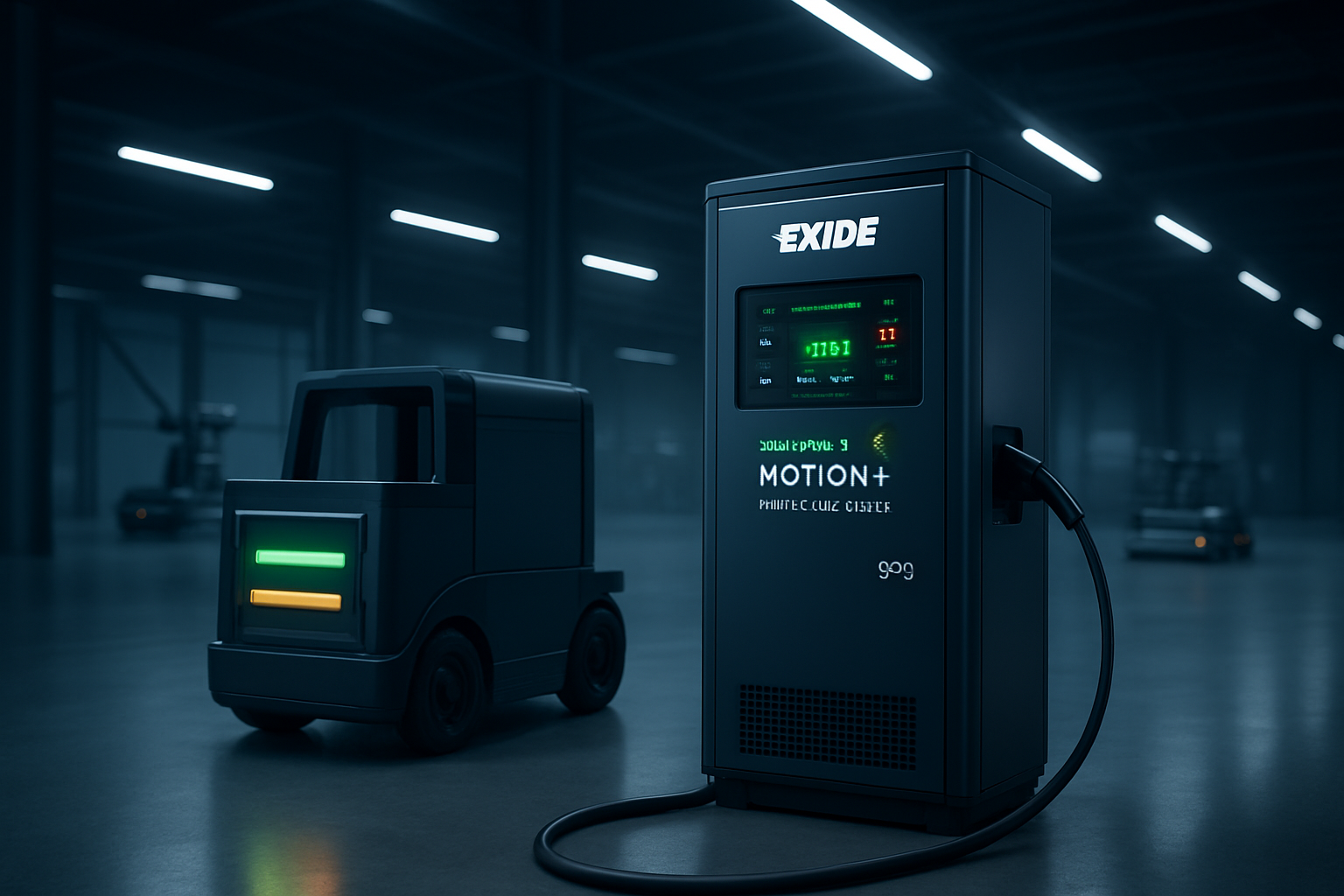
    October 22, 2025 – Exide Technologies (NASDAQ: XIDE), a global leader in energy storage solutions, has officially unveiled its groundbreaking Motion+ Premium Charger, also known as the SP3. This innovative charging solution marks a significant advancement in industrial power technology, promising enhanced efficiency, versatility, and user-friendliness for a wide array of small electric vehicles, cleaning machines, and pallet trucks. The launch of the Motion+ Premium Charger is set to redefine operational standards in logistics, manufacturing, and various industrial sectors by offering a sophisticated yet accessible approach to battery management.

    The introduction of the SP3 is particularly timely as industries increasingly adopt electric fleets and demand more sustainable and efficient operational practices. Exide's latest offering is designed to meet these evolving needs, providing optimized charging for both traditional lead-acid and modern lithium-ion batteries. Its compact design and advanced features are poised to deliver substantial benefits, including reduced charging times, lower energy consumption, and extended battery lifespan, ultimately contributing to a more productive and cost-effective industrial environment.

    Technical Prowess: Powering the Future of Industrial Operations

    The Motion+ Premium Charger (SP3) is engineered with cutting-edge High Frequency (HF) technology, which ensures highly efficient power conversion and optimal performance. This sophisticated approach minimizes energy loss during charging, leading to faster recharge cycles and a reduced strain on the electrical grid. A key differentiator of the SP3 is its universal battery compatibility, offering optimized charging profiles for both advanced lead-acid and the increasingly prevalent lithium-ion batteries. This eliminates the need for multiple, specialized chargers, streamlining inventory and operational complexity for businesses.

    Technically, the SP3 and its larger counterpart, the SP3+, support a broad voltage range from 12V to 48V, delivering up to 1700W of output power. The chargers boast a compact and smart design, with the SP3 measuring 253 x 143 x 83 mm and weighing just 3.5 kg, making installation remarkably simple. Its user interface is designed for maximum accessibility, featuring a single control button and an extra bright LED status indicator for clear, immediate feedback. Furthermore, the SP3 integrates CAN-board functionality for seamless communication with Li-Ion battery management systems and offers an optional USB data download for simplified monitoring and diagnostics. This level of integration and data accessibility represents a significant departure from older, less intelligent charging systems, providing operators with unprecedented control and insight into their battery health and charging processes.

    Competitive Edge: Reshaping the Industrial Charging Landscape

    The launch of the Motion+ Premium Charger positions Exide Technologies (NASDAQ: XIDE) to significantly strengthen its competitive standing in the industrial energy sector. Companies operating large fleets of material handling equipment, such as logistics firms, warehousing giants, and manufacturing facilities, stand to benefit immensely from the SP3's versatility and efficiency. By supporting both lead-acid and lithium-ion chemistries with optimized profiles, Exide offers a forward-compatible solution that reduces the total cost of ownership for its customers, making it an attractive proposition for businesses looking to upgrade their infrastructure or invest in new electric fleets.

    This development creates competitive implications for other major players in the industrial charging market. Exide's integrated system approach, combining advanced battery technology with intelligent charging solutions, could pressure competitors to accelerate their own research and development into more versatile and efficient chargers. The plug-and-play functionality, combined with backward compatibility for existing accessories, minimizes disruption for businesses transitioning to the new system, further enhancing Exide's market positioning. The SP3's ability to maximize battery performance and extend service life also provides a strategic advantage, as it directly addresses key operational concerns for businesses reliant on continuous uptime and efficient energy management.

    Wider Significance: Fueling the Smart Industrial Revolution

    The Motion+ Premium Charger's unveiling fits seamlessly into the broader landscape of industrial automation and smart factory trends. While not a direct AI breakthrough, this advancement in charging technology is foundational to the efficiency and reliability of the electric vehicles and machinery that often form the backbone of AI-driven logistics and automated manufacturing processes. Its high energy efficiency and optimized charging profiles contribute to environmental sustainability by reducing energy consumption and extending battery lifespans, aligning with global efforts towards greener industrial practices.

    The immediate impacts include significant operational cost savings for businesses due to reduced energy bills and fewer battery replacements. Furthermore, the enhanced reliability and reduced downtime offered by optimal charging ensure greater productivity across industrial operations. In comparison to previous industrial milestones, the SP3 represents a step towards a more intelligent, interconnected, and sustainable industrial ecosystem, where every component, down to the charger, plays a role in overall efficiency. While no significant concerns are immediately apparent, the initial investment for upgrading existing charging infrastructure might be a consideration for smaller enterprises, though the long-term benefits are expected to outweigh these costs.

    Future Horizons: Smarter, More Integrated Power Solutions

    In the near term, the Motion+ Premium Charger is expected to see rapid adoption across various industrial sectors, particularly in regions with a strong emphasis on automation and sustainability. Its versatility makes it an ideal solution for warehouses deploying automated guided vehicles (AGVs), manufacturing plants utilizing electric forklifts, and even commercial cleaning services. We can anticipate further integration of such smart charging solutions into broader fleet management systems, enabling real-time monitoring, predictive maintenance, and even autonomous charging scheduling.

    Looking further ahead, experts predict that industrial charging technology will continue to evolve towards even greater intelligence and connectivity. This could include chargers that dynamically adjust their profiles based on grid demand, integrate seamlessly with renewable energy sources, and offer even more sophisticated diagnostic capabilities. Challenges that need to be addressed include further standardization across diverse battery chemistries and communication protocols to ensure maximum interoperability. Exide's SP3 is a strong indicator of this future, laying the groundwork for more autonomous, energy-efficient, and data-driven industrial power solutions that will be critical for the smart factories of tomorrow.

    A New Benchmark for Industrial Charging Excellence

    The Exide Motion+ Premium Charger (SP3) represents a pivotal moment in industrial charging technology. Its key takeaways include unparalleled versatility through dual battery chemistry compatibility, superior energy efficiency via HF technology, and a user-centric design that simplifies operation and maintenance. This development is not merely an incremental upgrade; it is a significant step forward that sets a new benchmark for performance, reliability, and sustainability in industrial power management.

    Its significance in the broader context of technological advancement lies in its contribution to building more resilient and efficient industrial infrastructures, which are essential for supporting the ongoing digital transformation and increasing automation across sectors. The long-term impact will likely be seen in reduced operational costs, improved environmental footprints, and enhanced productivity for businesses globally. As we move into the coming weeks and months, the market will be watching closely for the widespread adoption of the Motion+ Premium Charger and how competitors respond to Exide's innovative stride.


    This content is intended for informational purposes only and represents analysis of current AI developments.

    TokenRing AI delivers enterprise-grade solutions for multi-agent AI workflow orchestration, AI-powered development tools, and seamless remote collaboration platforms.
    For more information, visit https://www.tokenring.ai/.