
Tag: Spatial Intelligence

  • Beyond Pixels: Fei-Fei Li’s World Labs Unveils ‘Large World Models’ to Bridge AI and the Physical Realm

    Beyond Pixels: Fei-Fei Li’s World Labs Unveils ‘Large World Models’ to Bridge AI and the Physical Realm

    In a move that many industry insiders are calling the "GPT-2 moment" for 3D spatial reasoning, World Labs—the high-octane startup co-founded by "Godmother of AI" Dr. Fei-Fei Li—has officially shifted the artificial intelligence landscape from static images to interactive, navigable 3D environments. On January 21, 2026, the company launched its "World API," providing developers and robotics firms with unprecedented access to Large World Models (LWMs) that understand the fundamental physical laws and geometric structures of the real world.

    The announcement marks a pivotal shift in the AI race. While the last two years were dominated by text-based Large Language Models (LLMs) and 2D video generators, World Labs is betting that the next frontier of intelligence is "Spatial Intelligence." By moving beyond flat pixels to create persistent, editable 3D worlds, the startup aims to provide the "operating system" for the next generation of embodied AI, autonomous vehicles, and professional creative tools. Currently valued at over $1 billion and reportedly in talks for a new $500 million funding round at a $5 billion valuation, World Labs has quickly become the focal point of the Silicon Valley AI ecosystem.

    Engineering the Third Dimension: How LWMs Differ from Sora

    At the heart of World Labs' technological breakthrough is the "Marble" model, a multimodal frontier model that generates structured 3D environments from simple text or image prompts. Unlike video generation models like OpenAI’s Sora, which predict the next frame in a sequence to create a visual illusion of depth, Marble creates what the company calls a "discrete spatial state." This means that if a user moves a virtual camera away from an object and then returns, the object remains exactly where it was—maintaining a level of persistence and geometric consistency that has long eluded generative video.

    Technically, World Labs leverages a combination of 3D Gaussian Splatting and proprietary "collider mesh" generation. While Gaussian Splats provide high-fidelity, photorealistic visuals, the model simultaneously generates a low-poly mesh that defines the physical boundaries of the space. This allows for a "dual-output" system: one for the human eye and one for the physics engine. Furthermore, the company released SparkJS, an open-source renderer that allows these heavy 3D files to be viewed instantly in web browsers, bypassing the traditional lag associated with 3D engine exports. Initial reactions from the research community have been overwhelmingly positive, with experts noting that World Labs is solving the "hallucination" problem of 3D space, where objects in earlier models would often morph or disappear when viewed from different angles.

    A New Power Player in the Chip and Cloud Ecosystem

    The rise of World Labs has significant implications for the existing tech hierarchy. The company’s strategic investor list reads like a "who’s who" of hardware and software giants, including NVIDIA (NASDAQ: NVDA), AMD (NASDAQ: AMD), Adobe (NASDAQ: ADBE), and Cisco (NASDAQ: CSCO). These partnerships highlight a clear market positioning: World Labs isn't just a model builder; it is a provider of simulation data for the robotics and spatial computing industries. For NVIDIA, World Labs' models represent a massive influx of content for their Omniverse and Isaac Sim platforms, potentially selling more H200 and Blackwell GPUs to power these compute-heavy 3D generations.

    In the competitive landscape, World Labs is positioning itself as the foundational alternative to the "black box" video models of OpenAI and Google (NASDAQ: GOOGL). By offering an API that outputs standard 3D formats like USD (Universal Scene Description), World Labs is courting the professional creative market—architects, game developers, and filmmakers—who require the ability to edit and refine AI-generated content rather than just accepting a final video file. This puts pressure on traditional 3D software incumbents and suggests a future where the barrier to entry for high-end digital twin creation is nearly zero.

    Solving the 'Sim-to-Real' Bottleneck for Embodied AI

    The broader significance of World Labs lies in its potential to unlock "Embodied AI"—AI that can interact with the physical world through robotic bodies. For years, robotics researchers have struggled with the "Sim-to-Real" gap, where robots trained in simplified simulators fail when confronted with the messy complexity of real-life environments. Dr. Fei-Fei Li’s vision of Spatial Intelligence addresses this directly by providing a "data flywheel" of photorealistic, physically accurate training environments. Instead of manually building a virtual kitchen to train a robot, developers can now generate 10,000 variations of that kitchen via the World API, each with different lighting, clutter, and physical constraints.

    This development echoes the early days of ImageNet, the massive dataset Li created that fueled the deep learning revolution of the 2010s. By creating a "spatial foundation," World Labs is providing the missing piece for Artificial General Intelligence (AGI): an understanding of space and time. However, this advancement is not without its concerns. Privacy advocates have already begun to question the implications of models that can reconstruct detailed 3D spaces from a single photograph, potentially allowing for the unauthorized digital recreation of private homes or sensitive industrial sites.

    The Road Ahead: From Simulation to Real-World Agency

    Looking toward the near future, the industry expects World Labs to focus on refining its "mesh quality." While the current visual outputs are stunning, the underlying geometric meshes can still be "rough around the edges," occasionally leading to collision errors in high-stakes robotics testing. Addressing these "hole-like defects" in 3D reconstruction will be critical for the startup’s success in the autonomous vehicle and industrial automation sectors. Furthermore, the high compute cost of 3D generation remains a hurdle; industry analysts predict that World Labs will need to innovate significantly in model compression to make 3D world generation as affordable and instantaneous as generating a text summary.

    Expert predictions suggest that by late 2026, we may see the first "closed-loop" robotic systems that use World Labs models in real-time to navigate unfamiliar environments. Imagine a search-and-rescue drone that, upon entering a collapsed building, uses an LWM to instantly construct a 3D map of its surroundings, predicting which walls are stable and which paths are traversable. The transition from "generating worlds for humans to see" to "generating worlds for robots to understand" is the next logical step in this trajectory.

    A Legacy of Vision: Final Assessment

    In summary, World Labs represents more than just another high-valued AI startup; it is the physical manifestation of Dr. Fei-Fei Li’s career-long pursuit of visual intelligence. The launch of the World API on January 21, 2026, has effectively democratized 3D creation, moving the industry away from "AI as a talker" toward "AI as a doer." The key takeaways are clear: persistence of space, physical grounding, and the integration of 3D geometry are now the standard benchmarks for frontier models.

    As we move through 2026, the tech community will be watching World Labs’ ability to scale its infrastructure and maintain its lead over potential rivals like Meta (NASDAQ: META) and Tesla (NASDAQ: TSLA), both of whom have vested interests in world-modeling for their respective hardware. Whether World Labs becomes the "AWS of the 3D world" or remains a niche tool for researchers, its impact on the roadmap toward AGI is already undeniable. The era of Spatial Intelligence has officially arrived.


    This content is intended for informational purposes only and represents analysis of current AI developments.

    TokenRing AI delivers enterprise-grade solutions for multi-agent AI workflow orchestration, AI-powered development tools, and seamless remote collaboration platforms.
    For more information, visit https://www.tokenring.ai/.

  • From Pixels to Playable Worlds: Google’s Genie 3 Redefines the Boundary Between AI Video and Reality

    From Pixels to Playable Worlds: Google’s Genie 3 Redefines the Boundary Between AI Video and Reality

    As of January 12, 2026, the landscape of generative artificial intelligence has shifted from merely creating content to constructing entire interactive realities. At the forefront of this evolution is Alphabet Inc. (NASDAQ: GOOGL) with its latest iteration of the Genie (Generative Interactive Environments) model. What began as a research experiment in early 2024 has matured into Genie 3, a sophisticated "world model" capable of transforming a single static image or a short text prompt into a fully navigable, 3D environment in real-time.

    The immediate significance of Genie 3 lies in its departure from traditional video generation. While previous AI models could produce high-fidelity cinematic clips, they lacked the fundamental property of agency. Genie 3 allows users to not only watch a scene but to inhabit it—controlling a character, interacting with objects, and modifying the environment’s physics on the fly. This breakthrough signals a major milestone in the quest for "Physical AI," where machines learn to understand the laws of the physical world through visual observation rather than manual programming.

    Technical Mastery: The Architecture of Infinite Environments

    Technically, Genie 3 represents a massive leap over its predecessors. While the 2024 prototype was limited to low-resolution, 2D-style simulations, the 2026 version operates at a crisp 720p resolution at 24 frames per second. This is achieved through a massive autoregressive transformer architecture that predicts the next visual state of the world based on both previous frames and the user’s specific inputs. Unlike a traditional game engine like those from Unity Software Inc. (NYSE: U), which relies on pre-rendered assets and hard-coded physics, Genie 3 generates its world entirely through latent action models, meaning it "imagines" the consequences of a user's movement in real-time.

    One of the most significant technical hurdles overcome in Genie 3 is "temporal consistency." In earlier generative models, turning around in a virtual space often resulted in the environment "hallucinating" a new layout when the user looked back. Google DeepMind has addressed this by implementing a dedicated visual memory mechanism. This allows the model to maintain consistent spatial geography and object permanence for extended periods, ensuring that a mountain or a building remains exactly where it was left, even after the user has navigated kilometers away in the virtual space.

    Furthermore, Genie 3 introduces "Promptable World Events." While a user is actively playing within a generated environment, they can issue natural language commands to alter the simulation’s state. Typing "increase gravity" or "change the season to winter" results in an immediate, seamless transition of the environment's visual and physical properties. This indicates that the model has developed a deep, data-driven understanding of physical causality—knowing, for instance, how snow should accumulate on surfaces or how objects should fall under different gravitational constants.

    Initial reactions from the AI research community have been transformative. Experts note that Genie 3 effectively bridges the gap between generative media and simulation science. By training on hundreds of thousands of hours of video data without explicit action labels, the model has learned to infer the "rules" of the world. This "unsupervised" approach to learning physics is seen by many as a more scalable path toward Artificial General Intelligence (AGI) than the labor-intensive process of manually coding every possible interaction in a virtual world.

    The Battle for Spatial Intelligence: Market Implications

    The release of Genie 3 has sent ripples through the tech industry, intensifying the competition between AI giants and specialized startups. NVIDIA (NASDAQ: NVDA), currently a leader in the space with its Cosmos platform, now faces a direct challenge to its dominance in industrial simulation. While NVIDIA’s tools are deeply integrated into the robotics and automotive sectors, Google’s Genie 3 offers a more flexible, "prompt-to-world" interface that could lower the barrier to entry for developers looking to create complex training environments for autonomous systems.

    For Microsoft (NASDAQ: MSFT) and its partner OpenAI, the pressure is mounting to evolve Sora—their high-profile video generation model—into a truly interactive experience. While OpenAI’s Sora 2 has achieved near-photorealistic cinematic quality, Genie 3’s focus on interactivity and "playable" physics positions Google as a leader in the emerging field of spatial intelligence. This strategic advantage is particularly relevant as the tech industry pivots toward "Physical AI," where the goal is to move AI agents out of chat boxes and into the physical world.

    The gaming and software development sectors are also bracing for disruption. Traditional game development is a multi-year, multi-million dollar endeavor. If a model like Genie 3 can generate a playable, consistent level from a single concept sketch, the role of traditional asset pipelines could be fundamentally altered. Companies like Meta Platforms, Inc. (NASDAQ: META) are watching closely, as the ability to generate infinite, personalized 3D spaces is the "holy grail" for the long-term viability of the metaverse and mixed-reality hardware.

    Strategic positioning is now shifting toward "World Models as a Service." Google is currently positioning Genie 3 as a foundational layer for other AI agents, such as SIMA (Scalable Instructable Multiworld Agent). By providing an infinite variety of "gyms" for these agents to practice in, Google is creating a closed-loop ecosystem where its world models train its behavioral models, potentially accelerating the development of capable, general-purpose robots far beyond the capabilities of its competitors.

    Wider Significance: A New Paradigm for Reality

    The broader significance of Genie 3 extends beyond gaming or robotics; it represents a fundamental shift in how we conceptualize digital information. We are moving from an era of "static data" to "dynamic worlds." This fits into a broader AI trend where models are no longer just predicting the next word in a sentence, but the next state of a physical system. It suggests that the most efficient way to teach an AI about the world is not to give it a textbook, but to let it watch and then "play" in a simulated version of reality.

    However, this breakthrough brings significant concerns, particularly regarding the blurring of lines between reality and simulation. As Genie 3 approaches photorealism and high temporal consistency, the potential for sophisticated "deepfake environments" increases. If a user can generate a navigable, interactive version of a real-world location from just a few photos, the implications for privacy and security are profound. Furthermore, the energy requirements for running such complex, real-time autoregressive simulations remain a point of contention in the context of global sustainability goals.

    Comparatively, Genie 3 is being hailed as the "GPT-3 moment" for spatial intelligence. Just as GPT-3 proved that large language models could perform a dizzying array of tasks through simple prompting, Genie 3 proves that large-scale video training can produce a functional understanding of the physical world. It marks the transition from AI that describes the world to AI that simulates the world, a distinction that many researchers believe is critical for achieving human-level reasoning and problem-solving.

    The Horizon: VR Integration and the Path to AGI

    Looking ahead, the near-term applications for Genie 3 are likely to center on the rapid prototyping of virtual environments. Within the next 12 to 18 months, we expect to see the integration of Genie-like models into VR and AR headsets, allowing users to "hallucinate" their surroundings in real-time. Imagine a user putting on a headset and saying, "Take me to a cyberpunk version of Tokyo," and having the world materialize around them, complete with interactive characters and consistent physics.

    The long-term challenge remains the "scaling of complexity." While Genie 3 can handle a single room or a small outdoor area with high fidelity, simulating an entire city with thousands of interacting agents and persistent long-term memory is still on the horizon. Addressing the computational cost of these models will be a primary focus for Google’s engineering teams throughout 2026. Experts predict that the next major milestone will be "Multi-Agent Genie," where multiple users or AI agents can inhabit and permanently alter the same generated world.

    As we look toward the future, the ultimate goal is "Zero-Shot Transfer"—the ability for an AI to learn a task in a Genie-generated world and perform it perfectly in the real world on the first try. If Google can achieve this, the barrier between digital intelligence and physical labor will effectively vanish, fundamentally transforming industries from manufacturing to healthcare.

    Final Reflections on a Generative Frontier

    Google’s Genie 3 is more than a technical marvel; it is a preview of a future where the digital world is as malleable as our imagination. By turning static images into interactive playgrounds, Google has provided a glimpse into the next phase of the AI revolution—one where models understand not just what we say, but how our world works. The transition from 2D pixels to 3D playable environments marks a definitive end to the era of "passive" AI.

    As we move further into 2026, the key metric for AI success will no longer be the fluency of a chatbot, but the "solidity" of the worlds it can create. Genie 3 stands as a testament to the power of large-scale unsupervised learning and its potential to unlock the secrets of physical reality. For now, the model remains in a limited research preview, but its influence is already being felt across every sector of the technology industry.

    In the coming weeks, observers should watch for the first public-facing "creator tools" built on the Genie 3 API, as well as potential counter-moves from OpenAI and NVIDIA. The race to build the ultimate simulator is officially on, and Google has just set a very high bar for the rest of the field.


    This content is intended for informational purposes only and represents analysis of current AI developments.

    TokenRing AI delivers enterprise-grade solutions for multi-agent AI workflow orchestration, AI-powered development tools, and seamless remote collaboration platforms.
    For more information, visit https://www.tokenring.ai/.

  • Beyond Pixels: The Rise of 3D World Models and the Quest for Spatial Intelligence

    Beyond Pixels: The Rise of 3D World Models and the Quest for Spatial Intelligence

    The era of Large Language Models (LLMs) is undergoing its most significant evolution to date, transitioning from digital "stochastic parrots" to AI agents that possess a fundamental understanding of the physical world. As of January 2026, the industry focus has pivoted toward "World Models"—AI architectures designed to perceive, reason about, and navigate three-dimensional space. This shift is being spearheaded by two of the most prominent figures in AI history: Dr. Fei-Fei Li, whose startup World Labs has recently emerged from stealth with groundbreaking spatial intelligence models, and Yann LeCun, Meta’s Chief AI Scientist, who has co-founded a new venture to implement his vision of "predictive" machine intelligence.

    The immediate significance of this development cannot be overstated. While previous generative models like OpenAI’s Sora could create visually stunning videos, they often lacked "physical common sense," leading to visual glitches where objects would spontaneously morph or disappear. The new generation of 3D World Models, such as World Labs’ "Marble" and Meta’s "VL-JEPA," solve this by building internal, persistent representations of 3D environments. This transition marks the beginning of the "Embodied AI" era, where artificial intelligence moves beyond the chat box and into the physical reality of robotics, autonomous systems, and augmented reality.

    The Technical Leap: From Pixel Prediction to Spatial Reasoning

    The technical core of this advancement lies in a move away from "autoregressive pixel prediction." Traditional video generators create the next frame by guessing what the next set of pixels should look like based on patterns. In contrast, World Labs’ flagship model, Marble, utilizes a technique known as 3D Gaussian Splatting combined with a hybrid neural renderer. Instead of just drawing a picture, Marble generates a persistent 3D volume that maintains geometric consistency. If a user "moves" a virtual camera through a generated room, the objects remain fixed in space, allowing for true navigation and interaction. This "spatial memory" ensures that if an AI agent turns away from a table and looks back, the objects on that table have not changed shape or position—a feat that was previously impossible for generative video.

    Parallel to this, Yann LeCun’s work at Meta Platforms Inc. (NASDAQ: META) and his newly co-founded Advanced Machine Intelligence Labs (AMI Labs) focuses on the Joint Embedding Predictive Architecture (JEPA). Unlike LLMs that predict the next word, JEPA models predict "latent embeddings"—abstract representations of what will happen next in a physical scene. By ignoring irrelevant visual noise (like the specific way a leaf flickers in the wind) and focusing on high-level causal relationships (like the trajectory of a falling glass), these models develop a "world model" that mimics human intuition. The latest iteration, VL-JEPA, has demonstrated the ability to train robotic arms to perform complex tasks with 90% less data than previous methods, simply by "watching" and predicting physical outcomes.

    The AI research community has hailed these developments as the "missing piece" of the AGI puzzle. Industry experts note that while LLMs are masters of syntax, they are "disembodied," lacking the grounding in reality required for high-stakes decision-making. By contrast, World Models provide a "physics engine" for the mind, allowing AI to simulate the consequences of an action before it is taken. This differs fundamentally from existing technology by prioritizing "depth and volume" over "surface-level patterns," effectively giving AI a sense of touch and spatial awareness that was previously absent.

    Industry Disruption: The Battle for the Physical Map

    This shift has created a new competitive frontier for tech giants and startups alike. World Labs, backed by over $230 million in funding, is positioning itself as the primary provider of "spatial intelligence" for the gaming and entertainment industries. By allowing developers to generate fully interactive, editable 3D worlds from text prompts, World Labs threatens to disrupt traditional 3D modeling pipelines used by companies like Unity Software Inc. (NYSE: U) and Epic Games. Meanwhile, the specialized focus of AMI Labs on "deterministic" world models for industrial and medical applications suggests a move toward AI agents that are auditable and safe for use in physical infrastructure.

    Major tech players are responding rapidly to protect their market positions. Alphabet Inc. (NASDAQ: GOOGL), through its Google DeepMind division, has accelerated the integration of its "Genie" world-building technology into its robotics programs. Microsoft Corp. (NASDAQ: MSFT) is reportedly pivoting its Azure AI services to include "Spatial Compute" APIs, leveraging its relationship with OpenAI to bring 3D awareness to the next generation of Copilots. NVIDIA Corp. (NASDAQ: NVDA) remains a primary benefactor of this trend, as the complex rendering and latent prediction required for 3D world models demand even greater computational power than text-based LLMs, further cementing their dominance in the AI hardware market.

    The strategic advantage in this new era belongs to companies that can bridge the gap between "seeing" and "doing." Startups focusing on autonomous delivery, warehouse automation, and personalized robotics are now moving away from brittle, rule-based systems toward these flexible world models. This transition is expected to devalue companies that rely solely on "wrapper" applications for 2D text and image generation, as the market value shifts toward AI that can interact with and manipulate the physical world.

    The Wider Significance: Grounding AI in Reality

    The emergence of 3D World Models represents a significant milestone in the broader AI landscape, moving the industry past the "hallucination" phase of generative AI. For years, the primary criticism of AI was its lack of "common sense"—the basic understanding that objects have mass, gravity exists, and two things cannot occupy the same space. By grounding AI in 3D physics, researchers are creating models that are inherently more reliable and less prone to the nonsensical errors that plagued earlier iterations of GPT and Llama.

    However, this advancement brings new concerns. The ability to generate persistent, hyper-realistic 3D environments raises the stakes for digital misinformation and "deepfake" realities. If an AI can create a perfectly consistent 3D world that is indistinguishable from reality, the potential for psychological manipulation or the creation of "digital traps" becomes a real policy challenge. Furthermore, the massive data requirements for training these models—often involving millions of hours of first-person video—raise significant privacy questions regarding the collection of visual data from the real world.

    Comparatively, this breakthrough is being viewed as the "ImageNet moment" for robotics. Just as Fei-Fei Li’s ImageNet dataset catalyzed the deep learning revolution in 2012, her work at World Labs is providing the spatial foundation necessary for AI to finally leave the screen. This is a departure from the "scaling hypothesis" that suggested more data and more parameters alone would lead to intelligence; instead, it proves that the structure of the data—specifically its spatial and physical grounding—is the true key to reasoning.

    Future Horizons: From Digital Twins to Autonomous Agents

    In the near term, we can expect to see 3D World Models integrated into consumer-facing augmented reality (AR) glasses. Devices from Meta and Apple Inc. (NASDAQ: AAPL) will likely use these models to "understand" a user’s living room in real-time, allowing digital objects to interact with physical furniture with perfect occlusion and physics. In the long term, the most transformative application will be in general-purpose robotics. Experts predict that by 2027, the first wave of "spatial-native" humanoid robots will enter the workforce, powered by world models that allow them to learn new household tasks simply by observing a human once.

    The primary challenge remaining is "causal reasoning" at scale. While current models can predict that a glass will break if dropped, they still struggle with complex, multi-step causal chains, such as the social dynamics of a crowded room or the long-term wear and tear of mechanical parts. Addressing these challenges will require a fusion of 3D spatial intelligence with the high-level reasoning capabilities of modern LLMs. The next frontier will likely be "Multimodal World Models" that can see, hear, feel, and reason across both digital and physical domains simultaneously.

    A New Dimension for Artificial Intelligence

    The transition from 2D generative models to 3D World Models marks a definitive turning point in the history of artificial intelligence. We are moving away from an era of "stochastic parrots" that mimic human language and toward "spatial reasoners" that understand the fundamental laws of our universe. The work of Fei-Fei Li at World Labs and Yann LeCun at AMI Labs and Meta has provided the blueprint for this shift, proving that true intelligence requires a physical context.

    As we look ahead, the significance of this development lies in its ability to make AI truly useful in the real world. Whether it is a robot navigating a complex disaster zone, an AR interface that seamlessly blends with our environment, or a scientific simulation that accurately predicts the behavior of new materials, the "World Model" is the engine that will power the next decade of innovation. In the coming months, keep a close watch on the first public releases of the "Marble" API and the integration of JEPA-based architectures into industrial robotics—these will be the first tangible signs of an AI that finally knows its place in the world.


    This content is intended for informational purposes only and represents analysis of current AI developments.

    TokenRing AI delivers enterprise-grade solutions for multi-agent AI workflow orchestration, AI-powered development tools, and seamless remote collaboration platforms.
    For more information, visit https://www.tokenring.ai/.
  • The Next Frontier: Spatial Intelligence Emerges as AI’s Crucial Leap Towards Real-World Understanding

    The Next Frontier: Spatial Intelligence Emerges as AI’s Crucial Leap Towards Real-World Understanding

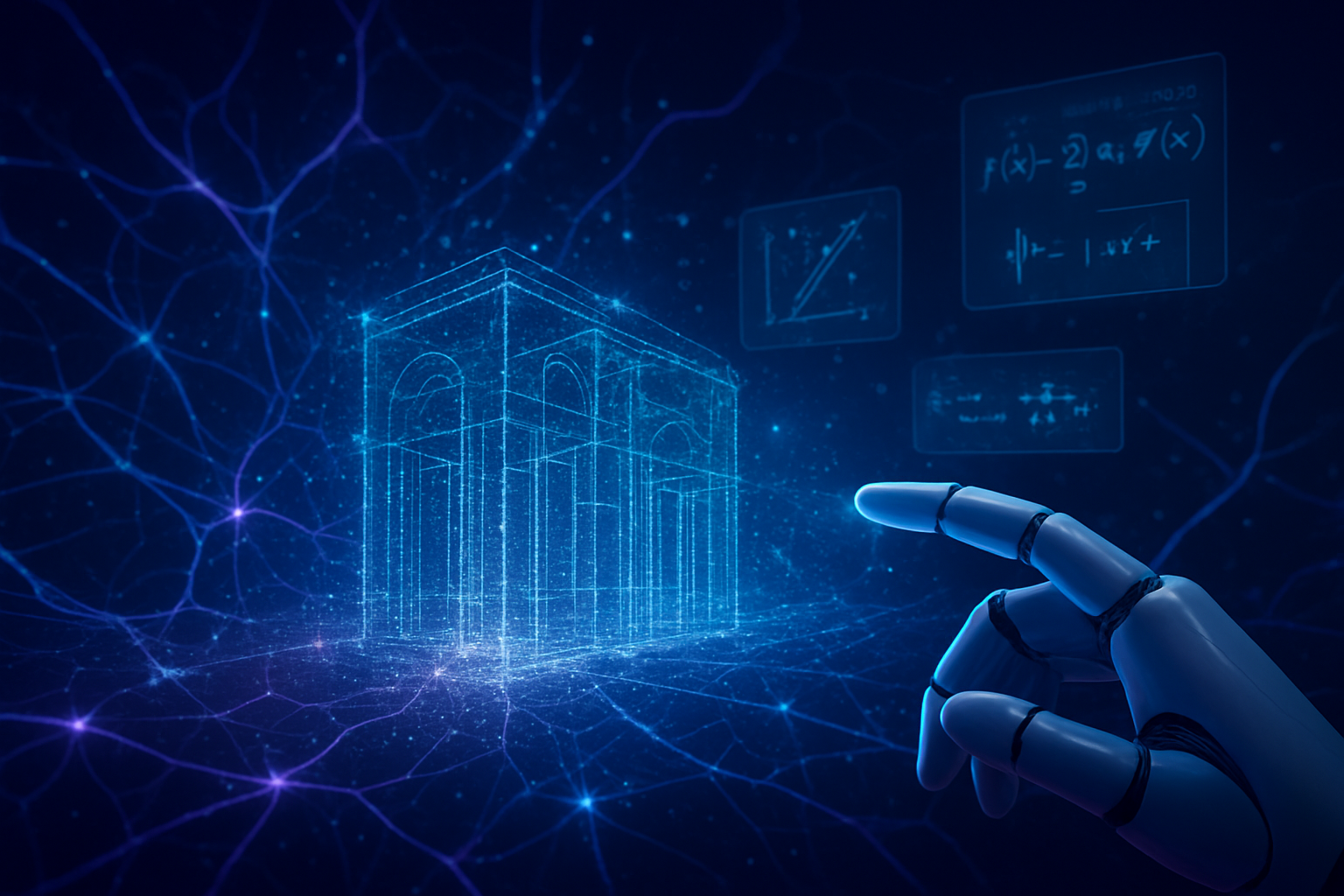
    Artificial intelligence is on the cusp of its next major evolution, moving beyond the mastery of language and two-dimensional data to embrace a profound understanding of the physical world. This paradigm shift centers on spatial intelligence, a critical capability that allows AI systems to perceive, understand, reason about, and interact with three-dimensional space, much like humans do. Experts universally agree that this leap is not merely an incremental improvement but a foundational requirement for future AI advancements, paving the way for truly intelligent machines that can navigate, manipulate, and comprehend our complex physical reality.

    The immediate significance of spatial intelligence is immense. It promises to bridge the long-standing gap between AI's impressive cognitive abilities in digital realms and its often-limited interaction with the tangible world. By enabling AI to "think" in three dimensions, spatial intelligence is poised to revolutionize autonomous systems, immersive technologies, and human-robot interaction, pushing AI closer to achieving Artificial General Intelligence (AGI) and unlocking a new era of practical, real-world applications.

    Technical Foundations of a 3D World Model

    The development of spatial intelligence in AI is a multifaceted endeavor, integrating novel architectural designs, advanced data processing techniques, and sophisticated reasoning models. Recent advancements are particularly focused on 3D reconstruction and representation learning, where AI can convert 2D images into detailed 3D models and generate 3D room layouts from single photographs. Techniques like Gaussian Splatting are enabling real-time 3D mapping, while researchers explore diverse 3D data representations—including point clouds, voxel-based, and mesh-based models—to capture intricate geometry and topology. At its core, Geometric Deep Learning (GDL) extends traditional deep learning to handle data with inherent geometric structures, utilizing Graph Neural Networks (GNNs) to analyze relationships between entities in network structures and invariant/equivariant architectures to ensure consistent performance under geometric transformations.

    Furthermore, spatial-temporal reasoning is crucial, allowing AI to understand and predict how spatial relationships evolve over time. This is bolstered by multimodal AI architectures and Vision-Language-Action (VLA) systems, which integrate sensory data (vision, touch) with language to enable comprehensive understanding and physical interaction. A key concept emerging is "World Models," a new type of generative model capable of understanding, reasoning about, and interacting with complex virtual or real worlds that adhere to physical laws. These models are inherently multimodal and interactive, predicting future states based on actions. To train these complex systems, simulation and digital twins are becoming indispensable, allowing AI, especially in robotics, to undergo extensive training in high-fidelity virtual environments before real-world deployment.

    This approach fundamentally differs from previous AI methodologies. While traditional computer vision excelled at 2D image analysis and object recognition, spatial AI transcends simple identification to understand how objects exist, where they are located, their depth, and their physical relationships in a three-dimensional space. It moves beyond passive data analysis to active planning and real-time adaptation, addressing the limitations of Large Language Models (LLMs) which, despite their linguistic prowess, often lack a grounded understanding of physical laws and struggle with basic spatial reasoning tasks. Initial reactions from the AI research community, including pioneers like Fei-Fei Li, hail spatial intelligence as the "next frontier," essential for truly embodied AI and for connecting AI's cognitive abilities to physical reality, though challenges in data scarcity, complex 3D reasoning, and computational demands are acknowledged.

    Reshaping the AI Industry Landscape

    The advent of spatial intelligence is set to profoundly reshape the competitive landscape for AI companies, tech giants, and startups alike. Companies developing foundational spatial AI models, often termed "Large World Models" (LWMs), are gaining significant competitive advantages through network effects, where every user interaction refines the AI's understanding of 3D environments. Specialized geospatial intelligence firms are also leveraging machine learning to integrate into Geographic Information Systems (GIS), offering automation and optimization across various sectors.

    Tech giants are making substantial investments, leveraging their vast resources. NVIDIA (NASDAQ: NVDA) remains a crucial enabler, providing the powerful GPUs necessary for 3D rendering and AI training. Companies like Apple (NASDAQ: AAPL), Meta Platforms (NASDAQ: META), and Alphabet (NASDAQ: GOOGL) are heavily invested in AR/VR devices and platforms, with products like Apple's Vision Pro serving as critical "spatial AI testbeds." Google (NASDAQ: GOOGL) is integrating GeoAI into its mapping and navigation services, while Amazon (NASDAQ: AMZN) employs spatial AI in smart warehousing. Startups, such as World Labs (founded by Fei-Fei Li) and Pathr.ai, are attracting significant venture capital by focusing on niche applications and pioneering LWMs, demonstrating that innovation is flourishing across the spectrum.

    This shift promises to disrupt existing products and services. Traditional EdTech, often limited to flat-screen experiences, risks obsolescence as spatial learning platforms offer more immersive and effective engagement. Static media experiences may be supplanted by AI-powered immersive content. Furthermore, truly AI-powered digital assistants and search engines, with a deeper understanding of physical contexts, could challenge existing offerings. The competitive edge will lie in a robust data strategy—capturing, generating, and curating high-quality spatial data—along with real-time capabilities, ecosystem building, and a privacy-first approach, positioning companies that can orchestrate multi-source spatial data into real-time analytics for significant market advantage.

    A New Era of AI: Broader Implications and Ethical Imperatives

    Spatial intelligence represents a significant evolutionary step for AI, fitting squarely into the broader trends of embodied AI and the development of world models that explicitly capture the 3D structure, physics, and spatial dynamics of environments. It pushes AI beyond 2D perception, enabling a multimodal integration of diverse sensory inputs for a holistic understanding of the physical world. This is not merely an enhancement but a fundamental shift towards making AI truly grounded in reality.

    The impacts are transformative, ranging from robotics and autonomous systems that can navigate and manipulate objects with human-like precision, to immersive AR/VR experiences that seamlessly blend virtual and physical realities. In healthcare, Spatial Reasoning AI (SRAI) systems are revolutionizing diagnostics, surgical planning, and robotic assistance. Urban planning and smart cities will benefit from AI that can analyze vast geospatial data to optimize infrastructure and manage resources, while manufacturing and logistics will see flexible, collaborative automation. However, this advancement also brings significant concerns: privacy and data security are paramount as AI collects extensive 3D data of personal spaces; bias and equity issues could arise if training data lacks diversity; and ethical oversight and accountability become critical for systems making high-stakes decisions.

    Comparing spatial intelligence to previous AI milestones reveals its profound significance. While early AI relied on programmed rules and deep learning brought breakthroughs in 2D image recognition and natural language processing, these systems often lacked a true understanding of the physical world. Spatial intelligence addresses this by connecting AI's abstract knowledge to concrete physical reality, much like how smartphones transformed basic mobile devices. It moves AI from merely understanding digital data to genuinely comprehending and interacting with the physical world, a crucial step towards achieving Artificial General Intelligence (AGI).

    The Horizon: Anticipating Future Developments

    The future of spatial intelligence in AI promises a landscape where machines are deeply integrated into our physical world. In the near-term (1-5 years), we can expect a surge in practical applications, particularly in robotics and geospatial reasoning. Companies like OpenAI are developing models with improved spatial reasoning for autonomous navigation, while Google's Geospatial Reasoning is tackling complex spatial problems by combining generative AI with foundation models. The integration of spatial computing into daily routines will accelerate, with AR glasses anchoring digital content to real-world locations. Edge computing will be critical for real-time data processing in autonomous driving and smart cities, and Large World Models (LWMs) from pioneers like Fei-Fei Li's World Labs will aim to understand, generate, and interact with large-scale 3D environments, complete with physics and semantics.

    Looking further ahead (beyond 5 years), experts envision spatial AI becoming the "operating system of the physical world," leading to immersive interfaces where digital and physical realms converge. Humanoid robots, enabled by advanced spatial awareness, are projected to become part of daily life, assisting in various sectors. The widespread adoption of digital twins and pervasive location-aware automation will be driven by advancements in AI foundations and synthetic data generation. Spatial AI is also expected to converge with search technologies, creating highly immersive experiences, and will advance fields like spatial omics in biotechnology. The ultimate goal is for spatial AI systems to not just mimic human perception but to augment and surpass it, developing their own operational logic for space while remaining trustworthy.

    Despite the immense potential, significant challenges remain. Data scarcity and quality for training 3D models are major hurdles, necessitating more sophisticated synthetic data generation. Teaching AI systems to accurately comprehend real-world physics and handle geometric data efficiently remains complex. Reconstructing complete 3D views from inherently incomplete sensor data, like 2D camera feeds, is a persistent challenge. Furthermore, addressing ethical and privacy concerns as spatial data collection becomes pervasive is paramount. Experts like Fei-Fei Li emphasize that spatial intelligence is the "next frontier" for AI, enabling it to go beyond language to perception and action, a sentiment echoed by industry reports projecting the global spatial computing market to reach hundreds of billions of dollars by the early 2030s.

    The Dawn of a Spatially Aware AI

    In summary, the emergence of spatial intelligence marks a pivotal moment in the history of artificial intelligence. It represents a fundamental shift from AI primarily processing abstract digital data to genuinely understanding and interacting with the three-dimensional physical world. This capability, driven by advancements in 3D reconstruction, geometric deep learning, and world models, promises to unlock unprecedented applications across robotics, autonomous systems, AR/VR, healthcare, and urban planning.

    The significance of this development cannot be overstated. It is the crucial bridge that will allow AI to move beyond being "wordsmiths in the dark" to becoming truly embodied, grounded, and effective agents in our physical reality. While challenges related to data, computational demands, and ethical considerations persist, the trajectory is clear: spatial intelligence is set to redefine what AI can achieve. As companies vie for leadership in this burgeoning field, investing in robust data strategies, foundational model development, and real-time capabilities will be key. The coming weeks and months will undoubtedly bring further breakthroughs and announcements, solidifying spatial intelligence's role as the indispensable next leap in AI's journey towards human-like understanding.


    This content is intended for informational purposes only and represents analysis of current AI developments.

    TokenRing AI delivers enterprise-grade solutions for multi-agent AI workflow orchestration, AI-powered development tools, and seamless remote collaboration platforms.
    For more information, visit https://www.tokenring.ai/.