Tag: Starship

  • Elon Musk’s ‘Bakery’ Forges the Future of Space Travel with Mass-Produced Starship Heat Shields

    Elon Musk’s ‘Bakery’ Forges the Future of Space Travel with Mass-Produced Starship Heat Shields

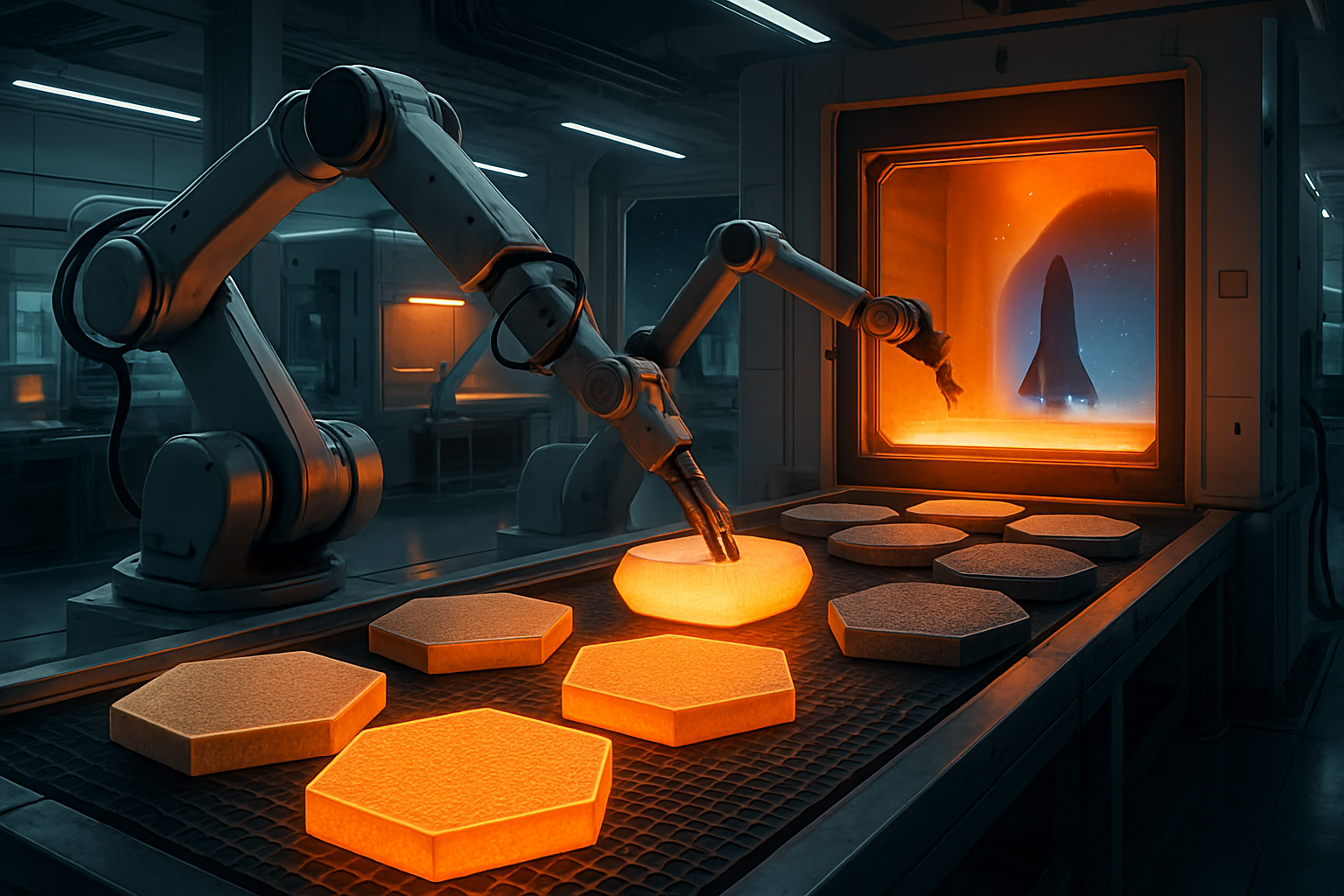
    BOCA CHICA, TX – October 17, 2025 – In a development poised to revolutionize space exploration, Elon Musk’s aptly named 'Bakery' in Florida is in full swing, mass-producing advanced ceramic heat shield tiles that are critical to the rapid reusability of SpaceX (NASDAQ:SPCX) Starship. This highly automated facility represents a pivotal shift in aerospace manufacturing, moving from bespoke, handcrafted components to industrial-scale production, a key enabler for Starship’s ambitious mission to make humanity a multiplanetary species.

    The immediate significance of this innovation cannot be overstated. The 'Bakery' is not just producing tiles; it's baking the foundation for Starship's rapid reusability, aiming for an aircraft-like operational tempo with minimal turnaround time between flights. This industrial-scale efficiency is designed to drastically drive down the cost of space missions, transforming the economic equation of space exploration and making frequent journeys to the Moon, Mars, and beyond a tangible reality.

    Engineering Resilience: The Starship Heat Shield's Technical Edge

    Starship's thermal protection system (TPS) is a marvel of modern engineering, comprising approximately 18,000 hexagonal ceramic heat shield tiles that cover over 50% of its surface. These tiles, made from advanced silica-based ceramics and often coated with black borosilicate glass, are designed to endure extreme atmospheric reentry temperatures exceeding 1,400°C (2,500°F). Their hexagonal shape, precise pin-mounted attachments, and small expansion gaps allow them to flex and absorb immense thermal and aerodynamic stresses without cracking, a significant improvement over previous designs. Recent innovations like "Crunchwrap Tiles" and "Vulcan felt" further enhance their protective capabilities against plasma leaks.

    The 'Bakery' manufacturing process stands in stark contrast to historical approaches, most notably NASA’s Space Shuttle program. While the Space Shuttle relied on thousands of uniquely shaped, handcrafted tiles that required extensive, months-long refurbishment, SpaceX's facility is a high-tech, automated production center capable of churning out thousands of uniform tiles daily – some reports indicate up to 7,000 tiles per day, with one tile every 13 seconds. This rapid, consistent production, with each tile taking approximately 40 hours from raw material to finished product, is crucial for achieving Starship's goal of near-immediate reflight. Initial reactions from the aerospace community, while acknowledging the immense innovation and scale, have also highlighted the persistent technical challenges of ensuring the long-term durability and rapid refurbishment of these tiles, a hurdle even Elon Musk identifies as "the biggest technology challenge remaining for Starship."

    Reshaping the Aerospace Industry: Competitive Shifts and Market Advantages

    SpaceX's advancements in heat shield manufacturing are sending ripples across the aerospace industry, creating both opportunities and competitive pressures. SpaceX (NASDAQ:SPCX) itself stands as the primary beneficiary, as enhanced heat shield technology directly underpins Starship's rapid reusability and significantly reduced launch costs, solidifying its strategic advantage in the burgeoning commercial space sector. Suppliers of advanced ceramic materials and specialized stainless steel alloys, as well as providers of automation and manufacturing technology, could also see increased demand as the industry strives to match SpaceX's production cadence.

    For established aerospace giants like Boeing (NYSE:BA) and Lockheed Martin (NYSE:LMT), and even national space agencies, Starship's projected low-cost, high-frequency launch capabilities necessitate a re-evaluation of current product offerings and business models. The traditional paradigm of expensive, expendable rockets is facing significant disruption. This forces a shift in R&D focus towards more durable, rapidly reusable, and cost-effective thermal protection systems. Smaller aerospace startups and "New Space" companies, however, stand to benefit immensely from the drastically reduced cost of access to space, which could unlock new markets in space manufacturing, tourism, and resource utilization. SpaceX's vertically integrated "Bakery" model also grants it greater control over quality, intellectual property, and production schedules, reducing reliance on external suppliers for a critical component and further cementing its market leadership.

    A New Era of Space Exploration: Broader Implications and Concerns

    The Starship reusable heat shield technology is not merely an engineering feat; it's a foundational element for a new era of space exploration, fitting squarely into the broader trend towards greater reusability and accessibility. By dramatically lowering launch costs—potentially to under $100 per kilogram to orbit—and enabling unprecedented launch frequency, Starship aims to make ambitious missions to the Moon, Mars, and beyond economically viable within existing budgets. This capability is critical for establishing large satellite constellations, space stations, and permanent lunar or Martian bases, including its role as the Human Landing System for NASA's (NASDAQ:NASA) Artemis program.

    However, significant concerns and challenges persist. The technical hurdles of ensuring the heat shield's long-term durability against extreme temperatures (up to 2,600°F) and the violent shaking of reentry remain paramount. Early test flights have seen tiles fall off or sections of the heat shield burn through, underscoring the ongoing need for refinement. The complexity of rapid refurbishment for thousands of tiles, coupled with the intricate process of in-orbit refueling for deep-space missions, adds further operational challenges. Environmentally, concerns regarding sonic booms and ecological disruption from frequent launches continue to draw scrutiny. Compared to the Space Shuttle's notoriously fragile and labor-intensive tiles, Starship's standardized, mass-produced design represents a major leap, aiming to overcome the Shuttle's limitations in turnaround time and maintenance, thereby pushing the boundaries of what is possible in reusable spaceflight.

    The Road Ahead: Future Developments and Expert Predictions

    In the near term, SpaceX is relentlessly focused on iterative improvements and rigorous testing of its heat shield. This includes continuous refinements to tile materials and designs, the strategic integration of ablative sublayers for secondary protection, and enhanced gap sealing techniques like the "crunch wrap." The "Bakery" itself will continue to evolve, integrating new material and design changes into its automated production lines. Long-term developments could see more radical innovations, though the immediate focus remains on perfecting the existing tiled system. While concepts like transpiration cooling for metallic heat shields have been explored, their complexity has deferred their implementation, but the ongoing experimentation with metallic tiles signifies a commitment to pushing material science boundaries.

    Experts predict an aggressive development and testing timeline for Starship. SpaceX aims for a significantly accelerated flight cadence, with internal plans suggesting up to 25 launches in a single year by 2026, and eventually even hourly launches for the Super Heavy booster during optimal Mars transfer windows. Elon Musk himself has stated that, barring major setbacks, SpaceX aims to demonstrate full reusability of Starship within the next year, delivering over 100 tons to a functional orbit. The heat shield remains a primary focus, with ongoing innovation in material science and design crucial for achieving rapid reusability without extensive refurbishment. Key milestones to watch include perfecting the booster catch with the launch tower arms and demonstrating reliable in-orbit refueling, both essential for Starship's full operational capability and deep-space missions. Furthermore, the transition to Starship Version 3 (V3) prototypes, expected to fly next year, will incorporate further design improvements, including revised flap positions to enhance heat shield performance.

    A Transformative Trajectory: The Enduring Impact of Starship's Heat Shield

    The advancements in Starship's heat shield technology, forged in the automated ovens of Elon Musk's 'Bakery,' represent a transformative moment in aerospace history. The key takeaway is clear: this is not just about protecting a spacecraft; it's about unlocking a new era of space travel. By enabling rapid and full reusability, SpaceX is poised to democratize access to space, drastically reduce costs, and accelerate human exploration beyond Earth.

    The long-term impact will be profound, facilitating the establishment of permanent lunar bases, Martian settlements, and extensive orbital infrastructure, bringing humanity closer to becoming a multi-planetary species. The iterative development philosophy applied to the heat shield will likely inspire entirely new thermal protection system designs across the industry. In the coming weeks and months, the aerospace community will be closely watching the data from recent flight tests, the effectiveness of new gap-sealing technologies, and the continued progress of the "Starfactory" in Florida. The success of Starship's heat shield is not merely a technical achievement; it is the linchpin for a future where frequent, affordable, and sustainable access to space is a reality, fundamentally reshaping our relationship with the cosmos.


    This content is intended for informational purposes only and represents analysis of current AI developments.

    TokenRing AI delivers enterprise-grade solutions for multi-agent AI workflow orchestration, AI-powered development tools, and seamless remote collaboration platforms.
    For more information, visit https://www.tokenring.ai/.

  • NVIDIA Fuels Starship Dreams: Jensen Huang Delivers Petaflop AI Supercomputer to SpaceX

    NVIDIA Fuels Starship Dreams: Jensen Huang Delivers Petaflop AI Supercomputer to SpaceX

    October 15, 2025 – In a move poised to redefine the intersection of artificial intelligence and space exploration, NVIDIA (NASDAQ: NVDA) CEO Jensen Huang personally delivered a cutting-edge 128GB AI supercomputer, the DGX Spark, to Elon Musk at SpaceX's Starbase facility. This pivotal moment, occurring amidst the advanced preparations for Starship's rigorous testing, signifies a strategic leap towards embedding powerful, localized AI capabilities directly into the heart of space technology development. The partnership between the AI hardware giant and the ambitious aerospace innovator is set to accelerate breakthroughs in autonomous spaceflight, real-time data analysis, and the overall efficiency of next-generation rockets, pushing the boundaries of what's possible for humanity's multi-planetary future.

    The immediate significance of this delivery lies in providing SpaceX with unprecedented on-site AI computing power. The DGX Spark, touted as the world's smallest AI supercomputer, packs a staggering petaflop of AI performance and 128GB of unified memory into a compact, desktop-sized form factor. This allows SpaceX engineers to prototype, fine-tune, and run inference for complex AI models with up to 200 billion parameters locally, bypassing the latency and costs associated with constant cloud interaction. For Starship's rapid development and testing cycles, this translates into accelerated analysis of vast flight data, enhanced autonomous system refinement for flight control and landing, and a truly portable supercomputing capability essential for a dynamic testing environment.

    Unpacking the Petaflop Powerhouse: The DGX Spark's Technical Edge

    The NVIDIA DGX Spark is an engineering marvel, designed to democratize access to petaflop-scale AI performance. At its core lies the NVIDIA GB10 Grace Blackwell Superchip, which seamlessly integrates a powerful Blackwell GPU with a 20-core Arm-based Grace CPU. This unified architecture delivers an astounding one petaflop of AI performance at FP4 precision, coupled with 128GB of LPDDR5X unified CPU-GPU memory. This shared memory space is crucial, as it eliminates data transfer bottlenecks common in systems with separate memory pools, allowing for the efficient processing of incredibly large and complex AI models.

    Capable of running inference on AI models up to 200 billion parameters and fine-tuning models up to 70 billion parameters locally, the DGX Spark also features NVIDIA ConnectX networking for clustering and NVLink-C2C, offering five times the bandwidth of PCIe. With up to 4TB of NVMe storage, it ensures rapid data access for demanding workloads. Its most striking feature, however, is its form factor: roughly the size of a hardcover book and weighing only 1.2 kg, it brings supercomputer-class performance to a "grab-and-go" desktop unit. This contrasts sharply with previous AI hardware in aerospace, which often relied on significantly less powerful, more constrained computational capabilities, or required extensive cloud-based processing. While earlier systems, like those on Mars rovers or Earth-observing satellites, focused on simpler algorithms due to hardware limitations, the DGX Spark provides a generational leap in local processing power and memory capacity, enabling far more sophisticated AI applications directly at the edge.

    Initial reactions from the AI research community and industry experts have been a mix of excitement and strategic recognition. Many hail the DGX Spark as a significant step towards "democratizing AI," making petaflop-scale computing accessible beyond traditional data centers. Experts anticipate it will accelerate agentic AI and physical AI development, fostering rapid prototyping and experimentation. However, some voices have expressed skepticism regarding the timing and marketing, with claims of chip delays, though the physical delivery to SpaceX confirms its operational status and strategic importance.

    Reshaping the AI Landscape: Corporate Impacts and Competitive Dynamics

    NVIDIA's delivery of the DGX Spark to SpaceX carries profound implications for AI companies, tech giants, and startups, reshaping competitive landscapes and market positioning. Directly, SpaceX gains an unparalleled advantage in accelerating the development and testing of AI for Starship, autonomous rocket operations, and satellite constellation management for Starlink. This on-site, high-performance computing capability will significantly enhance real-time decision-making and autonomy in space. Elon Musk's AI venture, xAI, which is reportedly seeking substantial NVIDIA GPU funding, could also leverage this technology for its large language models (LLMs) and broader AI research, especially for localized, high-performance needs.

    NVIDIA's (NASDAQ: NVDA) hardware partners, including Acer (TWSE: 2353), ASUS (TWSE: 2357), Dell Technologies (NYSE: DELL), GIGABYTE, HP (NYSE: HPQ), Lenovo (HKEX: 0992), and MSI (TWSE: 2377), stand to benefit significantly. As they roll out their own DGX Spark systems, the market for NVIDIA's powerful, compact AI ecosystem expands, allowing these partners to offer cutting-edge AI solutions to a broader customer base. AI development tool and software providers, such as Google (NASDAQ: GOOGL), Microsoft (NASDAQ: MSFT), and Meta (NASDAQ: META), are already optimizing their platforms for the DGX Spark, further solidifying NVIDIA's comprehensive AI stack. This democratization of petaflop-scale AI also empowers edge AI and robotics startups, enabling smaller teams to innovate faster and prototype locally for agentic and physical AI applications.

    The competitive implications are substantial. While cloud AI service providers remain crucial for massive-scale training, the DGX Spark's ability to perform data center-level AI workloads locally could reduce reliance on cloud infrastructure for certain on-site aerospace or edge applications, potentially pushing cloud providers to further differentiate. Companies offering less powerful edge AI hardware for aerospace might face pressure to upgrade their offerings. NVIDIA further solidifies its dominance in AI hardware and software, extending its ecosystem from large data centers to desktop supercomputers. Competitors like Intel (NASDAQ: INTC) and AMD (NASDAQ: AMD) will need to continue rapid innovation to keep pace with NVIDIA's advancements and the escalating demand for specialized AI hardware, as seen with Broadcom's (NASDAQ: AVGO) recent partnership with OpenAI for AI accelerators.

    A New Frontier: Wider Significance and Ethical Considerations

    The delivery of the NVIDIA DGX Spark to SpaceX represents more than a hardware transaction; it's a profound statement on the trajectory of AI, aligning with several broader trends in the AI landscape. It underscores the accelerating democratization of high-performance AI, making powerful computing accessible beyond the confines of massive data centers. This move echoes NVIDIA CEO Jensen Huang's 2016 delivery of the first DGX-1 to OpenAI, which is widely credited with "kickstarting the AI revolution" that led to generative AI breakthroughs like ChatGPT. The DGX Spark aims to "ignite the next wave of breakthroughs" by empowering a broader array of developers and researchers. This aligns with the rapid growth of AI supercomputing, where computational performance doubles approximately every nine months, and the notable shift of AI supercomputing power from public sectors to private industry, with the U.S. currently holding the majority of global AI supercomputing capacity.

    The potential impacts on space exploration are revolutionary. Advanced AI algorithms, powered by systems like the DGX Spark, are crucial for enhancing autonomy in space, from optimizing rocket landings and trajectories to enabling autonomous course corrections and fault predictions for Starship. For deep-space missions to Mars, where communication delays are extreme, on-board AI becomes indispensable for real-time decision-making. AI is also vital for managing vast satellite constellations like Starlink, coordinating collision avoidance, and optimizing network performance. Beyond operations, AI will be critical for mission planning, rapid data analysis from spacecraft, and assisting astronauts in crewed missions.

    In autonomous systems, the DGX Spark will accelerate the training and validation of sophisticated algorithms for self-driving vehicles, drones, and industrial robots. Elon Musk's integrated AI strategy, aiming to centralize AI across ventures like SpaceX, Tesla (NASDAQ: TSLA), and xAI, exemplifies how breakthroughs in one domain can rapidly accelerate innovation in others, from autonomous rockets to humanoid robots like Optimus. However, this rapid advancement also brings potential concerns. The immense energy consumption of AI supercomputing is a growing environmental concern, with projections for future systems requiring gigawatts of power. Ethical considerations around AI safety, including bias and fairness in LLMs, misinformation, privacy, and the opaque nature of complex AI decision-making (the "black box" problem), demand robust research into explainable AI (XAI) and human-in-the-loop systems. The potential for malicious use of powerful AI tools, from cybercrime to deepfakes, also necessitates proactive cybersecurity measures and content filtering.

    Charting the Cosmos: Future Developments and Expert Predictions

    The delivery of the NVIDIA DGX Spark to SpaceX is not merely an endpoint but a catalyst for significant near-term and long-term developments in AI and space technology. In the near term, the DGX Spark will be instrumental in refining Starship's autonomous flight adjustments, controlled descents, and intricate maneuvers. Its on-site, real-time data processing capabilities will accelerate the analysis of vast amounts of telemetry, optimizing rocket performance and improving fault detection and recovery. For Starlink, the enhanced supercomputing power will further optimize network efficiency and satellite collision avoidance.

    Looking further ahead, the long-term implications are foundational for SpaceX's ambitious goals of deep-space missions and planetary colonization. AI is expected to become the "neural operating system" for off-world industry, orchestrating autonomous robotics, intelligent planning, and logistics for in-situ resource utilization (ISRU) on the Moon and Mars. This will involve identifying, extracting, and processing local resources for fuel, water, and building materials. AI will also be vital for automating in-space manufacturing, servicing, and repair of spacecraft. Experts predict a future with highly autonomous deep-space missions, self-sufficient off-world outposts, and even space-based data centers, where powerful AI hardware, potentially space-qualified versions of NVIDIA's chips, process data in orbit to reduce bandwidth strain and latency.

    However, challenges abound. The harsh space environment, characterized by radiation, extreme temperatures, and launch vibrations, poses significant risks to complex AI processors. Developing radiation-hardened yet high-performing chips remains a critical hurdle. Power consumption and thermal management in the vacuum of space are also formidable engineering challenges. Furthermore, acquiring sufficient and representative training data for novel space instruments or unexplored environments is difficult. Experts widely predict increased spacecraft autonomy and a significant expansion of edge computing in space. The demand for AI in space is also driving the development of commercial-off-the-shelf (COTS) chips that are "radiation-hardened at the system level" or specialized radiation-tolerant designs, such as an NVIDIA Jetson Orin NX chip slated for a SpaceX rideshare mission.

    A New Era of AI-Driven Exploration: The Wrap-Up

    NVIDIA's (NASDAQ: NVDA) delivery of the 128GB DGX Spark AI supercomputer to SpaceX marks a transformative moment in both artificial intelligence and space technology. The key takeaway is the unprecedented convergence of desktop-scale supercomputing power with the cutting-edge demands of aerospace innovation. This compact, petaflop-performance system, equipped with 128GB of unified memory and NVIDIA's comprehensive AI software stack, signifies a strategic push to democratize advanced AI capabilities, making them accessible directly at the point of development.

    This development holds immense significance in the history of AI, echoing the foundational impact of the first DGX-1 delivery to OpenAI. It represents a generational leap in bringing data center-level AI capabilities to the "edge," empowering rapid prototyping and localized inference for complex AI models. For space technology, it promises to accelerate Starship's autonomous testing, enable real-time data analysis, and pave the way for highly autonomous deep-space missions, in-space resource utilization, and advanced robotics essential for multi-planetary endeavors. The long-term impact is expected to be a fundamental shift in how AI is developed and deployed, fostering innovation across diverse industries by making powerful tools more accessible.

    In the coming weeks and months, the industry should closely watch how SpaceX leverages the DGX Spark in its Starship testing, looking for advancements in autonomous flight and data processing. The innovations from other early adopters, including major tech giants like Google (NASDAQ: GOOGL), Microsoft (NASDAQ: MSFT), and Meta (NASDAQ: META), and various research institutions, will provide crucial insights into the system's diverse applications, particularly in agentic and physical AI development. Furthermore, observe the product rollouts from NVIDIA's OEM partners and the competitive responses from other chip manufacturers like AMD (NASDAQ: AMD). The distinct roles of desktop AI supercomputers like the DGX Spark versus massive cloud-based AI training systems will also continue to evolve, defining the future trajectories of AI infrastructure at different scales.


    This content is intended for informational purposes only and represents analysis of current AI developments.

    TokenRing AI delivers enterprise-grade solutions for multi-agent AI workflow orchestration, AI-powered development tools, and seamless remote collaboration platforms.
    For more information, visit https://www.tokenring.ai/.