Tag: Superintelligence Labs

  • Meta’s 2026 AI Gambit: Inside the ‘Mango’ and ‘Avocado’ Roadmap and the Rise of Superintelligence Labs

    Meta’s 2026 AI Gambit: Inside the ‘Mango’ and ‘Avocado’ Roadmap and the Rise of Superintelligence Labs

    In a sweeping strategic reorganization aimed at reclaiming the lead in the global artificial intelligence race, Meta Platforms, Inc. (NASDAQ:META) has unveiled its aggressive 2026 AI roadmap. At the heart of this transformation is the newly formed Meta Superintelligence Labs (MSL), a centralized powerhouse led by the high-profile recruit Alexandr Wang, founder of Scale AI. This pivot marks a definitive end to Meta’s era of "open research" and signals a transition into a "frontier product" company, prioritizing proprietary superintelligence over the open-source philosophy that defined the Llama series.

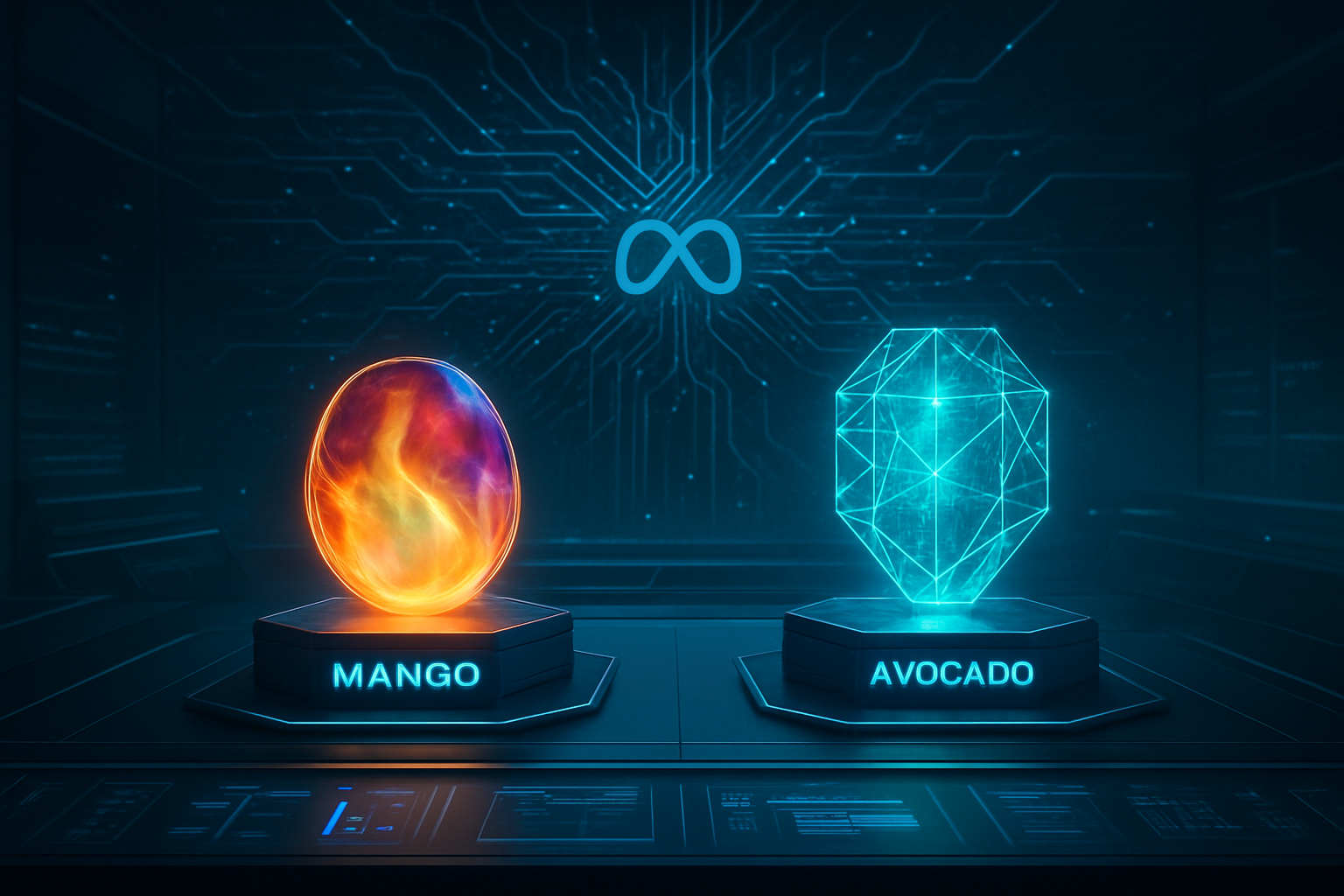
    The 2026 roadmap is anchored by two flagship models: "Mango," a high-fidelity multimodal world model designed to dominate the generative video space, and "Avocado," a reasoning-focused Large Language Model (LLM) built to close the logic and coding gap with industry leaders. As of January 2, 2026, these developments represent Mark Zuckerberg’s most expensive bet yet, following a landmark $14.3 billion investment in Scale AI and a radical internal restructuring that has sent shockwaves through the Silicon Valley talent pool.

    Technical Foundations: The Power of Mango and Avocado

    The technical specifications of Meta’s new arsenal suggest a move toward "World Models"—systems that don't just predict the next pixel or word but understand the underlying physical laws of reality. Mango, Meta’s answer to OpenAI’s Sora and the Veo series from Alphabet Inc. (NASDAQ:GOOGL), is a multimodal engine optimized for real-time video generation. Unlike previous iterations that struggled with physics and temporal consistency, Mango is built on a "social-first" architecture. It is designed to generate 5-10 second high-fidelity clips with perfect lip-syncing and environmental lighting, intended for immediate integration into Instagram Reels and WhatsApp. Early internal reports suggest Mango prioritizes generation speed, aiming to allow creators to "remix" their reality in near real-time using AR glasses and mobile devices.

    On the text and logic front, Avocado represents a generational leap in reasoning. While the Llama series focused on broad accessibility, Avocado is a proprietary powerhouse targeting advanced coding and complex problem-solving. Meta researchers claim Avocado is pushing toward a 60% score on the SWE-bench Verified benchmark, a critical metric for autonomous software engineering. This model utilizes a refined "Chain of Thought" architecture, aiming to match the cognitive depth of OpenAI’s latest "o-series" models. However, the path to Avocado has not been without hurdles; training-related performance issues pushed its initial late-2025 release into the first quarter of 2026, as MSL engineers work to stabilize its logical consistency across multi-step mathematical proofs.

    Market Disruption and the Scale AI Alliance

    The formation of Meta Superintelligence Labs (MSL) has fundamentally altered the competitive landscape of the AI industry. By appointing Alexandr Wang as Chief AI Officer, Meta has effectively "verticalized" its AI supply chain. The $14.3 billion deal for a near-majority stake in Scale AI—Meta’s largest investment since WhatsApp—has created a "data moat" that competitors are finding difficult to breach. This move prompted immediate retaliation from rivals; OpenAI and Microsoft Corporation (NASDAQ:MSFT) reportedly shifted their data-labeling contracts away from Scale AI to avoid feeding Meta’s training pipeline, while Google terminated a $200 million annual contract with the firm.

    This aggressive positioning places Meta in a direct "spending war" with the other tech giants. With a projected annual capital expenditure exceeding $70 billion for 2026, Meta is leveraging its massive distribution network of over 3 billion daily active users as its primary competitive advantage. While OpenAI remains the "gold standard" for frontier capabilities, Meta’s strategy is to bake Mango and Avocado so deeply into the world’s most popular social apps that users never feel the need to leave the Meta ecosystem for their AI needs. This "distribution-first" approach is a direct challenge to Google’s search dominance and Microsoft’s enterprise AI lead.

    Cultural Pivot: From Open Research to Proprietary Power

    Beyond the technical benchmarks, the 2026 roadmap signifies a profound cultural shift within Meta. The departure of Yann LeCun, the "Godfather of AI" and longtime Chief AI Scientist, in late 2025 marked the end of an era. LeCun’s exit, reportedly fueled by a rift over the focus on LLMs and the move away from open-source, has left the research community in mourning. For years, Meta was the primary benefactor of the open-weights movement, but the proprietary nature of Avocado suggests that the "arms race" has become too expensive for altruism. Developer adoption of Meta’s models reportedly dipped from 19% to 11% in the wake of this shift, as the open-source community migrated toward alternatives like Alibaba’s Qwen and Mistral.

    This pivot also highlights the increasing importance of "Superintelligence" as a corporate mission. By consolidating FAIR (Fundamental AI Research) and the elite TBD Lab under Wang’s MSL, Meta is signaling that general-purpose chatbots are no longer the goal. The new objective is "agentic AI"—systems that can architect software, manage complex workflows, and understand the physical world through Mango’s visual engine. This mirrors the broader industry trend where the "AI assistant" is evolving into an "AI coworker," capable of autonomous reasoning and execution.

    The Horizon: Integration and Future Challenges

    Looking ahead to the first half of 2026, the industry is closely watching the public rollout of the MSL suite. The near-term focus will be the integration of Mango into Meta’s Quest and Ray-Ban smart glasses, potentially enabling a "Live World Overlay" where AI can identify objects and generate virtual modifications to the user's environment in real-time. For Avocado, the long-term play involves an enterprise API that could rival GitHub Copilot, offering deep integration into the software development lifecycle for Meta’s corporate partners.

    However, significant challenges remain. Meta must navigate the internal friction between its legacy research teams and the high-pressure "demo, don't memo" culture introduced by Alexandr Wang. Furthermore, the massive compute requirements for these "world models" will continue to test the limits of global energy grids and GPU supply chains. Experts predict that the success of the 2026 roadmap will depend not just on the models' benchmarks, but on whether Meta can translate these high-fidelity generations into meaningful revenue through its advertising engine and the burgeoning metaverse economy.

    Summary: A Defining Moment for Meta

    Meta’s 2026 AI roadmap represents a "burn the boats" moment for Mark Zuckerberg. By centralizing power under Alexandr Wang and the MSL, the company has traded its reputation as an open-source champion for a shot at becoming the world's leading superintelligence provider. The Mango and Avocado models are the physical and logical pillars of this new strategy, designed to outpace Sora and the o-series through sheer scale and distribution.

    As we move further into 2026, the true test will be the user experience. If Mango can turn every Instagram user into a high-end cinematographer and Avocado can turn every hobbyist into a software architect, Meta may well justify its $70 billion-plus annual investment. For now, the tech world watches as the "Superintelligence Labs" prepare to launch their most ambitious projects yet, potentially redefining the relationship between human creativity and machine logic.


    This content is intended for informational purposes only and represents analysis of current AI developments.

    TokenRing AI delivers enterprise-grade solutions for multi-agent AI workflow orchestration, AI-powered development tools, and seamless remote collaboration platforms.
    For more information, visit https://www.tokenring.ai/.
  • The Great Brain Drain: Meta’s ‘Superintelligence Labs’ Reshapes the AI Power Balance

    The Great Brain Drain: Meta’s ‘Superintelligence Labs’ Reshapes the AI Power Balance

    The landscape of artificial intelligence has undergone a seismic shift as 2025 draws to a close, marked by a massive migration of elite talent from OpenAI to Meta Platforms Inc. (NASDAQ: META). What began as a trickle of departures in late 2024 has accelerated into a full-scale exodus, with Meta’s newly minted "Superintelligence Labs" (MSL) serving as the primary destination for the architects of the generative AI revolution. This talent transfer represents more than just a corporate rivalry; it is a fundamental realignment of power between the pioneer of modern LLMs and a social media titan that has successfully pivoted into an AI-first powerhouse.

    The immediate significance of this shift cannot be overstated. As of December 31, 2025, OpenAI—once the undisputed leader in AI innovation—has seen its original founding team dwindle to just two active members. Meanwhile, Meta has leveraged its nearly bottomless capital reserves and Mark Zuckerberg’s personal "recruiter-in-chief" campaign to assemble what many are calling an "AI Dream Team." This movement has effectively neutralized OpenAI’s talent moat, turning the race for Artificial General Intelligence (AGI) into a high-stakes war of attrition where compute and compensation are the ultimate weapons.

    The Architecture of Meta Superintelligence Labs

    Launched on June 30, 2025, Meta Superintelligence Labs (MSL) represents a total overhaul of the company’s AI strategy. Unlike the previous bifurcated structure of FAIR (Fundamental AI Research) and the GenAI product team, MSL merges research and product development under a single, unified mission: the pursuit of "personal superintelligence." The lab is led by a new guard of tech royalty, including Alexandr Wang—founder of Scale AI—who joined as Meta's Chief AI Officer following a landmark $14.3 billion investment in his company, and Nat Friedman, the former CEO of GitHub.

    The technical core of MSL is built upon the very people who built OpenAI’s most advanced models. In mid-2025, Meta successfully poached the "Zurich Team"—Lucas Beyer, Alexander Kolesnikov, and Xiaohua Zhai—the vision experts OpenAI had originally tapped to lead its European expansion. More critically, Meta secured the services of Shengjia Zhao, a co-creator of ChatGPT and GPT-4, and Trapit Bansal, a key researcher behind OpenAI’s "o1" reasoning models. These hires have allowed Meta to integrate advanced reasoning and "System 2" thinking into its upcoming Llama 4 and Llama 5 architectures, narrowing the gap with OpenAI’s proprietary frontier models.

    This influx of talent has led to a radical departure from Meta's previous AI philosophy. While the company remains committed to open-source "weights" for the developer community, the internal focus at MSL has shifted toward "Behemoth," a rumored 2-trillion-parameter model designed to operate as a ubiquitous, proactive agent across Meta’s ecosystem. The departure of legacy figures like Yann LeCun in November 2025, who left to pursue "world models" after his FAIR team was deprioritized, signaled the end of the academic era at Meta and the beginning of a product-driven superintelligence sprint.

    A New Competitive Frontier

    The aggressive recruitment drive has drastically altered the competitive landscape for Meta and its rivals, most notably Microsoft Corp. (NASDAQ: MSFT). For years, Microsoft relied on its exclusive partnership with OpenAI to maintain an edge in the AI race. However, as Meta "hollows out" OpenAI’s research core, the value of that partnership is being questioned. Meta’s strategy of offering "open" models like Llama has created a massive developer ecosystem that rivals the proprietary reach of Microsoft’s Azure AI.

    Market analysts suggest that Meta is the primary beneficiary of this talent shift. By late 2025, Meta’s capital expenditure reached a record $72 billion, much of it directed toward 2-gigawatt data centers and the deployment of its custom MTIA (Meta Training and Inference Accelerator) chips. With a talent pool that now includes the architects of GPT-4o’s vision and voice capabilities, such as Jiahui Yu and Hongyu Ren, Meta is positioned to dominate the multimodal AI market. This poses a direct threat not only to OpenAI but also to Alphabet Inc. (NASDAQ: GOOGL), as Meta AI begins to replace traditional search and assistant functions for its 3 billion daily users.

    The disruption extends to the startup ecosystem as well. Companies like Anthropic and Perplexity are finding it increasingly difficult to compete for talent when Meta is reportedly offering signing bonuses ranging from $1 million to $100 million. Sam Altman, CEO of OpenAI, has publicly acknowledged the "insane" compensation packages being offered in Menlo Park, which have forced OpenAI to undergo a painful internal restructuring of its equity and profit-sharing models to prevent further attrition.

    The Wider Significance of the Talent War

    The migration of OpenAI’s elite to Meta marks a pivotal moment in the history of technology, signaling the "Big Tech-ification" of AI. The era where a small, mission-driven startup could define the future of human intelligence is being superseded by a period of massive consolidation. When Mark Zuckerberg began personally emailing researchers and hosting them at his Lake Tahoe estate, he wasn't just hiring employees; he was executing a strategic "brain drain" designed to ensure that the most powerful technology in history remains under the control of established tech giants.

    This trend raises significant concerns regarding the concentration of power. As the world moves closer to superintelligence, the fact that a single corporation—controlled by a single individual via dual-class stock—holds the keys to the most advanced reasoning models is a point of intense debate. Furthermore, the shift from OpenAI’s safety-centric "non-profit-ish" roots to Meta’s hyper-competitive, product-first MSL suggests that the "safety vs. speed" debate has been decisively won by speed.

    Comparatively, this exodus is being viewed as the modern equivalent of the "PayPal Mafia" or the early departures from Fairchild Semiconductor. However, unlike those movements, which led to a flourishing of new, independent companies, the 2025 exodus is largely a consolidation of talent into an existing monopoly. The "Superintelligence Labs" represent a new kind of corporate entity: one that possesses the agility of a startup but the crushing scale of a global hegemon.

    The Road to Llama 5 and Beyond

    Looking ahead, the industry is bracing for the release of Llama 5 in early 2026, which is expected to be the first truly "open" model to achieve parity with OpenAI’s GPT-5. With Trapit Bansal and the reasoning team now at Meta, the upcoming models will likely feature unprecedented "deep research" capabilities, allowing AI agents to solve complex multi-step problems in science and engineering autonomously. Meta is also expected to lean heavily into "Personal Superintelligence," where AI models are fine-tuned on a user’s private data across WhatsApp, Instagram, and Facebook to create a digital twin.

    Despite Meta's momentum, significant challenges remain. The sheer cost of training "Behemoth"-class models is testing even Meta’s vast resources, and the company faces mounting regulatory pressure in Europe and the U.S. over the safety of its open-source releases. Experts predict that the next 12 months will see a "counter-offensive" from OpenAI and Microsoft, potentially involving a more aggressive acquisition strategy of smaller AI labs to replenish their depleted talent ranks.

    Conclusion: A Turning Point in AI History

    The mass exodus of OpenAI leadership to Meta’s Superintelligence Labs is a defining event of the mid-2020s. It marks the end of OpenAI’s period of absolute dominance and the resurgence of Meta as the primary architect of the AI future. By combining the world’s most advanced research talent with an unparalleled distribution network and massive compute infrastructure, Mark Zuckerberg has successfully repositioned Meta at the center of the AGI conversation.

    As we move into 2026, the key takeaway is that the "talent moat" has proven to be more porous than many expected. The coming months will be critical as we see whether Meta can translate its high-profile hires into a definitive technical lead. For the industry, the focus will remain on the "Superintelligence Labs" and whether this concentration of brilliance will lead to a breakthrough that benefits society at large or simply reinforces the dominance of the world’s largest social network.


    This content is intended for informational purposes only and represents analysis of current AI developments.

    TokenRing AI delivers enterprise-grade solutions for multi-agent AI workflow orchestration, AI-powered development tools, and seamless remote collaboration platforms.
    For more information, visit https://www.tokenring.ai/.