Tag: Tariffs

  • The Silicon Curtain: Trump’s 25% Semiconductor Tariff and the ‘Build-or-Pay’ Ultimatum Reshaping Global AI

    The Silicon Curtain: Trump’s 25% Semiconductor Tariff and the ‘Build-or-Pay’ Ultimatum Reshaping Global AI

    In a move that has sent shockwaves through the global technology sector and brought the U.S.-China trade war to a fever pitch, President Trump signed a sweeping Section 232 proclamation on January 14, 2026, imposing an immediate 25% tariff on advanced semiconductors. Citing a critical threat to national security due to the United States' reliance on foreign-made logic chips, the administration has framed the move as a necessary "sovereign toll" to force the reshoring of high-tech manufacturing. The proclamation marks a radical shift from targeted export controls to a broad-based fiscal barrier, effectively taxing the very hardware that powers the modern artificial intelligence revolution.

    The geopolitical tension escalated further on January 16, 2026, when Commerce Secretary Howard Lutnick issued a blunt "100% tariff ultimatum" to South Korean memory giants Samsung Electronics (KRX:005930) and SK Hynix (KRX:000660). Speaking at a groundbreaking for a new Micron Technology (NASDAQ:MU) facility, Lutnick declared that foreign memory manufacturers must transition from simple packaging to full-scale wafer fabrication on American soil or face a doubling of their costs at the U.S. border. This "Build-or-Pay" mandate has left international allies and tech conglomerates scrambling to navigate a new era of managed trade where access to the American market is contingent on multi-billion dollar domestic investments.

    Technical Scope and the 'Surgical Strike' on High-End Silicon

    The Section 232 proclamation, titled "Adjusting Imports of Semiconductors," utilizes the Trade Expansion Act of 1962 to implement a two-phase strategy aimed at reclaiming the domestic silicon supply chain. Phase One, which became effective on January 15, 2026, specifically targets high-end logic integrated circuits used in data centers and AI training clusters. The technical parameters for these tariffs are remarkably precise, focusing on chips that exceed a Total Processing Performance (TPP) of 14,000 with a DRAM bandwidth exceeding 4,500 GB/s. This technical "surgical strike" ensures that the 25% levy hits the most powerful hardware currently in production, most notably the H200 series from NVIDIA (NASDAQ:NVDA).

    Unlike previous trade measures that focused on denying China access to technology, this proclamation introduces a "revenue-sharing" model that affects even approved exports. In a paradoxical "whiplash" policy, the administration approved the export of NVIDIA's H200 chips to China on January 13, only to slap a 25% tariff on them the following day. Because these chips, often fabricated by Taiwan Semiconductor Manufacturing Company (NYSE:TSM), must transit through U.S. facilities for mandatory third-party security testing before reaching international buyers, the tariff acts as a mandatory surcharge on every high-end GPU sold globally.

    Industry experts and the AI research community have expressed immediate alarm over the potential for increased R&D costs. While the proclamation includes "carve-outs" for U.S.-based data centers with a power capacity over 100 MW and specific exemptions for domestic startups, the complexity of the Harmonized Tariff Schedule (HTS) codes—specifically 8471.50 and 8473.30—has created a compliance nightmare for hardware integrators. Researchers fear that the increased cost of "compute" will further widen the gap between well-funded tech giants and academic institutions, potentially centralizing AI innovation within a handful of elite, federally-subsidized corporations.

    Corporate Fallout and the Rise of Domestic Champions

    The corporate fallout from the Jan 14 proclamation has been immediate and severe, particularly for NVIDIA and Advanced Micro Devices (NASDAQ:AMD). NVIDIA, which relies on a complex global supply chain that bridges Taiwanese fabrication with U.S. design, now finds itself in the crossfire of a fiscal battle. The 25% tariff on the H200 effectively raises the price of the world’s most sought-after AI chip by tens of thousands of dollars per unit. While NVIDIA's market dominance provides some pricing power, the company faces the risk of a "shadow ban" in China, as Beijing has reportedly instructed domestic firms like Alibaba (NYSE:BABA) and Tencent (OTC:TCEHY) to halt purchases to avoid paying the "Trump Fee" to the U.S. Treasury.

    The big winners in this new landscape appear to be domestic champions with existing U.S. fabrication footprints. Intel (NASDAQ:INTC) has seen its stock buoyed by the prospect of becoming the primary beneficiary of the administration's "Tariffs-for-Investment" model. Under this framework, companies that commit to massive domestic expansions, such as the $500 billion "Taiwan Deal" signed by TSMC, can receive a 15% tariff cap and duty-free import quotas. This creates a tiered competitive environment where those who "build American" enjoy a significant price advantage over foreign competitors who remain tethered to overseas foundries.

    However, for startups and mid-tier AI labs, the disruption to the supply chain could be catastrophic. Existing products that rely on just-in-time delivery of specialized components are seeing lead times extend as customs officials implement the new TPP benchmarks. Market positioning is no longer just about who has the best architecture, but who has the most favorable "tariff offset" status. The strategic advantage has shifted overnight from firms with the most efficient global supply chains to those with the deepest political ties and the largest domestic construction budgets.

    The Geopolitical Schism: A New 'Silicon Curtain'

    This development represents a watershed moment in the broader AI landscape, signaling the end of the "borderless" era of technology development. For decades, the semiconductor industry operated on the principle of comparative advantage, with design in the West and manufacturing in the East. The Section 232 proclamation effectively dismantles this model, replacing it with a "Silicon Curtain" that prioritizes national security and domestic industrial policy over market efficiency. It echoes the steel and aluminum tariffs of 2018 but with far higher stakes, as semiconductors are now viewed as the "oil of the 21st century."

    The geopolitical implications for the U.S.-China trade war are profound. China has already retaliated by implementing a "customs blockade" on H200 shipments in Shenzhen and Hong Kong, signaling that it will not subsidize the U.S. economy through tariff payments. This standoff threatens to bifurcate the global AI ecosystem into two distinct technological blocs: a U.S.-led bloc powered by high-cost, domestically-manufactured silicon, and a China-led bloc forced to accelerate the development of homegrown alternatives like Huawei’s Ascend 910C. The risk of a total "decoupling" has moved from a theoretical possibility to an operational reality.

    Comparisons to previous AI milestones, such as the release of GPT-4 or the initial export bans of 2022, suggest that the 2026 tariffs may be more impactful in the long run. While software breakthroughs define what AI can do, these tariffs define who can afford to do it. The "100% ultimatum" on Samsung and SK Hynix is particularly significant, as it targets the High Bandwidth Memory (HBM) that is essential for all large-scale AI training. By threatening to double the cost of memory, the U.S. is using its market size as a weapon to force a total reconfiguration of the global high-tech map.

    Future Developments: The Race for Reshoring

    Looking ahead, the next several months will be defined by intense negotiations as the administration’s "Phase Two" looms. South Korean officials have already entered "emergency response mode" to seek a deal similar to Taiwan’s, hoping to secure a tariff cap in exchange for accelerated wafer fabrication plants in Texas and Indiana. If Samsung and SK Hynix fail to reach an agreement by mid-2026, the 100% tariff on memory chips could trigger a massive inflationary spike in the cost of all computing hardware, from enterprise servers to high-end consumer electronics.

    The industry also anticipates a wave of "tariff-dodging" innovation. Designers may begin to optimize AI models for lower-performance chips that fall just below the TPP 14,000 threshold, or explore novel architectures that rely less on high-bandwidth memory. However, the technical challenge of maintaining AI progress while operating under fiscal constraints is immense. Near-term, we expect to see an "AI construction boom" across the American Rust Belt and Silicon Prairie, as the combination of CHIPS Act subsidies and Section 232 penalties makes U.S. manufacturing the only viable long-term strategy for global chipmakers.

    Conclusion: Reimagining the Global Supply Chain

    The January 2026 Section 232 proclamation is a definitive assertion of technological sovereignty that will be remembered as a turning point in AI history. By leveraging 25% and 100% tariffs as tools of industrial policy, the Trump administration has fundamentally altered the economics of artificial intelligence. The key takeaways are clear: the era of globalized, low-cost semiconductor supply chains is over, and the future of AI hardware is now inextricably linked to domestic manufacturing capacity and geopolitical loyalty.

    The long-term impact of this "Silicon Curtain" remains to be seen. While it may succeed in reshoring critical manufacturing and securing the U.S. supply chain, it risks stifling global innovation and provoking a permanent technological schism with China. In the coming weeks, the industry will be watching for the outcome of the South Korean negotiations and the planned Trump-Xi Summit in April 2026. For now, the world of AI is in a state of suspended animation, waiting to see if the high cost of the new "sovereign toll" will be the price of security or the cause of a global tech recession.


    This content is intended for informational purposes only and represents analysis of current AI developments.

    TokenRing AI delivers enterprise-grade solutions for multi-agent AI workflow orchestration, AI-powered development tools, and seamless remote collaboration platforms.
    For more information, visit https://www.tokenring.ai/.

  • AMD Instinct MI325X vs. NVIDIA H200: The Battle for Memory Supremacy Amid 25% AI Chip Tariffs

    AMD Instinct MI325X vs. NVIDIA H200: The Battle for Memory Supremacy Amid 25% AI Chip Tariffs

    The battle for artificial intelligence supremacy has entered a volatile new chapter as Advanced Micro Devices, Inc. (NASDAQ: AMD) officially begins large-scale deployments of its Instinct MI325X accelerator, a hardware powerhouse designed to directly unseat the market-leading H200 from NVIDIA Corporation (NASDAQ: NVDA). This high-stakes corporate rivalry, centered on massive leaps in memory capacity, has been further complicated by a sweeping 25% tariff on advanced computing chips implemented by the U.S. government on January 15, 2026. The confluence of breakthrough hardware specs and aggressive trade policy marks a turning point in how AI infrastructure is built, priced, and regulated globally.

    The significance of this development cannot be overstated. As large language models (LLMs) continue to balloon in size, the "memory wall"—the limit on how much data a chip can store and access rapidly—has become the primary bottleneck for AI performance. By delivering nearly double the memory capacity of NVIDIA’s current flagship, AMD is not just competing on price; it is attempting to redefine the architecture of the modern data center. However, the new Section 232 tariffs introduce a layer of geopolitical friction that could redefine profit margins and supply chain strategies for the world’s largest tech giants.

    Technical Superiority: The 1.8x Memory Advantage

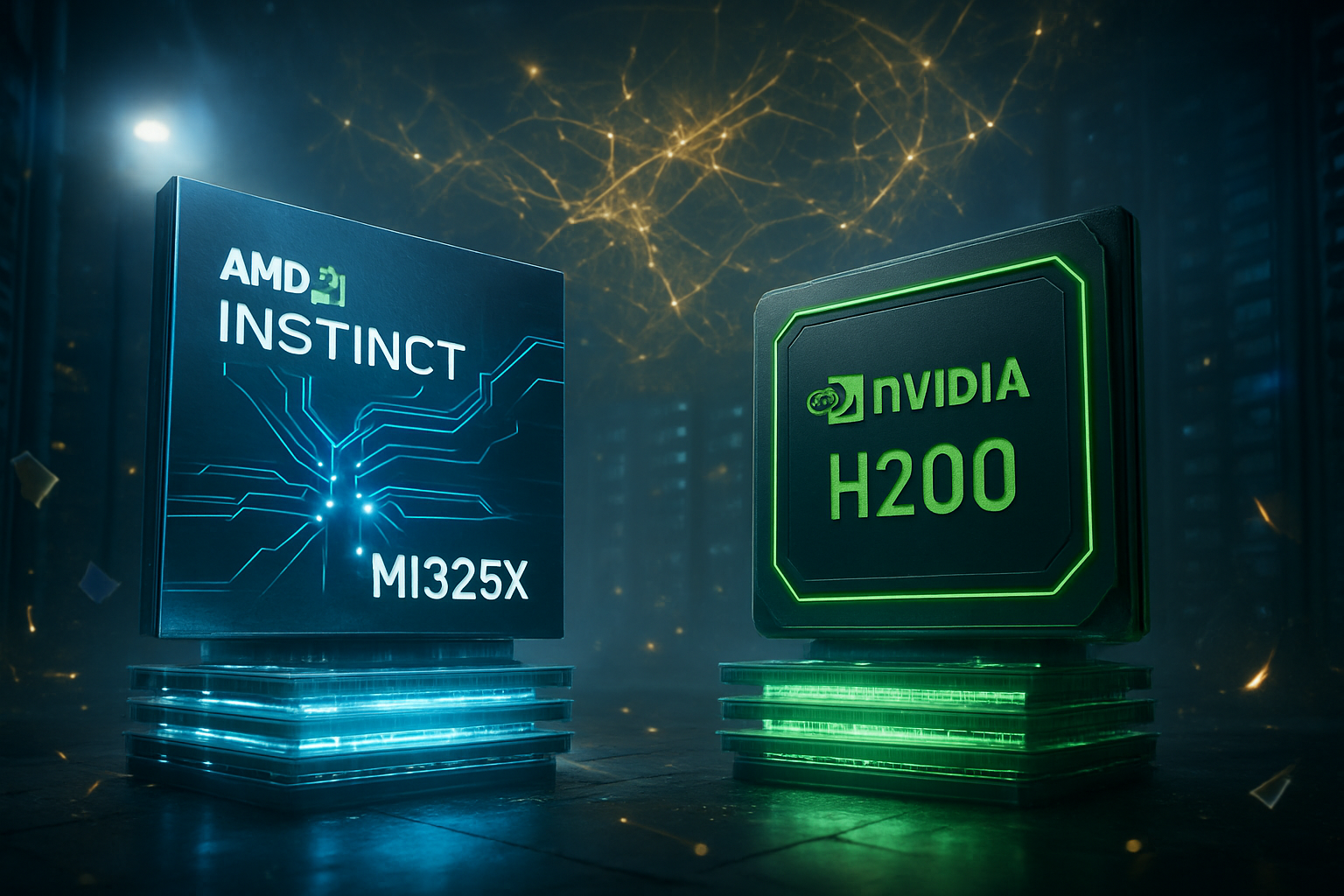
    The AMD Instinct MI325X is built on the CDNA 3 architecture and represents a strategic strike at NVIDIA's Achilles' heel: memory density. While the NVIDIA H200 remains a formidable competitor with 141GB of HBM3E memory, the MI325X boasts a staggering 256GB of usable HBM3E capacity. This 1.8x advantage in memory allows researchers to run massive models, such as Llama 3.1 405B, on fewer individual GPUs. By consolidating the model footprint, AMD reduces the need for complex, latency-heavy multi-node communication, which has historically been the standard for the highest-tier AI tasks.

    Beyond raw capacity, the MI325X offers a significant lead in memory bandwidth, clocking in at 6.0 TB/s compared to the H200’s 4.8 TB/s. This 25% increase in bandwidth is critical for the "prefill" stage of inference, where the model must process initial prompts at lightning speed. While NVIDIA’s Hopper architecture still maintains a lead in raw peak compute throughput (FP8/FP16 PFLOPS), initial benchmarks from the AI research community suggest that AMD’s larger memory buffer allows for higher real-world inference throughput, particularly in long-context window applications where memory pressure is most acute. Experts from leading labs have noted that the MI325X's ability to handle larger "KV caches" makes it an attractive alternative for developers building complex, multi-turn AI agents.

    Strategic Maneuvers in a Managed Trade Era

    The rollout of the MI325X comes at a time of unprecedented regulatory upheaval. The U.S. administration’s imposition of a 25% tariff on advanced AI chips, specifically targeting the H200 and MI325X, has sent shockwaves through the industry. While the policy includes broad exemptions for chips intended for domestic U.S. data centers and startups, it serves as a massive "export tax" for chips transiting to international markets, including recently approved shipments to China. This move effectively captures a portion of the record-breaking profits generated by AMD and NVIDIA, redirecting capital toward the government’s stated goal of incentivizing domestic fabrication and advanced packaging.

    For major hyperscalers like Microsoft Corporation (NASDAQ: MSFT), Alphabet Inc. (NASDAQ: GOOGL), and Meta Platforms, Inc. (NASDAQ: META), the tariff presents a complex logistical puzzle. These companies stand to benefit from the competitive pressure AMD is exerting on NVIDIA, potentially driving down procurement costs for domestic builds. However, for their international cloud regions, the increased costs associated with the 25% duty could accelerate the adoption of in-house silicon designs, such as Google’s TPU or Meta’s MTIA. AMD’s aggressive positioning—offering more "memory per dollar"—is a direct attempt to win over these "Tier 2" cloud providers and sovereign AI initiatives that are increasingly sensitive to both price and regulatory risk.

    The Global AI Landscape: National Security vs. Innovation

    This convergence of hardware competition and trade policy fits into a broader trend of "technological nationalism." The decision to use Section 232—a provision focused on national security—to tax AI chips indicates that the U.S. government now views high-end silicon as a strategic asset comparable to steel or aluminum. By making it more expensive to export these chips without direct domestic oversight, the administration is attempting to secure the AI supply chain against reliance on foreign manufacturing hubs, such as Taiwan Semiconductor Manufacturing Company (NYSE: TSM).

    The 25% tariff also serves as a check on the breakneck speed of global AI proliferation. While previous breakthroughs were defined by algorithmic efficiency, the current era is defined by the sheer scale of compute and memory. By targeting the MI325X and H200, the government is essentially placing a toll on the "fuel" of the AI revolution. Concerns have been raised by industry groups that these tariffs could inadvertently slow the pace of innovation for smaller firms that do not qualify for exemptions, potentially widening the gap between the "AI haves" (large, well-funded corporations) and the "AI have-nots."

    Looking Ahead: Blackwell and the Next Memory Frontier

    The next 12 to 18 months will be defined by how NVIDIA responds to AMD’s memory challenge and how both companies navigate the shifting trade winds. NVIDIA is already preparing for the full rollout of its Blackwell architecture (B200), which promises to reclaim the performance lead. However, AMD is not standing still; the roadmap for the Instinct MI350 series is already being teased, with even higher memory specifications rumored for late 2026. The primary challenge for both will be securing enough HBM3E supply from vendors like SK Hynix and Samsung to meet the voracious demand of the enterprise sector.

    Predicting the future of the AI market now requires as much expertise in geopolitics as in computer engineering. Analysts expect that if the 25% tariff succeeds in driving more manufacturing to the U.S., we may see a "bifurcated" silicon market: one tier of high-cost, domestically produced chips for sensitive government and enterprise applications, and another tier of international-standard chips subject to heavy duties. The MI325X's success will ultimately depend on whether its 1.8x memory advantage provides enough of a performance "moat" to overcome the logistical and regulatory hurdles currently being erected by global powers.

    A New Baseline for High-Performance Computing

    The arrival of the AMD Instinct MI325X and the implementation of the 25% AI chip tariff mark the end of the "wild west" era of AI hardware. AMD has successfully challenged the narrative that NVIDIA is the only viable option for high-end LLM training and inference, using memory capacity as a potent weapon to disrupt the status quo. Simultaneously, the U.S. government has signaled that the era of unfettered global trade in advanced semiconductors is over, replaced by a regime of managed trade and strategic taxation.

    The key takeaway for the industry is clear: hardware specs are no longer enough to guarantee dominance. Market leaders must now balance architectural innovation with geopolitical agility. As we look toward the coming weeks, the industry will be watching for the first large-scale performance reports from MI325X clusters and for any signs of further tariff adjustments. The memory war is just beginning, and the stakes have never been higher for the future of artificial intelligence.


    This content is intended for informational purposes only and represents analysis of current AI developments.

    TokenRing AI delivers enterprise-grade solutions for multi-agent AI workflow orchestration, AI-powered development tools, and seamless remote collaboration platforms.
    For more information, visit https://www.tokenring.ai/.
  • Trump Administration Slaps 25% Tariffs on High-End NVIDIA and AMD AI Chips to Force US Manufacturing

    Trump Administration Slaps 25% Tariffs on High-End NVIDIA and AMD AI Chips to Force US Manufacturing

    In a move that marks the most aggressive shift in global technology trade policy in decades, President Trump signed a national security proclamation yesterday, January 14, 2026, imposing a 25% tariff on the world’s most advanced artificial intelligence semiconductors. The order specifically targets NVIDIA (NASDAQ: NVDA) and AMD (NASDAQ: AMD), hitting their flagship H200 and Instinct MI325X chips. This "Silicon Surcharge" is designed to act as a financial hammer, forcing these semiconductor giants to move their highly sensitive advanced packaging and fabrication processes from Taiwan to the United States.

    The immediate significance of this order cannot be overstated. By targeting the H200 and MI325X—the literal engines of the generative AI revolution—the administration is signaling that "AI Sovereignty" now takes precedence over corporate margins. While the administration has framed the move as a necessary step to mitigate the national security risks of offshore fabrication, the tech industry is bracing for a massive recalibration of supply chains. Analysts suggest that the tariffs could add as much as $12,000 to the cost of a single high-end AI GPU, fundamentally altering the economics of data center builds and AI model training overnight.

    The Technical Battleground: H200, MI325X, and the Packaging Bottleneck

    The specific targeting of NVIDIA’s H200 and AMD’s MI325X is a calculated strike at the "gold standard" of AI hardware. The NVIDIA H200, built on the Hopper architecture, features 141GB of HBM3e memory and is the primary workhorse for large language model (LLM) inference. Its rival, the AMD Instinct MI325X, boasts an even larger 256GB of usable HBM3e memory, making it a critical asset for researchers handling massive datasets. Until now, both chips have relied almost exclusively on Taiwan Semiconductor Manufacturing Company (NYSE: TSM) for fabrication using 4nm and 5nm process nodes, and perhaps more importantly, for "CoWoS" (Chip-on-Wafer-on-Substrate) advanced packaging.

    This order differs from previous trade restrictions by moving away from the "blanket bans" of the early 2020s toward a "revenue-capture" model. By allowing the sale of these chips but taxing them at 25%, the administration is effectively creating a state-sanctioned toll road for advanced silicon. Initial reactions from the AI research community have been a mixture of shock and pragmatism. While some researchers at labs like OpenAI and Anthropic worry about the rising cost of compute, others acknowledge that the policy provides a clearer, albeit more expensive, path to acquiring hardware that was previously caught in a web of export-control uncertainty.

    Winners, Losers, and the "China Pivot"

    The implications for industry titans are profound. NVIDIA (NASDAQ: NVDA) and AMD (NASDAQ: AMD) now face a complex choice: pass the 25% tariff costs onto customers or accelerate their multi-billion dollar transitions to domestic facilities. Intel (NASDAQ: INTC) stands to benefit significantly from this shift; as the primary domestic alternative with established fabrication and growing packaging capabilities in Ohio and Arizona, Intel may see a surge in interest for its Gaudi-line of accelerators if it can close the performance gap with NVIDIA.

    For cloud giants like Amazon (NASDAQ: AMZN), Google (NASDAQ: GOOGL), and Microsoft (NASDAQ: MSFT), the tariffs represent a massive increase in capital expenditure for their international data centers. However, a crucial "Domestic Exemption" in the order ensures that chips imported specifically for use in U.S.-based data centers may be eligible for rebates, further incentivizing the concentration of AI power within American borders. Perhaps the most controversial aspect of the order is the "China Pivot"—a policy reversal that allows NVIDIA and AMD to sell H200-class chips to Chinese firms, provided the 25% tariff is paid directly to the U.S. Treasury and domestic U.S. demand is fully satisfied first.

    A New Era of Geopolitical AI Fragmentation

    This development fits into a broader trend of "technological decoupling" and the rise of a two-tier global AI market. By leveraging tariffs, the U.S. is effectively subsidizing its own domestic manufacturing through the fees collected from international sales. This marks a departure from the "CHIPS Act" era of direct subsidies, moving instead toward a more protectionist stance where access to the American AI ecosystem is the ultimate leverage. The 25% tariff essentially creates a "Trusted Tier" of hardware for the U.S. and its allies, and a "Taxed Tier" for the rest of the world.

    Comparisons are already being drawn to the 1980s semiconductor wars with Japan, but the stakes today are vastly higher. Critics argue that these tariffs could slow the global pace of AI innovation by making the necessary hardware prohibitively expensive for startups in Europe and the Global South. Furthermore, there are concerns that this move could provoke retaliatory measures from China, such as restricting the export of rare earth elements or the HBM (High Bandwidth Memory) components produced by firms like SK Hynix that are essential for these very chips.

    The Road to Reshoring: What Comes Next?

    In the near term, the industry is looking toward the completion of advanced packaging facilities on U.S. soil. Amkor Technology (NASDAQ: AMKR) and TSMC (NYSE: TSM) are both racing to finish high-end packaging plants in Arizona by late 2026. Once these facilities are operational, NVIDIA and AMD will likely be able to bypass the 25% tariff by certifying their chips as "U.S. Manufactured," a transition the administration hopes will create thousands of high-tech jobs and secure the AI supply chain against a potential conflict in the Taiwan Strait.

    Experts predict that we will see a surge in "AI hardware arbitrage," where secondary markets attempt to shuffle chips between jurisdictions to avoid the Silicon Surcharge. In response, the U.S. Department of Commerce is expected to roll out a "Silicon Passport" system—a blockchain-based tracking mechanism to ensure every H200 and MI325X chip can be traced from the fab to the server rack. The next six months will be a period of intense lobbying and strategic realignment as tech companies seek to define what exactly constitutes "U.S. Manufacturing" under the new rules.

    Summary and Final Assessment

    The Trump Administration’s 25% tariff on NVIDIA and AMD chips represents a watershed moment in the history of the digital age. By weaponizing the supply chain of the most advanced silicon on earth, the U.S. is attempting to forcefully repatriate an industry that has been offshore for decades. The key takeaways are clear: the cost of global AI compute is going up, the "China Ban" is being replaced by a "China Tax," and the pressure on semiconductor companies to build domestic capacity has reached a fever pitch.

    In the long term, this move may be remembered as the birth of true "Sovereign AI," where a nation’s power is measured not just by its algorithms, but by the physical silicon it can forge within its own borders. Watch for the upcoming quarterly earnings calls from NVIDIA and AMD in the weeks ahead; their guidance on "tariff-adjusted pricing" will provide the first real data on how the market intends to absorb this seismic policy shift.


    This content is intended for informational purposes only and represents analysis of current AI developments.

    TokenRing AI delivers enterprise-grade solutions for multi-agent AI workflow orchestration, AI-powered development tools, and seamless remote collaboration platforms.
    For more information, visit https://www.tokenring.ai/.
  • US-China Chip War Escalation: New Tariffs and the Section 301 Investigation

    US-China Chip War Escalation: New Tariffs and the Section 301 Investigation

    In a landmark decision that reshapes the global technology landscape, the Office of the United States Trade Representative (USTR) officially concluded its Section 301 investigation into China’s semiconductor industry today, December 23, 2025. The investigation, which has been the subject of intense geopolitical speculation for over a year, formally branded Beijing’s state-backed semiconductor expansion as "unreasonable" and "actionable." While the findings justify immediate and severe trade penalties, the U.S. government has opted for a strategic "trade truce," scheduling a new wave of aggressive tariffs to take effect on June 23, 2027.

    This 18-month "reprieve" period serves as a high-stakes cooling-off window, intended to allow American companies to further decouple their supply chains from Chinese foundries while providing the U.S. with significant diplomatic leverage. The announcement marks a pivotal escalation in the ongoing "Chip War," signaling that the battle for technological supremacy has moved beyond high-end AI processors into the "legacy" chips that power everything from electric vehicles to medical devices.

    The Section 301 Verdict: Legacy Dominance as a National Threat

    The USTR’s final report details a systematic effort by the Chinese government to achieve global dominance in the semiconductor sector through non-market policies. The investigation highlighted massive state subsidies, forced technology transfers, and intellectual property infringement as the primary drivers behind the rapid growth of companies like SMIC (HKG: 0981). Unlike previous trade actions that focused almost exclusively on cutting-edge 3nm or 5nm processes used in high-end AI, this new investigation focuses heavily on "foundational" or "legacy" chips—typically 28nm and above—which are increasingly produced in China.

    Technically, the U.S. is concerned about the "overconcentration" of these foundational chips in a single geography. While these chips are not as sophisticated as the latest AI silicon, they are the "workhorses" of the modern economy. The USTR findings suggest that China’s ability to flood the market with low-cost, state-subsidized legacy chips poses a structural threat to the viability of Western chipmakers who cannot compete on price alone. To counter this, the U.S. has set the current additional duty rate for these chips at 0% for the reprieve period, with a final, likely substantial, rate to be announced 30 days before the June 2027 implementation. This comes on top of the 50% tariffs that were already enacted on January 1, 2025.

    Industry Impact: NVIDIA’s Waiver and the TSMC Safe Haven

    The immediate reaction from the tech sector has been one of cautious relief mixed with long-term anxiety. NVIDIA (NASDAQ: NVDA), the current titan of the AI era, received a surprising one-year waiver as part of this announcement. In a strategic pivot, the administration will allow NVIDIA to continue shipping its H200 AI chips to the Chinese market, provided the company pays a 25% "national security fee" on each unit. This move is seen as a pragmatic attempt to maintain American dominance in the AI software layer while still collecting revenue from Chinese demand.

    Meanwhile, TSMC (NYSE: TSM) appears to have successfully insulated itself from the worst of the fallout. Through its massive $100 billion to $200 billion investment in Arizona-based fabrication plants, the Taiwanese giant has secured a likely exemption from the "universal" tariffs being considered under the parallel Section 232 national security investigation. Rumors circulating in Washington suggest that the U.S. may even facilitate a deal for TSMC to take a significant minority stake in Intel (NASDAQ: INTC), further anchoring the world’s most advanced manufacturing capabilities on American soil. Intel, for its part, continues to benefit from CHIPS Act subsidies but faces the daunting task of diversifying its revenue away from China, which still accounts for nearly 30% of its business.

    The Broader AI Landscape: Security vs. Inflation

    The 2027 tariff deadline is not just a trade policy; it is a fundamental reconfiguration of the AI infrastructure map. By targeting the legacy chips that facilitate the sensors, power management, and connectivity of AI-integrated hardware, the U.S. is attempting to ensure that the entire "AI stack"—not just the brain—is free from adversarial influence. This fits into a broader trend of "technological sovereignty" where nations are prioritizing supply chain security over the raw efficiency of globalized trade.

    However, the wider significance of these trade actions includes a looming inflationary threat. Industry analysts warn that if the 2027 tariffs are set at the 100% to 300% levels previously threatened, the cost of downstream electronics could skyrocket. S&P Global estimates that a 25% tariff on semiconductors could add over $1,100 to the cost of a single vehicle in the U.S. by 2027. This creates a difficult balancing act for the government: protecting the domestic chip industry while preventing a surge in consumer prices for products like laptops, medical equipment, and telecommunications gear.

    The Road to 2027: Rare Earths and Diplomatic Maneuvers

    Looking ahead, the 18-month reprieve is widely viewed as a "truce" following the Busan Summit in October 2025. This window provides a crucial period for negotiations regarding China’s own restrictions on rare earth metals like gallium, germanium, and antimony—materials essential for semiconductor manufacturing. Experts predict that the final tariff rates announced in 2027 will be directly tied to China's willingness to ease its export controls on these critical minerals.

    Furthermore, the Department of Commerce is expected to conclude its broader Section 232 national security investigation by mid-2026. This could lead to "universal" tariffs on all semiconductor imports, though officials have hinted that companies committing to significant U.S.-based manufacturing will receive "safe harbor" status. The near-term focus for tech giants like Apple (NASDAQ: AAPL) will be the rapid reshoring of not just final assembly, but the sourcing of the thousands of derivative components that currently rely on the Chinese ecosystem.

    A New Era of Managed Trade

    The conclusion of the Section 301 investigation marks the end of the era of "blind engagement" in the semiconductor trade. By setting a hard deadline for 2027, the U.S. has effectively put the global tech industry on a "war footing," demanding a transition to more secure, albeit more expensive, supply chains. This development is perhaps the most significant milestone in semiconductor policy since the original CHIPS Act, as it moves the focus from building domestic capacity to actively dismantling reliance on foreign adversaries.

    In the coming weeks, market watchers should look for the specific criteria the USTR will use to define "legacy" chips and any further waivers granted to U.S. firms. The long-term impact will likely be a bifurcated global tech market: one centered on a U.S.-led "trusted" supply chain and another centered on China’s state-subsidized ecosystem. As we move toward 2027, the ability of companies to navigate this geopolitical divide will be as critical to their success as the performance of the chips they design.


    This content is intended for informational purposes only and represents analysis of current AI developments.

    TokenRing AI delivers enterprise-grade solutions for multi-agent AI workflow orchestration, AI-powered development tools, and seamless remote collaboration platforms.
    For more information, visit https://www.tokenring.ai/.
  • US Chips for a New Era: Economic Nationalism and Tariffs Reshape Semiconductor Manufacturing

    US Chips for a New Era: Economic Nationalism and Tariffs Reshape Semiconductor Manufacturing

    The United States is in the midst of a profound strategic pivot, aggressively leveraging trade policies and economic nationalism to revitalize its domestic semiconductor manufacturing capabilities. This ambitious endeavor, primarily driven by concerns over national security, economic competitiveness, and the fragility of global supply chains, aims to reverse a decades-long decline in US chip production. As of November 2025, the landscape is marked by unprecedented governmental investment, a flurry of private sector commitments, and ongoing, often contentious, debates surrounding the implementation and impact of tariffs. The overarching goal is clear: to establish a resilient, self-sufficient, and technologically superior domestic semiconductor ecosystem, safeguarding America's digital future and economic sovereignty.

    The CHIPS Act and the Tariff Tightrope: A Deep Dive into Policy and Production

    The cornerstone of this nationalistic push is the CHIPS and Science Act of 2022, a landmark bipartisan legislative effort allocating a staggering $280 billion. This includes $52.7 billion in direct grants and incentives, coupled with a crucial 25% investment tax credit designed to catalyze domestic semiconductor production and research and development. The impact has been immediate and substantial; since the Act's enactment, over $450 billion in private investment has been pledged across 28 states. Giants like Intel (NASDAQ: INTC), Taiwan Semiconductor Manufacturing Company (TSMC) (NYSE: TSM), and Samsung Electronics (KRX: 005930) are among the major players set to receive billions for the construction of new fabrication plants (fabs) and the expansion of existing facilities. These incentives are strategically structured to encourage localization, not only to boost domestic capacity but also to mitigate geopolitical risks and circumvent potential future import duties.

    Beyond direct financial incentives, the CHIPS Act explicitly addresses supply chain vulnerabilities, a lesson painfully learned during the COVID-19 pandemic. It aims to reduce reliance on foreign manufacturing, particularly from Asia, by fostering US-driven capabilities across the entire value chain—from manufacturing to advanced packaging and testing. The vision includes establishing robust regional manufacturing clusters, enhancing distributed networks, and bolstering resilience against geopolitical disruptions. In a further move to secure the ecosystem, November 2025 saw the introduction of the bipartisan "Strengthening Essential Manufacturing and Industrial (SEMI) Investment Act." This proposed legislation seeks to expand the CHIPS tax credit to critical upstream materials, such as substrates, thin films, and process chemicals, acknowledging that true supply chain security extends beyond the chip itself to its foundational components, many of which currently see significant reliance on Chinese production.

    While the CHIPS Act provides a carrot, tariffs represent a more contentious stick in the US trade policy arsenal. Former President Trump had previously signaled intentions to impose tariffs of approximately 100% on imported semiconductors, with exemptions for companies manufacturing or planning to manufacture within the US. The USTR had also proposed lifting duties under Section 301 to 50% in 2025 on select semiconductor customs subheadings. However, as of November 2025, there are strong indications that the Trump administration may delay the implementation of these long-promised tariffs. Reasons for this potential delay include concerns over provoking China and risking a renewed trade war, which could jeopardize the supply of critical rare earth minerals essential for various US industries. Officials are also reportedly weighing the potential impact of such tariffs on domestic consumer prices and inflation. If fully implemented, a 10% tariff scenario, for instance, could add an estimated $6.4 billion to a $100 billion fab expansion project, potentially undermining the economic viability of reshoring efforts and leading to higher costs for consumers. Alongside tariffs, the US has also aggressively utilized export controls to restrict China's access to advanced semiconductors and associated manufacturing equipment, a measure intended to limit technology transfer but one that also carries the risk of lost revenue for US firms and impacts economies of scale.

    Corporate Fortunes in Flux: Winners, Losers, and the AI Race

    The assertive stance of US trade policies and burgeoning economic nationalism is fundamentally reshaping the fortunes of semiconductor companies, creating distinct winners and losers while profoundly influencing the competitive landscape for major AI labs and tech giants. The CHIPS and Science Act of 2022 stands as the primary catalyst, channeling billions into domestic manufacturing and R&D.

    Foremost among the beneficiaries are companies committing significant investments to establish or expand fabrication facilities within the United States. Intel (NASDAQ: INTC) is a prime example, slated to receive an unprecedented $8.5 billion in grants and potentially an additional $11 billion in government loans, alongside a 25% investment tax credit. This massive injection supports its $100 billion plan for new fabs in Arizona and Ohio, as well as upgrades in Oregon and New Mexico, solidifying its position as a key domestic chipmaker. Similarly, the world's largest contract chipmaker, Taiwan Semiconductor Manufacturing Company (TSMC) (NYSE: TSM), has committed $65 billion to new US facilities, receiving $6.6 billion in grants, with its first Arizona plant expected to commence production in the first half of 2025. South Korean titan Samsung (KRX: 005930) is also building a 4nm EUV facility in Taylor, Texas, backed by $6.4 billion in grants. Micron Technology (NASDAQ: MU), the sole US-based memory chip manufacturer, is set to receive $6.1 billion for its $50 billion investment in new factories in New York. These companies benefit not only from direct financial incentives but also from enhanced supply chain resilience and access to a growing domestic talent pool, fostered by initiatives like Purdue University's semiconductor degrees program.

    Conversely, US semiconductor equipment and design firms heavily reliant on the Chinese market face significant headwinds. Export controls, particularly those restricting the sale of advanced AI chips and manufacturing equipment to China, directly curtail market access and revenue. Companies like Nvidia (NASDAQ: NVDA) and Advanced Micro Devices (AMD) (NASDAQ: AMD) have encountered reduced access to the lucrative Chinese market, compelling them to develop modified AI chips for the region, often through complex revenue-sharing agreements. An economic model suggests a full decoupling from the Chinese market could lead to a $77 billion loss in sales for US firms in the initial year and a reduction of over 80,000 industry jobs. Chinese semiconductor companies themselves are the primary targets of these controls, facing immense pressure to innovate domestically and reduce reliance on foreign technology, a situation that has galvanized Beijing's industrial policy to achieve semiconductor independence. Furthermore, any widespread imposition of the proposed tariffs on semiconductor imports (which could range from 25% to 300% under certain scenarios) would significantly escalate costs for virtually every company relying on imported chips, impacting hardware startups, consumer electronics manufacturers, and the automotive sector.

    The implications for major AI labs and tech companies are equally profound. The CHIPS Act's push for increased domestic supply of leading-edge chips is critical for advancing AI research and development. US-based AI labs and tech giants such as Google (NASDAQ: GOOGL), Microsoft (NASDAQ: MSFT), Meta Platforms (NASDAQ: META), and OpenAI could benefit from more secure and potentially faster access to domestically produced advanced semiconductors, essential for their data centers and AI infrastructure. However, the specter of significant tariffs on semiconductor imports could substantially raise the cost of AI model training and data center expansion, potentially slowing AI innovation and increasing operational expenses for cloud service providers, costs that would likely be passed on to startups and end-users. This geopolitical bifurcation in AI hardware development, driven by export controls, is forcing a divergence, with US companies designing specific chips for China while Chinese AI labs are incentivized to innovate domestically or seek non-US alternatives. This could lead to fragmented AI hardware ecosystems, impacting global collaboration and potentially hindering overall AI progress due to fragmented R&D efforts. The combined effect of these policies is a complex recalibration of market positioning, with the US striving to re-establish itself as a manufacturing hub for advanced nodes, while the broader industry navigates a path toward diversification, regionalization, and, for China, aggressive self-sufficiency.

    A New Global Order: AI, National Security, and the Fragmented Tech Landscape

    The aggressive US trade policies and burgeoning economic nationalism in the semiconductor sector transcend mere industrial protectionism; they are fundamentally reshaping the global artificial intelligence (AI) landscape, ushering in an era where technological supremacy is inextricably linked to national security and economic power. As of November 2025, this strategic pivot is driving a complex interplay of technological advancement, intense geopolitical competition, and a reorientation of global supply chains.

    The foundation of this shift lies in stringent export controls, progressively tightened since 2018, primarily targeting China's access to advanced semiconductors and manufacturing equipment. These measures, which have seen significant refinements through October 2023, December 2024, and January 2025, aim to impede China's indigenous chip industry and preserve US leadership in the high-performance computing essential for cutting-edge AI. Specific targets include high-end AI chips like Nvidia's (NASDAQ: NVDA) A100 and H100, and critical extreme ultraviolet (EUV) lithography machines. Complementing these controls, the CHIPS and Science Act of 2022 represents a massive industrial policy initiative, dedicating over $70 billion directly to semiconductor manufacturing incentives and R&D, alongside an additional $200 billion for AI, quantum computing, and robotics research. A crucial "guardrails" provision within the CHIPS Act prohibits funding recipients from materially expanding advanced semiconductor manufacturing in "countries of concern" for ten years, explicitly linking economic incentives to national security objectives. While there were indications in May 2025 of a potential shift towards a more "due diligence"-focused system for AI development in allied nations, the overarching trend points to a hardening "techno-nationalism," where advanced technologies are viewed as strategic assets, and domestic capabilities are prioritized to reduce dependencies and project power.

    The impacts on the AI landscape are profound. The US currently holds a commanding lead in total AI compute capacity, possessing roughly ten times more advanced AI chips for research, training, and deployment than China, a direct consequence of these export controls. The insatiable demand for AI is projected to drive nearly half of the semiconductor industry's capital expenditure by 2030, fueling sustained growth in AI-driven cloud infrastructure. Moreover, AI itself is becoming a critical enabler for semiconductor innovation, with AI-driven Electronic Design Automation (EDA) tools accelerating chip design, improving energy efficiency, and pushing beyond traditional Moore's Law limits. In response, China has intensified its pursuit of technological self-sufficiency, pouring hundreds of billions into domestic chip production and focusing on indigenous innovation. Chinese companies are developing competitive AI chips, such as Huawei's Ascend series, and advanced large language models, often by prioritizing efficiency and utilizing workarounds. As of November 2025, China is further solidifying its localization efforts by mandating the use of domestically produced AI chips in state-funded data center projects.

    However, this strategic realignment comes with significant concerns. The extreme geographic concentration of advanced chip manufacturing, particularly with TSMC (NYSE: TSM) in Taiwan and Samsung (KRX: 005930) in South Korea dominating, presents inherent vulnerabilities to geopolitical disruptions or natural disasters. The rise of "chip nationalism" introduces further friction, potentially increasing production costs and slowing the diffusion of innovation across the global industry. The US-China semiconductor rivalry has escalated into a high-stakes "chip war," fundamentally restructuring global supply chains and exacerbating geopolitical tensions, with China retaliating with its own export controls on critical rare earth minerals. This unilateral approach risks fragmenting the global AI ecosystem, potentially making it harder for the US to maintain overall technological leadership if other nations develop independent and possibly divergent tech stacks. A concerning unintended consequence is that countries unable to access advanced US chips might be compelled to rely on less capable Chinese alternatives, potentially increasing global dependence on Beijing's technology and hindering overall AI development.

    Comparing this era to previous AI milestones reveals a distinct shift. Unlike earlier periods where software algorithms often outpaced hardware (e.g., early expert systems or even the initial deep learning revolution relying on general-purpose GPUs), the current wave of AI breakthroughs is actively driven by hardware innovation. Purpose-built AI accelerators and the integration of AI into the chip design process itself are defining this era, with AI chip development reportedly outpacing traditional Moore's Law. Crucially, the strategic importance of semiconductors and AI is now viewed through a critical national security and economic resilience lens, akin to how essential resources like steel, oil, or aerospace capabilities were perceived in previous eras. This represents a fundamental shift from primarily economic protectionism to policies directly tied to technological sovereignty in high-tech sectors. The current landscape is a "geopolitical chessboard," with nations actively leveraging economic tools like export controls and subsidies to gain strategic advantage, a level of direct state intervention and explicit linkage of advanced technology to military and national security objectives not as prominent in earlier AI booms.

    The Road Ahead: Navigating Tariffs, Talent, and the AI Revolution

    The trajectory of US semiconductor policy and its profound impact on artificial intelligence in the coming years is poised for continuous evolution, shaped by a delicate interplay of economic nationalism, strategic trade policies, and an unyielding drive for technological supremacy. As of November 2025, the near-term landscape is characterized by cautious policy adjustments and significant investment, while the long-term vision aims for robust domestic capabilities and strategic independence.

    In the near term (the next 1-3 years), US trade policies for semiconductors and AI will navigate a complex path. While the Trump administration had previously signaled a 100% tariff on imported semiconductors, reports in November 2025 suggest a potential delay in their implementation. This postponement is reportedly influenced by concerns over rising consumer prices and a desire to avoid escalating trade tensions with China, which could disrupt crucial rare earth mineral supplies. However, the threat of triple-digit tariffs remains, particularly for imports from companies not actively manufacturing or committed to manufacturing domestically. A notable policy shift in 2025 was the rescission of the Biden administration's "Export Control Framework for Artificial Intelligence (AI) Diffusion," replaced by a more flexible "deal-by-deal" strategy under the Trump administration. This approach, exemplified by recent approvals for advanced AI chip exports to allies like Saudi Arabia and the UAE (including significant quantities of Nvidia's (NASDAQ: NVDA) Blackwell chips), seeks to balance Washington's leverage with preserving commercial opportunities for US firms, though some lawmakers express unease about the potential spread of advanced chips.

    Looking further ahead (3-10+ years), US policy is expected to cement its economic nationalism through sustained investment in domestic capabilities and strategic decoupling from rivals in critical technology sectors. The CHIPS and Science Act remains the cornerstone, aiming to revitalize American semiconductor manufacturing and fortify supply chain resilience. The bipartisan "Strengthening Essential Manufacturing and Industrial (SEMI) Investment Act," introduced in November 2025, further reinforces this by expanding the CHIPS Act tax credit to include upstream materials crucial for semiconductor production, such as substrates and lithography materials. This aims to secure every link of the semiconductor ecosystem and reduce dependence on countries like China, with the ultimate long-term goal of achieving technological sovereignty and solidifying the US's position as a leader in AI and advanced technologies.

    The CHIPS Act has already catalyzed substantial progress in domestic semiconductor manufacturing, with over $200 billion committed and 90 new semiconductor projects announced across the US since 2022. By early 2025, 18 new fabrication facilities (fabs) were under construction, reversing a long-running decline in domestic wafer output. Companies like Intel (NASDAQ: INTC), TSMC (NYSE: TSM), Samsung (KRX: 005930), and Micron (NASDAQ: MU) are spearheading these efforts, with TSMC and Nvidia specifically collaborating on producing Blackwell wafers and expanding advanced packaging capabilities on US soil. Despite this momentum, significant challenges persist, including a persistent talent gap requiring a million new skilled workers by 2030, the increasing costs of building and operating advanced fabs, and continued supply chain vulnerabilities. Potential US government shutdowns, as experienced in 2025, also pose a risk by delaying grant processing and R&D partnerships.

    The looming threat of new tariffs on semiconductors, if fully implemented, could significantly impact the AI sector. Experts predict such tariffs could increase semiconductor costs by 5-25%, potentially raising the cost of end goods by as much as $3 for every $1 increase in chip prices. This would translate to higher prices for consumer electronics, automotive systems, and enterprise-grade hardware, including the critical infrastructure needed to power AI applications. TechNet, a bipartisan network of technology CEOs, has formally warned that semiconductor tariffs would undermine American innovation, jeopardize global competitiveness in AI, and stall progress in building a resilient domestic semiconductor supply chain, making it harder for companies to build the data centers and processing capacity essential for next-generation AI.

    Looking ahead, the demand for AI-driven chips is expected to see double-digit growth through 2030, fueling advancements across diverse sectors. Key applications include data centers and high-performance computing (HPC), where AI is driving significant capital expenditure for advanced GPUs, high-bandwidth memory (HBM), and optical interconnects. AI capabilities are also expanding to edge computing and endpoint devices, enabling more localized and responsive applications. The automotive sector, particularly Electric Vehicles (EVs) and autonomous driving systems, will see a tripling of semiconductor demand by 2030. Defense, healthcare, and industrial automation will also benefit from AI-enabled chips, and AI itself is transforming chip design and manufacturing processes, improving quality and increasing yields.

    However, challenges abound. Geopolitical tensions, particularly the US-China "chip war," remain a central concern, impacting global trade and supply chains. The persistent shortage of skilled talent, despite significant investment, continues to challenge the industry's growth. Maintaining a technological lead requires sustained and coordinated R&D investment, while regulatory hurdles and fragmentation, especially in AI, create compliance challenges. Experts predict the global semiconductor market will continue its rebound, with sales projected to reach $728 billion in 2025 and approximately $800 billion in 2026, putting the industry on track towards a $1 trillion milestone before the decade's end. AI is expected to drive nearly half of the semiconductor industry's capital expenditure by 2030, with the market for AI accelerator chips alone potentially reaching $500 billion by 2028. The US is reinforcing its role as a gatekeeper in the global semiconductor supply chain, balancing national security objectives with the commercial viability of its domestic industry, emphasizing resilient operations and public-private partnerships.

    Conclusion: A New Era of Techno-Nationalism

    The United States is currently navigating a complex and transformative period in semiconductor trade policy and economic nationalism, significantly impacting domestic manufacturing and the global AI landscape as of November 2025. This era is defined by a bipartisan commitment to re-establish U.S. leadership in critical technology, reduce reliance on foreign supply chains, and secure a competitive edge in artificial intelligence.

    Key Takeaways:

    • Aggressive Reshoring, Complex Implementation: The CHIPS Act is driving substantial domestic and foreign investment in U.S. semiconductor manufacturing. However, it grapples with challenges such as workforce development, project delays (e.g., Micron's New York plant now projected for 2030), and the potential for increased costs from tariffs.
    • Tariff Volatility and Strategic Nuance: While the Trump administration has signaled strong intentions for semiconductor tariffs, there is ongoing internal debate and a cautious approach due to geopolitical sensitivities and domestic economic concerns. The actual implementation of steep tariffs on semiconductors themselves is currently in flux, though tariffs on products containing semiconductors are in effect.
    • AI as the Driving Force: The insatiable demand for AI chips is the primary engine of growth and strategic competition in the semiconductor industry. Policies are increasingly tailored to ensure U.S. leadership in AI infrastructure, with proposals from entities like OpenAI to expand the CHIPS Act to include AI servers as critical infrastructure.
    • Geopolitical Balancing Act: The U.S. is employing a dual strategy: imposing restrictions on China while also engaging in selective trade deals and loosening some export controls in exchange for concessions (e.g., rare earth minerals). Concurrently, it is forging new tech alliances, particularly in the Middle East, to counter Chinese influence, exemplified by significant U.S. semiconductor exports of advanced AI chips to Saudi Arabia and the UAE.

    Final Thoughts on Long-Term Impact:

    The long-term impact of these policies points towards a more fragmented and regionalized global semiconductor supply chain. Experts predict an era of "techno-nationalism" and a potential bifurcation into two distinct technological ecosystems – one dominated by the U.S. and its allies, and another by China – possibly by 2035. This will compel companies and countries to align, increasing trade complexity. While the CHIPS Act aims for U.S. self-sufficiency and resilience, the introduction of tariffs could ironically undermine these goals by increasing the cost of building and operating fabs in the U.S., which is already more expensive than in Asia. The U.S. government's ability to balance national security objectives with the commercial viability of its domestic industry will be critical. The "policy, not just innovation," approach in 2025 is fundamentally reshaping global competitiveness, with flexible sourcing and strong global partnerships becoming paramount for industry players.

    What to Watch For in the Coming Weeks and Months:

    • Tariff Implementation Details: Keep a close watch on any official announcements regarding the 100% semiconductor tariffs and the proposed "1:1 domestic-to-import ratio" for chipmakers. The White House's final decision on these policies will have significant ripple effects.
    • U.S.-China Trade Dynamics: The fragile trade truce and the specifics of the recent agreements (e.g., permanent lifting of rare earth export bans versus temporary suspensions, actual impact of loosened U.S. chip export controls) will be crucial. Any renewed tit-for-tat actions could disrupt global supply chains.
    • CHIPS Act Rollout and Funding: Monitor the progress of CHIPS Act-funded projects, especially as some, like Micron's, face delays. The speed of grant distribution, effectiveness of workforce development initiatives, and any further revisions to the Act will be important indicators of its success.
    • AI Investment and Adoption Trends: Continued aggressive investment in AI infrastructure and the market's ability to sustain demand for advanced AI chips will determine the trajectory of the semiconductor industry. Any slowdown in AI investment is considered a significant risk.
    • Geopolitical Alliances and Export Controls: Observe how U.S. partnerships, particularly with countries like Saudi Arabia and the UAE, evolve in terms of AI chip exports and technological cooperation. Also, pay attention to China's progress in achieving domestic chip self-sufficiency and any potential retaliatory measures it might take in response to U.S. policies.

    This content is intended for informational purposes only and represents analysis of current AI developments.

    TokenRing AI delivers enterprise-grade solutions for multi-agent AI workflow orchestration, AI-powered development tools, and seamless remote collaboration platforms.
    For more information, visit https://www.tokenring.ai/.