Tag: Tech News 2026

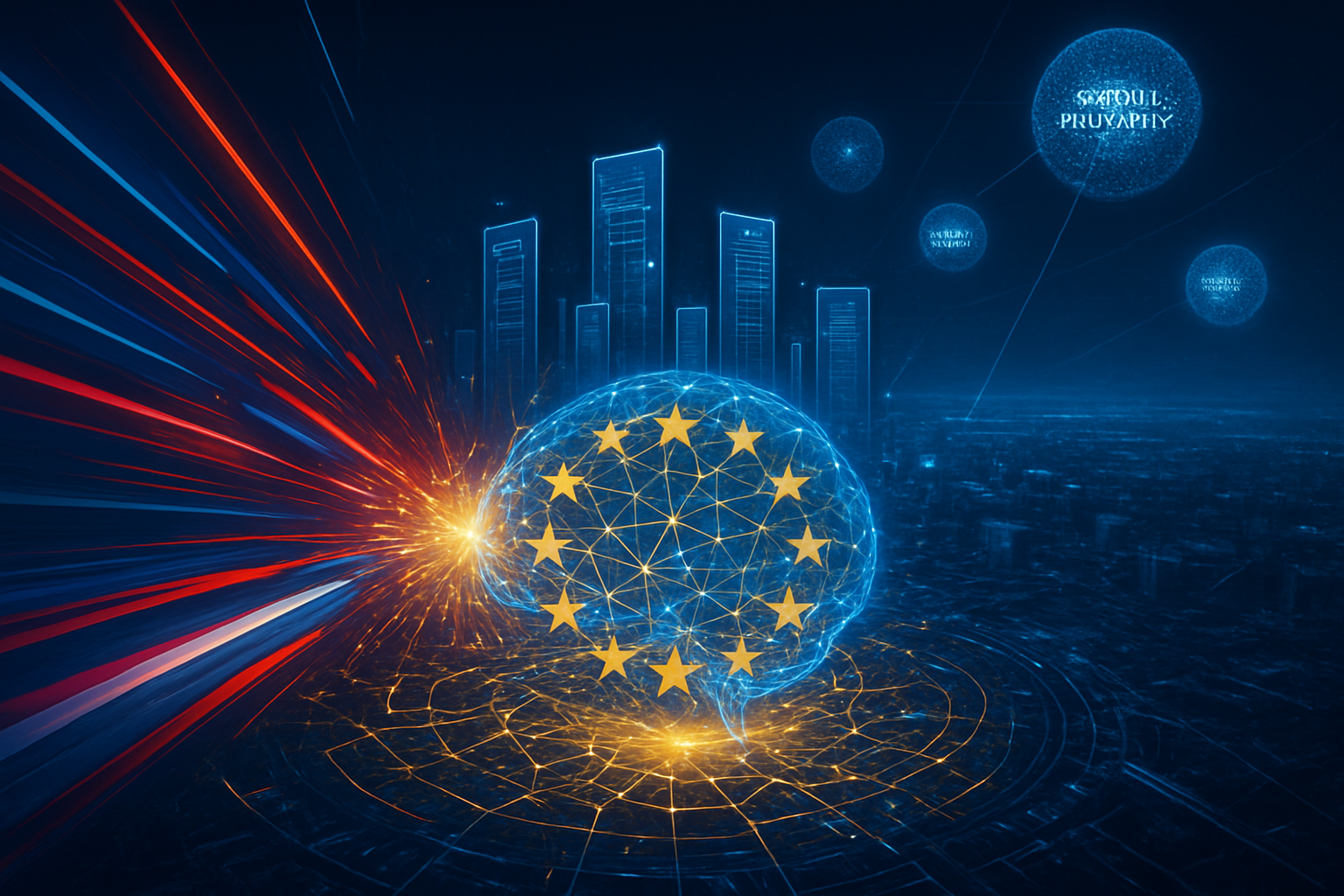
  • Brussels Tightens the Noose: EU AI Act Enforcement Hits Fever Pitch Amid Transatlantic Trade War Fears

    Brussels Tightens the Noose: EU AI Act Enforcement Hits Fever Pitch Amid Transatlantic Trade War Fears

    As of January 8, 2026, the European Union has officially entered a high-stakes "readiness window," signaling the end of the grace period for the world’s most comprehensive artificial intelligence regulation. The EU AI Act, which entered into force in 2024, is now seeing its most stringent enforcement mechanisms roar to life. With the European AI Office transitioning from an administrative body to a formidable "super-regulator," the global tech industry is bracing for a February 2 deadline that will finalize the guidelines for "high-risk" AI systems, effectively drawing a line in the sand for developers operating within the Single Market.

    The significance of this moment cannot be overstated. For the first time, General-Purpose AI (GPAI) providers—including the architects of the world’s most advanced Large Language Models (LLMs)—are facing mandatory transparency requirements and systemic risk assessments that carry the threat of astronomical fines. This intensification of enforcement has not only rattled Silicon Valley but has also ignited a geopolitical firestorm. A "transatlantic tech collision" is now in full swing, as the United States administration moves to shield its domestic champions from what it characterizes as "regulatory overreach" and "foreign censorship."

    Technical Mandates and the $10^{25}$ FLOP Threshold

    At the heart of the early 2026 enforcement surge are the specific obligations for GPAI models. Under the direction of the EU AI Office, any model trained with a total computing power exceeding $10^{25}$ floating-point operations (FLOPs) is now classified as possessing "systemic risk." This technical benchmark captures the latest iterations of flagship models from providers like OpenAI, Alphabet Inc. (NASDAQ: GOOGL), and Meta Platforms, Inc. (NASDAQ: META). These "systemic" providers are now legally required to perform adversarial testing, conduct continuous incident reporting, and ensure robust cybersecurity protections that meet the AI Office’s newly finalized standards.

    Beyond the compute threshold, the AI Office is finalizing the "Code of Practice on Transparency" under Article 50. This mandate requires all AI-generated content—from deepfake videos to synthetic text—to be clearly labeled with interoperable watermarks and metadata. Unlike previous voluntary efforts, such as the 2024 "AI Pact," these standards are now being codified into technical requirements that must be met by August 2, 2026. Experts in the AI research community note that this differs fundamentally from the US approach, which relies on voluntary commitments. The EU’s approach forces a "safety-by-design" architecture, requiring developers to integrate tracking and disclosure mechanisms into the very core of their model weights.

    Initial reactions from industry experts have been polarized. While safety advocates hail the move as a necessary step to prevent the "hallucination of reality" in the digital age, technical leads at major labs argue that the $10^{25}$ FLOP threshold is an arbitrary metric that fails to account for algorithmic efficiency. There are growing concerns that the transparency mandates could inadvertently expose proprietary model architectures to state-sponsored actors, creating a tension between regulatory compliance and corporate security.

    Corporate Fallout and the Retaliatory Shadow

    The intensification of the AI Act is creating a bifurcated landscape for tech giants and startups alike. Major US players like Microsoft (NASDAQ: MSFT) and NVIDIA Corporation (NASDAQ: NVDA) are finding themselves in a complex dance: while they must comply to maintain access to the European market, they are also caught in the crosshairs of a trade war. The US administration has recently threatened to invoke Section 301 of the Trade Act to impose retaliatory tariffs on European stalwarts such as SAP SE (NYSE: SAP), Siemens AG (OTC: SIEGY), and Spotify Technology S.A. (NYSE: SPOT). This "tit-for-tat" strategy aims to pressure the EU into softening its enforcement against American AI firms.

    For European AI startups like Mistral, the situation is a double-edged sword. While the AI Act provides a clear legal framework that could foster consumer trust, the heavy compliance burden—estimated to cost millions for high-risk systems—threatens to stifle the very innovation the EU seeks to promote. Market analysts suggest that the "Brussels Effect" is hitting a wall; instead of the world adopting EU standards, US-based firms are increasingly considering "geo-fencing" their most advanced features, leaving European users with "lite" versions of AI tools to avoid the risk of fines that can reach 7% of total global turnover.

    The competitive implications are shifting rapidly. Companies that have invested early in "compliance-as-a-service" or modular AI architectures are gaining a strategic advantage. Conversely, firms heavily reliant on uncurated datasets or "black box" models are facing a strategic crisis as the EU AI Office begins its first round of documentation audits. The threat of being shut out of the world’s largest integrated market is forcing a massive reallocation of R&D budgets toward safety and "explainability" rather than pure performance.

    The "Grok" Scandal and the Global Precedent

    The wider significance of this enforcement surge was catalyzed by the "Grok Deepfake Scandal" in late 2025, where xAI’s model was used to generate hyper-realistic, politically destabilizing content across Europe. This incident served as the "smoking gun" for EU regulators, who used the AI Act’s emergency provisions to launch investigations. This move has framed the AI Act not just as a consumer protection law, but as a tool for national security and democratic integrity. It marks a departure from previous tech milestones like the GDPR, as the AI Act targets the generative core of the technology rather than just the data it consumes.

    However, this "rights-first" philosophy is clashing head-on with the US "innovation-first" doctrine. The US administration’s late-2025 Executive Order, "Ensuring a National Policy Framework for AI," explicitly attempted to preempt state-level regulations that mirrored the EU’s approach. This has created a "regulatory moat" between the two continents. While the EU seeks to set a global benchmark for "Trustworthy AI," the US is pivoting toward "Economic Sovereignty," viewing EU regulations as a veiled form of protectionism designed to handicap American technological dominance.

    The potential concerns are significant. If the EU and US cannot find a middle ground through the Trade and Technology Council (TTC), the world risks a "splinternet" for AI. In this scenario, different regions operate under incompatible safety standards, making it nearly impossible for developers to deploy global products. This divergence could slow down the deployment of life-saving AI in healthcare and climate science, as researchers navigate a minefield of conflicting legal obligations.

    The Horizon: Visa Bans and Algorithmic Audits

    Looking ahead to the remainder of 2026, the industry expects a series of "stress tests" for the AI Act. The first major hurdle will be the August 2 deadline for full application, which will see the activation of the market surveillance framework. Predictably, the EU AI Office will likely target a high-profile "legacy" model for an audit to demonstrate its teeth. Experts predict that the next frontier of conflict will be "algorithmic sovereignty," as the EU demands access to the training logs and data sources of proprietary models to verify copyright compliance.

    In the near term, the "transatlantic tech collision" is expected to escalate. The US has already taken the unprecedented step of imposing travel bans on several former EU officials involved in the Act’s drafting, accusing them of enabling "foreign censorship." As we move further into 2026, the focus will likely shift to the "Scientific Panel of Independent Experts," which will be tasked with determining if the next generation of multi-modal models—expected to dwarf current compute levels—should be classified as "systemic risks" from day one.

    The challenge remains one of balance. Can the EU enforce its values without triggering a full-scale trade war that isolates its own tech sector? Predictions from policy analysts suggest that a "Grand Bargain" may eventually be necessary, where the US adopts some transparency standards in exchange for the EU relaxing its "high-risk" classifications for certain enterprise applications. Until then, the tech world remains in a state of high alert.

    Summary of the 2026 AI Landscape

    As of early 2026, the EU AI Act has moved from a theoretical framework to an active enforcement regime that is reshaping the global tech industry. The primary takeaways are clear: the EU AI Office is now a "super-regulator" with the power to audit the world's most advanced models, and the $10^{25}$ FLOP threshold has become the defining line for systemic oversight. The transition has been anything but smooth, sparking a geopolitical standoff with the United States that threatens to disrupt decades of transatlantic digital cooperation.

    This development is a watershed moment in AI history, marking the end of the "move fast and break things" era for generative AI in Europe. The long-term impact will likely be a more disciplined, safety-oriented AI industry, but at the potential cost of a fragmented global market. In the coming weeks and months, all eyes will be on the February 2 deadline for high-risk guidelines and the potential for retaliatory tariffs from Washington. The "Brussels Effect" is facing its ultimate test: can it bend the will of Silicon Valley, or will it break the transatlantic digital bridge?


    This content is intended for informational purposes only and represents analysis of current AI developments.

    TokenRing AI delivers enterprise-grade solutions for multi-agent AI workflow orchestration, AI-powered development tools, and seamless remote collaboration platforms.
    For more information, visit https://www.tokenring.ai/.

  • Anthropic Signals End of AI “Wild West” with Landmark 2026 IPO Preparations

    Anthropic Signals End of AI “Wild West” with Landmark 2026 IPO Preparations

    In a move that signals the transition of the generative AI era from speculative gold rush to institutional mainstay, Anthropic has reportedly begun formal preparations for an Initial Public Offering (IPO) slated for late 2026. Sources familiar with the matter indicate that the San Francisco-based AI safety leader has retained the prestigious Silicon Valley law firm Wilson Sonsini Goodrich & Rosati to spearhead the complex regulatory and corporate restructuring required for a public listing. The move comes as Anthropic’s valuation is whispered to have touched $350 billion following a massive $10 billion funding round in early January, positioning it as a potential cornerstone of the future S&P 500.

    The decision to go public marks a pivotal moment for Anthropic, which was founded by former OpenAI executives with a mission to build "steerable" and "safe" artificial intelligence. By moving toward the public markets, Anthropic is not just seeking a massive infusion of capital to fund its multi-billion-dollar compute requirements; it is attempting to establish itself as the "blue-chip" standard for the AI industry. For an ecosystem that has been defined by rapid-fire research breakthroughs and massive private cash burns, Anthropic’s IPO preparations represent the first clear path toward financial maturity and public accountability for a foundation model laboratory.

    Technical Prowess and the Road to Claude 4.5

    The momentum for this IPO has been built on a series of technical breakthroughs throughout 2025 that transformed Anthropic from a research-heavy lab into a dominant enterprise utility. The late-2025 release of the Claude 4.5 model family—comprising Opus, Sonnet, and Haiku—introduced "extended thinking" capabilities that fundamentally changed how AI processes complex tasks. Unlike previous iterations that relied on immediate token prediction, Claude 4.5 utilizes an iterative reasoning loop, allowing the model to "pause" and use tools such as web search, local code execution, and file system manipulation to verify its own logic before delivering a final answer. This "system 2" thinking has made Claude 4.5 the preferred engine for high-stakes environments in law, engineering, and scientific research.

    Furthermore, Anthropic’s introduction of the Model Context Protocol (MCP) in mid-2025 has created a standardized "plug-and-play" ecosystem for AI agents. By open-sourcing the protocol, Anthropic effectively locked in thousands of enterprise integrations, allowing Claude to act as a central "brain" that can seamlessly interact with diverse data sources and software tools. This technical infrastructure has yielded staggering financial results: the company’s annualized revenue run rate surged from $1 billion in early 2025 to over $9 billion by December, with projections for 2026 reaching as high as $26 billion. Industry experts note that while competitors have focused on raw scale, Anthropic’s focus on "agentic reliability" and tool-use precision has given it a distinct advantage in the enterprise market.

    Shifting the Competitive Landscape for Tech Giants

    Anthropic’s march toward the public markets creates a complex set of implications for its primary backers and rivals alike. Major investors such as Amazon (NASDAQ: AMZN) and Alphabet (NASDAQ: GOOGL) find themselves in a unique position; while they have poured billions into Anthropic to secure cloud computing contracts and AI integration for their respective platforms, a successful IPO would provide a massive liquidity event and validate their early strategic bets. However, it also means Anthropic will eventually operate with a level of independence that could see it competing more directly with the internal AI efforts of its own benefactors.

    The competitive pressure is most acute for OpenAI and Microsoft (NASDAQ: MSFT). While OpenAI remains the most recognizable name in AI, its complex non-profit/for-profit hybrid structure has long been viewed as a hurdle for a traditional IPO. By hiring Wilson Sonsini—the firm that navigated the public debuts of Alphabet and LinkedIn—Anthropic is effectively attempting to "leapfrog" OpenAI to the public markets. If successful, Anthropic will establish the first public "valuation benchmark" for a pure-play foundation model company, potentially forcing OpenAI to accelerate its own corporate restructuring. Meanwhile, the move signals to the broader startup ecosystem that the window for "mega-scale" private funding may be closing, as the capital requirements for training next-generation models—estimated to exceed $50 billion for Anthropic’s next data center project—now necessitate the depth of public equity markets.

    A New Era of Maturity for the AI Ecosystem

    Anthropic’s IPO preparations represent a significant evolution in the broader AI landscape, moving the conversation from "what is possible" to "what is sustainable." As a Public Benefit Corporation (PBC) governed by a Long-Term Benefit Trust, Anthropic is entering the public market with a unique governance model designed to balance profit with AI safety. This "Safety-First" premium is increasingly viewed by institutional investors as a risk-mitigation strategy rather than a hindrance. In an era of increasing regulatory scrutiny from the SEC and global AI safety bodies, Anthropic’s transparent governance structure provides a more digestible narrative for public investors than the more opaque "move fast and break things" culture of its peers.

    This move also highlights a growing divide in the AI startup ecosystem. While a handful of "sovereign" labs like Anthropic, OpenAI, and xAI are scaling toward trillion-dollar ambitions, smaller startups are increasingly pivoting toward the application layer or vertical specialization. The sheer cost of compute—highlighted by Anthropic’s recent $50 billion infrastructure partnership with Fluidstack—has created a high barrier to entry that only public-market levels of capital can sustain. Critics, however, warn of "dot-com" parallels, pointing to the $350 billion valuation as potentially overextended. Yet, unlike the 1990s, the revenue growth seen in 2025 suggests that the "AI bubble" may have a much firmer floor of enterprise utility than previous tech cycles.

    The 2026 Roadmap and the Challenges Ahead

    Looking toward the late 2026 listing, Anthropic faces several critical milestones. The company is expected to debut the Claude 5 architecture in the second half of the year, which is rumored to feature "meta-learning" capabilities—the ability for the model to improve its own performance on specific tasks over time without traditional fine-tuning. This development could further solidify its enterprise dominance. Additionally, the integration of "Claude Code" into mainstream developer workflows is expected to reach a $1 billion run rate by the time the IPO prospectus is filed, providing a clear "SaaS-like" predictability to its revenue streams that public market analysts crave.

    However, the path to the New York Stock Exchange is not without significant hurdles. The primary challenge remains the cost of inference and the ongoing "compute war." To maintain its lead, Anthropic must continue to secure massive amounts of NVIDIA (NASDAQ: NVDA) H200 and Blackwell chips, or successfully transition to custom silicon solutions. There is also the matter of regulatory compliance; as a public company, Anthropic’s "Constitutional AI" approach will be under constant scrutiny. Any significant safety failure or "hallucination" incident could result in immediate and severe hits to its market capitalization, a pressure the company has largely been shielded from as a private entity.

    Summary: A Benchmark Moment for Artificial Intelligence

    The reported hiring of Wilson Sonsini and the formalization of Anthropic’s IPO path marks the end of the "early adopter" phase of generative AI. If the 2023-2024 period was defined by the awe of discovery, 2025-2026 is being defined by the rigor of industrialization. Anthropic is betting that its unique blend of high-performance reasoning and safety-first governance will make it the preferred AI stock for a new generation of investors.

    As we move through the first quarter of 2026, the tech industry will be watching Anthropic’s S-1 filings with unprecedented intensity. The success or failure of this IPO will likely determine the funding environment for the rest of the decade, signaling whether AI can truly deliver on its promise of being the most significant economic engine since the internet. For now, Anthropic is leading the charge, transforming from a cautious research lab into a public-market titan that aims to define the very architecture of the 21st-century economy.


    This content is intended for informational purposes only and represents analysis of current AI developments.

    TokenRing AI delivers enterprise-grade solutions for multi-agent AI workflow orchestration, AI-powered development tools, and seamless remote collaboration platforms.
    For more information, visit https://www.tokenring.ai/.

  • The End of Robotic IVR: Zendesk’s Human-Like AI Voice Agents

    The End of Robotic IVR: Zendesk’s Human-Like AI Voice Agents

    The era of navigating frustrating "Press 1 for Sales" menus is officially drawing to a close. Zendesk, the customer experience (CX) giant, has completed the global rollout of its next-generation human-like AI voice agents. Announced during a series of high-profile summits in late 2025, these agents represent a fundamental shift in how businesses interact with their customers over the phone. By leveraging advanced generative models and proprietary low-latency architecture, Zendesk has managed to bridge the "uncanny valley" of voice communication, delivering a service that feels less like a machine and more like a highly efficient human assistant.

    This development is not merely an incremental upgrade to automated phone systems; it is a full-scale replacement of the traditional Interactive Voice Response (IVR) infrastructure. For decades, voice automation was synonymous with robotic voices and long delays. Zendesk’s new agents, however, are capable of handling complex, multi-step queries—from processing refunds to troubleshooting technical hardware issues—with a level of fluidity that was previously thought impossible for non-human entities. The immediate significance lies in the democratization of high-tier customer support, allowing mid-sized enterprises to offer 24/7, high-touch service that was once the exclusive domain of companies with massive call center budgets.

    Technical Mastery: Sub-Second Latency and Agentic Reasoning

    At the heart of Zendesk’s new voice offering is a sophisticated technical stack designed to eliminate the "robotic lag" that has plagued voice bots for years. The system achieves a "time to first response" as low as 300 milliseconds, with an average conversational latency of under 800 milliseconds. This is accomplished through a combination of optimized streaming technology and a strategic partnership with PolyAI, whose core spoken language technology allows the agents to handle interruptions, background noise, and varying accents without breaking character. Unlike legacy systems that process speech in discrete chunks, Zendesk’s agents use a continuous streaming loop that allows them to "listen" and "think" simultaneously.

    The "brain" of these agents is powered by a customized version of OpenAI’s (Private) latest frontier models, including GPT-5, integrated via the Model Context Protocol (MCP). This allows the AI to not only understand natural language but also to perform "agentic" tasks. For example, if a customer calls to report a missing package, the AI can independently authenticate the user, query a third-party logistics database, determine the cause of the delay, and offer a resolution—such as a refund or a re-shipment—all within a single, natural conversation. This differs from previous approaches that relied on rigid decision trees; here, the AI maintains context across the entire interaction, even if the customer switches topics or provides information out of order.

    Initial reactions from the AI research community have been overwhelmingly positive, particularly regarding the system's ability to handle "barge-ins"—when a human speaks over the AI. Industry experts note that Zendesk’s acquisition of HyperArc in mid-2025 played a crucial role in this, providing the narrative analytics needed for the AI to understand the intent behind an interruption rather than just stopping its speech. By integrating these capabilities directly into their existing Resolution Platform, Zendesk has created a seamless bridge between automated voice and their broader suite of digital support tools.

    A Seismic Shift in the CX Competitive Landscape

    The rollout of human-like voice agents has sent shockwaves through the customer service software market, placing immense pressure on traditional tech giants. Salesforce (NYSE: CRM) and ServiceNow (NYSE: NOW) have both accelerated their own autonomous agent roadmaps in response, but Zendesk’s early move into high-fidelity voice gives them a distinct strategic advantage. By moving away from "per-seat" pricing to an "outcome-based" model, Zendesk is fundamentally changing how the industry generates revenue. Companies now pay for successfully resolved issues rather than the number of human licenses they maintain, a move that aligns the software provider's incentives directly with the customer’s success.

    This shift is particularly disruptive for the traditional Business Process Outsourcing (BPO) sector. As AI agents begin to handle 50% to 80% of routine call volumes, the demand for entry-level human call center roles is expected to decline sharply. However, for tech companies like Microsoft (NASDAQ: MSFT) and Amazon (NASDAQ: AMZN), who provide the underlying cloud infrastructure (Azure and AWS) and competing CX solutions like Amazon Connect, the rise of Zendesk’s voice agents represents both a challenge and an opportunity. While they compete for the CX application layer, they also benefit from the massive compute requirements needed to run these low-latency models at scale.

    Market analysts suggest that Zendesk, which remains a private company under the ownership of Hellman & Friedman and Permira, is positioning itself for a massive return to the public markets. By focusing on "AI Annual Recurring Revenue" (ARR), which reportedly hit $200 million by the end of 2025, Zendesk is proving that AI is not just a feature, but a core driver of enterprise value. Their strategic acquisitions of Unleash for enterprise search and HyperArc for analytics have allowed them to build a "moat" around the data required to train these voice agents on specific company knowledge bases, making it difficult for generic AI providers to catch up.

    The Broader AI Landscape: From Augmentation to Autonomy

    The launch of these agents fits into a broader trend in the AI landscape: the transition from "copilots" that assist humans to "autonomous agents" that act on their behalf. In 2024 and 2025, the industry was focused on text-based chatbots; 2026 is clearly the year of the voice. This milestone is comparable to the release of GPT-4 in terms of its impact on public perception of AI capabilities. When a machine can hold a phone conversation that is indistinguishable from a human, the psychological barrier to trusting AI with complex tasks begins to dissolve.

    However, this advancement does not come without concerns. The primary anxiety revolves around the future of labor in the customer service industry. While Zendesk frames its AI as a tool to free humans from "drudgery," the reality is a significant transformation of the workforce. Human agents are increasingly being repositioned as "AI Supervisors" or "Empathetic Problem Solvers," tasked only with handling high-emotion cases or complex escalations that the AI cannot resolve. There are also ongoing discussions regarding "voice transparency"—whether an AI should be required to disclose its non-human nature at the start of a call.

    Furthermore, the environmental and hardware costs of running such low-latency systems are significant. The reliance on high-end GPUs from providers like NVIDIA (NASDAQ: NVDA) to maintain sub-second response times means that the "cost per call" for AI is currently higher than for text-based bots, though still significantly lower than human labor. As these models become more efficient, the economic argument for full voice automation will only become more compelling, potentially leading to a world where human-to-human phone support becomes a "premium" service tier.

    The Road Ahead: Multimodal and Emotionally Intelligent Agents

    Looking toward the near future, the next frontier for Zendesk and its competitors is multimodal AI and emotional intelligence. Near-term developments are expected to include "visual IVR," where an AI voice agent can send real-time diagrams, videos, or checkout links to a user's smartphone while they are still on the call. This "voice-plus-visual" approach would allow for even more complex troubleshooting, such as guiding a customer through a physical repair of a home appliance using their phone's camera.

    Long-term, we can expect AI agents to develop "emotional resonance"—the ability to detect frustration, sarcasm, or relief in a customer's voice and adjust their tone and strategy accordingly. While today's agents are polite and efficient, tomorrow's agents will be designed to build rapport. Challenges remain, particularly in ensuring that these agents remain unbiased and secure, especially when handling sensitive personal and financial data. Experts predict that by 2027, the majority of first-tier customer support across all industries will be handled by autonomous voice agents, with human intervention becoming the exception rather than the rule.

    A New Chapter in Human-Computer Interaction

    The rollout of Zendesk’s human-like AI voice agents marks a definitive turning point in the history of artificial intelligence. By solving the latency and complexity issues that have hampered voice automation for decades, Zendesk has not only improved the customer experience but has also set a new standard for how humans interact with machines. The "death of the IVR" is more than a technical achievement; it is a sign of a maturing AI ecosystem that is moving out of the lab and into the most fundamental aspects of our daily lives.

    As we move further into 2026, the key takeaway is that the line between human and machine capability in the service sector has blurred permanently. The significance of this development lies in its scale and its immediate utility. For businesses, the message is clear: the transition to AI-first support is no longer optional. For consumers, the promise of never having to wait on hold or shout "Representative!" into a phone again is finally becoming a reality. In the coming months, watch for how competitors respond and how the regulatory landscape evolves to keep pace with these increasingly human-like digital entities.


    This content is intended for informational purposes only and represents analysis of current AI developments.

    TokenRing AI delivers enterprise-grade solutions for multi-agent AI workflow orchestration, AI-powered development tools, and seamless remote collaboration platforms.
    For more information, visit https://www.tokenring.ai/.

  • The Cinematic Arms Race: How Sora, Veo 3, and Global Challengers are Redefining Reality

    The Cinematic Arms Race: How Sora, Veo 3, and Global Challengers are Redefining Reality

    The landscape of digital media has reached a fever pitch as we enter 2026. What was once a series of impressive but glitchy tech demos in 2024 has evolved into a high-stakes, multi-billion dollar competition for the future of visual storytelling. Today, the "Big Three" of AI video—OpenAI, Google, and a surge of high-performing Chinese labs—are no longer just fighting for viral clicks; they are competing to become the foundational operating system for Hollywood, global advertising, and the creator economy.

    This week's latest benchmarks reveal a startling convergence in quality. As OpenAI (Microsoft MSFT) and Google (Alphabet GOOGL) push the boundaries of cinematic realism and enterprise integration, challengers like Kuaishou (HKG: 1024) and MiniMax have narrowed the technical gap to mere months. The result is a democratization of high-end animation that allows a single creator to produce footage that, just three years ago, would have required a mid-sized VFX studio and a six-figure budget.

    Architectural Breakthroughs: From World Models to Physics-Aware Engines

    The technical sophistication of these models has leaped forward with the release of Sora 2 Pro and Google’s Veo 3.1. OpenAI’s Sora 2 Pro has introduced a breakthrough "Cameo" feature, which finally solves the industry’s most persistent headache: character consistency. By allowing users to upload a reference image, the model maintains over 90% visual fidelity across different scenes, lighting conditions, and camera angles. Meanwhile, Google’s Veo 3.1 has focused on "Ingredients-to-Video," a system that allows brand managers to feed the AI specific color palettes and product assets to ensure that generated marketing materials remain strictly on-brand.

    In the East, Kuaishou’s Kling 2.6 has set a new standard for audio-visual synchronization. Unlike earlier models that added sound as an afterthought, Kling utilizes a latent alignment approach, generating audio and video simultaneously. This ensures that the sound of a glass shattering or a footstep hitting gravel occurs at the exact millisecond of the visual impact. Not to be outdone, Pika 2.5 has leaned into the surreal, refining its "Pikaffects" library. These "physics-defying" tools—such as "Melt-it," "Explode-it," and the viral "Cake-ify it" (which turns any realistic object into a sliceable cake)—have turned Pika into the preferred tool for social media creators looking for physics-bending viral content.

    The research community notes that the underlying philosophy of these models is bifurcating. OpenAI continues to treat Sora as a "world simulator," attempting to teach the AI the fundamental laws of physics and light interaction. In contrast, models like MiniMax’s Hailuo 2.3 function more as "Media Agents." Hailuo uses an AI director to select the best sub-models for a specific prompt, prioritizing aesthetic appeal and render speed over raw physical accuracy. This divergence is creating a diverse ecosystem where creators can choose between the "unmatched realism" of the West and the "rapid utility" of the East.

    The Geopolitical Pivot: Silicon Valley vs. The Dragon’s Digital Cinema

    The competitive implications of this race are profound. For years, Silicon Valley held a comfortable lead in generative AI, but the gap is closing. While OpenAI and Google dominate the high-end Hollywood pre-visualization market, Chinese firms have pivoted toward the high-volume E-commerce and short-form video sectors. Kuaishou’s integration of Kling into its massive social ecosystem has given it a data flywheel that is difficult for Western companies to replicate. By training on billions of short-form videos, Kling has mastered human motion and "social realism" in ways that Sora is still refining.

    Market positioning has also been influenced by infrastructure constraints. Due to export controls on high-end Nvidia (NVDA) chips, Chinese labs like MiniMax have been forced to innovate in "compute-efficiency." Their models are significantly faster and cheaper to run than Sora 2 Pro, which can take up to eight minutes to render a single 25-second clip. This efficiency has made Hailuo and Kling the preferred choices for the "Global South" and budget-conscious creators, potentially locking OpenAI and Google into a "premium-only" niche if they cannot reduce their inference costs.

    Strategic partnerships are also shifting. Disney and other major studios have reportedly begun integrating Sora and Veo into their production pipelines for storyboarding and background generation. However, the rise of "good enough" video from Pika and Hailuo is disrupting the stock footage industry. Companies like Adobe (ADBE) and Getty Images are feeling the pressure as the cost of generating a custom, high-quality 4K clip drops below the cost of licensing a pre-existing one.

    Ethics, Authenticity, and the Democratization of the Imagination

    The wider significance of this "video-on-demand" era cannot be overstated. We are witnessing the death of the "uncanny valley." As AI video becomes indistinguishable from filmed reality, the potential for misinformation and deepfakes has reached a critical level. While OpenAI and Google have implemented robust C2PA watermarking and "digital fingerprints," many open-source and less-regulated models do not, creating a bifurcated reality where "seeing is no longer believing."

    Beyond the risks, the democratization of storytelling is a monumental shift. A teenager in Lagos or a small business in Ohio now has access to the same visual fidelity as a Marvel director. This is the ultimate fulfillment of the promise made by the first generative text models: the removal of the "technical tax" on creativity. However, this has led to a glut of content, sparking a new crisis of discovery. When everyone can make a cinematic masterpiece, the value shifts from the ability to create to the ability to curate and conceptualize.

    This milestone echoes the transition from silent film to "talkies" or the shift from hand-drawn to CGI animation. It is a fundamental disruption of the labor market in creative industries. While new roles like "AI Cinematographer" and "Latent Space Director" are emerging, traditional roles in lighting, set design, and background acting are facing an existential threat. The industry is currently grappling with how to credit and compensate the human artists whose work was used to train these increasingly capable "world simulators."

    The Horizon of Interactive Realism

    Looking ahead to the remainder of 2026 and beyond, the next frontier is real-time interactivity. Experts predict that by 2027, the line between "video" and "video games" will blur. We are already seeing early versions of "generative environments" where a user can not only watch a video but step into it, changing the camera angle or the weather in real-time. This will require a massive leap in "world consistency," a challenge that OpenAI is currently tackling by moving Sora toward a 3D-aware latent space.

    Furthermore, the "long-form" challenge remains. While Veo 3.1 can extend scenes up to 60 seconds, generating a coherent 90-minute feature film remains the "Holy Grail." This will require AI that understands narrative structure, pacing, and long-term character arcs, not just frame-to-frame consistency. We expect to see the first "AI-native" feature films—where every frame, sound, and dialogue line is co-generated—hit independent film festivals by late 2026.

    A New Epoch for Visual Storytelling

    The competition between Sora, Veo, Kling, and Pika has moved past the novelty phase and into the infrastructure phase. The key takeaway for 2026 is that AI video is no longer a separate category of media; it is becoming the fabric of all media. The "physics-defying" capabilities of Pika 1.5 and the "world-simulating" depth of Sora 2 Pro are just two sides of the same coin: the total digital control of the moving image.

    As we move forward, the focus will shift from "can it make a video?" to "how well can it follow a director's intent?" The winner of the AI video wars will not necessarily be the model with the most pixels, but the one that offers the most precise control. For now, the world watches as the boundaries of the possible are redrawn every few weeks, ushering in an era where the only limit to cinema is the human imagination.


    This content is intended for informational purposes only and represents analysis of current AI developments.

    TokenRing AI delivers enterprise-grade solutions for multi-agent AI workflow orchestration, AI-powered development tools, and seamless remote collaboration platforms.
    For more information, visit https://www.tokenring.ai/.