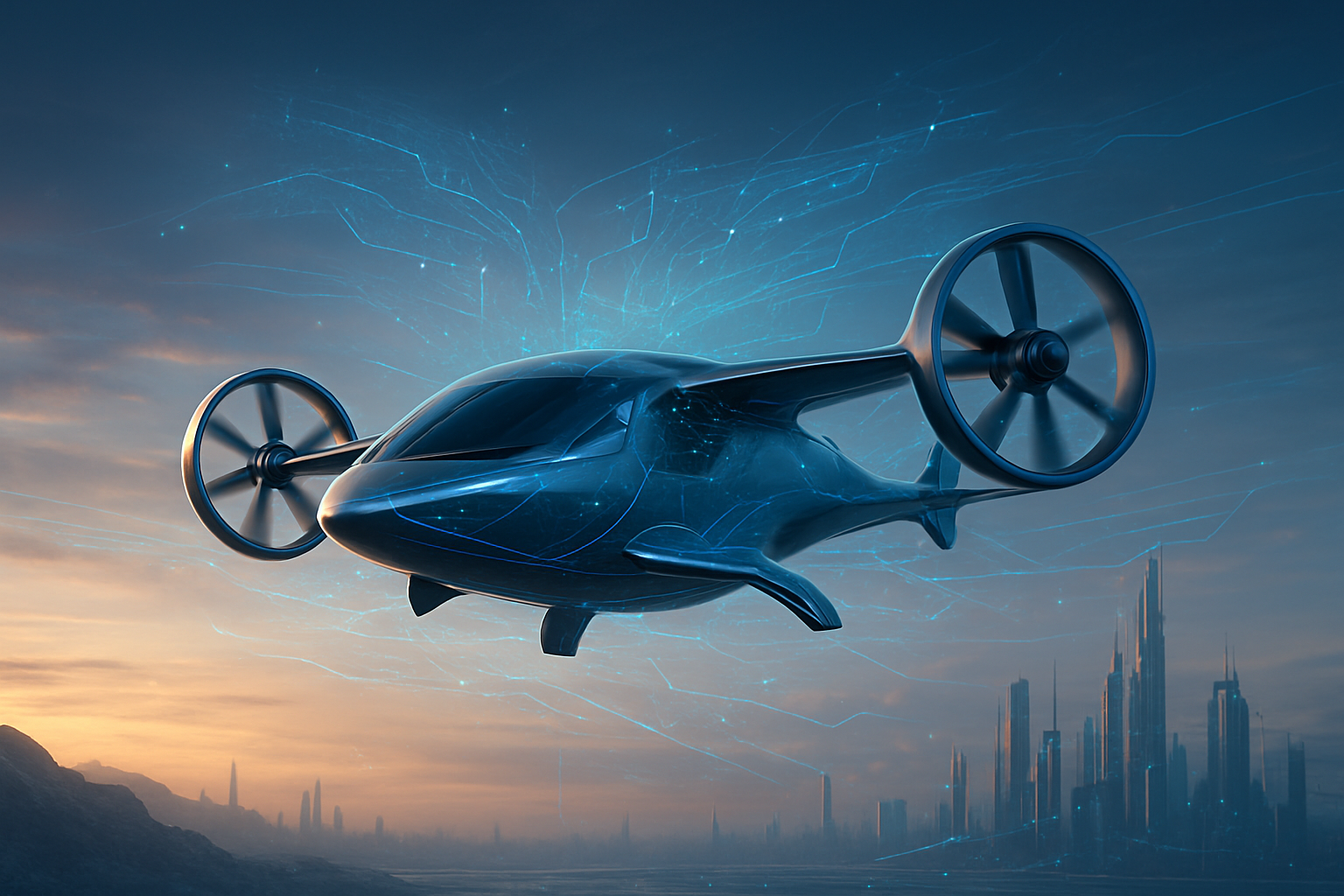
The Indian Institute of Technology (IIT) Madras has announced a significant leap forward in Vertical Take-Off and Landing (VTOL) technology, successfully demonstrating a hybrid rocket thruster capable of achieving the crucial velocity required for a "soft landing." This groundbreaking achievement, detailed in the International Journal of Aeronautical and Space Sciences, promises to redefine next-generation aviation by offering a safer, simpler, and more controllable propulsion system for VTOL aircraft and Unmanned Aerial Vehicles (UAVs). This development positions India as a key player in advanced air mobility, with profound implications for decentralized air transport, logistics, defense, and potentially, space exploration.
Unpacking the Engineering Marvel: Hybrid Rockets for Soft Landings
The core of IIT Madras's breakthrough lies in its innovative hybrid rocket thruster system. Unlike conventional liquid or solid rocket engines, hybrid rockets combine the advantages of both, offering inherent safety due to the separate storage of fuel and oxidizer, simplicity in design, and excellent throttling capabilities for precise thrust modulation. A standout feature of this research is the development of a unique hybrid rocket fuel that utilizes readily available compressed air as the oxidizer. This eliminates the need for complex, exotic chemicals or cryogenic liquids, significantly enhancing the system's safety and simplifying its integration into aerospace vehicles.
In a sophisticated experiment, the IIT Madras team employed a unique Hardware-in-the-Loop Simulation (HILS) framework. This framework is not merely a simulation; it directly integrated a live-firing hybrid rocket motor with a virtual simulation. This approach ensures an incredibly accurate and realistic testing environment, bridging the gap between theoretical development and a functional prototype. Through this HILS setup, the researchers successfully demonstrated the ability to achieve a safe touchdown velocity of just 0.66 meters per second, a critical metric for "soft landing" capabilities essential for various applications, from planetary exploration modules to terrestrial VTOL aircraft. A landing algorithm based on velocity tracking and a Proportional-Integral-Derivative (PID) controller was instrumental in monitoring and correcting the velocity profile for a seamless landing process.
This approach significantly differs from previous VTOL technologies. While electric VTOLs (eVTOLs) are gaining traction, the hybrid rocket thruster offers distinct advantages in terms of range, payload capacity, and potentially, faster refueling times compared to battery-dependent systems. Compared to traditional helicopters, which currently serve in remote terrains, the IIT Madras VTOL system promises superior speed, range, and efficiency, addressing long-standing limitations. The simplified oxidizer and the robust HILS framework represent a departure from more complex, high-maintenance liquid-engine VTOL systems, offering a more practical pathway to widespread adoption. Initial reactions from the broader aerospace community, while not explicitly detailed for this specific announcement, indicate a strong interest in IIT Madras's contributions to advanced air mobility, with experts noting the "game-changer" potential for both civil and military aviation.
Reshaping the Landscape: Impact on AI and Tech Companies
The IIT Madras VTOL hybrid rocket thruster breakthrough carries significant implications for AI companies, tech giants, and startups across various sectors, from aerospace and logistics to defense and urban air mobility.
Companies poised to benefit include traditional aerospace manufacturers such as Airbus (Euronext: AIR), Bell Textron Inc. (NYSE: TXT), Boeing (NYSE: BA), Lockheed Martin (NYSE: LMT), and Israel Aerospace Industries, who could integrate this technology into their next-generation VTOL designs. The simplified propulsion system and enhanced safety could accelerate their development cycles and expand their market reach. Logistics giants like Amazon (NASDAQ: AMZN) and UPS (NYSE: UPS), along with specialized cargo VTOL developers such as Elroy Air, could leverage this technology for more efficient, reliable, and cost-effective drone delivery and air cargo services, especially for reaching remote or underserved areas. The inherent safety and simpler maintenance of the hybrid thruster could make widespread autonomous cargo VTOL operations more feasible.
For tech giants with interests in cloud computing and AI research, such as Google (NASDAQ: GOOGL), Microsoft (NASDAQ: MSFT), and Amazon Web Services (AWS), the management of large fleets of autonomous VTOLs will generate vast amounts of flight data and require robust cloud infrastructure and advanced AI capabilities. This will likely lead to increased demand for their cloud services and AI development platforms. Startups in the Urban Air Mobility (UAM) space, including Joby Aviation (NYSE: JOBY), Archer Aviation (NYSE: ACHR), EHang Holdings (NASDAQ: EH), Vertical Aerospace (NYSE: EVTL), and Lilium (NASDAQ: LILM), currently focused on eVTOLs, might explore integrating this hybrid rocket technology for enhanced performance, range, and safety, potentially accelerating the widespread adoption of air taxis.
The competitive landscape will also shift. While current eVTOL development heavily focuses on electric propulsion, this breakthrough shifts emphasis to AI capable of managing the unique dynamics and thrust modulation of rocket-powered VTOLs. This will drive specialized AI research for rocket propulsion control, potentially creating new competitive niches for AI labs. Major tech and aerospace companies may strategically partner with or acquire startups and research entities that successfully integrate AI with this new thruster technology, securing an early advantage. The "holy grail" for defense AI—the ability to operate VTOL aircraft without runways—is a significant strategic advantage that will intensify competition among defense AI labs to develop highly autonomous, survivable, and adaptable VTOL systems. The technology could disrupt the traditional helicopter market by offering superior speed, range, and efficiency, and reduce reliance on expensive runway infrastructure for certain military and logistics applications.
Broader Horizons: Significance in the AI Landscape and Beyond
While primarily an aerospace engineering feat, the IIT Madras VTOL hybrid rocket thruster breakthrough holds crucial, albeit indirect, significance within the broader AI landscape and ongoing technological trends. It serves as a foundational hardware innovation that will accelerate the development and deployment of advanced AI-driven autonomous aerial systems.
The integration of sophisticated control algorithms, like the PID controller used for soft landing, is inherently linked to AI. Future iterations of this technology will undoubtedly leverage more advanced AI for greater precision, adaptability, and full autonomy in flight control, navigation, obstacle avoidance, and real-time decision-making. Furthermore, the aerospace industry is increasingly adopting AI for the design and optimization of propulsion systems, suggesting that future enhancements to this hybrid thruster could themselves be products of AI-driven engineering. This makes the breakthrough an enabler for future AI milestones in aerospace and robotics.
The broader impacts are transformative. The potential for decentralized air mobility is immense, allowing access to remote and rugged terrains previously inaccessible to conventional aircraft. This could revolutionize logistics, emergency services, and regional connectivity. For defense, the strategic advantages are staggering, enabling aircraft to operate from diverse, unprepared locations without vulnerable airbases. The "soft landing" capability also has direct applications in space exploration for planetary landers. The inherent safety, simplicity, and lower maintenance of hybrid rockets promise more cost-effective and sustainable aerial mobility solutions.
However, potential concerns exist. As a dual-use technology, its application in both civil and military contexts raises questions about proliferation and misuse, particularly concerning autonomous weapon systems. Regulatory frameworks will need to evolve rapidly to accommodate these novel VTOLs, especially for autonomous operations, covering certification, air traffic management, and safety protocols. Public acceptance and potential noise pollution in urban air mobility scenarios also remain challenges. Moreover, highly autonomous VTOLs relying on AI could be vulnerable to cyberattacks, necessitating robust security measures.
Compared to direct AI milestones like the Deep Learning Revolution or breakthroughs in autonomous driving, the IIT Madras achievement is a critical enabling technology. It provides the robust, controllable propulsion system that the next generation of AI-powered aerial vehicles will depend on, much like advanced microprocessors enabled the AI revolution. It's a testament to how hardware innovation can catalyze and accelerate progress in AI applications, pushing the boundaries of what autonomous systems can achieve.
The Flight Path Ahead: Future Developments and Expert Predictions
The journey for IIT Madras's VTOL hybrid rocket thruster technology is far from over, with clear near-term and long-term developments on the horizon.
In the near term, researchers are intensely focused on achieving attitude stabilization for experimental VTOL platforms equipped with multiple thrusters. This is a critical step, as maintaining the aircraft's orientation during all phases of flight is paramount for practical application. Following this, the team plans to conduct more advanced hardware-in-the-loop simulations that account for landing without the assumption of an already attitude-stabilized system, further validating their control strategies. The initial implementation of this VTOL technology is expected to be extended to fixed-wing Unmanned Aerial Vehicles (UAVs), serving as a vital proof-of-concept for broader aerospace applications.
The long-term vision, as articulated by Professor P. A. Ramakrishna of IIT Madras, is for this VTOL system to reach a Technology Readiness Level (TRL) suitable for widespread commercial and military deployment. He predicts it will be a "game-changer" by fundamentally decentralizing air transport, freeing aircraft from the constraints of traditional runway infrastructure. This opens up unprecedented possibilities for accessing remote locations, transforming logistics, emergency services, and regional connectivity. The "soft landing" capability also positions it for future planetary landing missions, extending its reach beyond Earth's atmosphere.
However, several challenges need to be addressed. While the hybrid rocket design aims for simplicity, achieving robust attitude stabilization with multiple thrusters in unpredictable real-world conditions is complex. Refining precise thrust control for various mission requirements, including emergency shutdowns and restarts, is crucial. Historically, hybrid rocket engines faced challenges with poor fuel regression rates, though IIT Madras has made strides in addressing this with innovative methods. Experts like Dr. Joel George Manathara emphasize the uniqueness of using hybrid rocket thrusters for VTOL and the precision offered by their HILS framework. The consensus is that this work paves the way for moving beyond conventional approaches, balancing safety, simplicity, and control, and placing India among the elite nations developing advanced aerospace propulsion systems.
A New Era of Flight: Wrapping Up the Revolution
The IIT Madras breakthrough in VTOL hybrid rocket technology marks a pivotal moment in aviation history, signaling a new era of decentralized and highly adaptable air transport. The key takeaways are the successful demonstration of a hybrid rocket thruster capable of soft landings, its innovative use of compressed air as an oxidizer for enhanced safety and simplicity, and the development of a unique live-firing Hardware-in-the-Loop Simulation framework that accelerates practical development. This advancement promises to address the complexities and maintenance demands of existing VTOL systems, paving the way for more robust and efficient aerial platforms.
While not an AI breakthrough in itself, this development holds profound significance in AI history as a crucial enabler for next-generation autonomous aerial systems. The reliable and controllable propulsion it offers is a prerequisite for the sophisticated AI necessary to pilot fully autonomous VTOL aircraft, from complex urban air mobility scenarios to critical defense operations and ambitious space missions. The interplay between advanced propulsion and AI autonomy, as seen in projects like Shield AI's X-BAT, underscores the deep synergy between these fields.
The long-term impact is truly transformative. This technology has the potential to fundamentally alter civil and military aviation by eliminating reliance on runways, opening up vast new operational possibilities. It can foster new paradigms in urban air mobility, emergency response, and logistics, while offering unparalleled strategic flexibility in defense. The inherent safety and potential for lower maintenance costs of hybrid thrusters could also lead to more sustainable and economically viable aerial solutions.
In the coming weeks and months, the world will be watching for several key developments from IIT Madras. Progress on attitude stabilization for multi-thruster platforms, advanced experimental studies of landing platforms with multiple degrees of freedom, and the advancement of the technology through higher Technology Readiness Levels will be critical indicators. Furthermore, any announcements regarding initial implementation in fixed-wing UAVs or potential industry partnerships will signal the accelerating trajectory of this groundbreaking Indian innovation.
This content is intended for informational purposes only and represents analysis of current AI developments.
TokenRing AI delivers enterprise-grade solutions for multi-agent AI workflow orchestration, AI-powered development tools, and seamless remote collaboration platforms.
For more information, visit https://www.tokenring.ai/.