Tag: Trump Administration

  • NVIDIA H200s Cleared for China: Inside the Trump Administration’s Bold High-Stakes Tech Thaw

    NVIDIA H200s Cleared for China: Inside the Trump Administration’s Bold High-Stakes Tech Thaw

    In a move that has sent shockwaves through both Silicon Valley and Beijing, the Trump administration has officially authorized the export of NVIDIA H200 GPU accelerators to the Chinese market. The decision, finalized in late January 2026, marks a dramatic reversal of the multi-year "presumption of denial" policy that had effectively crippled the sales of high-end American AI hardware to China. By replacing blanket bans with a transactional, security-monitored framework, the U.S. government aims to reassert American influence over global AI ecosystems while capturing significant federal revenue from the world’s second-largest economy.

    The policy shift is being hailed by industry leaders as a pragmatic "thaw" in tech relations, though it comes with a complex web of restrictions that distinguish it from the unrestricted trade of the past decade. For NVIDIA (NASDAQ: NVDA), the announcement represents a lifeline for its Chinese business, which had previously been relegated to selling "degraded" or lower-performance chips like the H20 to comply with strict 2023 and 2024 export controls. Under the new regime, the H200—one of the most powerful AI training and inference chips currently in production—will finally be available to vetted Chinese commercial entities.

    Advanced Silicon and the "Vulnerability Screening" Mandate

    The technical specifications of the NVIDIA H200 represent a massive leap forward for the Chinese AI industry. Built on the Hopper architecture, the H200 is the first GPU to feature HBM3e memory, delivering 141GB of capacity and 4.8 TB/s of memory bandwidth. Compared to the H100, the H200 offers nearly double the inference performance for large language models (LLMs) like Llama 3 or GPT-4. This bandwidth is the critical factor in modern AI scaling, and its availability in China is expected to dramatically shorten the training cycles for domestic Chinese models which had been stagnating under previous hardware constraints.

    To maintain a strategic edge, the U.S. Department of Commerce’s Bureau of Industry and Security (BIS) has introduced a new "regulatory sandwich." Under the January 13, 2026 ruling, chips are permitted for export only if their Total Processing Performance (TPP) remains below 21,000 and DRAM bandwidth stays under 6,500 GB/s. While the H200 fits within these specific bounds, the administration has eliminated the practice of "binning" or hardware-level performance capping for the Chinese market. Instead, the focus has shifted to who is using the chips and how they are being deployed.

    A key technical innovation in this policy is the "U.S. First" testing protocol. Before any H200 units are shipped to China, they must first be imported from manufacturing hubs into specialized American laboratories. There, they undergo "vulnerability screening" and technical verification to ensure no unauthorized firmware modifications have been made. This allows the U.S. government to maintain a literal hands-on check on the hardware before it enters the Chinese supply chain, a logistical hurdle that experts say is unprecedented in the history of semiconductor trade.

    Initial reactions from the AI research community have been cautiously optimistic. While researchers at institutions like Tsinghua University welcome the performance boost, there is lingering skepticism regarding the mandatory U.S. testing phase. Industry analysts note that this requirement could introduce a 4-to-6 week delay in the supply chain. However, compared to the alternative—developing sovereign silicon that still lags generations behind NVIDIA—most Chinese tech giants see this as a necessary price for performance.

    Revenue Levies and the Battle for Market Dominance

    The financial implications for NVIDIA are profound. Before the 2023 restrictions, China accounted for approximately 20% to 25% of NVIDIA’s data center revenue. This figure had plummeted as Chinese firms were forced to choose between underpowered U.S. chips and domestic alternatives. With the H200 now on the table, analysts predict a massive surge in capital expenditure from Chinese "hyperscalers" such as Alibaba (NYSE: BABA), Tencent (HKG: 0700), and Baidu (NASDAQ: BIDU). These companies have been eager to upgrade their aging infrastructure to compete with Western AI capabilities.

    However, the "Trump Thaw" is far from a free pass. The administration has imposed a mandatory 25% "revenue levy" on all H200 sales to China, structured as a Section 232 national security tariff. This ensures that the U.S. Treasury benefits directly from every transaction. Additionally, NVIDIA is subject to volume caps: the total number of H200s exported to China cannot exceed 50% of the volume sold to U.S. domestic customers. This "America First" ratio is designed to ensure that the U.S. always maintains a larger, more advanced install base of AI compute power.

    The move also places intense pressure on Advanced Micro Devices (NASDAQ: AMD), which has been seeking its own licenses for the Instinct MI325X series. As the market opens, a new competitive landscape is emerging where U.S. companies are not just competing against each other, but against the rising tide of Chinese domestic competitors like Huawei. By allowing the H200 into China, the U.S. is effectively attempting to "crowd out" Huawei’s Ascend 910C chips, making it harder for Chinese firms to justify the switch to a domestic ecosystem that remains more difficult to program for.

    Strategic advantages for ByteDance—the parent company of TikTok—are also in the spotlight. ByteDance has historically been one of NVIDIA's largest customers in Asia, using GPUs for its massive recommendation engines and generative AI projects. The ability to legally procure H200s gives ByteDance a clear path to maintaining its global competitive edge, provided it can navigate the stringent end-user vetting processes required by the new BIS rules.

    The Geopolitical "AI Overwatch" and a Fragile Thaw

    The broader significance of this decision cannot be overstated. It signals a shift in the U.S. strategy from total containment to a "managed dependency." By allowing China to buy NVIDIA’s second-best hardware (with the newer Blackwell architecture still largely restricted), the U.S. keeps the Chinese tech sector tethered to American software stacks like CUDA. Experts argue that if China were forced to fully decouple, they would eventually succeed in building a parallel, independent tech ecosystem. This policy is an attempt to delay that "Sputnik moment" indefinitely.

    This strategy has not been without fierce domestic opposition. On January 21, 2026, the House Foreign Affairs Committee advanced the "AI Overwatch Act" (H.R. 6875), a bipartisan effort to grant Congress the power to veto specific export licenses. Critics of the administration, including many "China hawks," argue that the H200 is too powerful to be exported safely. They contend that the 25% tariff is a "pay-to-play" scheme that prioritizes corporate profits and short-term federal revenue over long-term national security, fearing that the hardware will inevitably be diverted to military AI projects.

    Comparing this to previous AI milestones, such as the 2022 ban on the A100, the current situation represents a much more transactional approach to geopolitics. The administration's "AI and Crypto Czar," David Sacks, has defended the policy by stating that the U.S. must lead the global AI ecosystem through engagement rather than isolation. The "thaw" is seen as a way to lower the temperature on trade relations while simultaneously building a massive federal war chest funded by Chinese tech spending.

    Beijing’s response has been characteristically measured but complex. While the Ministry of Industry and Information Technology (MIIT) has granted "in-principle" approval for firms to order H200s, they have also reportedly mandated that for every U.S. chip purchased, a corresponding investment must be made in domestic silicon. This "one-for-one" quota system indicates that while China is happy to have access to NVIDIA’s power, it remains fully committed to its long-term goal of self-reliance.

    Future Developments: Blackwell and the Parity Race

    As we look toward the remainder of 2026, the primary question is whether this policy will extend to NVIDIA’s next-generation Blackwell architecture. Currently, the B200 remains restricted, keeping the "performance gap" between the U.S. and China at approximately 12 to 18 months. However, if the H200 export experiment is deemed a financial and security success, there is already talk in Washington of a "Blackwell Lite" variant being introduced by 2027.

    The near-term focus will be on the logistical execution of the "vulnerability screening" labs. If these facilities become a bottleneck, it could lead to renewed friction between the White House and the tech industry. Furthermore, the world will be watching to see if other nations, particularly in the Middle East and Southeast Asia, demand similar "case-by-case" license review policies to access the highest tiers of American compute power.

    Predicting the next moves of the Chinese "national champions" is also vital. With access to H200s, will Alibaba and Baidu finally reach parity with U.S.-based models like Claude or Gemini? Or will the U.S. domestic volume caps ensure that American labs always have a two-to-one advantage in raw compute? Most experts believe that while the H200 will prevent a total collapse of the Chinese AI sector, the structural advantages of the U.S. ecosystem—combined with the new 25% "AI Tax"—will keep the American lead intact.

    A New Chapter in the Silicon Cold War

    The approval of NVIDIA H200 exports to China is a defining moment in the history of artificial intelligence and international trade. It represents a pivot from the "small yard, high fence" strategy toward a more dynamic "toll-booth" model. By allowing high-performance hardware to flow into China under strict supervision and high taxation, the Trump administration is betting that economic interdependency can be used as a tool for national security rather than a vulnerability.

    In the coming weeks, the industry will watch closely for the first confirmed shipments of H200s landing in Shanghai and the resulting benchmarks from Chinese AI labs. The success or failure of this policy will likely dictate the trajectory of U.S.-China relations for the rest of the decade. If the H200s are used to create breakthroughs that threaten U.S. interests, the "AI Overwatch Act" will almost certainly be invoked to shut the gates once again.

    Ultimately, the H200 export decision is a high-stakes gamble. It provides NVIDIA and the U.S. Treasury with a massive financial windfall while offering China the tools it needs to stay in the AI race. Whether this leads to a stable "technological co-existence" or merely fuels the next phase of an escalating AI arms race remains the most critical question of 2026.


    This content is intended for informational purposes only and represents analysis of current AI developments.

    TokenRing AI delivers enterprise-grade solutions for multi-agent AI workflow orchestration, AI-powered development tools, and seamless remote collaboration platforms.
    For more information, visit https://www.tokenring.ai/.
  • US Eases NVIDIA H200 Exports to China with 25% Revenue Tariff

    US Eases NVIDIA H200 Exports to China with 25% Revenue Tariff

    In a move that signals a seismic shift in global technology trade, the Trump administration has finalized a new export policy for high-end artificial intelligence semiconductors. Effectively ending the "presumption of denial" that has defined U.S.-China chip relations for nearly four years, the Department of Commerce’s Bureau of Industry and Security (BIS) announced on January 13, 2026, that it would transition to a "case-by-case review" for elite hardware. This policy specifically clears the path for NVIDIA (NASDAQ: NVDA) and AMD (NASDAQ: AMD) to resume sales of their sophisticated H200 and Instinct MI325X accelerators to approved Chinese customers.

    The relaxation comes with a historic caveat: a mandatory 25% revenue tariff—dubbed the "Trump Cut" by industry insiders—on all such exports. By requiring these Taiwan-made chips to be routed through the United States for mandatory security testing before re-export, the administration has successfully leveraged Section 232 of the Trade Expansion Act to claim a quarter of the revenue from every transaction. The administration frames the policy as a way to support American manufacturing and job growth while maintaining a "technological leash" on Beijing, though the move has already sparked a firestorm of criticism from congressional hawks who view the deal as a dangerous gamble with national security.

    The Technical Threshold: TPP Scores and the H200 Standard

    The technical foundation of this policy shift rests on a new metrics-based classification system. The Bureau of Industry and Security has established a ceiling for "approved" exports based on a Total Processing Performance (TPP) score of 21,000 and a DRAM memory bandwidth limit of 6,500 GB/s. This carefully calibrated threshold allows for the export of the NVIDIA H200, which features approximately 141GB of HBM3e memory and a TPP score of roughly 15,832. Similarly, AMD’s Instinct MI325X, despite its massive 256GB memory capacity and higher raw bandwidth of 6.0 TB/s, falls just under the performance cap with a TPP score of 20,800.

    This shift represents a departure from previous Biden-era "performance density" rules that effectively banned anything more powerful than the aged H100. By focusing on the H200 and MI325X, the U.S. is permitting China access to hardware capable of training large language models (LLMs) and running high-concurrency inference, but stopping short of the next-generation "Blackwell" and "Instinct MI350" architectures. To enforce the 25% tariff, the government has mandated that these chips must physically enter the U.S. to undergo "third-party integrity verification" at independent labs, a process that verifies no "backdoors" or unauthorized modifications exist before they are shipped to China.

    Initial reactions from the AI research community are mixed. While some engineers argue that the H200 provides more than enough "compute juice" for China to bridge the gap in generative AI, others point out that the 25% premium will make large-scale clusters prohibitively expensive. "This isn't just an export license; it's a toll road for AI," noted one lead researcher at a Silicon Valley lab. Experts also highlight that while the hardware is being released, the software interconnects—such as NVIDIA’s proprietary NVLink—remain under strict scrutiny, potentially limiting the scale at which these chips can be networked in Chinese data centers.

    Market Implications: Clearing Inventory and Strategic Hedging

    For the giants of the semiconductor industry, the announcement is a double-edged sword. NVIDIA, which was reportedly sitting on an estimated $4.5 billion in unsold inventory due to previous restrictions, saw its stock fluctuate as investors weighed the benefit of renewed Chinese revenue against the 25% tariff hit. CEO Jensen Huang has remained publicly upbeat, characterizing the move as a "turning point" that allows the company to rebuild relationships with Chinese hyperscalers like Alibaba and Tencent. However, in a move of strategic caution, NVIDIA has reportedly begun requiring full upfront payment from Chinese clients to mitigate the risk of sudden policy reversals.

    AMD (NASDAQ: AMD) stands to benefit significantly from the increased memory capacity of its MI325X, which many analysts believe is superior for the specific "inference-heavy" workloads currently prioritized by Chinese firms. By positioning the MI325X as a viable alternative to NVIDIA’s ecosystem, AMD could capture a significant portion of the newly reopened market. Meanwhile, tech giants like Microsoft (NASDAQ: MSFT) and Intel (NASDAQ: INTC) are watching closely. Microsoft CEO Satya Nadella, speaking recently at Davos, emphasized that while chip availability is crucial, the real competition in 2026 will be defined by energy infrastructure and the "diffusion" of AI into tangible business products.

    The competitive landscape is further complicated by the 25% "Trump Cut." To maintain profit margins, analysts expect chipmakers to pass at least some of the cost to Chinese buyers, potentially pricing the H200 at over $35,000 per unit in the region. This price hike creates a "protectionist window" for Chinese domestic chipmakers, such as Huawei, to offer their own Ascend series at a massive discount. "We are effectively subsidizing the development of the Huawei Ascend 910C by making our own chips 25% more expensive in the eyes of the Chinese consumer," warned one semiconductor analyst.

    National Security and the "AI OVERWATCH" Counter-Movement

    The wider significance of this policy lies in its attempt to treat AI compute as a sovereign economic asset rather than just a restricted military technology. By monetizing the export of AI chips, the Trump administration is treating "compute" similarly to how oil or grain has been traded in past geopolitical eras. However, this "Silicon Realpolitik" has created a rift within the Republican party and invited sharp rebukes from Democratic leadership. Representative Raja Krishnamoorthi, the Ranking Member of the House Select Committee on China, has described the policy as a "disastrous dereliction of duty," claiming that U.S. national security is now "for sale."

    In response to the administration's move, a bipartisan group of lawmakers led by House Foreign Affairs Committee Chairman Brian Mast introduced the AI OVERWATCH Act on January 21, 2026. This legislation seeks to codify a two-year ban on the most advanced "Blackwell" class chips and would grant Congress the power to block specific export licenses through a joint resolution. The act argues that the current "case-by-case" review process lacks transparency and allows the executive branch too much leeway in defining what constitutes a "national security risk."

    This development marks a pivotal moment in the "Great Tech Rivalry." For years, the U.S. has used a "small yard, high fence" strategy—strictly protecting a narrow set of technologies. The new 25% tariff policy suggests the "yard" is expanding, but the "fence" is being replaced by a "gated community" where access can be bought for the right price. Critics argue this sends a confusing message to allies like the Netherlands and Japan, who have been pressured by the U.S. to implement their own strict bans on chip-making equipment from companies like ASML (NASDAQ: ASML).

    The Path Forward: Retaliation and Domestic Alternatives

    Looking ahead, the success of this policy depends largely on Beijing's response. Already, reports from late January 2026 indicate that Chinese customs officials have begun blocking shipments of the newly approved H200 chips at the border. The Chinese Ministry of Commerce has signaled that it will not simply allow the U.S. government to collect a "tax" on its technology imports. Instead, Beijing is reportedly "encouraging" domestic firms to double down on homegrown architectures, specifically the Huawei Ascend 910C and the Biren BR100, which are not subject to U.S. tariffs.

    In the near term, we can expect a period of intense "grey market" activity as firms attempt to bypass the 25% tariff through third-party nations. However, the mandatory U.S.-based testing requirement is designed specifically to close these loopholes. If the policy holds, 2026 will likely see the emergence of two distinct AI ecosystems: a high-cost, U.S.-monitored ecosystem in the West, and a subsidized, state-driven ecosystem in China.

    Experts predict that the next major flashpoint will be the "AI OVERWATCH Act." If passed, it could effectively nullify the administration's new policy by February or March, leading to further market volatility. For now, the semiconductor industry remains in a state of "cautious execution," waiting to see if the H200s currently sitting in U.S. testing labs will ever actually make it to data centers in Shanghai or Shenzhen.

    Summary and Final Thoughts

    The Trump administration's decision to ease H200 and MI325X exports in exchange for a 25% revenue tariff is perhaps the most aggressive attempt yet to blend economic populism with high-tech statecraft. By moving away from a blanket ban, the U.S. is attempting to reclaim its position as the global provider of AI infrastructure while ensuring that the American treasury—not just Silicon Valley—benefits from the trade.

    The key takeaways from this development are:

    • The 21,000 TPP Threshold: A new technical "red line" has been drawn, allowing H200-class hardware while keeping next-gen chips out of reach.
    • The Revenue-Sharing Model: The 25% tariff via mandatory U.S. routing is a novel use of trade law to "tax" high-tech exports.
    • Congressional Pushback: The AI OVERWATCH Act represents a significant hurdle that could still derail the administration's plan.
    • Beijing's Counter-Move: China's potential "counter-embargo" suggests that the trade war is entering a more localized, tit-for-tat phase.

    In the history of AI, January 2026 may be remembered as the moment when the "AI Arms Race" officially became a "Managed AI Trade." For investors and tech leaders, the coming weeks will be critical as the first batch of "tariffed" chips attempts to clear Chinese customs.


    This content is intended for informational purposes only and represents analysis of current AI developments.

    TokenRing AI delivers enterprise-grade solutions for multi-agent AI workflow orchestration, AI-powered development tools, and seamless remote collaboration platforms.
    For more information, visit https://www.tokenring.ai/.
  • The Great Divergence: White House Outlines Aggressive Strategy for American AI Supremacy and Deregulation

    The Great Divergence: White House Outlines Aggressive Strategy for American AI Supremacy and Deregulation

    On the first anniversary of the second Trump administration, the White House Council of Economic Advisers (CEA) has released a landmark report titled "Artificial Intelligence and the Great Divergence." The document, published today, January 21, 2026, frames the current era of artificial intelligence as a pivotal historical moment—a "Second Great Divergence"—that mirrors the 19th-century Industrial Revolution. The report argues that just as steam power and coal enabled a handful of nations to achieve multi-generational economic dominance two centuries ago, the rapid deployment of massive compute and energy infrastructure will now determine the next century’s global power structure.

    This release marks a definitive shift in U.S. policy, moving away from the safety-centric frameworks of the previous decade toward an unapologetic pursuit of technological hegemony. By prioritizing domestic infrastructure, drastic deregulation, and the "Stargate" mega-project, the administration aims to ensure that the economic gap between AI "leaders" and "laggards" leaves the United States firmly at the head of the global order. The immediate significance lies in the administration's declaration that AI is a zero-sum race for national security, where speed and scale are the only metrics that matter.

    Scaling at the Speed of Light: The Stargate Blueprint

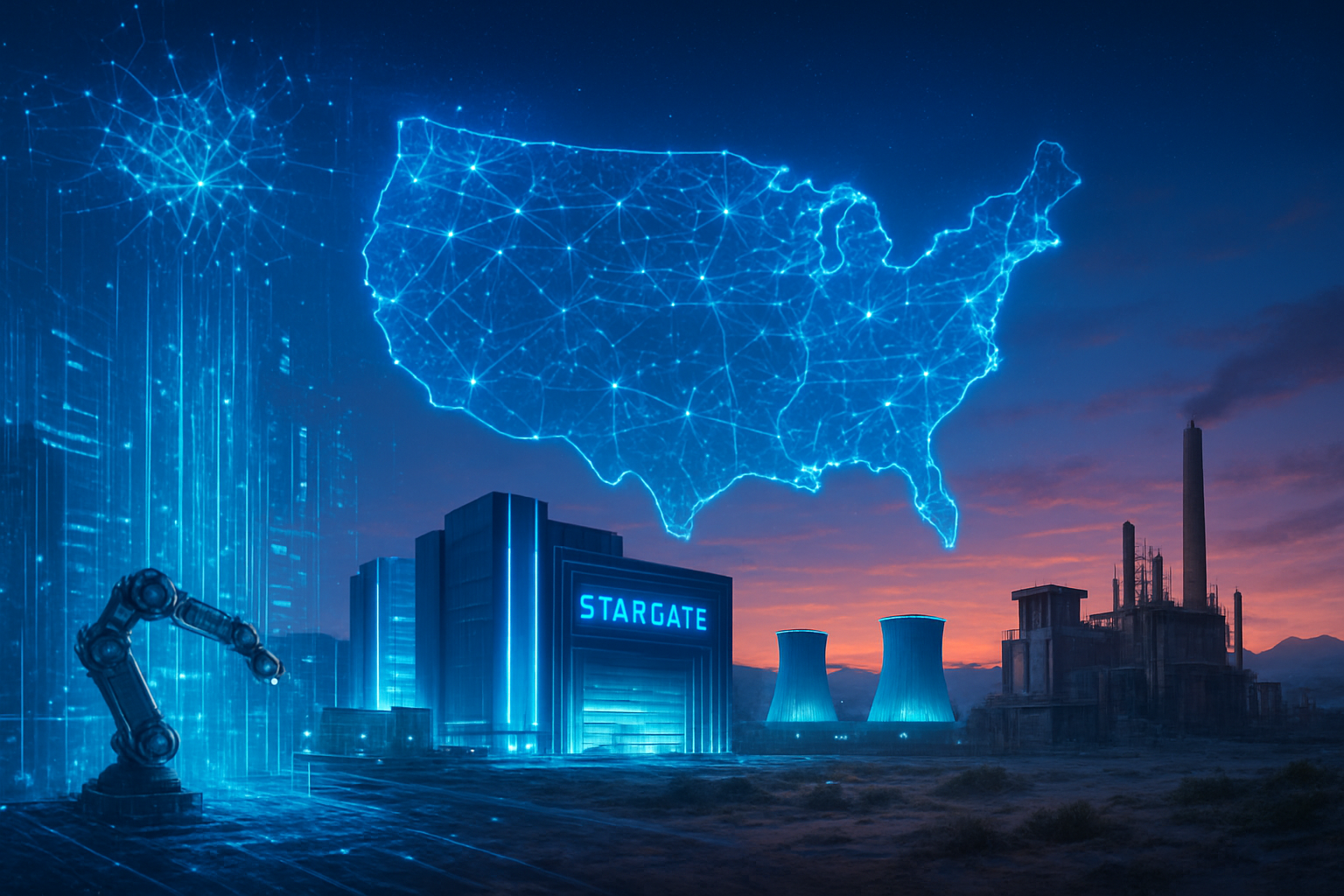
    The report provides the most detailed technical roadmap to date for the "Stargate" project, a $500 billion joint venture between OpenAI, Oracle Corporation (NYSE: ORCL), and SoftBank Group Corp. (OTC: SFTBY). Stargate is not merely a single facility but a planned network of 20 advanced AI data centers across the continental United States. The flagship site in Abilene, Texas, has already broken ground and is designed to consume 1.2 gigawatts of power—enough to support the training of next-generation artificial general intelligence (AGI) models that require compute power far beyond current commercial limits.

    Technically, the administration’s plan diverges from previous approaches by treating data centers as critical national security infrastructure. Under Executive Order 14156, the President has utilized emergency energy declarations to bypass traditional environmental reviews and permitting delays. This allows for the rapid construction of dedicated nuclear and natural gas power plants to fuel these "compute hubs." While previous administrations focused on the algorithmic "black box" and safety alignment, the current White House is focused on the physical "stack"—land, power, and silicon—to maintain an insurmountable lead over international rivals.

    Initial reactions from the AI research community have been sharply divided. Prominent figures in the "accelerationist" camp have praised the move, noting that removing the "red tape" of the Biden-era AI Executive Order 14110 allows American firms to innovate without the fear of preemptive litigation or "woke" bias constraints. However, safety advocates warn that the complete removal of guardrails in the pursuit of raw capability could lead to unpredictable catastrophic risks as models reach AGI-level complexity.

    Market Winners and the End of Regulatory Parity

    The "Great Divergence" report explicitly identifies the companies that stand to benefit from this new era of deregulation. By establishing a "minimally burdensome national policy framework," the administration is effectively preempting state-level regulations, such as those attempted in California. This is a massive strategic advantage for "Big Tech" giants and infrastructure providers like NVIDIA Corporation (NASDAQ: NVDA), which provides the essential H200 and Blackwell-class GPUs, and Microsoft Corporation (NASDAQ: MSFT), which continues to integrate these advancements into its global cloud footprint.

    Competitive implications are stark: the administration’s focus on "capability-first" development favors large-scale labs that can afford the multi-billion-dollar entry fee for the Stargate ecosystem. Startups that align with the administration’s "Anti-Woke" AI criteria are being courted with federal procurement promises, while those focused on safety and ethics-first frameworks may find themselves marginalized in the new "American AI Action Plan." This creates a "winner-take-all" market positioning where the primary competitive advantage is no longer just the algorithm, but the ability to tap into the government-backed energy and compute grid.

    The disruption to existing products is already visible. As the "Divergence" widens, the report predicts that companies failing to integrate AGI-level tools will see their productivity stagnate, while AI-leaders will experience "breakneck" growth. This economic chasm is expected to consolidate the tech industry further, with the "Stargate" partners forming a new technological aristocracy that controls the fundamental utilities of the 21st-century economy.

    A Global Chasm: AI as the New Geopolitical Fault Line

    The wider significance of the White House report cannot be overstated. It represents a total rejection of the "global cooperation" model favored by international bodies. While the United Nations recently issued warnings about AI worsening global inequality, the Trump administration’s report leans into this disparity as a tool of statecraft. By deliberately creating a "Great Divergence," the U.S. intends to make its technology the "reserve currency" of the digital age, forcing other nations to choose between American infrastructure or falling into the "laggard" category.

    This fits into a broader trend of technological nationalism. Unlike the early internet era, which was characterized by open standards and global connectivity, the AI era is being defined by "Sovereign AI" and closed, high-performance silos. The report makes frequent comparisons to the space race, but with a more aggressive economic component. The goal is "unquestioned and unchallenged" dominance, positioning the U.S. as the sole gatekeeper of AGI.

    Potential concerns regarding this strategy include the risk of a "race to the bottom" in AI safety and the potential for increased domestic inequality. As AI leaders pull away from laggards, the workforce displacement in traditional sectors may accelerate. However, the CEA argues that the risk of losing the race to China is the only existential threat that truly matters, viewing any domestic or global "divergence" as a necessary side effect of maintaining the American way of life.

    The Horizon: Nuclear SMRs and the Road to 10 Gigawatts

    Looking ahead, the administration is expected to pivot toward even more radical energy solutions to sustain the AI boom. Expected near-term developments include the mass deployment of Small Modular Reactors (SMRs) directly adjacent to data center sites. Experts predict that by 2028, the "Stargate" network will attempt to reach a total capacity of 10 gigawatts, a scale of energy consumption that would have been unthinkable for a single industry just a few years ago.

    Potential applications on the horizon include the total automation of federal logistics, advanced predictive defense systems, and a new "Sovereign AI Fund" that could theoretically distribute the dividends of AI-driven productivity to American citizens—or at least to those in the "leader" sector. The primary challenge remains the physical limitation of the power grid and the potential for social unrest as the economic gap widens.

    What experts predict next is a series of "compute-diplomacy" deals, where the U.S. offers access to its AGI resources to allied nations in exchange for raw materials or strategic concessions. The "Great Divergence" is not just an economic forecast; it is the blueprint for a new American-led world order where compute is the ultimate form of power.

    Conclusion: A New Chapter in Technological History

    The "Great Divergence" report will likely be remembered as the moment the United States officially abandoned the quest for a global AI consensus in favor of a unilateral sprint for dominance. By framing the gap between AI leaders and laggards as an inevitable and desirable outcome of American innovation, the Trump administration has set the stage for a period of unprecedented technological acceleration—and profound social and economic volatility.

    The key takeaway is that the "Stargate" project and the accompanying deregulation are now the central pillars of U.S. economic policy. This development marks a transition from AI being a tool for productivity to AI being the foundation of national sovereignty. In the coming weeks and months, watch for the first "Stargate" data centers to come online and for the inevitable legal battles as the administration continues to dismantle the regulatory frameworks of the past decade. The gap is widening, and for the White House, that is exactly the point.


    This content is intended for informational purposes only and represents analysis of current AI developments.

    TokenRing AI delivers enterprise-grade solutions for multi-agent AI workflow orchestration, AI-powered development tools, and seamless remote collaboration platforms.
    For more information, visit https://www.tokenring.ai/.
  • Silicon Sovereignty: Trump Administration Levies 25% Tariff on Foreign-Made AI Chips

    Silicon Sovereignty: Trump Administration Levies 25% Tariff on Foreign-Made AI Chips

    In a move that has sent shockwaves through the global technology sector, the Trump Administration has officially implemented a 25% tariff on high-end artificial intelligence (AI) chips manufactured outside the United States. Invoking Section 232 of the Trade Expansion Act of 1962, the White House has framed this "Silicon Surcharge" as a defensive measure necessary to protect national security and ensure what officials are calling "Silicon Sovereignty." The policy effectively transitions the U.S. strategy from mere export controls to an aggressive model of economic extraction and domestic protectionism.

    The immediate significance of this announcement cannot be overstated. By targeting the sophisticated silicon that powers the modern AI revolution, the administration is attempting to forcibly reshore the world’s most advanced manufacturing capabilities. For years, the U.S. has relied on a "fabless" model, designing chips domestically but outsourcing production to foundries in Asia. This new tariff structure aims to break that dependency, compelling industry giants to migrate their production lines to American soil or face a steep tax on the "oil of the 21st century."

    The technical scope of the tariff is surgical, focusing specifically on high-performance compute (HPC) benchmarks that define frontier AI models. The proclamation explicitly targets the latest iterations of hardware from industry leaders, including the H200 and the upcoming Blackwell series from NVIDIA (NASDAQ: NVDA), as well as the MI300 and MI325X accelerators from Advanced Micro Devices, Inc. (NASDAQ: AMD). Unlike broader trade duties, this 25% levy is triggered by specific performance metrics, such as total processing power (TFLOPS) and interconnect bandwidth speeds, ensuring that consumer-grade hardware for laptops and gaming remains largely unaffected while the "compute engines" of the AI era are heavily taxed.

    This approach marks a radical departure from the previous administration's "presumption of denial" strategy, which focused almost exclusively on preventing China from obtaining high-end chips. The 2026 policy instead prioritizes the physical location of the manufacturing process. Even chips destined for American data centers will be subject to the tariff if they are fabricated at offshore foundries like those operated by Taiwan Semiconductor Manufacturing Company (NYSE: TSM). This has led to a "policy whiplash" effect; for instance, certain NVIDIA chips previously banned for export to China may now be approved for sale there, but only after being routed through U.S. labs for "sovereignty testing," where the 25% tariff is collected upon entry.

    Initial reactions from the AI research community and industry experts have been a mix of alarm and strategic adaptation. While some researchers fear that the increased cost of hardware will slow the pace of AI development, others note that the administration has included narrow exemptions for U.S.-based startups and public sector defense applications to mitigate the domestic impact. "We are seeing the end of the globalized supply chain as we knew it," noted one senior analyst at a prominent Silicon Valley think tank. "The administration is betting that the U.S. market is too valuable to lose, forcing a total reconfiguration of how silicon is birthed."

    The market implications are profound, creating a clear set of winners and losers in the race for AI supremacy. Intel Corporation (NASDAQ: INTC) has emerged as the primary beneficiary, with its stock surging following the announcement. The administration has effectively designated Intel as a "National Champion," even reportedly taking a 9.9% equity stake in the company to ensure the success of its domestic foundry business. By making foreign-made chips 25% more expensive, the government has built a "competitive moat" around Intel’s 18A and future process nodes, positioning them as the more cost-effective choice for NVIDIA and AMD's next-generation designs.

    For major AI labs and tech giants like Microsoft (NASDAQ: MSFT), Google (NASDAQ: GOOGL), and Meta (NASDAQ: META), the tariffs introduce a new layer of capital expenditure complexity. These companies, which have spent billions on massive GPU clusters, must now weigh the costs of paying the "Silicon Surcharge" against the long-term project of transitioning their custom silicon—such as Google’s TPUs or Meta’s MTIA—to domestic foundries. This shift provides a strategic advantage to any firm that has already invested in U.S.-based manufacturing, while those heavily reliant on Taiwanese fabrication face a sudden and significant increase in training costs for their next-generation Large Language Models (LLMs).

    Smaller AI startups may find themselves in a precarious position despite the offered exemptions. While they might avoid the direct tariff cost, the broader supply chain disruption and the potential for a "bifurcated" hardware market could lead to longer lead times and reduced access to cutting-edge silicon. Meanwhile, NVIDIA’s Jensen Huang has already signaled a pragmatic shift, reportedly hedging against the policy by committing billions toward Intel’s domestic capacity. This move underscores a growing reality: for the world’s most valuable chipmaker, the path to market now runs through American factories.

    The broader significance of this move lies in the complete rejection of the "just-in-time" globalist philosophy that has dominated the tech industry for decades. The "Silicon Sovereignty" doctrine views the 90% concentration of advanced chip manufacturing in Taiwan as an unacceptable single point of failure. By leveraging tariffs, the U.S. is attempting to neutralize the geopolitical risk associated with the Taiwan Strait, essentially telling the world that American AI will no longer be built on a foundation that could be disrupted by a regional conflict.

    This policy also fundamentally alters the relationship between the U.S. and Taiwan. To mitigate the impact, the administration recently negotiated a "chips-for-protection" deal, where Taiwanese firms pledged $250 billion in U.S.-based investments in exchange for a tariff cap of 15% for compliant companies. However, this has created significant tension regarding the "Silicon Shield"—the theory that Taiwan’s vital role in the global economy protects it from invasion. As the most advanced 2nm and 1.4nm nodes are incentivized to move to Arizona and Ohio, some fear that Taiwan’s geopolitical leverage may be inadvertently weakened.

    Comparatively, this move is far more aggressive than the original CHIPS and Science Act. While that legislation used "carrots" in the form of subsidies to encourage domestic building, the 2026 tariffs are the "stick." It signals a pivot toward a more dirigiste economic policy where the state actively shapes the industrial landscape. The potential concern, however, remains a global trade war. China has already warned that these "protectionist barriers" will backfire, potentially leading to retaliatory measures against U.S. software and cloud services, or an acceleration of China’s own indigenous chip programs like the Huawei Ascend series.

    Looking ahead, the next 24 to 36 months will be a critical transition period for the semiconductor industry. Near-term developments will likely focus on the "Tariff Offset Program," which allows companies to earn credits against their tax bills by proving their chips were manufactured in the U.S. This will create a frantic rush to certify supply chains and may lead to a surge in demand for domestic assembly and testing facilities, not just the front-end wafer fabrication.

    In the long term, we can expect a "bifurcated" AI ecosystem. One side will be optimized for the U.S.-aligned "Sovereignty" market, utilizing domestic Intel and GlobalFoundries nodes, while the other side, centered in Asia, may rely on increasingly independent Chinese and regional supply chains. The challenge will be maintaining the pace of AI innovation during this fragmentation. Experts predict that if U.S. manufacturing can scale efficiently, the long-term result will be a more resilient, albeit more expensive, infrastructure for the American AI economy.

    The success of this gamble hinges on several factors: the ability of Intel and its peers to meet the rigorous yield and performance requirements of NVIDIA and AMD, and the government's ability to maintain these tariffs without causing a domestic inflationary spike in tech services. If the "Silicon Sovereignty" move succeeds, it will be viewed as the moment the U.S. reclaimed its industrial crown; if it fails, it could be remembered as the policy that handed the lead in AI cost-efficiency to the rest of the world.

    The implementation of the 25% tariff on high-end AI chips represents a watershed moment in the history of technology and trade. By prioritizing "Silicon Sovereignty" over global market efficiency, the Trump Administration has fundamentally reordered the priorities of the most powerful companies on earth. The message is clear: the United States will no longer tolerate a reality where its most critical future technology is manufactured in a geographically vulnerable region.

    Key takeaways include the emergence of Intel as a state-backed national champion, the forced transition of NVIDIA and AMD toward domestic foundries, and the use of trade policy as a primary tool for industrial reshoring. This development will likely be studied by future historians as the definitive end of the "fabless" era and the beginning of a new age of techno-nationalism.

    In the coming weeks, market watchers should keep a close eye on the implementation details of the Tariff Offset Program and the specific "sovereignty testing" protocols for exported chips. Furthermore, any retaliatory measures from China or further "chips-for-protection" negotiations with international partners will dictate the stability of the global tech economy in 2026 and beyond. The race for AI supremacy is no longer just about who has the best algorithms; it is now firmly about who controls the machines that build the machines.


    This content is intended for informational purposes only and represents analysis of current AI developments.

    TokenRing AI delivers enterprise-grade solutions for multi-agent AI workflow orchestration, AI-powered development tools, and seamless remote collaboration platforms.
    For more information, visit https://www.tokenring.ai/.
  • The ‘American AI First’ Mandate Faces Civil War: Lawmakers Rebel Against Trump’s State Preemption Plan

    The ‘American AI First’ Mandate Faces Civil War: Lawmakers Rebel Against Trump’s State Preemption Plan

    The second Trump administration has officially declared war on the "regulatory patchwork" of artificial intelligence, unveiling an aggressive national strategy designed to strip states of their power to oversee the technology. Centered on the "America’s AI Action Plan" and a sweeping Executive Order signed on December 11, 2025, the administration aims to establish a single, "minimally burdensome" federal standard. By leveraging billions in federal broadband funding as a cudgel, the White House is attempting to force states to abandon local AI safety and bias laws in favor of a centralized "truth-seeking" mandate.

    However, the plan has ignited a rare bipartisan firestorm on Capitol Hill and in state capitals across the country. From progressive Democrats in California to "tech-skeptical" conservatives in Tennessee and Florida, a coalition of lawmakers is sounding the alarm over what they describe as an unconstitutional power grab. Critics argue that the administration’s drive for national uniformity will create a "regulatory vacuum," leaving citizens vulnerable to deepfakes, algorithmic discrimination, and privacy violations while the federal government prioritizes raw compute power over consumer protection.

    A Technical Pivot: From Safety Thresholds to "Truth-Seeking" Benchmarks

    Technically, the administration’s new framework represents a total reversal of the safety-centric policies of 2023 and 2024. The most significant technical shift is the explicit repeal of the 10^26 FLOPs compute threshold, a previous benchmark that required companies to report large-scale training runs to the government. The administration has labeled this metric "arbitrary math regulation," arguing that it stifles the scaling of frontier models. In its place, the National Institute of Standards and Technology (NIST) has been directed to pivot away from risk-management frameworks toward "truth-seeking" benchmarks. These new standards will measure a model’s "ideological neutrality" and scientific accuracy, specifically targeting and removing what the administration calls "woke" guardrails—such as built-in biases regarding climate change or social equity—from the federal AI toolkit.

    To enforce this new standard, the plan tasks the Federal Communications Commission (FCC) with creating a Federal Reporting and Disclosure Standard. Unlike previous transparency requirements that focused on training data, this new standard focuses on high-level system prompts and technical specifications, allowing companies to protect their proprietary model weights as trade secrets. This shift from "predictive regulation" based on hardware capacity to "performance-based" oversight means that as long as a model adheres to federal "truth" standards, its raw power is essentially unregulated at the federal level.

    This deregulation is paired with a aggressive "litigation task force" led by the Department of Justice, aimed at striking down state laws like California’s SB 53 and Colorado’s AI Act. The administration argues that AI development is inherently interstate commerce and that state-level "algorithmic discrimination" laws are unconstitutional barriers to national progress. Initial reactions from the AI research community are polarized; while some applaud the removal of "compute caps" as a win for American innovation, others warn that the move ignores the catastrophic risks associated with unvetted, high-scale autonomous systems.

    Big Tech’s Federal Shield: Winners and Losers in the Preemption Battle

    The push for federal preemption has created an uneasy alliance between the White House and Silicon Valley’s largest players. Microsoft (NASDAQ: MSFT), Alphabet (NASDAQ: GOOGL), and Meta Platforms (NASDAQ: META) have all voiced strong support for a single national rulebook, arguing that a "patchwork" of 50 different state laws would make it impossible to deploy AI at scale. For these tech giants, federal preemption serves as a strategic shield, effectively neutralizing the "bite" of state-level consumer protection laws that would have required expensive, localized model retraining.

    Palantir Technologies (NYSE: PLTR) has been among the most vocal supporters, with executives praising the removal of "regulatory labyrinths" that they claim have slowed the integration of AI into national defense. Conversely, Tesla (NASDAQ: TSLA) and its CEO Elon Musk have had a more complicated relationship with the plan. While Musk supports the "truth-seeking" requirements, he has publicly clashed with the administration over the execution of the $500 billion "Stargate" infrastructure project, eventually withdrawing from several federal advisory boards in late 2025.

    The plan also attempts to throw a bone to AI startups through the "Genesis Mission." To prevent a Big Tech monopoly, the administration proposes treating compute power as a "commodity" via an expanded National AI Research Resource (NAIRR). This would allow smaller firms to access GPU power without being locked into long-term contracts with major cloud providers. Furthermore, the explicit endorsement of open-source and open-weight models is seen as a strategic move to export a "U.S. AI Technology Stack" globally, favoring developers who rely on open platforms to compete with the compute-heavy labs of China.

    The Constitutional Crisis: 10th Amendment vs. AI Dominance

    The wider significance of this policy shift lies in the growing tension between federalism and the "AI arms race." By threatening to withhold up to $42.5 billion in Broadband Equity Access and Deployment (BEAD) funds from states with "onerous" AI regulations, the Trump administration is testing the limits of federal power. This "carrots and sticks" approach has unified a diverse group of opponents. A bipartisan coalition of 36 state attorneys general recently signed a letter to Congress, arguing that states must remain "laboratories of democracy" and that federal law should serve as a "floor, not a ceiling" for safety.

    The skepticism is particularly acute among "tech-skeptical" conservatives like Sen. Josh Hawley (R-MO) and Sen. Marsha Blackburn (R-TN). They argue that state laws—such as Tennessee’s ELVIS Act, which protects artists from AI voice cloning—are essential protections for property rights and child safety that the federal government is too slow to address. On the other side of the aisle, Sen. Amy Klobuchar (D-MN) and Gov. Gavin Newsom (D-CA) view the plan as a deregulation scheme that specifically targets civil rights and privacy protections.

    This conflict mirrors previous technological milestones, such as the early days of the internet and the rollout of 5G, but the stakes are significantly higher. In the 1990s, the federal government largely took a hands-off approach to the web, which many credit for its rapid growth. However, the Trump administration’s plan is not "hands-off"; it is an active federal intervention designed to prevent states from stepping in where the federal government chooses not to act. This "mandatory deregulation" sets a new precedent in the American legal landscape.

    The Road Ahead: Litigation and the "Obernolte Bill"

    Looking toward the near-term future, the battle for control over AI will move from the halls of the White House to the halls of justice. The DOJ's AI Litigation Task Force is expected to file its first wave of lawsuits against California and Colorado by the end of Q1 2026. Legal experts predict these cases will eventually reach the Supreme Court, potentially redefining the Commerce Clause for the digital age. If the administration succeeds, state-level AI safety boards could be disbanded overnight, replaced by the NIST "truth" standards.

    In Congress, the fight will center on the "Obernolte Bill," a piece of legislation expected to be introduced by Rep. Jay Obernolte (R-CA) in early 2026. While the bill aims to codify the "America's AI Action Plan," Obernolte has signaled a willingness to create a "state lane" for specific types of regulation, such as deepfake pornography and election interference. Whether this compromise will satisfy the administration's hardliners or the state-rights advocates remains to be seen.

    Furthermore, the "Genesis Mission's" focus on exascale computing—utilizing supercomputers like El Capitan—suggests that the administration is preparing for a massive push into scientific AI. If the federal government can successfully centralize AI policy, we may see a "Manhattan Project" style acceleration of AI in energy and healthcare, though critics remain concerned that the cost of this speed will be the loss of local accountability and consumer safety.

    A Decisive Moment for the American AI Landscape

    The "America’s AI Action Plan" represents a high-stakes gamble on the future of global technology leadership. By dismantling state-level guardrails and repealing compute thresholds, the Trump administration is doubling down on a "growth at all costs" philosophy. The key takeaway from this development is clear: the U.S. government is no longer just encouraging AI; it is actively clearing the path by force, even at the expense of traditional state-level protections.

    Historically, this may be remembered as the moment the U.S. decided that the "patchwork" of democracy was a liability in the face of international competition. However, the fierce resistance from both parties suggests that the "One Rulebook" approach is far from a settled matter. The coming weeks will be defined by a series of legal and legislative skirmishes that will determine whether AI becomes a federally managed utility or remains a decentralized frontier.

    For now, the world’s largest tech companies have a clear win in the form of federal preemption, but the political cost of this victory is a deepening divide between the federal government and the states. As the $42.5 billion in broadband funding hangs in the balance, the true cost of "American AI First" is starting to become visible.


    This content is intended for informational purposes only and represents analysis of current AI developments.

    TokenRing AI delivers enterprise-grade solutions for multi-agent AI workflow orchestration, AI-powered development tools, and seamless remote collaboration platforms.
    For more information, visit https://www.tokenring.ai/.
  • The Great Re-Equilibrium: Trump Administration Reverses Course with Strategic Approval of NVIDIA H200 Exports to China

    The Great Re-Equilibrium: Trump Administration Reverses Course with Strategic Approval of NVIDIA H200 Exports to China

    In a move that has sent shockwaves through both Silicon Valley and the geopolitical corridors of Beijing, the Trump administration has officially rolled back key restrictions on high-end artificial intelligence hardware. Effective January 16, 2026, the U.S. Department of Commerce has issued a landmark policy update authorizing the export of the NVIDIA (NASDAQ: NVDA) H200 Tensor Core GPU to the Chinese market. The decision marks a fundamental departure from the previous administration’s "blanket ban" strategy, replacing it with a sophisticated "Managed Access" framework designed to maintain American technological dominance while re-establishing U.S. economic leverage.

    The policy shift is not a total liberalization of trade but rather a calculated gamble. Under the new rules, NVIDIA and other semiconductor leaders like AMD (NASDAQ: AMD) can sell their flagship Hopper-class and equivalent hardware to approved Chinese commercial entities, provided they navigate a gauntlet of new regulatory hurdles. By allowing these exports, the administration aims to blunt the rapid ascent of domestic Chinese AI chipmakers, such as Huawei, which had begun to monopolize the Chinese market in the absence of American competition.

    The Technical Leap: Restoring the Power Gap

    The technical implications of this policy are profound. For the past year, Chinese tech giants like Alibaba (NYSE: BABA) and ByteDance were restricted to the NVIDIA H20—a heavily throttled version of the Hopper architecture designed specifically to fall under the Biden-era performance caps. The H200, by contrast, is a powerhouse of the "Hopper" generation, boasting 141GB of HBM3e memory and a staggering 4.8 TB/s of bandwidth. Research indicates that the H200 is approximately 6.7 times faster for AI training tasks than the crippled H20 chips previously available in China.

    This "Managed Access" framework introduces three critical safeguards that differentiate it from pre-2022 trade:

    • The 25% "Government Cut": A mandatory tariff-style fee on every H200 sold to China, essentially turning high-end AI exports into a significant revenue stream for the U.S. Treasury.
    • Mandatory U.S. Routing: Every H200 destined for China must first be routed from fabrication sites in Taiwan to certified "Testing Hubs" in the United States. These labs verify that the hardware has not been tampered with or "overclocked" to exceed specified performance limits.
    • The 50% Volume Cap: Shipments to China are legally capped at 50% of the total volume sold to domestic U.S. customers, ensuring that American AI labs retain a hardware-availability advantage.

    Market Dynamics: A Windfall for Silicon Valley

    The announcement has had an immediate and electric effect on the markets. Shares of NVIDIA (NASDAQ: NVDA) surged 8% in pre-market trading, as analysts began recalculating the company’s "Total Addressable Market" (TAM) to include a Chinese demand surge that has been bottled up for nearly two years. For NVIDIA CEO Jensen Huang, the policy is a hard-won victory after months of lobbying for a "dependency model" rather than a "decoupling model." By supplying the H200, NVIDIA effectively resets the clock for Chinese developers, who might now abandon domestic alternatives like Huawei’s Ascend series in favor of the superior CUDA ecosystem.

    However, the competition is not limited to NVIDIA. The policy update also clears a path for AMD’s MI325X accelerators, sparking a secondary race between the two U.S. titans to secure long-term contracts with Chinese cloud providers. While the "Government Cut" will eat into margins, the sheer volume of anticipated orders from companies like Tencent (HKG: 0700) and Baidu (NASDAQ: BIDU) is expected to result in record-breaking quarterly revenues for the remainder of 2026. Startups in the U.S. AI space are also watching closely, as the 50% volume cap ensures that domestic supply remains a priority, preventing a price spike for local compute.

    Geopolitics: Dependency over Decoupling

    Beyond the balance sheets, the Trump administration's move signals a strategic pivot in the "AI Cold War." By allowing China access to the H200—but not the state-of-the-art "Blackwell" (B200) or the upcoming "Rubin" architectures—the U.S. is attempting to create a permanent "capability gap." The goal is to keep China’s AI ecosystem tethered to American software and hardware standards, making it difficult for Beijing to achieve true technological self-reliance.

    This approach acknowledges the reality that strict bans were accelerating China’s domestic innovation. Experts from the AI research community have noted that while the H200 will allow Chinese firms to train significantly larger models than before, they will still remain 18 to 24 months behind the frontier models being trained in the U.S. on Blackwell-class clusters. Critics, however, warn that the H200 is still more than capable of powering advanced surveillance and military-grade AI, raising questions about whether the 25% tariff is a sufficient price for the potential national security risks.

    The Horizon: What Comes After Hopper?

    Looking ahead, the "Managed Access" policy creates a roadmap for how future hardware generations might be handled. The Department of Commerce has signaled that as "Rubin" chips become the standard in the U.S., the currently restricted "Blackwell" architecture might eventually be moved into the approved export category for China. This "rolling release" strategy ensures that the U.S. always maintains a one-to-two generation lead in hardware capabilities.

    The next few months will be a testing ground for the mandatory U.S. routing and testing hubs. If the logistics of shipping millions of chips through U.S. labs prove too cumbersome, it could lead to supply chain bottlenecks. Furthermore, the world is waiting for Beijing’s official response. While Chinese firms are desperate for the hardware, the 25% "tax" to the U.S. government and the intrusive testing requirements may be seen as a diplomatic affront, potentially leading to retaliatory measures on raw materials like gallium and germanium.

    A New Chapter in AI Governance

    The approval of NVIDIA H200 exports to China marks the end of the "Total Ban" era and the beginning of a "Pragmatic Engagement" era. The Trump administration has bet that economic leverage and technological dependency are more powerful tools than isolation. By turning the AI arms race into a regulated, revenue-generating trade channel, the U.S. is attempting to control the speed of China’s development without fully severing the ties that bind the two largest economies.

    In the coming weeks, all eyes will be on the first shipments leaving U.S. testing facilities. Whether this policy effectively sustains American leadership or inadvertently fuels a Chinese AI resurgence remains to be seen. For now, NVIDIA and its peers are back in the game in China, but they are playing under a new and much more complex set of rules.


    This content is intended for informational purposes only and represents analysis of current AI developments.

    TokenRing AI delivers enterprise-grade solutions for multi-agent AI workflow orchestration, AI-powered development tools, and seamless remote collaboration platforms.
    For more information, visit https://www.tokenring.ai/.

  • US Eases AI Export Rules: NVIDIA H200 Chips Cleared for China with 15% Revenue Share Agreement

    US Eases AI Export Rules: NVIDIA H200 Chips Cleared for China with 15% Revenue Share Agreement

    In a major shift of geopolitical and economic strategy, the Trump administration has formally authorized the export of NVIDIA’s high-performance H200 AI chips to the Chinese market. The decision, finalized this week on January 14, 2026, marks a departure from the strict "presumption of denial" policies that have defined US-China tech relations for the past several years. Under the new regulatory framework, the United States will move toward a "managed access" model that allows American semiconductor giants to reclaim lost market share in exchange for direct payments to the U.S. Treasury.

    The centerpiece of this agreement is a mandatory 15% revenue-sharing requirement. For every H200 chip sold to a Chinese customer, NVIDIA (NASDAQ: NVDA) and Advanced Micro Devices (NASDAQ: AMD)—which secured similar clearance for its MI325X accelerators—must remit 15% of the gross revenue to the federal government. This "AI Tax" is designed to ensure that the expansion of China’s compute capabilities directly funds the preservation of American technological dominance, while providing a multi-billion dollar revenue lifeline to the domestic chip industry.

    Technical Breakthroughs and the Testing Gauntlet

    The NVIDIA H200 represents a massive leap in capability over the "compliance-grade" chips previously permitted for export, such as the H20. Built on an enhanced 4nm Hopper architecture, the H200 features a staggering 141 GB of HBM3e memory and 4.8 TB/s of memory bandwidth. Unlike its predecessor, the H20—which was essentially an inference-only chip with compute power throttled by a factor of 13—the H200 is a world-class training engine. It allows for the training of frontier-scale large language models (LLMs) that were previously out of reach for Chinese firms restricted to domestic or downgraded silicon.

    To prevent the diversion of these chips for unauthorized military applications, the administration has implemented a rigorous third-party testing protocol. Every shipment of H200s must pass through a U.S.-headquartered, independent laboratory with no financial ties to the manufacturers. These labs are tasked with verifying that the chips have not been modified or "overclocked" to exceed specific performance caps. Furthermore, the chips retain the full NVLink interconnect speeds of 900 GB/s, but are subject to a Total Processing Performance (TPP) score limit that sits just below the current 21,000 threshold, ensuring they remain approximately one full generation behind the latest Blackwell-class hardware being deployed in the United States.

    Initial reactions from the AI research community have been polarized. While some engineers at firms like ByteDance and Alibaba have characterized the move as a "necessary pragmatic step" to keep the global AI ecosystem integrated, security hawks argue that the H200’s massive memory capacity will allow China to run more sophisticated military simulations. However, the Department of Commerce maintains that the gap between the H200 and the U.S.-exclusive Blackwell (B200) and Rubin architectures is wide enough to maintain a strategic "moat."

    Market Dynamics and the "50% Rule"

    For NVIDIA and AMD, this announcement is a financial watershed. Since the implementation of strict export controls in 2023, NVIDIA's revenue from China had dropped significantly as local competitors like Huawei began to gain traction. By re-entering the market with the H200, NVIDIA is expected to recapture billions in annual sales. However, the approval comes with a strict "Volume Cap" known as the 50% Rule: shipments to China cannot exceed 50% of the volume produced for and delivered to the U.S. market. This "America First" supply chain mandate ensures that domestic AI labs always have priority access to the latest hardware.

    Wall Street has reacted favorably to the news, viewing the 15% revenue share as a "protection fee" that provides long-term regulatory certainty. Shares of NVIDIA rose 4.2% in early trading following the announcement, while AMD saw a 3.8% bump. Analysts suggest that the agreement effectively turns the U.S. government into a "silent partner" in the global AI trade, incentivizing the administration to facilitate rather than block commercial transactions, provided they are heavily taxed and monitored.

    The move also places significant pressure on Chinese domestic chipmakers like Moore Threads and Biren. These companies had hoped to fill the vacuum left by NVIDIA’s absence, but they now face a direct competitor that offers superior software ecosystem support via CUDA. If Chinese tech giants can legally acquire H200s—even at a premium—their incentive to invest in unproven domestic alternatives may diminish, potentially lengthening China’s dependence on U.S. intellectual property.

    A New Era of Managed Geopolitical Risk

    This policy shift fits into a broader trend of "Pragmatic Engagement" that has characterized the administration's 2025-2026 agenda. By moving away from total bans toward a high-tariff, high-monitoring model, the U.S. is attempting to solve a dual problem: the loss of R&D capital for American firms and the rapid rise of an independent, "de-Americanized" supply chain in China. Comparisons are already being drawn to the Cold War era "COCOM" lists, but with a modern, capitalistic twist where economic benefit is used as a tool for national security.

    However, the 15% revenue share has not been without its critics. National security experts warn that even a "one-generation gap" might not be enough to prevent China from making breakthroughs in autonomous systems or cyber-warfare. There are also concerns about "chip smuggling" and the difficulty of tracking 100% of the hardware once it crosses the border. The administration’s response has been to point to the "revenue lifeline" as a source of funding for the CHIPS Act 2.0, which aims to further accelerate U.S. domestic manufacturing.

    In many ways, this agreement represents the first time the U.S. has treated AI compute power like a strategic commodity—similar to oil or grain—that can be traded for diplomatic and financial concessions rather than just being a forbidden technology. It signals a belief that American innovation moves so fast that the U.S. can afford to sell "yesterday's" top-tier tech to fund "tomorrow's" breakthroughs.

    Looking Ahead: The Blackwell Gap and Beyond

    The near-term focus will now shift to the implementation of the third-party testing labs. These facilities are expected to be operational by late Q1 2026, with the first bulk shipments of H200s arriving in Shanghai and Beijing by April. Experts will be closely watching the "performance delta" between China's H200-powered clusters and the Blackwell clusters being built by Microsoft and Google. If the gap narrows too quickly, the 15% revenue share could be increased, or the volume caps further tightened.

    There is also the question of the next generation of silicon. NVIDIA is already preparing the Blackwell B200 and the Rubin architecture for 2026 and 2027 releases. Under the current framework, these chips would remain strictly prohibited for export to China for at least 18 to 24 months after their domestic launch. This "rolling window" of technology access is likely to become the new standard for the AI industry, creating a permanent, managed delay in China's capabilities.

    Challenges remain, particularly regarding software. While the hardware is now available, the U.S. may still limit access to certain high-level model weights and training libraries. The industry is waiting for a follow-up clarification from the BIS regarding whether "AI-as-a-Service" (AIaaS) providers will be allowed to host H200 clusters for Chinese developers remotely, a loophole that has remained a point of contention in previous months.

    Summary of a Landmark Policy Shift

    The approval of NVIDIA H200 exports to China marks a historic pivot in the "AI Cold War." By replacing blanket bans with a 15% revenue-sharing agreement and strict volume limits, the U.S. government has created a mechanism to tax the global AI boom while maintaining a competitive edge. The key takeaways from this development are the restoration of a multi-billion dollar market for U.S. chipmakers, the implementation of a 50% domestic-first supply rule, and the creation of a stringent third-party verification system.

    In the history of AI, this moment may be remembered as the point when "compute" officially became a taxable, regulated, and strategically traded sovereign asset. It reflects a confident, market-driven approach to national security that gambles on the speed of American innovation to stay ahead. Over the coming months, the tech world will be watching the Chinese response—specifically whether they accept these "taxed" chips or continue to push for total silicon independence.


    This content is intended for informational purposes only and represents analysis of current AI developments.

    TokenRing AI delivers enterprise-grade solutions for multi-agent AI workflow orchestration, AI-powered development tools, and seamless remote collaboration platforms.
    For more information, visit https://www.tokenring.ai/.
  • Federal Supremacy: Trump’s 2025 AI Executive Order Sets the Stage for Legal Warfare Against State Regulations

    Federal Supremacy: Trump’s 2025 AI Executive Order Sets the Stage for Legal Warfare Against State Regulations

    On December 11, 2025, President Trump signed the landmark Executive Order "Ensuring a National Policy Framework for Artificial Intelligence," a move that signaled a radical shift in the U.S. approach to technology governance. Designed to dismantle a burgeoning "patchwork" of state-level AI safety and bias laws, the order prioritizes a "light-touch" federal environment to accelerate American innovation. The administration argues that centralized control is not merely a matter of efficiency but a national security imperative to maintain a lead in the global AI race against adversaries like China.

    The immediate significance of the order lies in its aggressive stance against state autonomy. By establishing a dedicated legal and financial mechanism to suppress local regulations, the White House is seeking to create a unified domestic market for AI development. This move has effectively drawn a battle line between the federal government and tech-heavy states like California and Colorado, setting the stage for what legal experts predict will be a defining constitutional clash over the future of the digital economy.

    The AI Litigation Task Force: Technical and Legal Mechanisms of Preemption

    The crown jewel of the new policy is the establishment of the AI Litigation Task Force within the Department of Justice (DOJ). Directed by Attorney General Pam Bondi and closely coordinated with White House Special Advisor for AI and Crypto, David Sacks, this task force is mandated to challenge any state AI laws deemed inconsistent with the federal framework. Unlike previous regulatory bodies focused on safety or ethics, this unit’s "sole responsibility" is to sue states to strike down "onerous" regulations. The task force leverages the Dormant Commerce Clause, arguing that because AI models are developed and deployed across state lines, they constitute a form of interstate commerce that only the federal government has the authority to regulate.

    Technically, the order introduces a novel "Truthful Output" doctrine aimed at dismantling state-mandated bias mitigation and safety filters. The administration argues that laws like Colorado's (SB 24-205), which require developers to prevent "disparate impact" or algorithmic discrimination, essentially force AI models to embed "ideological bias." Under the new EO, the Federal Trade Commission (FTC) is directed to characterize state-mandated alterations to an AI’s output as "deceptive acts or practices" under Section 5 of the FTC Act. This frames state safety requirements not as consumer protections, but as forced modifications that degrade the accuracy and "truthfulness" of the AI’s capabilities.

    Furthermore, the order weaponizes federal funding to ensure compliance. The Secretary of Commerce has been instructed to evaluate state AI laws; those found to be "excessive" risk the revocation of federal Broadband Equity Access and Deployment (BEAD) funding. This puts billions of dollars at stake for states like California, which currently has an estimated $1.8 billion in broadband infrastructure funding that could be withheld if it continues to enforce its Transparency in Frontier AI Act (SB 53).

    Industry Impact: Big Tech Wins as State Walls Crumble

    The executive order has been met with a wave of support from the world's most powerful technology companies and venture capital firms. For giants like NVIDIA (NASDAQ: NVDA), Microsoft (NASDAQ: MSFT), and Alphabet (NASDAQ: GOOGL), the promise of a single, unified federal standard significantly reduces the "compliance tax" of operating in the U.S. market. By removing the need to navigate 50 different sets of safety and disclosure rules, these companies can move faster toward the deployment of multi-modal "frontier" models. Meta Platforms (NASDAQ: META) and Amazon (NASDAQ: AMZN) also stand to benefit from a regulatory environment that favors scale and rapid iteration over the "precautionary principle" that defined earlier state-level legislative attempts.

    Industry leaders, including OpenAI’s Sam Altman and xAI’s Elon Musk, have lauded the move as essential for the planned $500 billion AI infrastructure push. The removal of state-level "red tape" is seen as a strategic advantage for domestic AI labs that are currently competing in a high-stakes race to develop Artificial General Intelligence (AGI). Prominent venture capital firms like Andreessen Horowitz have characterized the EO as a "death blow" to the "decelerationist" movement, arguing that state laws were threatening to drive innovation—and capital—out of the United States.

    However, the disruption is not universal. Startups that had positioned themselves as "safe" or "ethical" alternatives, specifically tailoring their products to meet the rigorous standards of California or the European Union, may find their market positioning eroded. The competitive landscape is shifting away from compliance-as-a-feature toward raw performance and speed, potentially squeezing out smaller players who lack the hardware resources of the tech titans.

    Wider Significance: A Historic Pivot from Safety to Dominance

    The "Ensuring a National Policy Framework for Artificial Intelligence" EO represents a total reversal of the Biden administration’s 2023 approach, which focused heavily on "red-teaming" and mitigating existential risks. This new framework treats AI as the primary engine of the 21st-century economy, similar to how the federal government viewed the development of the internet or the interstate highway system. It marks a shift from a "safety-first" paradigm to an "innovation-first" doctrine, reflecting a broader belief that the greatest risk to the U.S. is not the AI itself, but falling behind in the global technological hierarchy.

    Critics, however, have raised significant concerns regarding the erosion of state police powers and the potential for a "race to the bottom" in terms of consumer safety. Civil society organizations, including the ACLU, have criticized the use of BEAD funding as "federal bullying," arguing that denying internet access to vulnerable populations to protect tech profits is an unprecedented overreach. There are also deep concerns that the "Truthful Output" doctrine could be used to suppress researchers from flagging bias or inaccuracies in AI models, effectively creating a federal shield for corporate liability.

    The move also complicates the international landscape. While the U.S. moves toward a "light-touch" deregulated model, the European Union is moving forward with its stringent AI Act. This creates a widening chasm in global tech policy, potentially leading to a "splinternet" where American AI models are functionally different—and perhaps prohibited—in European markets.

    Future Developments: The Road to the Supreme Court

    Looking ahead to the rest of 2026, the primary battleground will shift from the White House to the courtroom. A coalition of 20 states, led by California Governor Gavin Newsom and several state Attorneys General, has already signaled its intent to sue the federal government. They argue that the executive order violates the Tenth Amendment and that the threat to withhold broadband funding is unconstitutional. Legal scholars predict that these cases could move rapidly through the appeals process, potentially reaching the Supreme Court by early 2027.

    In the near term, we can expect the AI Litigation Task Force to file its first lawsuits against Colorado and California within the next 90 days. Concurrently, the White House is working with Congressional allies to codify this executive order into a permanent federal law that would provide a statutory basis for preemption. This would effectively "lock in" the deregulatory framework regardless of future changes in the executive branch.

    Experts also predict a surge in "frontier" model releases as companies no longer fear state-level repercussions for "critical incidents" or safety failures. The focus will likely shift to massive infrastructure projects—data centers and power grids—as the administration’s $500 billion AI push begins to take physical shape across the American landscape.

    A New Era of Federal Tech Power

    President Trump’s 2025 Executive Order marks a watershed moment in the history of artificial intelligence. By centralizing authority and aggressively preempting state-level restrictions, the administration has signaled that the United States is fully committed to a high-speed, high-stakes technological expansion. The establishment of the AI Litigation Task Force is an unprecedented use of the DOJ’s resources to act as a shield for a specific industry, highlighting just how central AI has become to the national interest.

    The takeaway for the coming months is clear: the "patchwork" of state regulation is under siege. Whether this leads to a golden age of American innovation or a dangerous rollback of consumer protections remains to be seen. What is certain is that the legal and political architecture of the 21st century is being rewritten in real-time.

    As we move further into 2026, all eyes will be on the first volley of lawsuits from the DOJ and the response from the California legislature. The outcome of this struggle will define the boundaries of federal power and state sovereignty in the age of intelligent machines.


    This content is intended for informational purposes only and represents analysis of current AI developments.

    TokenRing AI delivers enterprise-grade solutions for multi-agent AI workflow orchestration, AI-powered development tools, and seamless remote collaboration platforms.
    For more information, visit https://www.tokenring.ai/.
  • The ‘One Rule’ Era: Trump’s New Executive Order Sweeps Away State AI Regulations to Cement U.S. Dominance

    The ‘One Rule’ Era: Trump’s New Executive Order Sweeps Away State AI Regulations to Cement U.S. Dominance

    In a move that has sent shockwaves through state capitals and ripples of relief across Silicon Valley, President Donald J. Trump signed the "Ensuring a National Policy Framework for Artificial Intelligence" Executive Order on December 11, 2025. This landmark directive marks a definitive pivot from the "safety-first" caution of the previous administration to an "innovation-first" mandate, aimed squarely at ensuring the United States wins the global AI arms race. By asserting federal primacy over artificial intelligence policy, the order seeks to dismantle what the White House describes as a "suffocating patchwork" of state-level regulations that threaten to stifle American technological progress.

    The immediate significance of this Executive Order (EO) cannot be overstated. It effectively initiates a federal takeover of the AI regulatory landscape, utilizing the power of the purse and the weight of the Department of Justice to neutralize state laws like California’s safety mandates and Colorado’s anti-bias statutes. For the first time, the federal government has explicitly linked infrastructure funding to regulatory compliance, signaling that states must choose between federal dollars and their own independent AI oversight. This "One Rule" philosophy represents a fundamental shift in how the U.S. governs emerging technology, prioritizing speed and deregulation as the primary tools of national security.

    A Federal Takeover: Preemption and the Death of the 'Patchwork'

    The technical and legal core of the EO is its aggressive use of federal preemption. President Trump has directed the Secretary of Commerce to identify "onerous" state laws that interfere with the national goal of AI dominance. To enforce this, the administration is leveraging the Broadband Equity Access and Deployment (BEAD) program, withholding billions in federal grants from states that refuse to align their AI statutes with the new federal framework. This move is designed to force a unified national standard, preventing a scenario where a company like Nvidia Corporation (NASDAQ: NVDA) or Microsoft (NASDAQ: MSFT) must navigate 50 different sets of compliance rules to deploy a single model.

    Beyond financial leverage, the EO establishes a powerful new enforcement arm: the AI Litigation Task Force within the Department of Justice (DOJ). Mandated to be operational within 30 days of the signing, this task force is charged with a single mission: filing lawsuits to strike down state regulations that are "inconsistent" with the federal pro-innovation policy. The DOJ will utilize the Commerce Clause and the First Amendment to argue that state-mandated "transparency" requirements or "anti-bias" filters constitute unconstitutional burdens on interstate commerce and corporate speech.

    This approach differs radically from the Biden-era Executive Order 14110, which emphasized "safe, secure, and trustworthy" AI through rigorous testing and reporting requirements. Trump’s order effectively repeals those mandates, replacing them with a "permissionless innovation" model. While certain carveouts remain for child safety and data center infrastructure, the EO specifically targets state laws that require AI models to alter their outputs to meet "equity" or "social" goals. The administration has even moved to strip such language from the National Institute of Standards and Technology (NIST) guidelines, replacing "inclusion" metrics with raw performance and accuracy benchmarks.

    Initial reactions from the AI research community have been sharply divided. While many industry experts applaud the reduction in compliance costs, critics argue that the removal of safety guardrails could lead to a "race to the bottom." However, the administration’s Special Advisor for AI and Crypto, David Sacks, has been vocal in his defense of the order, stating that "American AI must be unburdened by the ideological whims of state legislatures if it is to surpass the capabilities of our adversaries."

    Silicon Valley’s Windfall: Big Tech and the Deregulatory Dividend

    For major AI labs and tech giants, this Executive Order is a historic victory. Companies like Alphabet Inc. (NASDAQ: GOOGL) and Meta Platforms, Inc. (NASDAQ: META) have spent a combined record of over $92 million on lobbying in 2025, specifically targeting the "fragmented" regulatory environment. By consolidating oversight at the federal level, these companies can now focus on a single set of light-touch guidelines, significantly reducing the legal and administrative overhead that had begun to pile up as states moved to fill the federal vacuum.

    The competitive implications are profound. Startups, which often lack the legal resources to navigate complex state laws, may find this deregulatory environment particularly beneficial for scaling quickly. However, the true winners are the "hyperscalers" and compute providers. Nvidia Corporation (NASDAQ: NVDA), whose CEO Jensen Huang recently met with the President to discuss the "AI Arms Race," stands to benefit from a streamlined permitting process for data centers and a reduction in the red tape surrounding the deployment of massive compute clusters. Amazon.com, Inc. (NASDAQ: AMZN) and Palantir Technologies Inc. (NYSE: PLTR) are also expected to see increased federal engagement as the government pivots toward using AI for national defense and administrative efficiency.

    Strategic advantages are already appearing as companies coordinate with the White House through the "Genesis Mission" roundtable. This initiative seeks to align private sector development with national security goals, essentially creating a public-private partnership aimed at achieving "AI Supremacy." By removing the threat of state-level "algorithmic discrimination" lawsuits, the administration is giving these companies a green light to push the boundaries of model capabilities without the fear of localized legal repercussions.

    Geopolitics and the New Frontier of Innovation

    The wider significance of the "Ensuring a National Policy Framework for Artificial Intelligence" EO lies in its geopolitical context. The administration has framed AI not just as a commercial technology, but as the primary battlefield of the 21st century. By choosing deregulation, the U.S. is signaling a departure from the European Union’s "AI Act" model of heavy-handed oversight. This shift positions the United States as the global hub for high-speed AI development, potentially drawing investment away from more regulated markets.

    However, this "innovation-at-all-costs" approach has raised significant concerns among civil rights groups and state officials. Attorneys General from 38 states have already voiced opposition, arguing that the federal government is overstepping its bounds and leaving citizens vulnerable to deepfakes, algorithmic stalking, and privacy violations. The tension between federal "dominance" and state "protection" is set to become the defining legal conflict of 2026, as states like Florida and California prepare to defend their "AI Bill of Rights" in court.

    Comparatively, this milestone is being viewed as the "Big Bang" of AI deregulation. Just as the deregulation of the telecommunications industry in the 1990s paved the way for the internet boom, the Trump administration believes this EO will trigger an unprecedented era of economic growth. By removing the "ideological" requirements of the previous administration, the White House hopes to foster a "truthful" and "neutral" AI ecosystem that prioritizes American values and national security over social engineering.

    The Road Ahead: Legal Battles and the AI Arms Race

    In the near term, the focus will shift from the Oval Office to the courtrooms. The AI Litigation Task Force is expected to file its first wave of lawsuits by February 2026, likely targeting the Colorado AI Act. These cases will test the limits of federal preemption and could eventually reach the Supreme Court, determining the balance of power between the states and the federal government in the digital age. Simultaneously, David Sacks is expected to present a formal legislative proposal to Congress to codify these executive actions into permanent law.

    Technically, we are likely to see a surge in the deployment of "unfiltered" or "minimally aligned" models as companies take advantage of the new legal protections. Use cases in high-stakes areas like finance, defense, and healthcare—which were previously slowed by state-level bias concerns—may see rapid acceleration. The challenge for the administration will be managing the fallout if an unregulated model causes significant real-world harm, a scenario that critics warn is now more likely than ever.

    Experts predict that 2026 will be the year of "The Great Consolidation," where the U.S. government and Big Tech move in lockstep to outpace international competitors. If the administration’s gamble pays off, the U.S. could see a widening lead in AI capabilities. If it fails, the country may face a crisis of public trust in AI systems that are no longer subject to localized oversight.

    A Paradigm Shift in Technological Governance

    The signing of the "Ensuring a National Policy Framework for Artificial Intelligence" Executive Order marks a total paradigm shift. It is the most aggressive move by any U.S. president to date to centralize control over a transformative technology. By sweeping away state-level barriers and empowering the DOJ to enforce a deregulatory agenda, President Trump has laid the groundwork for a new era of American industrial policy—one where the speed of innovation is the ultimate metric of success.

    The key takeaway for 2026 is that the "Wild West" of state-by-state AI regulation is effectively over, replaced by a singular, federal vision of technological dominance. This development will likely be remembered as a turning point in AI history, where the United States officially chose the path of maximalist growth over precautionary restraint. In the coming weeks and months, the industry will be watching the DOJ’s first moves and the response from state legislatures, as the battle for the soul of American AI regulation begins in earnest.


    This content is intended for informational purposes only and represents analysis of current AI developments.

    TokenRing AI delivers enterprise-grade solutions for multi-agent AI workflow orchestration, AI-powered development tools, and seamless remote collaboration platforms.
    For more information, visit https://www.tokenring.ai/.
  • Geopolitics and Silicon: Trump Administration Delays New China Chip Tariffs Until 2027

    Geopolitics and Silicon: Trump Administration Delays New China Chip Tariffs Until 2027

    In a significant recalibration of global trade policy, the Trump administration has officially announced a new round of Section 301 tariffs targeting Chinese semiconductor imports, specifically focusing on "legacy" and older-generation chips. However, recognizing the fragile state of global electronics manufacturing, the administration has implemented a strategic delay, pushing the enforcement of these new duties to June 23, 2027. This 18-month "reproach period" is designed to act as a pressure valve for U.S. manufacturers, providing them with a critical window to de-risk their supply chains while the White House maintains a powerful bargaining chip in ongoing negotiations with Beijing over rare earth metal exports.

    The announcement, which follows a year-long investigation into China’s state-subsidized dominance of mature-node semiconductor markets, marks a pivotal moment in the "Silicon War." By delaying the implementation, the administration aims to avoid the immediate inflationary shocks that would hit the automotive, medical device, and consumer electronics sectors—industries that remain heavily dependent on Chinese-made foundational chips. As of December 31, 2025, this move is being viewed by industry analysts as a high-stakes gamble: a "strategic pause" that bets on the rapid expansion of domestic fabrication capacity before the 2027 deadline arrives.

    The Legacy Chip Lockdown: Technical Specifics and the 2027 Timeline

    The new tariffs specifically target "legacy" semiconductors—chips built on 28-nanometer (nm) process nodes and larger. While these are not the cutting-edge processors found in the latest smartphones, they are the "workhorses" of the modern economy, controlling everything from power management in electric vehicles to the sensors in industrial robotics. The Trump administration’s Section 301 investigation concluded that China’s massive "Big Fund" subsidies have allowed its domestic firms to flood the market with artificially low-priced legacy silicon, threatening the viability of Western competitors like Intel Corporation (NASDAQ: INTC) and GlobalFoundries (NASDAQ: GFS).

    Technically, the new policy introduces a tiered tariff structure that would eventually see duties on these components rise to 100%. However, by setting the implementation date for June 2027, the U.S. is creating a temporary "tariff-free zone" for new orders, distinct from the existing 50% baseline tariffs established earlier in 2025. This differs from previous "shotgun" tariff approaches by providing a clear, long-term roadmap for industrial decoupling. Industry experts note that this approach gives companies a "glide path" to transition their designs to non-Chinese foundries, such as those being built by Taiwan Semiconductor Manufacturing Company (NYSE: TSM) in Arizona.

    Initial reactions from the semiconductor research community have been cautiously optimistic. Experts at the Center for Strategic and International Studies (CSIS) suggest that the delay prevents a "supply chain cardiac arrest" in the near term. By specifying the 28nm+ threshold, the administration is drawing a clear line between the "foundational" chips used in everyday infrastructure and the "frontier" chips used for high-end AI training, which are already subject to strict export controls.

    Market Ripple Effects: Winners, Losers, and the Nvidia Surcharge

    The 2027 delay provides a much-needed reprieve for major U.S. tech giants and automotive manufacturers. Ford Motor Company (NYSE: F) and General Motors (NYSE: GM), which faced potential production halts due to their reliance on Chinese microcontrollers, saw their stock prices stabilize following the announcement. However, the most complex market positioning involves Nvidia (NASDAQ: NVDA). While Nvidia focuses on high-end GPUs, its ecosystem relies on legacy chips for power delivery and cooling systems. The delay ensures that Nvidia’s hardware partners can continue to source these essential components without immediate cost spikes.

    Furthermore, the Trump administration has introduced a unique "25% surcharge" on certain high-end AI exports, such as the Nvidia H200, to approved Chinese customers. This move essentially transforms a national security restriction into a revenue stream for the U.S. Treasury, while the 2027 legacy chip delay acts as the "carrot" in this "carrot-and-stick" diplomatic strategy. Advanced Micro Devices (NASDAQ: AMD) is also expected to benefit from the delay, as it allows the company more time to qualify alternative suppliers for its non-processor components without disrupting its current product cycles.

    Conversely, Chinese semiconductor champions like SMIC and Hua Hong Semiconductor face a looming "structural cliff." While they can continue to export to the U.S. for the next 18 months, the certainty of the 2027 tariffs is already driving Western customers toward "friend-shoring" initiatives. This strategic advantage for U.S.-based firms is contingent on whether domestic capacity can scale fast enough to replace the Chinese supply by the mid-2027 deadline.

    Rare Earths and the Broader AI Landscape

    The decision to delay the tariffs is inextricably linked to the broader geopolitical struggle over critical minerals. In late 2025, China intensified its export restrictions on rare earth metals—specifically elements like dysprosium and terbium, which are essential for the high-performance magnets used in AI data center cooling systems and electric vehicle motors. The 2027 tariff delay is widely seen as a response to a "truce" reached in November 2025, where Beijing agreed to temporarily suspend its newest mineral export bans in exchange for U.S. trade flexibility.

    This fits into a broader trend where silicon and soil (minerals) have become the dual currencies of international power. The AI landscape is increasingly sensitive to these shifts; while much of the focus is on "compute" (the chips themselves), the physical infrastructure of AI—including power grids and cooling—is highly dependent on the very legacy chips and rare earth metals at the heart of this dispute. By delaying the tariffs, the Trump administration is attempting to secure the "physical layer" of the AI revolution while it builds out domestic self-sufficiency.

    Comparatively, this milestone is being likened to the "Plaza Accord" for the digital age—a managed realignment of global industrial capacity. However, the potential concern remains that China could use this 18-month window to further entrench its dominance in other parts of the supply chain, or that U.S. manufacturers might become complacent, failing to de-risk as aggressively as the administration hopes.

    The Road to 2027: Future Developments and Challenges

    Looking ahead, the next 18 months will be a race against time. The primary challenge is the "commissioning gap"—the time it takes for a new semiconductor fab to move from construction to high-volume manufacturing. All eyes will be on Intel’s Ohio facilities and TSMC’s expansion in the U.S. to see if they can meet the demand for legacy-node chips by June 2027. If these domestic "mega-fabs" face delays, the Trump administration may be forced to choose between a second delay or a massive spike in the cost of American-made electronics.

    Predicting the next moves, analysts suggest that the U.S. will likely expand its "Carbon Border Adjustment" style policies to include "Silicon Content," potentially taxing products based on the percentage of Chinese-made chips they contain, regardless of where the final product is assembled. On the horizon, we may also see the emergence of "sovereign supply chains," where nations or blocs like the EU and the U.S. create closed-loop ecosystems for critical technologies, further fragmenting the globalized trade model that has defined the last thirty years.

    Conclusion: A High-Stakes Strategic Pause

    The Trump administration’s decision to delay the new China chip tariffs until 2027 is a masterclass in "realpolitik" trade strategy. It acknowledges the inescapable reality of current supply chain dependencies while setting a firm expiration date on China's dominance of the legacy chip market. The key takeaways are clear: the U.S. is prioritizing industrial stability in the short term to gain a strategic advantage in the long term, using the 2027 deadline as both a threat to Beijing and a deadline for American industry.

    In the history of AI and technology development, this move may be remembered as the moment the "just-in-time" supply chain was permanently replaced by a "just-in-case" national security model. The long-term impact will be a more resilient, albeit more expensive, domestic tech ecosystem. In the coming weeks and months, market watchers should keep a close eye on rare earth pricing and the progress of U.S. fab construction—these will be the true indicators of whether the "2027 gamble" will pay off or lead to a significant economic bottleneck.


    This content is intended for informational purposes only and represents analysis of current AI developments.

    TokenRing AI delivers enterprise-grade solutions for multi-agent AI workflow orchestration, AI-powered development tools, and seamless remote collaboration platforms.
    For more information, visit https://www.tokenring.ai/.