Tag: US-China Relations

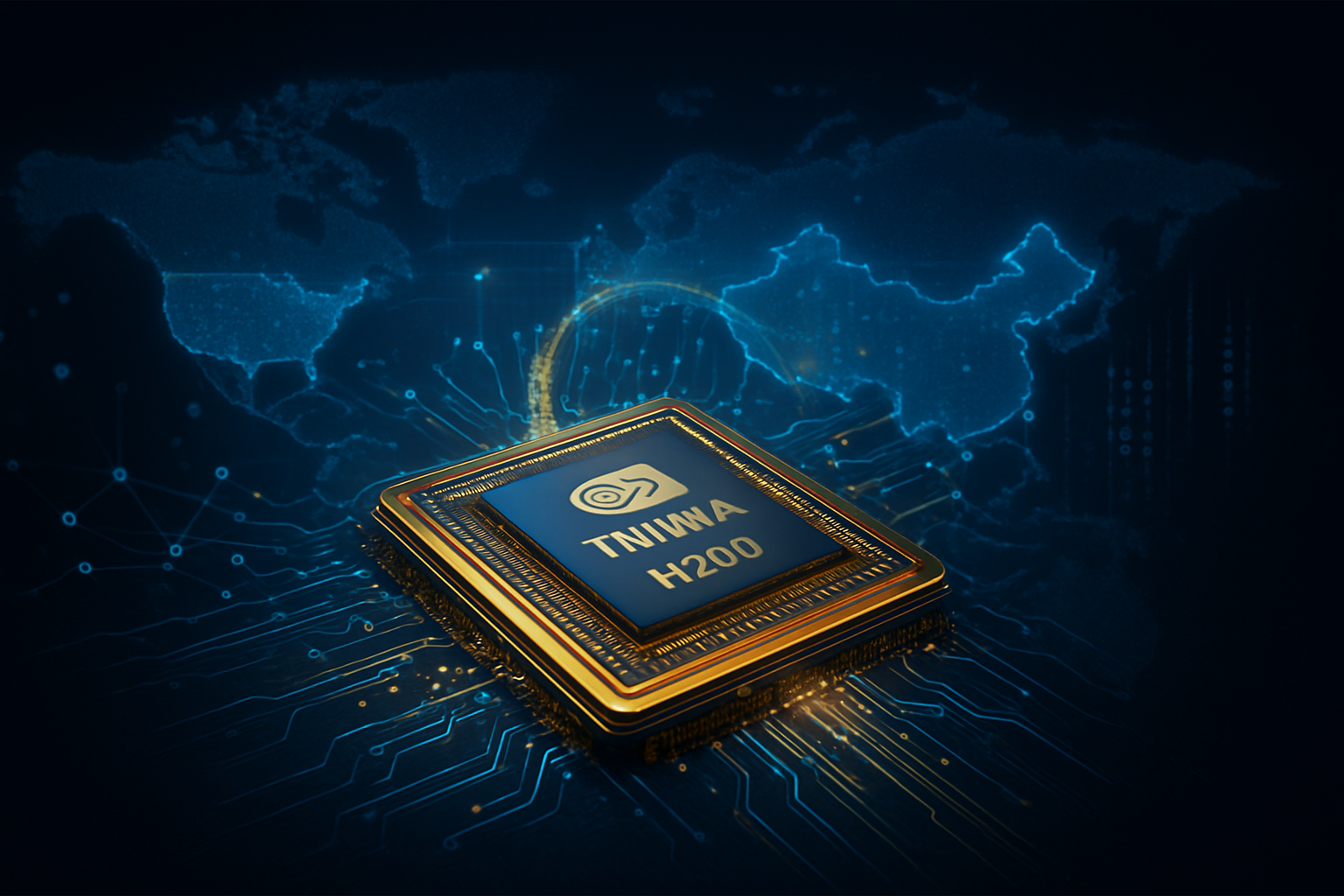
  • NVIDIA H200s Cleared for China: Inside the Trump Administration’s Bold High-Stakes Tech Thaw

    NVIDIA H200s Cleared for China: Inside the Trump Administration’s Bold High-Stakes Tech Thaw

    In a move that has sent shockwaves through both Silicon Valley and Beijing, the Trump administration has officially authorized the export of NVIDIA H200 GPU accelerators to the Chinese market. The decision, finalized in late January 2026, marks a dramatic reversal of the multi-year "presumption of denial" policy that had effectively crippled the sales of high-end American AI hardware to China. By replacing blanket bans with a transactional, security-monitored framework, the U.S. government aims to reassert American influence over global AI ecosystems while capturing significant federal revenue from the world’s second-largest economy.

    The policy shift is being hailed by industry leaders as a pragmatic "thaw" in tech relations, though it comes with a complex web of restrictions that distinguish it from the unrestricted trade of the past decade. For NVIDIA (NASDAQ: NVDA), the announcement represents a lifeline for its Chinese business, which had previously been relegated to selling "degraded" or lower-performance chips like the H20 to comply with strict 2023 and 2024 export controls. Under the new regime, the H200—one of the most powerful AI training and inference chips currently in production—will finally be available to vetted Chinese commercial entities.

    Advanced Silicon and the "Vulnerability Screening" Mandate

    The technical specifications of the NVIDIA H200 represent a massive leap forward for the Chinese AI industry. Built on the Hopper architecture, the H200 is the first GPU to feature HBM3e memory, delivering 141GB of capacity and 4.8 TB/s of memory bandwidth. Compared to the H100, the H200 offers nearly double the inference performance for large language models (LLMs) like Llama 3 or GPT-4. This bandwidth is the critical factor in modern AI scaling, and its availability in China is expected to dramatically shorten the training cycles for domestic Chinese models which had been stagnating under previous hardware constraints.

    To maintain a strategic edge, the U.S. Department of Commerce’s Bureau of Industry and Security (BIS) has introduced a new "regulatory sandwich." Under the January 13, 2026 ruling, chips are permitted for export only if their Total Processing Performance (TPP) remains below 21,000 and DRAM bandwidth stays under 6,500 GB/s. While the H200 fits within these specific bounds, the administration has eliminated the practice of "binning" or hardware-level performance capping for the Chinese market. Instead, the focus has shifted to who is using the chips and how they are being deployed.

    A key technical innovation in this policy is the "U.S. First" testing protocol. Before any H200 units are shipped to China, they must first be imported from manufacturing hubs into specialized American laboratories. There, they undergo "vulnerability screening" and technical verification to ensure no unauthorized firmware modifications have been made. This allows the U.S. government to maintain a literal hands-on check on the hardware before it enters the Chinese supply chain, a logistical hurdle that experts say is unprecedented in the history of semiconductor trade.

    Initial reactions from the AI research community have been cautiously optimistic. While researchers at institutions like Tsinghua University welcome the performance boost, there is lingering skepticism regarding the mandatory U.S. testing phase. Industry analysts note that this requirement could introduce a 4-to-6 week delay in the supply chain. However, compared to the alternative—developing sovereign silicon that still lags generations behind NVIDIA—most Chinese tech giants see this as a necessary price for performance.

    Revenue Levies and the Battle for Market Dominance

    The financial implications for NVIDIA are profound. Before the 2023 restrictions, China accounted for approximately 20% to 25% of NVIDIA’s data center revenue. This figure had plummeted as Chinese firms were forced to choose between underpowered U.S. chips and domestic alternatives. With the H200 now on the table, analysts predict a massive surge in capital expenditure from Chinese "hyperscalers" such as Alibaba (NYSE: BABA), Tencent (HKG: 0700), and Baidu (NASDAQ: BIDU). These companies have been eager to upgrade their aging infrastructure to compete with Western AI capabilities.

    However, the "Trump Thaw" is far from a free pass. The administration has imposed a mandatory 25% "revenue levy" on all H200 sales to China, structured as a Section 232 national security tariff. This ensures that the U.S. Treasury benefits directly from every transaction. Additionally, NVIDIA is subject to volume caps: the total number of H200s exported to China cannot exceed 50% of the volume sold to U.S. domestic customers. This "America First" ratio is designed to ensure that the U.S. always maintains a larger, more advanced install base of AI compute power.

    The move also places intense pressure on Advanced Micro Devices (NASDAQ: AMD), which has been seeking its own licenses for the Instinct MI325X series. As the market opens, a new competitive landscape is emerging where U.S. companies are not just competing against each other, but against the rising tide of Chinese domestic competitors like Huawei. By allowing the H200 into China, the U.S. is effectively attempting to "crowd out" Huawei’s Ascend 910C chips, making it harder for Chinese firms to justify the switch to a domestic ecosystem that remains more difficult to program for.

    Strategic advantages for ByteDance—the parent company of TikTok—are also in the spotlight. ByteDance has historically been one of NVIDIA's largest customers in Asia, using GPUs for its massive recommendation engines and generative AI projects. The ability to legally procure H200s gives ByteDance a clear path to maintaining its global competitive edge, provided it can navigate the stringent end-user vetting processes required by the new BIS rules.

    The Geopolitical "AI Overwatch" and a Fragile Thaw

    The broader significance of this decision cannot be overstated. It signals a shift in the U.S. strategy from total containment to a "managed dependency." By allowing China to buy NVIDIA’s second-best hardware (with the newer Blackwell architecture still largely restricted), the U.S. keeps the Chinese tech sector tethered to American software stacks like CUDA. Experts argue that if China were forced to fully decouple, they would eventually succeed in building a parallel, independent tech ecosystem. This policy is an attempt to delay that "Sputnik moment" indefinitely.

    This strategy has not been without fierce domestic opposition. On January 21, 2026, the House Foreign Affairs Committee advanced the "AI Overwatch Act" (H.R. 6875), a bipartisan effort to grant Congress the power to veto specific export licenses. Critics of the administration, including many "China hawks," argue that the H200 is too powerful to be exported safely. They contend that the 25% tariff is a "pay-to-play" scheme that prioritizes corporate profits and short-term federal revenue over long-term national security, fearing that the hardware will inevitably be diverted to military AI projects.

    Comparing this to previous AI milestones, such as the 2022 ban on the A100, the current situation represents a much more transactional approach to geopolitics. The administration's "AI and Crypto Czar," David Sacks, has defended the policy by stating that the U.S. must lead the global AI ecosystem through engagement rather than isolation. The "thaw" is seen as a way to lower the temperature on trade relations while simultaneously building a massive federal war chest funded by Chinese tech spending.

    Beijing’s response has been characteristically measured but complex. While the Ministry of Industry and Information Technology (MIIT) has granted "in-principle" approval for firms to order H200s, they have also reportedly mandated that for every U.S. chip purchased, a corresponding investment must be made in domestic silicon. This "one-for-one" quota system indicates that while China is happy to have access to NVIDIA’s power, it remains fully committed to its long-term goal of self-reliance.

    Future Developments: Blackwell and the Parity Race

    As we look toward the remainder of 2026, the primary question is whether this policy will extend to NVIDIA’s next-generation Blackwell architecture. Currently, the B200 remains restricted, keeping the "performance gap" between the U.S. and China at approximately 12 to 18 months. However, if the H200 export experiment is deemed a financial and security success, there is already talk in Washington of a "Blackwell Lite" variant being introduced by 2027.

    The near-term focus will be on the logistical execution of the "vulnerability screening" labs. If these facilities become a bottleneck, it could lead to renewed friction between the White House and the tech industry. Furthermore, the world will be watching to see if other nations, particularly in the Middle East and Southeast Asia, demand similar "case-by-case" license review policies to access the highest tiers of American compute power.

    Predicting the next moves of the Chinese "national champions" is also vital. With access to H200s, will Alibaba and Baidu finally reach parity with U.S.-based models like Claude or Gemini? Or will the U.S. domestic volume caps ensure that American labs always have a two-to-one advantage in raw compute? Most experts believe that while the H200 will prevent a total collapse of the Chinese AI sector, the structural advantages of the U.S. ecosystem—combined with the new 25% "AI Tax"—will keep the American lead intact.

    A New Chapter in the Silicon Cold War

    The approval of NVIDIA H200 exports to China is a defining moment in the history of artificial intelligence and international trade. It represents a pivot from the "small yard, high fence" strategy toward a more dynamic "toll-booth" model. By allowing high-performance hardware to flow into China under strict supervision and high taxation, the Trump administration is betting that economic interdependency can be used as a tool for national security rather than a vulnerability.

    In the coming weeks, the industry will watch closely for the first confirmed shipments of H200s landing in Shanghai and the resulting benchmarks from Chinese AI labs. The success or failure of this policy will likely dictate the trajectory of U.S.-China relations for the rest of the decade. If the H200s are used to create breakthroughs that threaten U.S. interests, the "AI Overwatch Act" will almost certainly be invoked to shut the gates once again.

    Ultimately, the H200 export decision is a high-stakes gamble. It provides NVIDIA and the U.S. Treasury with a massive financial windfall while offering China the tools it needs to stay in the AI race. Whether this leads to a stable "technological co-existence" or merely fuels the next phase of an escalating AI arms race remains the most critical question of 2026.


    This content is intended for informational purposes only and represents analysis of current AI developments.

    TokenRing AI delivers enterprise-grade solutions for multi-agent AI workflow orchestration, AI-powered development tools, and seamless remote collaboration platforms.
    For more information, visit https://www.tokenring.ai/.

  • The Silicon Super-Cycle: US Implements ‘Managed Bifurcation’ as Semiconductor Market nears $1 Trillion

    The Silicon Super-Cycle: US Implements ‘Managed Bifurcation’ as Semiconductor Market nears $1 Trillion

    As of January 8, 2026, the global semiconductor industry has entered a transformative era defined by what economists call the "Silicon Super-Cycle." With total annual revenue rapidly approaching the $1 trillion milestone, the geopolitical landscape has shifted from a chaotic trade war to a sophisticated state of "managed bifurcation." The United States government, moving beyond passive regulation, has emerged as an active market participant, implementing a groundbreaking revenue-sharing model for AI exports while simultaneously executing strategic interventions to protect domestic interests.

    This new paradigm was punctuated last week by the blocking of a sensitive acquisition and the revelation of a massive federal stake in the nation’s leading chipmaker. These moves signal a definitive end to the era of globalized, borderless silicon and the beginning of a world where advanced compute capacity is treated with the same strategic gravity as nuclear enrichment or oil reserves.

    The Revenue-Sharing Pivot and the 2nm Frontier

    The technical and policy centerpiece of early 2026 is the US Department of Commerce’s "reversal-for-revenue" strategy. In a surprising late-2025 policy shift, the US administration granted NVIDIA Corporation (NASDAQ: NVDA) permission to resume shipments of its high-performance H200 AI chips to select customers in China. However, this comes with a historic caveat: a mandatory 25% "geopolitical risk tax" on every unit sold, paid directly to the US Treasury. This model attempts to balance the commercial needs of American tech giants with the national security goal of funding domestic infrastructure through the profits of competitors.

    Technologically, the industry has reached the 2-nanometer (2nm) milestone. Taiwan Semiconductor Manufacturing Company (NYSE: TSM) reported this week that its N2 process has achieved commercial yields of nearly 70%, significantly ahead of internal projections. This leap allows for a 15% increase in speed or a 30% reduction in power consumption compared to the previous 3nm generation. This advancement is critical as the "Intelligence Economy" demands more efficient hardware to sustain the massive energy requirements of generative AI models that have now moved from text and image generation into real-time, high-fidelity world simulation.

    Initial reactions from the AI research community have been mixed. While the availability of H200-class hardware in China provides a temporary relief valve for global supply chains, industry experts note that the 25% tax effectively creates a "compute divide." Researchers in the West are already eyeing the next generation of Blackwell-Ultra and Rubin architectures, while Chinese firms are being forced to choose between heavily taxed US silicon or domestic alternatives like Huawei’s Ascend series, which Beijing is now mandating for state-level projects.

    Corporate Giants and the Rise of 'Sovereign AI'

    The corporate impact of these shifts is most visible in the partial "nationalization" of Intel Corporation (NASDAQ: INTC). Following a period of financial volatility in late 2025, the US government intervened with an $8.9 billion stock purchase, funded by the Secure Enclave program. This move ensures that the Department of Defense has a guaranteed, domestic source for leading-edge military and intelligence chips. Intel is now effectively a public-private partnership, focused on its Arizona and Oregon "Secure Enclaves" to maintain a "frontier compute" lead over global rivals.

    NVIDIA, meanwhile, is navigating a complex dual-market strategy. While facing a soft boycott in China—where Beijing has directed local firms to halt H200 orders in favor of domestic chips—the company has found a massive new growth engine in the Middle East. In late December 2025, the US greenlit a $1 billion shipment of 35,000 advanced chips to Saudi Arabia’s HUMAIN project and the UAE’s G42. This deal was contingent on the total removal of Chinese hardware from those nations' data centers, illustrating how the US is using its "silicon hegemony" to forge new diplomatic and technological alliances.

    Other major players like Advanced Micro Devices, Inc. (NASDAQ: AMD) and ASML Holding N.V. (NASDAQ: ASML) are adjusting to this highly regulated environment. AMD has seen increased demand for its MI350 series in markets where NVIDIA’s tax-heavy H200s are less competitive, while ASML continues to face tightening restrictions on the export of its High-NA EUV lithography machines, further cementing the "technological moat" around the US and its immediate allies.

    Geopolitical Friction and the 'Third Path'

    The wider significance of these developments lies in the aggressive stance the US is taking against even minor "on-ramps" for foreign influence. On January 2, 2026, a Presidential Executive Order blocked the $3 million acquisition of assets from Emcore Corporation (NASDAQ: EMKR) by HieFo Corp, a firm identified as having ties to Chinese nationals. While the deal was small in dollar terms, the focus was on Emcore’s expertise in indium phosphide (InP) chips—a technology vital for military lasers and advanced sensors. This underscores a policy of "zero-leakage" for dual-use technologies.

    In Europe, a "Third Path" is emerging. All 27 EU member states recently signed a declaration calling for "EU Chips Act 2.0," with a formal review scheduled for the first quarter of 2026. The goal is to secure €20 billion in additional funding to help Europe reach a 20% global market share by 2030. The EU is positioning itself as the global leader in specialized "specialty" chips for the automotive and industrial sectors, attempting to remain a neutral ground while the US and China continue their high-stakes compute race.

    This landscape is a stark departure from the early 2020s. We are no longer seeing a "chip shortage" driven by supply chain hiccups, but a "compute containment" strategy. The US is leveraging its 8:1 advantage in frontier compute capacity to dictate the terms of the global AI rollout, while China counters by leveraging its dominance in the critical mineral supply chains—gallium, germanium, and rare earths—necessary to build the next generation of hardware.

    The Road to 2030: Challenges and Predictions

    Looking ahead, the next 12 to 24 months will likely see the formalization of "CHIPS 2.0" in the United States. Rather than just building factories, the focus is shifting toward fraud risk management and the oversight of the original $50 billion fund. Experts predict that by 2027, the US will attempt to create a "Silicon NATO"—a formal alliance of nations that share compute resources and research while maintaining a unified export front against non-aligned states.

    A major challenge remains the "Malaysia Shift." Companies like Nexperia, currently under pressure due to Chinese ownership, are rapidly moving production to Southeast Asia to avoid "penetrating sanctions." This migration is creating a new semiconductor hub in Malaysia and Vietnam, which could eventually challenge the established order if they can move up the value chain from assembly and testing to actual wafer fabrication.

    Predicting the next move, analysts suggest that the "Intelligence Economy" will drive the semiconductor market toward $1.5 trillion by 2030. The primary hurdle will not be the physics of the chips themselves, but the geopolitical friction of their distribution. As AI models become more integrated into national infrastructure, the "sovereignty" of the silicon they run on will become the most important metric for any nation's security.

    Summary of the New Silicon Order

    The events of early 2026 mark a definitive turning point in the history of technology. The transition from free-market competition to "managed bifurcation" reflects the reality that semiconductors are now the foundational resource of the 21st century. The US government’s active role—from taking stakes in Intel to taxing NVIDIA’s exports—shows that the "invisible hand" of the market has been replaced by the strategic hand of the state.

    Key takeaways for the coming weeks include the EU’s formal decision on Chips Act 2.0 funding and the potential for a Chinese counter-response regarding critical mineral exports. As we monitor these developments, the central question remains: can the world sustain a $1 trillion industry that is increasingly divided by digital iron curtains, or will the cost of bifurcation eventually stifle the very AI revolution it seeks to control?


    This content is intended for informational purposes only and represents analysis of current AI developments.

    TokenRing AI delivers enterprise-grade solutions for multi-agent AI workflow orchestration, AI-powered development tools, and seamless remote collaboration platforms.
    For more information, visit https://www.tokenring.ai/.
  • The 2027 Cliff: Trump Administration Secures High-Stakes ‘Busan Truce’ Delaying Semiconductor Tariffs

    The 2027 Cliff: Trump Administration Secures High-Stakes ‘Busan Truce’ Delaying Semiconductor Tariffs

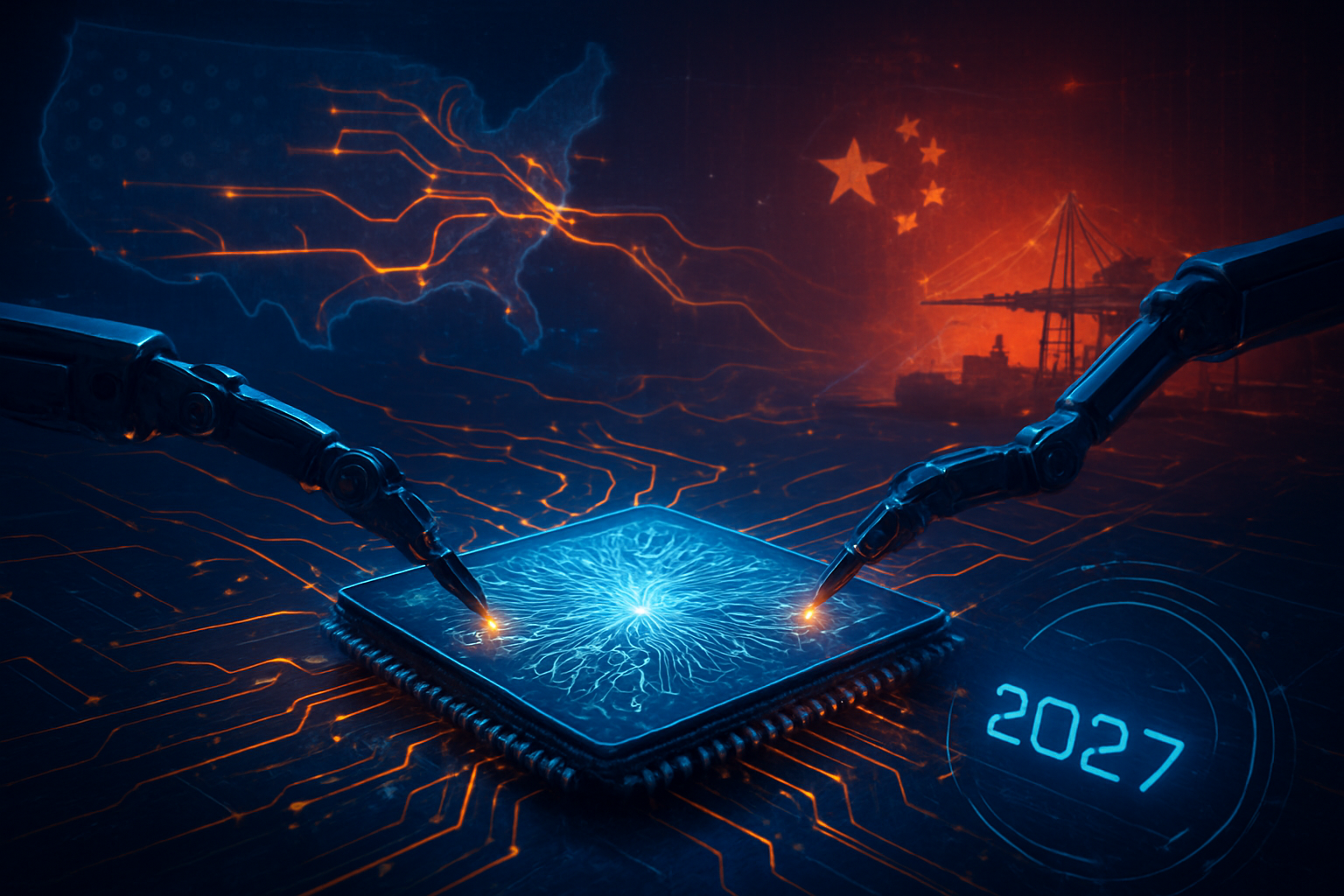
    In a move that has sent ripples through the global technology sector, the Trump administration has officially announced a tactical delay of semiconductor tariffs on Chinese imports until June 23, 2027. This decision, finalized in late 2025, serves as the cornerstone of the "Busan Truce"—a fragile diplomatic agreement reached between President Donald Trump and President Xi Jinping during the APEC summit in South Korea. The reprieve provides a critical breathing room for an AI industry that has been grappling with skyrocketing infrastructure costs and the looming threat of a total supply chain fracture.

    The immediate significance of this delay cannot be overstated. By setting the initial tariff rate at 0% for the next 18 months, the administration has effectively averted an immediate price shock for foundational "legacy" chips that power everything from data center cooling systems to the edge-AI devices currently flooding the consumer market. However, the June 2027 deadline acts as a "Sword of Damocles," forcing Silicon Valley to accelerate its "de-risking" strategies and onshore manufacturing capabilities before the 0% rate escalates into a potentially crippling protectionist wall.

    The Mechanics of the Busan Truce: A Tactical Reprieve

    The technical core of this announcement lies in the recalibration of the Section 301 investigation into China’s non-market practices. Rather than imposing immediate, broad-based levies, the U.S. Trade Representative (USTR) has opted for a tiered escalation strategy. The primary focus is on "foundational" or "legacy" semiconductors—chips manufactured on 28nm nodes or older. While these are not the cutting-edge H100s or B200s used for training Large Language Models (LLMs), they are essential for the power management and peripheral logic of AI servers. By delaying these tariffs, the administration is attempting to decouple the U.S. economy from Chinese mature-node dominance without triggering a domestic manufacturing crisis in the short term.

    Industry experts and the AI research community have reacted with a mix of relief and skepticism. The "Busan Truce" is not a formal treaty but a verbal and memorandum-based agreement that relies on mutual concessions. In exchange for the tariff delay, Beijing has agreed to a one-year pause on its aggressive export controls for rare earth metals, including gallium and germanium—elements vital for high-frequency AI communication hardware. However, technical analysts point out that China still maintains a "0.1% de minimis" threshold on refined rare earth elements, meaning they can still throttle the supply of finished magnets and specialized components at will, despite the raw material pause.

    This "transactional" approach to trade policy marks a significant departure from the more rigid export bans of the previous few years. The administration is essentially using the June 2027 date as a countdown clock for American firms to transition their supply chains. The technical challenge, however, remains immense: building a 28nm-capable foundry from scratch typically takes three to five years, meaning the 18-month window provided by the truce may still be insufficient for a total transition away from Chinese silicon.

    Winners, Losers, and the New 'Revenue-Sharing' Reality

    The impact on major technology players has been immediate and profound. NVIDIA (NASDAQ: NVDA), Advanced Micro Devices (NASDAQ: AMD), and Intel (NASDAQ: INTC) find themselves navigating a complex new landscape where market access is granted in exchange for "sovereignty fees." Under a new revenue-sharing model introduced alongside the truce, these companies are permitted to sell specifically neutered, high-end AI accelerators to the Chinese market, provided they pay a 25% "revenue share" directly to the U.S. Treasury. This allows these giants to maintain their lucrative Chinese revenue streams while funding the very domestic manufacturing subsidies that seek to replace Chinese suppliers.

    Apple (NASDAQ: AAPL) has emerged as a primary beneficiary of this strategic pivot. By pledging a staggering $100 billion investment into U.S.-based manufacturing and R&D over the next five years, the Cupertino giant secured a specific reprieve from the broader tariff regime. This "investment-for-exemption" strategy is becoming the new standard for tech titans. Meanwhile, smaller AI startups and hardware manufacturers are facing a more difficult path; while they benefit from the 0% tariff on legacy chips, they lack the capital to make the massive domestic investment pledges required to secure long-term protection from the 2027 "cliff."

    The competitive implications are also shifting toward the foundries. Intel (NASDAQ: INTC), as a domestic champion, stands to gain significantly as the 2027 deadline approaches, provided it can execute on its foundry roadmap. Conversely, the cost of building AI data centers has continued to rise due to auxiliary tariffs on steel, aluminum, and advanced cooling systems—materials not covered by the semiconductor truce. NVIDIA (NASDAQ: NVDA) reportedly raised prices on its latest AI accelerators by 15% in late 2025, citing the logistical overhead of navigating this fragmented global trade environment.

    Geopolitics and the Rare Earth Standoff

    The wider significance of the June 2027 delay is deeply rooted in the "Critical Minerals War." Throughout 2024 and early 2025, China weaponized its monopoly on rare earth elements, banning the export of antimony and "superhard materials" essential for the high-precision machinery used in chip fabrication. The Busan Truce’s one-year pause on these restrictions is seen as a major diplomatic win for the U.S., yet it remains a fragile peace. China continues to restrict the export of the refining technologies needed to process these minerals, ensuring that even if the U.S. mines its own rare earths, it remains dependent on Chinese infrastructure for processing.

    This development fits into a broader trend of "technological mercantilism," where AI hardware is no longer just a commodity but a primary instrument of statecraft. The 2027 deadline aligns with the anticipated completion of several major U.S. fabrication plants funded by the CHIPS Act, suggesting that the Trump administration is timing its trade pressure to coincide with the moment the U.S. achieves greater silicon self-sufficiency. This is a high-stakes gamble: if domestic capacity isn't ready by mid-2027, the resulting tariff wall could lead to a massive inflationary spike in AI services and consumer electronics.

    Furthermore, the truce highlights a growing divide in the AI landscape. While the U.S. and China are engaged in this "managed competition," other regions like the EU and Japan are being forced to choose sides or develop their own independent supply chains. The "0.1% de minimis" rule implemented by Beijing is particularly concerning for the global AI landscape, as it gives China extraterritorial reach over any AI hardware produced anywhere in the world that contains even trace amounts of Chinese-processed minerals.

    The Road to June 2027: What Lies Ahead

    Looking forward, the tech industry is entering a period of frantic "friend-shoring" and vertical integration. In the near term, expect to see major AI lab operators and cloud providers investing directly in mining and mineral processing to bypass the rare earth bottleneck. We are also likely to see an explosion in "AI-driven material science," as companies use their own models to discover synthetic alternatives to the rare earth metals currently under Chinese control.

    The long-term challenge remains the "2027 Cliff." As that date approaches, market volatility is expected to increase as investors weigh the possibility of a renewed trade war against the progress of U.S. domestic chip production. Experts predict that the administration may use the threat of the 2027 escalation to extract further concessions from Beijing, potentially leading to a "Phase Two" deal that addresses intellectual property theft and state subsidies more broadly. However, if diplomatic relations sour before then, the AI industry could face a sudden and catastrophic decoupling.

    Summary and Final Assessment

    The Trump administration’s decision to delay semiconductor tariffs until June 2027 represents a calculated "tactical retreat" designed to protect the current AI boom while preparing for a more self-reliant future. The Busan Truce has successfully de-escalated a looming crisis, securing a temporary flow of rare earth metals and providing a cost-stabilization window for hardware manufacturers. Yet, the underlying tensions of the U.S.-China tech rivalry remain unresolved, merely pushed further down the road.

    This development will likely be remembered as a pivotal moment in AI history—the point where the industry moved from a globalized "just-in-time" supply chain to a geopolitically-driven "just-in-case" model. For now, the AI industry has its reprieve, but the clock is ticking. In the coming months, the focus will shift from trade headlines to the construction sites of new foundries and the laboratories of material scientists, as the world prepares for the inevitable arrival of June 2027.


    This content is intended for informational purposes only and represents analysis of current AI developments.

    TokenRing AI delivers enterprise-grade solutions for multi-agent AI workflow orchestration, AI-powered development tools, and seamless remote collaboration platforms.
    For more information, visit https://www.tokenring.ai/.

  • The Great Decoupling: One Year Since the Biden Administration’s 2024 Semiconductor Siege

    The Great Decoupling: One Year Since the Biden Administration’s 2024 Semiconductor Siege

    In December 2024, the Biden Administration launched what has since become the most aggressive offensive in the ongoing "chip war," a sweeping export control package that fundamentally reshaped the global artificial intelligence landscape. By blacklisting 140 Chinese entities and imposing unprecedented restrictions on High Bandwidth Memory (HBM) and advanced lithography software, the U.S. moved beyond merely slowing China’s progress to actively dismantling its ability to scale frontier AI models. One year later, as we close out 2025, the ripples of this "December Surge" have created a bifurcated tech world, where the "compute gap" between East and West has widened into a chasm.

    The significance of the 2024 package lay in its precision and its breadth. It didn't just target hardware; it targeted the entire ecosystem—the memory that feeds AI, the software that designs the chips, and the financial pipelines that fund the factories. For the U.S., the goal was clear: prevent China from achieving the "holy grail" of 5nm logic and advanced HBM3e memory, which are essential for the next generation of generative AI. For the global semiconductor industry, it marked the end of the "neutral" supply chain, forcing giants like NVIDIA (NASDAQ: NVDA) and SK Hynix (KRX: 000660) to choose sides in a high-stakes geopolitical game.

    The Technical Blockade: HBM and the Software Key Lockdown

    At the heart of the December 2024 rules was a new technical threshold for High Bandwidth Memory (HBM), the specialized RAM that allows AI accelerators to process massive datasets. The Bureau of Industry and Security (BIS) established a "memory bandwidth density" limit of 2 gigabytes per second per square millimeter (2 GB/s/mm²). This specific metric was a masterstroke of regulatory engineering; it effectively banned the export of HBM2, HBM3, and HBM3e—the very components that power the NVIDIA H100 and Blackwell architectures. By cutting off HBM, the U.S. didn't just slow down Chinese chips; it created a "memory wall" that makes training large language models (LLMs) exponentially more difficult and less efficient.

    Beyond memory, the package took a sledgehammer to China’s "design-to-fab" pipeline by targeting three critical software categories: Electronic Computer-Aided Design (ECAD), Technology Computer-Aided Design (TCAD), and Computational Lithography. These tools are the invisible architects of the semiconductor world. Without the latest ECAD updates from Western leaders, Chinese designers are unable to layout complex 3D chiplet architectures. Furthermore, the U.S. introduced a novel "software key" restriction, stipulating that the act of providing a digital activation key for existing software now constitutes a controlled export. This effectively "bricked" advanced design suites already inside China the moment their licenses required renewal.

    The 140-entity addition to the U.S. Entity List was equally surgical. It didn't just target the usual suspects like Huawei; it went after the "hidden" champions of China's supply chain. This included Naura Technology Group (SHE: 002371), China’s largest toolmaker, and Piotech (SHA: 688072), a leader in thin-film deposition. By targeting these companies, the U.S. aimed to starve Chinese fabs of the domestic tools they would need to replace barred equipment from Applied Materials (NASDAQ: AMAT) or Lam Research (NASDAQ: LRCX). The inclusion of investment firms like Wise Road Capital also signaled a shift toward "geofinancial" warfare, blocking the capital flows used to acquire foreign IP.

    Market Fallout: Winners, Losers, and the "Pay-to-Play" Shift

    The immediate impact on the market was a period of intense volatility for the "Big Three" memory makers. SK Hynix (KRX: 000660) emerged as the dominant victor, leveraging its early lead in HBM3e to capture over 55% of the global market by late 2025. Having moved its most sensitive packaging operations out of China and into new facilities in Indiana and South Korea, SK Hynix became the primary partner for the U.S. AI boom. Conversely, Samsung Electronics (KRX: 005930) faced a grueling year; the revocation of its "Validated End User" (VEU) status for its Xi’an NAND plant in mid-2025 forced the company to pivot toward a maintenance-only strategy in China, leading to multi-billion dollar write-downs.

    For the logic players, the 2024 controls forced a radical strategic pivot. Micron Technology (NASDAQ: MU) effectively completed its exit from the Chinese server market this year, choosing to double down on the U.S. domestic supply chain backed by billions in CHIPS Act grants. Meanwhile, NVIDIA (NASDAQ: NVDA) spent much of 2025 navigating the narrow corridors of "License Exception HBM." In a surprising turn of events in late 2025, the U.S. government reportedly began piloting a "geoeconomic monetization" model, allowing NVIDIA to export limited quantities of H200-class hardware to vetted Chinese entities in exchange for a significant revenue-sharing agreement with the U.S. Treasury—a move that underscores how tech supremacy is now being used as a direct tool of national revenue and control.

    In China, the response was one of "brute-force" resilience. SMIC (HKG: 0981) and Huawei shocked the world in late 2025 by confirming the production of the Kirin 9030 SoC on a 5nm-class "N+3" node. However, this was achieved using quadruple-patterning on older Deep Ultraviolet (DUV) machines—a process that experts estimate has yields as low as 30% and costs 50% more than TSMC’s (NYSE: TSM) 5nm process. While China has proven it can technically manufacture 5nm chips, the 2024 controls have ensured that it cannot do so at a scale or cost that is commercially viable for global competition, effectively trapping their AI industry in a subsidized "high-cost bubble."

    The Wider Significance: A Small Yard with a Very High Fence

    The December 2024 package represented the full realization of National Security Advisor Jake Sullivan’s "small yard, high fence" strategy. By late 2025, it is clear that the "fence" is not just about keeping technology out of China, but about forcing the rest of the world to align with U.S. standards. The rules successfully pressured allies in Japan and the Netherlands to align their own export controls on lithography, creating a unified Western front that has made it nearly impossible for China to acquire the sub-14nm equipment necessary for sustainable advanced manufacturing.

    This development has had a profound impact on the broader AI landscape. We are now seeing the emergence of two distinct AI "stacks." In the West, the stack is built on NVIDIA's CUDA, HBM3e, and TSMC's 3nm nodes. In China, the stack is increasingly centered on Huawei’s Ascend 910C and the CANN software ecosystem. While the U.S. stack leads in raw performance, the Chinese stack is becoming a "captive market" masterclass, forcing domestic giants like Baidu (NASDAQ: BIDU) and Alibaba (NYSE: BABA) to optimize their software for less efficient hardware. This has led to a "software-over-hardware" innovation trend in China that some experts fear could eventually bridge the performance gap through sheer algorithmic efficiency.

    Looking Ahead: The 2026 Horizon and the HBM4 Race

    As we look toward 2026, the battleground is shifting to HBM4 and sub-2nm "GAA" (Gate-All-Around) transistors. The U.S. is already preparing a "2025 Refresh" of the export controls, which is expected to target the specific chemicals and precursor gases used in 2nm manufacturing. The challenge for the U.S. will be maintaining this pressure without causing a "DRAM famine" in the West, as the removal of Chinese capacity from the global upgrade cycle has already contributed to a 200% spike in memory prices over the last twelve months.

    For China, the next two years will be about survival through "circular supply chains." We expect to see more aggressive efforts to "scavenge" older DUV parts and a massive surge in domestic R&D for "Beyond-CMOS" technologies that might bypass the need for Western lithography altogether. However, the immediate challenge remains the "yield crisis" at SMIC; if China cannot move its 5nm process from a subsidized experiment to a high-yield reality, its domestic AI industry will remain permanently one to two generations behind the global frontier.

    Summary: A New Era of Algorithmic Sovereignty

    The Biden Administration’s December 2024 export control package was more than a regulatory update; it was a declaration of algorithmic sovereignty. By cutting off the HBM and software lifelines, the U.S. successfully "frozen" the baseline of Chinese AI capability, forcing the CCP to spend hundreds of billions of dollars just to maintain a fraction of the West's compute power. One year later, the semiconductor industry is no longer a global marketplace, but a collection of fortified islands.

    The key takeaway for 2026 is that the "chip war" has moved from a battle over who makes the chips to a battle over who can afford the memory. As AI models grow in size, the HBM restrictions of 2024 will continue to be the single most effective bottleneck in the U.S. arsenal. For investors and tech leaders, the coming months will require a close watch on the "pay-to-play" export licenses and the potential for a "memory-led" inflation spike that could redefine the economics of the AI era.


    This content is intended for informational purposes only and represents analysis of current AI developments.

    TokenRing AI delivers enterprise-grade solutions for multi-agent AI workflow orchestration, AI-powered development tools, and seamless remote collaboration platforms.
    For more information, visit https://www.tokenring.ai/.
  • Geopolitical Fault Lines Deepen: US Bill Targets Chinese Semiconductor Tools, Reshaping Global Tech Landscape

    Geopolitical Fault Lines Deepen: US Bill Targets Chinese Semiconductor Tools, Reshaping Global Tech Landscape

    Washington D.C., November 20, 2025 – The geopolitical chessboard of semiconductor trade is experiencing another seismic shift with the recent introduction of the Semiconductor Technology Resilience, Integrity, and Defense Enhancement (STRIDE) Act (H.R. 6058). Proposed on November 17, 2025, this bipartisan bill aims to dramatically reshape the supply chain for American chipmakers by prohibiting recipients of CHIPS Act funding from purchasing Chinese chipmaking equipment for a decade. This aggressive legislative move escalates the ongoing technological rivalry between the United States and China, sending ripples of uncertainty and strategic realignment across the global tech landscape.

    The STRIDE Act is the latest in a series of stringent measures taken by the US to curb China's advancements in critical semiconductor technology, underscoring a deepening commitment to national security and technological leadership. Its immediate significance lies in its direct impact on domestic manufacturing initiatives, forcing companies benefiting from significant federal subsidies to sever ties with Chinese equipment suppliers, thereby accelerating a broader decoupling of the two tech superpowers.

    The STRIDE Act: A New Front in the Tech War

    The proposed STRIDE Act explicitly targets the foundation of semiconductor manufacturing: the tools and equipment used to produce advanced chips. Under its provisions, any company receiving funding from the landmark CHIPS and Science Act of 2022 – which allocates over $52 billion to boost domestic semiconductor manufacturing and R&D – would be barred for ten years from acquiring chipmaking equipment from China, as well as from Iran, Russia, and North Korea. While the bill includes potential waivers, its intent is clear: to fortify a secure, resilient, and domestically-focused semiconductor supply chain.

    This legislation builds upon and intensifies previous US export controls. In October 2022, the Biden administration enacted sweeping restrictions on China's access to advanced computing and semiconductor manufacturing items, including AI chips and design tools. These were further expanded in December 2024, limiting the export of 24 types of cutting-edge chip-making equipment and three critical software tools necessary for producing advanced semiconductors at 7nm or below. These earlier measures also saw 140 Chinese companies, including prominent firms like Piotech and SiCarrier, added to an entity list, severely restricting their access to American technology. The STRIDE Act takes this a step further by directly influencing the procurement decisions of federally-funded US entities.

    The primary objective behind these stringent US policies is multifaceted. At its core, it’s a national security imperative to prevent China from leveraging advanced semiconductors for military modernization. The US also aims to maintain its global leadership in the semiconductor industry and emerging technologies like artificial intelligence and quantum computing, thereby impeding China's development of competitive capabilities. Initial reactions from the industry have been mixed. While some view it as a necessary step for national security, US chip equipment manufacturers, who previously benefited from the vast Chinese market, have expressed concerns about potential reduced sales and R&D opportunities.

    Navigating the New Landscape: Impacts on CHIPS Act Recipients and Tech Giants

    The STRIDE Act's introduction directly impacts recipients of CHIPS Act funding, compelling them to re-evaluate their supply chain strategies. Companies like Intel (NASDAQ: INTC), Taiwan Semiconductor Manufacturing Company (NYSE: TSM) (for its US operations), and Samsung (KRX: 005930) (for its US fabs), all significant beneficiaries of CHIPS Act incentives, will need to ensure their procurement practices align with the new prohibitions. This will likely necessitate a shift towards American, European, Japanese, or other allied nation suppliers for critical manufacturing equipment, fostering greater collaboration among trusted partners.

    The competitive implications for major AI labs and tech companies are substantial. While the immediate focus is on manufacturing equipment, the broader restrictions on advanced chip technology will continue to affect AI development. Companies reliant on cutting-edge AI chips, whether for training large language models or deploying advanced AI applications, will need to secure their supply chains, potentially favoring US or allied-made components. This could provide a strategic advantage to companies with strong domestic manufacturing ties or those with diversified international partnerships that exclude restricted nations.

    Potential disruption to existing products or services could arise from the need to re-qualify new equipment or adjust manufacturing processes. However, for CHIPS Act recipients, the long-term benefit of a more secure and resilient domestic supply chain, backed by federal funding, is expected to outweigh these short-term adjustments. For US chip equipment makers like Lam Research (NASDAQ: LRCX) and Applied Materials (NASDAQ: AMAT), while losing access to the Chinese market due to broader export controls has been a challenge, the STRIDE Act could, paradoxically, stimulate demand for their equipment from CHIPS Act-funded facilities in the US, albeit within a more restricted sales environment.

    Wider Significance: Decoupling, Innovation, and Geopolitical Realignment

    The STRIDE Act and preceding export controls are not isolated incidents but integral components of a broader US strategy to decouple its critical technology sectors from China. This ongoing technological rivalry is reshaping global alliances and supply chains, pushing countries to choose sides in an increasingly bifurcated tech ecosystem. The US is actively encouraging allied nations, including Japan, South Korea, and the Netherlands, to adopt similar export controls, aiming to form a united front against China's technological ambitions.

    However, this push for decoupling carries significant potential concerns. US semiconductor companies face substantial revenue losses due to reduced access to the vast Chinese market, the world's largest semiconductor consumer. This can lead to decreased R&D investment capabilities and job losses in the short term. Furthermore, the restrictions have led to disruptions in global supply chains, increasing costs and uncertainty. China has already retaliated by restricting exports of critical rare earth metals such as gallium and germanium, causing global price surges and prompting firms to seek alternative suppliers.

    Paradoxically, these restrictions have also galvanized China's efforts toward achieving semiconductor self-reliance. Beijing is channeling massive financial resources into its domestic semiconductor industry, encouraging in-house innovation, and pressuring domestic companies to procure Chinese-made semiconductors and equipment. A notable example is Huawei, which, in partnership with SMIC, was able to produce a 7nm chip despite stringent Western technology restrictions, a feat previously thought impossible. This suggests that while the US policies may slow China's progress, they also accelerate its resolve to develop indigenous capabilities, potentially leading to a fragmented global innovation landscape where parallel ecosystems emerge.

    The Road Ahead: Future Developments and Expert Predictions

    In the near term, the passage of the STRIDE Act will be a critical development to watch. Its implementation will necessitate significant adjustments for CHIPS Act recipients, further solidifying the domestic focus of US semiconductor manufacturing. We can expect continued diplomatic efforts by the US to align its allies on similar export control policies, potentially leading to a more unified Western approach to restricting China's access to advanced technologies. Conversely, China is expected to double down on its indigenous innovation efforts, further investing in domestic R&D and manufacturing capabilities, potentially through state-backed initiatives and national champions.

    Potential applications and use cases on the horizon include a robust, secure domestic supply of leading-edge chips, which could fuel advancements in US-based AI, quantum computing, and advanced defense systems. The emphasis on secure supply chains could also spur innovation in new materials and manufacturing processes that are less reliant on geopolitical flashpoints. However, challenges remain significant, including balancing national security imperatives with the economic interests of US companies, managing potential retaliatory measures from China, and ensuring that domestic production can meet the diverse demands of a rapidly evolving tech sector.

    Experts predict a continued trend of technological decoupling, leading to the emergence of two distinct, albeit interconnected, global tech ecosystems. While this may slow overall global innovation in some areas, it will undoubtedly accelerate innovation within each bloc as nations strive for self-sufficiency. The long-term impact could see a significant reshaping of global trade routes, investment flows, and technological partnerships. The coming months will be crucial in observing how the STRIDE Act progresses through the legislative process and how both US and Chinese companies adapt to this increasingly complex and politicized technological environment.

    A New Era of Geopolitical Tech Rivalry

    The introduction of the STRIDE Act marks a pivotal moment in the ongoing geopolitical saga of semiconductor trade. It underscores the US's unwavering commitment to securing its technological future and maintaining its leadership in critical sectors, even at the cost of further decoupling from China. The key takeaways are clear: the US is prioritizing national security over unfettered global economic integration in the semiconductor sector, CHIPS Act recipients face new, stringent procurement rules, and China's drive for technological self-reliance will only intensify.

    This development is significant in AI history not just for its direct impact on chip supply, but for setting a precedent for how nations will navigate the intersection of technology, trade, and international relations in an era where AI and advanced computing are central to economic and military power. The long-term impact will likely be a more fragmented but potentially more resilient global tech ecosystem, with nations increasingly focusing on securing domestic and allied supply chains for critical technologies.

    What to watch for in the coming weeks and months includes the legislative progress of the STRIDE Act, any further announcements regarding export controls or retaliatory measures from China, and how major semiconductor companies and CHIPS Act recipients adjust their strategic plans. The geopolitical currents shaping the semiconductor industry are strong, and their effects will continue to ripple through the entire global tech landscape for years to come.


    This content is intended for informational purposes only and represents analysis of current AI developments.

    TokenRing AI delivers enterprise-grade solutions for multi-agent AI workflow orchestration, AI-powered development tools, and seamless remote collaboration platforms.
    For more information, visit https://www.tokenring.ai/.

  • US and Chinese Experts Poised to Forge Consensus on Restricting Military AI

    US and Chinese Experts Poised to Forge Consensus on Restricting Military AI

    As the world grapples with the accelerating pace of artificial intelligence development, a significant, albeit unofficial, step towards global AI governance is on the horizon. Tomorrow, November 19, 2025, experts from the United States and China are expected to converge in Hong Kong, aiming to establish a crucial consensus on limiting the use of AI in the defense sector. This anticipated agreement, while not a binding governmental treaty, signifies a pivotal moment in the ongoing dialogue between the two technological superpowers, highlighting a shared understanding of the inherent risks posed by unchecked AI in military applications.

    The impending expert consensus builds upon a foundation of prior intergovernmental talks initiated in November 2023, when US President Joe Biden and Chinese President Xi Jinping first agreed to launch discussions on AI safety. Subsequent high-level dialogues in May and August 2024 laid the groundwork for exchanging views on AI risks and governance. The Hong Kong forum represents a tangible move towards identifying specific areas for restriction, particularly emphasizing the need for cooperation in preventing AI's weaponization in sensitive domains like bioweapons.

    Forging Guardrails: Specifics of Military AI Limitations

    The impending consensus in Hong Kong is expected to focus on several critical areas designed to establish robust guardrails around military AI. Central to these discussions is the principle of human control over critical functions, with experts advocating for a mutual pledge ensuring affirmative human authorization for any weapons employment, even by AI-enabled platforms, in peacetime and routine military encounters. This move directly addresses widespread ethical concerns regarding autonomous weapon systems and the potential for unintended escalation.

    A particularly sensitive area of focus is nuclear command and control. Building on a previous commitment between Presidents Biden and Xi Jinping in 2024 regarding human control over nuclear weapon decisions, experts are pushing for a mutual pledge not to use AI to interfere with each other's nuclear command, control, and communications systems. This explicit technical limitation aims to reduce the risk of AI-induced accidents or miscalculations involving the most destructive weapons. Furthermore, the forum is anticipated to explore the establishment of "red lines" – categories of AI military applications deemed strictly off-limits. These taboo norms would clarify thresholds not to be crossed, thereby reducing the risks of uncontrolled escalation. Christopher Nixon Cox, a board member of the Richard Nixon Foundation, specifically highlighted bioweapons as an "obvious area" for US-China collaboration to limit AI's influence.

    These proposed restrictions mark a significant departure from previous approaches, which often involved unilateral export controls by the United States (such as the sweeping AI chip ban in October 2022) aimed at limiting China's access to advanced AI hardware and software. While those restrictions continue, the Hong Kong discussions signal a shift towards mutual agreement on limitations, fostering a more collaborative, rather than purely competitive, approach to AI governance in defense. Unlike earlier high-level talks in May 2024, which focused broadly on exchanging views on "technical risks of AI" without specific deliverables, this forum aims for more concrete, technical limitations and mutually agreed-upon "red lines." China's consistent advocacy for global AI cooperation, including a July 2025 proposal for an international AI cooperation organization, finds a specific bilateral platform here, potentially bridging definitional gaps concerning autonomous weapons.

    Initial reactions from the AI research community and industry experts are a blend of cautious optimism and urgent calls for stability. There is a broad recognition of AI's inherent fragility and the potential for catastrophic accidents in high-stakes military scenarios, making robust safeguards imperative. While some US chipmakers have expressed concerns about losing market share in China due to existing export controls – potentially spurring China's domestic chip development – many experts, including former (Alphabet (NASDAQ: GOOGL)) CEO Eric Schmidt, emphasize the critical need for US-China collaboration on AI to maintain global stability and ensure human control. Despite these calls for cooperation, a significant lack of trust between the two nations remains, complicating efforts to establish effective governance. Chinese officials, for instance, have previously viewed US "responsible AI" approaches with skepticism, seeing them as attempts to avoid multilateral negotiations. This underlying tension makes achieving comprehensive, binding agreements "logically difficult," as noted by Tsinghua University's Sun Chenghao, yet underscores the importance of even expert-level consensus.

    Navigating the AI Divide: Implications for Tech Giants and Startups

    The impending expert consensus on restricting military AI, while a step towards global governance, operates within a broader context of intensifying US-China technological competition, profoundly impacting AI companies, tech giants, and startups on both sides. The landscape is increasingly bifurcated, forcing strategic adaptations and creating distinct winners and losers.

    For US companies, the effects are mixed. Chipmakers and hardware providers like (NVIDIA (NASDAQ: NVDA)) have already faced significant restrictions on exporting advanced AI chips to China, compelling them to develop less powerful, China-specific alternatives, impacting revenue and market share. AI firms developing dual-use technologies face heightened scrutiny and export controls, limiting market reach. Furthermore, China has retaliated by banning several US defense firms and AI companies, including TextOre, Exovera, (Skydio (Private)), and (Shield AI (Private)), from its market. Conversely, the US government's robust support for domestic AI development in defense creates significant opportunities for startups like (Anduril Industries (Private)), (Scale AI (Private)), (Saronic (Private)), and (Rebellion Defense (Private)), enabling them to disrupt traditional defense contractors. Companies building foundational AI infrastructure also stand to benefit from streamlined permits and access to compute resources.

    On the Chinese side, the restrictions have spurred a drive for indigenous innovation. While Chinese AI labs have been severely hampered by limited access to cutting-edge US AI chips and chip-making tools, hindering their ability to train large, advanced AI models, this has accelerated efforts towards "algorithmic sovereignty." Companies like DeepSeek have shown remarkable progress in developing advanced AI models with fewer resources, demonstrating innovation under constraint. The Chinese government's heavy investment in AI research, infrastructure, and military applications creates a protected and well-funded domestic market. Chinese firms are also strategically building dominant positions in open-source AI, cloud infrastructure, and global data ecosystems, particularly in emerging markets where US policies may create a vacuum. However, many Chinese AI and tech firms, including (SenseTime (HKEX: 0020)), (Inspur Group (SSE: 000977)), and the Beijing Academy of Artificial Intelligence, remain on the US Entity List, restricting their ability to obtain US technologies.

    The competitive implications for major AI labs and tech companies are leading to a more fragmented global AI landscape. Both nations are prioritizing the development of their own comprehensive AI ecosystems, from chip manufacturing to AI model production, fostering domestic champions and reducing reliance on foreign components. This will likely lead to divergent innovation pathways: US labs, with superior access to advanced chips, may push the boundaries of large-scale model training, while Chinese labs might excel in software optimization and resource-efficient AI. The agreement on human control in defense AI could also spur the development of more "explainable" and "auditable" AI systems globally, impacting AI design principles across sectors. Companies are compelled to overhaul supply chains, localize products, and navigate distinct market blocs with varying hardware, software, and ethical guidelines, increasing costs and complexity. The strategic race extends to control over the entire "AI stack," from natural resources to compute power and data, with both nations vying for dominance. Some analysts caution that an overly defensive US strategy, focusing too heavily on restrictions, could inadvertently allow Chinese AI firms to dominate AI adoption in many nations, echoing past experiences with Huawei.

    A Crucial Step Towards Global AI Governance and Stability

    The impending consensus between US and Chinese experts on restricting AI in defense holds immense wider significance, transcending the immediate technical limitations. It emerges against the backdrop of an accelerating global AI arms race, where both nations view AI as pivotal to future military and economic power. This expert-level agreement could serve as a much-needed moderating force, potentially reorienting the focus from unbridled competition to cautious, targeted collaboration.

    This initiative aligns profoundly with escalating international calls for ethical AI development and deployment. Numerous global bodies, from UNESCO to the G7, have championed principles of human oversight, transparency, and accountability in AI. By attempting to operationalize these ethical tenets in the high-stakes domain of military applications, the US-China consensus demonstrates that even geopolitical rivals can find common ground on responsible AI use. This is particularly crucial concerning the emphasis on human control over AI in the military sphere, especially regarding nuclear weapons, addressing deep-seated ethical and existential concerns.

    The potential impacts on global AI governance and stability are profound. Currently, AI governance is fragmented, lacking universally authoritative institutions. A US-China agreement, even at an expert level, could serve as a foundational step towards more robust global frameworks, demonstrating that cooperation is achievable amidst competition. This could inspire other nations to engage in similar dialogues, fostering shared norms and standards. By establishing agreed-upon "red lines" and restrictions, especially concerning lethal autonomous weapons systems (LAWS) and AI's role in nuclear command and control, the likelihood of accidental or rapid escalation could be significantly mitigated, enhancing global stability. This initiative also aims to foster greater transparency in military AI development, building confidence between the two superpowers.

    However, the inherent dual-use dilemma of AI technology presents a formidable challenge. Advancements for civilian purposes can readily be adapted for military applications, and vice versa. China's military-civil fusion strategy explicitly seeks to leverage civilian AI for national defense, intensifying this problem. While the agreement directly confronts this dilemma by attempting to draw lines where AI's application becomes impermissible for military ends, enforcing such restrictions will be exceptionally difficult, requiring innovative verification mechanisms and unprecedented international cooperation to prevent the co-option of private sector and academic research for military objectives.

    Compared to previous AI milestones – from the Turing Test and the coining of "artificial intelligence" to Deep Blue's victory in chess, the rise of deep learning, and the advent of large language models – this agreement stands out not as a technological achievement, but as a geopolitical and ethical milestone. Past breakthroughs showcased what AI could do; this consensus underscores the imperative of what AI should not do in certain contexts. It represents a critical shift from simply developing AI to actively governing its risks on an international scale, particularly between the world's two leading AI powers. Its importance is akin to early nuclear arms control discussions, recognizing the existential risks associated with a new, transformative technology and attempting to establish guardrails before a full-blown crisis emerges, potentially setting a crucial precedent for future international norms in AI governance.

    The Road Ahead: Challenges and Predictions for Military AI Governance

    The anticipated consensus between US and Chinese experts on restricting AI in defense, while a significant step, is merely the beginning of a complex journey towards effective international AI governance. In the near term, a dual approach of unilateral restrictions and bilateral dialogues is expected to persist. The United States will likely continue and potentially expand its export and investment controls on advanced AI chips and systems to China, particularly those with military applications, as evidenced by a final rule restricting US investments in Chinese AI, semiconductor, and quantum information technologies that took effect on January 2, 2025. Simultaneously, China will intensify its "military-civil fusion" strategy, leveraging its civilian tech sector to advance military AI and circumvent US restrictions, focusing on developing more efficient and less expensive AI technologies. Non-governmental "Track II Dialogues" will continue to explore confidence-building measures and "red lines" for unacceptable AI military applications.

    Longer-term developments point towards a continued bifurcation of global AI ecosystems, with the US and China developing distinct technological architectures and values. This divergence, coupled with persistent geopolitical tensions, makes formal, verifiable, and enforceable AI treaties between the two nations unlikely in the immediate future. However, the ongoing discussions are expected to shape the development of specific AI applications. Restrictions primarily target AI systems for weapons targeting, combat, location tracking, and advanced AI chips crucial for military development. Governance discussions will influence lethal autonomous weapon systems (LAWS), emphasizing human control over the use of force, and AI in command and control (C2) and decision support systems (DSS), where human oversight is paramount to mitigate automation bias. The mutual pledge regarding AI's non-interference with nuclear command and control will also be a critical area of focus.

    Implementing and expanding upon this consensus faces formidable challenges. The dual-use nature of AI technology, where civilian advancements can readily be militarized, makes regulation exceptionally difficult. The technical complexity and "black box" nature of advanced AI systems pose hurdles for accountability, explainability, and regulatory oversight. Deep-seated geopolitical rivalry and a fundamental lack of trust between the US and China will continue to narrow the space for effective cooperation. Furthermore, devising and enforcing verifiable agreements on AI deployment in military systems is inherently difficult, given the intangible nature of software and the dominance of the private sector in AI innovation. The absence of a comprehensive global framework for military AI governance also creates a perilous regulatory void.

    Experts predict that while competition for AI leadership will intensify, there's a growing recognition of the shared responsibility to prevent harmful military AI uses. International efforts will likely prioritize developing shared norms, principles, and confidence-building measures rather than binding treaties. Military AI is expected to fundamentally alter the character of war, accelerating combat tempo and changing risk thresholds, potentially eroding policymakers' understanding of adversaries' behavior. Concerns will persist regarding operational dangers like algorithmic bias and automation bias. Experts also warn of the risks of "enfeeblement" (decreasing human skills due to over-reliance on AI) and "value lock-in" (AI systems amplifying existing biases). The proliferation of AI-enabled weapons is a significant concern, pushing for multilateral initiatives from groups like the G7 to establish global standards and ensure responsible AI use in warfare.

    Charting a Course for Responsible AI: A Crucial First Step

    The impending expert consensus between Chinese and US experts on restricting AI in defense represents a critical, albeit foundational, moment in the history of artificial intelligence. The key takeaway is a shared recognition of the urgent need for human control over lethal decisions, particularly concerning nuclear weapons, and a general agreement to limit AI's application in military functions to foster collaboration and dialogue. This marks a shift from solely unilateral restrictions to a nascent bilateral understanding of shared risks, building upon established official dialogue channels between the two nations.

    This development holds immense significance, positioning itself not as a technological breakthrough, but as a crucial geopolitical and ethical milestone. In an era often characterized by an AI arms race, this consensus attempts to forge norms and governance regimes, akin to early nuclear arms control efforts. Its long-term impact hinges on the ability to translate these expert-level understandings into more concrete, verifiable, and enforceable agreements, despite deep-seated geopolitical rivalries and the inherent dual-use challenge of AI. The success of these initiatives will ultimately depend on both powers prioritizing global stability over unilateral advantage.

    In the coming weeks and months, observers should closely monitor any further specifics emerging from expert or official channels regarding what types of military AI applications will be restricted and how these restrictions might be implemented. The progress of official intergovernmental dialogues, any joint statements, and advancements in establishing a common glossary of AI terms will be crucial indicators. Furthermore, the impact of US export controls on China's AI development and Beijing's adaptive strategies, along with the participation and positions of both nations in broader multilateral AI governance forums, will offer insights into the evolving landscape of military AI and international cooperation.


    This content is intended for informational purposes only and represents analysis of current AI developments.

    TokenRing AI delivers enterprise-grade solutions for multi-agent AI workflow orchestration, AI-powered development tools, and seamless remote collaboration platforms.
    For more information, visit https://www.tokenring.ai/.