
Tag: US Trade

  • The Silicon Pact: US and Taiwan Ink $500 Billion Landmark Trade Deal to Secure AI Future

    The Silicon Pact: US and Taiwan Ink $500 Billion Landmark Trade Deal to Secure AI Future

    In a move that fundamentally reshapes the global technology landscape, the United States and Taiwan signed a historic trade agreement on January 15, 2026, officially known as the "Silicon Pact." This sweeping deal secures a massive $250 billion commitment from leading Taiwanese technology firms to expand their footprint in the U.S., matched by $250 billion in credit guarantees from the American government. The primary objective is the creation of a vertically integrated, "full-stack" semiconductor supply chain within North America, effectively shielding the critical infrastructure required for the artificial intelligence revolution from geopolitical volatility.

    The signing of the agreement marks the end of a decades-long reliance on offshore manufacturing for the world’s most advanced processors. By establishing a domestic ecosystem that includes everything from raw wafer production to advanced lithography and chemical processing, the U.S. aims to decouple its AI future from vulnerable overseas routes. Immediate market reaction was swift, with semiconductor indices surging as the pact also included a strategic reduction of baseline tariffs on Taiwanese imports from 20% to 15%, providing an instant financial boost to the hardware companies fueling the generative AI boom.

    Technical Infrastructure: Beyond the Fab to a Full Supply Chain

    The technical backbone of the deal centers on the rapid expansion of "megafab" clusters, primarily in Arizona and Texas. Taiwan Semiconductor Manufacturing Co. (NYSE: TSM), the linchpin of the pact, has committed to expanding its initial three-fab roadmap to a staggering 11-fab complex by 2030. This expansion isn't just about quantity; it brings the world’s first domestic 2-nanometer (2nm) and sub-2nm mass production lines to U.S. soil. Unlike previous initiatives that focused solely on logic chips, this agreement includes the entire ecosystem: GlobalWafers (TPE: 6488) is scaling its 300mm silicon wafer plant in Texas, while Chang Chun Group and Sunlit Chemical are building specialized facilities to provide the electronic-grade chemicals required for high-NA EUV lithography.

    A critical, often overlooked component of the pact is the commitment to advanced packaging. For years, "Made in America" chips still had to be shipped back to Asia for the complex assembly required for high-performance AI chips like those from NVIDIA (NASDAQ: NVDA). Under the new deal, a network of domestic packaging centers will be established in collaboration with firms like Amkor and Hon Hai Technology Group (Foxconn) (TPE: 2317). This technical integration ensures that the "latency of the ocean" is removed from the supply chain, allowing for a 30% faster turnaround from silicon design to data center deployment. Industry experts note that this represents the first time a major manufacturing nation has attempted to replicate the high-density industrial "clustering" effect of Hsinchu, Taiwan, within the vast geography of the United States.

    Industry Impact: Bridging the Software-Hardware Divide

    The implications for the technology industry are profound, creating a "two-tier" market where participants in the Silicon Pact gain significant strategic advantages. Cloud hyperscalers like Microsoft (NASDAQ: MSFT), Amazon (NASDAQ: AMZN), and Alphabet (NASDAQ: GOOGL) are expected to be the immediate beneficiaries, as the domestic supply chain will offer them first-access to "sovereign" AI hardware that meets the highest security standards. Meanwhile, Intel (NASDAQ: INTC) stands to gain through enhanced cross-border collaboration, as the pact encourages joint ventures between Intel Foundry and Taiwanese designers like MediaTek (TPE: 2454), who are increasingly moving their mobile and AI edge-device production to U.S.-based nodes.

    For consumer tech giants, the deal provides a long-awaited hedge against supply shocks. Apple (NASDAQ: AAPL), which has long been TSMC’s largest customer, will see its high-end iPhone and Mac processors manufactured entirely within the U.S. by 2027. The competitive landscape will likely see a shift where "hardware-software co-design" becomes more localized. Startups specializing in niche AI applications will also benefit from the $250 billion in credit guarantees, which are specifically designed to help smaller tier-two and tier-three suppliers move their operations to the new American tech hubs, ensuring that the supply chain isn't just a collection of giant fabs, but a robust network of specialized innovators.

    Geopolitical Significance and the "Silicon Shield"

    Beyond the immediate economic figures, the US-Taiwan deal signals a broader shift toward "Sovereign AI." In a world where compute power has become synonymous with national power, the ability to produce advanced semiconductors is no longer just a business interest—it is a national security imperative. The reduction of tariffs from 20% to 15% is a deliberate diplomatic lever, effectively rewarding Taiwan for its cooperation while creating a "Silicon Shield" that integrates the two economies more tightly than ever before. This move is a clear response to the global trend of "onshoring," mirroring similar moves by the European Union and Japan to secure their own technological autonomy.

    However, the scale of this commitment has raised concerns regarding environmental and labor impacts. Building 11 mega-fabs in a water-stressed state like Arizona requires unprecedented investments in water reclamation and renewable energy infrastructure. The $250 billion in U.S. credit guarantees, largely funneled through the Department of Energy’s loan programs, are intended to address this by funding massive clean-energy projects to power these power-hungry facilities. Comparisons are already being drawn to the historic breakthroughs of the 1950s aerospace era; this is the "Apollo Program" of the AI age, a massive state-supported push to ensure the digital foundation of the next century remains stable.

    The Road Ahead: 2nm Nodes and the Infrastructure of 2030

    Looking ahead, the near-term focus will be on the construction "gold rush" in the Southwest. By mid-2026, the first wave of specialized Taiwanese suppliers is expected to break ground on over 40 new facilities. The real test of the pact will come in 2027 and 2028, as the first 2nm chips roll off the assembly lines. We are also likely to see the emergence of "AI Economic Zones" in Texas and Arizona, where local universities and tech firms receive targeted funding to develop the talent pool required to manage these highly automated facilities.

    Experts predict that the next phase of this trade relationship will focus on "next-gen" materials beyond silicon, such as gallium nitride and silicon carbide for power electronics. Challenges remain, particularly in workforce development and the potential for regulatory bottlenecks. If the U.S. cannot streamline its permitting processes for these high-tech zones, the massive financial commitments could face delays. However, the sheer scale of the $500 billion framework suggests a political and corporate will that is unlikely to be deterred by bureaucratic hurdles.

    Summary: A New Era for the AI Economy

    The signing of the US-Taiwan trade deal on January 15, 2026, will be remembered as the moment the AI era transitioned from a software race to a physical infrastructure reality. By committing half a trillion dollars in combined private and public resources, the two nations have laid a foundation for decades of technological growth. The key takeaway for the industry is clear: the future of high-performance computing is moving home, and the era of the "globalized-but-fragile" supply chain is coming to a close.

    As the industry watches these developments, the focus over the coming months will shift to the implementation phase. Investors will be looking for quarterly updates on construction milestones and the first signs of the "clustering effect" taking hold. This development doesn't just represent a new chapter in trade; it defines the infrastructure of the 21st century.


    This content is intended for informational purposes only and represents analysis of current AI developments.

    TokenRing AI delivers enterprise-grade solutions for multi-agent AI workflow orchestration, AI-powered development tools, and seamless remote collaboration platforms.
    For more information, visit https://www.tokenring.ai/.
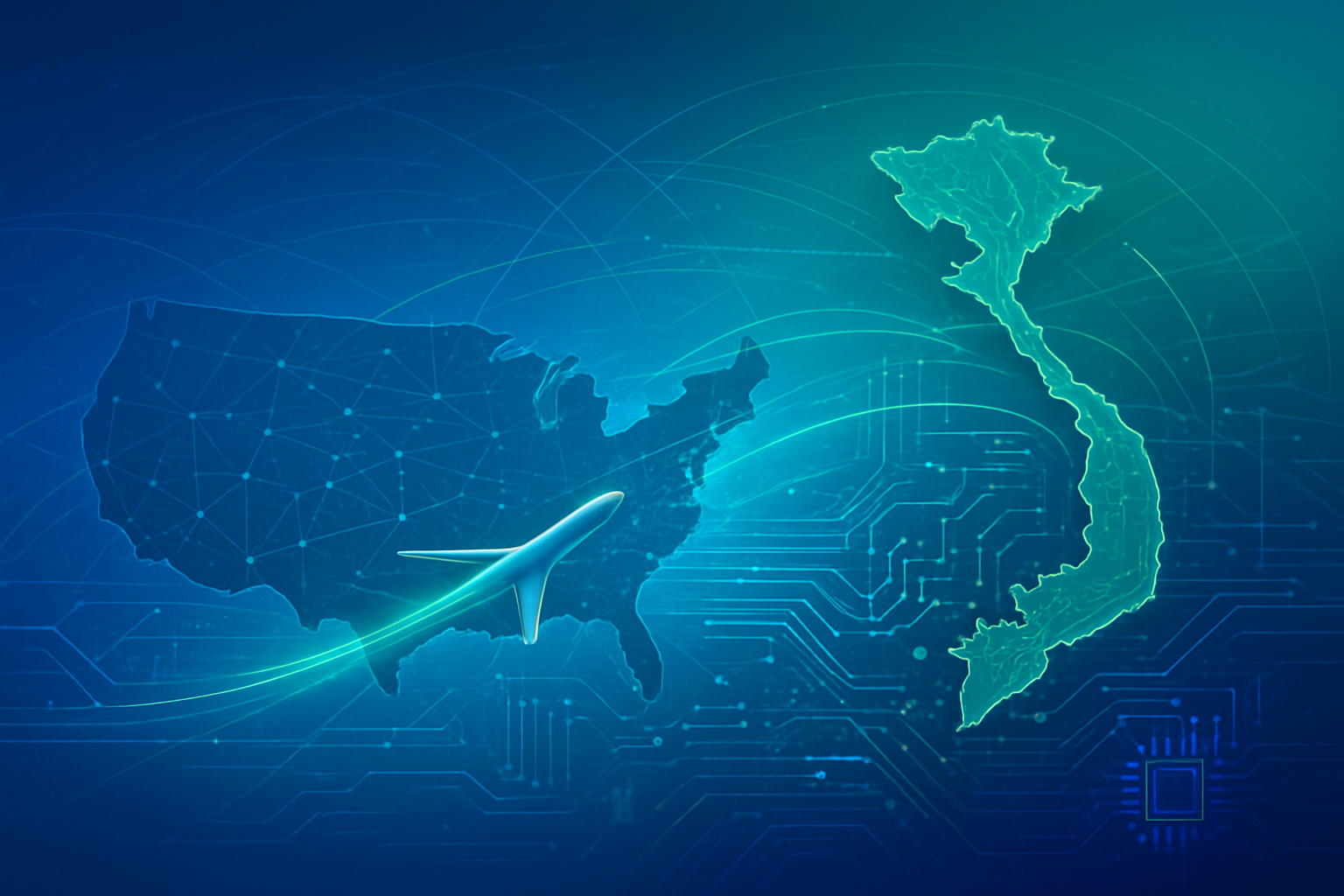
  • Vietnam’s High-Tech Ambitions Soar: A New Era of US Trade and Strategic Partnership

    Vietnam’s High-Tech Ambitions Soar: A New Era of US Trade and Strategic Partnership

    Hanoi, Vietnam – October 23, 2025 – Vietnam is rapidly accelerating its pursuit of high-tech American goods, particularly in the critical sectors of aircraft and semiconductors, signaling a profound shift in its economic and geopolitical strategy. This intensified interest is not merely about acquiring advanced technology; it represents a deliberate effort to deepen technological collaboration with the United States, diversify global supply chains, and elevate Vietnam's position in the international arena. The flurry of delegation exchanges, high-level meetings, and significant investment pledges underscores a burgeoning strategic partnership with far-reaching implications for global trade and regional stability.

    This strategic pivot is driven by Vietnam's ambitious goals to modernize its economy, enhance its defense capabilities, and mitigate trade imbalances with the U.S. By actively seeking to import more American high-tech products, Vietnam aims to rebalance its substantial trade surplus with the U.S., which reached $104.4 billion in 2024, thereby reducing the risk of trade disputes and strengthening its diplomatic ties. The move also positions Vietnam as a crucial player in the ongoing global restructuring of supply chains, offering an attractive alternative for companies looking to diversify their manufacturing and R&D operations away from traditional hubs.

    Unpacking the High-Tech Influx: Aircraft and Semiconductor Specifics

    Vietnam's embrace of American high-tech is manifesting through concrete agreements and significant investments across both its commercial and defense sectors. The specifics reveal a clear intent to upgrade capabilities and integrate more deeply into advanced global ecosystems.

    In the aviation sector, Vietnamese carriers are making substantial commitments to American manufacturers. Vietjet has a standing order for 200 Boeing (NYSE: BA) 737 MAX aircraft, with 14 scheduled for delivery in 2025, part of a deal potentially valued at $20 billion. Similarly, Vietnam Airlines finalized a $7.8 billion agreement with Boeing in September 2023 for 50 737 MAX aircraft, aiming to modernize its narrow-body fleet and expand routes. Beyond commercial aviation, Vietnam is also eyeing military hardware, with reports of an agreement to purchase at least 24 Lockheed Martin (NYSE: LMT) F-16 V fighter jets and consideration for C-130J military transport planes. The Textron Aviation (NYSE: TXT) T-6C trainer aircraft have already begun delivery, with the first five of 12 arriving in November 2024, crucial for modernizing pilot training. These procurements mark a significant diversification away from Vietnam's historical reliance on Russian arms and a strategic alignment with Western defense technology.

    The semiconductor industry is witnessing an even more profound transformation. Vietnam is actively positioning itself as a critical node in the global semiconductor supply chain, attracting major US investments. Intel (NASDAQ: INTC) has invested over $1.5 billion in its chip assembly and test manufacturing facility in Ho Chi Minh City, its largest global facility of its kind. Nvidia (NASDAQ: NVDA) has committed $250 million to partnerships with Vietnamese companies like Viettel, FPT, Vingroup, and VNG, focusing on AI and semiconductor design. Amkor Technology (NASDAQ: AMKR) unveiled its $1.6 billion assembly, testing, and packaging (ATP) plant in Bac Ninh province in October 2023. Other US giants like Qualcomm (NASDAQ: QCOM), Marvell (NASDAQ: MRVL), and Synopsys (NASDAQ: SNPS) are also expanding their footprints. Vietnam's imports of computers, electronics, and components from the US surged to over $4.34 billion in 2024, up from $3.8 billion in 2023. This marks a strategic shift from low-value assembly towards higher-value activities like chip design, research, and advanced manufacturing, aiming to establish foundational capabilities across the semiconductor value chain.

    Corporate Beneficiaries and Competitive Shifts

    The surge in Vietnam's high-tech imports from the US presents a mutually beneficial scenario, creating significant opportunities for both American and Vietnamese companies while reshaping competitive landscapes.

    On the American side, Boeing (NYSE: BA) stands as a primary beneficiary, securing massive commercial aircraft orders from Vietnam Airlines and VietJet, solidifying its presence in Southeast Asia's rapidly growing aviation market. The potential for Lockheed Martin (NYSE: LMT) to supply F-16 fighter jets and C-130J transport planes represents a landmark shift in Vietnam's defense procurement, opening a significant new market for the company and diversifying Vietnam's military suppliers. In semiconductors, Intel (NASDAQ: INTC) continues to leverage its substantial existing investment in Vietnam, with potential for further expansion in assembly and testing. Qualcomm (NASDAQ: QCOM) benefits from Vietnam becoming its second-largest global market, with expanding R&D centers in Hanoi focused on wireless technology, IoT, and AI. These companies gain not only from direct sales but also from the strategic advantage of diversified supply chains and strengthened partnerships in a geopolitically crucial region.

    Vietnamese companies, while still developing their advanced manufacturing capabilities, are also poised for significant growth. Vietnam Airlines and VietJet directly benefit from fleet modernization, enhancing their operational efficiency and expanding their route networks. In the semiconductor realm, FPT Corporation, a leading Vietnamese IT conglomerate, is making strides in chip design and outsourcing services, having already designed commercialized power management integrated circuits. Viettel, the state-owned military-telecoms conglomerate, is actively involved in researching and manufacturing microchips for various applications. Companies like Universal Alloy Corporation Vietnam (UACV) are integrating into global aerospace supply chains by manufacturing advanced aircraft parts for Boeing. This influx of US technology and investment facilitates technology transfer, workforce development, and the gradual ascent of Vietnamese industries up the global value chain, fostering a more skilled workforce and increased domestic capabilities in design and production.

    Wider Significance: Geopolitics, Supply Chains, and a New Era of Partnership

    Vietnam's deepening engagement with US high-tech industries carries profound wider significance, reshaping the international trade landscape, influencing geopolitical trends, and contributing to the ongoing restructuring of global supply chains.

    This strategic alignment is a cornerstone of the "Comprehensive Strategic Partnership" elevated between the U.S. and Vietnam in September 2023. This partnership is largely driven by shared strategic and economic interests, particularly a mutual concern over China's increasing assertiveness in the region. The U.S. actively encourages Vietnam to reduce its reliance on Chinese-made components, aligning with a broader "tech decoupling" strategy. Vietnam, in turn, employs a nimble "bamboo diplomacy," aiming to maintain good relations with all major powers while cautiously pivoting towards US technology and defense. This pivot, including potential F-16 fighter jet purchases, strengthens defense ties and diversifies Vietnam's arms sources away from Russia, aligning it more closely with US security interests in the Indo-Pacific.

    Vietnam has emerged as a critical "outpost" in the global supply chain restructuring, benefiting significantly from the "China+1" strategy, where companies diversify production away from China. Major tech corporations like Qualcomm (NASDAQ: QCOM), Google (NASDAQ: GOOGL), Meta (NASDAQ: META), NVIDIA (NASDAQ: NVDA), Intel (NASDAQ: INTC), and Samsung (KRX: 005930) are increasing investments and expanding operations in Vietnam, particularly in semiconductors. The country is strategically shifting from basic electronics assembly towards higher-value activities like chip design and fabrication, with Vietnam approving its first wafer fabrication plant in March 2025. This aligns with the US CHIPS Act, which encourages foreign investment in Vietnam's semiconductor and electronics sectors. By 2027, Vietnam's semiconductor market is projected to reach US$31.28 billion, underscoring its growing role.

    However, this deepening relationship comes with potential concerns. Vietnam's heavy reliance on the US market for its tech exports (30% of its GDP in 2024) creates vulnerability to shifts in US trade policy. The US pressure to reduce Chinese components puts Hanoi in a delicate position between its largest trading partner (China) and its largest export market (US). The July 2025 trade deal, imposing a 20% tariff on most Vietnamese exports to the US and a 40% tariff on transshipped goods, introduces uncertainty, potentially making Vietnamese semiconductors less competitive. This current high-tech trade signifies a dramatic evolution from previous milestones like the 1995 normalization of relations or the 2001 Bilateral Trade Agreement, which focused on basic trade liberalization. The current phase is characterized by a strategic, high-tech, and geopolitically charged partnership, including the first significant US arms sales to Vietnam since the war.

    Future Horizons: Growth, Challenges, and Expert Predictions

    The trajectory of US-Vietnam high-tech trade points towards continued robust growth, though not without significant challenges that both nations must address.

    In the near-term (2026-2028), Vietnam's semiconductor industry is projected to grow at an 11.6% CAGR, reaching US$31.28 billion by 2027. Foreign direct investment will continue to pour into OSAT facilities and R&D centers, with Amkor (NASDAQ: AMKR) and Hana Micron expanding significantly. Vietnam's first wafer fabrication plant, approved in March 2025, is a key step towards higher-value chip manufacturing. Nvidia (NASDAQ: NVDA) and the Vietnamese government's AI cooperation agreement in December 2024 will establish an AI R&D center, fueling domestic innovation. For aviation, the near-term will see aggressive airport expansion, with Long Thanh International Airport's first phase opening in 2026. Deliveries of Textron Aviation (NYSE: TXT) T-6C trainers will continue, and discussions for Lockheed Martin (NYSE: LMT) C-130J airlifters and F-16 fighter jets could materialize into agreements.

    Looking further ahead (2029-2035), Vietnam aims to become a global semiconductor hub by 2050, with experts predicting an annual growth rate of 20-25% for its semiconductor sector over the next decade. This long-term vision focuses on talent development, manufacturing capacity, and global integration, particularly in high-performance computing and AI technologies. In aviation, Vietnam plans for 33 airports by 2050, requiring vast investment and fostering a significant market for US aircraft. The development of Aircraft Maintenance, Repair & Overhaul (MRO) centers will also create new avenues for US suppliers.

    However, significant challenges persist. A critical issue is the severe shortage of a skilled workforce; Vietnam aims to train 50,000 semiconductor engineers by 2030, but the demand is far greater. Infrastructure constraints, particularly stable energy supply for advanced semiconductor fabrication and the massive investment required for airport expansion, remain hurdles. Geopolitical sensitivities, especially regarding military sales and Vietnam's delicate balancing act between the US and China, will continue to shape decisions. Experts predict that while Vietnam could become one of the fastest-growing emerging markets by 2035, new US tariffs could impede growth if Vietnamese firms do not diversify markets and upgrade to higher-value production to remain competitive. The US, through initiatives like the ITSI-CHIPS Workforce Accelerator Program, is actively supporting Vietnam in addressing these challenges.

    A New Chapter in AI and Global Trade

    Vietnam's escalating interest in importing high-tech American goods, particularly aircraft and semiconductors, marks a pivotal moment in its economic development and its relationship with the United States. This strategic pivot is a testament to Vietnam's ambition to transform its economy into a high-value manufacturing and innovation hub, while simultaneously navigating the complex geopolitical landscape of the Indo-Pacific.

    The immediate significance lies in the tangible economic benefits for both nations – expanded markets for US aerospace and semiconductor giants, and critical technology transfer and investment for Vietnam. More profoundly, it solidifies the "Comprehensive Strategic Partnership," positioning Vietnam as a crucial partner in the US strategy for resilient supply chains and a free and open Indo-Pacific. This shift represents a departure from previous trade dynamics, moving beyond basic goods to embrace advanced technology and strategic defense cooperation. The July 2025 trade deal, while introducing tariffs, also incentivizes Vietnam to increase domestic value content, driving further industrial upgrading.

    As we look to the coming weeks and months, key indicators to watch will include the progress of major infrastructure projects like Long Thanh International Airport, the rate of foreign direct investment into Vietnam's semiconductor sector, and the tangible outcomes of workforce development initiatives. The delicate balance Vietnam maintains with its major trading partners, particularly amidst US-China tensions, will also be a critical factor influencing the pace and direction of this high-tech trade evolution. This new chapter promises to be dynamic, challenging, and ultimately, transformative for both Vietnam and the broader international trade arena.


    This content is intended for informational purposes only and represents analysis of current AI developments.

    TokenRing AI delivers enterprise-grade solutions for multi-agent AI workflow orchestration, AI-powered development tools, and seamless remote collaboration platforms.
    For more information, visit https://www.tokenring.ai/.