Tag: Walmart

  • AI’s Unseen Hand: Amazon and Walmart Reshape Workforces Amidst Efficiency Revolution

    AI’s Unseen Hand: Amazon and Walmart Reshape Workforces Amidst Efficiency Revolution

    The tectonic plates of the global labor market are shifting, and artificial intelligence is the primary force driving this transformation. Major employers, from e-commerce titan Amazon (NASDAQ: AMZN) to retail behemoth Walmart (NYSE: WMT), are actively recalibrating their workforces, embracing AI-driven efficiencies that are leading to significant job adjustments, including targeted cuts and stagnant headcounts, even amidst periods of revenue growth. This strategic pivot signals a profound redefinition of work, raising critical questions about the future of employment in an increasingly automated world.

    The immediate significance of these developments is multifaceted. Companies are leveraging AI not merely for incremental improvements but for fundamental restructuring, aiming to become leaner, more agile, and ultimately more profitable. While executives often cite a desire for a "cultural shift" or a "leaner, flatter, and faster" organization, the underlying current of AI-driven automation is undeniable. This transformation is positioning AI integration as a hallmark of a forward-thinking business model, yet it simultaneously ignites a crucial debate about job displacement versus job creation and the imperative for widespread reskilling.

    The AI Engine Behind Corporate Restructuring

    The AI advancements driving these workforce changes are sophisticated and pervasive, moving beyond simple automation to intelligent systems capable of complex decision-making and optimization. Amazon, for instance, has been at the forefront of deploying over a million robots in its fulfillment centers, revolutionizing logistics and reducing the need for manual labor in repetitive tasks. More recently, the company announced substantial corporate workforce reductions, with figures ranging from 14,000 to potentially 30,000 jobs. While CEO Andy Jassy initially linked some reductions to "efficiency gains from using AI," later clarifications emphasized a "cultural shift" towards a more streamlined organization. However, other Amazon executives, like Beth Galetti, Senior Vice President of People Experience and Technology, have explicitly framed AI as "the most transformative technology we've seen since the Internet," necessitating a "leaner, with fewer layers and more ownership" structure. This suggests that while not every layoff is directly attributable to an AI system taking a specific job, AI's overarching influence on operational strategy and the desire for efficiency is a core driver. The affected roles include software development engineers, indicating that even highly skilled positions are not immune to AI-driven re-evaluation.

    Walmart (NYSE: WMT), the largest private employer in the U.S., provides another compelling case study. Despite anticipating continued revenue growth, the company expects to maintain a flat global workforce of approximately 2.1 million employees over the next three years. This strategic decision is a direct consequence of integrating AI. Walmart recently eliminated around 1,500 corporate roles, particularly within its global technology division, U.S. e-commerce operations, and the Walmart Connect advertising unit, as part of a restructuring to "sharpen focus" and accelerate automation. The company has invested over $500 million in robotic systems and is expanding its use of AI-driven tools for inventory management, advertising campaigns, and supply chain optimization. These AI systems differ from previous approaches by offering predictive analytics, real-time adjustments, and automated task execution that significantly reduce the need for human intervention in planning and oversight. For example, AI-powered tools are streamlining tasks and reducing shift planning time for managers from 90 to 30 minutes. Initial reactions from industry experts highlight a recognition that this is not merely an economic downturn response but a fundamental, AI-accelerated shift in business models.

    Competitive Edge and Market Repositioning

    These AI-driven workforce adjustments are creating a new competitive landscape, with companies like Amazon and Walmart positioning themselves for long-term strategic advantages. Both companies stand to benefit immensely from enhanced operational efficiency, reduced labor costs, and the ability to scale operations with fewer human resources. For Amazon, a "leaner, flatter" structure enabled by AI can mean faster decision-making, quicker product development cycles, and a more agile response to market demands, reinforcing its dominance in e-commerce and cloud services (AWS). The strategic deployment of AI in its logistics, supply chain, and even corporate functions allows Amazon to extract more value from its existing infrastructure while potentially mitigating future headcount growth.

    Walmart's proactive embrace of AI, even to the extent of maintaining a flat headcount amidst growth, signals a strategic pivot to optimize its vast retail empire. By leveraging AI for inventory management, personalized advertising, and supply chain efficiency, Walmart can improve customer experience, reduce waste, and enhance profitability. This move not only strengthens its market position against traditional retail competitors but also equips it to better compete with online giants like Amazon. The competitive implications for major AI labs and tech companies are also significant; the demand for enterprise-grade AI solutions, particularly in areas like multi-agent AI workflow orchestration and AI-powered development tools, will surge. Companies that can provide these robust, scalable AI platforms will gain a substantial advantage, potentially disrupting existing enterprise software markets. The strategic advantage lies in achieving greater output with fewer employees, a metric increasingly valued by investors and a clear path to sustained growth in a competitive environment.

    Broader Implications for the AI Landscape and Labor Market

    The workforce transformations at Amazon and Walmart are not isolated incidents but rather microcosms of a broader, accelerating trend across the AI landscape. This fits into the wider movement towards "intelligent automation," where AI is not just automating repetitive tasks but also augmenting human capabilities and, in some cases, entirely replacing roles that involve data analysis, decision-making, and even creative functions. The impact on the labor market is profound and dual-edged. On one hand, there is undeniable job displacement, particularly in administrative, clerical, and some operational roles. The sheer scale of these companies means that even marginal efficiency gains can translate into thousands of jobs either eliminated or not created.

    On the other hand, AI is also creating new categories of jobs, such as Walmart's "agent builder" roles, focused on developing and managing AI tools. However, the pace and scale of job creation often lag behind displacement, and the skills required for these new roles are vastly different. This creates a significant challenge for the existing workforce, necessitating massive reskilling and upskilling initiatives. Walmart's investment of over $500 million in robotic systems and its commitment to one of the largest corporate AI training initiatives, aimed at reskilling its 2.1 million employees, underscores this imperative. Potential concerns include widening economic inequality if access to reskilling opportunities is uneven, and the societal challenge of managing large-scale workforce transitions. Comparisons to previous AI milestones, such as the advent of industrial robotics, suggest that while technology historically creates more jobs than it destroys in the long run, the transition period can be tumultuous and requires proactive policy and corporate strategies.

    The Road Ahead: Evolving Work and Emerging Challenges

    Looking ahead, the near-term and long-term developments in AI's impact on the workforce are expected to intensify. We will likely see continued refinement and broader deployment of AI tools across all facets of business operations, from customer service chatbots to sophisticated supply chain optimizers and even AI-driven content generation. This will lead to further evolution of existing roles, with many becoming "AI-augmented," where humans work collaboratively with intelligent systems. Experts predict a continued shift towards roles requiring uniquely human skills such as creativity, critical thinking, emotional intelligence, and complex problem-solving, which are harder for current AI to replicate.

    Potential applications and use cases on the horizon include highly personalized customer experiences driven by AI, fully autonomous logistics networks, and AI-powered R&D that dramatically accelerates innovation cycles. However, significant challenges need to be addressed. The primary challenge remains the large-scale reskilling and upskilling of the global workforce to equip individuals with the skills needed for the AI-driven economy. This requires robust educational reforms, corporate training programs, and potentially new social safety nets. Ethical considerations around AI's impact on employment, algorithmic bias, and data privacy will also become increasingly critical. Experts predict that the future of work will be defined by continuous learning and adaptability, with a growing demand for hybrid skills that blend technical AI proficiency with human-centric capabilities.

    A New Era of Work: Naving the AI Transformation

    In summary, the workforce adjustments at Amazon and Walmart serve as a powerful harbinger of the AI transformation sweeping across industries. The key takeaways are clear: AI is not just a tool for automation but a strategic imperative driving fundamental corporate restructuring towards greater efficiency and agility. This shift, while promising significant benefits for companies in terms of profitability and competitiveness, also brings forth the critical challenge of job evolution and displacement.

    The significance of this development in AI history cannot be overstated; it marks a transition from AI as a specialized technology to an embedded, systemic force reshaping the very fabric of work. The long-term impact will depend heavily on how effectively societies, governments, and corporations collaborate to manage this transition, investing in education, reskilling, and creating new economic opportunities. What to watch for in the coming weeks and months includes further announcements of AI integration by other major employers, the development of new AI-powered tools and platforms, and the ongoing public and policy debates surrounding the ethical and societal implications of a rapidly automating world. The era of AI-augmented and AI-transformed work is not just on the horizon; it is here, and navigating its complexities will define the next chapter of economic and social progress.


    This content is intended for informational purposes only and represents analysis of current AI developments.

    TokenRing AI delivers enterprise-grade solutions for multi-agent AI workflow orchestration, AI-powered development tools, and seamless remote collaboration platforms.
    For more information, visit https://www.tokenring.ai/.

  • AI Revolutionizes Retail: Amazon’s Smart Shopping Tools and OpenAI’s Strategic Partnerships Usher in a New Era of E-commerce

    AI Revolutionizes Retail: Amazon’s Smart Shopping Tools and OpenAI’s Strategic Partnerships Usher in a New Era of E-commerce

    The landscape of e-commerce is undergoing a profound transformation, driven by a new wave of artificial intelligence innovations that promise to fundamentally reshape how consumers discover, evaluate, and purchase products. At the forefront of this revolution are tech giants like Amazon, which is rolling out sophisticated AI-powered shopping assistants, and strategic collaborations such as the groundbreaking partnership between OpenAI and retail behemoth Walmart. These developments signal a decisive shift towards hyper-personalized, proactive, and remarkably efficient shopping experiences, moving beyond traditional search-and-browse models to an era of intelligent, conversational commerce. The immediate significance is clear: consumers are gaining unprecedented assistance in navigating vast product selections, while retailers are unlocking new avenues for engagement and operational efficiency.

    The Technical Deep Dive: Unpacking the AI Engines of Modern Retail

    The latest AI advancements in e-commerce are characterized by their ability to understand nuanced user intent, provide contextual recommendations, and even complete complex transactions autonomously. Amazon (NASDAQ: AMZN) has introduced a suite of tools designed to combat "analysis paralysis" and streamline the shopping journey. Its "Help Me Decide" tool, for instance, leverages advanced machine learning algorithms to analyze a user's browsing history, search queries, shopping patterns, and product preferences. When a shopper lingers on similar items, the tool intelligently recommends a specific product, offering detailed justifications drawn from product features and aggregated customer reviews. This goes beyond simple collaborative filtering by incorporating a deeper understanding of individual decision-making processes, even suggesting "upgrade" or "budget" alternatives.

    Complementing this, Amazon is piloting "Rufus," an AI shopping assistant powered by a large language model (LLM) that can answer complex product questions in real-time, compare items, and even provide information about past orders. This conversational interface marks a significant departure from static product pages, offering dynamic, personalized assistance. Furthermore, AI Shopping Guides utilize generative AI to synthesize information from various sources, presenting users with curated product selections and insights for over 100 product types, adapting to individual shopping needs. This differs from previous approaches by moving from reactive keyword-based searches to proactive, context-aware guidance that anticipates user requirements. Initial reactions from industry experts highlight the sophistication of these tools, noting their potential to significantly reduce friction in the purchasing process and set new benchmarks for customer experience.

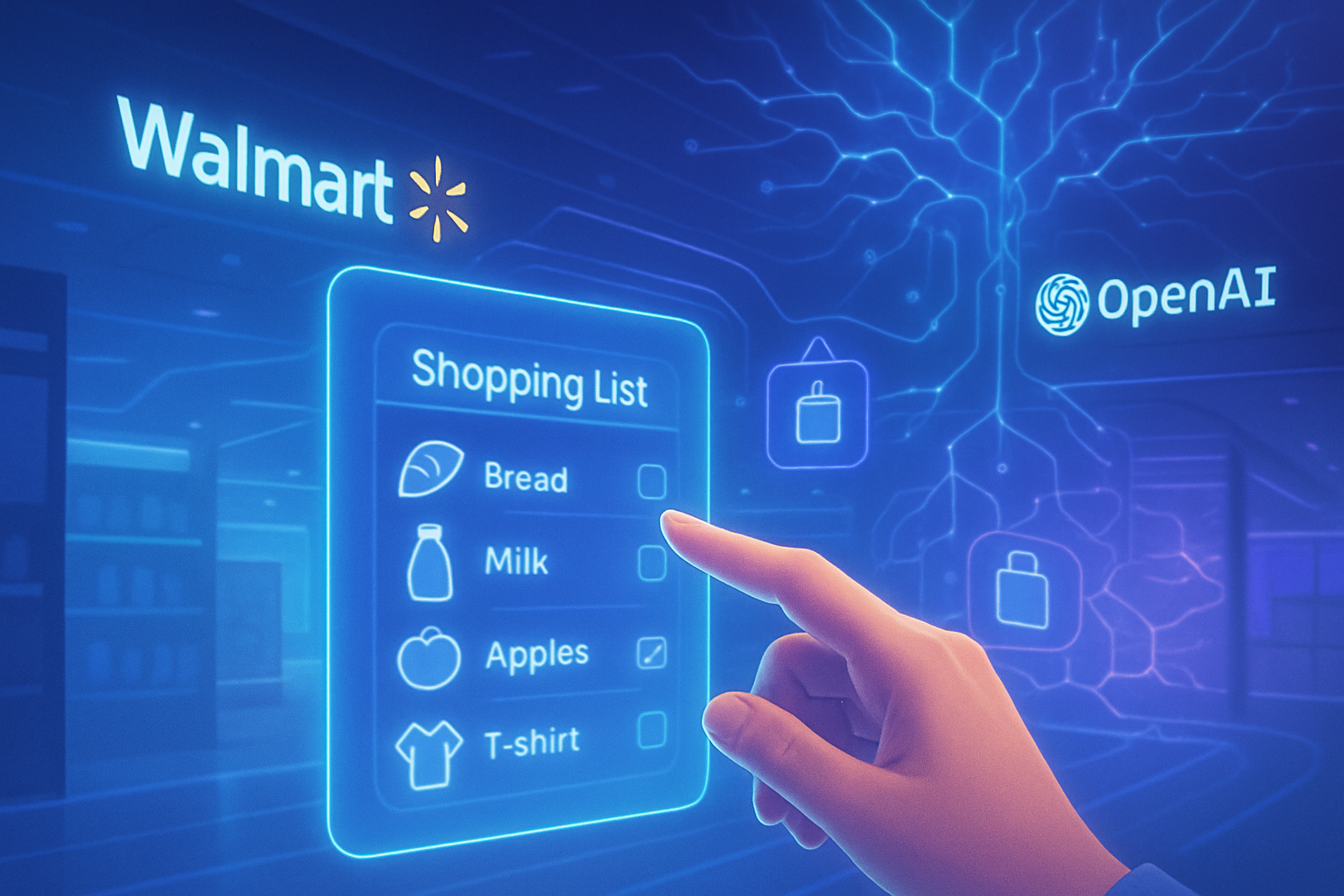
    Meanwhile, the partnership between OpenAI and Walmart (NYSE: WMT) represents a strategic leap into "agentic commerce." This collaboration integrates OpenAI's powerful generative AI, specifically ChatGPT, directly into the shopping experience, enabling customers to plan meals, restock essentials, or discover new products through natural language conversations. The "Instant Checkout" feature, co-developed with Stripe, allows these conversational interactions to seamlessly transition into completed purchases, with Walmart handling the fulfillment. This is a fundamental shift from traditional e-commerce, where AI primarily served as a recommendation engine or a backend optimization tool. Here, the AI acts as a true shopping agent, capable of understanding complex requests, making informed suggestions, and executing transactions. This direct integration of a leading LLM into a transactional pipeline sets a new standard for conversational commerce and underscores the growing trend of embedding AI capabilities deeply into consumer touchpoints.

    Competitive Landscape and Market Disruption

    These developments are poised to significantly reshape the competitive landscape of the retail and tech industries. Amazon, with its new AI-powered shopping tools, stands to further cement its dominance in e-commerce. By making the shopping experience more intuitive and personalized, Amazon aims to increase customer satisfaction, reduce bounce rates, and drive higher conversion rates. The integration of AI for sellers, such as "Enhance My Listing" and AI video generators, also empowers its vast network of merchants, indirectly strengthening the platform's overall appeal and competitive edge. This aggressive AI push is a strategic move to maintain its market leadership against emerging threats and evolving consumer expectations.

    The OpenAI-Walmart partnership, on the other hand, presents a formidable challenge to Amazon's singular dominance. By leveraging OpenAI's cutting-edge AI, Walmart is positioning itself as a leader in conversational and agentic commerce, potentially drawing a significant segment of online shoppers who prefer a more interactive and guided experience. This collaboration could disrupt existing e-commerce models by shifting consumer habits towards AI-first shopping interfaces, where the AI proactively manages the entire purchasing journey. For OpenAI, these retail partnerships, which also extend to platforms like Etsy and Shopify, solidify its position as a critical infrastructure provider for the next generation of e-commerce. It demonstrates the versatility and commercial viability of its large language models beyond content generation, embedding them directly into transactional workflows. This creates competitive implications for other AI labs and tech companies vying for similar enterprise partnerships, highlighting the importance of robust, scalable AI solutions for real-world applications.

    Startups in the retail tech space will face both opportunities and challenges. Those offering specialized AI solutions that complement these larger platforms, such as advanced analytics, personalized marketing, or supply chain optimization, may find new markets. However, companies that offer generic recommendation engines or basic chatbot services might find their offerings commoditized or overshadowed by the sophisticated, integrated solutions from giants like Amazon and the OpenAI-Walmart alliance. The market is increasingly demanding comprehensive, end-to-end AI solutions, pushing smaller players to specialize or integrate deeply with larger ecosystems.

    Broader Significance and Societal Implications

    The integration of advanced AI into e-commerce fits into a broader AI landscape characterized by the rapid maturation of large language models and their deployment in real-world applications. This trend signifies a move beyond AI as a backend optimization tool to AI as a direct customer interface, capable of complex reasoning, personalized interaction, and autonomous transaction. It underscores the increasing emphasis on "agentic AI" – systems that can not only process information but also take action on behalf of the user.

    The impacts are far-reaching. For consumers, it promises unprecedented convenience, reducing the time and mental effort required for shopping. For businesses, it offers enhanced personalization, improved customer engagement, and significant operational efficiencies through optimized inventory, supply chain, and demand forecasting. However, these advancements also raise potential concerns. Privacy implications are paramount, as AI systems collect and analyze vast amounts of personal data to provide tailored experiences. There are also ethical considerations around algorithmic bias in recommendations, potentially reinforcing existing inequalities or limiting consumer choice. Furthermore, the increasing automation of shopping tasks could have implications for employment in customer service and retail support roles, necessitating a focus on workforce retraining and adaptation.

    Comparing this to previous AI milestones, such as the rise of recommendation engines in the early 2010s or the advent of basic chatbots, the current wave represents a qualitative leap. These new AI systems are not just suggesting products; they are engaging in sophisticated conversations, understanding complex needs, and facilitating entire purchasing processes. This marks a transition from AI as a tool for passive filtering to AI as an active, intelligent assistant, fundamentally altering the user-system dynamic in commerce. The ability of AI to proactively anticipate and fulfill needs, as seen in agentic commerce, is a breakthrough that holds the potential to redefine consumer expectations across industries.

    The Future of Shopping: A Glimpse into Tomorrow

    Looking ahead, the trajectory of AI in e-commerce points towards even more integrated and immersive shopping experiences. In the near term, we can expect to see wider adoption and refinement of conversational AI shopping assistants, becoming standard features across major retail platforms. These assistants will likely gain enhanced capabilities in understanding multimodal inputs (voice, image, text) and providing richer, more interactive responses, potentially incorporating augmented reality (AR) for virtual try-ons or product visualizations directly within the shopping interface. The "Instant Checkout" model, pioneered by OpenAI and its partners, is expected to expand rapidly, making direct purchases from AI conversations a common occurrence.

    Long-term developments could see AI becoming an almost invisible layer that anticipates needs before they even arise. Imagine an AI that proactively replenishes household staples based on consumption patterns, suggests gifts for upcoming events based on social cues, or even curates entire lifestyle packages tailored to evolving preferences. The concept of "proactive commerce," where AI agents manage a significant portion of routine purchasing, is firmly on the horizon. Challenges that need to be addressed include ensuring data security and privacy as AI systems become more deeply embedded in personal lives, developing robust ethical guidelines for AI-driven recommendations, and fostering transparency in algorithmic decision-making. Furthermore, the seamless integration of AI across various channels – online, in-store, and through smart home devices – will be crucial for a truly unified shopping experience.

    Experts predict that the future of retail will be characterized by a symbiotic relationship between human shoppers and AI assistants, with AI handling the mundane and complex tasks, freeing humans to focus on discovery, inspiration, and enjoyment. The focus will shift from simply buying products to solving problems and enhancing lifestyles through intelligent recommendations and automated fulfillment. We can anticipate AI-powered personal shoppers becoming as common as search engines are today, fundamentally altering consumer behavior and the competitive dynamics of the global retail market.

    Wrap-Up: A New Chapter in AI-Powered Commerce

    The recent advancements in AI for e-commerce, exemplified by Amazon's sophisticated shopping tools and the strategic OpenAI-Walmart partnership, mark a pivotal moment in the history of artificial intelligence and retail. The key takeaways are clear: AI is moving beyond simple automation to become a proactive, intelligent agent in the shopping journey, offering unprecedented levels of personalization and convenience. This shift is redefining customer expectations, creating new competitive battlegrounds for tech giants, and opening novel avenues for innovation across the retail ecosystem.

    The significance of these developments in AI history cannot be overstated. They represent a tangible step towards general-purpose AI applications that can engage in complex human-like interactions and execute real-world transactions. This demonstrates the commercial viability and transformative power of large language models when integrated with robust retail infrastructure. The long-term impact will likely see a more efficient, intuitive, and deeply personalized shopping experience for consumers, coupled with significant operational efficiencies and new business models for retailers.

    In the coming weeks and months, it will be crucial to watch for the widespread adoption rates of these new AI shopping tools, the expansion of conversational commerce platforms, and the regulatory responses to data privacy and ethical concerns. The rapid pace of innovation suggests that what seems futuristic today will quickly become commonplace, cementing AI's role as an indispensable driver of the future of commerce.


    This content is intended for informational purposes only and represents analysis of current AI developments.

    TokenRing AI delivers enterprise-grade solutions for multi-agent AI workflow orchestration, AI-powered development tools, and seamless remote collaboration platforms.
    For more information, visit https://www.tokenring.ai/.

  • Walmart and OpenAI Forge Groundbreaking Alliance for AI-Driven Shopping via ChatGPT

    Walmart and OpenAI Forge Groundbreaking Alliance for AI-Driven Shopping via ChatGPT

    In a landmark announcement that sent ripples across the retail and technology sectors yesterday, October 14, 2025, retail behemoth Walmart (NYSE: WMT) officially unveiled a strategic partnership with artificial intelligence pioneer OpenAI. This collaboration is set to revolutionize the online shopping experience by integrating advanced AI capabilities directly into ChatGPT, allowing customers to engage in "agentic commerce" through conversational interfaces. The move signals a significant leap in how consumers will interact with e-commerce platforms, promising a future where shopping is not just personalized but proactively intelligent.

    This unprecedented alliance aims to transform the transactional nature of online retail into a seamless, intuitive, and highly personalized dialogue. By leveraging OpenAI's cutting-edge language models and newly introduced "Instant Checkout" feature, Walmart is positioning itself at the forefront of AI-powered commerce, redefining convenience and efficiency for its vast customer base and loyalty members across Walmart and Sam's Club. The immediate significance lies in the potential for mass adoption of truly conversational shopping, moving beyond the traditional search bar and into a dynamic, AI-guided purchasing journey.

    The Dawn of Agentic Commerce: A Technical Deep Dive into Conversational Retail

    The core of the Walmart-OpenAI partnership lies in its innovative approach to AI-driven shopping, fundamentally shifting from reactive search to proactive, "agentic commerce." At its heart, customers will be able to "Chat and Buy" directly within ChatGPT using natural language, either through text or voice commands. This goes far beyond simple product searches; the system is designed to understand complex requests and anticipate user needs. For instance, a user planning a "Taco Tuesday" dinner can simply ask ChatGPT to find all necessary ingredients, and the AI will curate a comprehensive grocery list, ready for purchase.

    Technically, this experience is powered by OpenAI's recently launched "Instant Checkout" feature, which enables direct purchases within the ChatGPT interface. This feature, initially rolled out for Etsy sellers and slated for Shopify (NYSE: SHOP) merchants, facilitates a frictionless transaction process, eliminating the need for users to navigate to external websites or applications. The underlying mechanism, dubbed "Agentic Commerce Protocol," was co-developed by OpenAI and Stripe (NYSE: STRIP), ensuring secure and efficient payment processing. Initially, the Instant Checkout system will support single-item purchases, with ambitious plans to expand to multi-item carts and additional geographical regions, signifying a phased but rapid deployment strategy.

    This approach dramatically differs from previous e-commerce models, which predominantly relied on keyword searches, curated product listings, and manual navigation. While some retailers have experimented with AI chatbots, their functionalities have largely been limited to customer service or basic product recommendations. The Walmart-OpenAI integration, however, introduces a truly multi-media, personalized, and contextual shopping experience. It's an AI that learns, plans, and predicts, effectively acting as a personal shopping assistant that evolves with the consumer's habits and preferences. Initial reactions from the AI research community and industry experts highlight this as a pivotal moment, demonstrating the practical application of large language models (LLMs) in transforming real-world consumer interactions at an unprecedented scale.

    Reshaping the Retail Landscape: Implications for AI Companies and Tech Giants

    This groundbreaking partnership between Walmart (NYSE: WMT) and OpenAI sends a clear signal to the entire tech and retail industry: AI is no longer just a backend optimization tool but a front-facing, revenue-generating engine. Walmart stands to benefit immensely, solidifying its position as an innovator in digital retail and potentially capturing a significant share of the burgeoning conversational commerce market. By being an early mover in integrating advanced LLMs into its core shopping experience, Walmart gains a strategic advantage over competitors, particularly Amazon (NASDAQ: AMZN), which has traditionally dominated online retail. While Amazon has its own AI capabilities (like Alexa), the direct, conversational "Chat and Buy" integration within a widely adopted platform like ChatGPT represents a novel and potentially more fluid user experience.

    For OpenAI, this collaboration is a massive validation of its generative AI capabilities and its strategic push into "agentic commerce." The partnership with a retail giant like Walmart demonstrates the commercial viability and scalability of its Instant Checkout and Agentic Commerce Protocol. This move positions OpenAI not just as a developer of foundational AI models but as a critical enabler of next-generation digital marketplaces. Other AI labs and tech companies will undoubtedly feel the pressure to innovate in similar conversational commerce spaces. Companies like Google (NASDAQ: GOOGL), Meta (NASDAQ: META), and Apple (NASDAQ: AAPL), all with significant AI investments and consumer-facing platforms, will likely accelerate their efforts to integrate sophisticated shopping functionalities into their own AI assistants and ecosystems to avoid being left behind.

    The potential disruption to existing products and services is substantial. Traditional e-commerce interfaces, comparison shopping sites, and even some niche shopping apps could face significant challenges as consumers gravitate towards the ease and intelligence of AI-driven conversational shopping. Market positioning will increasingly depend on the seamless integration of AI into the customer journey, with companies that can offer personalized, predictive, and frictionless experiences gaining a significant competitive edge. This partnership underscores a strategic shift where AI companies are becoming direct partners in consumer transactions, rather than just providing underlying technology, thereby reshaping the competitive dynamics across both the AI and retail sectors.

    The Broader AI Landscape: A Paradigm Shift in Consumer Interaction

    The Walmart-OpenAI partnership represents more than just a new feature; it signifies a profound shift in the broader AI landscape, particularly in how artificial intelligence is expected to interact with and serve consumers. This move towards "agentic commerce" aligns perfectly with the overarching trend of AI becoming more proactive and less reactive. Instead of merely responding to explicit commands, AI is now being designed to anticipate needs, plan complex tasks (like meal planning), and execute multi-step processes (like shopping and checkout) autonomously. This is a significant evolution from earlier AI applications, which were often siloed or offered limited interactive capabilities.

    The impacts are far-reaching. For consumers, it promises unparalleled convenience and personalization, potentially reducing decision fatigue and saving time. Imagine an AI that not only knows your dietary preferences but also your typical shopping list, prompting you to restock essentials before you even realize you're running low. However, this level of integration also raises potential concerns, particularly around data privacy and security. The linking of personal shopping habits and financial information to an AI platform necessitates robust safeguards and transparent data handling policies. There's also the question of algorithmic bias in product recommendations and the potential for over-reliance on AI for purchasing decisions, which could impact consumer autonomy.

    Comparing this to previous AI milestones, the Walmart-OpenAI collaboration stands out as a major step in the commercialization and mainstream adoption of advanced generative AI. While the introduction of voice assistants like Alexa and Google Assistant marked an initial foray into conversational AI, their shopping capabilities remained relatively rudimentary. This new partnership, leveraging the sophisticated understanding and generation capabilities of ChatGPT, pushes the boundaries into truly intelligent and transactional conversations. It echoes the transformative impact of early e-commerce platforms but with an added layer of AI-driven intelligence that fundamentally alters the user experience, moving from browsing to a guided, predictive interaction.

    Future Horizons: What's Next for AI-Driven Retail

    Looking ahead, the Walmart-OpenAI partnership is merely the beginning of a transformative era for AI-driven retail. In the near-term, we can expect the gradual rollout of the "Chat and Buy" feature to Walmart (NYSE: WMT) and Sam's Club customers across the US, initially focusing on single-item purchases. The expansion to multi-item carts and more complex shopping scenarios, such as subscription management and personalized recommendations based on evolving lifestyle needs, is a highly anticipated next step. Beyond basic transactions, the "Agentic Commerce Protocol" could evolve to integrate with smart home devices, automatically reordering groceries when stock is low, or suggesting recipes based on available ingredients and dietary goals.

    Long-term developments are poised to see AI becoming an indispensable personal shopping agent that understands not just what you want to buy, but why, when, and how you prefer to shop. This could lead to a hyper-personalized retail experience where AI anticipates needs even before they manifest, offering curated selections, exclusive deals, and proactive problem-solving. Potential applications extend beyond groceries to fashion, electronics, and even services, with AI assisting in booking appointments or managing subscriptions based on user preferences and schedules.

    However, several challenges need to be addressed for this vision to fully materialize. Ensuring the ethical use of AI, particularly concerning data privacy and algorithmic transparency, will be paramount. Developing robust security measures to protect sensitive customer data and financial information is crucial. Furthermore, refining the AI's understanding of nuanced human language and intent, especially in complex or ambiguous shopping scenarios, will require continuous development. Experts predict that the success of this model will spur other major retailers and tech companies to invest heavily in similar "agentic" AI solutions, leading to a highly competitive landscape where the most intelligent and trustworthy AI assistants will gain consumer loyalty. The evolution of the "Instant Checkout" feature to support a wider array of merchants and product categories will also be a key indicator of its broader market impact.

    The AI Retail Revolution: A Concluding Assessment

    The recent announcement of the partnership between Walmart (NYSE: WMT) and OpenAI to launch AI-driven shopping through ChatGPT marks a pivotal moment in the history of both artificial intelligence and retail. The key takeaway is the shift towards "agentic commerce," where AI moves beyond simple chatbots to become a proactive, intelligent assistant capable of understanding complex needs, planning purchases, and executing transactions directly within a conversational interface. This integration of OpenAI's advanced language models and "Instant Checkout" feature into Walmart's vast retail ecosystem is set to redefine consumer expectations for convenience, personalization, and efficiency in online shopping.

    This development holds immense significance in AI history, illustrating the maturation of large language models from experimental tools to commercially viable engines driving fundamental changes in consumer behavior. It underscores the accelerating trend of AI becoming deeply embedded in our daily lives, transforming mundane tasks into seamless, intelligent interactions. While offering unprecedented convenience, it also brings to the forefront critical discussions around data privacy, algorithmic ethics, and the evolving relationship between humans and AI in commercial contexts.

    In the long term, this partnership is likely to be remembered as a catalyst that spurred a new wave of innovation in conversational commerce. It sets a new benchmark for how retailers and technology companies will collaborate to leverage AI for enhanced customer experiences. What to watch for in the coming weeks and months includes the initial rollout and customer adoption rates of the "Chat and Buy" feature, the expansion of "Instant Checkout" to multi-item carts and other merchants, and how competitors will respond to this bold strategic move. The AI retail revolution has truly begun, and its trajectory will be shaped by how effectively these intelligent systems can deliver on their promise while navigating the inherent challenges of advanced AI integration.


    This content is intended for informational purposes only and represents analysis of current AI developments.

    TokenRing AI delivers enterprise-grade solutions for multi-agent AI workflow orchestration, AI-powered development tools, and seamless remote collaboration platforms.
    For more information, visit https://www.tokenring.ai/.

  • Walmart and OpenAI Forge Historic Partnership: ChatGPT Revolutionizes Online Shopping

    Walmart and OpenAI Forge Historic Partnership: ChatGPT Revolutionizes Online Shopping

    Walmart (NYSE: WMT) has announced a groundbreaking partnership with OpenAI, integrating ChatGPT directly into its online shopping experience. This collaboration, unveiled on Tuesday, October 14, 2025, aims to usher in an "AI-first" era for retail, fundamentally transforming how customers browse, discover, and purchase products. The immediate significance of this alliance lies in its potential to shift online retail from a reactive search-based model to a proactive, personalized, and conversational journey, where AI anticipates and fulfills customer needs.

    This strategic move is designed to empower Walmart and Sam's Club customers to engage with ChatGPT's conversational interface for a myriad of shopping tasks. From receiving personalized meal suggestions and automatically adding ingredients to their cart, to effortlessly restocking household essentials and discovering new products based on nuanced preferences, the integration promises an intuitive and efficient experience. A key enabler of this seamless process is OpenAI's "Instant Checkout" feature, allowing users to complete purchases directly within the chat interface after linking their existing Walmart or Sam's Club accounts. While the initial rollout, expected later this fall, will exclude fresh food items, it will encompass a broad spectrum of products, including apparel, entertainment, and packaged goods from both Walmart's extensive inventory and third-party sellers. This partnership builds upon OpenAI's existing commerce integrations with platforms like Etsy and Shopify, further solidifying conversational AI as a rapidly expanding channel in the digital retail landscape.

    The Technical Backbone: How Walmart is Powering "Agentic Commerce"

    Walmart's integration of generative AI, particularly with OpenAI's ChatGPT, represents a significant leap in its technological strategy, extending across both customer-facing applications and internal operations. This multifaceted approach is designed to foster "adaptive retail" and "agentic commerce," where AI proactively assists customers and streamlines employee tasks.

    At the core of this technical advancement is the ability for customers to engage in "conversational shopping." Through ChatGPT, users can articulate complex needs in natural language, such as "ingredients for a week's worth of meals," prompting the AI to suggest recipes and compile a comprehensive shopping list, which can then be purchased via "Instant Checkout." This feature initially focuses on nonperishable categories, with fresh items slated for future integration. Beyond direct shopping, Walmart is enhancing its search capabilities across its website and mobile apps, leveraging generative AI to understand the context of a customer's query rather than just keywords. For instance, a search for "I need a red top to wear to a party" will yield more relevant and curated results than a generic "red women's blouse." On the customer service front, an upgraded AI assistant now recognizes individual customers, understands their intent, and can execute actions like managing returns, offering a more integrated and transactional support experience. Internally, generative AI is bolstering the "Ask Sam" app for employees, providing immediate, detailed answers on everything from product locations to company policies. A new "My Assistant" app helps associates summarize documents and create content, while an AI tool intelligently prioritizes and recommends tasks for store associates, significantly reducing shift planning time. Real-time translation in 44 languages further empowers associates to assist a diverse customer base.

    Walmart's generative AI strategy is a sophisticated blend of proprietary technology and external partnerships. It utilizes OpenAI's advanced large language models (LLMs), likely including GPT-3 and more recent iterations, accessible through the Microsoft (NASDAQ: MSFT) Azure OpenAI Service, ensuring enterprise-grade security and compliance. Crucially, Walmart has also developed its own system of proprietary Generative AI platforms, notably "Wallaby," a series of retail-specific LLMs trained on decades of Walmart's vast internal data. This allows for highly contextual and tailored responses aligned with Walmart's unique retail environment and values. The company has also launched its own customer-facing generative AI assistant named "Sparky," envisioned as a "super agent" within Walmart's new company-wide AI framework, designed to help shoppers find and compare products, manage reorders, and accept multimodal inputs (text, images, audio, video). Further technical underpinnings include a Content Decision Platform for personalized website customization and a Retina AR Platform for creating 3D assets and immersive commerce experiences.

    This integration marks a significant departure from previous retail AI approaches. Earlier e-commerce AI was largely reactive, offering basic recommendations or simple chatbots for frequently asked questions. Walmart's current strategy embodies "agentic commerce," where AI proactively anticipates needs, plans, and predicts, moving beyond mere response to active assistance. The level of contextual understanding and multi-turn conversational capabilities offered by ChatGPT is far more sophisticated than previous voice ordering or basic chatbot experiments. The ability to complete purchases directly within the chat interface via "Instant Checkout" collapses the traditional sales funnel, transforming inspiration into transaction seamlessly. This holistic enterprise integration of AI, from customer interactions to supply chain and employee tools, positions AI not as a supplementary feature, but as a core driver of the entire business. Initial reactions from the AI research community and industry experts have been overwhelmingly positive, hailing the integration as a "game-changing role" for AI in retail and a "paradigm shift." Data from Similarweb even indicates ChatGPT driving significant referral traffic to retailers, with one in five of Walmart's referral clicks in August 2025 reportedly originating from ChatGPT. Walmart's stock surged following the announcement, reflecting investor optimism. While acknowledging benefits, experts also caution against "AI workslop"—AI-generated content lacking substance—and emphasize the need for clear quality standards. Walmart CEO Doug McMillon has stressed that AI will "change literally every job" at Walmart, transforming roles rather than eliminating them, with significant investment in reskilling the workforce.

    Reshaping the AI and Tech Landscape: Winners, Losers, and Disruptors

    Walmart's (NYSE: WMT) partnership with OpenAI and the integration of ChatGPT is more than just a retail innovation; it's a seismic event poised to send ripple effects across the entire AI and tech industry, redefining competitive dynamics and market positioning. This move towards "agentic commerce" will undoubtedly create beneficiaries, challenge incumbents, and disrupt existing services.

    Walmart stands as a clear winner, strategically positioning itself as a pioneer in "AI-first shopping experiences" and "adaptive retail." By leveraging OpenAI's cutting-edge AI, Walmart aims to create a highly differentiated online shopping journey that boosts customer retention and increases average basket sizes. Its vast proprietary data, gleaned from its extensive physical and digital footprint, provides a powerful engine for its AI models, enhancing demand forecasting and personalization. The profitability of its e-commerce business, with over 20% growth across segments, underscores the efficacy of its AI strategy. OpenAI also reaps substantial benefits, monetizing its advanced AI models and significantly expanding ChatGPT's application beyond general conversation into a direct commerce platform. This partnership solidifies OpenAI's role as a foundational technology provider across diverse industries and positions ChatGPT as a potential central gateway for digital services, unlocking new revenue streams through transaction commissions. Indirectly, Microsoft (NASDAQ: MSFT), a major investor in OpenAI, benefits from the validation of its AI strategy and the potential for increased enterprise adoption of its cloud AI solutions like Azure OpenAI Service. The ripple effect extends to other retailers and brands that proactively adapt to AI shopping agents, optimizing their online presence to integrate with these new interaction models. Data already suggests ChatGPT is driving significant referral traffic to other major retailers, indicating a new avenue for customer acquisition. Furthermore, the burgeoning demand for specialized AI tools in areas like personalization, demand forecasting, supply chain optimization, and generative AI for marketing content will create substantial opportunities for various AI solution providers and startups.

    The competitive implications for major AI labs and tech giants are profound. Amazon (NASDAQ: AMZN), Walmart's primary e-commerce rival, faces a direct challenge to its long-standing dominance in AI-driven retail. By focusing on narrowing the personalization gap, Walmart aims to compete more effectively. While Amazon has its own AI features, such as the Rufus shopping assistant, experts suggest it might need to integrate AI more deeply into its core search experience to truly compete, potentially impacting its significant advertising revenue. Google (NASDAQ: GOOGL), whose business model heavily relies on search-based advertising, could see disruption as "agentic commerce" facilitates direct purchases rather than traditional search. Google will be pressured to enhance its AI assistants with stronger shopping capabilities and leverage its vast data to offer competitive, personalized experiences. The precedent set by the Walmart-OpenAI collaboration will likely compel other major AI labs to seek similar strategic partnerships across industries, intensifying competition in the AI platform space and accelerating the monetization of their advanced models. Traditional e-commerce search and comparison engines face significant disruption as AI agents increasingly handle product discovery and purchase directly, shifting consumer behavior from "scroll searching" to "goal searching." Similarly, affiliate marketing websites face a considerable threat as AI tools like ChatGPT can directly surface product recommendations, potentially undermining existing affiliate marketing structures and revenues.

    The potential disruption to existing products and services is widespread. Traditional e-commerce interfaces, with their static search bars and product listing pages, will be fundamentally altered as users engage with AI to articulate complex shopping goals and receive curated recommendations. Existing customer service platforms will need to evolve to offer more sophisticated, integrated, and transactional AI capabilities, building on Walmart's demonstrated ability to cut customer care resolution times by up to 40%. The models for digital advertising could be reshaped as AI agents facilitate direct discovery and purchase, impacting ad placements and click-through metrics, though Walmart Connect, the company's advertising arm, is already leveraging AI-driven insights. Supply chain management will see further disruption as AI-driven optimization algorithms enhance demand forecasting, route optimization, and warehouse automation, pushing out less intelligent, traditional software providers. In workforce management and training, AI will increasingly automate or augment routine tasks, necessitating new training programs for employees. Finally, content and product catalog creation will be transformed by generative AI, which can improve product data quality, create engaging marketing content, and reduce timelines for processes like fashion production, disrupting traditional manual generation. Walmart's strategic advantage lies in its commitment to "agentic commerce" and its "open ecosystem" approach to AI shopping agents, aiming to become a central hub for AI-mediated shopping, even for non-Walmart purchases. OpenAI, in turn, solidifies its position as a dominant AI platform provider, showcasing the practical, revenue-generating capabilities of its LLMs in a high-stakes industry.

    A Wider Lens: AI's Evolving Role in Society and Commerce

    Walmart's (NYSE: WMT) integration of ChatGPT through its partnership with OpenAI represents a pivotal moment in the broader AI landscape, signaling a profound shift towards more intuitive, personalized, and "agentic" commerce. This move underscores AI's transition from a supplementary tool to a foundational engine driving the retail business, with far-reaching implications for customers, employees, operational efficiency, and the competitive arena.

    This development aligns with several overarching trends in the evolving AI landscape. Firstly, it exemplifies the accelerating shift towards conversational and agentic AI. Unlike earlier e-commerce AI that offered reactive recommendations or basic chatbots, this integration introduces AI that proactively learns, plans, predicts customer needs, and can execute purchases directly within a chat interface. Secondly, it underscores the relentless pursuit of hyper-personalization. By combining OpenAI's advanced LLMs with its proprietary retail-specific LLM, "Wallaby," trained on decades of internal data, Walmart can offer tailored recommendations, curated product suggestions, and unique homepages for every customer. Thirdly, it champions the concept of AI-first shopping experiences, aiming to redefine consumer interaction with online retail beyond traditional search-and-click models. This reflects a broader industry expectation that AI assistants will become a primary interface for shopping. Finally, Walmart's strategy emphasizes end-to-end AI adoption, integrating AI throughout its operations, from supply chain optimization and inventory management to marketing content creation and internal employee tools, demonstrating a comprehensive understanding of AI's enterprise-wide value.

    The impacts of this ChatGPT integration are poised to be substantial. For the customer experience, it promises seamless conversational shopping, allowing users to articulate complex needs in natural language and complete purchases via "Instant Checkout." This translates to enhanced personalization, improved 24/7 customer service, and future immersive discovery through multimodal AI and Augmented Reality (AR) platforms like Walmart's "Retina." For employee productivity and operations, AI tools will streamline workflows, assist with task management, provide enhanced internal support through conversational AI like an upgraded "Ask Sam," and offer real-time translation. Furthermore, AI will optimize supply chain and inventory management, reducing waste and improving availability, and accelerate product development, such as reducing fashion production timelines by up to 18 weeks. From a business outcomes and industry landscape perspective, this integration provides a significant competitive advantage, narrowing the personalization gap with rivals like Amazon (NASDAQ: AMZN) and enhancing customer retention. Generative AI is projected to contribute an additional $400 billion to $660 billion annually to the retail and consumer packaged goods sectors, with Walmart's AI initiatives already demonstrating substantial improvements in customer service resolution times (up to 40%) and operational efficiency. This also signals an evolution of business models, where AI informs and improves every critical decision.

    Despite the transformative potential, several potential concerns warrant attention. Data privacy and security are paramount, as the collection of vast amounts of customer data for personalization raises ethical questions about consent and usage. Ensuring algorithmic bias is minimized is crucial, as AI systems can perpetuate biases present in their training data, potentially leading to unfair recommendations. While Walmart emphasizes AI's role in augmenting human performance, concerns about job displacement persist, necessitating significant investment in employee reskilling and training. The complexity and cost of integrating advanced AI solutions across an enterprise of Walmart's scale are considerable. The potential for AI accuracy issues and "hallucinations" (inaccurate information generation) from LLMs like ChatGPT could impact customer trust if not carefully managed. Lastly, while online, customers may have fewer privacy concerns, in-store AI applications could lead to greater discomfort if perceived as intrusive, and the proliferation of siloed AI systems could replicate inefficiencies, highlighting the need for cohesive AI frameworks.

    In comparison to previous AI milestones, Walmart's ChatGPT integration represents a fundamental leap. Earlier AI in e-commerce was largely confined to basic product recommendations or simple chatbots. This new era transcends those reactive systems, shifting to proactive, agentic AI that anticipates needs and directly executes purchases. The complexity of interaction is vastly superior, enabling sophisticated, multi-turn conversational capabilities for complex shopping tasks. This partnership is viewed as a "game-changing role" for AI in retail, moving it from a supplementary tool to a core driver of the entire business. Some experts predict AI's impact on retail in the coming years will be even more significant than that of big box stores like Walmart and Target (NYSE: TGT) in the 1990s. The emphasis on enterprise-wide integration across customer interactions, internal operations, and the supply chain marks a foundational shift in how the business will operate.

    The Road Ahead: Anticipating Future Developments and Challenges

    Walmart's (NYSE: WMT) aggressive integration of ChatGPT and other generative AI technologies is not merely a tactical adjustment but a strategic pivot aimed at fundamentally reshaping the future of retail. The company is committed to an "AI-first" shopping experience, driven by continuous innovation and adaptation to evolving consumer behaviors.

    In the near-term, building on already implemented and soon-to-launch features, Walmart will continue to refine its generative AI-powered conversational search on its website and apps, allowing for increasingly nuanced natural language queries. The "Instant Checkout" feature within ChatGPT will expand its capabilities, moving beyond single-item purchases to accommodate multi-item carts and more complex shopping scenarios. Internally, the "Ask Sam" app for associates will become even more sophisticated, offering deeper insights and proactive assistance, while corporate tools like "My Assistant" will continue to evolve, enhancing content creation and document summarization. AI-powered customer service chatbots will handle an even broader range of inquiries, further freeing human agents for intricate issues. Furthermore, the company will leverage AI for advanced supply chain and warehouse optimization, improving demand forecasting, inventory management, and waste reduction through robotics and computer vision. AI-powered anti-theft measures and an AI interview coach for job applicants are also part of this immediate horizon.

    Looking further ahead, the long-term developments will center on the realization of true "agentic commerce." This envisions AI assistants that proactively manage recurring orders, anticipate seasonal shopping needs, and even suggest items based on health or dietary goals, becoming deeply embedded in customers' daily lives. Hyper-personalization will reach new heights, with generative AI creating highly customized online homepages and product recommendations tailored to individual interests, behaviors, and purchase history, effectively mimicking a personal shopper. Walmart's AI shopping assistant, "Sparky," is expected to evolve into a truly multimodal assistant, accepting inputs beyond text to include images, voice, and video, offering more immersive and intuitive shopping experiences. Internally, advanced AI-powered task management, real-time translation tools for associates, and agent-to-agent retail protocols will automate complex workflows across the enterprise. AI will also continue to revolutionize product development and marketing, accelerating design processes and enabling hyper-targeted advertising. Walmart also plans further AI integration into digital environments, including proprietary mobile games and experiences on platforms like Roblox (NYSE: RBLX), and has indicated an openness to an industry-standard future where external shopping agents can directly interact with its systems.

    However, this ambitious vision is not without its challenges. Data privacy and security remain paramount, as integrating customer accounts and purchase data with external AI platforms like ChatGPT necessitates robust safeguards and adherence to privacy regulations. Ensuring data accuracy and ethical AI is crucial to maintain customer trust and prevent biased outcomes. Widespread user adoption of AI-powered shopping experiences will be key, requiring seamless integration and intuitive interfaces. The issue of job displacement versus reskilling is a significant concern; while Walmart emphasizes augmentation, the transformation of "every job" necessitates substantial investment in talent development and employee training. The impact on traditional affiliate marketing models also needs to be addressed, as AI's ability to directly recommend products could bypass existing structures.

    Experts predict that Walmart's AI strategy is a "game-changing" move for the retail industry, solidifying AI's role as an essential, not optional, component of e-commerce, with hyper-personalization becoming the new standard. The rise of "agentic commerce" will redefine customer interactions, making shopping more intuitive and proactive. Over half of consumers are expected to use AI assistants for shopping by the end of 2025, highlighting the shift towards conversational AI as a primary interface. Economically, the integration of AI in retail is projected to significantly boost productivity and revenue, potentially adding hundreds of billions annually to the sector through automated tasks and cost savings. Retailers that embrace AI early, like Walmart, are expected to capture greater market share and customer loyalty. The workforce transformation anticipated by Walmart's CEO will lead to a shift in required skills rather than a reduction in overall headcount, necessitating significant reskilling efforts across the enterprise.

    A New Era of Retail: A Comprehensive Wrap-Up

    Walmart's (NYSE: WMT) integration of ChatGPT, a product of its strategic partnership with OpenAI, marks a watershed moment in the retail sector, definitively signaling a shift towards an AI-powered, conversational commerce paradigm. This initiative is a cornerstone of Walmart's broader "Adaptive Retail" strategy, designed to deliver hyper-personalized and exceptionally seamless shopping experiences for its vast customer base and Sam's Club members.

    The key takeaways from this groundbreaking development underscore a fundamental transformation of the online shopping journey. Customers can now engage in truly conversational and personalized shopping, articulating complex needs in natural language within ChatGPT and receiving curated product recommendations directly from Walmart's and Sam's Club's extensive catalogs. This represents a significant evolution from reactive tools to proactive, predictive assistance. The introduction of "Instant Checkout" is pivotal, allowing users to complete purchases directly within the ChatGPT interface, thereby streamlining the buying process and eliminating the need for multi-page navigation. This integration ushers in "agentic commerce," where AI becomes a proactive agent that learns, plans, and predicts customer needs, making shopping inherently more intuitive and efficient. Beyond customer-facing applications, Walmart is deeply embedding ChatGPT Enterprise internally and fostering AI literacy across its workforce through OpenAI Certifications. This comprehensive approach extends AI's transformative impact to critical operational areas such as inventory management, scheduling, supplier coordination, and has already demonstrated significant efficiencies, including reducing fashion production timelines by up to 18 weeks and cutting customer care resolution times by up to 40%. This integration builds upon and enhances Walmart's existing AI tools, like "Sparky," transforming them into more dynamic and predictive shopping aids.

    This development holds significant historical importance in AI history, widely regarded as a "monumental leap" in the evolution of e-commerce. It fundamentally redefines how consumers will interact with online retail, moving beyond traditional search-bar-driven experiences and challenging existing e-commerce paradigms. This partnership positions conversational AI, specifically ChatGPT, as a potential central gateway for digital services, thereby challenging traditional app store models and opening new revenue streams through transaction commissions for OpenAI. It also signifies a democratization of advanced AI in everyday life, making sophisticated capabilities accessible for routine shopping tasks. Competitively, this strategic move is a direct challenge to e-commerce giants like Amazon (NASDAQ: AMZN), aiming to capture greater market share by leveraging emerging consumer behavior changes and vastly improving the user experience.

    The long-term impact of Walmart's ChatGPT integration is expected to be profound, shaping the very fabric of retail and consumer behavior. It will undoubtedly lead to a complete transformation of product discovery and marketing, as AI agents become central to the shopping journey, necessitating an "AI-first approach" from all retailers. Consumer behavior will increasingly gravitate towards greater convenience and personalization, with AI potentially managing a significant portion of shopping tasks, from intricate meal planning to automatic reordering of essentials. This envisions a future where AI agents become more proactive, anticipating needs and potentially even making autonomous purchasing decisions. This integration also underscores a future hybrid retail model, where AI and human decision-makers collaborate to ensure accuracy and maintain a customer-centric experience. Walmart envisions "adaptive stores" and self-optimizing logistics systems driven by AI. The investment in AI-powered personalization by Walmart could set a new global standard for customer experience, influencing other retailers worldwide. Furthermore, continued AI integration will yield even greater efficiencies in supply chain management, demand forecasting, and inventory optimization, reducing waste and ensuring optimal stock availability.

    In the coming weeks and months, several key aspects will be critical to observe. The industry will closely monitor the speed and success of the new feature's rollout and, crucially, how quickly consumers adopt these AI-powered shopping experiences within ChatGPT. User feedback will be paramount in understanding effectiveness and identifying areas for improvement, and new, unanticipated use cases are likely to emerge as users explore the capabilities. The responses and strategies of Walmart's competitors, particularly Amazon, will be a significant indicator of the broader industry impact. The expansion of "Instant Checkout" capabilities to include multi-item carts and more complex shopping scenarios will be a key technical development to watch. Internally, continued progress in Walmart's AI initiatives, including the adoption of ChatGPT Enterprise and the impact of AI literacy programs on employee productivity and innovation, will provide valuable insights into the company's internal transformation. Finally, observing how this specific ChatGPT integration aligns with and accelerates Walmart's overarching "Adaptive Retail" strategy, including its use of Generative AI, Augmented Reality, and Immersive Commerce platforms, will be essential for understanding its holistic impact.


    This content is intended for informational purposes only and represents analysis of current AI developments.

    TokenRing AI delivers enterprise-grade solutions for multi-agent AI workflow orchestration, AI-powered development tools, and seamless remote collaboration platforms.
    For more information, visit https://www.tokenring.ai/.

  • Walmart and OpenAI Forge New Frontier in E-commerce with ChatGPT Shopping Integration

    Walmart and OpenAI Forge New Frontier in E-commerce with ChatGPT Shopping Integration

    In a landmark announcement made today, Tuesday, October 14, 2025, retail giant Walmart (NYSE: WMT) has officially partnered with OpenAI to integrate a groundbreaking shopping feature directly into ChatGPT. This strategic collaboration is poised to redefine the landscape of online retail, moving beyond traditional search-and-click models to usher in an era of intuitive, conversational, and "agentic commerce." The immediate significance of this development lies in its potential to fundamentally transform consumer shopping behavior, offering unparalleled convenience and personalized assistance, while simultaneously intensifying the competitive pressures within the e-commerce and technology sectors.

    The essence of this partnership is to embed a comprehensive shopping experience directly within the ChatGPT interface, enabling customers to discover and purchase products from Walmart and Sam's Club through natural language commands. Termed "Instant Checkout," this feature allows users to engage with the AI chatbot for various shopping needs—from planning elaborate meals and restocking household essentials to exploring new products—with Walmart handling the fulfillment. This initiative represents a definitive leap from static search bars to an AI that proactively learns, plans, and predicts customer needs, promising a shopping journey that is not just efficient but also deeply personalized.

    The Technical Blueprint of Conversational Commerce

    The integration of Walmart's vast product catalog and fulfillment capabilities with OpenAI's advanced conversational AI creates a seamless, AI-first shopping experience. At its core, the system leverages sophisticated Natural Language Understanding (NLU) to interpret complex, multi-turn queries, discern user intent, and execute transactional actions. This allows users to articulate their shopping goals in everyday language, such as "Help me plan a healthy dinner for four with chicken," and receive curated product recommendations that can be added to a cart and purchased directly within the chat.

    A critical technical component is the "Instant Checkout" feature, which directly links a user's existing Walmart or Sam's Club account to ChatGPT, facilitating a frictionless transaction process without requiring users to navigate away from the chat interface. This capability is a significant departure from previous AI shopping tools that primarily offered recommendations or directed users to external websites. Furthermore, the system is designed for "multi-media, personalized and contextual" interactions, implying that the AI analyzes user input to provide highly relevant suggestions, potentially leveraging Walmart's internal AI for deeper personalization based on past purchases and browsing history. Walmart CEO Doug McMillon describes this as "agentic commerce in action," where the AI transitions from a reactive tool to a proactive agent that dynamically learns and anticipates customer needs. This integration is also part of Walmart's broader "super agents" framework, with customer-facing agents like "Sparky" designed for personalized recommendations and eventual automatic reordering of staple items.

    This approach dramatically differs from previous e-commerce models. Historically, online shopping has relied on explicit keyword searches and extensive product listings. The ChatGPT integration replaces this with an interactive, conversational interface that aims to understand and predict consumer needs with greater accuracy. Unlike traditional recommendation engines that react to browsing history, this new feature strives for proactive, predictive assistance. While Walmart has previously experimented with voice ordering and basic chatbots, the ChatGPT integration signifies a far more sophisticated level of contextual understanding and multi-turn conversational capabilities for complex shopping tasks. Initial reactions from the AI research community and industry experts highlight this as a "game-changing role" for AI in retail, recognizing its potential to revolutionize online shopping by embedding AI directly into the purchase flow. Data already indicates ChatGPT's growing role in driving referral traffic to retailers, underscoring the potential for in-chat checkout to become a major transactional channel.

    Reshaping the AI and Tech Landscape

    The Walmart-OpenAI partnership carries profound implications for AI companies, tech giants, and startups alike, igniting a new phase of competition and innovation in the AI commerce space. OpenAI, in particular, stands to gain immensely, extending ChatGPT's utility from a general conversational AI to a direct commerce platform. This move, coupled with similar integrations with partners like Shopify, positions ChatGPT as a potential central gateway for digital services, challenging traditional app store models and opening new revenue streams through transaction commissions. This solidifies OpenAI's position as a leading AI platform provider, showcasing the practical, revenue-generating applications of its large language models (LLMs).

    For Walmart (NYSE: WMT), this collaboration accelerates its "people-led, tech-powered" AI strategy, enabling it to offer hyper-personalized, convenient, and engaging shopping experiences. It empowers Walmart to narrow the personalization gap with competitors and enhance customer retention and basket sizes across its vast physical and digital footprint. The competitive implications for major tech giants are significant. Amazon (NASDAQ: AMZN), a long-time leader in AI-driven e-commerce, faces a direct challenge to its dominance. While Amazon has its own AI initiatives like Rufus, this partnership introduces a powerful new conversational shopping interface backed by a major retailer, compelling Amazon to accelerate its own investments in conversational commerce. Google (NASDAQ: GOOGL), whose core business relies on search-based advertising, could see disruption as agentic commerce encourages direct AI interaction for purchases rather than traditional searches. Google will need to further integrate shopping capabilities into its AI assistants and leverage its data to offer competitive, personalized experiences. Microsoft (NASDAQ: MSFT), a key investor in OpenAI, indirectly benefits as the partnership strengthens OpenAI's ecosystem and validates its AI strategy, potentially driving more enterprises to adopt Microsoft's cloud AI solutions.

    The potential for disruption to existing products and services is substantial. Traditional e-commerce search, comparison shopping engines, and even digital advertising models could be fundamentally altered as AI agents handle discovery and purchase directly. The shift from "scroll searching" to "goal searching" could reduce reliance on traditional product listing pages. Moreover, the rise of agentic commerce presents both challenges and opportunities for payment processors, demanding new fraud prevention methods and innovative payment tools for AI-initiated purchases. Customer service tools will also need to evolve to offer more integrated, transactional AI capabilities. Walmart's market positioning is bolstered as a frontrunner in "AI-first shopping experiences," leveraging OpenAI's cutting-edge AI to differentiate itself. OpenAI gains a critical advantage by monetizing its advanced AI models and broadening ChatGPT's application, cementing its role as a foundational technology provider for diverse industries. This collaborative innovation between a retail giant and a leading AI lab sets a precedent for future cross-industry AI collaborations.

    A Broader Lens: AI's March into Everyday Life

    The Walmart-OpenAI partnership transcends a mere business deal; it signifies a pivotal moment in the broader AI landscape, aligning with several major trends and carrying far-reaching societal and economic implications. This collaboration vividly illustrates the transition to "agentic commerce," where AI moves beyond being a reactive tool to a proactive, dynamic agent that learns, plans, and predicts customer needs. This aligns with the trend of conversational AI becoming a primary interface, with over half of consumers expected to use AI assistants for shopping by the end of 2025. OpenAI's strategy to embed commerce directly into ChatGPT, potentially earning commissions, positions AI platforms as direct conduits for transactions, challenging traditional digital ecosystems.

    Economically, the integration of AI in retail is predicted to significantly boost productivity and revenue, with generative AI alone potentially adding hundreds of billions annually to the retail sector. AI automates routine tasks, leading to substantial cost savings in areas like customer service and supply chain management. For consumers, this promises enhanced convenience, making online shopping more intuitive and accessible, potentially evolving human-technology interaction where AI assistants become integral to managing daily tasks.

    However, this advancement is not without its concerns. Data privacy is paramount, as the feature necessitates extensive collection and analysis of personal data, raising questions about transparency, consent, and security risks. The "black box" nature of some AI algorithms further complicates accountability. Ethical AI use is another critical area, with concerns about algorithmic bias perpetuating discrimination in recommendations or pricing. The ability of AI to hyper-personalize also raises ethical questions about potential consumer manipulation and the erosion of human agency as AI agents make increasingly autonomous purchasing decisions. Lastly, job displacement is a significant concern, as AI is poised to automate many routine tasks in retail, particularly in customer service and sales, with estimates suggesting a substantial percentage of retail jobs could be automated in the coming years. While new roles may emerge, a significant focus on employee reskilling and training, as exemplified by Walmart's internal AI literacy initiatives, will be crucial.

    Compared to previous AI milestones in e-commerce, this partnership represents a fundamental leap. Early e-commerce AI focused on basic recommendations and chatbots for FAQs. This new era transcends those reactive systems, moving towards proactive, agentic commerce where AI anticipates needs and executes purchases directly within the chat interface. The seamless conversational checkout and holistic enterprise integration across Walmart's operations signify that AI is no longer a supplementary tool but a core engine driving the entire business, marking a foundational shift in how consumers will interact with commerce.

    The Horizon of AI-Driven Retail

    Looking ahead, the Walmart-OpenAI partnership sets the stage for a dynamic evolution in AI-driven e-commerce. In the near-term, we can expect a refinement of the conversational shopping experience, with ChatGPT becoming even more adept at understanding nuanced requests and providing hyper-personalized product suggestions. The "Instant Checkout" feature will likely be streamlined further, and Walmart's internal AI initiatives, such as deploying ChatGPT Enterprise and training its workforce in AI literacy, will continue to expand, fostering a more AI-empowered retail ecosystem.

    Long-term developments point towards a future of truly "agentic" and immersive commerce. AI agents are expected to become increasingly proactive, learning individual preferences to anticipate needs and even make purchasing decisions autonomously, such as automatically reordering groceries or suggesting new outfits based on calendar events. Potential applications include advanced product discovery through multi-modal AI, where users can upload images to find similar items. Immersive commerce, leveraging Augmented Reality (AR) platforms like Walmart's "Retina," will aim to bring shopping into new virtual environments. Voice-activated shopping is also projected to dominate a significant portion of e-commerce sales, with AI assistants simplifying product discovery and transactions.

    However, several challenges must be addressed for widespread adoption. Integration complexity and high costs remain significant hurdles for many retailers. Data quality, privacy, and security are paramount, demanding transparent AI practices and robust safeguards to build customer trust. The shortage of AI/ML expertise within retail, alongside concerns about job displacement, necessitates substantial investment in talent development and employee reskilling. Experts predict that AI will become an essential rather than optional component of e-commerce, with hyper-personalization becoming the standard. The rise of agentic commerce will lead to smarter, faster, and more self-optimizing online storefronts, while AI will provide deeper insights into market trends and automate various operational tasks. The coming months will be critical to observe the initial rollout, user adoption, competitor responses, and the evolving capabilities of this groundbreaking AI shopping feature.

    A New Chapter in Retail History

    In summary, Walmart's partnership with OpenAI to embed a shopping feature within ChatGPT represents a monumental leap in the evolution of e-commerce. The key takeaways underscore a definitive shift towards conversational, personalized, and "agentic" shopping experiences, powered by seamless "Instant Checkout" capabilities and supported by Walmart's broader, enterprise-wide AI strategy. This development is not merely an incremental improvement but a foundational redefinition of how consumers will interact with online retail.

    This collaboration holds significant historical importance in the realm of AI. It marks one of the most prominent instances of a major traditional retailer integrating advanced generative AI directly into the consumer purchasing journey, moving AI from an auxiliary tool to a central transactional agent. It signals a democratization of AI in everyday life, challenging existing e-commerce paradigms and setting a precedent for future cross-industry AI integrations. The long-term impact on e-commerce will see a transformation in product discovery and marketing, demanding that retailers adapt their strategies to an AI-first approach. Consumer behavior will evolve towards greater convenience and personalization, with AI potentially managing a significant portion of shopping tasks.

    In the coming weeks and months, the industry will closely watch the rollout and adoption rates of this new feature, user feedback on the AI-powered shopping experience, and the specific use cases that emerge. The responses from competitors, particularly Amazon (NASDAQ: AMZN), will be crucial in shaping the future trajectory of AI-driven commerce. Furthermore, data on sales impact and referral traffic, alongside any further enhancements to the AI's capabilities, will provide valuable insights into the true disruptive potential of this partnership. This alliance firmly positions Walmart (NYSE: WMT) and OpenAI at the forefront of a new chapter in retail history, where AI is not just a tool, but a trusted shopping agent.


    This content is intended for informational purposes only and represents analysis of current AI developments.

    TokenRing AI delivers enterprise-grade solutions for multi-agent AI workflow orchestration, AI-powered development tools, and seamless remote collaboration platforms.
    For more information, visit https://www.tokenring.ai/.